An Octahedral Fibrous Constitutive Model for Heart Valve Mechanics and Function
Pith reviewed 2026-06-28 07:02 UTC · model grok-4.3
The pith
Reorientation of fibers in mitral valves that increases circumferential compliance over radial compliance leads to regurgitation, amplified by chordal softening.
A machine-rendered reading of the paper's core claim, the machinery that carries it, and where it could break.
Core claim
The authors develop an octahedral fibrous constitutive model for heart valve mechanics that accounts for fiber contributions under both tension and compression. Calibration to mitral valve data shows that anisotropy with radial compliance exceeding circumferential enables proper function, whereas reorientation making circumferential more compliant causes incomplete closure and regurgitation, further worsened by chordal softening. This suggests fiber architecture changes contribute to mitral valve incompetence.
What carries the argument
Octahedral fiber network in an anisotropic hyperelastic constitutive model that captures strain stiffening, reverse Poynting effect, and anisotropy under tensile and compressive loads.
Load-bearing premise
The octahedral representation of the fiber network, calibrated via inverse finite element analysis to leaflet data, correctly captures the tissue behavior under physiological loading.
What would settle it
An experiment or simulation in which valves with fiber reorientation that increases circumferential compliance over radial still achieve full closure without regurgitation would falsify the central claim.
Figures

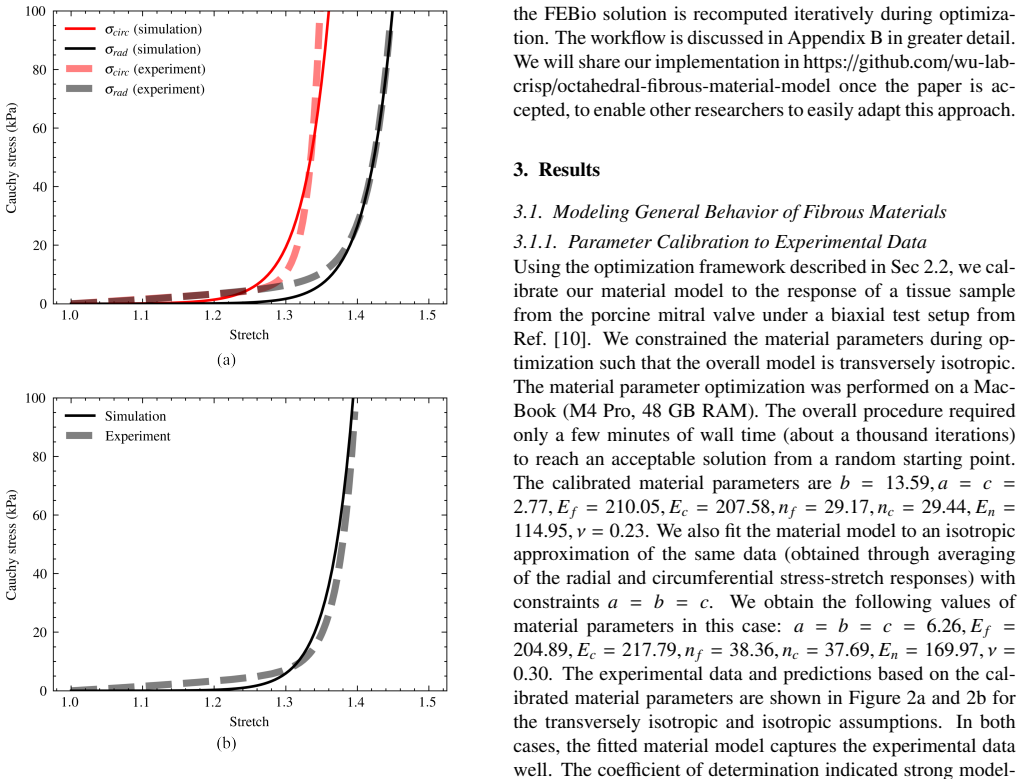
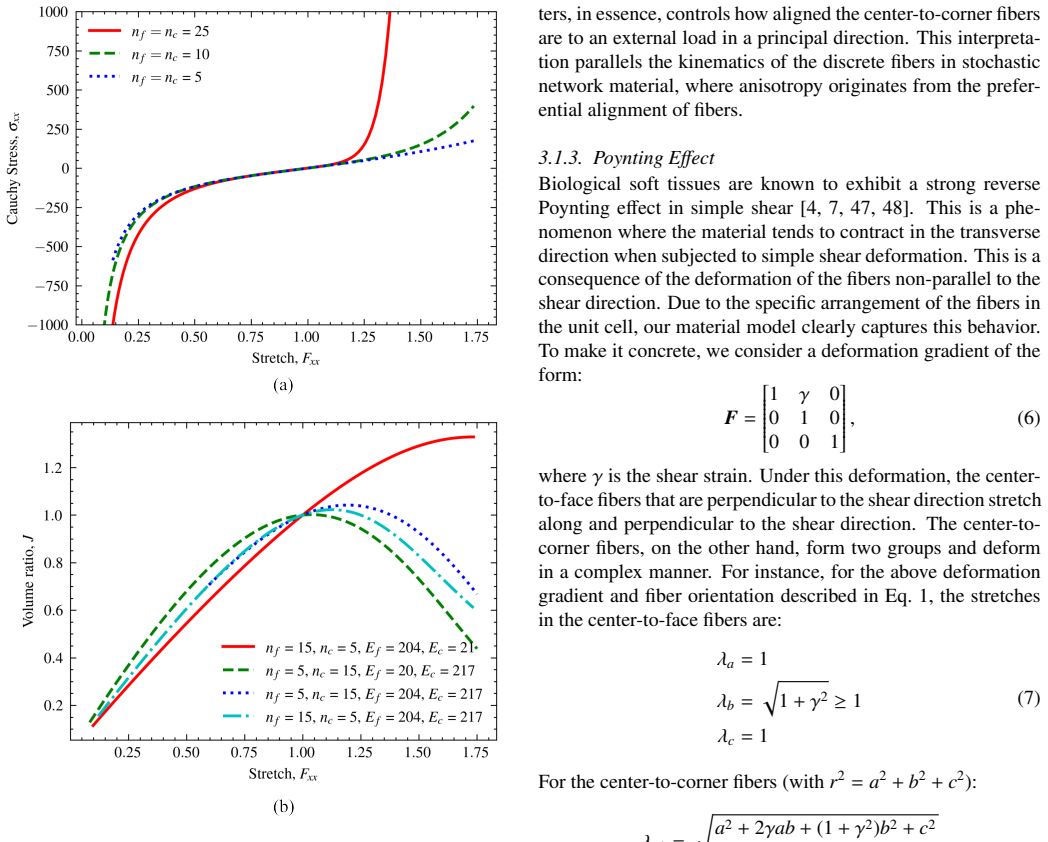
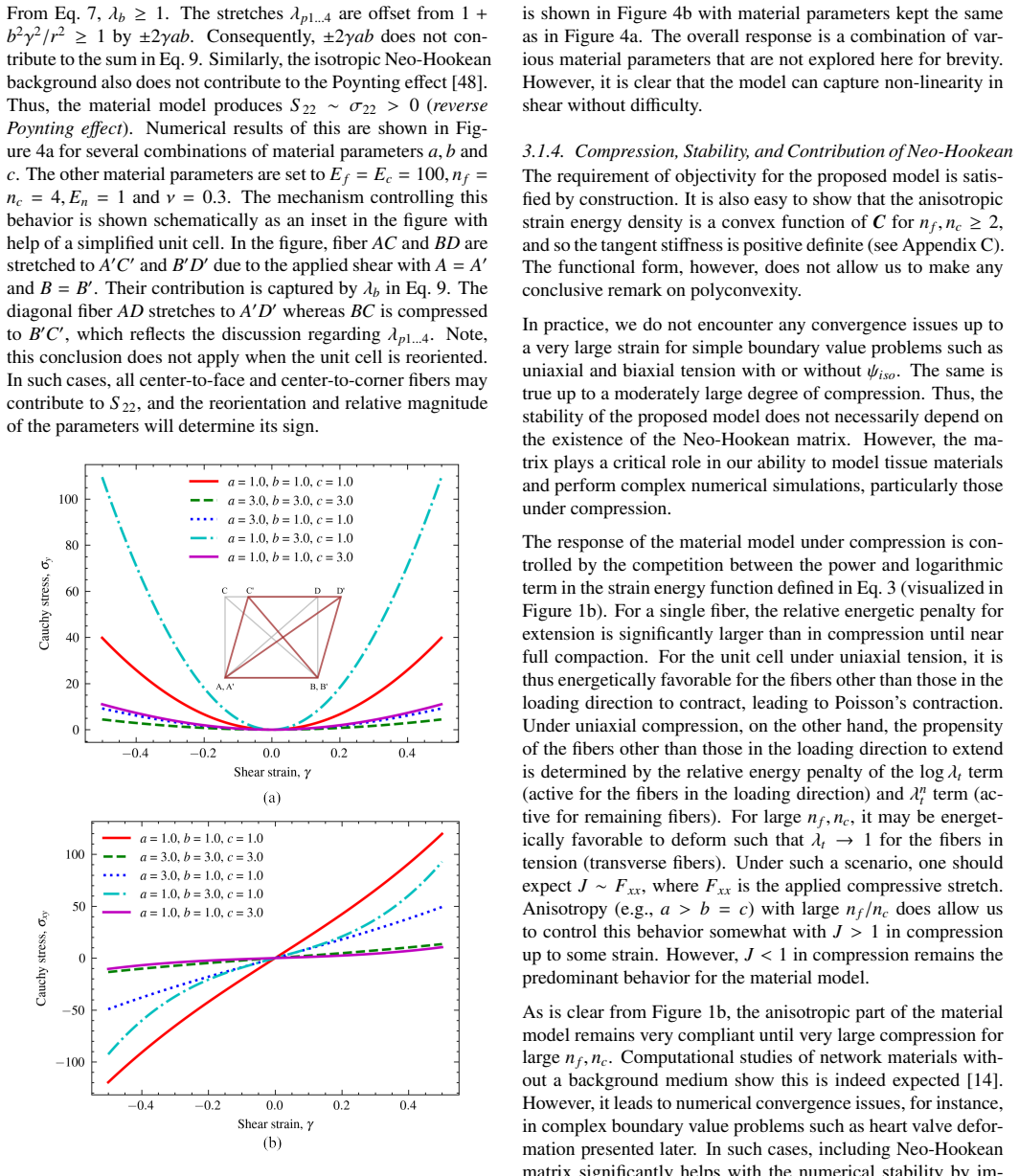


read the original abstract
Fibrous soft tissues derive their nonlinear mechanical response from networks of extracellular matrix fibers, whose organization gives rise to strain stiffening, the reverse Poynting effect, and anisotropic mechanical behavior. Motivated by these coupled features, we develop an anisotropic hyperelastic model for fibrous biological tissues that accounts for the contribution of the fiber network under both tensile and compressive deformation. We calibrate the model to experimental data for mitral valve leaflets using an inverse finite element approach that is coupled to automatic differentiation to facilitate efficient parameter calibration. Using the calibrated model, we investigate how anisotropy and fiber reorientation affect valve deformation under physiological loading. The results show that greater leaflet compliance in the radial direction yields proper valve closure, whereas localized fiber reorientation leads to stress concentrations that may promote progressive functional degradation. Fiber reorientation that makes the circumferential direction more compliant than the radial direction compromises valve closure and leads to mitral regurgitation. Chordal softening further amplifies the severity of this regurgitant response. These findings suggest that alterations in fiber architecture, especially when accompanied by chordal degradation, can contribute to the onset and progression of mitral valve incompetence.
Editorial analysis
A structured set of objections, weighed in public.
Referee Report
Summary. The manuscript develops an anisotropic hyperelastic constitutive model based on an octahedral fiber network representation to capture the tensile-compressive and anisotropic response of fibrous tissues such as mitral valve leaflets. The model, stated to possess a single free parameter after network assumptions, is calibrated to experimental leaflet data via inverse finite-element analysis coupled with automatic differentiation. Forward simulations with the calibrated model are then used to examine the effects of fiber reorientation and chordal softening on valve closure under physiological loading, concluding that reorientation rendering the circumferential direction more compliant than the radial direction impairs coaptation and produces mitral regurgitation, with chordal softening amplifying the regurgitant volume.
Significance. If the octahedral form is shown to remain predictive once fiber directions are rotated, the work supplies a mechanistic explanation linking microstructural reorientation to functional valve incompetence and identifies a potential pathway by which fiber architecture changes, together with chordal degradation, can initiate or worsen mitral regurgitation. The automatic-differentiation-enabled inverse calibration is a methodological strength that improves reproducibility of the fitting step.
major comments (2)
- [Calibration and validation sections] Calibration and validation sections: the inverse-FE fit is performed exclusively on native-anisotropy leaflet data; no additional experiments or cross-validation are reported that test whether the single-parameter octahedral response continues to reproduce the correct coupled tension-compression behavior and stress concentrations once fiber directions are arbitrarily rotated. Because the central claim rests on forward simulations of precisely these reoriented architectures, this gap is load-bearing.
- [Results on reorientation simulations] Results on reorientation simulations: the reported regurgitation arises from the assumption that the calibrated constitutive law remains valid under altered fiber orientations; without a demonstration that the octahedral network enforces the correct transverse compression response for rotated fibers (rather than an implicit fixed relationship that may not hold), the predicted closure failure cannot be distinguished from a constitutive artifact.
minor comments (2)
- [Abstract] The abstract states that the model accounts for both tensile and compressive deformation but does not quantify how many independent parameters remain after the octahedral assumptions; a brief statement of the final parameter count would clarify the claim of a 'single free parameter'.
- [Figure captions] Figure captions for the valve-closure simulations should explicitly state the fiber-angle perturbations and chordal-stiffness reductions used in each panel to allow direct comparison with the text.
Simulated Author's Rebuttal
We thank the referee for the constructive feedback and for highlighting the potential significance of the work. We provide point-by-point responses to the major comments below.
read point-by-point responses
-
Referee: [Calibration and validation sections] Calibration and validation sections: the inverse-FE fit is performed exclusively on native-anisotropy leaflet data; no additional experiments or cross-validation are reported that test whether the single-parameter octahedral response continues to reproduce the correct coupled tension-compression behavior and stress concentrations once fiber directions are arbitrarily rotated. Because the central claim rests on forward simulations of precisely these reoriented architectures, this gap is load-bearing.
Authors: The octahedral constitutive model is formulated at the microstructural level using a fixed network geometry whose response—including tension-compression coupling—is independent of the macroscopic tissue axes. Fiber orientations enter only as inputs that rotate the network relative to the coordinate system; the single calibrated parameter governs fiber stiffness and is not direction-specific. Consequently, the same constitutive relations apply after reorientation. We will add a clarifying paragraph in the Methods and Discussion sections to emphasize this orientation independence and to note that the network geometry itself supplies the transverse response for any prescribed fiber directions. revision: partial
-
Referee: [Results on reorientation simulations] Results on reorientation simulations: the reported regurgitation arises from the assumption that the calibrated constitutive law remains valid under altered fiber orientations; without a demonstration that the octahedral network enforces the correct transverse compression response for rotated fibers (rather than an implicit fixed relationship that may not hold), the predicted closure failure cannot be distinguished from a constitutive artifact.
Authors: Because the transverse compression arises directly from the fixed octahedral network geometry (fiber interactions and effective Poisson effect), the response is preserved under rotation; only the alignment of the stiffening directions changes. The regurgitation observed in the forward simulations is therefore attributable to the altered anisotropy (circumferential compliance exceeding radial) rather than an artifact. We will revise the Results section to include a short verification that the rotated configuration retains the expected tension-compression coupling predicted by the network. revision: partial
Circularity Check
No circularity: model calibrated to data then used for forward simulation of reorientation scenarios
full rationale
The paper proposes an octahedral fiber network hyperelastic model motivated by observed tissue behaviors, explicitly calibrates its single free parameter to mitral leaflet tensile data via inverse finite-element analysis, and then performs forward simulations of altered fiber orientations and chordal softening to predict closure and regurgitation. No quoted equation or step reduces a claimed prediction to the calibration data by construction, no self-citation is invoked as a uniqueness theorem or load-bearing premise, and the central claims are outputs of numerical simulation rather than algebraic identities or renamed fits. The derivation chain is therefore self-contained against external benchmarks.
Axiom & Free-Parameter Ledger
free parameters (1)
- fiber network parameters
axioms (1)
- domain assumption Octahedral fiber network captures both tensile and compressive contributions in fibrous tissues
Reference graph
Works this paper leans on
-
[1]
Cambridge Univer- sity Press, jun 2016
Krishan Chawla.Fibrous Materials. Cambridge Univer- sity Press, jun 2016. ISBN 978-1-316-53884-5. 13
2016
-
[2]
Picu.Network Materials: Structure and Prop- erties
Catalin R. Picu.Network Materials: Structure and Prop- erties. Cambridge University Press, 1 edition, sep 2022. ISBN 978-1-108-77992-0 978-1-108-49003-0. doi: 10. 1017/9781108779920
2022
-
[3]
Boal.Mechanics of the Cell
David H. Boal.Mechanics of the Cell. Cambridge Uni- versity Press, jan 2012. ISBN 978-0-521-11376-2
2012
-
[4]
Janmey, Margaret E
Paul A. Janmey, Margaret E. McCormick, Sebastian Ram- mensee, Jennifer L. Leight, Penelope C. Georges, and Fred C. MacKintosh. Negative normal stress in semi- flexible biopolymer gels.Nature Materials, 6(1):48–51, jan 2007. ISSN 1476-1122, 1476-4660. doi: 10.1038/ nmat1810
2007
-
[5]
Albert James Licup, Stefan Münster, Abhinav Sharma, Michael Sheinman, Louise M. Jawerth, Ben Fabry, David A. Weitz, and Fred C. MacKintosh. Stress con- trols the mechanics of collagen networks.Proceedings of the National Academy of Sciences of the United States of America, 112(31):9573–9578, 2015. ISSN 10916490. doi: 10.1073/pnas.1504258112
-
[6]
M. R. Islam, G. Tudryn, R. Bucinell, L. Schadler, and R. C. Picu. Morphology and mechanics of fungal mycelium.Scientific Reports, 7(1):1–12, 2017. ISSN 20452322. doi: 10.1038/s41598-017-13295-2
-
[7]
M. Destrade, C. O. Horgan, and J. G. Murphy. Domi- nant negative Poynting effect in simple shearing of soft tissues.Journal of Engineering Mathematics, 95(1): 87–98, dec 2015. ISSN 0022-0833, 1573-2703. doi: 10.1007/s10665-014-9706-5
-
[8]
Rausch, Nele Famaey, Tyler O’Brien Shultz, Wolfgang Bothe, D
Manuel K. Rausch, Nele Famaey, Tyler O’Brien Shultz, Wolfgang Bothe, D. Craig Miller, and Ellen Kuhl. Me- chanics of the mitral valve: A critical review, an in vivo parameter identification, and the effect of prestrain. Biomechanics and Modeling in Mechanobiology, 12(5): 1053–1071, oct 2013. ISSN 1617-7959, 1617-7940. doi: 10.1007/s10237-012-0462-z
-
[9]
Meador, Mrudang Mathur, Gabriella P
William D. Meador, Mrudang Mathur, Gabriella P. Sug- erman, Tomasz Jazwiec, Marcin Malinowski, Matthew R. Bersi, Tomasz A. Timek, and Manuel K. Rausch. A de- tailed mechanical and microstructural analysis of ovine tricuspid valve leaflets.Acta Biomaterialia, 102:100–113, jan 2020. ISSN 17427061. doi: 10.1016/j.actbio.2019.11. 039
-
[10]
Mohammad Javad Sadeghinia, Bjørn Skallerud, Ger- hard A. Holzapfel, and Victorien Prot. Biomechan- ics of mitral valve leaflets: Second harmonic generation microscopy, biaxial mechanical tests and tissue model- ing.Acta Biomaterialia, 141:244–254, mar 2022. ISSN 17427061. doi: 10.1016/j.actbio.2022.01.003
-
[11]
Christian Gasser, Ray W Ogden, and Gerhard A Holzapfel
T. Christian Gasser, Ray W Ogden, and Gerhard A Holzapfel. Hyperelastic modelling of arterial layers with distributed collagen fibre orientations.Journal of the Royal Society, Interface, 3(6):15–35, feb 2006. ISSN 1742-5689, 1742-5662. doi: 10.1098/rsif.2005.0073
-
[12]
Mirit Sharabi. Structural Motifs in Soft Fibrous Tis- sues: Revealing Structure-Mechanics Relationships in Deformation and Tear Resistance for Biomimetic Ma- terial Design.Advanced Healthcare Materials, 14(24): 2500153, sep 2025. ISSN 2192-2640. doi: 10.1002/adhm. 202500153
-
[13]
Structural Mechanisms in Soft Fibrous Tis- sues: A Review.Frontiers in Materials, 8, jan 2022
Mirit Sharabi. Structural Mechanisms in Soft Fibrous Tis- sues: A Review.Frontiers in Materials, 8, jan 2022. ISSN 2296-8016. doi: 10.3389/fmats.2021.793647
-
[14]
M. R. Islam and R. C. Picu. Effect of network architec- ture on the mechanical behavior of random fiber networks. Journal of Applied Mechanics, Transactions ASME, 85 (8):1–8, 2018. ISSN 15289036. doi: 10.1115/1.4040245
-
[15]
Broedersz, Xiaoming Mao, Tom C
Chase P. Broedersz, Xiaoming Mao, Tom C. Lubensky, and Frederick C. MacKintosh. Criticality and isostaticity in fibre networks.Nature Physics, 7(12):983–988, Oct
-
[16]
doi: 10.1038/nphys2127
-
[17]
R. G. Hutchinson and N. A. Fleck. The structural per- formance of the periodic truss.Journal of the Mechanics and Physics of Solids, 54(4):756–782, apr 2006. ISSN 00225096. doi: 10.1016/j.jmps.2005.10.008
-
[18]
Parvez, J
N. Parvez, J. Merson, and R. C. Picu. Stiffening mecha- nisms in stochastic athermal fiber networks.Physical Re- view E, 108(4):44502, oct 2023. ISSN 2470-0045, 2470-
2023
-
[19]
doi: 10.1103/PhysRevE.108.044502
-
[20]
R. C. Picu, S. Deogekar, and M. R. Islam. Poisson’s Con- traction and Fiber Kinematics in Tissue: Insight from Col- lagen Network Simulations.Journal of Biomechanical Engineering, 140(2):1–12, 2018. ISSN 15288951. doi: 10.1115/1.4038428
-
[21]
Homogenization of rate-independent elastoplastic spring network models with non-local ran- dom fields, sep 2025
Simone Hermann. Homogenization of rate-independent elastoplastic spring network models with non-local ran- dom fields, sep 2025
2025
-
[22]
Konstantinos Poulios and Christian F. Niordson. Ho- mogenization of long fiber reinforced composites includ- ing fiber bending effects.Journal of the Mechanics and Physics of Solids, 94:433–452, sep 2016. ISSN 00225096. doi: 10.1016/j.jmps.2016.04.010
-
[23]
Arun Raina and Christian Linder. A homogenization ap- proach for nonwoven materials based on fiber undula- tions and reorientation.Journal of the Mechanics and Physics of Solids, 65(1):12–34, 2014. ISSN 00225096. doi: 10.1016/j.jmps.2013.12.011
-
[24]
G. Chagnon, M. Rebouah, and D. Favier. Hyperelastic Energy Densities for Soft Biological Tissues: A Review. Journal of Elasticity, 120(2):129–160, aug 2015. ISSN 1573-2681. doi: 10.1007/s10659-014-9508-z. 14
-
[25]
Catalin R. Picu. Constitutive models for random fiber net- work materials: A review of current status and challenges. Mechanics Research Communications, 114:103605, jun
-
[26]
ISSN 0093-6413. doi: 10.1016/j.mechrescom. 2020.103605
-
[27]
Gerhard A. Holzapfel, Thomas C. Gasser, and Ray W. Ogden. A new constitutive framework for arterial wall mechanics and a comparative study of material models. Journal of Elasticity, 61(1):1–48, 2000. doi: 10.1023/A: 1010835316564
work page doi:10.1023/a: 2000
-
[28]
Marcos Latorre and Francisco J. Montáns. On the tension- compression switch of the Gasser–Ogden–Holzapfel model: Analysis and a new pre-integrated proposal.Jour- nal of the Mechanical Behavior of Biomedical Materi- als, 57:175–189, apr 2016. ISSN 1751-6161. doi: 10.1016/j.jmbbm.2015.11.018
-
[29]
Mahutga, Lauren M
Maryam Nikpasand, Ryan R. Mahutga, Lauren M. Bersie- Larson, Elizabeth Gacek, and Victor H. Barocas. A Hy- brid Microstructural-Continuum Multiscale Approach for Modeling Hyperelastic Fibrous Soft Tissue.Journal Of Elasticity, 145(1-2):295–319, August 2021. ISSN 0374-
2021
-
[30]
doi: 10.1007/s10659-021-09843-7
-
[32]
Michael C. H. Wu, Rana Zakerzadeh, David Kamensky, Josef Kiendl, Michael S. Sacks, and Ming-Chen Hsu. An anisotropic constitutive model for immersogeometric fluid–structure interaction analysis of bioprosthetic heart valves.Journal of biomechanics, 74:23–31, jun 2018. ISSN 0021-9290. doi: 10.1016/j.jbiomech.2018.04.012
-
[33]
A. J. Licup, A. Sharma, and F. C. Mackintosh. Elastic regimes of subisostatic athermal fiber networks.Physical Review E, 93(1):1–12, 2016. ISSN 24700053. doi: 10. 1103/PhysRevE.93.012407
2016
-
[34]
Ehret, Kevin Bircher, Alberto Stracuzzi, Vita Marina, Manuel Zündel, and Edoardo Mazza
Alexander E. Ehret, Kevin Bircher, Alberto Stracuzzi, Vita Marina, Manuel Zündel, and Edoardo Mazza. Inverse poroelasticity as a fundamental mechanism in biomechan- ics and mechanobiology.Nature Communications, 8(1): 1002, October 2017. ISSN 2041-1723. doi: 10.1038/ s41467-017-00801-3
2017
-
[36]
Evolution of force chains explains the onset of strain stiffening in fiber net- works.Journal of Applied Mechanics, 89(11):111008, 09
Mainak Sarkar and Jacob Notbohm. Evolution of force chains explains the onset of strain stiffening in fiber net- works.Journal of Applied Mechanics, 89(11):111008, 09
-
[37]
ISSN 0021-8936. doi: 10.1115/1.4055586. URL https://doi.org/10.1115/1.4055586
-
[38]
Peerasait Prachaseree and Emma Lejeune. Towards understanding structure-function relationships in ran- dom fiber networks.Journal of the Mechanics and Physics of Solids, 203:106221, 2025. ISSN 0022-5096. doi: https://doi.org/10.1016/j.jmps.2025. 106221. URLhttps://www.sciencedirect.com/ science/article/pii/S0022509625001978
-
[39]
Valerie Tutwiler, Jaspreet Singh, Rustem I. Litvinov, John L. Bassani, Prashant K. Purohit, and John W. Weisel. Rupture of blood clots: Mechanics and pathophysiol- ogy.Science Advances, 6(35):eabc0496, aug 2020. ISSN 2375-2548. doi: 10.1126/sciadv.abc0496
-
[40]
J. E. Bischoff, E. A. Arruda, and K. Grosh. A microstruc- turally based orthotropic hyperelastic constitutive law. Journal of Applied Mechanics, 69(5):570–579, sep 2002. ISSN 0021-8936, 1528-9036. doi: 10.1115/1.1485754
-
[41]
Ellen Kuhl and Gerhard A. Holzapfel. A continuum model for remodeling in living structures.Journal of Materials Science, 42(21):8811–8823, November 2007. ISSN 1573-4803. doi: 10.1007/s10853-007-1917-y
-
[43]
Zheng Jia and Thao D. Nguyen. A micromechan- ical model for the growth of collagenous tissues under mechanics-mediated collagen deposition and degradation.Journal of the Mechanical Behavior of Biomedical Materials, 98:96–107, 2019. ISSN 1751-6161. doi: 10.1016/j.jmbbm.2019.06.004. URLhttps://www.sciencedirect.com/science/ article/pii/S1751616119302735
-
[44]
Evgenii Kliuchnikov, Angelos Gkarsen Dagklis, Rustem I. Litvinov, Kenneth A. Marx, John W. Weisel, John L. Bassani, Prashant K. Purohit, and Valeri Barsegov. Strength, deformability, damage and fracture toughness of fibrous material networks: Application to fibrin clots.Acta Biomaterialia, 201:347–359, jul 2025. ISSN 17427061. doi: 10.1016/j.actbio.2025.05.057
-
[45]
Gil, and Richard D
Javier Bonet, Antonio J. Gil, and Richard D. Wood.Non- linear Solid Mechanics for Finite Element Analysis: Stat- ics. Cambridge University Press, 1 edition, jun 2016. ISBN 978-1-107-11579-8 978-1-316-33614-4. doi: 10. 1017/CBO9781316336144. 15
2016
-
[46]
Berglund, and Sam Coppieters
Bin Chen, Bojan Starman, Miroslav Halilovi ˇc, Lars A. Berglund, and Sam Coppieters. Finite Element Model Updating for Material Model Calibration: A Review and Guide to Practice.Archives of Computational Methods in Engineering, 32(4):2035–2112, May 2025. ISSN 1886-
2035
-
[47]
URLhttps: //doi.org/10.1007/s11831-024-10200-9
doi: 10.1007/s11831-024-10200-9. URLhttps: //doi.org/10.1007/s11831-024-10200-9
-
[48]
A New Approach to Linear Filtering and Prediction Problems
Steve A. Maas, Benjamin J. Ellis, Gerard A. Ateshian, and Jeffrey A. Weiss. FEBio: Finite Elements for Biome- chanics.Journal of Biomechanical Engineering, 134(1): 11005–NaN, jan 2012. ISSN 0148-0731. doi: 10.1115/1. 4005694
work page doi:10.1115/1 2012
-
[49]
JAX: Composable transformations of Python+NumPy programs, 2018
James Bradbury, Roy Frostig, Peter Hawkins, Matthew James Johnson, Yash Katariya, Chris Leary, Dougal Maclaurin, George Necula, Adam Paszke, Jake VanderPlas, Skye Wanderman-Milne, and Qiao Zhang. JAX: Composable transformations of Python+NumPy programs, 2018
2018
-
[50]
Sultan Al Hassanieh, Wesley F. Reinhart, and Alli- son M. Beese. Efficient material model parameter op- timization in finite element analysis with differentiable physics.Computational Materials Science, 253:113828, may 2025. ISSN 0927-0256. doi: 10.1016/j.commatsci. 2025.113828
-
[51]
André E. X. Brown, Rustem I. Litvinov, Dennis E. Dis- cher, Prashant K. Purohit, and John W. Weisel. Multiscale Mechanics of Fibrin Polymer: Gel Stretching with Pro- tein Unfolding and Loss of Water.Science, 325(5941): 741–744, August 2009. doi: 10.1126/science.1172484
-
[52]
Konstantinos Garyfallogiannis, Prashant K. Purohit, and John L. Bassani. Cracks in tensile-contracting and tensile- dilating poroelastic materials.International Journal of Solids and Structures, 286–287:112563, January 2024. ISSN 0020-7683. doi: 10.1016/j.ijsolstr.2023.112563
-
[53]
Destrade, Y
M. Destrade, Y . Du, J. Blackwell, N. Colgan, and V . Balbi. Canceling the elastic Poynting effect with geometry.Phys- ical Review E, 107(5):L053001, may 2023. doi: 10.1103/ PhysRevE.107.L053001
2023
-
[54]
C. O. Horgan and J. G. Murphy. Poynting Effects in Soft Elastic Materials: A Review of Recent Results.Journal of Elasticity, 157(2):35, may 2025. ISSN 0374-3535, 1573-
2025
-
[55]
doi: 10.1007/s10659-025-10126-8
-
[56]
Floppy Modes and Nonaffine Deformations in Random Fiber Networks
Claus Heussinger and Erwin Frey. Floppy Modes and Nonaffine Deformations in Random Fiber Networks. Physical Review Letters, 97(10):105501, sep 2006. ISSN 0031-9007, 1079-7114. doi: 10.1103/PhysRevLett.97. 105501
-
[57]
Moerman, Behrooz Fereidoonnezhad, and J
Kevin M. Moerman, Behrooz Fereidoonnezhad, and J. Patrick McGarry. Novel hyperelastic models for large volumetric deformations.International Journal of Solids and Structures, 193–194:474–491, jun 2020. ISSN 00207683. doi: 10.1016/j.ijsolstr.2020.01.019
-
[58]
Yonghoon Rim, Frederick Mun, and Hyunggun Kim. Optimization-based fiber orientation modeling for com- putational mitral valve evaluation.International Jour- nal of Precision Engineering and Manufacturing, 16(12): 2563–2568, nov 2015. ISSN 2234-7593, 2005-4602. doi: 10.1007/s12541-015-0328-2
-
[60]
R. W. Ogden.Non-Linear Elastic Deformations. Courier Corporation, jan 1997. ISBN 978-0-486-69648-5
1997
-
[61]
Nariman Khaledian, Pierre-Frédéric Villard, Peter E. Hammer, Douglas P. Perrin, and Marie-Odile Berger. Image-based simulation of mitral valve dynamic clo- sure including anisotropy.Medical Image Analysis, 99: 103323, jan 2025. ISSN 1361-8415. doi: 10.1016/j. media.2024.103323
work page doi:10.1016/j 2025
-
[62]
Holzapfel, Bjørn Skallerud, Victorien Prot, and Stig Urheim
Mohammad Javad Sadeghinia, Robert Matongo Persson, Vegard Skalstad Ellensen, Rune Haaverstad, Gerhard A. Holzapfel, Bjørn Skallerud, Victorien Prot, and Stig Urheim. Quantified planar collagen distribution in healthy and degenerative mitral valve: Biomechanical and clinical implications.Scientific Reports, 14(1):15670, July 2024. ISSN 2045-2322. doi: 10.1...
-
[63]
Thuy Pham and Wei Sun. Material properties of aged human mitral valve leaflets.Journal of Biomedical Materials Research Part A, 102(8):2692– 2703, 2014. doi: https://doi.org/10.1002/jbm.a. 34939. URLhttps://onlinelibrary.wiley.com/ doi/abs/10.1002/jbm.a.34939
-
[64]
Nicolas R. Mangine, Devin W. Laurence, Patricia M. Sabin, Wensi Wu, Christian Herz, Christopher N. Zelo- nis, Justin S. Unger, Csaba Pinter, Andras Lasso, Steve A. Maas, Jeffrey A. Weiss, and Matthew A. Jolley. Effect of Parametric Variation of Chordae Tendineae Structure on Simulated Atrioventricular Valve Closure.ArXiv, page arXiv:2411.09599v1, nov 2024...
arXiv 2024
-
[65]
Wensi Wu, Matthew Daemer, Jeffrey A. Weiss, Alison M. Pouch, and Matthew A. Jolley. A geometric feature track- ing approach for noninvasive patient specific estimation of leaflet strain from 3D images of heart valves, Febru- ary 2026. URLhttp://arxiv.org/abs/2510.06578. arXiv:2510.06578
arXiv 2026
-
[66]
Tianju Xue, Shuheng Liao, Zhengtao Gan, Chanwook Park, Xiaoyu Xie, Wing Kam Liu, and Jian Cao. JAX- FEM: A differentiable GPU-accelerated 3D finite ele- ment solver for automatic inverse design and mechanistic data science.Computer Physics Communications, 291: 16 108802, oct 2023. ISSN 0010-4655. doi: 10.1016/j.cpc. 2023.108802
-
[67]
Mohit Pundir, Flavio Lorez, and David S. Kammer. A versatile FEM framework with native GPU scalability via globally-applied AD, feb 2026. 17
2026
discussion (0)
Sign in with ORCID, Apple, or X to comment. Anyone can read and Pith papers without signing in.