REVIEW 2 major objections 4 minor 4 references
Spatially Grounded Concept Bottleneck Models via Part-Factorized Attention
T0 review · 2 major / 4 minor · reviewed 2026-08-02 · deepseek-v4-flash
Pith's one-line read Concept bottleneck models can be spatially grounded by construction: a fixed concept-to-part routing plus a learnable Gaussian prior yields near-baseline accuracy and 52-70% pointing with little or no per-image annotation.
desk verdict A genuinely structural CBM grounding method with a striking 0.5%-init result, but the pointing numbers need a trivial baseline and the abstract's alignment narrative contradicts the body. read the letter →
The pith
A machine-rendered reading of the paper's core claim, the machinery that carries it, and where it could break.
The reading
What carries the argument
The load-bearing mechanism is a learnable isotropic Gaussian spatial prior per part, injected additively in log-space into the part attention logits, with means initialized from the dataset-average keypoint position of each part. This prior breaks the permutation symmetry among otherwise identical part queries, forcing each query to specialize on one anatomical region; a fixed concept-to-part map then hard-routes every attribute to the token of its named part, making spatial grounding a structural guarantee rather than a learned outcome.
What would settle it
Train the same architecture on a fine-grained dataset with high pose variance or multiple objects per image (e.g., a vehicle dataset with varied viewpoints) using dataset-average keypoint initialization, and measure pointing accuracy; a substantial drop below the supervised baseline would show that the prior cannot generalize beyond canonical poses. Alternatively, within the current benchmark, group held-out images by pose difficulty (e.g., flying vs. perched birds) and check whether pointing accuracy degrades significantly on the difficult subset.
Extended reading notes
Core claim
The paper's central claim is that spatial grounding of a CBM can be achieved by removing the freedom of concept heads to attend anywhere. It proposes a part-factorized CBM in which each of 293 part-specific attributes reads only from a single anatomical part token via a fixed concept-to-part map, and 19 whole-object attributes read from a separate global token. A learnable two-dimensional Gaussian spatial prior over patch locations, initialized from dataset-average keypoint positions, breaks the permutation symmetry among part queries. With this prior, the model matches a fully supervised baseline (89.01% vs 88.95% top-1) while raising pointing accuracy from 36.4% to 52.2%; combining the pri
Load-bearing premise
The load-bearing premise is that a single per-part Gaussian, whose mean is the dataset-average keypoint position, is an adequate spatial anchor for every image—meaning the object must appear in a reasonably canonical pose, so that 'average beak position' carries most of the localization signal.
Editorial extensions
If this is right
- If the claim holds, CBMs can be made spatially auditable without per-image keypoint or box annotations, at an accuracy cost within one point of a supervised baseline.
- Pointing-game accuracy becomes a practical metric for evaluating grounding in fine-grained recognition, since it rises from near-chance to 52-70% with the prior.
- The 0.5% initialization result implies that dataset-average geometric priors are sufficient to anchor part-level concept heads, reducing annotation to a one-time cost for canonical-pose domains.
- The sequential-versus-joint training result indicates that joint training packs class-discriminative signal into concept magnitudes, so a genuinely constrained bottleneck is better approximated by sequential training at a substantial accuracy cost.
- The fixed concept-to-part routing gives a test-time intervention guarantee: correcting a concept changes the prediction only through its named part, which makes error attribution straightforward.
Reading between the lines
- The 'nearly free' grounding may be partly inherited from the benchmark's canonical pose distribution: the dataset-average keypoint position already carries much of the per-image localization signal, so the method's transfer to arbitrary-viewpoint or multi-object scenes would likely require object-frame normalization and class-conditional priors, as the authors note.
- A testable extension is to apply the same prior-initialization scheme to other canonical-pose domains (faces, cars in catalog views) and measure whether pointing gains match the bird results; if they do, the result generalizes beyond birds.
- The PCA foreground target outperforming box supervision on pointing suggests that tighter, object-shaped foreground masks help part queries localize; this hints that grounding quality could be further improved with better foreground estimation rather than more part supervision.
- The collapse of pointing without any spatial signal (2.9%) quantifies the failure mode of naive concept heads: with no anchor, queries collapse to the object centroid, so any future method removing part identity must supply an alternative symmetry-breaking signal, such as pseudo-keypoints or unsupervised part discovery.
Editorial analysis
A structured set of objections, weighed in public.
Referee Report
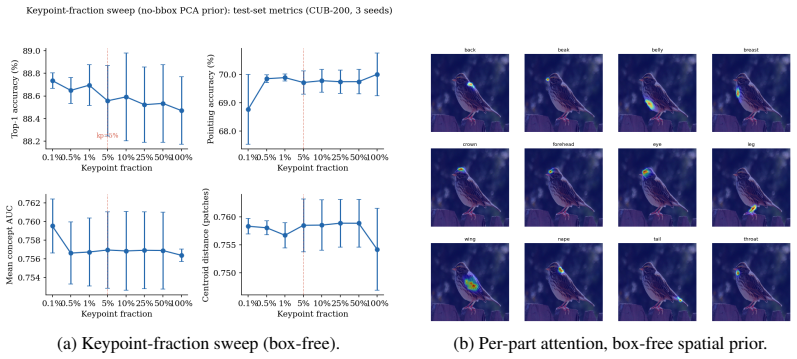
Summary. The paper proposes PF-CBM, a concept bottleneck model on frozen DINOv3 features in which each part-specific attribute is hard-routed to one of 12 anatomical part queries via a fixed concept-to-part map, while 19 whole-object attributes read from a separate global query. Each part query attends to patch features with a learnable isotropic Gaussian spatial prior injected additively into the attention logits; the prior means are initialized from dataset-average keypoint positions (Eq. 4) and require no per-image keypoints during training or inference. On CUB-200-2011, the spatial-prior version matches a box+keypoint supervised baseline on top-1 (89.01% vs 88.95%) while improving pointing accuracy from 36.4% to 52.2%; combining a PCA-derived foreground target with the Gaussian prior removes both box and keypoint supervision and reaches 88.77% top-1 and 69.5% pointing. A keypoint-fraction sweep shows that the prior initialization is stable down to 0.5% of the training set (about 27 images).
Significance. If the results hold, the paper makes a practically valuable contribution: it shows that spatial grounding of a CBM can be made a structural property of the forward graph at negligible classification cost and with near-zero per-image annotation, at least on canonical-pose fine-grained benchmarks. The method is clearly specified (Eqs. 1–7), the ablation ladder is well designed, and the two-stage training schedule with a slowed grounding path is a sensible way to prevent classification pressure from destroying the concept-aligned attention. The keypoint-fraction sweep is a strong annotation-efficiency experiment. The main weakness is that the central evidence for "grounding" — the pointing accuracy — is not placed against the trivial baseline of always predicting the average keypoint position, so it is currently unclear how much of the reported pointing gain is due to image-specific content rather than to CUB's canonical pose statistics. This missing control is load-bearing for the paper's central claim and should be addressed before the results can be fully credited.
major comments (2)
- [Table 2, §4; Eq. (4)] The pointing accuracy is the operational measure of the central claim that the model "grounds attention to the right evidence." However, the paper never reports the pointing accuracy of a trivial predictor that always outputs the average keypoint position μ_p from Eq. (4) as the argmax location. Since the Gaussian prior is a population-level template and CUB images are largely canonical-pose, μ_p alone may already achieve substantial pointing accuracy. The no-prior ablation (2.93% pointing) shows that the prior is necessary, but it does not show that the image-conditioned attention improves over the prior alone. Please report pointing accuracy and centroid distance for the constant average-keypoint predictor, and, ideally, for the prior-only attention with features ablated. Without this control, the 69.5% pointing number cannot be attributed to image-specific semantic localization.
- [Table 3 vs Table 2] There is an unexplained numeric discrepancy between Table 2 and Table 3 for what appears to be the same configuration. Table 2's no_bbox_spatial_prior row (box-free + PCA + prior) reports 88.77 top-1 and 69.50 pointing, while Table 3's Joint-312 row, described as the "box-free spatial-prior configuration," reports 87.7 top-1 and 60.2 pointing. If these are the same configuration, one table is incorrect; if they differ (e.g., by seed, PCA variant, or architecture detail), the difference must be stated. This inconsistency affects the sequential-vs-joint comparison and makes it difficult to trust the headline numbers.
minor comments (4)
- [Table 2] The row labeled "Ablation: no keypoints" (no_bbox_no_kp) also removes the spatial prior, as the text clarifies. The row name is misleading; consider renaming it "no box, no keypoints, no prior" to make the ablation ladder unambiguous.
- [§4, pointing metric] The pointing game threshold of "within one patch" of the keypoint is quite generous at 512×512 input with a 32×32 grid (16 px). Reporting a small set of thresholds (e.g., 1, 2, 3 patches) would make the metric more informative and less sensitive to the arbitrary choice.
- [Abstract / §6] The text says "all per-image supervision is removed" for the box-free + PCA + prior condition, but the prior means are still initialized from dataset-average keypoint annotations (Eq. 4). This is clearly disclosed in §3.3, but the abstract's phrasing overstates the annotation-free nature; suggest saying "no per-image annotation" rather than "all supervision."
- [§3.4] The 312-entry concept-to-part map is fixed and hand-committed, and the paper acknowledges the need for a part vocabulary. It would strengthen the paper to state how the map was produced (e.g., from CUB attribute definitions, or a labeler), and whether any assignments were ambiguous or validated. A wrong entry cannot be corrected by learning because routing is structural.
Circularity Check
No significant circularity: the spatial prior is not fitted to the evaluation target, and no load-bearing step reduces to its own input by construction.
full rationale
The paper's central empirical claims are grounded in held-out test-set evaluation, not in a self-referential construction. The spatial prior means are initialized from dataset-average keypoint positions (Eq. 4), and pointing accuracy is measured against per-image keypoints (§4). This is a population-level supervision signal, not a fitted prediction target: in the spatial-prior and box-free conditions no per-image keypoint is used during training or test, and the final attention logits combine the prior with content-dependent cross-attention (Eq. 2), so the predicted attention map is not forced by construction to equal the prior mean. The keypoint-fraction sweep is an empirical claim about the statistical stability of the mean estimator, not a circular prediction. The paper cites prior work for architectural components (PDiscoFormer, ALiBi, slot attention), but no load-bearing claim rests on a self-citation or an imported uniqueness theorem. The most plausible concern is that the paper does not report the pointing accuracy of a trivial baseline that always outputs the dataset-average keypoint, so part of the reported pointing gain may be inherited from CUB's canonical pose distribution rather than from image-specific content. That is a missing control and an attribution weakness, not an equation-level circularity: the paper itself acknowledges the canonical-pose scope in §6. Because no derivation step reduces to its own input by definition, the circularity score is 0.
Assumptions & free parameters
free parameters (5)
- Gaussian prior means mu_p (12 parts x 2 coords) =
initialized from dataset-average keypoint positions (Eq. 4), then trained
- log sigma_p initialization =
log 5
- PCA foreground target heuristic =
component most concentrated in a central window relative to the border; window size unspecified
- 15-to-12 keypoint merging rule =
average the three bilateral pairs (eye, leg, wing)
- Loss weights w_cls, w_cpt, w_fg, w_al, w_ent and temperature clamp [0.5, 5] =
not numerically reported
assumptions (5)
- domain assumption DINOv3 patch features are nearly linearly separable for foreground vs background, so a one-hidden-layer gate suffices.
- domain assumption Canonical-pose, single-object domain: the dataset-average keypoint position is a useful per-image anchor for each part.
- ad hoc to paper The 312 CUB attributes are partitionable into exactly 12 part-routed slots plus 19 global attributes via a fixed map, and mis-routing cannot be corrected by learning.
- domain assumption An isotropic per-part Gaussian is a sufficient spatial prior (no inter-part coupling, no elongation, limited occlusion reasoning).
- standard math Standard deep-learning training assumptions: AdamW finds good solutions on frozen cached features; CUB attribute labels and certainty codes are reliable training signal.
Cite this review
Pith. "Pith review of Spatially Grounded Concept Bottleneck Models via Part-Factorized Attention." pith.science (2026). https://pith.science/paper/UY3ZB4BJ
@misc{pith2026260604364,
  author       = {Pith},
  title        = {Pith review of: Spatially Grounded Concept Bottleneck Models via Part-Factorized Attention},
  year         = {2026},
  howpublished = {\url{https://pith.science/paper/UY3ZB4BJ}},
  note         = {Machine review of arXiv:2606.04364}
}
read the original abstract
Concept bottleneck models (CBMs) predict a layer of human-named attributes before predicting a class, which makes their decisions auditable. On fine-grained recognition tasks, though, the concept heads are usually free to attend anywhere in the image, so a head named for one body region can be satisfied by evidence on another, and the model reaches the right answer for the wrong reason. We propose a part-factorized CBM (PF-CBM) that removes this freedom by construction. A frozen DINOv3 vision transformer feeds a set of part queries, each tied by name to a specific anatomical region through a fixed concept-to-part map, while whole-object attributes such as size and shape are handled separately by a query with no spatial prior, since they are not anchored to any single body part. A learnable Gaussian prior over patch locations, initialized from average keypoint positions, keeps the part queries from collapsing onto the same evidence. On its own this prior spreads the queries apart but does not reliably land them on the correct anatomy. What closes that gap is a lightweight alignment loss that nudges each part query toward its keypoint, and the central finding of this paper is how little of that supervision is required. Aligning on well under one percent of the training images already moves pointing accuracy from near-chance to roughly three-quarters of what full keypoint supervision achieves, and the gains continue, more slowly, as more annotated images are added. Classification accuracy on CUB-200-2011 barely moves across this entire range and stays within a point of a fully supervised baseline whether the model sees no keypoints at all or every one of them. Grounding a CBM's attention to the right evidence turns out to be nearly free in accuracy and cheap in annotation, provided the model has the right inductive bias to make efficient use of that small amount of supervision.
Figures

Reference graph
Works this paper leans on
-
[4]
Post-hoc concept bottleneck models
Mert Yuksekgonul, Maggie Wang, and James Zou. Post-hoc concept bottleneck models. InICLR 2022 Workshop on PAIR^2Struct: Privacy, Accountability, Interpretability, Robustness, Reasoning on Structured Data,
2022
-
[2022]
Ioannis Kakogeorgiou, Spyros Gidaris, Konstantinos Karantzalos, and Nikos Komodakis. Spotlight attention: Robust object-centric learning with a spatial locality prior.arXiv preprint arXiv:2305.19550,
-
[2023]
C. Wah, S. Branson, P. Welinder, P. Perona, and S. Belongie. The Caltech-UCSD birds-200-2011 dataset. Technical Report CNS-TR-2011-001, California Institute of Technology,
2011
-
[2024]
Promises and pitfalls of black-box concept learning models.arXiv preprint arXiv:2106.13314,
Anita Mahinpei, Justin Clark, Isaac Lage, Finale Doshi-Velez, and Weiwei Pan. Promises and pitfalls of black-box concept learning models.arXiv preprint arXiv:2106.13314,
Reviewed August 2, 2026 · model on record in the stance chip above.
Discussion (0). Sign in to comment.