Distributed Variational Quantum Optimisation by Entanglement-Selective Transport
Pith reviewed 2026-06-28 06:15 UTC · model grok-4.3
The pith
QESTO uses only pre-shared Bell pairs after setup to outperform partitioned QAOA on distributed Wang tile problems at depths two and higher.
A machine-rendered reading of the paper's core claim, the machinery that carries it, and where it could break.
Core claim
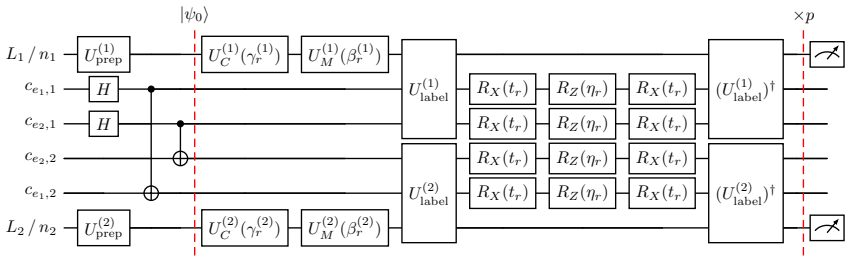
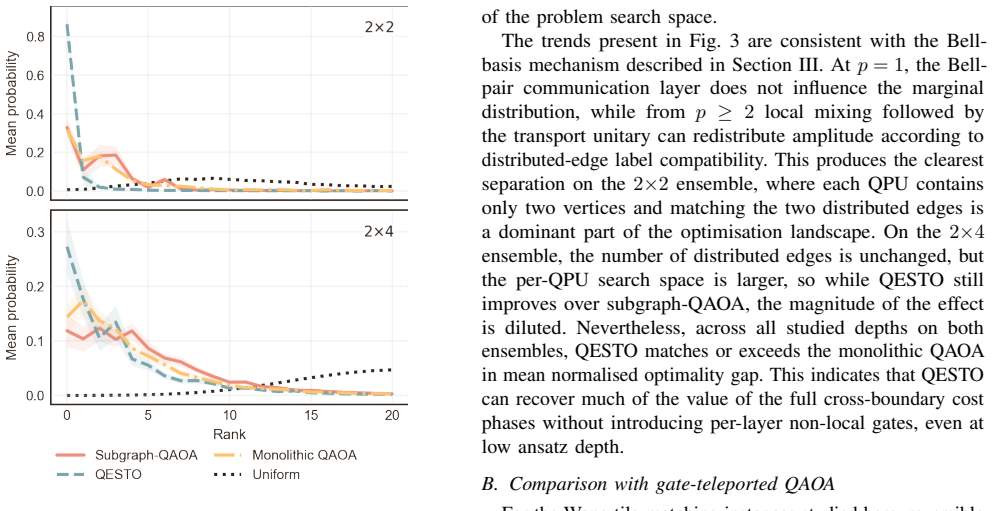
QESTO is a distributed variational ansatz that requires one Bell pair per distributed edge of the problem graph. After initialisation of the Bell states, it applies only local operations to encode local constraint information in the pairs and thereby produce amplitude transfer toward globally valid distributed solution states. On two bounded weighted Wang tile-matching problem ensembles, QESTO achieves stronger convergence to low-cost tilings than equivalently partitioned QAOA with no distributed gates at ansatz depths of two or higher, and exceeds the mean performance of monolithic QAOA at the deepest studied depth in both ensembles.
What carries the argument
The QESTO ansatz: local operations on pre-shared Bell pairs that encode constraint information and enable amplitude transfer to valid global states without post-initialisation non-local gates.
If this is right
- Persistent entanglement can support useful variational communication across processors.
- Per-layer non-local gate overhead is reduced while still allowing distributed optimisation.
- Performance gains over partitioned QAOA appear reliably once ansatz depth reaches two or higher.
- At sufficient depth the distributed method can surpass the average result of a single-processor QAOA on the tested ensembles.
Where Pith is reading between the lines
- The approach may reduce the need for real-time entanglement generation during algorithm execution.
- Similar local manipulation of pre-shared pairs could be explored in other variational algorithms such as VQE.
- The tile-matching results suggest the method could extend to other graph-based constraint problems if the Bell-pair encoding generalises.
- Scaling tests would need to check how the number of required Bell pairs grows with problem size.
Load-bearing premise
Local operations on pre-shared Bell pairs can reliably encode local constraint information and produce amplitude transfer toward globally valid distributed solution states without any non-local gates after initialization.
What would settle it
Running the same two Wang tile ensembles at ansatz depth two or higher and finding that QESTO does not reach lower-cost tilings than the partitioned QAOA baseline, or that its deepest-depth mean does not exceed the monolithic QAOA mean.
Figures

read the original abstract
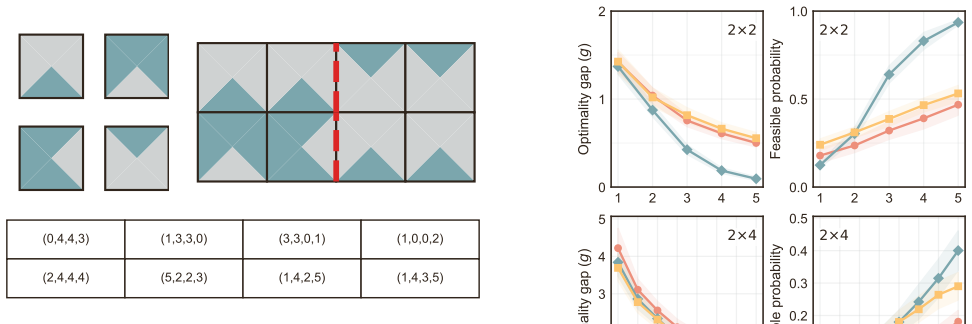
Distributed quantum optimisation is challenging because computing the problem cost function across multiple quantum processors requires non-local gates, which can incur overhead in latency and fidelity. Here we introduce QESTO, a distributed variational ansatz for graph-based discrete optimisation that requires only persistent pre-shared Bell pairs for remote operations. Using local operations, it encodes local constraint information in the Bell pairs that is leveraged to produce amplitude transfer towards globally valid distributed solution states. QESTO requires one Bell pair per distributed edge of the problem graph and, after initialisation of the Bell states, uses no non-local gates. On two bounded weighted Wang tile-matching problem ensembles, QESTO achieves stronger convergence to low-cost tilings than equivalently partitioned QAOA with no distributed gates at ansatz depths of two or higher, and exceeds the mean performance of monolithic QAOA at the deepest studied depth in both ensembles. These results suggest that persistent entanglement can support useful variational communication while reducing per-layer non-local gate overhead.
Editorial analysis
A structured set of objections, weighed in public.
Referee Report
Summary. The manuscript introduces QESTO, a distributed variational ansatz for graph-based discrete optimization problems. It uses one pre-shared Bell pair per distributed edge, initializes them, and then applies only local unitaries to encode per-edge constraint information, claiming this produces amplitude transfer toward globally valid distributed solution states without any subsequent non-local gates. On two bounded weighted Wang tile-matching ensembles, QESTO is reported to achieve stronger convergence to low-cost tilings than equivalently partitioned QAOA (no distributed gates) at depths ≥2 and to exceed the mean performance of monolithic QAOA at the deepest depth studied.
Significance. If the claimed mechanism holds and the empirical advantage is robust, the approach could reduce non-local gate overhead in distributed variational quantum optimization by leveraging persistent entanglement for selective amplitude transfer. The work provides concrete empirical comparisons on tile-matching instances and highlights a potential route to variational communication with lower per-layer communication cost.
major comments (2)
- [Abstract / QESTO definition] Abstract (paragraph on QESTO definition) and the corresponding methods section: the central claim that local unitaries alone on pre-shared Bell pairs can encode remote constraint information and produce constraint-dependent amplitude transfer relies on the tensor-product structure correlating the processors. No derivation, explicit circuit, or reduced-density-matrix calculation is provided showing how the local encoding on one side can depend on constraint data held only on the remote processor; without this, the reported performance advantage cannot be attributed to the ansatz rather than an implementation artifact.
- [Results] Results section (performance on the two Wang-tile ensembles): the abstract and reported comparisons state stronger convergence and exceedance of monolithic QAOA but supply no information on number of independent runs, error bars, statistical tests, or the precise partitioning method used for the distributed QAOA baseline. These details are load-bearing for assessing whether the central empirical claim is statistically supported.
minor comments (2)
- [Abstract] Abstract: the two ensembles are described only as 'bounded weighted Wang tile-matching problem ensembles'; adding their sizes, edge densities, and weighting scheme would improve reproducibility.
- [Methods / QESTO ansatz] Notation: the manuscript should define the precise form of the local unitaries applied to each Bell pair (e.g., which Pauli rotations or parameterized gates) and how they are chosen from the local constraint data.
Simulated Author's Rebuttal
We thank the referee for their thorough review and insightful comments, which have helped us identify areas for improvement. We address each major comment below and commit to revisions that strengthen the manuscript without altering its core claims.
read point-by-point responses
-
Referee: [Abstract / QESTO definition] Abstract (paragraph on QESTO definition) and the corresponding methods section: the central claim that local unitaries alone on pre-shared Bell pairs can encode remote constraint information and produce constraint-dependent amplitude transfer relies on the tensor-product structure correlating the processors. No derivation, explicit circuit, or reduced-density-matrix calculation is provided showing how the local encoding on one side can depend on constraint data held only on the remote processor; without this, the reported performance advantage cannot be attributed to the ansatz rather than an implementation artifact.
Authors: We agree that an explicit derivation is needed to rigorously support the mechanism. In the revised manuscript, we will expand the Methods section with a reduced-density-matrix calculation for a representative distributed edge. This will include the explicit circuit (local unitaries applied to each half of the pre-shared Bell pair) and show how the joint state evolves to produce constraint-dependent amplitude transfer. Each processor encodes its local portion of the edge constraint; the pre-shared entanglement correlates the processors such that the local operations yield the desired non-local effect on the global amplitude distribution. We will also clarify the partitioning of constraint data across processors. revision: yes
-
Referee: [Results] Results section (performance on the two Wang-tile ensembles): the abstract and reported comparisons state stronger convergence and exceedance of monolithic QAOA but supply no information on number of independent runs, error bars, statistical tests, or the precise partitioning method used for the distributed QAOA baseline. These details are load-bearing for assessing whether the central empirical claim is statistically supported.
Authors: We acknowledge that these experimental details are necessary for proper assessment. In the revised version, we will augment the Results section with: the number of independent runs per instance, error bars (standard deviation across runs), statistical significance tests (e.g., paired t-tests between QESTO and baselines), and a precise description of the graph partitioning method used for the distributed QAOA baseline, including how vertices and edges were assigned to processors. revision: yes
Circularity Check
No significant circularity; empirical performance claims rest on direct simulation results rather than self-referential definitions or fitted predictions.
full rationale
The paper defines QESTO as a variational ansatz using only local operations on pre-shared Bell pairs after initialization, then reports empirical convergence results on two Wang-tile ensembles compared to QAOA baselines. No equations, parameter-fitting procedures, or self-citation chains are described that would reduce the reported performance advantage to a quantity defined in terms of itself. The central claim is an observed numerical outcome on specific problem instances, which is externally falsifiable via independent simulation and does not rely on renaming known results or importing uniqueness theorems from prior author work. The mechanism (amplitude transfer via local unitaries on EPR pairs) is presented as an assumption whose validity is tested by the simulations themselves, not presupposed by construction.
Axiom & Free-Parameter Ledger
Reference graph
Works this paper leans on
-
[1]
Quantum computing in the NISQ era and beyond,
J. Preskill, “Quantum computing in the NISQ era and beyond,”Quantum, vol. 2, p. 79, 2018
2018
-
[2]
Quantum internet: Networking challenges in distributed quantum computing,
A. S. Cacciapuoti, M. Caleffi, F. Tafuri, F. S. Cataliotti, S. Gherardini, and G. Bianchi, “Quantum internet: Networking challenges in distributed quantum computing,”IEEE Netw., vol. 34, no. 1, pp. 137–143, 2020
2020
-
[3]
Optimal local implementation of nonlocal quantum gates,
J. Eisert, K. Jacobs, P. Papadopoulos, and M. B. Plenio, “Optimal local implementation of nonlocal quantum gates,”Phys. Rev. A, vol. 62, p. 052317, 2000
2000
-
[4]
Demonstrating the viability of universal quantum computation using teleportation and single-qubit operations,
D. Gottesman and I. L. Chuang, “Demonstrating the viability of universal quantum computation using teleportation and single-qubit operations,” Nature, vol. 402, pp. 390–393, 1999
1999
-
[5]
Generalized GHZ states and distributed quantum computing,
A. Yimsiriwattana and S. J. Lomonaco, Jr., “Generalized GHZ states and distributed quantum computing,” inCoding Theory and Quantum Computing, ser. Contemporary Mathematics. American Mathematical Society, 2005, vol. 381, pp. 131–147
2005
-
[6]
Distributed quantum computing: a survey,
M. Caleffi, M. Amoretti, D. Ferrari, J. Illiano, A. Manzalini, and A. S. Cacciapuoti, “Distributed quantum computing: a survey,”Comput. Networks, vol. 254, p. 110672, 2024
2024
-
[7]
Towards a distributed quantum computing ecosystem,
D. Cuomo, M. Caleffi, and A. S. Cacciapuoti, “Towards a distributed quantum computing ecosystem,”IET Quantum Commun., vol. 1, no. 1, pp. 3–8, 2020
2020
-
[8]
A Quantum Approximate Optimization Algorithm
E. Farhi, J. Goldstone, and S. Gutmann, “A quantum approximate optimization algorithm,” 2014, arXiv:1411.4028 [quant-ph]
work page internal anchor Pith review Pith/arXiv arXiv 2014
-
[9]
S. Kim, V . R. Pascuzzi, Z. Xu, T. Luo, E. Lee, and I.-S. Suh, “Distributed quantum approximate optimization algorithm on a quantum-centric supercomputing architecture,” 2024, arXiv:2407.20212 [cs.DC, quant-ph]
-
[10]
Noise- aware distributed quantum approximate optimization algorithm on near- term quantum hardware,
K.-C. Chen, X. Xu, F. Burt, C.-Y . Liu, S. Yu, and K. K. Leung, “Noise- aware distributed quantum approximate optimization algorithm on near- term quantum hardware,” in2024 IEEE International Conference on Quantum Computing and Engineering (QCE), 2024, pp. 144–149
2024
-
[11]
Distributed quantum comput- ing and network control for accelerated VQE,
S. DiAdamo, M. Ghibaudi, and J. Cruise, “Distributed quantum comput- ing and network control for accelerated VQE,”IEEE Trans. Quantum Eng., vol. 2, pp. 1–21, 2021
2021
-
[12]
AutoComm: A framework for enabling efficient communication in distributed quantum programs,
A. Wu, H. Zhang, G. Li, A. Shabani, Y . Xie, and Y . Ding, “AutoComm: A framework for enabling efficient communication in distributed quantum programs,” inProceedings of the 55th Annual IEEE/ACM International Symposium on Microarchitecture, 2022, pp. 1027–1041
2022
-
[13]
Entanglement-efficient bipartite-distributed quantum computing,
J.-Y . Wuet al., “Entanglement-efficient bipartite-distributed quantum computing,”Quantum, vol. 7, p. 1196, 2023
2023
-
[14]
Divide and conquer for combinatorial optimization and distributed quantum computation,
T. Tomesh, Z. H. Saleem, M. A. Perlin, P. Gokhale, M. Suchara, and M. Martonosi, “Divide and conquer for combinatorial optimization and distributed quantum computation,” in2023 IEEE International Conference on Quantum Computing and Engineering (QCE), 2023, pp. 1–12
2023
-
[15]
Postquantum common-cause channels: the resource theory of local operations and shared entanglement,
D. Schmid, H. Du, M. Mudassar, G. Coulter-de Wit, D. Rosset, and M. J. Hoban, “Postquantum common-cause channels: the resource theory of local operations and shared entanglement,”Quantum, vol. 5, p. 419, 2021
2021
-
[16]
Proving theorems by pattern recognition — II,
H. Wang, “Proving theorems by pattern recognition — II,”Bell Syst. Tech. J., vol. 40, no. 1, pp. 1–41, 1961
1961
-
[17]
Jigsaw puzzles, edge matching, and polyomino packing: Connections and complexity,
E. D. Demaine and M. L. Demaine, “Jigsaw puzzles, edge matching, and polyomino packing: Connections and complexity,”Graphs Combin., vol. 23, pp. 195–208, 2007, supplement
2007
-
[18]
On the hardness of solving edge-matching puzzles as SAT or CSP problems,
C. Ans ´otegui, R. B ´ejar, C. Fern ´andez, and C. Mateu, “On the hardness of solving edge-matching puzzles as SAT or CSP problems,”Constraints, vol. 18, no. 1, pp. 7–37, 2013
2013
-
[19]
Combinatorial optimization via highly efficient quantum walks,
S. Marsh and J. B. Wang, “Combinatorial optimization via highly efficient quantum walks,”Phys. Rev. Res., vol. 2, p. 023302, 2020
2020
-
[20]
Quantum walk informed variational algorithm design.arXiv preprint arXiv:2406.11620, 2024
E. Matwiejew and J. B. Wang, “Quantum walk informed variational algorithm design,” 2024, arXiv:2406.11620 [quant-ph]
-
[21]
Bounded Wang tilings with integer program- ming and graph-based heuristics,
M. Tyburec and J. Zeman, “Bounded Wang tilings with integer program- ming and graph-based heuristics,”Sci. Rep., vol. 13, no. 1, p. 4865, 2023
2023
-
[22]
Benchmarking quantum heuristics: Nonvariational quantum-walk-based optimization algorithm for the weighted MaxCut problem,
T. Bennett, A. Smith, E. Matwiejew, and J. B. Wang, “Benchmarking quantum heuristics: Nonvariational quantum-walk-based optimization algorithm for the weighted MaxCut problem,”Phys. Rev. A, vol. 113, no. 3, p. 032603, 2026
2026
-
[23]
Toward a linear-ramp QAOA protocol: evidence of a scaling advantage in solving some combinatorial optimization problems,
J. A. Monta ˜nez-Barrera and K. Michielsen, “Toward a linear-ramp QAOA protocol: evidence of a scaling advantage in solving some combinatorial optimization problems,”npj Quantum Inf., vol. 11, no. 1, p. 131, 2025
2025
-
[24]
Efficient quantum circuits for diagonal unitaries without ancillas,
J. Welch, D. Greenbaum, S. Mostame, and A. Aspuru-Guzik, “Efficient quantum circuits for diagonal unitaries without ancillas,”New J. Phys., vol. 16, no. 3, p. 033040, 2014
2014
-
[25]
A limited memory algorithm for bound constrained optimization,
R. H. Byrd, P. Lu, J. Nocedal, and C. Zhu, “A limited memory algorithm for bound constrained optimization,”SIAM J. Sci. Comput., vol. 16, no. 5, pp. 1190–1208, 1995
1995
-
[26]
A. Javadi-Abhariet al., “Quantum computing with Qiskit,” 2024, arXiv:2405.08810 [quant-ph]
work page internal anchor Pith review Pith/arXiv arXiv 2024
-
[27]
SciPy 1.0: Fundamental Algorithms for Scientific Computing in Python,
P. Virtanenet al., “SciPy 1.0: Fundamental Algorithms for Scientific Computing in Python,”Nat. Methods, vol. 17, pp. 261–272, 2020
2020
-
[28]
Elementary gates for quantum computation,
A. Barencoet al., “Elementary gates for quantum computation,”Phys. Rev. A, vol. 52, pp. 3457–3467, 1995
1995
-
[29]
Distributed quantum computing across an optical network link,
D. Mainet al., “Distributed quantum computing across an optical network link,”Nature, vol. 638, no. 8050, pp. 383–388, 2025
2025
-
[30]
High-fidelity remote entanglement of trapped atoms mediated by time-bin photons,
S. Sahaet al., “High-fidelity remote entanglement of trapped atoms mediated by time-bin photons,”Nat. Commun., vol. 16, no. 1, p. 2533, 2025
2025
discussion (0)
Sign in with ORCID, Apple, or X to comment. Anyone can read and Pith papers without signing in.