Minimax Private Estimation of Smooth Optimal-Transport Maps
Pith reviewed 2026-06-28 04:12 UTC · model grok-4.3
The pith
Differentially private estimators for smooth optimal transport maps achieve near-minimax rates in dimension two and higher, with exact minimax rates in one dimension under central privacy.
A machine-rendered reading of the paper's core claim, the machinery that carries it, and where it could break.
Core claim
The authors build differentially private estimators for smooth OT maps by privatizing wavelet density estimators and invoking stability bounds; the resulting main procedure attains near-minimax rates in d ≥ 2 under both central and local DP, a quantile-based variant attains minimax rates in d = 1 under central DP, and matching lower bounds confirm that the achieved rates cannot be improved by more than logarithmic factors.
What carries the argument
Privatized wavelet density estimators that are fed into stability-based recovery of the OT map while preserving the original convergence rates under privacy noise.
If this is right
- Near-minimax rates hold for the main estimator in every dimension d ≥ 2 under both central and local differential privacy.
- The quantile-based estimator attains exact minimax rates in dimension one under central differential privacy.
- Matching lower bounds establish that the rates cannot be improved beyond logarithmic factors.
- The construction supplies the first differentially private OT-map estimator possessing these optimality guarantees.
Where Pith is reading between the lines
- The reliance on wavelets suggests that similar privatized density estimators could be reused for other smooth functionals of distributions.
- Dimension-dependent rate behavior indicates that one-dimensional private transport problems may admit qualitatively simpler solutions than higher-dimensional ones.
- The approach leaves open whether the same stability-plus-wavelet route can be adapted to non-smooth or unbounded maps without losing the rate guarantees.
Load-bearing premise
Adding differential privacy noise to the wavelet density estimates does not substantially worsen the accuracy of the recovered optimal transport maps beyond the near-minimax level.
What would settle it
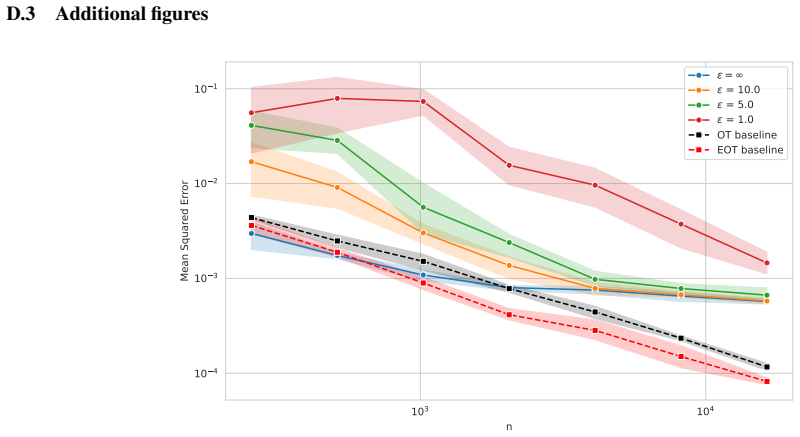
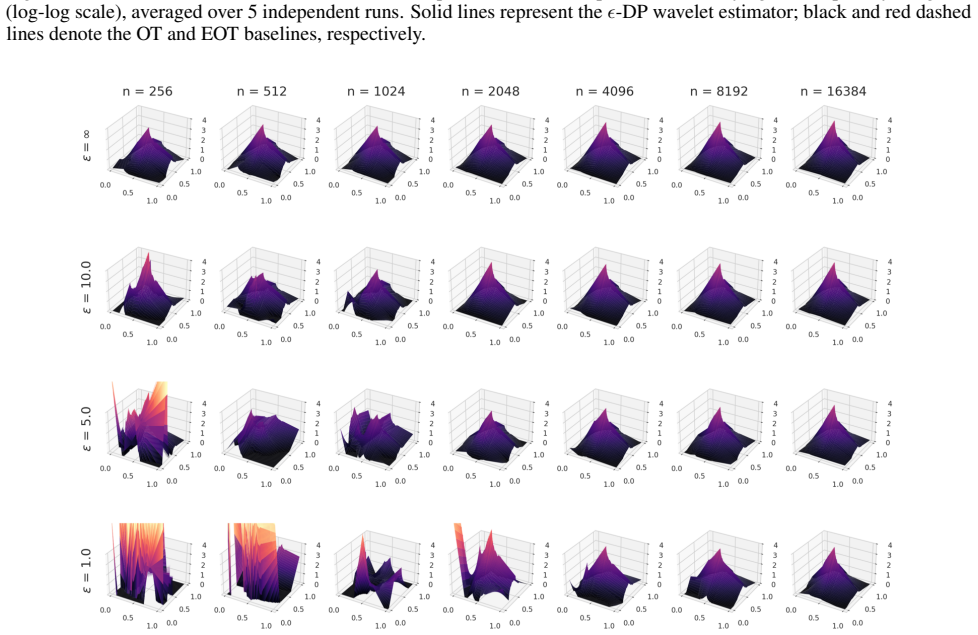
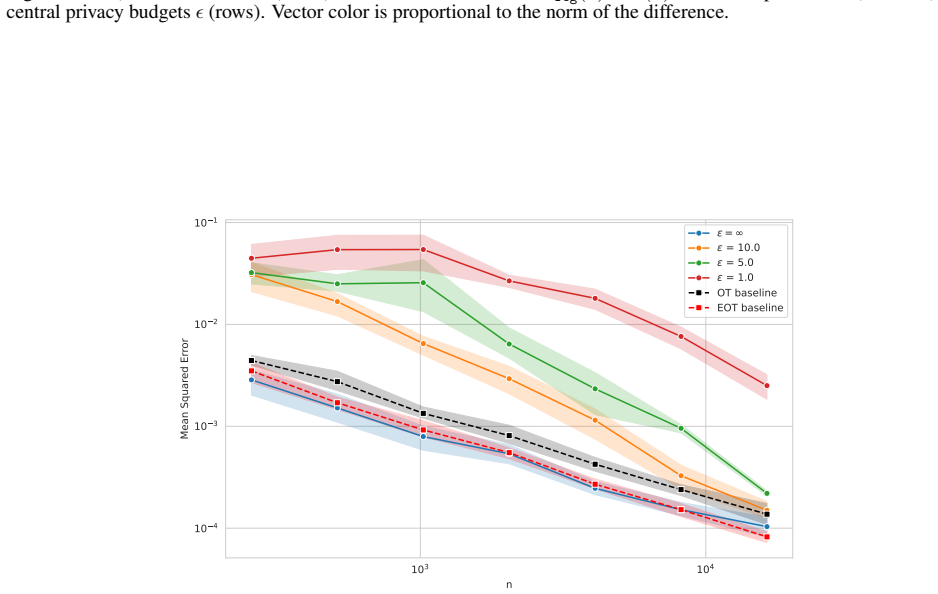
A simulation on a pair of smooth densities in dimension two that measures whether the private estimator's error exceeds the claimed near-minimax rate by more than a small constant factor once the privacy parameter is fixed.
Figures

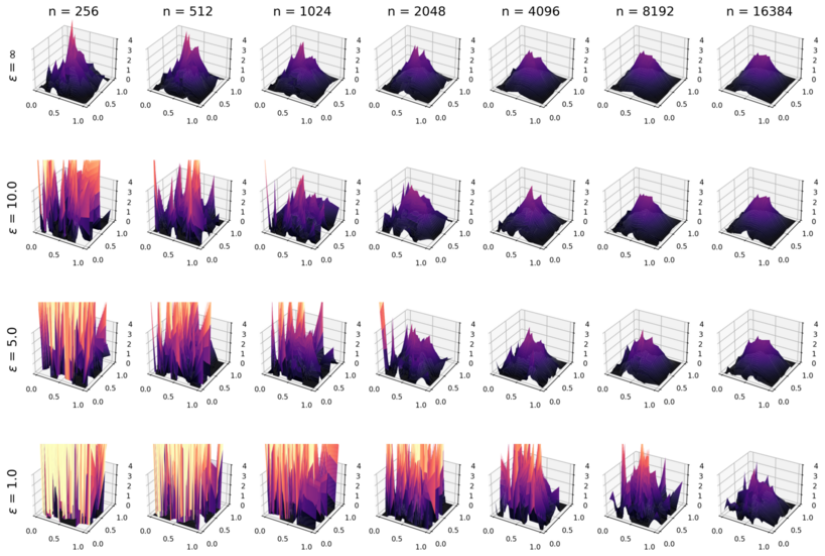
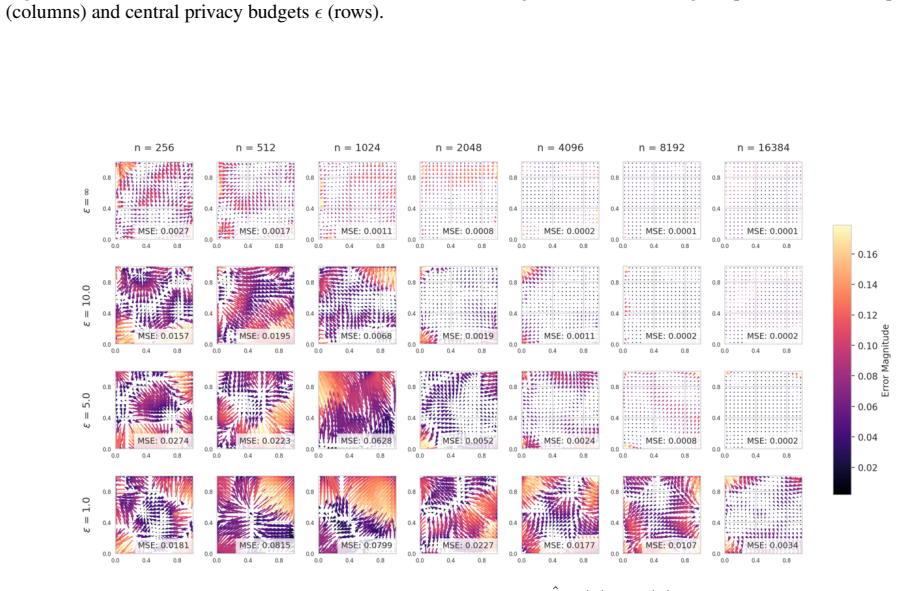

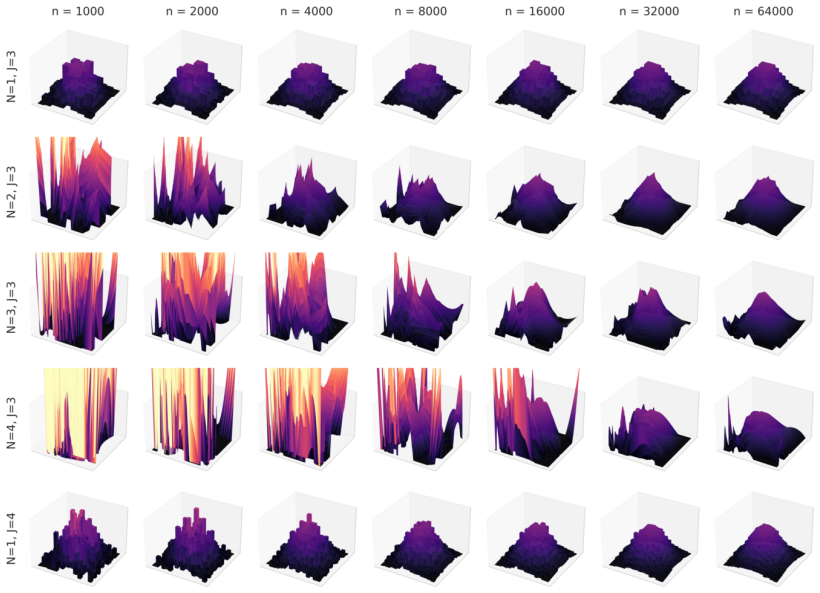
read the original abstract
We study the problem of estimating smooth optimal transport (OT) maps between two probability distributions under differential privacy (DP) constraints. Leveraging wavelet-based density estimators and recent stability bounds for smooth OT maps, we propose differentially private estimators that apply to both central and local DP models. Our main estimator achieves near-minimax optimal rates in dimension $d \geq 2$, and we complement it with a quantile-based estimator that attains minimax optimal rates in dimension $d = 1$ under central DP. We further establish matching minimax lower bounds, confirming the near-optimality of our approach. To the best of our knowledge, this constitutes the first differentially private procedure for OT map estimation with minimax optimality guarantees.
Editorial analysis
A structured set of objections, weighed in public.
Referee Report
Summary. The paper develops differentially private estimators for smooth optimal transport maps between probability distributions. It combines wavelet-based density estimators with existing stability bounds for smooth OT maps to produce estimators under both central and local DP. The main estimator is claimed to achieve near-minimax optimal rates for dimension d ≥ 2; a separate quantile-based procedure attains exact minimax rates for d = 1 under central DP. Matching minimax lower bounds are established, and the work is presented as the first DP procedure for OT map estimation with minimax optimality guarantees.
Significance. If the composition of privacy noise with the stability bounds preserves the claimed rates, the result would be a notable advance in private nonparametric estimation, providing the first minimax-optimal rates for this problem. The explicit matching lower bounds and the separation of the d=1 case (which avoids the stability step) are strengths. The approach usefully bridges recent OT stability results with wavelet privatization techniques.
major comments (2)
- [§4.1–4.2, Theorem 4.1] §4.1–4.2 and the proof of Theorem 4.1: the stability bound (invoked from the cited reference) is applied directly to the output of the privatized wavelet density estimator. The analysis must confirm that the Laplace or Gaussian noise added to the wavelet coefficients preserves the precise Hölder/Besov regularity and norm control required by the stability result; if the noise enters in a norm (e.g., sup-norm) not controlled by the stability theorem, the OT-map error bound inflates and the near-minimax claim for d ≥ 2 fails.
- [§4.2 (after Eq. (12))] The rate derivation for the main estimator (displayed after Eq. (12) in §4.2) treats the privacy-induced density error as an additive term whose contribution remains of lower order. An explicit calculation showing that the effective smoothness index after privatization does not drop below the threshold needed for the stability map is required; otherwise the claimed rate for d ≥ 2 is not justified.
minor comments (2)
- [§3] Notation for the wavelet basis and the precise DP mechanism (Laplace vs. Gaussian) is introduced in §3 but used inconsistently in the error bounds of §4; a single consistent definition would improve readability.
- [§5] The lower-bound construction in §5 is stated for the central DP model; a brief remark on whether the same lower bound extends to local DP would clarify the scope of the optimality result.
Simulated Author's Rebuttal
We thank the referee for the detailed and constructive report. The comments highlight important points about the interaction between privacy noise and the stability bounds that we will clarify in revision. We address each major comment below.
read point-by-point responses
-
Referee: [§4.1–4.2, Theorem 4.1] the stability bound is applied directly to the output of the privatized wavelet density estimator. The analysis must confirm that the Laplace or Gaussian noise added to the wavelet coefficients preserves the precise Hölder/Besov regularity and norm control required by the stability result; if the noise enters in a norm not controlled by the stability theorem, the OT-map error bound inflates.
Authors: We agree that an explicit verification is needed. The wavelet coefficients receive independent Laplace (or Gaussian) noise scaled to the privacy budget; because the wavelet basis is unconditional for Besov spaces and the noise is added at each resolution level with amplitude decaying as 2^{-j(s+d/2)} (where s is the smoothness index), the perturbed estimator remains in the same Besov ball up to a logarithmic factor with high probability. The stability theorem (invoked from the cited reference) is stated for perturbations measured in the sup-norm, which is controlled by the wavelet coefficient noise via standard embedding arguments. We will insert a short auxiliary lemma (new Lemma 4.3) that states this preservation and derives the resulting constant factors, thereby justifying direct application of the stability bound. revision: yes
-
Referee: [§4.2 (after Eq. (12))] The rate derivation treats the privacy-induced density error as an additive term whose contribution remains of lower order. An explicit calculation showing that the effective smoothness index after privatization does not drop below the threshold needed for the stability map is required.
Authors: The privacy noise level is chosen so that its contribution to the Besov norm is o(2^{-j s}) at the resolution j that balances bias and variance; consequently the effective smoothness index remains strictly above the threshold required by the stability map (s > d/2 + 1). The calculation appears implicitly in the proof of Theorem 4.1 via the triangle inequality separating the wavelet estimation error from the privacy error, but we acknowledge it is not written out as a separate display. In the revision we will add an explicit paragraph immediately after Eq. (12) that computes the post-privatization Besov norm and verifies it stays above the stability threshold, confirming that the privacy term remains lower order for d ≥ 2. revision: yes
Circularity Check
No circularity; derivation relies on external stability bounds and independent lower bounds
full rationale
The paper's central claims rest on applying wavelet density estimators under DP noise and invoking cited stability results that map density error to OT-map error, followed by separate minimax lower-bound arguments. No equations reduce a claimed rate to a fitted parameter by construction, no self-citation chain is load-bearing for the optimality statement, and the lower bounds are presented as independently derived matching results. The composition of privacy noise with the stability bounds is an assumption whose validity is external to the derivation itself; it does not create a definitional loop or rename a fitted quantity as a prediction.
Axiom & Free-Parameter Ledger
axioms (2)
- domain assumption Stability bounds for smooth OT maps exist and survive privatization.
- domain assumption Wavelet density estimators admit DP versions with controlled rates.
Reference graph
Works this paper leans on
-
[1]
J. M. Abowd. The us census bureau adopts differential privacy. InProceedings of the 24th ACM SIGKDD International Conference on Knowledge Discovery & Data Mining, pages 2867–2867, 2018
2018
-
[2]
Acharya, Z
J. Acharya, Z. Sun, and H. Zhang. Differentially private Assouad, Fano, and Le Cam. In V . Feldman, K. Ligett, and S. Sabato, editors,Algorithmic Learning Theory, 16-19 March 2021, Virtual Conference, Worldwide, volume 132 of Proceedings of Machine Learning Research, pages 48–78. PMLR, 2021
2021
-
[3]
Aden-Ali, H
I. Aden-Ali, H. Ashtiani, and G. Kamath. On the sample complexity of privately learning unbounded high- dimensional gaussians. In V . Feldman, K. Ligett, and S. Sabato, editors,Algorithmic Learning Theory, 16-19 March 2021, Virtual Conference, Worldwide, volume 132 ofProceedings of Machine Learning Research, pages 185–216. PMLR, 2021
2021
-
[4]
Unsupervised Hyperalignment for Multilingual Word Embeddings
J. Alaux, E. Grave, M. Cuturi, and A. Joulin. Unsupervised hyperalignment for multilingual word embeddings. CoRR, abs/1811.01124, 2018
work page internal anchor Pith review Pith/arXiv arXiv 2018
-
[5]
Alvarez-Melis, T
D. Alvarez-Melis, T. S. Jaakkola, and S. Jegelka. Structured optimal transport. In A. J. Storkey and F. Pérez- Cruz, editors,International Conference on Artificial Intelligence and Statistics, AISTATS 2018, 9-11 April 2018, Playa Blanca, Lanzarote, Canary Islands, Spain, volume 84 ofProceedings of Machine Learning Research, pages 1771–1780. PMLR, 2018
2018
-
[6]
Arjovsky, S
M. Arjovsky, S. Chintala, and L. Bottou. Wasserstein generative adversarial networks. In D. Precup and Y . W. Teh, editors,Proceedings of the 34th International Conference on Machine Learning, ICML 2017, Sydney, NSW, Australia, 6-11 August 2017, volume 70 ofProceedings of Machine Learning Research, pages 214–223. PMLR, 2017
2017
-
[7]
Backstrom, C
L. Backstrom, C. Dwork, and J. M. Kleinberg. Wherefore art thou r3579x?: anonymized social networks, hidden patterns, and structural steganography. In C. L. Williamson, M. E. Zurko, P. F. Patel-Schneider, and P. J. Shenoy, editors,Proceedings of the 16th International Conference on World Wide Web, WWW 2007, Banff, Alberta, Canada, May 8-12, 2007, pages 18...
2007
-
[8]
Balakrishnan and T
S. Balakrishnan and T. Manole. Stability bounds for smooth optimal transport maps and their statistical implications, 2025
2025
-
[9]
R. F. Barber and J. C. Duchi. Privacy and statistical risk: Formalisms and minimax bounds.CoRR, abs/1412.4451, 2014
work page internal anchor Pith review Pith/arXiv arXiv 2014
- [10]
-
[11]
T. B. Berrett, L. Györfi, and H. Walk. Strongly universally consistent nonparametric regression and classification with privatised data.Electronic Journal of Statistics, 15(1):2430 – 2453, 2021
2021
-
[12]
Biswas, Y
S. Biswas, Y . Dong, G. Kamath, and J. R. Ullman. Coinpress: Practical private mean and covariance estimation. In H. Larochelle, M. Ranzato, R. Hadsell, M. Balcan, and H. Lin, editors,Advances in Neural Information Processing Systems 33: Annual Conference on Neural Information Processing Systems 2020, NeurIPS 2020, December 6-12, 2020, virtual, 2020
2020
-
[13]
Brown, M
G. Brown, M. Gaboardi, A. D. Smith, J. R. Ullman, and L. Zakynthinou. Covariance-aware private mean estimation without private covariance estimation. In M. Ranzato, A. Beygelzimer, Y . N. Dauphin, P. Liang, and J. W. Vaughan, editors,Advances in Neural Information Processing Systems 34: Annual Conference on Neural Information Processing Systems 2021, Neur...
2021
-
[14]
M. Bun, G. Kamath, T. Steinke, and Z. S. Wu. Private hypothesis selection. In H. M. Wallach, H. Larochelle, A. Beygelzimer, F. d’Alché-Buc, E. B. Fox, and R. Garnett, editors,Advances in Neural Information Processing Systems 32: Annual Conference on Neural Information Processing Systems 2019, NeurIPS 2019, December 8-14, 2019, Vancouver, BC, Canada, pages...
2019
-
[15]
M. Bun, G. Kamath, T. Steinke, and Z. S. Wu. Private hypothesis selection.IEEE Trans. Inf. Theory, 67(3):1981– 2000, 2021
1981
-
[16]
C. Butucea, A. Dubois, M. Kroll, and A. Saumard. Local differential privacy: Elbow effect in optimal density estimation and adaptation over besov ellipsoids.CoRR, abs/1903.01927, 2019. 10
work page internal anchor Pith review Pith/arXiv arXiv 1903
- [17]
-
[18]
G. D. Cañas and L. Rosasco. Learning probability measures with respect to optimal transport metrics. In P. L. Bartlett, F. C. N. Pereira, C. J. C. Burges, L. Bottou, and K. Q. Weinberger, editors,Advances in Neural Information Processing Systems 25: 26th Annual Conference on Neural Information Processing Systems 2012. Proceedings of a meeting held Decembe...
2012
-
[19]
Cazelles, V
E. Cazelles, V . Seguy, J. Bigot, M. Cuturi, and N. Papadakis. Geodesic PCA versus log-pca of histograms in the wasserstein space.SIAM J. Sci. Comput., 40(2), 2018
2018
-
[20]
Chernozhukov, A
V . Chernozhukov, A. Galichon, M. Hallin, and M. Henry. Monge-kantorovich depth, quantiles, ranks, and signs, 2015
2015
-
[21]
Chhor and F
J. Chhor and F. Sentenac. Robust estimation of discrete distributions under local differential privacy. InInternational Conference on Algorithmic Learning Theory, pages 411–446. PMLR, 2023
2023
-
[22]
Cohen, I
A. Cohen, I. Daubechies, and P. Vial. Wavelets on the interval and fast wavelet transforms.Applied and computational harmonic analysis, 1993
1993
-
[23]
Courty, R
N. Courty, R. Flamary, A. Habrard, and A. Rakotomamonjy. Joint distribution optimal transportation for domain adaptation. In I. Guyon, U. V . Luxburg, S. Bengio, H. Wallach, R. Fergus, S. Vishwanathan, and R. Garnett, editors, Advances in Neural Information Processing Systems, volume 30. Curran Associates, Inc., 2017
2017
-
[24]
Courty, R
N. Courty, R. Flamary, and D. Tuia. Domain adaptation with regularized optimal transport. In T. Calders, F. Esposito, E. Hüllermeier, and R. Meo, editors,Machine Learning and Knowledge Discovery in Databases - European Conference, ECML PKDD 2014, Nancy, France, September 15-19, 2014. Proceedings, Part I, volume 8724 of Lecture Notes in Computer Science, p...
2014
-
[25]
Courty, R
N. Courty, R. Flamary, D. Tuia, and A. Rakotomamonjy. Optimal transport for domain adaptation.IEEE Trans. Pattern Anal. Mach. Intell., 39(9):1853–1865, 2017
2017
- [26]
-
[27]
B. B. Damodaran, B. Kellenberger, R. Flamary, D. Tuia, and N. Courty. Deepjdot: Deep joint distribution optimal transport for unsupervised domain adaptation. In V . Ferrari, M. Hebert, C. Sminchisescu, and Y . Weiss, editors, Computer Vision - ECCV 2018 - 15th European Conference, Munich, Germany, September 8-14, 2018, Proceedings, Part IV, volume 11208 o...
2018
-
[28]
Deb and B
N. Deb and B. Sen. Multivariate rank-based distribution-free nonparametric testing using measure transportation, 2019
2019
-
[29]
del Barrio, A
E. del Barrio, A. González-Sanz, and J.-M. Loubes. Central limit theorems for general transportation costs. In Annales de l’Institut Henri Poincare (B) Probabilites et statistiques, volume 60, pages 847–873. Institut Henri Poincaré, 2024
2024
-
[30]
Del Barrio, A
E. Del Barrio, A. González Sanz, and J.-M. Loubes. Central limit theorems for semi-discrete wasserstein distances. Bernoulli, 30(1):554–580, 2024
2024
-
[31]
del Barrio, P
E. del Barrio, P. Gordaliza, H. Lescornel, and J. Loubes. Central limit theorem and bootstrap procedure for wasserstein’s variations with an application to structural relationships between distributions.J. Multivar. Anal., 169:341–362, 2019
2019
-
[32]
Diakonikolas, M
I. Diakonikolas, M. Hardt, and L. Schmidt. Differentially private learning of structured discrete distributions. In C. Cortes, N. D. Lawrence, D. D. Lee, M. Sugiyama, and R. Garnett, editors,Advances in Neural Information Processing Systems 28: Annual Conference on Neural Information Processing Systems 2015, December 7-12, 2015, Montreal, Quebec, Canada, ...
2015
-
[33]
B. Ding, J. Kulkarni, and S. Yekhanin. Collecting telemetry data privately. In I. Guyon, U. von Luxburg, S. Bengio, H. M. Wallach, R. Fergus, S. V . N. Vishwanathan, and R. Garnett, editors,Advances in Neural Information Processing Systems 30: Annual Conference on Neural Information Processing Systems 2017, December 4-9, 2017, Long Beach, CA, USA, pages 3...
2017
-
[34]
Y . Ding, R. Li, and L. Xue. Statistical convergence rates of optimal transport map estimation between general distributions, 2024. 11
2024
-
[35]
Dinur and K
I. Dinur and K. Nissim. Revealing information while preserving privacy. In F. Neven, C. Beeri, and T. Milo, editors, Proceedings of the Twenty-Second ACM SIGACT-SIGMOD-SIGART Symposium on Principles of Database Systems, June 9-12, 2003, San Diego, CA, USA, pages 202–210. ACM, 2003
2003
-
[36]
J. C. Duchi, M. I. Jordan, and M. J. Wainwright. Local privacy and statistical minimax rates. In51st Annual Allerton Conference on Communication, Control, and Computing, Allerton 2013, Allerton Park & Retreat Center, Monticello, IL, USA, October 2-4, 2013, page 1592. IEEE, 2013
2013
-
[37]
J. C. Duchi, M. J. Wainwright, and M. I. Jordan. Minimax optimal procedures for locally private estimation.CoRR, abs/1604.02390, 2016
work page internal anchor Pith review Pith/arXiv arXiv 2016
-
[38]
Dwork, F
C. Dwork, F. McSherry, K. Nissim, and A. D. Smith. Calibrating noise to sensitivity in private data analysis. In S. Halevi and T. Rabin, editors,Theory of Cryptography, Third Theory of Cryptography Conference, TCC 2006, New York, NY, USA, March 4-7, 2006, Proceedings, volume 3876 ofLecture Notes in Computer Science, pages 265–284. Springer, 2006
2006
-
[39]
Dwork and A
C. Dwork and A. Roth. The algorithmic foundations of differential privacy.Found. Trends Theor. Comput. Sci., 9(3-4):211–407, 2014
2014
-
[40]
Erlingsson, V
Ú. Erlingsson, V . Pihur, and A. Korolova. RAPPOR: randomized aggregatable privacy-preserving ordinal response. In G. Ahn, M. Yung, and N. Li, editors,Proceedings of the 2014 ACM SIGSAC Conference on Computer and Communications Security, Scottsdale, AZ, USA, November 3-7, 2014, pages 1054–1067. ACM, 2014
2014
-
[41]
Evfimievski, J
A. Evfimievski, J. Gehrke, and R. Srikant. Limiting privacy breaches in privacy preserving data mining. In Proceedings of the Twenty-Second ACM SIGMOD-SIGACT-SIGART Symposium on Principles of Database Systems, PODS ’03, page 211–222, New York, NY , USA, 2003. Association for Computing Machinery
2003
-
[42]
Feydy, B
J. Feydy, B. Charlier, F. Vialard, and G. Peyré. Optimal transport for diffeomorphic registration. In M. Descoteaux, L. Maier-Hein, A. M. Franz, P. Jannin, D. L. Collins, and S. Duchesne, editors,Medical Image Computing and Computer Assisted Intervention - MICCAI 2017 - 20th International Conference, Quebec City, QC, Canada, September 11-13, 2017, Proceed...
2017
-
[43]
Flamary, N
R. Flamary, N. Courty, A. Gramfort, M. Z. Alaya, A. Boisbunon, S. Chambon, L. Chapel, A. Corenflos, K. Fatras, N. Fournier, et al. Pot: Python optimal transport.Journal of Machine Learning Research, 22(78):1–8, 2021
2021
-
[44]
Flamary, M
R. Flamary, M. Cuturi, N. Courty, and A. Rakotomamonjy. Wasserstein discriminant analysis.Mach. Learn., 107(12):1923–1945, 2018
1923
-
[45]
Forrow, J
A. Forrow, J. Hütter, M. Nitzan, P. Rigollet, G. Schiebinger, and J. Weed. Statistical optimal transport via factored couplings. In K. Chaudhuri and M. Sugiyama, editors,The 22nd International Conference on Artificial Intelligence and Statistics, AISTATS 2019, 16-18 April 2019, Naha, Okinawa, Japan, volume 89 ofProceedings of Machine Learning Research, pa...
2019
-
[46]
Fredrikson, S
M. Fredrikson, S. Jha, and T. Ristenpart. Model inversion attacks that exploit confidence information and basic countermeasures. In I. Ray, N. Li, and C. Kruegel, editors,Proceedings of the 22nd ACM SIGSAC Conference on Computer and Communications Security, Denver, CO, USA, October 12-16, 2015, pages 1322–1333. ACM, 2015
2015
-
[47]
Genevay, G
A. Genevay, G. Peyré, and M. Cuturi. Learning generative models with sinkhorn divergences. In A. J. Storkey and F. Pérez-Cruz, editors,International Conference on Artificial Intelligence and Statistics, AISTATS 2018, 9-11 April 2018, Playa Blanca, Lanzarote, Canary Islands, Spain, volume 84 ofProceedings of Machine Learning Research, pages 1608–1617. PMLR, 2018
2018
-
[48]
Gillenwater, M
J. Gillenwater, M. Joseph, and A. Kulesza. Differentially private quantiles. In M. Meila and T. Zhang, editors, Proceedings of the 38th International Conference on Machine Learning, ICML 2021, 18-24 July 2021, Virtual Event, volume 139 ofProceedings of Machine Learning Research, pages 3713–3722. PMLR, 2021
2021
-
[49]
Gordaliza, E
P. Gordaliza, E. Del Barrio, G. Fabrice, and J.-M. Loubes. Obtaining fairness using optimal transport theory. In International conference on machine learning, pages 2357–2365. PMLR, 2019
2019
-
[50]
Gordaliza, E
P. Gordaliza, E. del Barrio, F. Gamboa, and J. Loubes. Obtaining fairness using optimal transport theory. In K. Chaudhuri and R. Salakhutdinov, editors,Proceedings of the 36th International Conference on Machine Learning, ICML 2019, 9-15 June 2019, Long Beach, California, USA, volume 97 ofProceedings of Machine Learning Research, pages 2357–2365. PMLR, 2019. 12
2019
-
[51]
Grave, A
E. Grave, A. Joulin, and Q. Berthet. Unsupervised alignment of embeddings with wasserstein procrustes. In K. Chaudhuri and M. Sugiyama, editors,The 22nd International Conference on Artificial Intelligence and Statistics, AISTATS 2019, 16-18 April 2019, Naha, Okinawa, Japan, volume 89 ofProceedings of Machine Learning Research, pages 1880–1890. PMLR, 2019
2019
-
[52]
F. F. Gunsilius. On the convergence rate of potentials of brenier maps.Econometric Theory, 38(2):381–417, 2022
2022
-
[53]
L. Györfi and M. Kroll. On rate optimal private regression under local differential privacy.arXiv preprint arXiv:2206.00114, 2022
-
[54]
Györfi and M
L. Györfi and M. Kroll. Multivariate density estimation from privatised data: universal consistency and minimax rates.Journal of Nonparametric Statistics, 0(0):1–23, 2023
2023
-
[55]
Harder, K
F. Harder, K. Adamczewski, and M. Park. Dp-merf: Differentially private mean embeddings with randomfeatures for practical privacy-preserving data generation. InInternational conference on artificial intelligence and statistics, pages 1819–1827. PMLR, 2021
2021
-
[56]
J. Holm, T. Arildsen, M. Nielsen, and S. L. Nielsen. Orthonormal, moment preserving boundary wavelet scaling functions in python.SN Applied Sciences, 2(12):2032, 2020
2032
-
[57]
Homer, S
N. Homer, S. Szelinger, M. Redman, D. Duggan, W. Tembe, J. Muehling, J. V . Pearson, D. A. Stephan, S. F. Nelson, and D. W. Craig. Resolving individuals contributing trace amounts of dna to highly complex mixtures using high-density snp genotyping microarrays.PLoS Genet, 4(8):e1000167, 2008
2008
-
[58]
Hütter and P
J.-C. Hütter and P. Rigollet. Minimax estimation of smooth optimal transport maps.The Annals of Statistics, 49(2):1166 – 1194, 2021
2021
-
[59]
Janati, M
H. Janati, M. Cuturi, and A. Gramfort. Wasserstein regularization for sparse multi-task regression. In K. Chaudhuri and M. Sugiyama, editors,The 22nd International Conference on Artificial Intelligence and Statistics, AISTATS 2019, 16-18 April 2019, Naha, Okinawa, Japan, volume 89 ofProceedings of Machine Learning Research, pages 1407–1416. PMLR, 2019
2019
-
[60]
Kamath, J
G. Kamath, J. Li, V . Singhal, and J. R. Ullman. Privately learning high-dimensional distributions. In A. Beygelzimer and D. Hsu, editors,Conference on Learning Theory, COLT 2019, 25-28 June 2019, Phoenix, AZ, USA, volume 99 ofProceedings of Machine Learning Research, pages 1853–1902. PMLR, 2019
2019
-
[61]
Kamath, X
G. Kamath, X. Liu, and H. Zhang. Improved rates for differentially private stochastic convex optimization with heavy-tailed data. In K. Chaudhuri, S. Jegelka, L. Song, C. Szepesvári, G. Niu, and S. Sabato, editors,International Conference on Machine Learning, ICML 2022, 17-23 July 2022, Baltimore, Maryland, USA, volume 162 of Proceedings of Machine Learni...
2022
- [62]
-
[63]
Kamath, A
G. Kamath, A. Mouzakis, and V . Singhal. New lower bounds for private estimation and a generalized fingerprinting lemma. InNeurIPS, 2022
2022
-
[64]
Kamath, V
G. Kamath, V . Singhal, and J. R. Ullman. Private mean estimation of heavy-tailed distributions. In J. D. Abernethy and S. Agarwal, editors,Conference on Learning Theory, COLT 2020, 9-12 July 2020, Virtual Event [Graz, Austria], volume 125 ofProceedings of Machine Learning Research, pages 2204–2235. PMLR, 2020
2020
-
[65]
Kaplan, S
H. Kaplan, S. Schnapp, and U. Stemmer. Differentially private approximate quantiles. In K. Chaudhuri, S. Jegelka, L. Song, C. Szepesvári, G. Niu, and S. Sabato, editors,International Conference on Machine Learning, ICML 2022, 17-23 July 2022, Baltimore, Maryland, USA, volume 162 ofProceedings of Machine Learning Research, pages 10751–10761. PMLR, 2022
2022
-
[66]
Karwa and S
V . Karwa and S. P. Vadhan. Finite sample differentially private confidence intervals. In A. R. Karlin, editor,9th Innovations in Theoretical Computer Science Conference, ITCS 2018, January 11-14, 2018, Cambridge, MA, USA, volume 94 ofLIPIcs, pages 44:1–44:9. Schloss Dagstuhl - Leibniz-Zentrum für Informatik, 2018
2018
-
[67]
S. P. Kasiviswanathan, H. K. Lee, K. Nissim, S. Raskhodnikova, and A. Smith. What can we learn privately? In 2008 49th Annual IEEE Symposium on Foundations of Computer Science, pages 531–540, 2008
2008
-
[68]
Kawamoto and T
Y . Kawamoto and T. Murakami. Local obfuscation mechanisms for hiding probability distributions. In K. Sako, S. A. Schneider, and P. Y . A. Ryan, editors,Computer Security - ESORICS 2019 - 24th European Symposium on Research in Computer Security, Luxembourg, September 23-27, 2019, Proceedings, Part I, volume 11735 ofLecture Notes in Computer Science, page...
2019
-
[69]
Klatt, C
M. Klatt, C. Tameling, and A. Munk. Empirical regularized optimal transport: Statistical theory and applications. SIAM J. Math. Data Sci., 2(2):419–443, 2020
2020
-
[70]
M. Kroll. On density estimation at a fixed point under local differential privacy.Electronic Journal of Statistics, 15(1):1783 – 1813, 2021
2021
-
[71]
Kroshnin, V
A. Kroshnin, V . G. Spokoiny, and A. L. Suvorikova. Statistical inference for bures–wasserstein barycenters.The Annals of Applied Probability, 2019
2019
-
[72]
Lalanne and S
C. Lalanne and S. Gadat. Privately Learning Smooth Distributions on the Hypercube by Projections. InICML 2024 - 41st International Conference on Machine Learning, page 39 p., Vienna, Austria, July 2024
2024
-
[73]
Lalanne, A
C. Lalanne, A. Garivier, and R. Gribonval. About the cost of central privacy in density estimation.Transactions on Machine Learning Research, 2023
2023
-
[74]
Lalanne, A
C. Lalanne, A. Garivier, and R. Gribonval. Private Statistical Estimation of Many Quantiles. InICML 2023 - 40th International Conference on Machine Learning, Honolulu, United States, July 2023
2023
-
[75]
Lalanne, F
C. Lalanne, F. Iutzeler, J.-M. Loubes, and J. Chhor. On the Private Estimation of Smooth Transport Maps. InICML 2025 - 42nd International Conference on Machine Learning, page 30 p., Vancouver (BC), Canada, July 2025
2025
-
[76]
Lavenant, S
H. Lavenant, S. Claici, E. Chien, and J. Solomon. Dynamical optimal transport on discrete surfaces.ACM Trans. Graph., 37(6):250, 2018
2018
-
[77]
T. Le, K. Nguyen, S. Sun, K. Han, N. Ho, and X. Xie. Diffeomorphic mesh deformation via efficient optimal transport for cortical surface reconstruction. InThe Twelfth International Conference on Learning Representations, ICLR 2024, Vienna, Austria, May 7-11, 2024. OpenReview.net, 2024
2024
-
[78]
Loukides, J
G. Loukides, J. C. Denny, and B. A. Malin. The disclosure of diagnosis codes can breach research participants’ privacy.J. Am. Medical Informatics Assoc., 17(3):322–327, 2010
2010
-
[79]
Manole, S
T. Manole, S. Balakrishnan, J. Niles-Weed, and L. A. Wasserman. Plugin estimation of smooth optimal transport maps.The Annals of Statistics, 2024
2024
-
[80]
Montavon, K
G. Montavon, K. Müller, and M. Cuturi. Wasserstein training of restricted boltzmann machines. In D. D. Lee, M. Sugiyama, U. von Luxburg, I. Guyon, and R. Garnett, editors,Advances in Neural Information Processing Systems 29: Annual Conference on Neural Information Processing Systems 2016, December 5-10, 2016, Barcelona, Spain, pages 3711–3719, 2016
2016
discussion (0)
Sign in with ORCID, Apple, or X to comment. Anyone can read and Pith papers without signing in.