REVIEW 3 major objections 3 minor 15 references
CADENCE: Predicting Realized MAPF Execution Time Beyond Sum of Costs
T0 review · 3 major / 3 minor · reviewed 2026-08-02 · deepseek-v4-flash
Pith's one-line read On a fixed seven-robot workcell, multi-agent pathfinding plans' realized wall-clock completion time is largely predictable before execution — and the standard Sum of Costs metric is too coarse to do it alone.
desk verdict A careful hardware study showing SoC is not enough and primitive motion burden is the best offline signal, but 15 scenarios is thin for the strongest generalization claims. read the letter →
The pith
A machine-rendered reading of the paper's core claim, the machinery that carries it, and where it could break.
The reading
What carries the argument
The Action Dependency Graph (ADG) — a graph whose nodes are per-robot stages and whose inter-robot edges record where one robot must wait for another — is the central object that carries the argument. It is compiled from each plan before execution and yields the interaction-aware features (dependency count, pairs, depth), while the primitive-motion features are read directly from the raw path sequences; together they form the four-model feature ladder tested under scenario-held-out validation with ridge and mixed-effects estimators.
What would settle it
Run the same feature ladder on a fresh set of, say, 30 scenarios drawn from a different layout distribution on the same hardware; if adding primitive-motion features to SoC no longer cuts held-out MAE by roughly half, the central claim fails.
Extended reading notes
Core claim
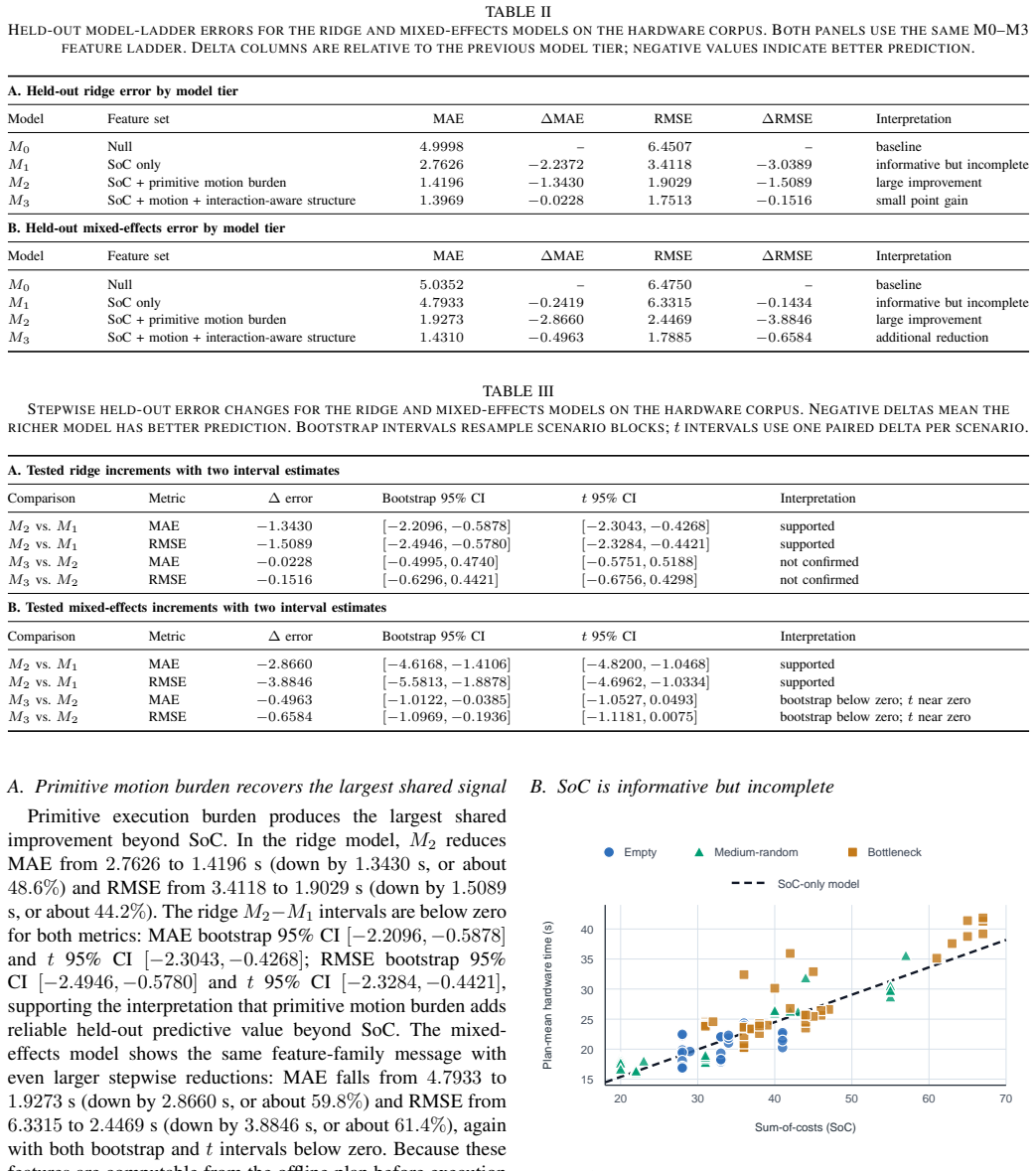
The central discovery is that most of the gap between planned and realized execution time is already visible in the offline plan: augmenting Sum of Costs with four primitive-motion features reduces held-out mean absolute error from 2.76 s to 1.42 s in the ridge model and from 4.79 s to 1.93 s in the mixed-effects model, roughly a 49–60% improvement. The additional interaction-aware coordination tier — dependency edges, pairs, depth, and crowding — moves both estimators in the same direction, but the strictest scenario-held-out comparison does not separate it from the primitive-motion tier with confidence intervals away from zero. The authors' own reading is that primitive motion burden is th
Load-bearing premise
The load-bearing premise is that the 15 hand-constructed scenarios — five each of Empty, Medium-Random, and Bottleneck — are representative enough that scenario-held-out error estimates the feature ranking's generalization; if actual deployment layouts differ, the ranking may not transfer.
Editorial extensions
If this is right
- Plan-selection and deployment-side screening can use primitive-motion features computed before any robot moves, rather than relying on SoC alone.
- MAPF benchmark evaluation could report motion-burden descriptors alongside SoC and makespan, since they capture execution-relevant structure that scalar cost suppresses.
- On this hardware, interaction-aware coordination features are directionally consistent but not yet sized; a larger scenario corpus would be needed to certify their contribution.
- Because much of the execution-time gap is visible offline, hardware-in-the-loop evaluation is not required for the first-order improvement; it becomes a refinement layer.
Reading between the lines
- An obvious next test is to hold Sum of Costs fixed across plans that vary in turns, stops, or consecutive moves; if wall-clock time tracks the motion-burden features while SoC is constant, the causal role of primitive burden is confirmed.
- The same features could be folded into planner objectives, creating bounded-suboptimal search that explicitly trades SoC against predicted wall-clock time — the paper shows enough signal exists to make that trade meaningful.
- On larger fleets or sparser arenas, interaction-aware coordination structure may matter more than it did here; the 7×7 arena is dense and small, so scaling to warehouses could shift the ranking.
Editorial analysis
A structured set of objections, weighed in public.
Referee Report
Summary. The paper presents CADENCE, a fixed-platform hardware study (7×7 arena, seven differential-drive robots, precedence-faithful continuous executor) of how well pre-execution MAPF plan descriptors predict realized wall-clock completion time. A 15-scenario library (5 Empty, 5 Medium-Random, 5 Bottleneck) with an eight-slot planner menu produces 120 plans, each executed four times (480 trials). The authors compare a four-tier feature ladder: null, SoC, SoC + primitive motion burden (planner-side makespan, turns, consecutive moves, start–stop transitions), and the latter plus interaction-aware ADG-derived structure. Using scenario-level family-balanced 5-fold splits, ridge and mixed-effects models, they report that adding primitive motion burden to SoC cuts held-out MAE from 2.76 to 1.42 s (ridge) and 4.79 to 1.93 s (mixed-effects), with bootstrap and paired-t intervals excluding zero, while M3 adds smaller, less uniform gains. The central claim is that primitive motion burden is the most reliable additional signal beyond SoC.
Significance. If the conclusions hold, the work provides a useful, platform-scoped finding for MAPF evaluation: standard SoC is insufficient, and simple motion-burden descriptors recover a large share of the missing execution-time signal before deployment. The study is carefully designed in several respects: scenario-level held-out splits prevent plan leakage; family balance in folds preserves regime coverage; plan means rather than individual trials are the confirmatory unit; both bootstrap and paired-scenario t intervals are reported; and executor-conditioning is stated explicitly. The authors are also appropriately cautious about the interaction-aware tier. The main limitation is not internal inconsistency but the narrow evidence base for cross-scenario generalization; this limits the strength of the 'most reliable' wording.
major comments (3)
- [§V, Table III; §VI] The central claim that primitive motion burden is the 'most reliable' signal rests on pooled M2-vs-M1 deltas over 15 scenarios. With only 5 scenarios per family and family-balanced folds holding out one scenario per family, the pooled bootstrap and t intervals could be significant even if the improvement is absent or reversed in one or two families. Report family-stratified held-out deltas (or leave-one-scenario-out results) for M2 vs M1, or restrict the claim to the exact 15-scenario mixture. This is needed before the cross-regime wording in the abstract and conclusion is supported.
- [§IV.D] The mixed-effects model is underspecified. The text says it is fit at the trial level and evaluated on held-out plan means, but gives no fixed-effect structure, random-effect structure, or estimation method. Without this, the large mixed-effects M2-vs-M1 delta and the M2→M3 bootstrap intervals in Table III cannot be audited. In particular, M1 (SoC only) is close to M0 in the mixed-effects panel but not in the ridge panel; a specification detail (e.g., scenario random intercepts) may explain this, but the reader cannot tell. Provide the model equation and fitting details.
- [§IV.C vs §V.C] The definition of M2 is inconsistent. Section IV.C defines M2 as SoC plus planner-side makespan, total turn count, consecutive-move count, and start–stop transition count. Section V.C describes M2 as adding per-plan turn count, start–stop count, and 'total commanded path length' on top of SoC, omitting makespan and consecutive-move count. If 'total commanded path length' is essentially SoC, the description is redundant; if not, the feature set used for the main result is unclear. Correct the inconsistency and report the exact M2 feature list.
minor comments (3)
- [Abstract] 'Reducing held-out error by about 48.6%–59.8% in MAE and 44.2%–61.4% in RMSE' should state that these are relative reductions from M1 to M2 within each model, not a single universal range.
- [§IV.D] 'Between-plan variance accounts for 99.4% of total execution-time variance' — clarify how this was computed (e.g., random-effects ANOVA on plan means vs. repeats).
- [References] References [14] and [15] duplicate the same work; [15] is an arXiv version. Cite once.
Circularity Check
No significant circularity: the prediction target is measured hardware time and all predictors are offline plan descriptors.
full rationale
The paper's derivation chain is self-contained and not circular. The target is "realized total execution wall-clock time, measured per trial from the hardware logs," which is independent of the model and of the plan-side features. All predictors are "computed before hardware execution from the MAPF plan alone; no hardware timing outcome enters the extraction pipeline." The held-out evaluation is scenario-level family-balanced, so the regression coefficients are not fit to the evaluated plans. The primitive-motion and interaction-aware features are not renamed versions of the target: they are logical plan properties (makespan in timesteps, turn counts, ADG edge counts) that are causally related to, but not identical to, wall-clock seconds. The interaction-aware features are read from the same ADG that the executor consumes, but this is a mechanistic link, not a definitional equivalence; the paper does not define execution time as an ADG function, and it explicitly reports the interaction-aware tier as directionally consistent but not settled under the strictest held-out comparison. No load-bearing self-citations or imported uniqueness claims are present. The acknowledged limitations (compact scenario support, controlled hardware scope) are statistical-external-validity caveats, not circularity.
Assumptions & free parameters
free parameters (3)
- Ridge and mixed-effects feature coefficients =
estimated from training folds; numeric values not reported
- Ridge penalty lambda =
per fold, chosen by inner scenario-grouped cross-validation
- Mixed-effects variance components =
estimated during model fitting
assumptions (4)
- ad hoc to paper The 15-scenario library is an adequate sample of interaction regimes (Empty/Medium/Bottleneck) for generalization claims.
- domain assumption The precedence-faithful continuous executor faithfully implements the ADG's dependency order and does not introduce scheduling artifacts that dominate wall-clock times.
- domain assumption Generated plans (CBSH2-RTC, EECBS, LaCAM3) are feasible under the hardware execution model.
- standard math Standard linear-model assumptions for ridge and mixed-effects regressions: linearity, homoscedastic errors, scenario-block independence.
Cite this review
Pith. "Pith review of CADENCE: Predicting Realized MAPF Execution Time Beyond Sum of Costs." pith.science (2026). https://pith.science/paper/FI4O2Z7I
@misc{pith2026260604746,
  author       = {Pith},
  title        = {Pith review of: CADENCE: Predicting Realized MAPF Execution Time Beyond Sum of Costs},
  year         = {2026},
  howpublished = {\url{https://pith.science/paper/FI4O2Z7I}},
  note         = {Machine review of arXiv:2606.04746}
}
read the original abstract
Multi-Agent Path Finding (MAPF) algorithms are increasingly used to plan motion for robot teams in industrial warehouses and robotic shared workspaces, but standard MAPF algorithm evaluation metrics, such as Sum of Costs (SoC), makespan, and planner runtime, can obscure how planner choices translate into realistic execution performance. We present CADENCE (Coordination and Action-Driven Estimation for Networked Continuous Execution), a hardware study of this evaluation gap on a fixed 7 by 7 workcell with seven differential drive robots, asking which features available before execution can best predict final wall-clock completion time. We compare SoC, total planned travel cost, primitive motion burden (how much basic motion the plan requires, such as makespan, turns, consecutive moves, and start-stop transitions), and interaction aware coordination structure (how much inter-robot coordination the plan induces, such as dependency links, interacting robot pairs, dependency depth, and crowding exposure). To test this, we generate 120 plans across 15 scenarios -- 5 Empty, 5 Medium Random, and 5 Bottleneck and execute each plan four times, yielding a 480 trial hardware corpus. Using both a scenario-held -- out ridge model and a trial-level mixed-effects model, we find that SoC alone is informative but incomplete, while primitive motion burden gives the strongest improvement, reducing held out error by about 48.6%-59.8% in MAE and 44.2%-61.4% in RMSE relative to SoC-only models. Interaction-aware coordination features add smaller, less uniform gains, most clearly in the mixed-effects analysis. Across both models and uncertainty checks, primitive motion burden is the most reliable additional signal beyond SoC, suggesting that much of the execution time gap is already visible in the offline plan before any robot starts moving.
Figures


Figures from the paper (1 more)
Reference graph
Works this paper leans on
-
[1]
Multi-agent path finding with delay probabilities,
H. Ma, T. K. S. Kumar, and S. Koenig, “Multi-agent path finding with delay probabilities,” inProceedings of the AAAI Conference on Artificial Intelligence, vol. 31, no. 1, 2017
2017
-
[2]
Persistent and robust execution of mapf schedules in warehouses,
W. H ¨onig, S. Kiesel, A. Tinka, J. W. Durham, and N. Ayanian, “Persistent and robust execution of mapf schedules in warehouses,”IEEE Robotics and Automation Letters, vol. 4, no. 2, pp. 1125–1131, 2019
2019
-
[3]
Bidirectional temporal plan graph: Enabling switchable passing orders for more efficient multi-agent path finding plan execution,
Y . Su, R. Veerapaneni, and J. Li, “Bidirectional temporal plan graph: Enabling switchable passing orders for more efficient multi-agent path finding plan execution,” inProceedings of the AAAI Conference on Artificial Intelligence, vol. 38, no. 16, 2024, pp. 17 559–17 566
2024
-
[4]
Multi-agent pathfinding: Definitions, variants, and benchmarks,
R. Stern, N. Sturtevant, A. Felner, S. Koenig, H. Ma, T. Walker, J. Li, D. Atzmon, L. Cohen, T. K. S. Kumar, R. Bartak, and E. Boyarski, “Multi-agent pathfinding: Definitions, variants, and benchmarks,” in Proceedings of the Annual Symposium on Combinatorial Search, 2019
2019
-
[5]
Conflict-based search for optimal multi-agent pathfinding,
G. Sharon, R. Stern, A. Felner, and N. R. Sturtevant, “Conflict-based search for optimal multi-agent pathfinding,”Artificial Intelligence, vol. 219, pp. 40–66, 2015
2015
-
[6]
Coordinating hundreds of cooperative, autonomous vehicles in warehouses,
P. R. Wurman, R. D’Andrea, and M. Mountz, “Coordinating hundreds of cooperative, autonomous vehicles in warehouses,”AI Magazine, vol. 29, no. 1, pp. 9–20, 2008
2008
-
[7]
Analyzing planner design trade-offs for mapf under adg-based realistic execution,
J. Yan, Z. Li, W. Kang, S. F. Smith, and J. Li, “Analyzing planner design trade-offs for mapf under adg-based realistic execution,” 2025
2025
-
[8]
Which mapf model works best for automated warehousing?
S. Varambally, J. Li, and S. Koenig, “Which mapf model works best for automated warehousing?”Proceedings of the International Symposium on Combinatorial Search, vol. 15, no. 1, pp. 190–198, 2022
2022
Show all 15 references
-
[9]
Traffic flow optimisation for lifelong multi-agent path finding,
Z. Chen, D. Harabor, J. Li, and P. J. Stuckey, “Traffic flow optimisation for lifelong multi-agent path finding,” inProceedings of the AAAI Conference on Artificial Intelligence, vol. 38, no. 18, 2024, pp. 20 674– 20 682
2024
-
[10]
P3gasus: Pre-planned path execution graphs for multi-agent systems at ultra-large scale,
T. Duhan, C. He, and G. Sartoretti, “P3gasus: Pre-planned path execution graphs for multi-agent systems at ultra-large scale,”IEEE Robotics and Automation Letters, vol. 11, no. 2, pp. 1274–1281, 2026
2026
-
[11]
Improved heuristics for multi-agent path finding with conflict-based search,
J. Li, A. Felner, E. Boyarski, H. Ma, and S. Koenig, “Improved heuristics for multi-agent path finding with conflict-based search,” in Proceedings of the Twenty-Eighth International Joint Conference on Artificial Intelligence, 2019, pp. 442–449
2019
-
[12]
Eecbs: A bounded-suboptimal search for multi-agent path finding,
J. Li, W. Ruml, and S. Koenig, “Eecbs: A bounded-suboptimal search for multi-agent path finding,” inProceedings of the AAAI Conference on Artificial Intelligence, vol. 35, no. 14, 2021, pp. 12 353–12 362
2021
-
[13]
Lacam: Search- based algorithm for quick multi-agent pathfinding,
K. Okumura, M. Machida, X. Defago, and Y . Tamura, “Lacam: Search- based algorithm for quick multi-agent pathfinding,” inProceedings of the AAAI Conference on Artificial Intelligence, vol. 37, no. 10, 2023, pp. 11 655–11 662
2023
-
[14]
Engineering lacam*: Towards real-time, large-scale, and near-optimal multi-agent pathfinding,
K. Okumura, R. Kuroiwa, and Y . Tamura, “Engineering lacam*: Towards real-time, large-scale, and near-optimal multi-agent pathfinding,” inIn- ternational Conference on Autonomous Agents and Multiagent Systems, 2024
2024
-
[15]
Engineering LaCAM: Towards real-time, large-scale, and near-optimal multi-agent pathfinding,
K. Okumura, “Engineering LaCAM: Towards real-time, large-scale, and near-optimal multi-agent pathfinding,” 2024, presented at AAMAS-24. [Online]. Available: https://arxiv.org/abs/2308.04292
2024 arXiv
Reviewed August 2, 2026 · model on record in the stance chip above.
Discussion (0). Continue with ORCID to comment.