Monitored chaotic scattering
Pith reviewed 2026-06-28 04:53 UTC · model grok-4.3
The pith
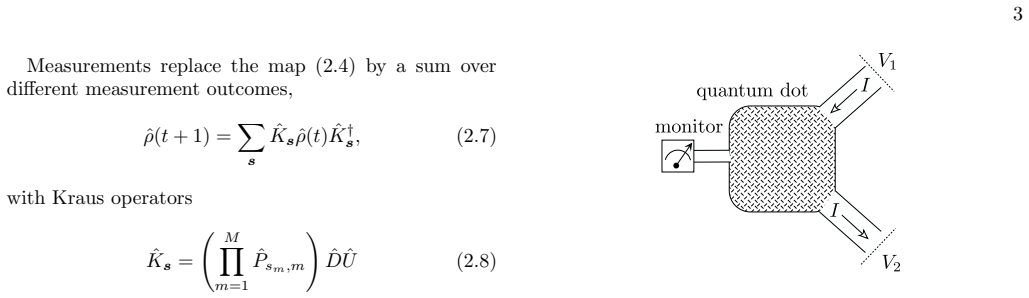
Monitored chaotic scattering in quantum dots produces a discrete-time master equation for charge transfer.
A machine-rendered reading of the paper's core claim, the machinery that carries it, and where it could break.
Core claim
Starting from a scattering matrix drawn from a circular ensemble, the corresponding ensemble of Kraus operators is constructed for the monitored evolution of the many-body density matrix. In the single-particle sector the sum over measurement outcomes can be carried out algebraically, giving a discrete-time quantum master equation for the transferred charge. Closed-form random-matrix predictions rely on an equipartition rule for monitored particles formulated as a conjecture and tested against the master equation.
What carries the argument
The ensemble of Kraus operators derived from the circular ensemble scattering matrix, which allows algebraic summation over measurement outcomes in the single-particle sector to obtain the master equation.
If this is right
- The charge-transfer statistics are obtained by numerically solving the discrete-time quantum master equation.
- Closed-form expressions for the statistics follow from the equipartition rule conjecture applied to the random-matrix ensemble.
- The algebraic summation over outcomes holds specifically in the single-particle sector.
- The framework connects the monitored evolution directly to the original circular ensemble of scattering matrices.
Where Pith is reading between the lines
- Similar algebraic simplifications might exist in other monitored mesoscopic systems if the Kraus operators retain sufficient structure from the underlying ensemble.
- The conjecture on equipartition could be tested in larger systems by checking whether the master equation still reproduces the same statistics when particle number increases.
- Experimental realizations in quantum dots with continuous weak monitoring could measure the full distribution of transferred charge to confront the predictions.
Load-bearing premise
The initial scattering matrix is drawn from a circular ensemble and the monitored evolution is fully captured by the corresponding ensemble of Kraus operators.
What would settle it
A calculation or experiment showing that the charge-transfer statistics from a monitored quantum dot deviate from both the numerical solutions of the derived master equation and the closed-form predictions based on the equipartition rule.
Figures

read the original abstract
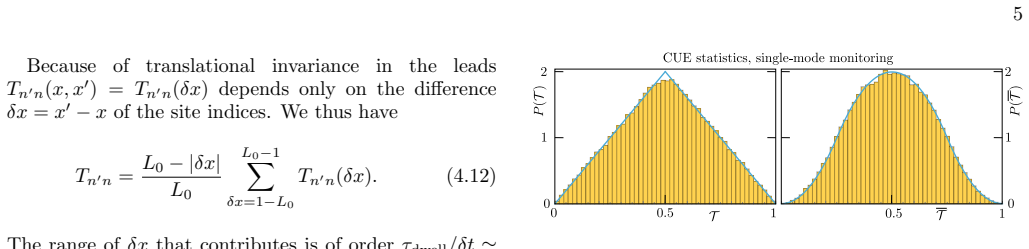
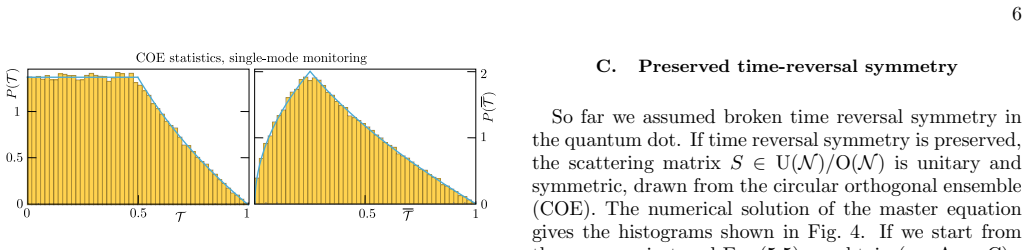
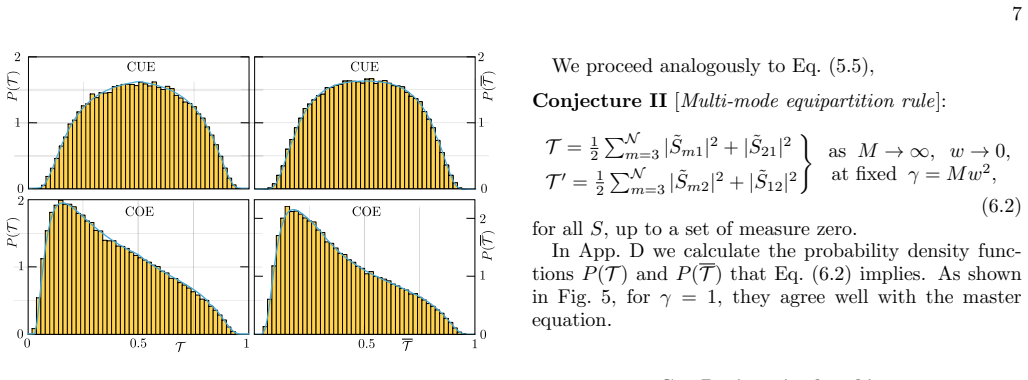
We extend the random-matrix theory of chaotic scattering to quantum dots whose dynamics is monitored by time-resolved measurements. Starting from a scattering matrix drawn from a circular ensemble, we construct the corresponding ensemble of Kraus operators for the monitored evolution of the many-body density matrix. In the single-particle sector the sum over measurement outcomes can be carried out algebraically, giving a discrete-time quantum master equation for the transferred charge. We solve this equation numerically and compare the resulting charge-transfer statistics with closed-form random-matrix predictions. The latter rely on an equipartition rule for monitored particles, which we formulate as a conjecture and test against the master equation.
Editorial analysis
A structured set of objections, weighed in public.
Referee Report
Summary. The manuscript extends random-matrix theory of chaotic scattering to monitored quantum dots. Starting from a scattering matrix drawn from a circular ensemble, it constructs the corresponding ensemble of Kraus operators describing monitored evolution of the many-body density matrix. In the single-particle sector the sum over measurement outcomes is performed algebraically to obtain a discrete-time quantum master equation for transferred charge. Numerical solutions of this equation are compared with closed-form random-matrix predictions that rest on an equipartition rule for monitored particles; the rule is formulated as a conjecture and tested against the master equation.
Significance. If the central derivation and numerical test hold, the work supplies a concrete link between chaotic-scattering random-matrix theory and continuously monitored quantum transport, yielding testable predictions for charge-transfer statistics. The algebraic summation that produces the single-particle master equation and the explicit numerical confrontation of the equipartition conjecture constitute clear strengths. The approach is directly relevant to mesoscopic experiments that combine chaotic scattering with time-resolved charge detection.
minor comments (2)
- The abstract states that the equipartition rule is 'formulated as a conjecture and tested against the master equation,' but the manuscript should explicitly label the paragraph or subsection in which the conjecture is first stated so that readers can locate the precise formulation being tested.
- Notation for the Kraus operators and the circular ensembles should be introduced with a brief reminder of the standard definitions (e.g., the circular unitary ensemble) to improve accessibility for readers outside random-matrix theory.
Simulated Author's Rebuttal
We thank the referee for the positive summary and significance assessment of our work on monitored chaotic scattering. The recommendation for minor revision is appreciated. No specific major comments were provided in the report, so we have no points to address point-by-point at this stage. We will make any minor editorial or technical adjustments as needed in the revised manuscript.
Circularity Check
No significant circularity; derivation self-contained
full rationale
The paper begins with a scattering matrix from a circular ensemble, constructs the Kraus operator ensemble, performs an algebraic sum over outcomes to obtain the single-particle master equation, solves that equation numerically, and compares charge-transfer statistics to closed-form predictions based on a separately formulated equipartition conjecture that is then tested numerically against the master-equation solutions. No step reduces by construction to its inputs, no parameter is fitted and renamed as a prediction, and no load-bearing self-citation or uniqueness theorem is invoked. The conjecture is explicitly presented as such and subjected to independent numerical verification rather than assumed.
Axiom & Free-Parameter Ledger
Reference graph
Works this paper leans on
-
[1]
equipartition rule
we work in the framework of RMT, where we have closed form expressions for the transferred charge. We consider the multi-mode regime ofM≫1 monitoring modes in the closed lead, all with the same measurement strengthw 2 =γ/M≪1. Generalizing the previous section, we allow for an ar- bitrary numberN=N 1 +N 2 of modes in the open lead. We seek the chargeTtrans...
-
[2]
Single-mode case Upon summation of Eq. (5.1) overtwe have Ξ =QDSΞ(QDS) † +P DSΞ(P DS) † +ρ(0).(B1) Given thatρ(0) =Sχ in has no overlap with the moni- tored mode,P ρ(0) = 0 =ρ(0)P, the matrix Ξ has only components in thePandQsubspaces, Ξ = ΞQQ +χ|3⟩⟨3|,Ξ QQ =QΞQ.(B2) We project the master equation onto theQ-subspace, ΞQQ =QDS(X QQ +χ|3⟩⟨3|)(QDS) † +ρ(0).(...
-
[3]
In the more generalM-mode case of Sec
Multi-mode case TheO(N 3) complexity is for a single monitored mode. In the more generalM-mode case of Sec. VI, with master equation (4.5), we need to solve a set ofMcoupled linear equations instead of the single equation forχ. The com- plexity of the algorithm then increases toO(N 4), which is still more efficient than theO(N 6) solution by vector- izati...
-
[4]
Case of asymmetric bias Marginal distributions of the elements of matrices in the CUE or COE have been calculated in Refs. 33–35. Specifying those general results to 3×3 matricesUwe find that PCUE(τ21, τ31) = 2 PCOE(τ21, τ31) = (τ21 +τ 31)−1 ) ifτ 21 +τ 31 <1,(C1) where we have definedτ nm =|U nm|2 ∈(0,1). This gives the probability density functions (5.6...
-
[5]
This follows from the general formulas in Ref
Case of symmetric bias For the distribution of T= 1 2 τ21 + 1 4 τ31 + 1 2 τ12 + 1 4 τ32 = 1 4 2 +τ 12 +τ 21 −τ 11 −τ 22 = 1 2 − 1 4 Truσ zu†σz,(C2) with Pauli matrixσ z, we need the marginal distribution of the 2×2 upper-left submatrixuofU. This follows from the general formulas in Ref. 5. The submatrixuhas the singular value decomposition u=V 1ΛV2,Λ = 1 ...
-
[6]
(6.2) identically as T= 1 2 + 1 2 | ˜S21|2 − 1 2 | ˜S11|2 = 1 2 − 1 4 Tr ˜u†σz ˜u(1 +σ z),(D1) with ˜uthe 2×2 upper-left block of theN × Nunitary matrix ˜Sdefined in Eq
Case of asymmetric bias We use unitarity of ˜Sto rewrite Eq. (6.2) identically as T= 1 2 + 1 2 | ˜S21|2 − 1 2 | ˜S11|2 = 1 2 − 1 4 Tr ˜u†σz ˜u(1 +σ z),(D1) with ˜uthe 2×2 upper-left block of theN × Nunitary matrix ˜Sdefined in Eq. (6.1). The matrix ˜Shas the Poisson kernel distribution inherited from the circular ensemble forS(the CUE forβ= 2, the COE for...
-
[7]
This is the solid curve in Fig
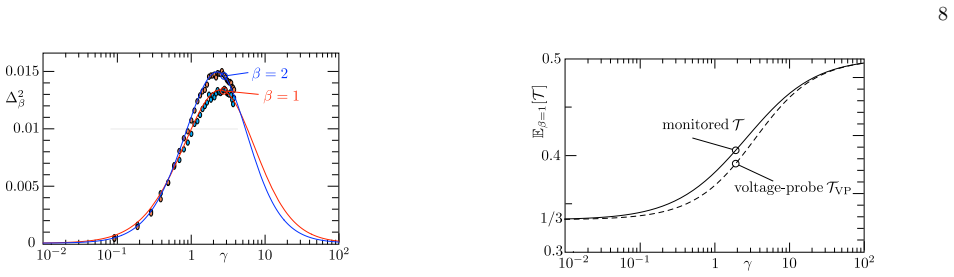
Mean transferred charge The first moment has a closed form expression, E[T] β=1 = 1 2 − 1 12 Z 1 0 dλ1 Z 1 0 dλ2 (λ1 +λ 2)Pβ=1(λ1, λ2) = 2γ−1 h 2eγ −γ 2 −2γ−2 Ei(−γ)− 1 2 γ2 −γ+ 1−e −γ eγ/2 Ei (−γ/2) + 1−(1 +γ)e −γ i ,(D6) with Ei the exponential integral function. This is the solid curve in Fig. 7. For comparison also the mean transferred charge in the v...
-
[8]
Case of symmetric bias Turning next to the symmetric bias, we have the trans- ferred charge T= 1 2(T+T ′) = 1 2 − 1 4 Tr ˜uσz ˜u†σz.(D8) The conditional probability density function forβ= 2 now takes the form Pβ=2(T |λ 1, λ2) = 2 |λ1 −λ 2| arsinh |λ1 −λ 2| 2√λ1λ2 ,|Y|< √λ1λ2, 2 |λ1 −λ 2| arsinh |λ1 −λ 2| 2√λ1λ2 −arsinh √Y 2 −λ 1λ2√λ1λ2 , √λ1...
-
[9]
14 The average vanishes, while the variance is given by ∆2 β =E[(T − T ′)2] = 1 12 Z 1 0 dλ1 Z 1 0 dλ2 (λ2 −λ 1)2Pβ(λ1, λ2),(D12) which evaluates to Eq
Reciprocity breaking The differenceT − T ′ of the transferred charge from contact 1 to contact 2 and the other way around is given by T − T ′ =− 1 2 Tr ˜uσz ˜u† =− 1 2 Tr ˜Λ2(n·σ) = 1 2(λ2 −λ 1)nz,(D11) withnuniformly distributed on the unit sphere. 14 The average vanishes, while the variance is given by ∆2 β =E[(T − T ′)2] = 1 12 Z 1 0 dλ1 Z 1 0 dλ2 (λ2 ...
-
[10]
Bl¨ umel and U
R. Bl¨ umel and U. Smilansky,Random-matrix description of chaotic scattering: Semiclassical approach, Phys. Rev. Lett.64, 241 (1990)
1990
-
[11]
Smilansky,The classical and quantum theory of chaotic scattering, in Chaos and Quantum Physics, edited by M.-J
U. Smilansky,The classical and quantum theory of chaotic scattering, in Chaos and Quantum Physics, edited by M.-J. Giannoni, A. Voros, and J. Zinn-Justin (North-Holland, Amsterdam, 1990)
1990
-
[12]
F. J. Dyson,Statistical theory of the energy levels of com- plex systems, J. Math. Phys.3, 140 (1962)
1962
-
[13]
E. P. Wigner,Statistical properties of real symmetric ma- trices with many dimensions, in Proc. Canadian Math- ematical Congress (Univ. of Toronto Press, Toronto, 1957)
1957
-
[14]
C. W. J. Beenakker,Random-matrix theory of quantum transport, Rev. Mod. Phys.69, 731 (1997)
1997
-
[15]
M. A. Nielsen and I. L. Chuang,Quantum Computation and Quantum Information(Cambridge University Press, 2010)
2010
-
[16]
Chao-Ming Jian, Bela Bauer, Anna Keselman, and An- dreas W. W. Ludwig,Criticality and entanglement in nonunitary quantum circuits and tensor networks of non- interacting fermions, Phys. Rev. B106, 134206 (2022)
2022
-
[17]
Szyniszewski, O
M. Szyniszewski, O. Lunt, and A. Pal,Disordered moni- tored free fermions, Phys. Rev. B108, 165126 (2023)
2023
-
[18]
V. B. Bulchandani, S. L. Sondhi, and J. T. Chalker, Random-matrix models of monitored quantum circuits, J. Stat. Phys.191, 55 (2024)
2024
-
[19]
Gerbino, P
F. Gerbino, P. Le Doussal, G. Giachetti, and A. De Luca,A Dyson Brownian motion model for weak mea- surements in chaotic quantum systems, Quantum Rep. 6, 200 (2024)
2024
-
[20]
Ferreira, T
J. Ferreira, T. Jin, J. Mannhart, T. Giamarchi, and M. Filippone,Exact description of transport and non- reciprocity in monitored quantum devices, Phys. Rev. Lett.132, 136301 (2024)
2024
-
[21]
Thompson, Y
F. Thompson, Y. Huang, and A. Kamenev,Localiza- tion of Lindbladian fermions, Phys. Rev. B109, 174201 (2024)
2024
-
[22]
Z. Xiao, T. Ohtsuki, and K. Kawabata,Universal stochastic equations of monitored quantum dynamics, Phys. Rev. Lett.134, 140401 (2025)
2025
-
[23]
Gurarie,Randomly measured quantum particle, arXiv:2504.05479
V. Gurarie,Randomly measured quantum particle, arXiv:2504.05479
-
[24]
C. W. J. Beenakker and Jin-Fu Chen,Monitored quan- tum transport: full counting statistics of a quantum Hall interferometer, Quantum9, 1874 (2025)
2025
-
[25]
Haining Pan, Hassan Shapourian, and Chao-Ming Jian, Topological modes in monitored quantum dynamics, Phys. Rev. B112, 144301 (2025)
2025
-
[26]
Piccitto, G
G. Piccitto, G. Chiriac´ o, D. Rossini, and A. Russo- manno,Entanglement behavior and localization proper- ties in monitored fermion systems, Phys. Rev. B112, 174311 (2025)
2025
-
[27]
R. Hamazaki, K. Mochizuki, H. Oshima, and Y. Fuji, An introduction to monitored quantum systems and quantum trajectories: spectrum, typicality, and phases, arXiv:2512.19922
-
[28]
Poboiko and A
I. Poboiko and A. D. Mirlin,Quantum dynamics of mon- itored free fermions, Phys. Rev. B113, 144311 (2026)
2026
-
[29]
A. Delmonte and M. Schir` o,Entanglement dy- namics across a monitored quantum point contact, arXiv:2605.22555
-
[30]
J. S´ anchez Fern´ an, J. Tworzyd lo, and C. W. J. Beenakker,Monitored localization in a disordered one- dimensional conductor, arXiv:2605.22701
-
[31]
For an introduction to the concepts from quantum mea- surement theory used in this work, see the lecture notes by R. B. Griffiths: Quantum Channels, Kraus Operators, POVMs (2012, unpublished)
2012
-
[32]
C. W. J. Beenakker and B. Michaelis,Stub model for dephasing in a quantum dot, J. Phys. A38, 10639 (2005)
2005
-
[33]
B¨ uttiker,Role of quantum coherence in series resis- tors, Phys
M. B¨ uttiker,Role of quantum coherence in series resis- tors, Phys. Rev. B33, 3020 (1986)
1986
-
[34]
This was the case in our localization study [21]
For sparse matrices vectorization can become comparably efficient to the Lyapunov method of solution. This was the case in our localization study [21]
-
[35]
The invariance of the Haar measure forS7→SS 0 and S7→S 0S, with arbitraryS 0 ∈U(N), implies the corre- sponding invariance forUif we takeS 0 =U 0⊕IM−1×M−1 and arbitraryU 0 ∈U(3)
-
[36]
P. W. Brouwer and C. W. J. Beenakker,Voltage- probe and imaginary-potential models for dephasing in a chaotic quantum dot, Phys. Rev. B55, 4695 (1997); Erratum:66, 209901 (2002)
1997
-
[37]
L. S. Levitov, H.-W. Lee and G. B. Lesovik,Electron counting statistics and coherent states of electric current, J. Math. Phys.37, 10 (1996)
1996
-
[38]
B was suggested to us by AI (GPT-5.5)
The method of solution of the master equation described in App. B was suggested to us by AI (GPT-5.5). It is based directly on established linear algebra algorithms [30–32], but we have not found a reference for precisely our application
-
[39]
Simoncini,Computational methods for linear matrix equations, SIAM Review58, 377 (2016)
V. Simoncini,Computational methods for linear matrix equations, SIAM Review58, 377 (2016)
2016
-
[40]
Bartels and G
R. Bartels and G. W. Stewart.Solution of the matrix equationAX+XB=C, Comm A.C.M.15, 820 (1972)
1972
-
[41]
Kitagawa,An algorithm for solving the matrix equa- tionX=F XF ⊤ +S, Int
G. Kitagawa,An algorithm for solving the matrix equa- tionX=F XF ⊤ +S, Int. J. Control25, 745 (1977)
1977
-
[42]
Pereyra and P
P. Pereyra and P. A. Mello,Marginal distribution of the S-matrix elements for Dyson’s measure and some appli- cations, J. Phys. A16, 237 (1983)
1983
-
[43]
W. A. Friedman and P. A. Mello,Marginal distribution of an arbitrary square submatrix of the S-matrix for Dyson’s measure, J. Phys. A18, 425 (1985). 15
1985
-
[44]
P. W. Brouwer and C. W. J. Beenakker,Effect of a volt- age probe on the phase-coherent conductance of a ballistic chaotic cavity, Phys. Rev. B51, 7739 (1985)
1985
-
[45]
The expression forP β(λ1, λ2) is very lengthy and not recorded here, we refer to Ref. 27, Eq. (17), with notation λn 7→1−T n
discussion (0)
Sign in with ORCID, Apple, or X to comment. Anyone can read and Pith papers without signing in.