AdS₉ solutions in type II supergravities
Pith reviewed 2026-06-28 05:39 UTC · model grok-4.3
The pith
Type IIB supergravity admits an analytic family of AdS9 solutions warped over an interval with finite Euclidean on-shell action and holographic central charge.
A machine-rendered reading of the paper's core claim, the machinery that carries it, and where it could break.
Core claim
We present new solutions in type II supergravities describing AdS9 geometries warped over an interval. In type IIB, we construct an analytic family of backgrounds supported by a non-trivial axio-dilaton profile. Despite the presence of strong-coupling singularities at both ends of the interval, these solutions exhibit both a finite Euclidean on-shell action and a finite holographic central charge. Moreover, they possess a Z2 symmetry under which the axion transforms as C0 to -C0. We also investigate AdS9 backgrounds in massive IIA supergravity supported by the Romans mass and the dilaton. Numerical integration reveals solutions with a strong-coupling singularity whose asymptotic behavior is
What carries the argument
Warped metric ansatz over a finite interval together with explicit profiles for the axio-dilaton (type IIB) or for the Romans mass and dilaton (massive IIA) that are required to solve the full supergravity equations of motion.
If this is right
- The type IIB family possesses a Z2 symmetry under which the axion transforms as C0 to -C0.
- Both the Euclidean on-shell action and the holographic central charge remain finite for the analytic type IIB solutions.
- The Euclidean on-shell action diverges for the numerically obtained massive IIA AdS9 solutions.
- A family of perturbative dS9 solutions exists in massive IIA supergravity.
- The strong-coupling singularities of the type IIB solutions are compatible with finite physical quantities.
Where Pith is reading between the lines
- These warped AdS9 geometries could serve as starting points for holographic calculations of observables in eight-dimensional dual theories.
- The contrast in action finiteness between the IIB and IIA cases may indicate different regimes for consistent string embeddings.
- The perturbative dS9 solutions could be extended to fully nonlinear de Sitter backgrounds to test their stability.
- Resolving the endpoint singularities via additional branes or stringy corrections might produce globally regular ten-dimensional solutions.
Load-bearing premise
The chosen field profiles inserted into the warped-interval metric ansatz are assumed to satisfy every component of the type II supergravity equations of motion.
What would settle it
Direct substitution of the proposed analytic or numerical profiles into the type IIB or massive IIA Einstein and dilaton equations to check whether every component vanishes identically, or an independent evaluation of the Euclidean on-shell action that shows divergence in the type IIB family.
Figures

read the original abstract
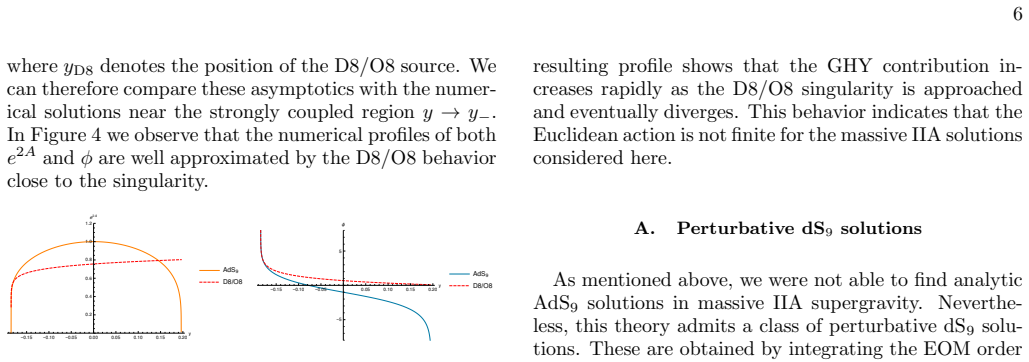
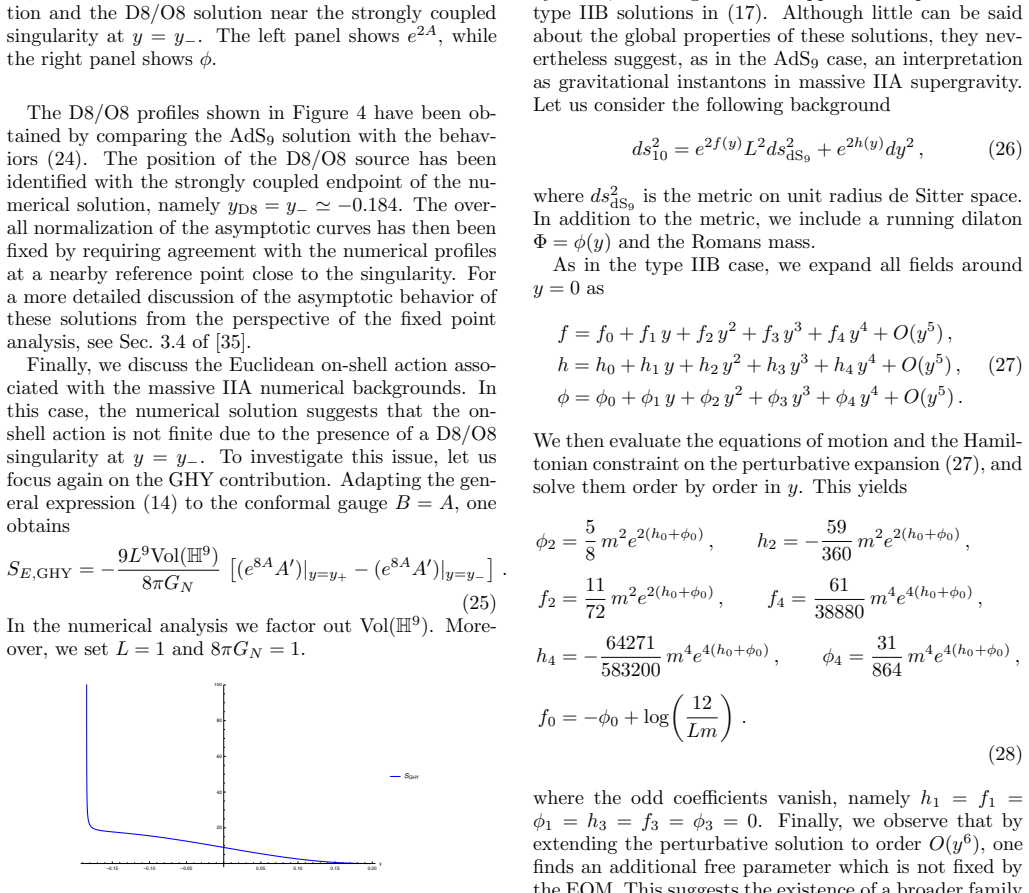
We present new solutions in type II supergravities describing AdS$_9$ geometries warped over an interval. In type IIB, we construct an analytic family of backgrounds supported by a non-trivial axio-dilaton profile. Despite the presence of strong-coupling singularities at both ends of the interval, these solutions exhibit both a finite Euclidean on-shell action and a finite holographic central charge. Moreover, they possess a $\mathbb Z_2$ symmetry under which the axion transforms as $C_0\rightarrow -C_0$. We also investigate AdS$_9$ backgrounds in massive IIA supergravity supported by the Romans mass and the dilaton. Numerical integration reveals solutions with a strong-coupling singularity whose asymptotic behavior is consistent with the characteristic D8/O8 profile. In contrast to the type IIB case, our analysis indicates that the Euclidean on-shell action diverges. Finally, we identify a family of perturbative dS$_9$ solutions in massive IIA supergravity.
Editorial analysis
A structured set of objections, weighed in public.
Referee Report
Summary. The paper constructs new AdS9 solutions in type II supergravities warped over an interval. In type IIB it gives an analytic family supported by a non-trivial axio-dilaton profile that is claimed to yield finite Euclidean on-shell action and finite holographic central charge despite strong-coupling singularities at the interval ends, together with a Z2 symmetry under which the axion flips sign. In massive IIA it reports numerical solutions whose asymptotics match the D8/O8 profile and whose on-shell action diverges; it also identifies a family of perturbative dS9 solutions.
Significance. If the claimed solutions satisfy the complete 10d equations of motion, the IIB family supplies explicit examples of AdS9 backgrounds with finite observables despite singularities, while the IIA results highlight a qualitative difference in action behavior; both would enlarge the known landscape of higher-dimensional AdS solutions in string theory.
major comments (2)
- [IIB construction (analytic family)] The central claim that the analytic IIB profiles solve the full type-IIB equations of motion rests on a reduction to an effective 1d system; the manuscript must explicitly verify that every component of the Einstein, dilaton and form-field equations (including Bianchi identities) is satisfied by the chosen warping ansatz and axio-dilaton profile, rather than only a subset of the equations.
- [IIA numerical integration] For the numerical IIA solutions, the manuscript states that the on-shell action diverges; the integration procedure, boundary conditions, and numerical accuracy checks that establish this divergence (as opposed to a truncation artifact) must be documented in detail, including the precise ODE system solved and the tolerance achieved.
minor comments (2)
- The definition of the holographic central charge and the precise regularization used for the on-shell action should be stated explicitly, including any counterterms or cutoff procedure.
- Notation for the interval coordinate and the various warp factors should be introduced once and used consistently throughout the text and equations.
Simulated Author's Rebuttal
We thank the referee for the careful reading of our manuscript and the constructive comments. We respond to the major comments point by point below.
read point-by-point responses
-
Referee: [IIB construction (analytic family)] The central claim that the analytic IIB profiles solve the full type-IIB equations of motion rests on a reduction to an effective 1d system; the manuscript must explicitly verify that every component of the Einstein, dilaton and form-field equations (including Bianchi identities) is satisfied by the chosen warping ansatz and axio-dilaton profile, rather than only a subset of the equations.
Authors: We agree that explicit verification of all 10d equations enhances clarity. The solutions were derived via a complete reduction of the type IIB equations to the effective 1d system under the chosen ansatz, which ensures consistency with the full set when the reduction is exhaustive. In the revised manuscript we will add an appendix that substitutes the warping and axio-dilaton profiles into every component of the Einstein, dilaton, and form-field equations as well as the Bianchi identities, confirming that each reduces to the solved 1d equations and is therefore satisfied. revision: yes
-
Referee: [IIA numerical integration] For the numerical IIA solutions, the manuscript states that the on-shell action diverges; the integration procedure, boundary conditions, and numerical accuracy checks that establish this divergence (as opposed to a truncation artifact) must be documented in detail, including the precise ODE system solved and the tolerance achieved.
Authors: We concur that additional documentation is required to substantiate the divergence result. The revised manuscript will include a new subsection detailing the full system of second-order ODEs obtained from the 10d massive IIA equations under the ansatz, the boundary conditions imposed to match the D8/O8 asymptotics at the singularities, the numerical integration algorithm used, and the convergence tests performed (including variation of integration tolerances and step sizes) that confirm the action divergence is a physical feature rather than a numerical artifact. revision: yes
Circularity Check
No circularity: solutions constructed directly from supergravity equations under standard ansatz
full rationale
The paper constructs explicit AdS9 solutions by positing a warped metric over an interval together with field profiles (analytic axio-dilaton in IIB; Romans mass plus dilaton in IIA) and verifying that they satisfy the full set of type-II supergravity equations of motion, Bianchi identities, and boundary conditions. This is a standard first-principles construction; the claimed properties (finite on-shell action, central charge, Z2 symmetry, perturbative dS9 solutions) are direct consequences of the solved profiles rather than redefinitions or fits of the input data. No load-bearing self-citations, uniqueness theorems, or ansatzes imported from prior work by the same authors appear in the derivation chain. The approach remains self-contained against the external benchmark of the 10d equations.
Axiom & Free-Parameter Ledger
axioms (2)
- domain assumption Type II supergravity equations of motion hold for the chosen metric and field ansatz
- domain assumption The warping is over a one-dimensional interval with appropriate boundary conditions at the ends
Forward citations
Cited by 1 Pith paper
-
$\text{AdS}_D\times I$ solutions in axio-dilaton gravity
The authors reformulate the equations of motion for AdS_D × I solutions in axio-dilaton gravity as a first-order autonomous dynamical system, identify fixed points and analytic solutions for arbitrary D including in t...
Reference graph
Works this paper leans on
-
[1]
In the present case, the matching of the quadratic coefficients impliesa 1 = 5
-
[2]
This coefficient can be extracted from the expansion of the functionh
Therefore, the first possible mismatch between the two parametrizations can only arise through the cubic coefficienta 3. This coefficient can be extracted from the expansion of the functionh. Under the redefinition (19), one has h(y) = ˜h(˜y) + log d˜y dy , where the tilded quantities cor- respond to the solution (18). Fora 1 = 1, this implies h0 = ˜h0 an...
-
[3]
N. Arkani-Hamed, L. Motl, A. Nicolis, and C. Vafa, The String landscape, black holes and gravity as the weakest force (2007), arXiv:hep-th/0601001
Pith/arXiv arXiv 2007
-
[4]
H. Ooguri and C. Vafa, Non-supersymmetric AdS and the Swampland (2017), arXiv:1610.01533 [hep-th]
Pith/arXiv arXiv 2017
-
[5]
Palti, The Swampland: Introduction and Review (2019), arXiv:1903.06239 [hep-th]
E. Palti, The Swampland: Introduction and Review (2019), arXiv:1903.06239 [hep-th]
Pith/arXiv arXiv 2019
-
[6]
J. McNamara and C. Vafa, Cobordism Classes and the Swampland (2019), arXiv:1909.10355 [hep-th]
arXiv 2019
-
[7]
J. J. Heckman, J. McNamara, J. Parra-Martinez, and E. Torres, Gliozzi-Scherk-Olive defects: IIA/IIB walls and the surprisingly stable R7-brane (2026), arXiv:2507.21210 [hep-th]
arXiv 2026
-
[8]
Torres, A Matrix Theory Construction of the IIA/IIB Wall (2026), arXiv:2603.02199 [hep-th]
E. Torres, A Matrix Theory Construction of the IIA/IIB Wall (2026), arXiv:2603.02199 [hep-th]
arXiv 2026
-
[9]
E. Anastasi, M. Montero, A. M. Uranga, and C. Wang, What IIB looks IIA string: String Cobordisms via Non- Compact CFTs (2026), arXiv:2603.00225 [hep-th]
arXiv 2026
-
[10]
M. Dierigl, J. J. Heckman, M. Montero, and E. Torres, IIB string theory explored: Reflection 7-branes (2023), arXiv:2212.05077 [hep-th]
arXiv 2023
- [11]
-
[12]
M. Dierigl, J. J. Heckman, M. Montero, and E. Tor- res, R7-branes as charge conjugation operators (2024), arXiv:2305.05689 [hep-th]
arXiv 2024
-
[13]
V. Chakrabhavi, A. Debray, M. Dierigl, and J. J. Heck- man, Reflection branes, bordisms, and U dualities (2026), arXiv:2509.03573 [hep-th]
arXiv 2026
-
[14]
A. C ¸ avu¸ so˘ glu, M. Cvetiˇ c, J. J. Heckman, J. Kuntz, and C. Murdia, Gravitational Background of Alice-Vortices and R7-Branes (2026), arXiv:2602.13196 [hep-th]
arXiv 2026
- [15]
- [16]
-
[17]
J. Huertas and A. M. Uranga, Aspects of dynamical cobordism in AdS/CFT (2023), arXiv:2306.07335 [hep- th]
arXiv 2023
-
[18]
G. T. Horowitz, J. Orgera, and J. Polchinski, Non- perturbative Instability of AdS(5) x S**5/Z(k) (2008), arXiv:0709.4262 [hep-th]
Pith/arXiv arXiv 2008
-
[19]
H. Ooguri and L. Spodyneiko, New Kaluza-Klein instantons and the decay of AdS vacua (2017), arXiv:1703.03105 [hep-th]
Pith/arXiv arXiv 2017
-
[20]
I. Garc´ ıa Etxebarria, M. Montero, K. Sousa, and I. Valen- zuela, Nothing is certain in string compactifications (2020), arXiv:2005.06494 [hep-th]
arXiv 2020
- [21]
-
[22]
S. Giri, L. Martucci, and A. Tomasiello, On the stability of string theory vacua (2022), arXiv:2112.10795 [hep-th]
arXiv 2022
-
[23]
G. Dibitetto and N. Petri, Searching for Cole- man–de Luccia bubbles in AdS compactifications (2023), arXiv:2207.02172 [hep-th]
arXiv 2023
-
[24]
V. Menet and A. Tomasiello, Stability of non- supersymmetric vacua from calibrations (2025), arXiv:2507.02787 [hep-th]
Pith/arXiv arXiv 2025
-
[25]
Andriot, Dark energy from string theory: an intro- ductory review (2026), arXiv:2603.25797 [hep-th]
D. Andriot, Dark energy from string theory: an intro- ductory review (2026), arXiv:2603.25797 [hep-th]
Pith/arXiv arXiv 2026
-
[26]
A. Ghodsi, E. Kiritsis, and F. Nitti, The phase dia- gram of confining holographic theories on constant cur- vature manifolds in the presence of aθ-angle (2026), arXiv:2604.20418 [hep-th]
Pith/arXiv arXiv 2026
-
[27]
E. Dudas and J. Mourad, Brane solutions in strings with broken supersymmetry and dilaton tadpoles (2000), arXiv:hep-th/0004165
Pith/arXiv arXiv 2000
-
[28]
J. Mourad and A. Sagnotti,AdSVacua from Dila- ton Tadpoles and Form Fluxes (2017), arXiv:1612.08566 [hep-th]
Pith/arXiv arXiv 2017
-
[29]
A. Sagnotti and J. Mourad, String (In)Stability Issues with Broken Supersymmetry (2021), arXiv:2107.04064 [hep-th]
arXiv 2021
-
[30]
Raucci, On new vacua of non-supersymmetric strings (2023), arXiv:2209.06537 [hep-th]
S. Raucci, On new vacua of non-supersymmetric strings (2023), arXiv:2209.06537 [hep-th]
arXiv 2023
-
[31]
Raucci, On codimension-one vacua and string theory (2022), arXiv:2206.06399 [hep-th]
S. Raucci, On codimension-one vacua and string theory (2022), arXiv:2206.06399 [hep-th]
arXiv 2022
- [32]
-
[33]
S. Raucci and A. Tomasiello, AdS vacua of non- supersymmetric strings (2025), arXiv:2510.01324 [hep- th]
arXiv 2025
-
[34]
I. Basile, D. Robbins, and H. Saleem, Non- supersymmetric heterotic strings onAdS 4 ×S 3 ×S 3 (2026), arXiv:2604.18692 [hep-th]
Pith/arXiv arXiv 2026
-
[35]
C. C´ ordova, G. B. De Luca, and A. Tomasiello, AdS8 so- lutions in type II supergravity (2019), arXiv:1811.06987 [hep-th]
arXiv 2019
-
[36]
C. C´ ordova, G. B. De Luca, and A. Tomasiello, Clas- sical de Sitter Solutions of 10-Dimensional Supergravity (2019), arXiv:1812.04147 [hep-th]
Pith/arXiv arXiv 2019
-
[37]
G. Dibitetto and N. Petri, AdS D ×Isolutions in axio- dilaton gravity (2026), arXiv:2606.04933 [hep-th]
Pith/arXiv arXiv 2026
-
[38]
Salam and E
A. Salam and E. Sezgin, d=8 supergravity (1985)
1985
-
[39]
G. Dibitetto, N. Petri, and M. Schillo, Nothing really matters (2020), arXiv:2002.01764 [hep-th]
arXiv 2020
-
[40]
I. R. Klebanov, D. Kutasov, and A. Murugan, Entangle- ment as a probe of confinement (2008), arXiv:0709.2140 [hep-th]
Pith/arXiv arXiv 2008
-
[41]
I. Bena, G. B. De Luca, M. Gra˜ na, and G. Lo Monaco, Oh, wait, O8 de Sitter may be unstable! (2021), arXiv:2010.05936 [hep-th]
arXiv 2021
discussion (0)
Sign in with ORCID, Apple, or X to comment. Anyone can read and Pith papers without signing in.