Generalized Bicycle Codes as Cyclic Submodules and their Automorphism Structure
Pith reviewed 2026-06-28 05:39 UTC · model grok-4.3
The pith
Generalized bicycle codes expressed as cyclic submodules of R_ℓ² turn automorphism search into an algebraic problem on the ring.
A machine-rendered reading of the paper's core claim, the machinery that carries it, and where it could break.
Core claim
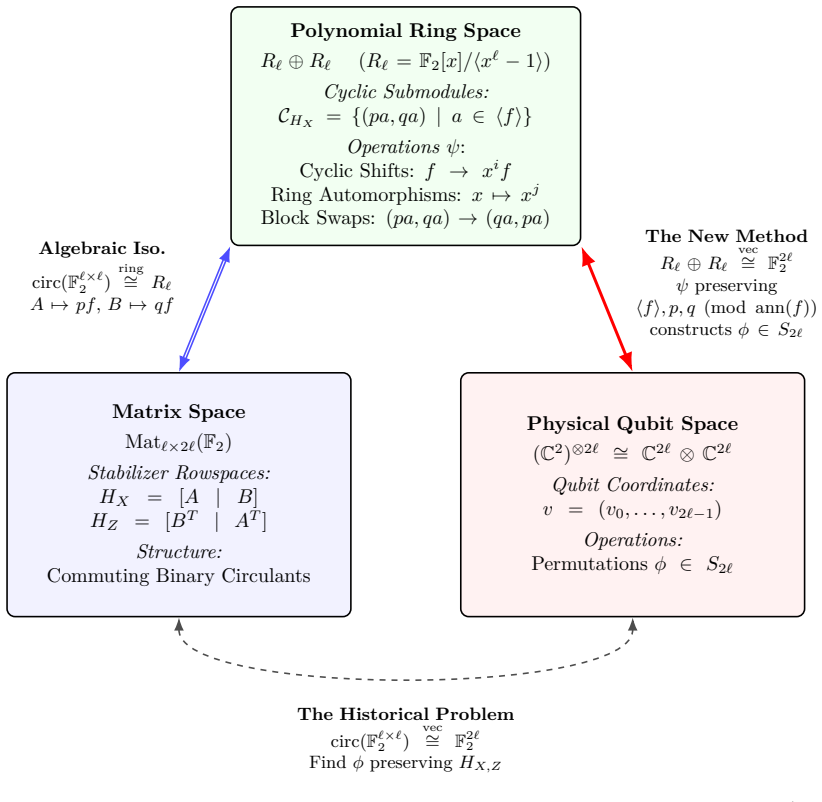
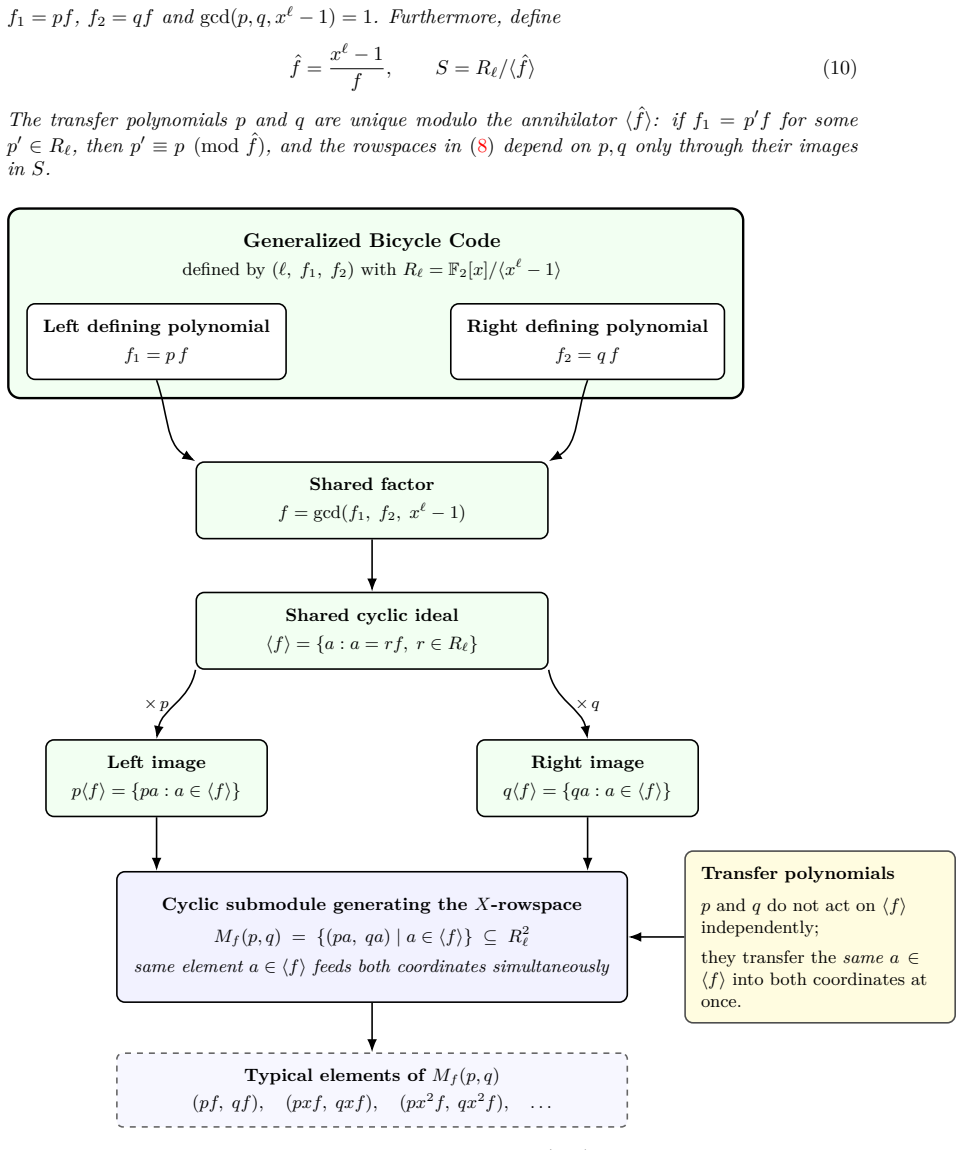
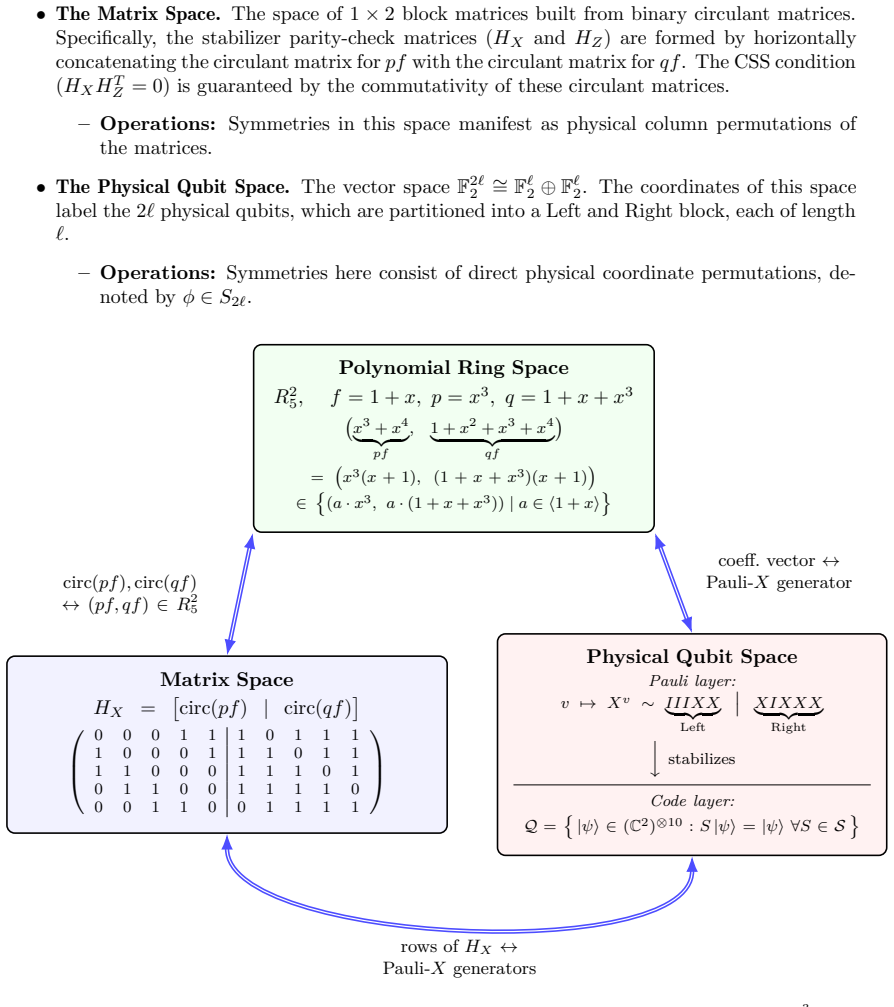
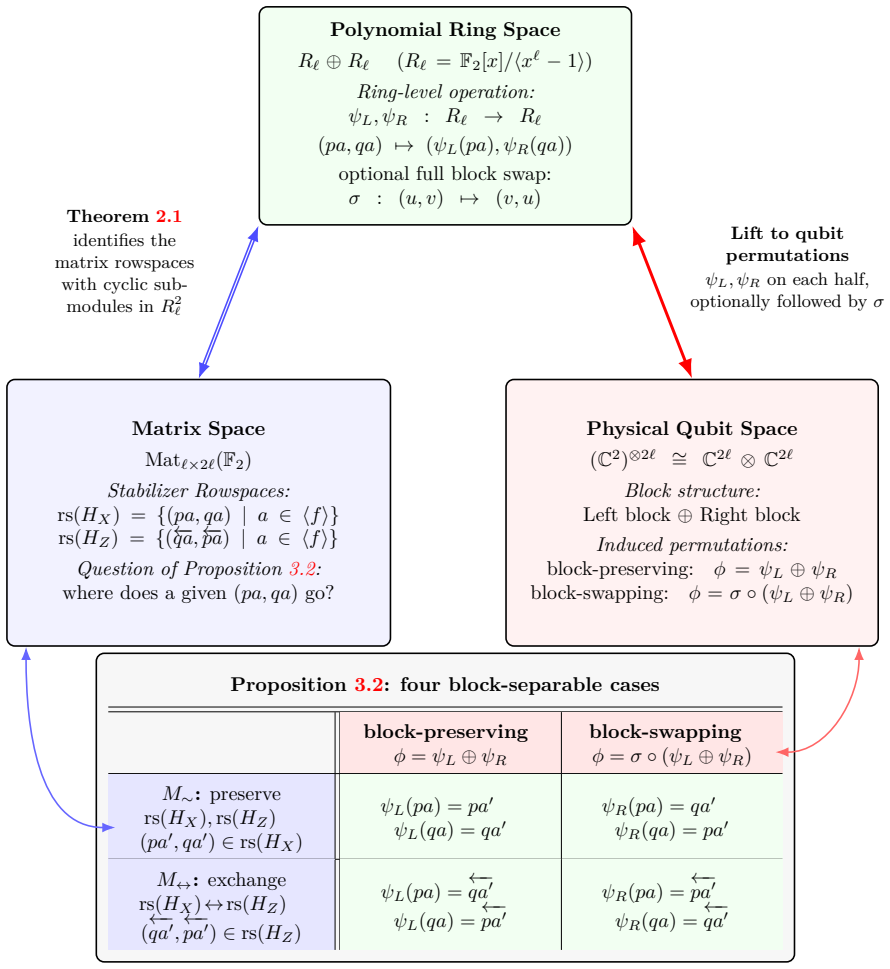
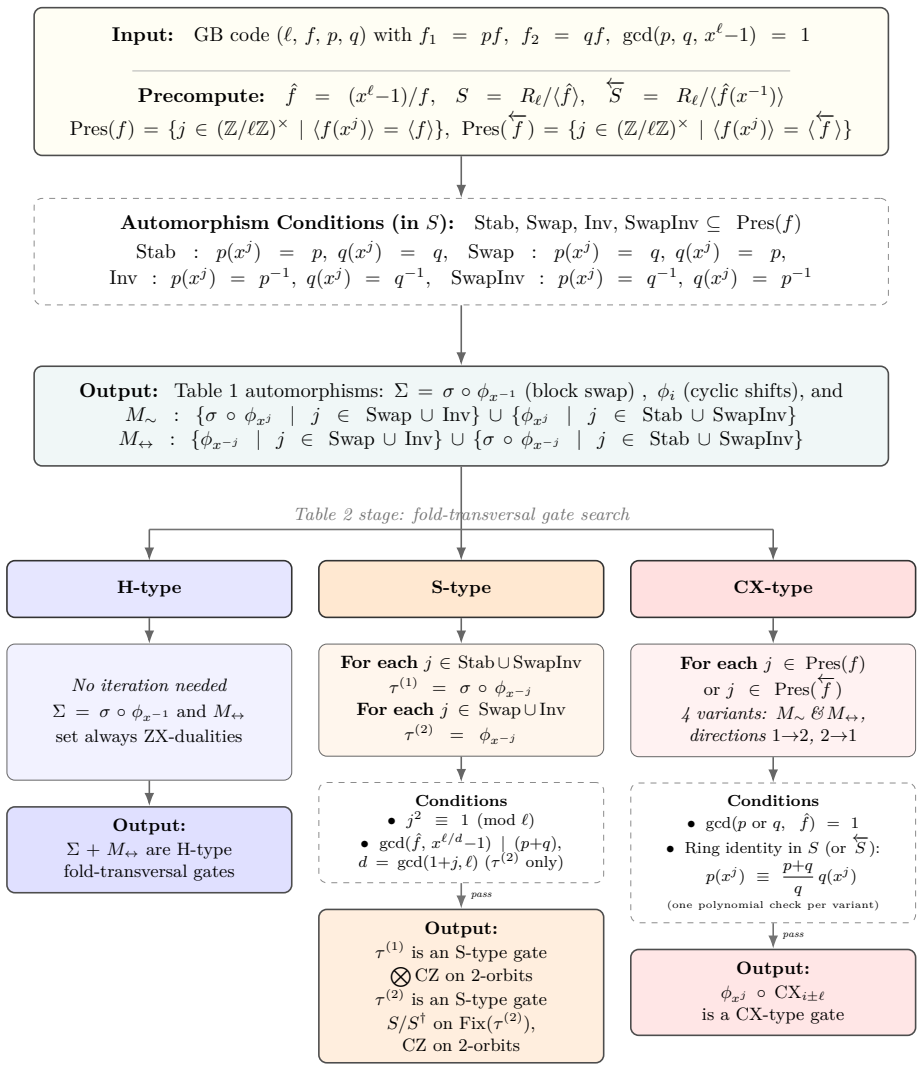
By deriving a three-space dependency between the polynomial ring space, the parity check matrix space, and the F₂^{2ℓ} qubit space, GB codes are expressed as a pair of cyclic submodules of R_ℓ² ≅ F₂[x]/(x^ℓ−1). This reduces the search for code automorphisms to a deterministic algebraic problem, deriving necessary and sufficient conditions for the existence of block-separable automorphisms built from cyclic shifts, ring automorphisms and block-swaps. These conditions connect to the fold-transversal gate framework, providing explicit criteria for the existence of H-, S-, and CX-type fold-transversal gates. The MCR family is introduced to maximize automorphism flexibility, with k=2 codes up to
What carries the argument
The representation of a GB code as a pair of cyclic submodules of R_ℓ², which converts automorphism questions into algebraic conditions on the ring.
If this is right
- Block-separable automorphisms exist if and only if the corresponding ring conditions hold.
- Explicit algebraic criteria decide the existence of H-, S-, and CX-type fold-transversal gates.
- Structured bases for logical operators determine the logical action realized by any automorphism.
- The MCR family produces k=2 codes up to distance 13 that generate the full 2-qubit Clifford group.
- k>2 MCR codes yield at least 20 distinct logical gates from automorphisms alone.
Where Pith is reading between the lines
- The same submodule representation could be used to engineer codes whose automorphism groups realize other finite gate sets beyond the Clifford group.
- Because the construction rests on classical cyclic-code ideas, the method may extend to other CSS or quasi-cyclic quantum codes.
- Inverse design becomes feasible: one can search the ring for submodule pairs that simultaneously satisfy distance and desired automorphism properties.
- The algebraic criteria supply a decidable test that could be automated to enumerate all low-weight GB codes with nontrivial logical gates.
Load-bearing premise
Generalized bicycle codes admit a three-space dependency that allows them to be expressed as cyclic submodules of R_ℓ² in a manner that directly reduces automorphism search to algebraic conditions on the ring.
What would settle it
A concrete GB code whose automorphism group contains an element that cannot be obtained from any combination of cyclic shifts, ring automorphisms, and block swaps satisfying the derived ring conditions, or an MCR code whose combined automorphism and fold-transversal gates fail to produce all elements of the 2-qubit Clifford group.
Figures
read the original abstract
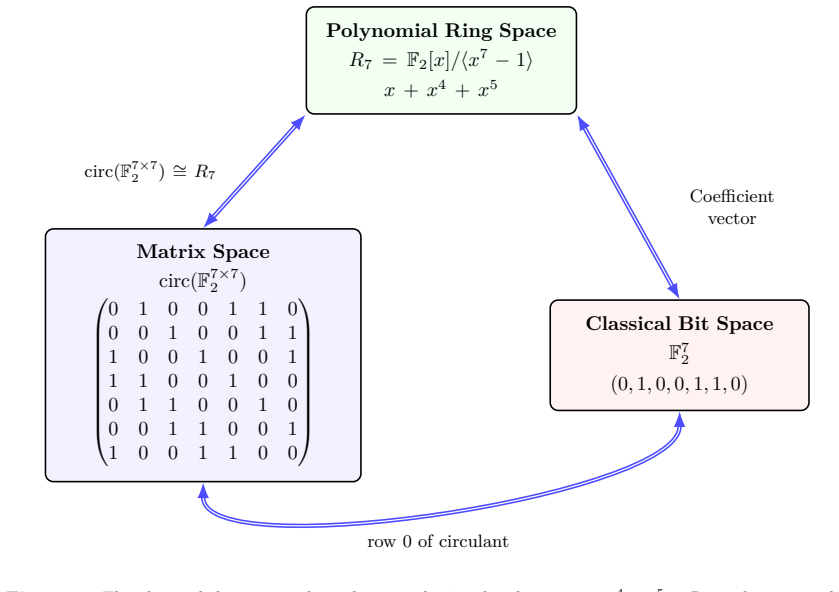
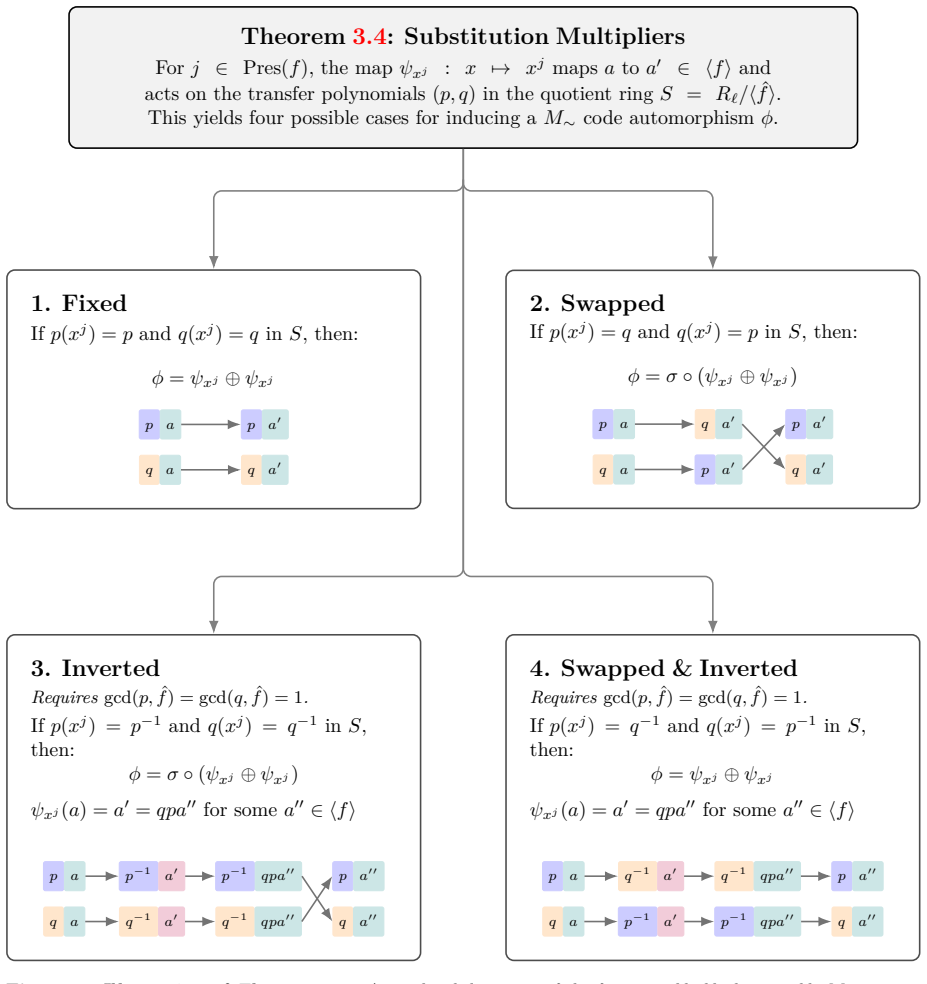
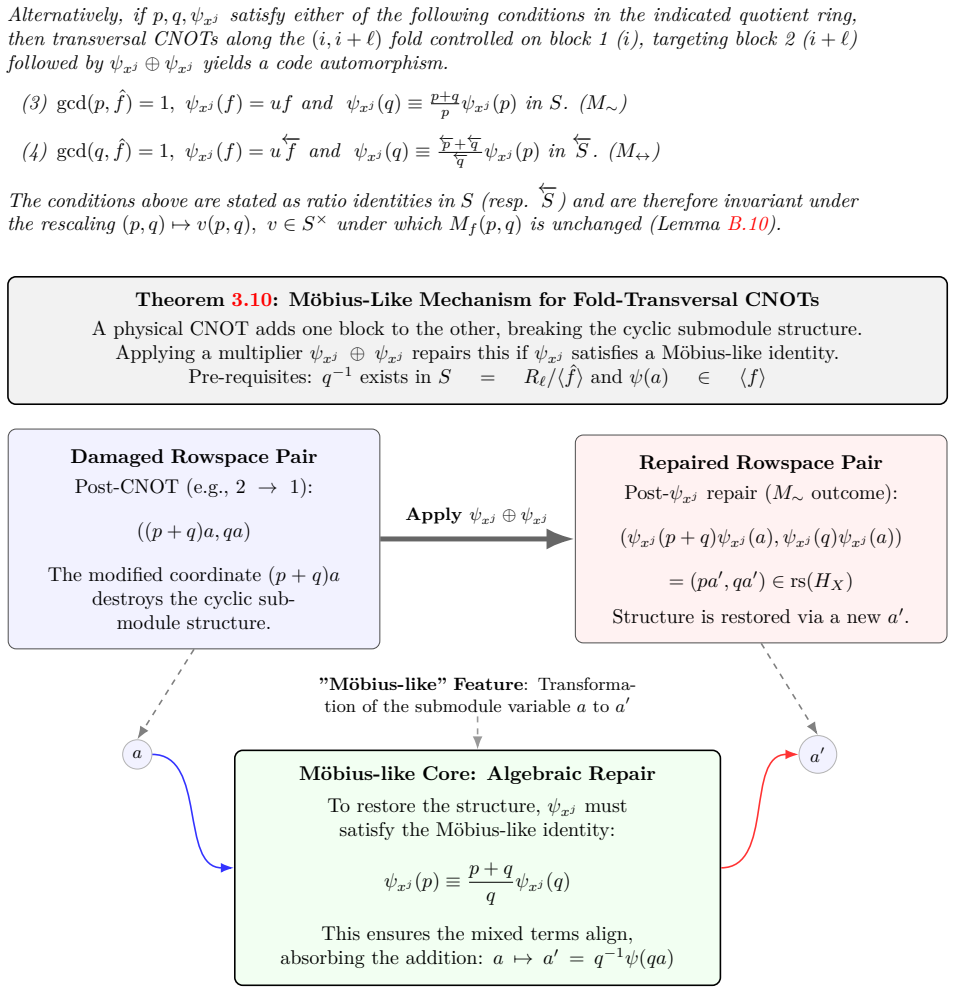
Automorphisms of quantum codes, when they exist, offer a pathway toward fault-tolerant gate implementation via qubit relabeling. Although useful, the conditions under which automorphisms appear in a given code remain poorly understood. In this paper, we develop an algebraic framework for systematically analyzing and engineering automorphisms in Generalized Bicycle (GB) codes. Central to our approach is the derivation of a three-space dependency between the polynomial ring space, the parity check matrix space, and the $\mathbb{F}_2^{2\ell}$ qubit space, similar to the structure found in the study of classical cyclic codes. By expressing GB codes as a pair of cyclic submodules of $R_\ell^2$, where $R_\ell \cong \mathbb{F}_2[x]/\langle x^\ell-1\rangle$, we reduce the search for code automorphisms to a deterministic algebraic problem, deriving necessary and sufficient conditions for the existence of block-separable automorphisms built from cyclic shifts, ring automorphisms and block-swaps. We connect these conditions to the fold-transversal gate framework, providing explicit criteria for the existence of $H$-, $S$-, and $CX$-type fold-transversal gates. We further discuss structured bases for logical operators in order to determine the logical action of a given automorphism. Finally, we introduce the Maximal Cube Root (MCR) code family, a family of GB codes constructed around the principle of maximizing automorphism flexibility and fold-CX gates. We demonstrate a collection of $k=2$ MCR codes up to $d=13$ generating the 2-qubit Clifford group via automorphism and fold-transversal gates, with stabilizer weight ranging from 8 to 16, and $k>2$ MCR codes with a minimum of 20 distinct logical gates achievable from automorphisms. This serves as a first demonstration of inverse design: using these methods to build codes around a rich automorphism structure from the ground up.
Editorial analysis
A structured set of objections, weighed in public.
Referee Report
Summary. The manuscript develops an algebraic framework for Generalized Bicycle (GB) codes by deriving a three-space dependency between the polynomial ring, parity-check matrix, and qubit space, expressing GB codes as a pair of cyclic submodules of R_ℓ² ≅ F₂[x]/(x^ℓ−1). It reduces automorphism search to algebraic conditions on the ring and derives necessary and sufficient conditions for block-separable automorphisms (cyclic shifts, ring automorphisms, block-swaps). The work connects these to explicit criteria for fold-transversal H-, S-, and CX-type gates, discusses structured bases for logical operators, and introduces the Maximal Cube Root (MCR) code family. Explicit k=2 MCR constructions up to d=13 are shown to generate the 2-qubit Clifford group via automorphisms and fold-transversal gates (stabilizer weights 8–16), along with k>2 examples achieving at least 20 distinct logical gates.
Significance. If the algebraic modeling and derivations hold, the paper provides a systematic, ring-theoretic method for engineering quantum codes with prescribed automorphism groups, enabling inverse design for fault-tolerant gates. The reduction of automorphism existence to deterministic algebraic conditions on R_ℓ and the explicit MCR constructions that realize the full 2-qubit Clifford group constitute a concrete advance, offering falsifiable examples with moderate stabilizer weights.
major comments (1)
- [Abstract / introduction (three-space dependency)] The three-space dependency (abstract, paragraph beginning 'Central to our approach') is load-bearing for the central claim that GB codes can be expressed as cyclic submodules of R_ℓ² and that this directly yields necessary and sufficient conditions on the ring. The manuscript should include an explicit derivation or proposition showing that the GB parity-check matrix structure induces the submodule property for arbitrary defining polynomials without hidden constraints.
minor comments (2)
- The abstract states that 'necessary and sufficient conditions' are derived; the main text should cross-reference the specific theorem or proposition numbers where these conditions appear.
- [MCR code family] In the MCR code family section, the design principle of 'maximizing automorphism flexibility' should be stated more formally (e.g., as an optimization over the ring elements) to facilitate reproducibility of the constructions.
Simulated Author's Rebuttal
We thank the referee for their positive assessment and recommendation of minor revision. We address the single major comment below.
read point-by-point responses
-
Referee: [Abstract / introduction (three-space dependency)] The three-space dependency (abstract, paragraph beginning 'Central to our approach') is load-bearing for the central claim that GB codes can be expressed as cyclic submodules of R_ℓ² and that this directly yields necessary and sufficient conditions on the ring. The manuscript should include an explicit derivation or proposition showing that the GB parity-check matrix structure induces the submodule property for arbitrary defining polynomials without hidden constraints.
Authors: We agree that an explicit derivation strengthens the central claim. In the revised manuscript we will add a new Proposition (placed immediately after the GB code definition) that starts from the parity-check matrix in polynomial form H = [a(x) | b(x)] and derives the three-space dependency. The proof shows that the code is the intersection of two cyclic submodules of R_ℓ² for arbitrary a(x), b(x) ∈ R_ℓ, with no additional constraints on the defining polynomials; it explicitly maps the row space of H to the submodule generators and verifies closure under multiplication by x. revision: yes
Circularity Check
No significant circularity detected
full rationale
The paper's central contribution is a modeling choice that expresses GB codes as cyclic submodules of R_ℓ², followed by algebraic derivation of automorphism conditions from that representation. This is a standard extension of classical cyclic-code techniques to the quantum setting and does not reduce any claimed result to a fitted parameter, self-referential definition, or load-bearing self-citation. The MCR family is explicitly constructed around stated design goals rather than reverse-engineered from target outcomes, and the Clifford-group demonstration follows directly from the derived algebraic criteria. No load-bearing step collapses to its own inputs by construction.
Axiom & Free-Parameter Ledger
axioms (1)
- domain assumption GB codes admit a three-space dependency between the polynomial ring space, the parity-check matrix space, and the F₂^{2ℓ} qubit space that permits representation as cyclic submodules of R_ℓ²
invented entities (1)
-
Maximal Cube Root (MCR) code family
no independent evidence
Reference graph
Works this paper leans on
-
[1]
Jean-Pierre Tillich and Gilles Zemor. Quantum LDPC Codes With Positive Rate and Min- imum Distance Proportional to the Square Root of the Blocklength.IEEE Transactions on Information Theory, 60(2):1193–1202, February 2014. URLhttp://dx.doi.org/10.1109/ TIT.2013.2292061
arXiv 2014
-
[2]
In Victor V
Hypergraph product (HGP) code. In Victor V. Albert and Philippe Faist, editors,The Error Correction Zoo. 2024. URLhttps://errorcorrectionzoo.org/c/hypergraph_product
2024
-
[3]
Asymptotically good Quantum and locally testable classical LDPC codes
Pavel Panteleev and Gleb Kalachev. Asymptotically good Quantum and locally testable classical LDPC codes. InProceedings of the 54th Annual ACM SIGACT Symposium on Theory of Computing, STOC 2022, pages 375–388, New York, NY, USA, 2022. Association for Computing Machinery. URLhttps://dl.acm.org/doi/10.1145/3519935.3520017
-
[4]
Pablo Bonilla Ataides, Christopher A
Qian Xu, J. Pablo Bonilla Ataides, Christopher A. Pattison, Nithin Raveendran, Dolev Bluvstein, Jonathan Wurtz, Bane Vasi´ c, Mikhail D. Lukin, Liang Jiang, and Hengyun Zhou. Constant-overhead fault-tolerant quantum computation with reconfigurable atom ar- rays.Nature Physics, 20(7):1084–1090, 2024. URLhttps://www.nature.com/articles/ s41567-024-02479-z
2024
-
[5]
Nikolas P. Breuckmann and Jens N. Eberhardt. Balanced Product Quantum Codes.IEEE Transactions on Information Theory, 67(10):6653–6674, October 2021. URLhttps:// ieeexplore.ieee.org/document/9490244/. 50
arXiv 2021
-
[6]
Cross, Jay M
Sergey Bravyi, Andrew W. Cross, Jay M. Gambetta, Dmitri Maslov, Patrick Rall, and Theodore J. Yoder. High-threshold and low-overhead fault-tolerant quantum mem- ory.Nature, 627(8005):778–782, March 2024. URLhttps://www.nature.com/articles/ s41586-024-07107-7
2024
-
[7]
Towards Ultra- High-Rate Quantum Error Correction with Reconfigurable Atom Arrays, 2026
Chen Zhao, Casey Duckering, Andi Gu, Nishad Maskara, and Hengyun Zhou. Towards Ultra- High-Rate Quantum Error Correction with Reconfigurable Atom Arrays, 2026. URLhttps: //arxiv.org/abs/2604.16209
Pith/arXiv arXiv 2026
-
[8]
Breaking the Orthogonality Barrier in Quantum LDPC Codes, 2026
Kenta Kasai. Breaking the Orthogonality Barrier in Quantum LDPC Codes, 2026. URL https://arxiv.org/abs/2601.08824
arXiv 2026
-
[9]
Leveraging automorphisms of quantum codes for fault- tolerant quantum computation
Markus Grassl and Martin Roetteler. Leveraging automorphisms of quantum codes for fault- tolerant quantum computation. In2013 IEEE International Symposium on Information The- ory, pages 534–538, 2013. URLhttps://ieeexplore.ieee.org/document/6620283
arXiv 2013
-
[10]
Breuckmann and Simon Burton
Nikolas P. Breuckmann and Simon Burton. Fold-Transversal Clifford Gates for Quan- tum Codes.Quantum, 8:1372, June 2024. URLhttps://quantum-journal.org/papers/ q-2024-06-13-1372/
2024
-
[11]
Zhiyang He, Alexander Cowtan, Dominic J Williamson, and Theodore J Yoder. Ex- tractors: QLDPC Architectures for Efficient Pauli-Based Computation.arXiv preprint arXiv:2503.10390, 2025. URLhttps://arxiv.org/abs/2503.10390
arXiv 2025
-
[12]
Yoder, Eddie Schoute, Patrick Rall, Emily Pritchett, Jay M
Theodore J. Yoder, Eddie Schoute, Patrick Rall, Emily Pritchett, Jay M. Gambetta, An- drew W. Cross, Malcolm Carroll, and Michael E. Beverland. Tour de gross: A modular quantum computer based on bivariate bicycle codes, 2025. URLhttps://arxiv.org/abs/ 2506.03094
Pith/arXiv arXiv 2025
-
[13]
Wilson, Jon Gorchon, Charles-Henri Lambert, Sayeef Salahuddin, and Jeffrey Bokor
Lawrence Z. Cohen, Isaac H. Kim, Stephen D. Bartlett, and Benjamin J. Brown. Low- overhead fault-tolerant quantum computing using long-range connectivity.Science Advances, 8(20), May 2022. ISSN 2375-2548. URLhttps://www.science.org/doi/10.1126/sciadv. abn1717
-
[14]
Andrew Cross, Zhiyang He, Patrick Rall, and Theodore Yoder. Improved QLDPC Surgery: Logical Measurements and Bridging Codes.arXiv preprint arXiv:2407.18393, 2024. URL https://arxiv.org/abs/2407.18393
arXiv 2024
-
[15]
Williamson and Theodore J
Dominic J. Williamson and Theodore J. Yoder. Low-overhead fault-tolerant quantum com- putation by gauging logical operators.Nature Physics, 22(4):598–603, 2026. URLhttps: //www.nature.com/articles/s41567-026-03220-8
2026
-
[16]
Gowda, Priya J
Benjamin Ide, Manoj G. Gowda, Priya J. Nadkarni, and Guillaume Dauphinais. Fault- Tolerant Logical Measurements via Homological Measurement.Physical Review X, 15(2), June
-
[17]
URLhttps://journals.aps.org/prx/abstract/10.1103/PhysRevX.15.021088
-
[18]
Esha Swaroop, Tomas Jochym-O’Connor, and Theodore J. Yoder. Universal Adapters between Quantum Low-Density Parity Check Codes.PRX Quantum, 7(1), 2026. URLhttps:// journals.aps.org/prxquantum/abstract/10.1103/1g44-jp62
-
[19]
Yuan, Alexander Cowtan, Zhiyang He, Ting-Chun Lin, and Dominic J
Andrew C. Yuan, Alexander Cowtan, Zhiyang He, Ting-Chun Lin, and Dominic J. Williamson. Parsimonious Quantum Low-Density Parity-Check Code Surgery, 2026. URLhttps:// arxiv.org/abs/2603.05082
arXiv 2026
-
[20]
Hasan Sayginel, Stergios Koutsioumpas, Mark Webster, Abhishek Rajput, and Dan E. Browne. Fault-tolerant logical clifford gates from code automorphisms.PRX Quantum, 6: 030343, Sep 2025. URLhttps://link.aps.org/doi/10.1103/vf7v-cpq9
-
[21]
Diaconu, Daniel Bochen Tan, Alexandra A
Jin Ming Koh, Anqi Gong, Andrei C. Diaconu, Daniel Bochen Tan, Alexandra A. Geim, Michael J. Gullans, Norman Y. Yao, Mikhail D. Lukin, and Shayan Majidy. Entangling logical qubits without physical operations, 2026. URLhttps://arxiv.org/abs/2601.20927
arXiv 2026
-
[22]
Exhaustive Optimisation of Automorphism Groups for Stabiliser Codes, 2026
Aisling Mac Aree and Mark Howard. Exhaustive Optimisation of Automorphism Groups for Stabiliser Codes, 2026. URLhttps://arxiv.org/abs/2604.01282
arXiv 2026
-
[23]
Logical Operators and Fold-Transversal Gates of Bivariate Bicycle Codes, 2024
Jens Niklas Eberhardt and Vincent Steffan. Logical Operators and Fold-Transversal Gates of Bivariate Bicycle Codes, 2024. URLhttps://arxiv.org/abs/2407.03973
arXiv 2024
-
[24]
Gullans, Yifan Hong, Maryam Mudassar, and Shi Jie Samuel Tan
Noah Berthusen, Michael J. Gullans, Yifan Hong, Maryam Mudassar, and Shi Jie Samuel Tan. Automorphism gadgets in homological product codes, 2025. URLhttps://arxiv.org/ abs/2508.04794
arXiv 2025
-
[25]
Simple logical quantum computation with concate- nated symplectic double codes, 2025
Noah Berthusen and Elijah Durso-Sabina. Simple logical quantum computation with concate- nated symplectic double codes, 2025. URLhttps://arxiv.org/abs/2510.18753. 51
arXiv 2025
-
[26]
Degenerate Quantum LDPC Codes With Good Finite Length Performance.Quantum, 5:585, November 2021
Pavel Panteleev and Gleb Kalachev. Degenerate Quantum LDPC Codes With Good Finite Length Performance.Quantum, 5:585, November 2021. URLhttps://quantum-journal. org/papers/q-2021-11-22-585/pdf/
2021
-
[27]
Renyu Wang and Leonid P. Pryadko. Distance bounds for generalized bicycle codes, 2022. URLhttps://arxiv.org/abs/2203.17216
arXiv 2022
-
[28]
Alexey A. Kovalev and Leonid P. Pryadko. Quantum Kronecker sum-product low-density parity-check codes with finite rate.Physical Review A, 88(1):012311, July 2013. URLhttps: //link.aps.org/doi/10.1103/PhysRevA.88.012311
-
[29]
Cary Huffman and Vera Pless.Fundamentals of Error-Correcting Codes
W. Cary Huffman and Vera Pless.Fundamentals of Error-Correcting Codes. Cambridge University Press, Cambridge, UK, 2003. ISBN 9780521782807
2003
-
[30]
Dummit and R.M
D.S. Dummit and R.M. Foote.Abstract Algebra. Wiley, 2003. ISBN 9780471433347
2003
-
[31]
Pavel Panteleev and Gleb Kalachev. Quantum LDPC Codes With Almost Linear Minimum Distance.IEEE Transactions on Information Theory, 68(1):213–229, January 2022. URL https://ieeexplore.ieee.org/document/9567703
arXiv 2022
-
[32]
Quasicyclic codes of indexℓoverFq viewed asFq[x]-submodules ofFqℓ[x]/⟨xm− 1⟩.LCNS: Applied algebra, algebraic algorithms and error-correcting codes, 2643:244–253,
Kristine Lally. Quasicyclic codes of indexℓoverFq viewed asFq[x]-submodules ofFqℓ[x]/⟨xm− 1⟩.LCNS: Applied algebra, algebraic algorithms and error-correcting codes, 2643:244–253,
-
[33]
URLhttps://link.springer.com/chapter/10.1007/3-540-44828-4_26
-
[34]
Dzhumadil’daev, and San Ling
Kanat Abdukhalikov, Askar S. Dzhumadil’daev, and San Ling. Quasi-cyclic codes of index 2.Discrete Mathematics, 349(6):115004, June 2026. URLhttps://arxiv.org/abs/2504. 00568
2026
-
[35]
Polynomial representation of additive cyclic codes and new quantum codes.Adv
Reza Dastbasteh and Khalil Shivji. Polynomial representation of additive cyclic codes and new quantum codes.Adv. Math. Commun., 19:49–68, 2023. URLhttps://api. semanticscholar.org/CorpusID:255372576
2023
-
[36]
E. Mart´ ınez-Moro, A. Pi˜ nera Nicol´ as, and I.F. R´ ua. Codes over affine algebras with a finite commutative chain coefficient ring.Finite Fields Appl., 49(C):94–107, January 2018. URL https://dl.acm.org/doi/10.1016/j.ffa.2017.09.008
-
[37]
Graham H. Norton and Ana S˘ al˘ agean. On the Structure of Linear and Cyclic Codes over a Finite Chain Ring.Applicable Algebra in Engineering, Communication and Computing, 10 (6):489–506, 2000. URLhttps://link.springer.com/article/10.1007/PL00012382
-
[38]
Hai Quang Dinh and S.R. Lopez-Permouth. Cyclic and negacyclic codes over finite chain rings.IEEE Transactions on Information Theory, 50(8):1728–1744, 2004. URLhttps:// ieeexplore.ieee.org/document/1317117
arXiv 2004
-
[39]
PhD thesis, California In- stitute of Technology, Pasadena, California, 1997
Daniel Gottesman.Stabilizer Codes and Quantum Error Correction. PhD thesis, California In- stitute of Technology, Pasadena, California, 1997. URLhttps://arxiv.org/abs/quant-ph/ 9705052
1997
-
[40]
Conway and Neil J
John H. Conway and Neil J. A. Sloane.Sphere Packings, Lattices and Groups, volume 290 ofGrundlehren der mathematischen Wissenschaften. Springer-Verlag, New York, 3 edition,
-
[41]
ISBN 978-0-387-98585-5
-
[42]
The use of information sets in decoding cyclic codes.IRE Transactions on Information Theory, 8(5):5–9, 1962
Eugene Prange. The use of information sets in decoding cyclic codes.IRE Transactions on Information Theory, 8(5):5–9, 1962. URLhttps://ieeexplore.ieee.org/document/ 1057777
1962
-
[43]
Gurobi Optimizer Reference Manual, 2026
Gurobi Optimization, LLC. Gurobi Optimizer Reference Manual, 2026. URLhttps://www. gurobi.com
2026
-
[44]
SubMIT: A physics analysis facility at MIT, 2025
Josh Bendavid, Mariarosaria D’Alfonso, Jan Eysermans, Chad Freer, Maxim Goncharov, Matthew Heine, Luca Lavezzo, Marianne Moore, Christoph Paus, Xuejian Shen, David Walter, and Zhangqier Wang. SubMIT: A physics analysis facility at MIT, 2025. URL https://arxiv.org/abs/2506.01958
arXiv 2025
-
[45]
Thierry Berger and Pascale Charpin. The Automorphism Groups of BCH Codes and of Some Affine-Invariant Codes Over Extension Fields.Designs, Codes and Cryptography, 18:29–53, December 1999. URLhttps://dl.acm.org/doi/abs/10.1023/A%3A1008372800005
work page doi:10.1023/a 1999
-
[46]
Tao Feng, Henk D. L. Hollmann, Weicong Li, and Qing Xiang. The permutation automorphism groups of irreducible cyclic codes, 2026. URLhttps://arxiv.org/abs/2603.01904
arXiv 2026
-
[47]
P. P. P´ alfy. Isomorphism problem for relational structures with a cyclic automorphism.Euro- pean Journal of Combinatorics, 8(1):35–43, 1987. URLhttps://www.sciencedirect.com/ science/article/pii/S0195669887800185. 52
1987
-
[48]
W. C. Huffman, V. Job, and V. Pless. Multipliers and generalized multipliers of cyclic objects and cyclic codes.Journal of Combinatorial Theory, Series A, 62(2):183–215, 1993. URL https://dl.acm.org/doi/10.1016/0097-3165%2893%2990043-8
-
[49]
The permutation groups and the equivalence of cyclic and quasi-cyclic codes
Kenza Guenda. The permutation groups and the equivalence of cyclic and quasi-cyclic codes. arXiv preprint, 2010. URLhttps://arxiv.org/abs/1002.2456
Pith/arXiv arXiv 2010
-
[50]
Reza Dastbasteh and Petr Lisonˇ ek. On the equivalence of linear cyclic and constacyclic codes. Discrete Math., 346(9), September 2023. URLhttps://dl.acm.org/doi/10.1016/j.disc. 2023.113489. A List of Symbols The tables below collect the principal symbols used throughout the paper, organized according to the three-space dependency framework introduced in ...
-
[51]
There exists a proper divisord|ℓ,d<ℓ, such thatψd(c) =c∀c∈C, i.e., cyclically shifting bydpositions returns every codeword back to itself ford<ℓ
-
[52]
ˆg|xd−1 ford|ℓ, d<ℓ Non-trivial exceptions toPAut(C) =Z/ℓZ ⋊M(C)include the punctured Reed–Muller codes and the binary Golay code, withPAut(C) =M 23. It is a longstanding conjecture by Berger and Charpin [42], recently confirmed for irreducible cyclic codes [43], that for almost all cyclic codes the permutation automorphism group coincides with the affine...
discussion (0)
Sign in with ORCID, Apple, or X to comment. Anyone can read and Pith papers without signing in.