Deep Learning Based Multi-Step Channel Prediction for Adaptive Underwater Acoustic OFDM Systems
Pith reviewed 2026-06-28 04:36 UTC · model grok-4.3
The pith
A Transformer model with shared parameters predicts multiple future states of underwater acoustic channels to drive adaptive modulation and power allocation in OFDM systems.
A machine-rendered reading of the paper's core claim, the machinery that carries it, and where it could break.
Core claim
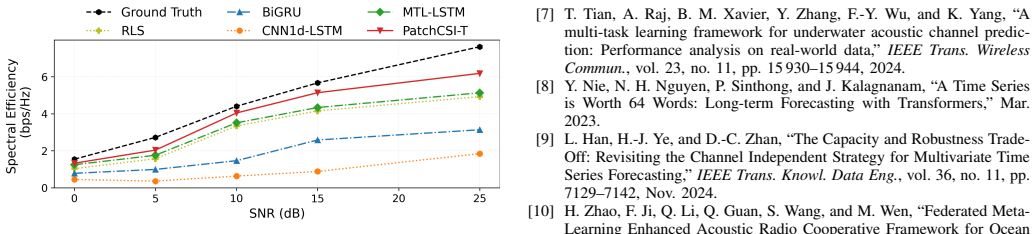
The authors develop PatchCSI-T, a Transformer-based multistep channel prediction model with feature-independent modeling and parameter sharing, which, combined with a greedy adaptive modulation and power allocation scheme, enables accurate low-latency CSI forecasting and improves end-to-end BER and spectral efficiency on real-world UWA channel datasets.
What carries the argument
PatchCSI-T, a Transformer-based multistep channel prediction model with feature-independent modeling and parameter sharing that generates future CSI values for input to the adaptive allocation scheme.
If this is right
- Accurate low-latency CSI forecasting becomes feasible for underwater acoustic OFDM.
- End-to-end bit error rate decreases when the forecasts feed the greedy allocation scheme.
- Spectral efficiency rises on the same real-world channel datasets.
- The combined prediction-plus-adaptation framework operates without requiring frequent pilot overhead.
Where Pith is reading between the lines
- The same prediction approach might reduce the need for frequent channel sounding in other rapidly varying wireless environments.
- Lower prediction latency could support higher vehicle speeds or more frequent adaptation in mobile UWA links.
- Replacing the greedy allocator with an optimization-based one might extract still larger gains from the same forecasts.
Load-bearing premise
The multi-step forecasts produced by PatchCSI-T remain accurate enough on real underwater channels to improve the decisions made by the greedy adaptive modulation and power allocation scheme.
What would settle it
Running the full adaptive OFDM system on the real-world UWA datasets with PatchCSI-T predictions yields no BER reduction and no spectral-efficiency gain relative to using the most recent measured CSI without prediction.
Figures


read the original abstract
We develop an adaptive OFDM framework for underwater acoustic communications based on PatchCSI-T, a Transformer-based multistep channel prediction model with feature-independent modeling and parameter sharing. Combined with a greedy adaptive modulation and power allocation scheme, the proposed approach enables accurate, low-latency CSI forecasting and improves end-to-end BER and spectral efficiency on real-world UWA channel datasets.
Editorial analysis
A structured set of objections, weighed in public.
Referee Report
Summary. The paper proposes PatchCSI-T, a Transformer-based multi-step channel prediction model using feature-independent modeling and parameter sharing, for adaptive underwater acoustic OFDM systems. Combined with a greedy adaptive modulation and power allocation scheme, it claims to enable accurate low-latency CSI forecasting and to improve end-to-end BER and spectral efficiency on real-world UWA channel datasets.
Significance. If the claimed BER and SE gains are rigorously validated, the work would be significant for practical adaptive communications in highly non-stationary UWA channels, where multi-step forecasting could enable better resource allocation than myopic schemes relying on outdated CSI.
major comments (3)
- [Abstract] Abstract: the central claim of improved end-to-end BER and spectral efficiency is asserted without any quantitative results, baselines, error bars, or validation details, preventing assessment of whether the data support the claim.
- [Results / Experiments] The manuscript does not isolate the contribution of PatchCSI-T multi-step forecasts to the reported gains; an ablation replacing the forecasts with perfect CSI, last-known CSI, or a naïve predictor when driving the identical greedy allocator on the same real traces is required, because moderate prediction error on non-stationary channels can cause the myopic allocator to select suboptimal constellations or powers.
- [Proposed Method / §3] The feature-independent modeling and parameter sharing in PatchCSI-T are presented as enabling accurate forecasts, yet no quantitative multi-step prediction metrics (e.g., NMSE at different horizons) or comparisons to standard predictors (LSTM, AR) are supplied to substantiate that these design choices remain useful inputs to the greedy scheme.
minor comments (2)
- Notation for the channel prediction horizon and the greedy allocation objective should be defined consistently between the model description and the performance evaluation sections.
- Figure captions should explicitly state the number of real-world traces, the prediction horizon used, and the exact baselines plotted.
Simulated Author's Rebuttal
We thank the referee for the constructive comments. We address each major point below and indicate the planned revisions.
read point-by-point responses
-
Referee: [Abstract] Abstract: the central claim of improved end-to-end BER and spectral efficiency is asserted without any quantitative results, baselines, error bars, or validation details, preventing assessment of whether the data support the claim.
Authors: We agree that the abstract should contain quantitative support for the central claims. In the revised manuscript we will update the abstract to report specific BER and spectral-efficiency gains (with baselines and error bars) obtained on the real UWA datasets. revision: yes
-
Referee: [Results / Experiments] The manuscript does not isolate the contribution of PatchCSI-T multi-step forecasts to the reported gains; an ablation replacing the forecasts with perfect CSI, last-known CSI, or a naïve predictor when driving the identical greedy allocator on the same real traces is required, because moderate prediction error on non-stationary channels can cause the myopic allocator to select suboptimal constellations or powers.
Authors: We accept the need for explicit isolation of the predictor's contribution. The revised manuscript will include the requested ablation experiments that replace PatchCSI-T forecasts with perfect CSI, last-known CSI, and a naïve predictor while keeping the identical greedy allocator and the same real traces. revision: yes
-
Referee: [Proposed Method / §3] The feature-independent modeling and parameter sharing in PatchCSI-T are presented as enabling accurate forecasts, yet no quantitative multi-step prediction metrics (e.g., NMSE at different horizons) or comparisons to standard predictors (LSTM, AR) are supplied to substantiate that these design choices remain useful inputs to the greedy scheme.
Authors: We will add the missing quantitative evidence. The revised §3 and results section will report multi-step NMSE at multiple horizons together with direct comparisons of PatchCSI-T against LSTM and AR predictors, confirming that the design choices improve the inputs supplied to the greedy allocator. revision: yes
Circularity Check
No significant circularity; claims rest on empirical evaluation rather than self-referential derivation
full rationale
The abstract and provided text describe a Transformer-based model (PatchCSI-T) trained for multi-step CSI prediction, then combined with a greedy allocator for BER/SE gains on real UWA datasets. No equations, fitted parameters, or self-citations are shown that reduce a claimed prediction or uniqueness result to the inputs by construction. The central claim is an empirical performance improvement, which is externally falsifiable on the stated datasets and does not invoke self-definitional loops, fitted-input-as-prediction, or load-bearing self-citation chains. A score of 2 reflects the normal minor self-citation tolerance without load-bearing reduction.
Axiom & Free-Parameter Ledger
Reference graph
Works this paper leans on
-
[1]
2024 , volume=
Tian, Tian and Raj, Agastya and Xavier, Bruno Missi and Zhang, Ying and Wu, Fei-Yun and Yang, Kunde , journal=IEEE_J_WCOM, title=. 2024 , volume=
2024
-
[2]
Hu, Xin and Huo, Yiming and Dong, Xiaodai and Wu, Fei-Yun and Huang, Aiping , issn =. Channel
-
[3]
Liu, Lei and Cai, Lin and Ma, Lu and Qiao, Gang , issn =. Channel
-
[4]
Boyd, Stephen , year =. Distributed. FNT in Machine Learning , volume =. doi:10.1561/2200000016 , langid =
-
[5]
Parikh, Neal and Boyd, Stephen , year =. Proximal. OPT , volume =. doi:10.1561/2400000003 , abstract =
-
[6]
2014 , doi =
Statistical Characterization of a Class of Underwater Acoustic Communication Channels , author =. 2014 , doi =
2014
-
[7]
and Yu, Wenxian , year =
Wen, Fei and Liu, Peilin and Liu, Yipeng and Qiu, Robert C. and Yu, Wenxian , year =. Robust
-
[8]
2019 , month = may, journal =
Inexact Alternating Direction Methods of Multipliers for Separable Convex Optimization , author =. 2019 , month = may, journal =
2019
-
[9]
arxiv , langid =:arXiv:1704.06209 , publisher =
Wohlberg, Brendt , year =. arxiv , langid =:arXiv:1704.06209 , publisher =
-
[10]
Acceleration. 2021 , journal =. doi:10.1561/2400000036 , urldate =. arxiv , langid =:2101.09545 , primaryclass =
-
[11]
Beck, Amir and Teboulle, Marc , year =. A. SIAM Journal on Imaging Sciences , volume =. doi:10.1137/080716542 , urldate =
-
[12]
Cai, T. Tony and Wang, Lie , year =. Orthogonal. IEEE Transactions on Information Theory , volume =. doi:10.1109/TIT.2011.2146090 , urldate =
-
[13]
Zhang, Yijian and Dall'Anese, Emiliano and Hong, Mingyi , year =. Online. IEEE Transactions on Signal and Information Processing over Networks , volume =. doi:10.1109/TSIPN.2021.3051292 , keywords =
-
[14]
and Proakis, John G
Radosevic, Andreja and Ahmed, Rameez and Duman, Tolga M. and Proakis, John G. and Stojanovic, Milica , year = 2014, month = apr, journal = IEEE_J_OE, volume =. Adaptive
2014
-
[15]
Efficiency
Huang, Lihuan and Zhang, Qunfei and Zhang, Lifan and Shi, Juan and Zhang, Lingling , year = 2020, month = aug, journal = IEEE_J_COML, volume =. Efficiency
2020
-
[16]
Underwater Acoustic Communication Channels:
Stojanovic, Milica and Preisig, James , year = 2009, month = jan, journal = IEEE_M_COM, volume =. Underwater Acoustic Communication Channels:
2009
-
[17]
Federated
Zhao, Hao and Ji, Fei and Li, Qiang and Guan, Quansheng and Wang, Shuai and Wen, Miaowen , year = 2022, month = apr, journal =. Federated
2022
-
[18]
Han, Lu and Ye, Han-Jia and Zhan, De-Chuan , year = 2024, month = nov, journal = IEEE_J_KDE, volume =. The
2024
-
[19]
Zhu, Zhengliang and Tong, Feng and Zhou, Yuehai and Zhang, Ziqiao and Zhang, Fumin , year = 2023, month = sep, journal =. Deep
2023
-
[20]
and Sinthong, Phanwadee and Kalagnanam, Jayant , year = 2023, month = mar, number =
Nie, Yuqi and Nguyen, Nam H. and Sinthong, Phanwadee and Kalagnanam, Jayant , year = 2023, month = mar, number =. A. arXiv , langid =:2211.14730 , primaryclass =
Pith/arXiv arXiv 2023
discussion (0)
Sign in with ORCID, Apple, or X to comment. Anyone can read and Pith papers without signing in.