Angular and invariant-mass observables in the four-body Higgs decay htoellbar{ν}_ellbar{ell}^primeν_(ell^prime)
Pith reviewed 2026-06-28 05:29 UTC · model grok-4.3
The pith
Re-pairing the four-body Higgs decay into charged-lepton and neutrino pairs yields a measurable angular distribution after integrating out neutrino angles.
A machine-rendered reading of the paper's core claim, the machinery that carries it, and where it could break.
Core claim
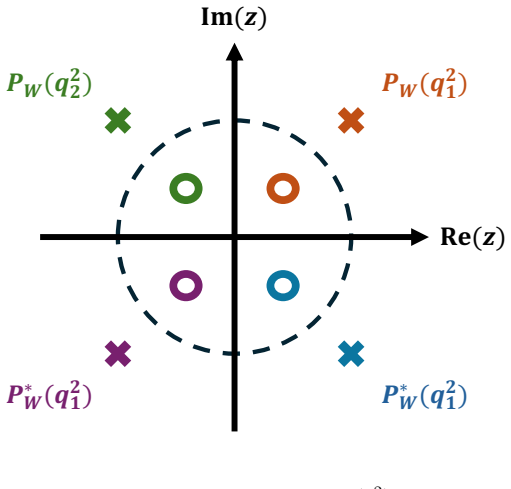
In the effective field theory framework the differential decay rate for h→ℓν̄ℓ ℓ'̄νℓ' is expressed after re-pairing the kinematics into an ℓℓ' system and a νν' system. This allows complete integration over the neutrino-associated angles while retaining all information relevant to the hWW vertex and the EFT operators. The resulting rate depends on experimentally accessible variables, among them the invariant mass squared of the neutrino pair.
What carries the argument
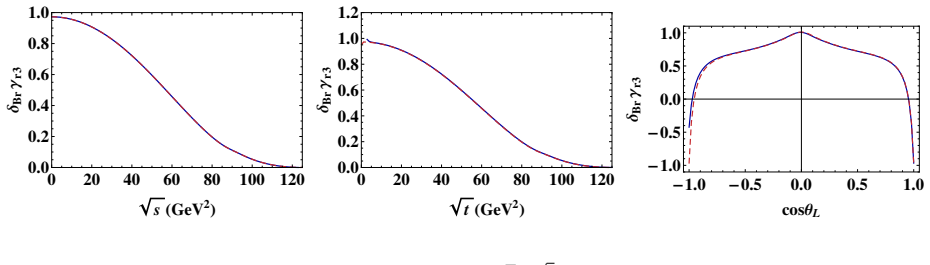
Re-pairing of final-state particles into a charged-lepton pair (ℓℓ') and a neutrino pair (νν'), which permits integration over neutrino angles while preserving hWW and EFT information.
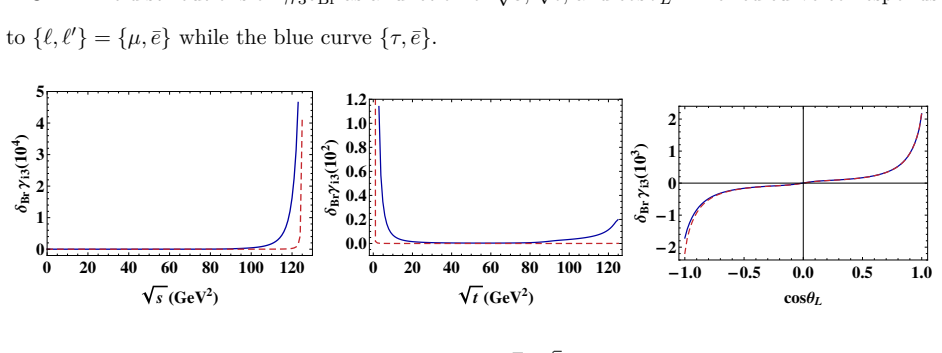
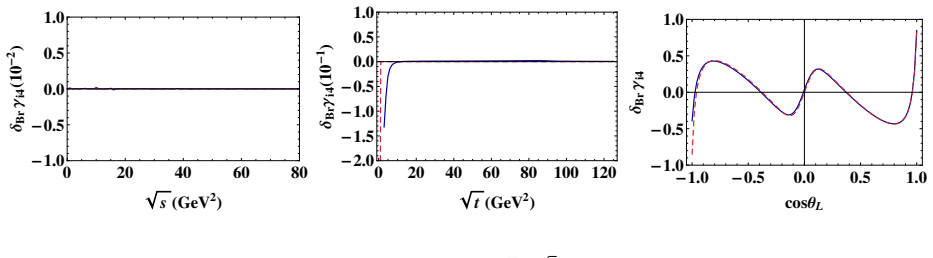
If this is right
- The angular distribution in the decay becomes measurable despite the presence of two undetected neutrinos.
- The distribution directly constrains the structure of the hWW coupling.
- Deviations from the Standard Model prediction can reveal contributions from effective field theory operators.
- The invariant mass of the neutrino pair functions as an additional experimental observable.
Where Pith is reading between the lines
- The same re-pairing technique could be tested in other multi-body decays that contain multiple invisible particles.
- The method supplies an independent handle on Higgs properties that complements existing diboson and four-lepton channels.
- It may help separate the effects of different dimension-six operators in global Higgs fits.
Load-bearing premise
Regrouping the particles into a charged-lepton pair and a neutrino pair allows complete integration of the neutrino angles without discarding essential information about the hWW vertex and the effective operators.
What would settle it
A precision measurement of the angular distribution in this decay channel at a hadron or lepton collider that fails to match the predicted shape after background subtraction and efficiency corrections.
Figures



read the original abstract
We study the angular distribution of the Higgs boson decay $h\to\ell\bar{\nu}_\ell\bar{\ell}^\prime\nu_{\ell^\prime}$ with $\ell\neq\ell^\prime$. Due to the presence of two undetected neutrinos, a complete angular analysis is not feasible at experiments. To overcome this, we reorganize the kinematics from the conventional lepton-neutrino pairs into a charged-lepton pair and a neutrino pair, i.e.~$\ell\bar{\ell}^\prime$ and $\bar{\nu}_\ell\nu_{\ell^\prime}$. This allows us to express the differential decay rate in terms of experimentally accessible variables, including the invariant mass squared of the neutrino pair. Using the effective field theory framework, we derive this rate and integrate over the neutrino-associated angles. This parametrization provides a clean and measurable angular distribution, offering a new probe of the $hWW$ coupling and possible beyond-the-Standard-Model contributions.
Editorial analysis
A structured set of objections, weighed in public.
Referee Report
Summary. The manuscript studies the four-body Higgs decay h→ℓν̄_ℓ ℓ̄'ν_ℓ' (ℓ≠ℓ') by reorganizing the kinematics into charged-lepton pair ℓℓ̄' and neutrino pair νν̄', derives the differential rate in the EFT framework, integrates over neutrino-associated angles, and presents the resulting distribution in measurable variables (m_ℓℓ'^2, m_νν'^2, lepton angles) as a new probe of the hWW coupling and BSM contributions.
Significance. If the integrated distribution retains non-trivial dependence on the hWW vertex and relevant EFT operators, the approach could supply a practical angular observable for Higgs studies at colliders where neutrinos are undetected.
major comments (1)
- [Abstract, paragraph beginning 'To overcome this'] Abstract, paragraph beginning 'To overcome this': the central claim requires that re-pairing to (ℓℓ', νν') and integrating the unobservable neutrino angles leaves a differential rate that still depends non-trivially on the hWW coupling and all relevant EFT operators. The text states the integration is performed but provides no explicit result or check that operators entering with momentum structures or helicity configurations odd under the integrated angles do not integrate to zero or become degenerate with SM terms.
Simulated Author's Rebuttal
We thank the referee for the detailed reading and the insightful comment on the integration procedure. We address the concern point by point below and will revise the manuscript accordingly to make the explicit results more prominent.
read point-by-point responses
-
Referee: Abstract, paragraph beginning 'To overcome this': the central claim requires that re-pairing to (ℓℓ', νν') and integrating the unobservable neutrino angles leaves a differential rate that still depends non-trivially on the hWW coupling and all relevant EFT operators. The text states the integration is performed but provides no explicit result or check that operators entering with momentum structures or helicity configurations odd under the integrated angles do not integrate to zero or become degenerate with SM terms.
Authors: We agree that the abstract does not display the post-integration expression. The full derivation appears in Section 3 of the manuscript, where the four-body phase space is reorganized into the (ℓℓ', νν') basis and the neutrino angles are integrated analytically. The resulting differential rate in the variables m_ℓℓ'^2, m_νν'^2, cosθ_ℓ, cosθ_ℓ' retains explicit dependence on the SM hWW vertex as well as on the dimension-6 operators that modify the hWW coupling and introduce new helicity structures. No operator that survives the angular integration becomes degenerate with the SM term; the coefficients of the new angular structures remain linearly independent. To address the referee's request, we will add the explicit integrated formula (currently Eq. (12) in the supplementary material) directly into the main text and include a short paragraph verifying that the integration does not project out any of the relevant EFT contributions. revision: yes
Circularity Check
No circularity; derivation proceeds from EFT amplitude to integrated observables without reduction to inputs
full rationale
The paper starts from the EFT framework for the hWW vertex, reorganizes the four-body kinematics into measurable ℓℓ' and νν' pairs, writes the differential rate, and performs the explicit integration over neutrino angles. This is a direct calculation whose output (the angular distribution in m_ℓℓ'^2, m_νν'^2 and lepton angles) is not defined in terms of itself, does not rename a fitted parameter as a prediction, and does not rely on a load-bearing self-citation chain. No equation is shown to equal its own input by construction, and the integration step is presented as a standard phase-space reduction rather than an ansatz smuggled via prior work. The result therefore remains independent of the target observables.
Axiom & Free-Parameter Ledger
Reference graph
Works this paper leans on
-
[1]
+ (ϵW ℓ)∗ m2 W gℓ′ W PW (q2
-
[2]
+ ϵW ℓ′ m2 W gℓ W ∗ PW (q2
-
[3]
, G3 q2 1, q2 2 = ϵW W gℓ W ∗ gℓ′ W PW (q2
-
[4]
, G4 q2 1, q2 2 = ϵCP W W gℓ W ∗ gℓ′ W PW (q2
-
[5]
Following Refs
, (3) where gW are the effective on-shell couplings of the W boson to fermions and PW (q2) = q2 − m2 W + imW ΓW is the W propagator. Following Refs. [ 8–10], we assume that κW W is a real coupling, while ϵW W , ϵCP W W , and ϵW ℓ(′) are generally allowed to be complex. In the SM at tree level, one has κW W = 1 , whereas ϵW W , ϵCP W W , and ϵW ℓ(′) all va...
-
[6]
Consequently, A(h → ℓ(s)¯νℓ ¯ℓ′(s′)ν¯ℓ′) 2 also depends on these same five variables. B. Kinematics and Decay rate Using the distinct reference frames defined in Fig. 1, the differential decay rate for h → ℓ¯νℓ ¯ℓ′νℓ′ is given by dΓ = |⃗k1||⃗ pℓ||⃗ pν| (4π)6m2 H p k2 1 p w2 1 A h → ℓ¯νℓ ¯ℓ′νℓ′ 2 d cos θνdϕd q k2 1d q w2 1d cos θL, (15) where ⃗k1, ⃗ pℓ, an...
-
[7]
appearing in the squared amplitude give rise to four poles inside the unit circle, one from each propagator, which correspond, respectively, to the first through fourth lines in Eq. ( 21). To evaluate the contributions from the poles, the explicit form of sin ϕ at each pole is required, as it appears in the squared amplitude. At the pole for PW (q2 1), i....
-
[8]
Simulated distributions of the branching ratio as functions of √s, √ t, and cos θL are shown in Fig. 3. These results are based exclusively on the SM tree-level contribution, i.e. κW W = 1 with all other couplings set to zero. The red curves correspond to {ℓ, ℓ′} = {µ, ¯e}, while the blue curves correspond to {τ, ¯e}. The distributions for {τ, ¯µ} are alm...
-
[9]
( 13), respectively
in Eq. ( 13), respectively. In contrast, ΓSM receives contributions only from F11. Furthermore, we define γr3 = κ/Re[ϵW W ], γ i3 = κ/Im[ϵW W ], γ r4 = κ/Re[ϵCP W W ], γ i4 = κ/Im[ϵCP W W ]. The simulated distributions of γr3δBr, γi3δBr, γr4δBr, and γi4δBr as functions of √s, √ t, and cos θL are shown in Figs. 4– 7. In Fig. 4, the three distributions exhi...
-
[10]
G. Aad et al. (ATLAS Collaboration), Phys. Lett. B 716, 1 (2012). [arXiv:1207.7214 [hep-ex]]
work page internal anchor Pith review Pith/arXiv arXiv 2012
-
[11]
Observation of a new boson at a mass of 125 GeV with the CMS experiment at the LHC
S. Chatrchyan et al. (CMS Collaboration), Phys. Lett. B 716, 30 (2012). [arXiv:1207.7235 [hep-ex]]
work page internal anchor Pith review Pith/arXiv arXiv 2012
-
[12]
Handbook of LHC Higgs Cross Sections: 4. Deciphering the Nature of the Higgs Sector
D. de Florian et al. [LHC Higgs Cross Section Working Group], CERN Yellow Rep. Monogr. 2, 1 (2017) [arXiv:1610.07922 [hep-ph]]
work page internal anchor Pith review Pith/arXiv arXiv 2017
-
[13]
S. Berge, S. Groote, J. G. Körner and L. Kaldamäe, Phys. Rev. D 92, 033001 (2015) [arXiv:1505.06568 [hep-ph]]
work page internal anchor Pith review Pith/arXiv arXiv 2015
- [14]
-
[15]
E. Maina, Phys. Lett. B 818, 136360 (2021) [arXiv:2007.12080 [hep-ph]]
-
[16]
Pseudo-observables in Higgs decays
M. Gonzalez-Alonso, A. Greljo, G. Isidori and D. Marzocca, Eur. Phys. J. C 75, 128 (2015) [arXiv:1412.6038 [hep-ph]]
work page internal anchor Pith review Pith/arXiv arXiv 2015
-
[17]
Constraining anomalous HVV interactions at proton and lepton colliders
I. Anderson et al. , Phys. Rev. D 89, 035007 (2014) [arXiv:1309.4819 [hep-ph]]
work page internal anchor Pith review Pith/arXiv arXiv 2014
- [18]
- [19]
-
[20]
P. B. Pal, [arXiv:physics/0703214 [physics.ed-ph]]
work page internal anchor Pith review Pith/arXiv arXiv
- [21]
- [22]
- [23]
-
[24]
Precise predictions for the Higgs-boson decay H -> W W/Z Z -> 4 leptons
A. Bredenstein, A. Denner, S. Dittmaier and M. M. Weber, Phys. Rev. D 74, 013004 (2006) [arXiv:hep-ph/0604011 [hep-ph]]. 15
work page internal anchor Pith review Pith/arXiv arXiv 2006
discussion (0)
Sign in with ORCID, Apple, or X to comment. Anyone can read and Pith papers without signing in.