Squeezed Phonon Lasing via Floquet-Controlled Solid-State Defects
Pith reviewed 2026-06-28 05:28 UTC · model grok-4.3
The pith
Floquet driving of spin-phonon systems in hBN membranes produces stable squeezed phonon lasing with phase locking.
A machine-rendered reading of the paper's core claim, the machinery that carries it, and where it could break.
Core claim
A Floquet-engineered effective drive applied to a mechanical oscillator coupled to principal and ancilla spins in a circular hBN membrane simultaneously produces squeezed-state amplification and cooling, so that the oscillator crosses into a stable phase-locked squeezed phonon laser whose mechanical occupation, emission spectrum, and second-order correlations can be controlled through the drive parameters.
What carries the argument
Floquet-engineered effective driving that couples principal and ancilla spins to the mechanical oscillator, enabling quadrature squeezing while sustaining lasing.
If this is right
- The lasing threshold is shifted by the Floquet parameters and can be located from the steady-state mechanical occupation.
- Cooling dynamics reduce the average phonon number below the conventional lasing value.
- The emission spectrum narrows while the second-order correlation function indicates phase-locked behavior.
- Quadrature squeezing can be tuned continuously from zero to a finite value by changing the drive amplitude or frequency.
Where Pith is reading between the lines
- The same Floquet protocol could be transplanted to other defect-hosting 2D membranes if the spin-phonon coupling remains comparable.
- Squeezed mechanical states generated this way might improve force sensitivity in on-chip sensors without additional cryogenic filtering.
- Time-resolved quadrature tomography on the membrane motion would directly test whether the predicted squeezing survives in the lasing regime.
Load-bearing premise
The periodic drive can be realized in the membrane without adding decoherence channels strong enough to destroy the stable squeezed state.
What would settle it
A measurement showing that the mechanical quadrature variance remains at or above the vacuum level once the Floquet drive is applied and the system reaches steady state.
Figures
read the original abstract
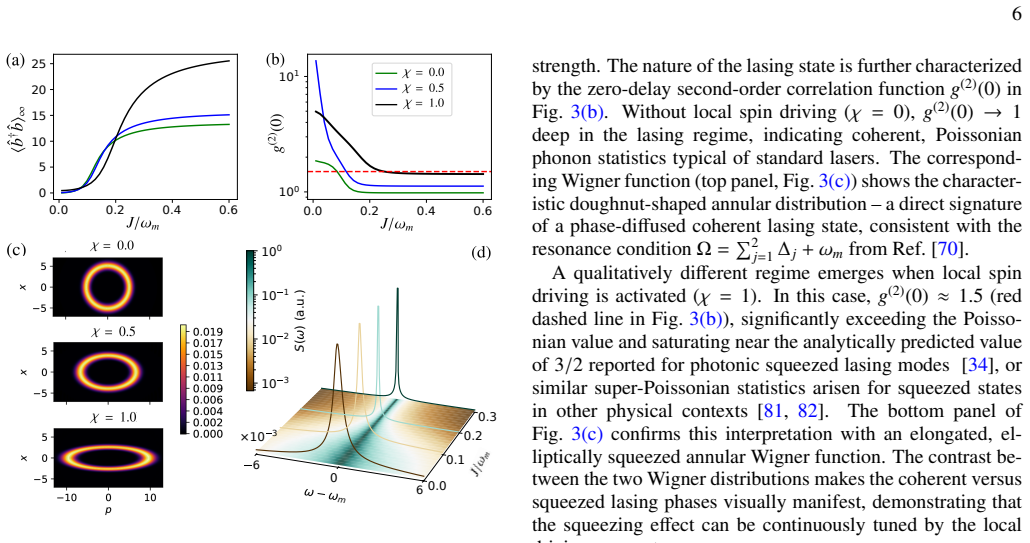
We propose a general Floquet-engineered scheme for phonon lasing that enables a continuous transition from conventional lasing to phase-locked squeezed phonon lasing. Focusing on a solid-state platform based on color centers embedded in a circular hexagonal boron nitride (hBN) membrane, we demonstrate that a mechanical oscillator coupled to principal and ancilla spins, and controlled via effective Floquet driving simultaneously exhibits squeezed-state amplification and cooling dynamics, leading to the emergence of a stable squeezed phonon laser. We analyse the steady-state properties of the system, including the lasing threshold, mechanical occupation, emission spectrum and second-order correlations. Furthermore, we show that Floquet engineering can realize phase-locked lasing while enabling controlled quadrature squeezing, thereby providing a simple yet effective route toward squeezed lasing in quantum mechanical systems. Our results offer new insights into the generation of squeezed phonon lasers in solid-state platforms, with potential applications in quantum metrology.
Editorial analysis
A structured set of objections, weighed in public.
Referee Report
Summary. The manuscript proposes a Floquet-engineered scheme for phonon lasing using color centers in a circular hBN membrane. It claims that effective Floquet driving of a mechanical oscillator coupled to principal and ancilla spins enables a continuous transition from conventional lasing to phase-locked squeezed phonon lasing, with analysis of steady-state properties including the lasing threshold, mechanical occupation, emission spectrum, and second-order correlations.
Significance. If the central claims hold, the work provides a concrete solid-state route to squeezed phonon lasers via Floquet control, with potential relevance to quantum metrology. The simultaneous engineering of squeezing, cooling, and phase-locking in a single effective Hamiltonian is a notable technical feature.
major comments (2)
- [model description / master-equation section] The emergence of the stable squeezed state (abstract and model section) rests on the assumption that Floquet-drive-induced decoherence channels remain negligible compared with the engineered spin-phonon rates. No quantitative bound is supplied using realistic hBN defect T2, membrane Q, or drive-induced heating values to confirm that the required regime is accessible; this inequality is load-bearing for the reported steady-state squeezing and g(2) results.
- [Floquet driving implementation] The claim of a continuous transition to phase-locked squeezed lasing (abstract) is supported only by the effective Floquet Hamiltonian; the manuscript does not show how the additional microwave or optical control fields required for the Floquet modulation are incorporated without introducing new dominant loss channels that would alter the threshold or quadrature squeezing.
minor comments (1)
- [abstract] The abstract states that 'we analyse the steady-state properties' but does not specify the range of drive amplitudes or detunings over which the squeezed-lasing regime is stable; adding this would improve clarity.
Simulated Author's Rebuttal
We thank the referee for their careful review and constructive comments on our manuscript. We address each major point below, agreeing where revisions are needed to strengthen the presentation.
read point-by-point responses
-
Referee: [model description / master-equation section] The emergence of the stable squeezed state (abstract and model section) rests on the assumption that Floquet-drive-induced decoherence channels remain negligible compared with the engineered spin-phonon rates. No quantitative bound is supplied using realistic hBN defect T2, membrane Q, or drive-induced heating values to confirm that the required regime is accessible; this inequality is load-bearing for the reported steady-state squeezing and g(2) results.
Authors: We agree that explicit quantitative bounds are needed to substantiate the regime of validity. In the revised manuscript we will add a dedicated paragraph (and associated figure) in the model section that supplies order-of-magnitude estimates drawn from the hBN defect literature (T2 ≈ 1–10 μs), typical membrane Q factors (10^5–10^6), and reported drive-induced heating rates in similar Floquet experiments. These estimates will demonstrate that the engineered spin-phonon rates can exceed the additional decoherence channels by at least a factor of ten for experimentally accessible drive amplitudes, thereby supporting the reported steady-state squeezing and g(2) values. revision: yes
-
Referee: [Floquet driving implementation] The claim of a continuous transition to phase-locked squeezed lasing (abstract) is supported only by the effective Floquet Hamiltonian; the manuscript does not show how the additional microwave or optical control fields required for the Floquet modulation are incorporated without introducing new dominant loss channels that would alter the threshold or quadrature squeezing.
Authors: The effective Floquet Hamiltonian is derived under the rotating-wave and high-frequency approximations; the concrete control fields are implicit in that derivation. To make the implementation explicit, we will expand the supplementary material (and add a short paragraph in the main text) that specifies the microwave and optical drive frequencies, amplitudes, and polarizations required to realize the periodic modulation. We will also include a brief loss-channel analysis showing that the additional dissipation introduced by these drives remains subdominant to the engineered rates, thereby preserving both the lasing threshold and the quadrature squeezing across the continuous transition. revision: yes
Circularity Check
No circularity: proposal derives from effective Floquet model without self-referential fits or load-bearing self-citations
full rationale
The manuscript presents a theoretical proposal for a Floquet-engineered phonon laser in an hBN membrane system. The abstract and available description outline an effective Hamiltonian plus master equation leading to steady-state squeezing, cooling, and lasing, with analysis of threshold, occupation, spectrum, and g(2). No equations, fitted parameters, or predictions that reduce to inputs by construction are shown. No self-citation chains or uniqueness theorems imported from prior author work are invoked as load-bearing. The derivation chain is therefore self-contained against external benchmarks and receives the default non-finding.
Axiom & Free-Parameter Ledger
Reference graph
Works this paper leans on
-
[1]
(yellow spheres), each interacting with a second spin placed atr 2(r′
-
[2]
A local pe- riodic drive is applied to the second spins
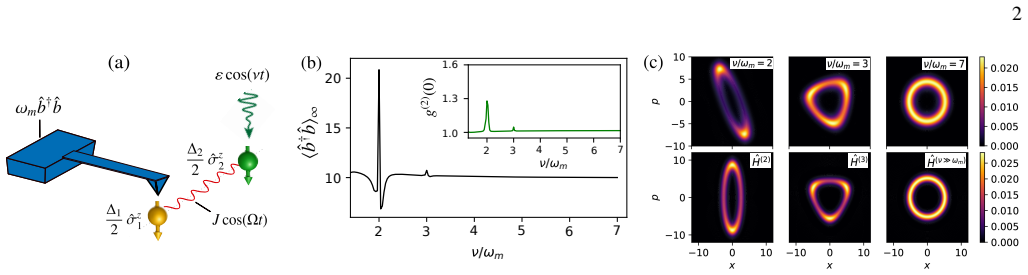
(green spheres) via a driven spin-spin coupling. A local pe- riodic drive is applied to the second spins. Hamiltonian states the amplification of the squeezed mode ˆB. Observe that in the numerical results shown in Fig. 1(b)-(c), we have consideredχ=1 (i.e.ε=ν/2). Therefore, it follows that|u|>|v|(see the Supplementary material for details). Finally, we r...
-
[3]
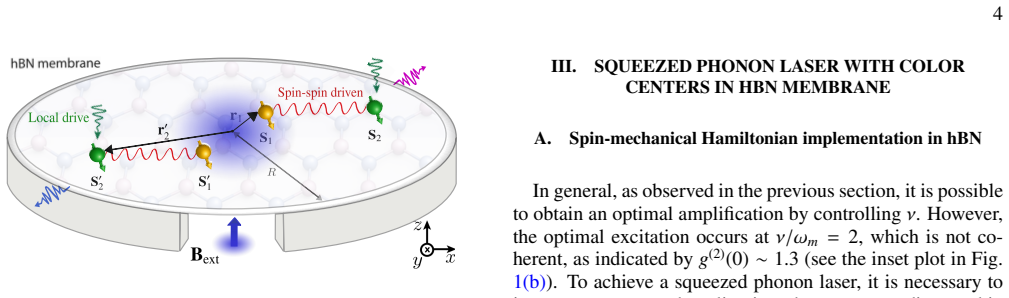
Spin-phonon interaction mediated by the magnetic gradient We consider four spin qubits in a membrane (see Fig. 2): two principal spin qubits,S 1(S2), located at positionsr 1(r2), and two ancillary spin qubits,S ′ 1(S′ 2), located at positions r′ 1(r′ 2), all immersed in an external magnetic fieldBext. The co- herent evolution of the coupled spin-field sys...
-
[4]
(6) can be neglected [50]
Driven spin-spin coupling In general, the spin-dipole interactions between qubits in the Hamiltonian of Eq. (6) can be neglected [50]. This ap- proximation is well justified when the defects are separated by several hundreds of unit cells. While neglecting dipole in- teractions simplifies the noise floor, it poses a challenge for the lasing threshold. To ...
-
[5]
In principle, independent time-periodic electric fields can be applied to individual spins
Local spin drive Finally, as will be discussed below, the realization of squeezed phonon lasing requires the introduction of a local drive. In principle, independent time-periodic electric fields can be applied to individual spins. In practice, however, their close spatial proximity can give rise to cross-talk effects due to the finite spatial extent of t...
-
[6]
The total Hamiltonian To provide a comprehensive overview of our squeezed phonon laser proposal, we introduce the full Hamiltonian, in- cluding all relevant contributions given by Eqs. (6), (7) and (8), in the following form: ˆH=H S +H J +H LD ≡ω m ˆb† ˆb+ ˆHA + ˆHC,(9) where ˆHA( ˆHC) describes the degrees of freedom of the prin- cipal (ancilla) spins em...
-
[7]
The angleθspecifies the direction in phase space along which the fluctuations are evaluated, so that for the Wigner func- tionW(x,p), one has ˆx= ˆX0 and ˆp= ˆXπ/2
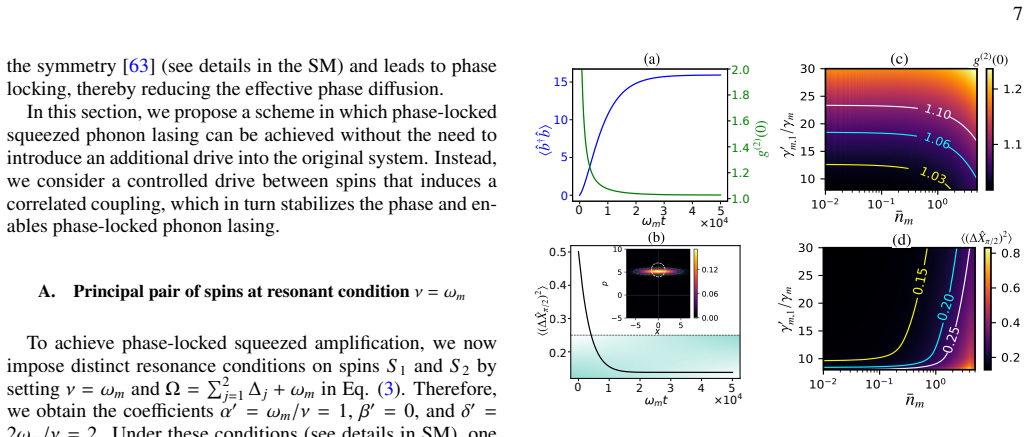
Squeezing witness The degree of squeezing of the phonon mode is quantified by the variance of the generalized quadrature operator ⟨(∆ ˆXθ)2⟩=⟨ ˆX2 θ ⟩ − ⟨ ˆXθ⟩2,(17) where the quadrature is defined as ˆXθ = 1 2 ˆbe−iθ + ˆb†eiθ . The angleθspecifies the direction in phase space along which the fluctuations are evaluated, so that for the Wigner func- tionW(...
-
[8]
Finite temperature effects To investigate the resilience of the squeezed lasing against the detrimental effects of the thermal reservoir, we analyze in Figs. 4(c)-(d) the dependence of the second-order coher- ence function,g (2)(0), and the squeezing witness,⟨(∆ ˆXθ)2⟩, on both the mean thermal phonon number ¯nm and the engineered decay ratioγ ′ m,1/γm. R...
2024
-
[9]
Nanomechanical analog of a laser: Amplification of mechanical oscillations by stimu- lated zeeman transitions,
Igor Bargatin and M. L. Roukes, “Nanomechanical analog of a laser: Amplification of mechanical oscillations by stimu- lated zeeman transitions,” Physical Review Letters91, 138302 (2003)
2003
-
[10]
Vi- brational amplification by stimulated emission of radiation,
S. Wallentowitz, W. V ogel, I. Siemers, and P. E. Toschek, “Vi- brational amplification by stimulated emission of radiation,” Physical Review A54, 943–950 (1996). 9
1996
-
[11]
Phonon superradiance and phonon laser effect in nanomagnets,
E. M. Chudnovsky and D. A. Garanin, “Phonon superradiance and phonon laser effect in nanomagnets,” Physical Review Let- ters93, 257205 (2004)
2004
-
[12]
Dissipation-engineered nonreciprocal phonon laser,
Baijun Li, Tian-Xiang Lu, Le-Man Kuang, Hui Jing, and Chaohong Lee, “Dissipation-engineered nonreciprocal phonon laser,” Phys. Rev. Appl.24, 044032 (2025)
2025
-
[13]
Phase-controlled phonon laser,
Yan-Lei Zhang, Chang-Ling Zou, Chuan-Sheng Yang, Hui Jing, Chun-Hua Dong, Guang-Can Guo, and Xu-Bo Zou, “Phase-controlled phonon laser,” New Journal of Physics20, 093005 (2018)
2018
-
[14]
Phonon laser in the coupled vector cavity optomechanics,
Bao Wang, Hao Xiong, Xiao Jia, and Ying Wu, “Phonon laser in the coupled vector cavity optomechanics,” Scientific Reports 8, 282 (2018)
2018
-
[15]
Prototype of a phonon laser with trapped ions,
Chen-Yu Lee, Kuan-Ting Lin, and Guin-Dar Lin, “Prototype of a phonon laser with trapped ions,” Physical Review Research5, 023082 (2023)
2023
-
[16]
Magnomechanical phonon laser beyond the steady state,
Saeid Vashahri-Ghamsari, Qing Lin, Bing He, and Min Xiao, “Magnomechanical phonon laser beyond the steady state,” Phys. Rev. A104, 033511 (2021)
2021
-
[17]
Phonon maser stimulated by spin postselection,
Vitalie Eremeev and Miguel Orszag, “Phonon maser stimulated by spin postselection,” Phys. Rev. A101, 063815 (2020)
2020
-
[18]
Simultaneous photon and phonon lasing from pumping optomechanical systems with a two-tone field,
Vitalie Eremeev, Hugo Molinares, Luis A. Correa, and Bing He, “Simultaneous photon and phonon lasing from pumping optomechanical systems with a two-tone field,” Adv. Quant. Techn.8, 2400497 (2024)
2024
-
[19]
Quantum-interference-enhanced phonon laser in cavity optomechanics,
Changyong Lei and Jie Ren, “Quantum-interference-enhanced phonon laser in cavity optomechanics,” Phys. Rev. Appl.19, 054093 (2023)
2023
-
[20]
Proposal for a phonon laser utilizing quantum-dot spin states,
A. Khaetskii, V . N. Golovach, X. Hu, and I. ˇZuti´c, “Proposal for a phonon laser utilizing quantum-dot spin states,” Phys. Rev. Lett.111, 186601 (2013)
2013
-
[21]
David Baur, Tanja Behrle, Ivan Rojkov, Jan Jeske, Susanne Yelin, Jonathan Home, and Florentin Reiter, “Quantum theory for phonon lasing and non-classical state generation in mixed- species and single trapped ions,” (2026), arXiv:2604.18295
Pith/arXiv arXiv 2026
-
[22]
Stimulated phonon emission,
W. E. Bron and W. Grill, “Stimulated phonon emission,” Phys- ical Review Letters40, 1459 (1978)
1978
-
[23]
Stimulated emission of phonons in an acoustical cavity,
P. A. Fokker, J. I. Dijkhuis, and H. W. de Wijn, “Stimulated emission of phonons in an acoustical cavity,” Phys. Rev. B55, 2925–2933 (1997)
1997
-
[24]
A phonon laser,
Kerry Vahala, Markus Herrmann, Stefan Kn ¨unz, Valentin Bat- teiger, G ¨unter Saathoff, Theodor W. H ¨ansch, and Theodor Udem, “A phonon laser,” Nature Physics5, 682 (2009)
2009
-
[25]
Phonon laser action in a tunable two-level system,
Ivan S. Grudinin, Hansuek Lee, O. Painter, and Kerry J. Vahala, “Phonon laser action in a tunable two-level system,” Phys. Rev. Lett.104, 083901 (2010)
2010
-
[26]
A phonon laser operating at an exceptional point,
Jing Zhang, Bo Peng, S ¸ahin Kaya ¨Ozdemir, Kevin Pichler, Dmitry O. Krimer, Guangming Zhao, Franco Nori, Yu-Xi Liu, Stefan Rotter, and Lan Yang, “A phonon laser operating at an exceptional point,” Nature Photonics12, 479–484 (2018)
2018
-
[27]
An electrically pumped phonon-polariton laser,
Keita Ohtani, Bo Meng, Martin Francki ´e, Lorenzo Bosco, Camille Ndebeka-Bandou, Mattias Beck, and J ´erˆome Faist, “An electrically pumped phonon-polariton laser,” Science Ad- vances5, eaau1632 (2019)
2019
-
[28]
An optical tweezer phonon laser,
Robert M. Pettit, Wenchao Ge, P. Kumar, Danika R. Luntz- Martin, Justin T. Schultz, Levi P. Neukirch, Mishkat Bhat- tacharya, and A. Nick Vamivakas, “An optical tweezer phonon laser,” Nature Photonics13, 402 (2019)
2019
-
[29]
Floquet phonon lasing in multimode optomechanical systems,
Laura Mercad ´e, Karl Pelka, Roel Burgwal, Andr´e Xuereb, Ale- jandro Mart´ınez, and Ewold Verhagen, “Floquet phonon lasing in multimode optomechanical systems,” Phys. Rev. Lett.127, 073601 (2021)
2021
-
[30]
Polariton-driven phonon laser,
D. L. Chafatinos, A. S. Kuznetsov, S. Anguiano, A. E. Bruch- hausen, A. A. Reynoso, K. Biermann, P. V . Santos, and A. Fainstein, “Polariton-driven phonon laser,” Nature Commu- nications11, 4552 (2020)
2020
-
[31]
Dissipative coupling-induced phonon lasing,
Qiankun Zhang, Cheng Yang, Jiteng Sheng, and Haibin Wu, “Dissipative coupling-induced phonon lasing,” Proceedings of the National Academy of Sciences119, e2207543119 (2022)
2022
-
[32]
Phonon laser in the quantum regime,
Tanja Behrle, Thanh Long Nguyen, Florentin Reiter, David Baur, Brennan de Neeve, Martin Stadler, Matteo Marinelli, Francesco Lancellotti, Susanne F. Yelin, and Jonathan P. Home, “Phonon laser in the quantum regime,” Physical Review Letters 131, 043605 (2023)
2023
-
[33]
Laser2: A two-domain photon–phonon laser,
Ning Wang, He Wen, Juan Carlos Alvarado Zacarias, Jose En- rique Antonio-Lopez, Yuanhang Zhang, Daniel Cruz Delgado, Pierre Sillard, Axel Sch ¨ulzgen, Bahaa E. A. Saleh, Rodrigo Amezcua-Correa, and Guifang Li, “Laser2: A two-domain photon–phonon laser,” Science Advances9, eadg7841 (2023)
2023
-
[34]
Nonlinear multi-frequency phonon lasers with active levitated optomechanics,
Tengfang Kuang, Ran Huang, Wei Xiong, Yunlan Zuo, Xiang Han, Franco Nori, Cheng-Wei Qiu, Hui Luo, Hui Jing, and Guangzong Xiao, “Nonlinear multi-frequency phonon lasers with active levitated optomechanics,” Nature Physics19, 414 (2023)
2023
-
[35]
Photon–phonon collaboratively pumped laser,
Yu Fu, Fei Liang, Cheng He, Haohai Yu, Huaijin Zhang, and Yan-Feng Chen, “Photon–phonon collaboratively pumped laser,” Nature Communications14, 8110 (2023)
2023
-
[36]
Phonon and photon lasing dynam- ics in optomechanical cavities,
Jian Xiong, Zhilei Huang, Kaiyu Cui, Xue Feng, Fang Liu, Wei Zhang, and Yidong Huang, “Phonon and photon lasing dynam- ics in optomechanical cavities,” Fundamental Research3, 37 (2023)
2023
-
[37]
Ultra-stable phonon laser through closed- loop feedback control for optomechanical sensing,
Ziwen Pan, Yi Yang, Wenyao Liu, Enbo Xing, Yanru Zhou, Jun Tang, and Jun Liu, “Ultra-stable phonon laser through closed- loop feedback control for optomechanical sensing,” Laser & Photonics Reviews18, 2400593 (2024)
2024
-
[38]
Injection locking of a trapped-ion phonon laser,
S. Kn ¨unz, M. Herrmann, V . Batteiger, G. Saathoff, T. W. H¨ansch, K. Vahala, and Th. Udem, “Injection locking of a trapped-ion phonon laser,” Phys. Rev. Lett.105, 013004 (2010)
2010
-
[39]
Analysis of radiation-pressure induced mechanical os- cillation of an optical microcavity,
T. J. Kippenberg, H. Rokhsari, T. Carmon, A. Scherer, and K. J. Vahala, “Analysis of radiation-pressure induced mechanical os- cillation of an optical microcavity,” Physical Review Letters95, 033901 (2005)
2005
-
[40]
Backaction limits on self- sustained optomechanical oscillations,
Menno Poot, King Yan Fong, Mahmood Bagheri, Wolfram H. P. Pernice, and Hong X. Tang, “Backaction limits on self- sustained optomechanical oscillations,” Physical Review A86, 053826 (2012)
2012
-
[41]
Inducing nonclassical lasing via periodic driv- ings in circuit quantum electrodynamics,
Carlos Navarrete-Benlloch, Juan Jos ´e Garc ´ıa-Ripoll, and Diego Porras, “Inducing nonclassical lasing via periodic driv- ings in circuit quantum electrodynamics,” Phys. Rev. Lett.113, 193601 (2014)
2014
-
[42]
Squeezed lasing,
Carlos S ´anchez Mu ˜noz and Dieter Jaksch, “Squeezed lasing,” Phys. Rev. Lett.127, 183603 (2021)
2021
-
[43]
Broad- band amplitude squeezing at room temperature in electrically driven quantum dot lasers,
Shiyuan Zhao, Shihao Ding, Heming Huang, Isabelle Zaquine, Nicolas Fabre, Nadia Belabas, and Fr ´ed´eric Grillot, “Broad- band amplitude squeezing at room temperature in electrically driven quantum dot lasers,” Phys. Rev. Res.6, L032021 (2024)
2024
-
[44]
Reservoir-engineered squeezed lasing through the parametric coupling,
Yuhang Tian, Yajun Wang, Weijie Wang, Xiaocong Sun, Yuhang Li, Shaoping Shi, Long Tian, and Yaohui Zheng, “Reservoir-engineered squeezed lasing through the parametric coupling,” Phys. Rev. Lett.134, 243803 (2025)
2025
-
[45]
Strong broadband intensity noise squeezing from in- frared to terahertz frequencies in lasers with nonlinear dissipa- tion,
Sahil Pontula, Jamison Sloan, Nicholas Rivera, and Marin Soljaˇci´c, “Strong broadband intensity noise squeezing from in- frared to terahertz frequencies in lasers with nonlinear dissipa- tion,” Nanophotonics14, 3243 (2025)
2025
-
[46]
Quantum metrol- 10 ogy with strongly interacting spin systems,
Hengyun Zhou, Joonhee Choi, Soonwon Choi, Renate Landig, Alexander M. Douglas, Junichi Isoya, Fedor Jelezko, Shinobu Onoda, Hitoshi Sumiya, Paola Cappellaro, Helena S. Knowles, Hongkun Park, and Mikhail D. Lukin, “Quantum metrol- 10 ogy with strongly interacting spin systems,” Phys. Rev. X10, 031003 (2020)
2020
-
[47]
Light- mediated strong coupling between a mechanical oscillator and atomic spins 1 meter apart,
Thomas M. Karg, Baptiste Gouraud, Chun Tat Ngai, Gian-Luca Schmid, Klemens Hammerer, and Philipp Treutlein, “Light- mediated strong coupling between a mechanical oscillator and atomic spins 1 meter apart,” Science369, 174 (2020)
2020
-
[48]
Phase sensing beyond the standard quantum limit with a variation on the su(1,1) interferometer,
Brian E. Anderson, Prasoon Gupta, Bonnie L. Schmittberger, Travis Horrom, Carla Hermann-Avigliano, Kevin M. Jones, and Paul D. Lett, “Phase sensing beyond the standard quantum limit with a variation on the su(1,1) interferometer,” Optica4, 752 (2017)
2017
-
[49]
Continuous force and displacement measurement below the standard quantum limit,
D. Mason, J. Chen, M. Rossi, Y . Tsaturyan, and A. Schliesser, “Continuous force and displacement measurement below the standard quantum limit,” Nat. Phys.15, 745 (2019)
2019
-
[50]
Ramsey spectroscopy with nonclassical light sources,
Girish S. Agarwal and Marlan O. Scully, “Ramsey spectroscopy with nonclassical light sources,” Phys. Rev. A53, 467 (1996)
1996
-
[51]
Squeezed-light- enhanced atom interferometry below the standard quantum limit,
Stuart S. Szigeti, Behnam Tonekaboni, Wing Yung S. Lau, Samantha N. Hood, and Simon A. Haine, “Squeezed-light- enhanced atom interferometry below the standard quantum limit,” Phys. Rev. A90, 063630 (2014)
2014
-
[52]
Quantum metrology with nonclassical states of atomic ensembles,
Luca Pezz `e, Augusto Smerzi, Markus K. Oberthaler, Roman Schmied, and Philipp Treutlein, “Quantum metrology with nonclassical states of atomic ensembles,” Rev. Mod. Phys.90, 035005 (2018)
2018
-
[53]
Electron–phonon–photon excitation in steady non- linear lasing,
Fei Liang, Cheng He, Haohai Yu, Huaijin Zhang, and Yan- Feng Chen, “Electron–phonon–photon excitation in steady non- linear lasing,” Nature Physics21, 1905 (2025)
1905
-
[54]
Entanglement- enhanced optomechanical sensing,
Y . Xia, A. R. Agrawal, C. M. Pluchar, A. J. Brady, Z. Liu, Q. Zhuang, D. J. Wilson, and Z. Zhang, “Entanglement- enhanced optomechanical sensing,” Nat. Photonics17, 470 (2023)
2023
-
[55]
Overcoming detection loss and noise in squeezing-based opti- cal sensing,
G. Frascella, S. Agne, F. Ya. Khalili, and M. V . Chekhova, “Overcoming detection loss and noise in squeezing-based opti- cal sensing,” npj Quantum Inf.7, 72 (2021)
2021
-
[56]
Enhanced sensitivity of photodetection via quan- tum illumination,
Seth Lloyd, “Enhanced sensitivity of photodetection via quan- tum illumination,” Science321, 1463 (2008)
2008
-
[57]
Phonon-induced spin-spin interactions in dia- mond nanostructures: Application to spin squeezing,
S. D. Bennett, N. Y . Yao, J. Otterbach, P. Zoller, P. Rabl, and M. D. Lukin, “Phonon-induced spin-spin interactions in dia- mond nanostructures: Application to spin squeezing,” Phys. Rev. Lett.110, 156402 (2013)
2013
-
[58]
Spin-mechanical scheme with color centers in hexagonal boron nitride membranes,
Mehdi Abdi, Myung-Joong Hwang, Mortaza Aghtar, and Mar- tin B. Plenio, “Spin-mechanical scheme with color centers in hexagonal boron nitride membranes,” Phys. Rev. Lett.119, 233602 (2017)
2017
-
[59]
Spin squeezing in an ensemble of nitrogen–vacancy centres in diamond,
Weijie Wu, Emily J. Davis, Lillian B. Hughes, B. Ye, Zilin Wang, Dominik S. Kufel, Tasuku Ono, S. Meynell, Maxwell Block, Che Liu, Haopu Yang, Ania C. Bleszynski Jayich, and N. Yao, “Spin squeezing in an ensemble of nitrogen–vacancy centres in diamond,” Nature646, 74 (2025)
2025
-
[60]
Phonon cooling and lasing with nitrogen-vacancy cen- ters in diamond,
K. V . Kepesidis, S. D. Bennett, S. Portolan, M. D. Lukin, and P. Rabl, “Phonon cooling and lasing with nitrogen-vacancy cen- ters in diamond,” Phys. Rev. B88, 064105 (2013)
2013
-
[61]
Spin defects in hBN as promising temperature, pressure and magnetic field quantum sensors,
Andreas Gottscholl, Matthias Diez, V . Soltamov, C. Kasper, Dominik Krausse, A. Sperlich, M. Kianinia, C. Bradac, I. Aharonovich, and V . Dyakonov, “Spin defects in hBN as promising temperature, pressure and magnetic field quantum sensors,” Nature Communications12, 4480 (2021)
2021
-
[62]
Extending the coherence of spin defects in hBN enables advanced qubit control and quantum sensing,
R. Rizzato, M. Schalk, Stephan Mohr, Jens C. Hermann, Joachim P. Leibold, Fleming Bruckmaier, Giovanna Salvitti, C. Qian, Peirui Ji, G. Astakhov, U. Kentsch, M. Helm, A. Stier, J. Finley, and D. Bucher, “Extending the coherence of spin defects in hBN enables advanced qubit control and quantum sensing,” Nature Communications14, 5089 (2023)
2023
-
[63]
Generation of phonon quantum states and quantum correlations among single photon emitters in hexagonal boron nitride,
Hugo Molinares, Fernanda Pinilla, Enrique Mu ˜noz, Francisco Mu˜noz, and Vitalie Eremeev, “Generation of phonon quantum states and quantum correlations among single photon emitters in hexagonal boron nitride,” EPJ Quantum Technology11, 75 (2024)
2024
-
[64]
Stabilizing entanglement of boron-vacancy de- fects in a hexagonal boron-nitride membrane by two-phonon driving,
Yi-Fan Qiao, Xue-Feng Pan, Xiao-Yu Yao, Xin-Lei Hei, and Peng-Bo Li, “Stabilizing entanglement of boron-vacancy de- fects in a hexagonal boron-nitride membrane by two-phonon driving,” Phys. Rev. A111, 022616 (2025)
2025
-
[65]
Bath-free squeezed phonon lasing via intrinsic ion-phonon coupling,
Chen-Yu Lee and Guin-Dar Lin, “Bath-free squeezed phonon lasing via intrinsic ion-phonon coupling,” (2026), arXiv:2601.05575
arXiv 2026
-
[66]
Tanja Behrle,A phonon laser in the quantum regime, Doctoral thesis, ETH Zurich (2025)
2025
-
[67]
A two-mode thermomechanically squeezed phonon laser,
K. Zhang, K. Xiao, M. Bhattacharya, and A. N. Vamivakas, “A two-mode thermomechanically squeezed phonon laser,” Nat. Commun.17, 2882 (2026)
2026
-
[68]
Quantum sensing and imaging with spin defects in hexagonal boron nitride,
Sumukh Vaidya, Xingyu Gao, S. Dikshit, I. Aharonovich, and Tongcang Li, “Quantum sensing and imaging with spin defects in hexagonal boron nitride,” Advances in Physics: X8(2023)
2023
-
[69]
Uni- versal high-frequency behavior of periodically driven systems: from dynamical stabilization to floquet engineering,
Marin Bukov, Luca D’Alessio, and Anatoli Polkovnikov, “Uni- versal high-frequency behavior of periodically driven systems: from dynamical stabilization to floquet engineering,” Advances in Physics64, 139 (2015)
2015
-
[70]
Quantum emission from hexagonal boron nitride monolayers,
T. T. Tran, K. Bray, M. J. Ford, M. Toth, and I. Aharonovich, “Quantum emission from hexagonal boron nitride monolayers,” Nat. Nanotechnol.11, 37 (2016)
2016
-
[71]
Quantum sens- ing close to a dissipative phase transition: Symmetry break- ing and criticality as metrological resources,
Samuel Fern ´andez-Lorenzo and Diego Porras, “Quantum sens- ing close to a dissipative phase transition: Symmetry break- ing and criticality as metrological resources,” Phys. Rev. A96, 013817 (2017)
2017
-
[72]
A single spin in hexagonal boron nitride for vectorial quantum magnetometry,
Carmem M. Gilardoni, Simone Eizagirre Barker, Catherine L. Curtin, Stephanie A. Fraser, Oliver F. J. Powell, Dillon K. Lewis, Xiaoxi Deng, Andrew J. Ramsay, Sonachand Adhikari, Chi Li, Igor Aharonovich, Hark Hoe Tan, Mete Atat ¨ure, and Hannah L. Stern, “A single spin in hexagonal boron nitride for vectorial quantum magnetometry,” Nature Communications16,...
2025
-
[73]
Quantum sensing with optically accessible spin defects in van der waals layered materials,
Hong-Hua Fang, Xiao-Jie Wang, Xavier Marie, and Hong-Bo Sun, “Quantum sensing with optically accessible spin defects in van der waals layered materials,” Light: Science & Applica- tions13, 303 (2024)
2024
-
[74]
Metrology for 2d materi- als: a perspective review from the international roadmap for de- vices and systems,
Umberto Celano, Daniel Schmidt, Carlos Beitia, George Orji, Albert V . Davydov, and Yaw Obeng, “Metrology for 2d materi- als: a perspective review from the international roadmap for de- vices and systems,” Nanoscale Advances6, 2260–2281 (2024)
2024
-
[75]
Quantum sensing in two dimensional materials,
XiaoJie Wang, YangYi Chen, and Hong-Hua Fang, “Quantum sensing in two dimensional materials,” (2025), arXiv:2508.00731
arXiv 2025
-
[76]
Hybrid mechanical systems,
Philipp Treutlein, Claudiu Genes, Klemens Hammerer, Martino Poggio, and Peter Rabl, “Hybrid mechanical systems,” inCav- ity Optomechanics(Springer Berlin Heidelberg, Berlin, Heidel- berg, 2014) pp. 327–351
2014
-
[77]
Floquet-engineered system-reservoir in- teraction in the transverse field ising model,
Maritza Ahumada, Natalia Valderrama-Quinteros, and Guillermo Romero, “Floquet-engineered system-reservoir in- teraction in the transverse field ising model,” Advanced Quan- tum Technologies8, e00031 (2025)
2025
-
[78]
Scalable phonon-laser arrays with self- organized synchronization,
Hugo Molinares, Guillermo Romero, Victor Montenegro, and Vitalie Eremeev, “Scalable phonon-laser arrays with self- organized synchronization,” (2026), arXiv:2603.29099
arXiv 2026
-
[79]
Heinz-Peter Breuer and Francesco Petruccione,The theory of open quantum systems(Oxford University Press, 2002)
2002
-
[80]
Scully and M
Marlan O. Scully and M. Suhail Zubairy,Quantum Optics (Cambridge University Press, 1997). 11
1997
discussion (0)
Sign in with ORCID, Apple, or X to comment. Anyone can read and Pith papers without signing in.