CMB Bounds on Primordial Black Holes via Radiation Capture
Pith reviewed 2026-06-28 04:52 UTC · model grok-4.3
The pith
Primordial black holes capture cosmic radiation and modify the expansion history, allowing Planck to bound their abundance below 0.1 for masses above 10^15 solar masses.
A machine-rendered reading of the paper's core claim, the machinery that carries it, and where it could break.
Core claim
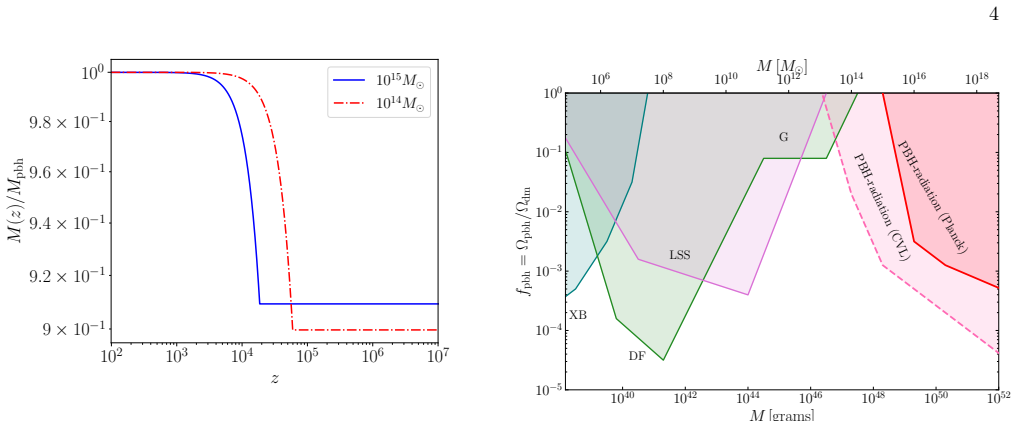
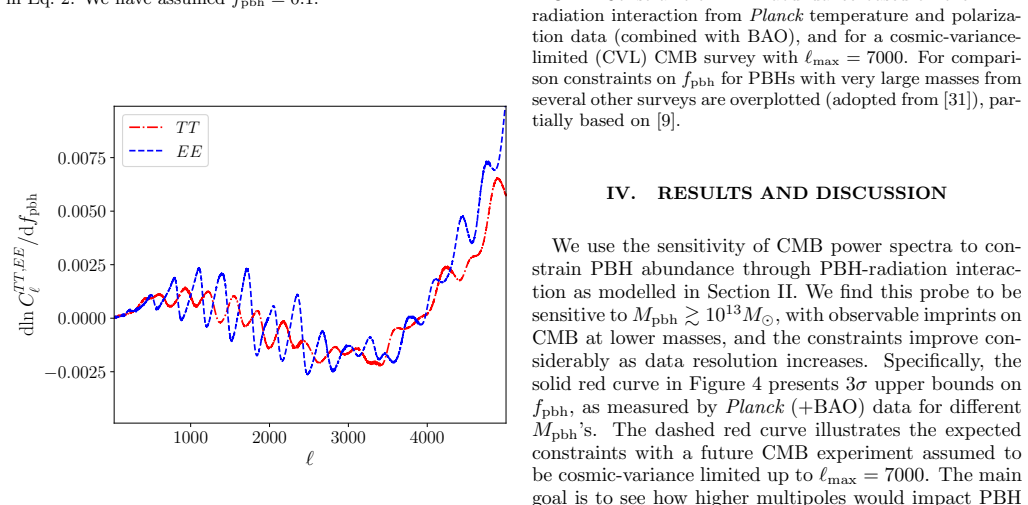
The gravitational capture of neutrinos and photons by primordial black holes modifies the continuity equations for radiation and PBH densities and the cosmic expansion history. The observability of this modified history is highly sensitive to PBH mass, and only extraordinarily massive PBHs leave an observable trace on CMB temperature and E-mode polarization. Planck data restrict PBH abundance to f_pbh less than or equal to 0.1 for masses above 10^15 solar masses, with the bound getting considerably tighter for higher masses. A future cosmic-variance-limited experiment with l_max equal to 7000 would set f_pbh less than or equal to 0.1 down to 8 times 10 to the minus 5 across 10^13 to 10^18 so
What carries the argument
Gravitational capture of background photons and neutrinos, modeled through modifications to the continuity equations for radiation and PBH densities that alter the cosmic expansion history.
If this is right
- Only extraordinarily massive PBHs produce observable effects on CMB temperature and E-mode polarization.
- Planck data set an upper limit of 0.1 on PBH abundance above 10^15 solar masses, tightening at higher masses.
- A cosmic-variance-limited experiment to l_max of 7000 constrains abundance from 0.1 down to 8 times 10 to the minus 5 over 10^13 to 10^18 solar masses.
- The resulting bounds are comparable to existing limits at the high-mass end of the PBH spectrum.
- The radiation-capture process supplies an independent probe of PBH abundance through its effect on cosmic expansion.
Where Pith is reading between the lines
- Higher-multipole CMB data could extend constraints to somewhat lower PBH masses than those reachable with current observations.
- The mass-dependent sensitivity implies that any detected signal would point to a narrow range of very heavy PBHs rather than a broad distribution.
- If the modeled capture rate holds, the bounds would reduce the allowed contribution of these massive objects to the total energy density at late times.
Load-bearing premise
The capture of radiation by PBHs can be represented entirely as a gravitational process that modifies only the continuity equations and expansion history.
What would settle it
A high-resolution measurement of CMB temperature or E-mode polarization spectra at multipoles above 2000 that matches standard Lambda CDM predictions without any excess power or shift attributable to modified expansion from PBH capture in the 10^13 to 10^18 solar mass range.
Figures

read the original abstract
We explore the capture of neutrinos and photons in the cosmic neutrino and photon background by primordial black holes (PBHs). We model this phenomenon as a gravitational interaction that effectively modifies the continuity equations for radiation and PBH densities and the cosmic expansion history. We find that the observability of this modified cosmic history is highly sensitive to PBH mass, and only extraordinarily massive PBHs would leave observable trace on the temperature and E-mode polarization of the cosmic microwave background (CMB). Specifically, Planck data restrict PBH abundance to $f_{\rm pbh}\lesssim 10^{-1}$ for PBH masses above $10^{15} M_\odot$, getting considerably tighter for higher masses. We expect substantial improvement as high-resolution measurements of larger CMB multipoles become available. A future cosmic-variance-limited experiment, with $\ell_{\rm max}=7000$, would set $f_{\rm pbh}\lesssim 10^{-1}-8\times 10^{-5}$ (for the fiducial $\Lambda$CDM cosmology) across $10^{13}-10^{18}M_\odot$. These constraints would be comparable to the current limits at the high-mass end of the spectrum [Carr et al, 2026]. The gravitational interaction of PBHS with the cosmic background radiation and its imprints on CMB would thus provide an independent complementary probe of extraordinarily massive PBH abundance.
Editorial analysis
A structured set of objections, weighed in public.
Referee Report
Summary. The paper models the gravitational capture of cosmic neutrinos and photons by primordial black holes (PBHs) as an effective interaction that modifies the continuity equations for radiation and PBH energy densities together with the cosmic expansion history. It reports that this effect is observable in the CMB temperature and E-mode polarization only for extraordinarily massive PBHs (M ≳ 10^15 M_⊙), derives Planck-based upper limits f_pbh ≲ 10^{-1} that tighten at higher masses, and forecasts stronger constraints from future high-ℓ CMB data up to ℓ_max = 7000.
Significance. If the effective modification to the continuity equations is shown to be a faithful representation of the underlying microphysics, the work supplies an independent CMB probe of the high-mass tail of the PBH mass function that is complementary to existing limits. The projected sensitivity of a cosmic-variance-limited experiment is stated to reach levels comparable to current high-mass bounds.
major comments (1)
- [Abstract / modeling description] The central quantitative bounds rest on the modeling choice that radiation capture can be captured by an effective source term in the continuity equations for ρ_rad and ρ_pbh. No derivation of this effective term, no explicit form of the modified Friedmann or continuity equations, and no numerical implementation or validation against the full Boltzmann hierarchy are provided in the manuscript, making it impossible to assess whether the claimed sensitivity to M > 10^15 M_⊙ is robust or an artifact of the approximation.
Simulated Author's Rebuttal
We thank the referee for their careful reading of the manuscript and for identifying the need for greater transparency in the modeling. We address the major comment below and will revise the manuscript to incorporate the requested details.
read point-by-point responses
-
Referee: [Abstract / modeling description] The central quantitative bounds rest on the modeling choice that radiation capture can be captured by an effective source term in the continuity equations for ρ_rad and ρ_pbh. No derivation of this effective term, no explicit form of the modified Friedmann or continuity equations, and no numerical implementation or validation against the full Boltzmann hierarchy are provided in the manuscript, making it impossible to assess whether the claimed sensitivity to M > 10^15 M_⊙ is robust or an artifact of the approximation.
Authors: We agree that the current manuscript introduces the effective source term without providing a derivation from the underlying capture physics, the explicit modified equations, or details of the numerical implementation and its relation to the Boltzmann hierarchy. In the revised manuscript we will add a dedicated section that (i) derives the effective source term from the gravitational capture rate of photons and neutrinos by PBHs, (ii) writes out the modified continuity and Friedmann equations in full, (iii) describes the numerical implementation, and (iv) discusses the regime of validity of the effective description together with any comparison to the full hierarchy that is feasible. These additions will allow an independent assessment of whether the reported sensitivity to M ≳ 10^15 M_⊙ is robust. revision: yes
Circularity Check
No significant circularity detected
full rationale
The paper introduces a modeling assumption (capture as effective modification to continuity equations) and derives CMB signatures that are then compared directly to external Planck data for bounds on f_pbh. No self-definitional reductions, no parameters fitted to a subset and relabeled as predictions, and no load-bearing self-citations appear in the provided text. The central constraints rest on independent observational input rather than internal re-derivation or ansatz smuggling.
Axiom & Free-Parameter Ledger
axioms (1)
- domain assumption Gravitational interaction of PBHs with cosmic background radiation modifies the continuity equations for radiation and PBH densities and the cosmic expansion history
Reference graph
Works this paper leans on
-
[1]
We therefore getσ γ ≈45π(GM) 2
Using Michel model for the spherical accretion of relativistic fluids, the capture cross section is found to beσ γ = 4πλGR(GM)2c−3 ∞ wherec ∞ is the dimensionless sound speed at infinity andλ GR ≈ 0.7 for a radiation-dominated fluid with adiabatic index Γ = 4/3 [22, 23]. We therefore getσ γ ≈45π(GM) 2. The rate of neutrino or photon capture by a single PB...
2000
-
[2]
B. Carr, A. J. Iovino, G. Perna, V. Vaskonen, and H. Veerm¨ ae, Primordial black holes: constraints, poten- tial evidence and prospects, Nuovo Cimento Rivista Se- rie 10.1007/s40766-026-00080-z (2026), arXiv:2601.06024 [astro-ph.CO]
-
[3]
A. S. Josan, A. M. Green, and K. A. Malik, Gener- alised constraints on the curvature perturbation from pri- mordial black holes, Phys. Rev. D79, 103520 (2009), arXiv:0903.3184 [astro-ph.CO]
Pith/arXiv arXiv 2009
-
[4]
B. J. Carr, K. Kohri, Y. Sendouda, and J. Yokoyama, New cosmological constraints on primordial black holes, Phys. Rev. D81, 104019 (2010)
2010
-
[5]
B. Carr, K. Kohri, Y. Sendouda, and J. Yokoyama, Con- straints on primordial black holes, Rept. Prog. Phys.84, 116902 (2021)
2021
-
[6]
N. Bellomo, J. L. Bernal, A. Raccanelli, and L. Verde, Primordial Black Holes as Dark Matter: Converting Con- straints from Monochromatic to Extended Mass Distri- butions, JCAP01, 004, arXiv:1709.07467 [astro-ph.CO]
-
[7]
B. Carr, M. Raidal, T. Tenkanen, V. Vaskonen, and H. Veerm¨ ae, Primordial black hole constraints for ex- tended mass functions, Phys. Rev. D96, 023514 (2017), arXiv:1705.05567 [astro-ph.CO]
Pith/arXiv arXiv 2017
-
[8]
Sasaki, T
M. Sasaki, T. Suyama, T. Tanaka, and S. Yokoyama, Pri- mordial black holes—perspectives in gravitational wave astronomy, Class. Quant. Grav.35, 063001 (2018)
2018
-
[9]
B. Carr, K. Kohri, Y. Sendouda, and J. Yokoyama, Con- straints on primordial black holes, Rept. Prog. Phys.84, 116902 (2021), arXiv:2002.12778 [astro-ph.CO]
Pith/arXiv arXiv 2021
-
[10]
B. Carr and F. Kuhnel, Primordial Black Holes as Dark Matter: Recent Developments, Ann. Rev. Nucl. Part. Sci. 70, 355 (2020), arXiv:2006.02838 [astro-ph.CO]
Pith/arXiv arXiv 2020
-
[11]
A. M. Green and B. J. Kavanagh, Primordial Black Holes as a dark matter candidate, J. Phys. G48, 043001 (2021), arXiv:2007.10722 [astro-ph.CO]
Pith/arXiv arXiv 2021
-
[12]
J. R. Rice and B. Zhang, Cosmological evolution of primordial black holes, JHEAp13-14, 22 (2017), arXiv:1702.08069 [astro-ph.HE]. 6
arXiv 2017
-
[13]
V. De Luca, G. Franciolini, P. Pani, and A. Riotto, The evolution of primordial black holes and their final ob- servable spins, JCAP04, 052, arXiv:2003.02778 [astro- ph.CO]
arXiv 2003
-
[14]
M. R. Mosbech and Z. S. C. Picker, Effects of Hawking evaporation on PBH distributions, SciPost Phys.13, 100 (2022), arXiv:2203.05743 [astro-ph.HE]
arXiv 2022
-
[15]
S. Nesseris, D. Sapone, and S. Sypsas, Evaporating primordial black holes as varying dark energy, Phys. Dark Univ.27, 100413 (2020), arXiv:1907.05608 [astro- ph.CO]
arXiv 2020
-
[16]
Masina, Dark matter and dark radiation from evap- orating primordial black holes, Eur
I. Masina, Dark matter and dark radiation from evap- orating primordial black holes, Eur. Phys. J. Plus135, 552 (2020), arXiv:2004.04740 [hep-ph]
arXiv 2020
-
[17]
P. S. Custodio and J. E. Horvath, The Evolution of pri- mordial black hole masses in the radiation dominated era, Gen. Rel. Grav.34, 1895 (2002), arXiv:gr-qc/0203031
Pith/arXiv arXiv 2002
-
[18]
S. Safi, M. Farhang, O. Mena, and E. Di Valentino, Semi- blind reconstruction of the history of effective number of neutrinos using CMB data, Phys. Rev. D110, 103513 (2024), arXiv:2404.01457 [astro-ph.CO]
arXiv 2024
-
[19]
Planck Collaboration, Planck 2018 results. VI. Cosmo- logical parameters (Corrigendum), Astronomy and As- trophysics652, C4 (2021)
2018
-
[20]
J. M. Bardeen, Timelike and null geodesics in the Kerr metric, Proceedings, Ecole d’Et´ e de Physique Th´ eorique: Les Astres Occlus : Les Houches, France, August, 1972, 215-240 , 215 (1973)
1972
-
[21]
C. W. Misner, K. S. Thorne, and J. A. Wheeler,Gravi- tation(W. H. Freeman, San Francisco, 1973)
1973
-
[22]
A. F. Zakharov, Capture of photons and slow uncharged particles by a spherically symmetric charged compact body in the relativistic theory of gravitation, Theoret- ical and Mathematical Physics90, 97 (1992)
1992
-
[23]
F. C. Michel, Accretion of Matter by Condensed Objects, Astrophysics and Space Science15, 153 (1972)
1972
-
[24]
A. Aguayo-Ortiz, E. Tejeda, O. Sarbach, and D. L´ opez- C´ amara, Spherical accretion: Bondi, Michel, and rotat- ing black holes, Mon. Not. Roy. Astron. Soc.504, 5039 (2021), arXiv:2102.12529 [astro-ph.HE]
arXiv 2021
-
[25]
Amendola, Coupled quintessence, Phys
L. Amendola, Coupled quintessence, Phys. Rev. D62, 043511 (2000), arXiv:astro-ph/9908023
Pith/arXiv arXiv 2000
-
[26]
J. Valiviita, E. Majerotto, and R. Maartens, Instability in interacting dark energy and dark matter fluids, JCAP 07, 020, arXiv:0804.0232 [astro-ph]
-
[27]
Y. L. Bolotin, A. Kostenko, O. A. Lemets, and D. A. Yerokhin, Cosmological Evolution With Interaction Be- tween Dark Energy And Dark Matter, Int. J. Mod. Phys. D24, 1530007 (2014), arXiv:1310.0085 [astro-ph.CO]
Pith/arXiv arXiv 2014
-
[28]
B. Wang, E. Abdalla, F. Atrio-Barandela, and D. Pavon, Dark Matter and Dark Energy Interactions: Theoreti- cal Challenges, Cosmological Implications and Observa- tional Signatures, Rept. Prog. Phys.79, 096901 (2016), arXiv:1603.08299 [astro-ph.CO]
Pith/arXiv arXiv 2016
-
[29]
M. W. Choptuik, Universality and scaling in gravita- tional collapse of a massless scalar field, Phys. Rev. Lett. 70, 9 (1993)
1993
-
[30]
C. R. Evans and J. S. Coleman, Observation of criti- cal phenomena and selfsimilarity in the gravitational col- lapse of radiation fluid, Phys. Rev. Lett.72, 1782 (1994), arXiv:gr-qc/9402041
Pith/arXiv arXiv 1994
-
[31]
J. C. Niemeyer and K. Jedamzik, Near-critical gravi- tational collapse and the initial mass function of pri- mordial black holes, Phys. Rev. Lett.80, 5481 (1998), arXiv:astro-ph/9709072
Pith/arXiv arXiv 1998
-
[32]
B. Carr, F. Kuhnel, and L. Visinelli, Constraints on Stu- pendously Large Black Holes, Mon. Not. Roy. Astron. Soc.501, 2029 (2021), arXiv:2008.08077 [astro-ph.CO]
arXiv 2029
-
[33]
A. Lewis, A. Challinor, and A. Lasenby, Efficient com- putation of CMB anisotropies in closed FRW models, Astrophys. J.538, 473 (2000), arXiv:astro-ph/9911177
Pith/arXiv arXiv 2000
-
[34]
A. Lewis and S. Bridle, Cosmological parameters from CMB and other data: A Monte Carlo approach, Phys. Rev. D66, 103511 (2002), arXiv:astro-ph/0205436
Pith/arXiv arXiv 2002
-
[35]
Planck Collaboration, Planck 2018 results. X. Con- straints on inflation, Astronomy and Astrophysics641, A10 (2020), arXiv:1807.06211 [astro-ph.CO]
Pith/arXiv arXiv 2018
-
[36]
F. Beutler, C. Blake, M. Colless, D. H. Jones, L. Staveley- Smith, L. Campbell, Q. Parker, W. Saunders, and F. Watson, The 6dF Galaxy Survey: Baryon Acous- tic Oscillations and the Local Hubble Constant, Mon. Not. Roy. Astron. Soc.416, 3017 (2011), arXiv:1106.3366 [astro-ph.CO]
Pith/arXiv arXiv 2011
-
[37]
A. J. Ross, L. Samushia, C. Howlett, W. J. Percival, A. Burden, and M. Manera, The clustering of the SDSS DR7 main Galaxy sample – I. A 4 per cent distance mea- sure atz= 0.15, Mon. Not. Roy. Astron. Soc.449, 835 (2015), arXiv:1409.3242 [astro-ph.CO]
Pith/arXiv arXiv 2015
-
[38]
S. Alamet al.(BOSS), The clustering of galaxies in the completed SDSS-III Baryon Oscillation Spectroscopic Survey: cosmological analysis of the DR12 galaxy sam- ple, Mon. Not. Roy. Astron. Soc.470, 2617 (2017), arXiv:1607.03155 [astro-ph.CO]
Pith/arXiv arXiv 2017
-
[39]
L. Chen, Q.-G. Huang, and K. Wang, Constraint on the abundance of primordial black holes in dark mat- ter from Planck data, JCAP12, 044, arXiv:1608.02174 [astro-ph.CO]
-
[40]
Y. Ali-Ha¨ ımoud and M. Kamionkowski, Cosmic mi- crowave background limits on accreting primordial black holes, Phys. Rev. D95, 043534 (2017), arXiv:1612.05644 [astro-ph.CO]
Pith/arXiv arXiv 2017
discussion (0)
Sign in with ORCID, Apple, or X to comment. Anyone can read and Pith papers without signing in.