Compressed Gaussian likelihood for the Planck low-ell data
Pith reviewed 2026-06-28 04:45 UTC · model grok-4.3
The pith
An offset log-normal form compresses the non-Gaussian SRoll2 Planck low-ℓ likelihood into a Gaussian proxy usable for both MCMC and Fisher analyses.
A machine-rendered reading of the paper's core claim, the machinery that carries it, and where it could break.
Core claim
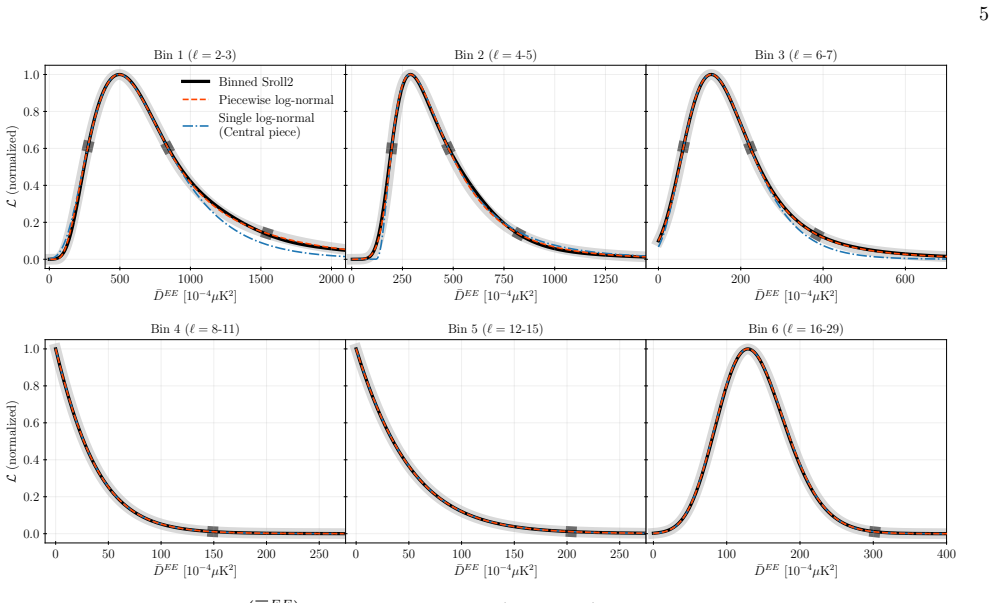
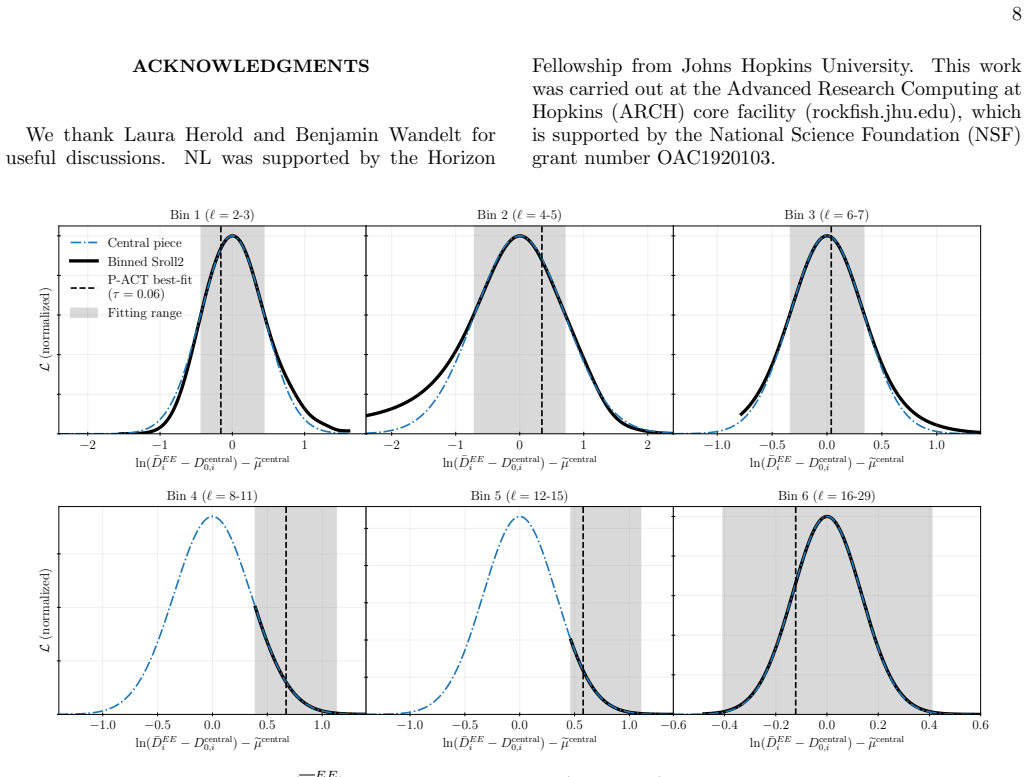
The chi-squared of an offset log-normal likelihood takes a Gaussian form in the log-transformed power spectrum amplitudes and can therefore serve as a proxy for the true Gaussian likelihood of this variable in Fisher matrix analyses without any explicit change of variables; building on this, the SRoll2 likelihood is compressed into a small number of piecewise offset log-normal functions that reproduce the full likelihood constraints in MCMC and yield matching Fisher uncertainties.
What carries the argument
Piecewise offset log-normal functions that make the chi-squared Gaussian in log power-spectrum amplitudes, allowing direct use in analyses that require an analytic Gaussian form.
If this is right
- The compressed form can be inserted directly into Fisher-bias calculations and Fisher forecasts that demand an analytic Gaussian chi-squared.
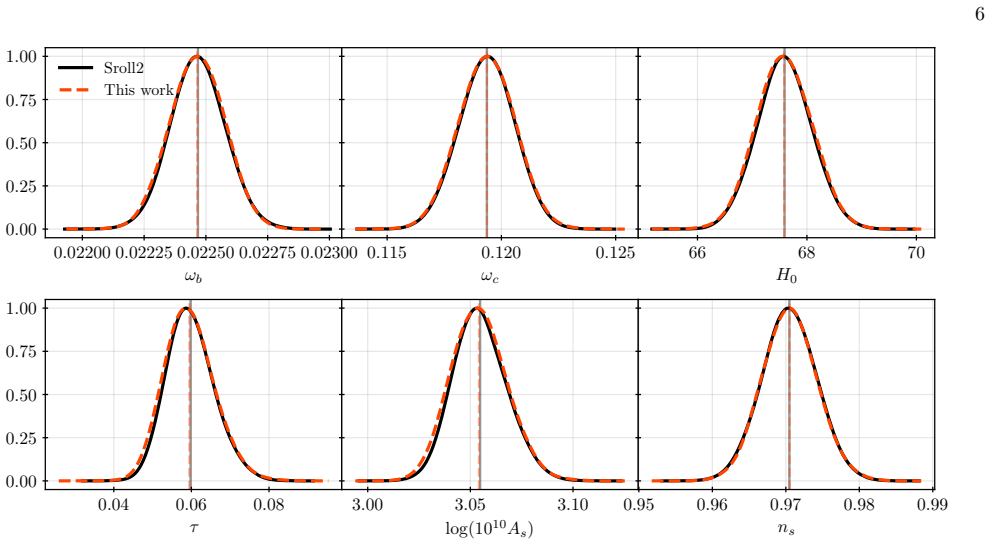
- MCMC constraints on LambdaCDM and extended models remain consistent with the full SRoll2 likelihood when the compressed version is combined with Planck and ACT DR6 data.
- Fisher-matrix uncertainty estimates from the compressed likelihood agree with the full MCMC posteriors across the tested parameters.
- The released planck-gaussian-lowl package supplies both the new low-ℓ EE compression and the earlier TT compression for immediate use in any Gaussian-likelihood pipeline.
Where Pith is reading between the lines
- The same log-normal compression technique could be tested on other non-Gaussian low-ℓ or large-scale-structure likelihoods that currently block analytic Fisher work.
- Because the form is lightweight, it may enable rapid re-derivation of Fisher matrices when survey specifications change during mission planning.
- The agreement between Fisher and MCMC opens the possibility of using the compressed likelihood for quick bias checks in analyses that mix low-ℓ polarization with high-ℓ or external datasets.
Load-bearing premise
The offset log-normal approximation and its piecewise compression preserve the full information content of the SRoll2 likelihood without introducing parameter biases.
What would settle it
An MCMC run with the compressed likelihood that produces a statistically significant shift in the posterior for tau or any other LambdaCDM parameter relative to the full SRoll2 likelihood.
Figures

read the original abstract
We present a compressed Gaussian likelihood for the Planck CMB low-$\ell$ E-mode polarization data, constructed from the SRoll2 likelihood which provides the tightest constraint on the reionization optical depth $\tau$ to date. The non-Gaussian form of CMB low-$\ell$ TT and EE likelihoods makes them incompatible with Fisher matrix analyses that require an analytic Gaussian $\chi^2$, such as the Fisher-bias formalism and Fisher forecasts. We show that the $\chi^2$ of an offset log-normal likelihood takes a Gaussian form in the log-transformed power spectrum amplitudes, and can therefore serve as a proxy for the true Gaussian likelihood of this variable in Fisher matrix analyses, without any explicit change of variables. Building on this, we compress the SRoll2 likelihood into a small number of piecewise offset log-normal functions and validate it against the full SRoll2 likelihood via MCMC combined with Planck and ACT DR6 data, finding excellent agreement across all $\Lambda$CDM parameters and in extended cosmological models. We further demonstrate that Fisher matrix uncertainty estimates from our compressed likelihood agree well with the full MCMC posteriors. We release our compressed likelihood planck-gaussian-lowl, a lightweight Python package incorporating the compressed low-$\ell$ TT likelihood from previous work, allowing a straightforward incorporation of the Planck CMB low-$\ell$ data into any Gaussian-likelihood-based analysis. The package is publicly available at \href{https://github.com/nanoomlee/planck-gaussian-lowl}{github.com/nanoomlee/planck-gaussian-lowl}.
Editorial analysis
A structured set of objections, weighed in public.
Referee Report
Summary. The paper constructs a compressed Gaussian likelihood for Planck low-ℓ TT/EE data starting from the non-Gaussian SRoll2 likelihood. It shows that the χ² of an offset log-normal form becomes exactly Gaussian when expressed in log(C_ℓ) amplitudes, allowing direct use in Fisher-matrix calculations without an explicit variable change. The SRoll2 likelihood is then approximated by a small number of piecewise offset log-normal pieces; the resulting compressed likelihood is validated by MCMC (combined with Planck+ACT DR6) against the full SRoll2 likelihood and shown to produce statistically indistinguishable ΛCDM and extended-model posteriors. Fisher-matrix error bars from the compressed form are also reported to match the MCMC posterior widths. A lightweight Python package implementing the compressed likelihood is released.
Significance. If the reported MCMC and Fisher validations hold, the work supplies a practical, lightweight Gaussian proxy for the Planck low-ℓ data that can be dropped into any Fisher-based pipeline (Fisher-bias formalism, forecasts, etc.) while preserving the tight τ constraint of SRoll2. The explicit numerical agreement between compressed and full likelihoods on both MCMC posteriors and Fisher uncertainties is a concrete strength that directly addresses the central usability claim.
major comments (2)
- [§3] §3 (validation section): the statement that Fisher uncertainties 'agree well' with MCMC posterior widths is central to the claim that the compressed form can replace the full likelihood in Fisher analyses, yet no quantitative metric (e.g., fractional difference per parameter, or table of σ_Fisher/σ_MCMC ratios) is provided; without it the agreement remains qualitative.
- [method section] Eq. (X) defining the piecewise offset log-normal χ²: the number and placement of the piecewise knots appear to be chosen after inspecting the SRoll2 likelihood; the manuscript should demonstrate that the final parameter constraints are insensitive to reasonable variations in knot placement, or state the selection criterion explicitly.
minor comments (3)
- [abstract] The abstract and introduction use 'excellent agreement' without defining the threshold; a sentence quantifying the maximum parameter shift (in σ) between compressed and full likelihoods would make the claim reproducible.
- [conclusions] The released package is mentioned but no example script or notebook demonstrating its use inside a Fisher-matrix code is provided; adding one would increase immediate utility.
- [§2] Notation: the symbol for the offset parameter in the log-normal form is introduced without an explicit equation reference in the main text; a short equation block would clarify the mapping to the Gaussian χ².
Simulated Author's Rebuttal
We thank the referee for their constructive comments and positive recommendation. We address each major comment below and will revise the manuscript to incorporate the suggested improvements.
read point-by-point responses
-
Referee: [§3] §3 (validation section): the statement that Fisher uncertainties 'agree well' with MCMC posterior widths is central to the claim that the compressed form can replace the full likelihood in Fisher analyses, yet no quantitative metric (e.g., fractional difference per parameter, or table of σ_Fisher/σ_MCMC ratios) is provided; without it the agreement remains qualitative.
Authors: We agree that the current description of the agreement is qualitative. In the revised manuscript we will add a table in §3 reporting the ratio σ_Fisher/σ_MCMC (and fractional differences) for each cosmological parameter in both ΛCDM and extended models, thereby providing a quantitative metric. revision: yes
-
Referee: [method section] Eq. (X) defining the piecewise offset log-normal χ²: the number and placement of the piecewise knots appear to be chosen after inspecting the SRoll2 likelihood; the manuscript should demonstrate that the final parameter constraints are insensitive to reasonable variations in knot placement, or state the selection criterion explicitly.
Authors: The number and locations of the knots were selected by minimizing the Kullback-Leibler divergence between the compressed and SRoll2 likelihoods over the relevant parameter ranges while keeping the total number of pieces small. We will state this explicit selection criterion in the methods section of the revised manuscript. We will also add a short robustness test showing that the final MCMC posteriors change by less than 0.1σ when the knot positions are shifted by ±10% within each piece. revision: yes
Circularity Check
Minor self-citation on TT part; central math identity and external validation are independent
full rationale
The paper's core claim is the algebraic demonstration that the χ² of an offset log-normal likelihood is exactly Gaussian in log(C_ℓ) space, which follows directly from the functional form without fitting or self-reference. Compression of the SRoll2 likelihood is then validated by explicit MCMC comparison to the external full SRoll2 (combined with Planck+ACT DR6), showing agreement on ΛCDM and extended models, plus numerical match between Fisher uncertainties and MCMC widths. The sole self-reference is to prior work for the TT compression component, which is not load-bearing for the EE result or the Gaussian-form identity. No fitted-input-as-prediction, self-definitional, or uniqueness-imported steps appear.
Axiom & Free-Parameter Ledger
Forward citations
Cited by 1 Pith paper
-
What it takes to solve the Hubble tension through Modifications of Cosmological Recombination II: in light of ACT DR6 and DESI DR2
Perturbative modifications to the electron mass m_e(z) resolve the Hubble tension with Planck+ACT CMB data but cannot when DESI DR2 BAO data are added due to lowered Omega_m.
Reference graph
Works this paper leans on
-
[1]
N. Aghanimet al.(Planck), Astron. Astrophys.641, A1 (2020), arXiv:1807.06205 [astro-ph.CO]
Pith/arXiv arXiv 2020
-
[2]
N. Aghanimet al.(Planck), Astron. Astrophys.641, A6 (2020), arXiv:1807.06209 [astro-ph.CO]
Pith/arXiv arXiv 2020
-
[3]
N. Aghanimet al.(Planck), Astron. Astrophys.641, A5 (2020), arXiv:1907.12875 [astro-ph.CO]
Pith/arXiv arXiv 2020
-
[4]
N. Aghanimet al.(Planck), Astron. Astrophys.641, A3 (2020), arXiv:1807.06207 [astro-ph.CO]
arXiv 2020
- [5]
-
[6]
N. Aghanimet al.(Planck), Astron. Astrophys.596, A107 (2016), arXiv:1605.02985 [astro-ph.CO]. 9
Pith/arXiv arXiv 2016
-
[7]
R. de Belsunce, S. Gratton, W. Coulton, and G. Efs- tathiou, Mon. Not. Roy. Astron. Soc.507, 1072 (2021), arXiv:2103.14378 [astro-ph.CO]
arXiv 2021
-
[8]
L. Knox, R. Scoccimarro, and S. Dodelson, Phys. Rev. Lett.81, 2004 (1998), arXiv:astro-ph/9805012
Pith/arXiv arXiv 2004
-
[9]
A. G. Kim, E. V. Linder, R. Miquel, and N. Mostek, Mon. Not. Roy. Astron. Soc.347, 909 (2004), arXiv:astro-ph/0304509
Pith/arXiv arXiv 2004
-
[10]
A. N. Taylor, T. D. Kitching, D. J. Bacon, and A. F. Heavens, Mon. Not. Roy. Astron. Soc.374, 1377 (2007), arXiv:astro-ph/0606416
Pith/arXiv arXiv 2007
-
[11]
C. Shapiro, Astrophys. J.696, 775 (2009), arXiv:0812.0769 [astro-ph]
Pith/arXiv arXiv 2009
-
[12]
F. De Bernardis, R. Bean, S. Galli, A. Melchiorri, J. I. Silk, and L. Verde, Phys. Rev. D79, 043503 (2009), arXiv:0812.3557 [astro-ph]
Pith/arXiv arXiv 2009
-
[13]
N. Lee, Y. Ali-Ha¨ ımoud, N. Sch¨ oneberg, and V. Poulin, Phys. Rev. Lett.130, 161003 (2023), arXiv:2212.04494 [astro-ph.CO]
arXiv 2023
- [14]
-
[15]
T. Jhaveri, T. Karwal, and W. Hu, Phys. Rev. D112, 043541 (2025), arXiv:2504.21813 [astro-ph.CO]
arXiv 2025
-
[16]
J. R. Bond, A. H. Jaffe, and L. E. Knox, Astrophys. J. 533, 19 (2000), arXiv:astro-ph/9808264
Pith/arXiv arXiv 2000
-
[17]
H. Prince and J. Dunkley, Phys. Rev. D105, 023518 (2022), arXiv:2104.05715 [astro-ph.CO]
arXiv 2022
-
[18]
H. Plombat, T. Simon, J. Flitter, and V. Poulin, JCAP 01, 071 (2025), arXiv:2410.01486 [astro-ph.CO]
arXiv 2025
-
[19]
S. H. Mirpoorian, K. Jedamzik, and L. Pogosian, (2024), arXiv:2411.16678 [astro-ph.CO]
arXiv 2024
-
[20]
N. Lee, M. Braglia, and Y. Ali-Ha¨ ımoud, Phys. Rev. D 112, 083506 (2025), arXiv:2504.07966 [astro-ph.CO]
arXiv 2025
- [21]
-
[22]
Louiset al.(Atacama Cosmology Telescope), JCAP 11, 062 (2025), arXiv:2503.14452 [astro-ph.CO]
T. Louiset al.(Atacama Cosmology Telescope), JCAP 11, 062 (2025), arXiv:2503.14452 [astro-ph.CO]
Pith/arXiv arXiv 2025
-
[23]
J. Torrado and A. Lewis, JCAP05, 057 (2021), arXiv:2005.05290 [astro-ph.IM]
Pith/arXiv arXiv 2021
-
[24]
D. Blas, J. Lesgourgues, and T. Tram, JCAP07, 034 (2011), arXiv:1104.2933 [astro-ph.CO]
Pith/arXiv arXiv 2011
-
[25]
Y. Ali-Haimoud and C. M. Hirata, Phys. Rev. D82, 063521 (2010), arXiv:1006.1355 [astro-ph.CO]
Pith/arXiv arXiv 2010
-
[26]
Y. Ali-Haimoud and C. M. Hirata, Phys. Rev. D83, 043513 (2011), arXiv:1011.3758 [astro-ph.CO]
Pith/arXiv arXiv 2011
- [27]
discussion (0)
Sign in with ORCID, Apple, or X to comment. Anyone can read and Pith papers without signing in.