Multi-Fidelity Learning with Shallow Recurrent Decoders for Reactor Physics
Pith reviewed 2026-06-30 14:33 UTC · model grok-4.3
The pith
Shallow recurrent decoders map point-kinetics trajectories to full diffusion solutions in reactor physics.
A machine-rendered reading of the paper's core claim, the machinery that carries it, and where it could break.
Core claim
Shallow Recurrent Decoders trained on point-kinetics trajectories can reconstruct the high-dimensional diffusion solution for the reactor state under varying input conditions, thereby enabling multi-fidelity mapping at substantially reduced computational cost.
What carries the argument
Shallow Recurrent Decoders that map temporal trajectories from a low-fidelity lumped model to the full spatial reactor state.
If this is right
- High-fidelity diffusion states become available from abundant low-fidelity point-kinetics runs.
- Overall computational expense for reactor neutronics drops sharply compared with direct diffusion solves.
- The same architecture accepts either model outputs or measurement time series as input.
- The mapping holds for the tested benchmark geometry and range of input conditions.
Where Pith is reading between the lines
- The decoder could be tested as a bridge from diffusion to transport-level fidelity.
- Real-time state estimation might become feasible if sensor streams replace the point-kinetics input.
- Performance on reactor geometries other than the benchmark remains an open question.
Load-bearing premise
A decoder trained only on point-kinetics data will generalize to new input conditions and recover diffusion-level accuracy without large systematic errors or loss of physical consistency.
What would settle it
Apply the trained decoder to a fresh set of input conditions, solve the diffusion equation independently for those same conditions, and check whether the decoder output matches the diffusion solution within acceptable error.
Figures

read the original abstract
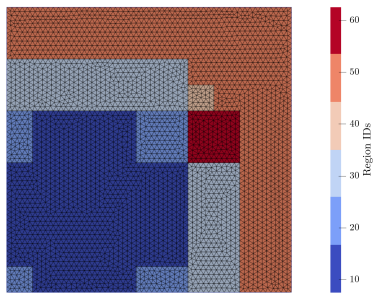
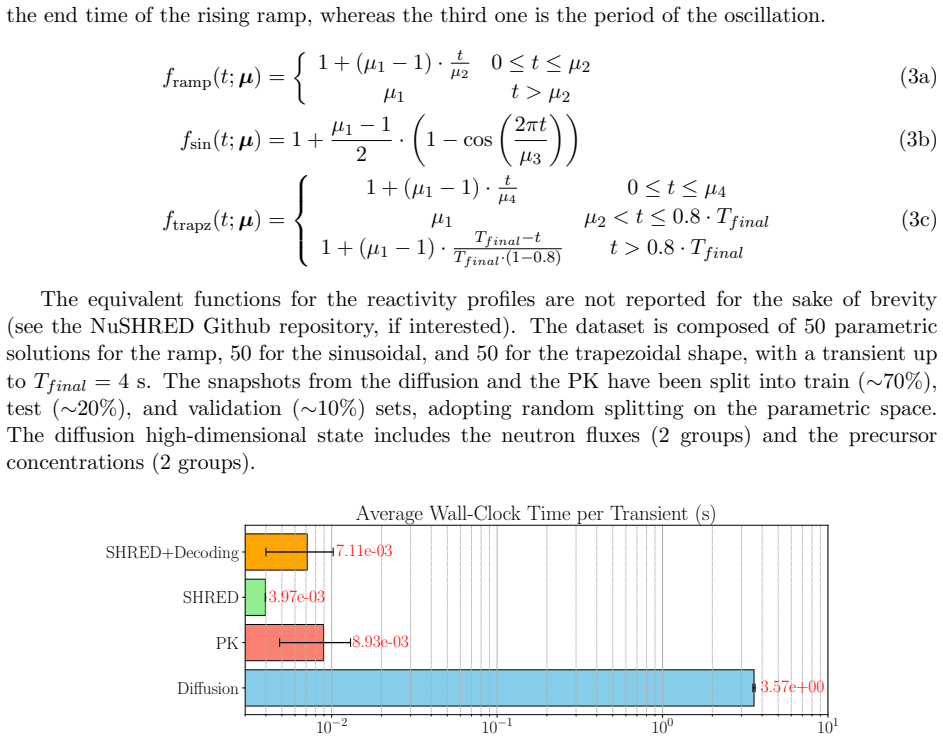
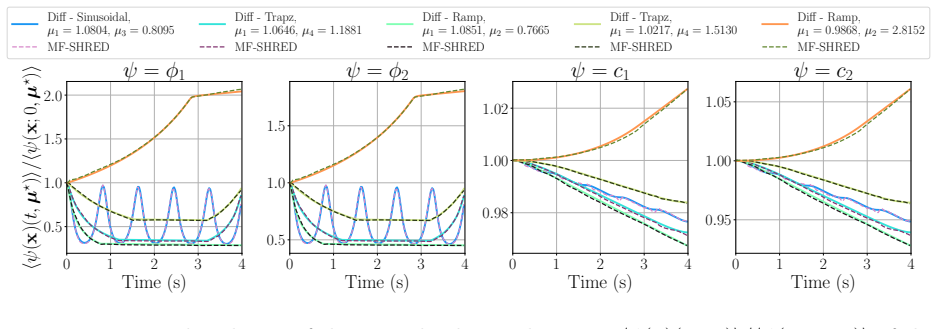
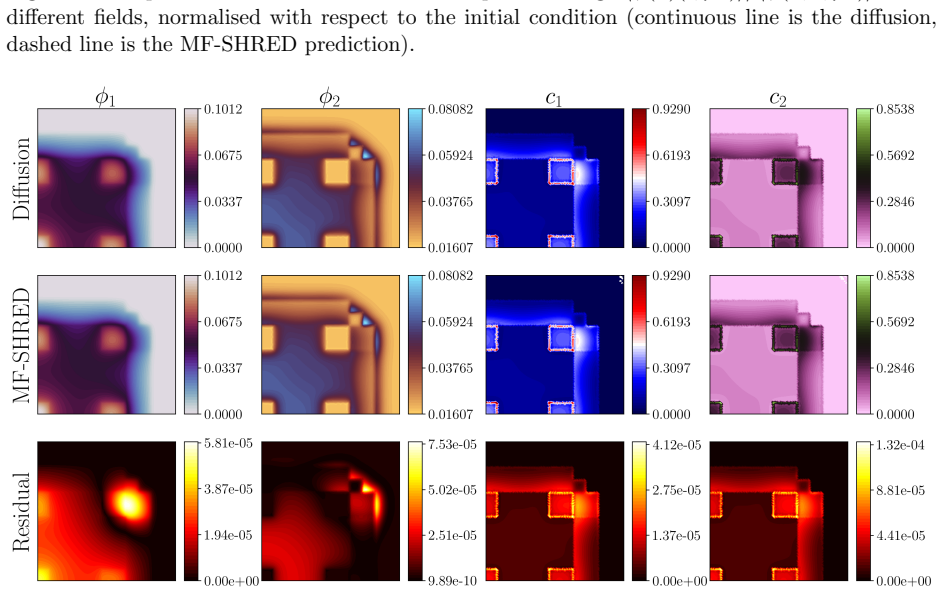
In reactor physics, neutronics can be treated with different fidelity levels, according to the needs of the user. On one hand, the precise modeling of neutrons' behaviour in reactor physics is often expensive and time-consuming due to the high computational costs to numerically solve the Boltzmann transport equation. Conversely, by adopting suitable assumptions, such as the SP$_N$, diffusion theory, and point kinetics, it is possible to generate efficiently low-fidelity data. From the perspective of surrogate models, this computational limitation translates into a scarcity of high-fidelity data and a significant amount of low-fidelity data. Given this difference in fidelity levels, it would be interesting to develop a suitable procedure to map low-fidelity models towards higher fidelity models; for instance, one could obtain the solution to a multi-group diffusion equation starting from time-series data obtained from a point kinetics model. Indeed, this work investigates this possibility by leveraging multi-fidelity information with Shallow Recurrent Decoders, a novel machine learning architecture able to map time-series observations to the full state of the reactor. This technique has been designed to use local or global measurements as input and map their temporal trajectories to the high-dimensional state; by the same logic, in principle, this architecture can also be used when the input is formed by the solution of a lumped model. This work applies this idea to a benchmark reactor geometry, mapping the point kinetics model to the diffusion solution under various input conditions, with much less computational costs.
Editorial analysis
A structured set of objections, weighed in public.
Referee Report
Summary. The paper proposes a multi-fidelity surrogate modeling approach in reactor physics that employs Shallow Recurrent Decoders (SRD) to map time-series outputs from a low-fidelity point-kinetics model to high-fidelity multi-group diffusion solutions. The method is demonstrated on a benchmark reactor geometry for various input conditions (reactivity insertions, control-rod motions), with the goal of achieving diffusion-level accuracy at substantially reduced computational cost by leveraging abundant low-fidelity data.
Significance. If the SRD mapping generalizes robustly while preserving physical consistency (non-negativity, neutron balance, modal structure), the approach would address a practical bottleneck in nuclear engineering: the scarcity of high-fidelity data and the expense of transport/diffusion solves. It extends standard supervised multi-fidelity ideas to a recurrent decoder architecture that reconstructs full spatial fields from 0-D lumped inputs, which could enable faster parametric studies and real-time applications if quantitative validation confirms low systematic error under distribution shift.
major comments (2)
- [Abstract, §4] Abstract and §4 (Results): The central claim that the SRD produces 'diffusion-level accuracy' for unseen input conditions is not supported by any reported quantitative metrics (e.g., relative L2 error on flux or power, train/test split details, or out-of-distribution error growth). Without these, it is impossible to evaluate whether the learned decoder reconstructs spatial dependence without large systematic biases.
- [§3, §5] §3 (Methodology) and §5 (Discussion): No enforcement or post-hoc verification of physical invariants (neutron balance, non-negativity of scalar flux, or correct modal structure) is described for the decoder outputs. Because the point-kinetics input is spatially lumped, any mismatch in training distribution can produce unphysical states; the absence of such checks is load-bearing for the multi-fidelity claim.
minor comments (2)
- [§2] Notation for the SRD architecture (input dimension, hidden state size, decoder layers) should be defined explicitly with a diagram or equations rather than left to the general reference.
- [§4] The benchmark geometry and the specific set of input transients (amplitudes, frequencies, rod positions) used for training versus testing should be tabulated for reproducibility.
Simulated Author's Rebuttal
We thank the referee for the careful reading and constructive suggestions. We address each major comment below and will incorporate the requested clarifications and additions in the revised manuscript.
read point-by-point responses
-
Referee: [Abstract, §4] Abstract and §4 (Results): The central claim that the SRD produces 'diffusion-level accuracy' for unseen input conditions is not supported by any reported quantitative metrics (e.g., relative L2 error on flux or power, train/test split details, or out-of-distribution error growth). Without these, it is impossible to evaluate whether the learned decoder reconstructs spatial dependence without large systematic biases.
Authors: We agree that explicit quantitative metrics are needed to substantiate the accuracy claim. The original manuscript reports only qualitative comparisons; the revised version will include relative L2 errors on scalar flux and power for both training and held-out test conditions, explicit train/test split ratios, and error growth under distribution shift (reactivity insertions and control-rod motions outside the training range). These additions will be placed in §4 with a new table and accompanying text. revision: yes
-
Referee: [§3, §5] §3 (Methodology) and §5 (Discussion): No enforcement or post-hoc verification of physical invariants (neutron balance, non-negativity of scalar flux, or correct modal structure) is described for the decoder outputs. Because the point-kinetics input is spatially lumped, any mismatch in training distribution can produce unphysical states; the absence of such checks is load-bearing for the multi-fidelity claim.
Authors: We acknowledge that the manuscript does not describe any post-training verification of physical invariants. In the revision we will add a dedicated subsection in §5 that reports (i) the fraction of test samples violating non-negativity of the reconstructed flux, (ii) the residual of the integrated neutron balance, and (iii) a brief modal analysis comparing the dominant spatial modes of the SRD output against the reference diffusion solution. If violations exceed a small threshold we will also discuss mitigation strategies (e.g., projection or constrained training). revision: yes
Circularity Check
No circularity: standard supervised multi-fidelity mapping via SRD
full rationale
The paper presents a supervised learning procedure in which an SRD is trained on paired point-kinetics (low-fidelity) and diffusion (high-fidelity) trajectories to produce a decoder that maps the former to the latter. No equation or procedure is shown to define the target output in terms of the fitted parameters themselves, nor does any load-bearing step reduce to a self-citation chain or an ansatz smuggled from prior work by the same authors. The claimed mapping is therefore an empirical model fit whose validity rests on generalization performance rather than on definitional equivalence to the training data.
Axiom & Free-Parameter Ledger
free parameters (1)
- Trainable weights and biases of the Shallow Recurrent Decoder
axioms (1)
- domain assumption Point-kinetics time series contain sufficient information to reconstruct the diffusion-level reactor state via a learned decoder
Reference graph
Works this paper leans on
-
[1]
Stefano Riva and Carolina Introini and Antonio Cammi and J. Nathan Kutz , keywords =. Robust state estimation from partial out-core measurements with Shallow Recurrent Decoder for nuclear reactors , journal =. 2025 , issn =. doi:https://doi.org/10.1016/j.pnucene.2025.105928 , url =
-
[2]
Brovchenko, Mariya and Merle Lucotte, Elsa and Rouch, Herv
-
[3]
Turbulence and the dynamics of coherent structures
Sirovich, Lawrence , month = oct, year =. Turbulence and the dynamics of coherent structures. doi:10.1090/qam/910462 , journal =
-
[4]
Progress in Nuclear Energy , author =
The molten salt reactor (. Progress in Nuclear Energy , author =. 2014 , keywords =. doi:10.1016/j.pnucene.2014.02.014 , abstract =
-
[5]
Paul K. Romano and Nicholas E. Horelik and Bryan R. Herman and Adam G. Nelson and Benoit Forget and Kord Smith , keywords =. Annals of Nuclear Energy , volume =. 2015 , note =. doi:https://doi.org/10.1016/j.anucene.2014.07.048 , url =
-
[6]
Ricotti and Hervé Rouch , keywords =
Manuele Aufiero and Antonio Cammi and Olivier Geoffroy and Mario Losa and Lelio Luzzi and Marco E. Ricotti and Hervé Rouch , keywords =. Development of an OpenFOAM model for the Molten Salt Fast Reactor transient analysis , journal =. 2014 , issn =. doi:https://doi.org/10.1016/j.ces.2014.03.003 , url =
-
[7]
Aufiero, Manuele , year =
-
[8]
and Hamilton, Louis J
Duderstadt, James J. and Hamilton, Louis J. , title =. 1976 , type =
1976
-
[9]
Williams, Jan P. and Zahn, Olivia and Kutz, J. Nathan , title =. Proceedings of the Royal Society A: Mathematical, Physical and Engineering Sciences , volume =. 2024 , doi =. https://royalsocietypublishing.org/doi/pdf/10.1098/rspa.2024.0054 , abstract =
-
[10]
arXiv preprint arXiv:2307.11793 , year=
Leveraging arbitrary mobile sensor trajectories with shallow recurrent decoder networks for full-state reconstruction , author=. arXiv preprint arXiv:2307.11793 , year=
-
[11]
J. N. Kutz and S. L. Brunton and B. W. Brunton and J. L. Proctor , date-added =. Dynamic Mode Decomposition: Data-Driven Modeling of Complex Systems , year =
-
[12]
arXiv preprint arXiv:2402.07463 , year=
PyDMD: A Python package for robust dynamic mode decomposition , author=. arXiv preprint arXiv:2402.07463 , year=
-
[13]
SIAM Journal on Applied Dynamical Systems , volume=
Variable projection methods for an optimized dynamic mode decomposition , author=. SIAM Journal on Applied Dynamical Systems , volume=. 2018 , publisher=
2018
-
[14]
Philosophical Transactions of the Royal Society A , volume=
Bagging, optimized dynamic mode decomposition for robust, stable forecasting with spatial and temporal uncertainty quantification , author=. Philosophical Transactions of the Royal Society A , volume=. 2022 , publisher=
2022
-
[15]
Review of Scientific Instruments , volume=
Dynamic mode decomposition for plasma diagnostics and validation , author=. Review of Scientific Instruments , volume=. 2018 , publisher=
2018
-
[16]
Characterizing Magnetized Plasmas with Dynamic Mode Decomposition , volume =
Kaptanoglu, Alan A and Morgan, Kyle D and Hansen, Chris J and Brunton, Steven L , journal =. Characterizing Magnetized Plasmas with Dynamic Mode Decomposition , volume =
-
[17]
Extraction of spatiotemporally coherent patterns , author=
Dynamic mode decomposition for data-driven analysis and reduced-order modeling of E B plasmas: I. Extraction of spatiotemporally coherent patterns , author=. Journal of Physics D: Applied Physics , volume=. 2023 , publisher=
2023
-
[18]
Application to parametric dynamics , author=
Data-driven local operator finding for reduced-order modelling of plasma systems: II. Application to parametric dynamics , author=. arXiv preprint arXiv:2403.01532 , year=
-
[19]
Concept and verifications , author=
Data-driven local operator finding for reduced-order modelling of plasma systems: I. Concept and verifications , author=. arXiv preprint arXiv:2403.01523 , year=
-
[20]
Dynamics forecasting , author=
Dynamic mode decomposition for data-driven analysis and reduced-order modeling of E B plasmas: II. Dynamics forecasting , author=. Journal of Physics D: Applied Physics , volume=. 2023 , publisher=
2023
-
[21]
Brunton, B. W. and Johnson, L. A. and Ojemann, J. G. and Kutz, J. N. , journal =. Extracting spatial--temporal coherent patterns in large-scale neural recordings using dynamic mode decomposition , volume =
-
[22]
arXiv preprint arXiv:2111.08481 , year=
PySINDy: A comprehensive Python package for robust sparse system identification , author=. arXiv preprint arXiv:2111.08481 , year=
-
[23]
Physical Review Research , volume=
Data-driven discovery and extrapolation of parameterized pattern-forming dynamics , author=. Physical Review Research , volume=. 2023 , publisher=
2023
-
[24]
Physics-constrained, low-dimensional models for MHD: First-principles and data-driven approaches , volume =
Kaptanoglu, Alan A and Morgan, Kyle D and Hansen, Chris J and Brunton, Steven L , journal =. Physics-constrained, low-dimensional models for MHD: First-principles and data-driven approaches , volume =
-
[25]
Journal of Computational Physics , volume=
Weak SINDy for partial differential equations , author=. Journal of Computational Physics , volume=. 2021 , publisher=
2021
-
[26]
Proceedings of 2024 SciTech Forum conference , address =
Faraji, Farbod and Reza, Maryam and Knoll, Aaron , title =. Proceedings of 2024 SciTech Forum conference , address =. 2024 , doi =
2024
-
[27]
A Critical Review of Recurrent Neural Networks for Sequence Learning
A critical review of recurrent neural networks for sequence learning , author=. arXiv preprint arXiv:1506.00019 , year=
work page internal anchor Pith review Pith/arXiv arXiv
-
[28]
Neural computation , volume=
Long short-term memory , author=. Neural computation , volume=. 1997 , publisher=
1997
-
[29]
Neural computation , volume=
A review of recurrent neural networks: LSTM cells and network architectures , author=. Neural computation , volume=. 2019 , publisher=
2019
-
[30]
Detecting strange attractors in turbulence , year =
F Takens , journal =. Detecting strange attractors in turbulence , year =
-
[31]
S. L. Brunton and B. W. Brunton and J. L. Proctor and E. Kaiser and J. N. Kutz , journal =. Chaos as an intermittently forced linear system , year =
-
[32]
A Data-Driven
Arbabi, Hassan and Korda, Milan and Mezi\'c, Igor , booktitle =. A Data-Driven
-
[33]
Proceedings of the Royal Society A , volume=
Discovering governing equations from partial measurements with deep delay autoencoders , author=. Proceedings of the Royal Society A , volume=. 2023 , publisher=
2023
-
[34]
arXiv preprint arXiv:2404.07536 , year=
EKF-SINDy: Empowering the extended Kalman filter with sparse identification of nonlinear dynamics , author=. arXiv preprint arXiv:2404.07536 , year=
-
[35]
International Journal of Dynamics and Control , volume=
Identification of nonlinear dynamical systems with time delay , author=. International Journal of Dynamics and Control , volume=. 2022 , publisher=
2022
-
[36]
Proceedings of the Royal Society A , volume=
Shallow neural networks for fluid flow reconstruction with limited sensors , author=. Proceedings of the Royal Society A , volume=. 2020 , publisher=
2020
-
[37]
Nuclear Fusion , volume=
Time-dependent SOLPS-ITER simulations of the tokamak plasma boundary for model predictive control using SINDy , author=. Nuclear Fusion , volume=. 2023 , publisher=
2023
-
[38]
arXiv preprint arXiv:2111.10992 , year=
Ensemble-SINDy: Robust sparse model discovery in the low-data, high-noise limit, with active learning and control , author=. arXiv preprint arXiv:2111.10992 , year=
-
[39]
arXiv preprint arXiv:2211.10575 , year=
Bayesian autoencoders for data-driven discovery of coordinates, governing equations and fundamental constants , author=. arXiv preprint arXiv:2211.10575 , year=
-
[40]
International Conference on Physics of Reactors (PHYSOR24) , address =
Riva, Stefano and Deanesi, Sophie and Introini, Carolina and Lorenzi, Stefano and Cammi, Antonio , year =. International Conference on Physics of Reactors (PHYSOR24) , address =
-
[41]
Stefano Riva and Carolina Introini and Antonio Cammi , keywords =. Multi-physics model bias correction with data-driven reduced order techniques: Application to nuclear case studies , journal =. 2024 , issn =. doi:https://doi.org/10.1016/j.apm.2024.06.040 , url =
-
[42]
Nuclear Engineering and Design , volume =
Antonio Cammi and Stefano Riva and Carolina Introini and Lorenzo Loi and Enrico Padovani , keywords =. Nuclear Engineering and Design , volume =. 2024 , issn =. doi:https://doi.org/10.1016/j.nucengdes.2024.113105 , url =
-
[43]
Computer Methods in Applied Mechanics and Engineering , author =
The. Computer Methods in Applied Mechanics and Engineering , author =. 2015 , note =. doi:10.1016/j.cma.2015.01.018 , abstract =
-
[44]
A real-time variational data assimilation method with data-driven model enrichment for time-dependent problems , volume =. Comput. Methods Appl. Mech. Eng. , author =. 2023 , keywords =. doi:10.1016/j.cma.2022.115868 , abstract =
-
[45]
and Varoquaux, G
Pedregosa, F. and Varoquaux, G. and Gramfort, A. and Michel, V. and Thirion, B. and Grisel, O. and Blondel, M. and Prettenhofer, P. and Weiss, R. and Dubourg, V. and Vanderplas, J. and Passos, A. and Cournapeau, D. and Brucher, M. and Perrot, M. and Duchesnay, E. , journal=. Scikit-learn: Machine Learning in
-
[46]
International Journal of Prognostics and Health Management , author =
A. International Journal of Prognostics and Health Management , author =. 2018 , note =. doi:10.36001/ijphm.2018.v9i1.2670 , abstract =
-
[47]
de Silva and Krithika Manohar and Emily Clark and Bingni W
Brian M. de Silva and Krithika Manohar and Emily Clark and Bingni W. Brunton and J. Nathan Kutz and Steven L. Brunton , title =. 2021 , publisher =. doi:10.21105/joss.02828 , url =
-
[48]
Sensor placement in nuclear reactors based on the generalized empirical interpolation method , volume =. J. Comput. Phys. , author =. 2018 , keywords =. doi:10.1016/j.jcp.2018.02.050 , abstract =
-
[49]
Versteeg, H K and Malalasekera, W , isbn =
-
[50]
Machine Learning: Science and Technology , abstract =
Faraji, Farbod and Reza, Maryam and Kutz, J Nathan , title =. Machine Learning: Science and Technology , abstract =. 2025 , month =. doi:10.1088/2632-2153/adcd20 , url =
-
[51]
Brunton, Steven L and Kutz, J Nathan , year =. Data-
-
[52]
Nuclear Science and Techniques , author =
Reactor field reconstruction from sparse and movable sensors using. Nuclear Science and Techniques , author =. 2024 , keywords =. doi:10.1007/s41365-024-01400-w , abstract =
-
[53]
Michael W. Grieves , title =. Complex Systems Engineering: Theory and Practice , chapter =. doi:10.2514/5.9781624105654.0175.0200 , URL =. https://arc.aiaa.org/doi/pdf/10.2514/5.9781624105654.0175.0200 , publisher =
-
[54]
Nuclear Science and Engineering , author =
Data-. Nuclear Science and Engineering , author =. 2022 , note =. doi:10.1080/00295639.2021.2014752 , abstract =
-
[55]
2025 , eprint=
Artificial Intelligence in Reactor Physics: Current Status and Future Prospects , author=. 2025 , eprint=
2025
-
[56]
Nathan and Cammi, Antonio , year =
Riva, Stefano and Introini, Carolina and Kutz, J. Nathan and Cammi, Antonio , year =. The 21st International Topical Meeting on Nuclear Reactor Thermal Hydraulics (NURETH-21) , address =
-
[57]
Annals of Nuclear Energy , author =
Parameter identification and state estimation for nuclear reactor operation digital twin , volume =. Annals of Nuclear Energy , author =. 2023 , pages =. doi:10.1016/j.anucene.2022.109497 , abstract =
-
[58]
Annals of Nuclear Energy , author =
An efficient digital twin based on machine learning. Annals of Nuclear Energy , author =. 2022 , pages =. doi:10.1016/j.anucene.2022.109431 , abstract =
-
[59]
Journal of Computational Physics , author =
Efficient deep data assimilation with sparse observations and time-varying sensors , volume =. Journal of Computational Physics , author =. 2024 , keywords =. doi:10.1016/j.jcp.2023.112581 , abstract =
-
[60]
Mohanty, Subhasish and Vilim, Richard , month = sep, year =. Physics-. doi:10.2172/1830413 , pages =
-
[61]
Mohanty, Subhasish and Listwan, Joseph , month = sep, year =. Development of. doi:10.2172/1822853 , pages =
-
[62]
Michael G. Kapteyn and David J. Knezevic and Karen Willcox , title =. AIAA Scitech 2020 Forum , chapter =. doi:10.2514/6.2020-0418 , URL =. https://arc.aiaa.org/doi/pdf/10.2514/6.2020-0418 , abstract =
-
[63]
Rozza, Gianluigi and Hess, Martin and Stabile, Giovanni and Tezzele, Marco and Ballarin, Francesco and Gräßle, Carmen and Hinze, Michael and Volkwein, Stefan and Chinesta, Francisco and Ladeveze, Pierre and Maday, Yvon and Patera, Anthony and Farhat Char, J , year =. Model
-
[64]
Lassila, Toni and Manzoni, Andrea and Quarteroni, Alfio and Rozza, Gianluigi , year =. Model. Reduced. doi:10.1007/978-3-319-02090-7_9 , pages =
-
[65]
Maday, Yvon and Patera, Anthony and Penn, James and Yano, Masayuki , year =. A parameterized-background data-weak approach to variational data assimilation: formulation, analysis, and application to acoustics , volume =. doi:10.1002/nme.4747 , journal =
-
[66]
and Kutz, J
Manohar, Krithika and Brunton, Bingni W. and Kutz, J. Nathan and Brunton, Steven L. , journal=. Data-Driven Sparse Sensor Placement for Reconstruction: Demonstrating the Benefits of Exploiting Known Patterns , year=
-
[67]
Demazière, Christophe , editor =. 6 -. Modelling of. 2020 , doi =
2020
-
[68]
SIAM/ASA Journal on Uncertainty Quantification , author =
Greedy. SIAM/ASA Journal on Uncertainty Quantification , author =. 2018 , note =. doi:10.1137/17M1157635 , abstract =
-
[69]
Carolina Introini and Stefano Riva and Stefano Lorenzi and Simone Cavalleri and Antonio Cammi , keywords =. Non-intrusive system state reconstruction from indirect measurements: A novel approach based on Hybrid Data Assimilation methods , journal =. 2023 , issn =. doi:https://doi.org/10.1016/j.anucene.2022.109538 , url =
-
[70]
2015 , url =
Quarteroni, A and Manzoni, A and Negri, F , isbn =. 2015 , url =
2015
-
[71]
Ansel, Jason and et al. , title =. Proceedings of the 29th ACM International Conference on Architectural Support for Programming Languages and Operating Systems, Volume 2 , pages =. 2024 , isbn =. doi:10.1145/3620665.3640366 , abstract =
-
[72]
Nuclear–Renewable Hybrid Energy Systems , series=
International Atomic Energy Agency , institution=. Nuclear–Renewable Hybrid Energy Systems , series=. 2023 , isbn=
2023
-
[73]
Mark F. Ruth and Owen R. Zinaman and Mark Antkowiak and Richard D. Boardman and Robert S. Cherry and Morgan D. Bazilian , keywords =. Nuclear-renewable hybrid energy systems: Opportunities, interconnections, and needs , journal =. 2014 , issn =. doi:https://doi.org/10.1016/j.enconman.2013.11.030 , url =
-
[74]
A general multipurpose interpolation procedure:
Maday, Yvon and Nguyen, Ngoc and Patera, Anthony and Pau, George Shu Heng , year =. A general multipurpose interpolation procedure:. doi:10.3934/cpaa.2009.8.383 , journal =
-
[75]
Computer Methods in Applied Mechanics and Engineering , author =
Stabilization of. Computer Methods in Applied Mechanics and Engineering , author =. 2023 , keywords =. doi:https://doi.org/10.1016/j.cma.2022.115773 , abstract =
-
[76]
Jan L. Kloosterman , keywords =. 20 - Safety assessment of the molten salt fast reactor (SAMOFAR) , editor =. Molten Salt Reactors and Thorium Energy , publisher =. 2017 , isbn =. doi:https://doi.org/10.1016/B978-0-08-101126-3.00020-8 , url =
-
[77]
SIAM Journal on Matrix Analysis and Applications , author =
A. SIAM Journal on Matrix Analysis and Applications , author =. 2016 , pages =. doi:10.1137/16M1058467 , abstract =
-
[78]
and Braghin, Francesco and Manzoni, Andrea and Kutz, J
Tomasetto, Matteo and Williams, Jan P. and Braghin, Francesco and Manzoni, Andrea and Kutz, J. Nathan , year =. Reduced order modeling with shallow recurrent decoder networks , volume =. Nature Communications , publisher =. doi:10.1038/s41467-025-65126-y , number =
-
[79]
Gao, Mars Liyao and Williams, Jan P. and Kutz, J. Nathan , month = jan, year =. Sparse identification of nonlinear dynamics and. doi:10.48550/arXiv.2501.13329 , abstract =
-
[80]
Kobayashi, Kazuma and Alam, Syed Bahauddin , date =. Deep neural operator-driven real-time inference to enable digital twin solutions for nuclear energy systems , url =. Scientific Reports , number =. 2024 , bdsk-url-1 =. doi:10.1038/s41598-024-51984-x , id =
discussion (0)
Sign in with ORCID, Apple, or X to comment. Anyone can read and Pith papers without signing in.