The Double Well Done Doubly-Well
Pith reviewed 2026-06-28 05:06 UTC · model grok-4.3
The pith
Resurgence organizes the exact spectrum of the symmetric double well into a single tightly-constrained trans-series.
A machine-rendered reading of the paper's core claim, the machinery that carries it, and where it could break.
Core claim
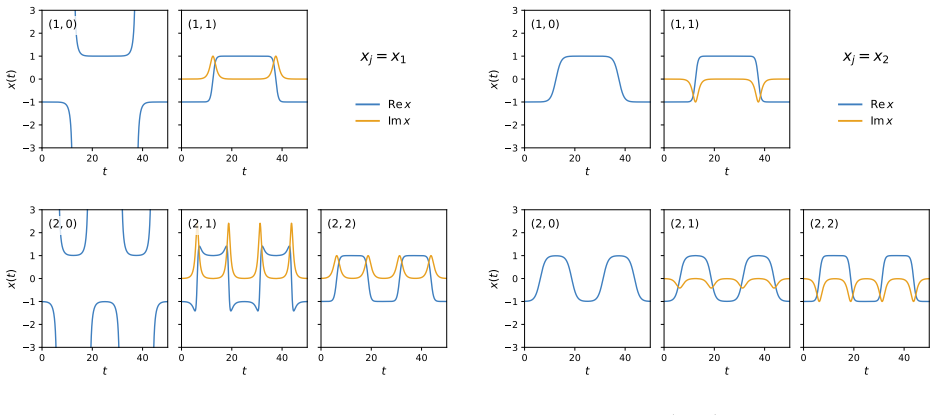
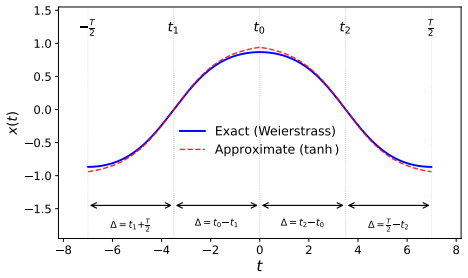
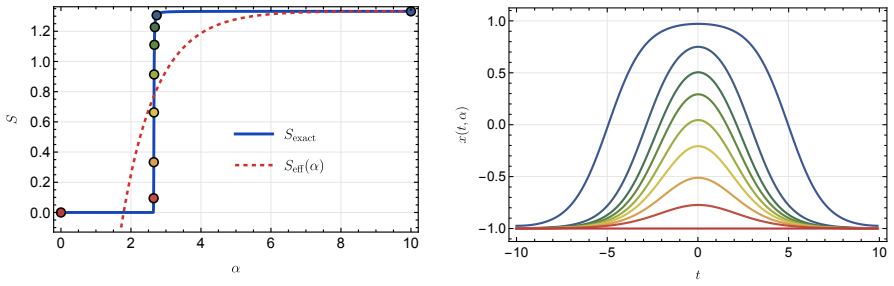
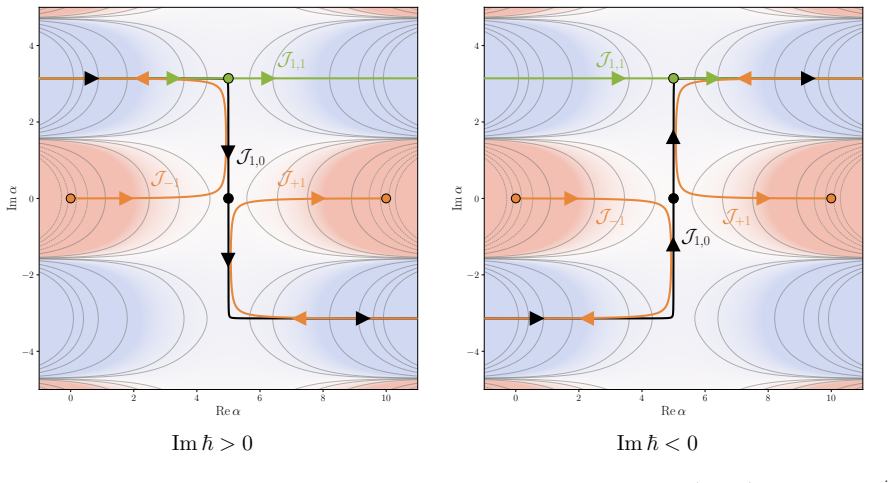
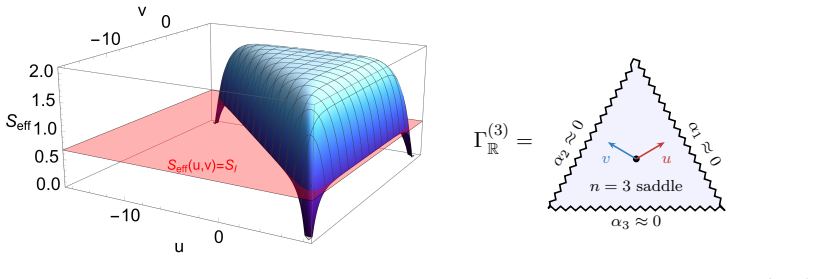
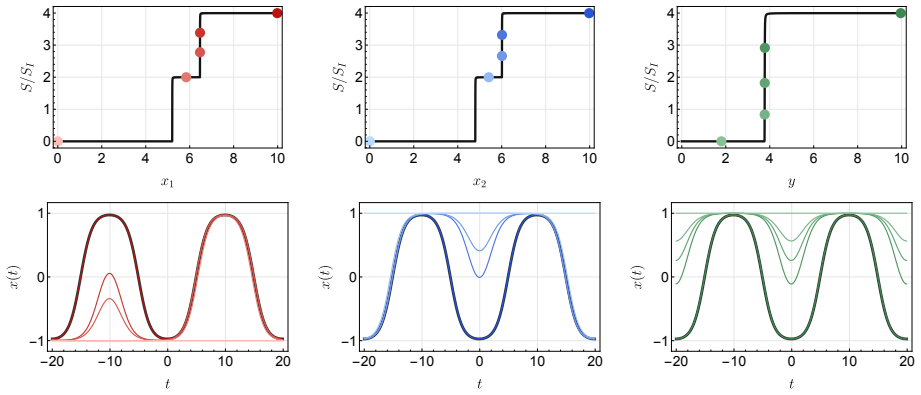
The symmetric double well's energy spectrum forms a single resurgence trans-series. In exact WKB the Delabaere-Dillinger-Pham relations encode the Stokes phenomena that control analytic continuation of the wave function past turning points, and the resulting quantization condition in Voros symbols yields the complete trans-series. In the path integral the classical saddles are elliptic functions of Euclidean time, and a Lefschetz thimble decomposition on the quasi-zero-mode manifold selects the contributing saddles, producing a simpler trans-series whose T-dependence at each instanton order is a fixed polynomial.
What carries the argument
The resurgence trans-series for the energy levels, fixed by Delabaere-Dillinger-Pham relations in exact WKB and by Lefschetz thimble integrals over quasi-zero modes in the path integral.
If this is right
- The quantization condition expressed in Voros symbols determines the entire trans-series from the local Stokes data alone.
- At each instanton order the path-integral partition-function trans-series has a polynomial time dependence fixed solely by the thimble integrals.
- The energy trans-series is more intricate than the partition-function trans-series, yet both are consistent through the computed orders.
- The elliptic curve structure of the energy surface appears in both approaches but enters through different mechanisms.
Where Pith is reading between the lines
- The same local Stokes and thimble machinery may organize spectra for other potentials whose classical saddles form elliptic curves.
- Extending the explicit calculations to five or six instantons would provide a direct test of whether the pattern continues without new parameters.
- The wave-function trans-series itself, not only the energies, could be extracted from the same WKB data for comparison with numerical solutions.
Load-bearing premise
The local Delabaere-Dillinger-Pham relations together with the Lefschetz thimble decomposition on the quasi-zero-mode manifold suffice to fix the full trans-series without additional global information or fitting parameters.
What would settle it
An independent high-precision numerical computation of the energy levels that finds coefficients at four-instanton three-loop order differing from the predicted trans-series values would disprove the claimed organization.
Figures

read the original abstract
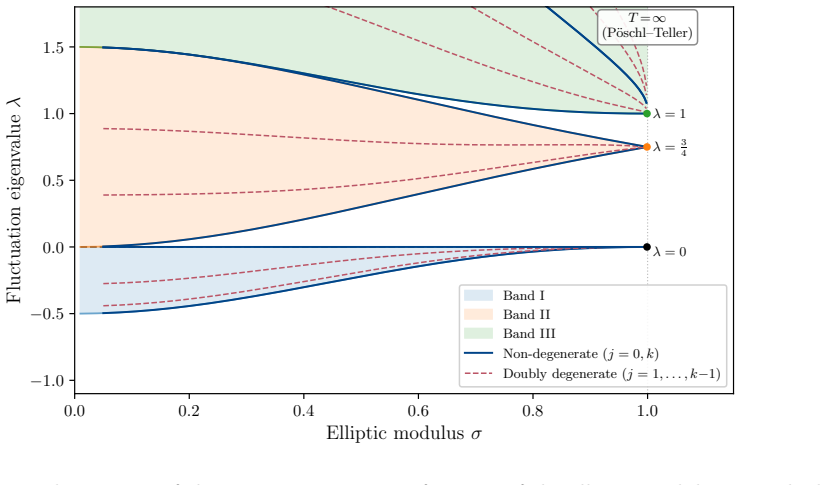
The symmetric double-well potential is one of the simplest quantum-mechanical systems in which perturbative and non-perturbative physics are deeply entangled. Its energy levels have non-analytic expansions in inverse powers of the inter-well separation, with factorially growing coefficients, while the parity splitting is exponentially small and invisible to perturbation theory. Resurgence ties the two features together, organizing the exact spectrum into a single tightly-constrained trans-series. This paper gives a self-contained account of this trans-series from two complementary approaches: exact WKB and the Euclidean path integral, developed in a common notation with explicit calculations through the four-instanton level and three-loop order. In exact WKB, Stokes phenomena encoded in the Delabaere--Dillinger--Pham relations control the analytic continuation of the wavefunction past turning points. The quantization condition expressed in terms of Voros symbols then determines the full trans-series. The DDP relations are local and do not require knowing the global topology of the energy surface, but that surface is an elliptic curve. In the path integral, elliptic curves enter differently: the classical saddle points are doubly-periodic elliptic functions of Euclidean time, and Stokes phenomena play out within the finite-dimensional manifold of quasi-zero modes rather than through analytic continuation of the wavefunction. A Lefschetz thimble decomposition determines which saddles contribute, and the resulting partition function trans-series is much simpler than the energy trans-series: at each instanton order the $T$-dependence is a polynomial fixed by the quasi-zero-mode thimble integrals. Together, the two approaches deploy a shared mathematical infrastructure in complementary ways, showing that the double well is an ideal setting to explore resurgence.
Editorial analysis
A structured set of objections, weighed in public.
Referee Report
Summary. The paper claims to provide a self-contained derivation of the trans-series for both the energy levels and the partition function of the symmetric double-well potential. It employs exact WKB with Delabaere-Dillinger-Pham (DDP) Stokes relations for the quantization condition in terms of Voros symbols, together with the Euclidean path integral using Lefschetz thimble decomposition over the quasi-zero-mode manifold, yielding explicit results through four-instanton order and three-loop order. The central assertion is that these local relations and thimble integrals determine all trans-series coefficients without global elliptic-curve periods or fitting parameters.
Significance. If the explicit calculations are correct, the work would be significant as a detailed benchmark for resurgence techniques in quantum mechanics, showing how two complementary formalisms (exact WKB and path integrals) produce consistent trans-series in a shared notation. The explicit four-instanton, three-loop results and the demonstration that local DDP relations suffice despite the elliptic-curve energy surface constitute a concrete strength; the paper ships explicit calculations at high perturbative and non-perturbative orders.
minor comments (2)
- The abstract is lengthy and contains several technical clauses; a shorter version focused on the main results and the parameter-free character of the construction would improve accessibility.
- The title is informal; consider whether a more descriptive title would better suit the journal's conventions while retaining the pun if desired.
Simulated Author's Rebuttal
We thank the referee for their positive summary, recognition of the significance of the explicit four-instanton calculations, and recommendation of minor revision. No specific major comments appear in the report.
Circularity Check
Derivation self-contained from exact WKB and path integrals; no reduction to inputs by construction
full rationale
The paper presents explicit four-instanton, three-loop trans-series for the double-well spectrum derived from Delabaere-Dillinger-Pham (DDP) Stokes relations in exact WKB and from Lefschetz thimble integrals over the quasi-zero-mode manifold in the path integral. The abstract and description state that DDP relations are local (do not require global elliptic-curve topology) and that thimble integrals fix the polynomial T-dependence at each order. No equations or claims indicate that coefficients are fitted to data, defined in terms of the output trans-series, or obtained via self-citation load-bearing steps. The construction is presented as parameter-free once the local relations and thimble decomposition are applied, consistent with the reader's assessment of score 2.0. No self-definitional, fitted-input, or ansatz-smuggling patterns appear in the provided text.
Axiom & Free-Parameter Ledger
Reference graph
Works this paper leans on
-
[1]
Coleman,The uses of instantons, inThe Whys of Subnuclear Physics, A
S. Coleman,The uses of instantons, inThe Whys of Subnuclear Physics, A. Zichichi, ed., (Boston, MA), pp. 805–941, Springer US (1979), DOI
1979
-
[2]
Rayleigh,The Theory of Sound, no
J. Rayleigh,The Theory of Sound, no. v. 1 in The Theory of Sound, Macmillan (1894)
-
[3]
Schrödinger,Quantisierung als Eigenwertproblem,Annalen Phys.385(1926) 437
E. Schrödinger,Quantisierung als Eigenwertproblem,Annalen Phys.385(1926) 437. 146
1926
-
[4]
Damburg, R.K
R.J. Damburg, R.K. Propin, S. Graffi, V. Grecchi, E.M. Harrell, J. Čížek et al.,1 R expansion forH + 2 : Analyticity, summability, asymptotics, and calculation of exponentially small terms, Phys. Rev. Lett.52(1984) 1112
1984
-
[5]
Čížek, R.J
J. Čížek, R.J. Damburg, S. Graffi, V. Grecchi, E.M. Harrell, J.G. Harris et al.,1/r expansion forH 2+: Calculation of exponentially small terms and asymptotics,Phys. Rev. A33(1986) 12
1986
-
[6]
Holstein,Mobilities of positive ions in their parent gases,J
T. Holstein,Mobilities of positive ions in their parent gases,J. Phys. Chem.56(1952) 832
1952
-
[7]
Herring,Critique of the Heitler-London method of calculating spin couplings at large distances,Rev
C. Herring,Critique of the Heitler-London method of calculating spin couplings at large distances,Rev. Mod. Phys.34(1962) 631
1962
-
[8]
Ecalle,Les fonctions resurgentes
J. Ecalle,Les fonctions resurgentes. Tome I: Les algèbres de fonctions résurgentes, no. 81-05 in Publications Mathématiques d’Orsay, Univ. de Paris-Sud, Dép. de Mathématique (1981)
1981
-
[9]
Ecalle,Les fonctions resurgentes
J. Ecalle,Les fonctions resurgentes. Tome II: Les fonctions résurgentes appliquées à l’itération, no. 81-06 in Publications Mathématiques d’Orsay, Univ. de Paris-Sud, Dép. de Mathématique (1981)
1981
-
[10]
Ecalle,Les fonctions resurgentes
J. Ecalle,Les fonctions resurgentes. Tome III: L’équation du pont et la classification analytique des objets locaux, no. 85-05 in Publications Mathématiques d’Orsay, Univ. de Paris-Sud, Dép. de Mathématique (1985)
1985
-
[11]
Wentzel,Eine Verallgemeinerung der Quantenbedingungen für die Zwecke der Wellenmechanik,Z
G. Wentzel,Eine Verallgemeinerung der Quantenbedingungen für die Zwecke der Wellenmechanik,Z. Phys.38(1926) 518
1926
-
[12]
Kramers,Wellenmechanik und halbzahlige Quantisierung,Z
H.A. Kramers,Wellenmechanik und halbzahlige Quantisierung,Z. Phys.39(1926) 828
1926
-
[13]
Brillouin,La mécanique ondulatoire de Schrödinger; une méthode générale de resolution par approximations successives,Compt
L. Brillouin,La mécanique ondulatoire de Schrödinger; une méthode générale de resolution par approximations successives,Compt. Rend. Hebd. Seances Acad. Sci.183(1926) 24
1926
-
[14]
Voros,The return of the quartic oscillator
A. Voros,The return of the quartic oscillator. The complex WKB method,Annales de l’I.H.P. Physique théorique39(1983) 211
1983
-
[15]
Delabaere and F
E. Delabaere and F. Pham,Resurgent methods in semi-classical asymptotics,Annales de l’Institut Henri Poincaré (A). Physique Theorique71(1999) 1
1999
-
[16]
Dillinger, E
H. Dillinger, E. Delabaere and F. Pham,Résurgence de voros et périodes des courbes hyperelliptiques,Annales de l’institut Fourier43(1993) 163
1993
-
[17]
Dorigoni,An Introduction to Resurgence, Trans-Series and Alien Calculus,Annals Phys
D. Dorigoni,An Introduction to Resurgence, Trans-Series and Alien Calculus,Annals Phys. 409(2019) 167914 [1411.3585]
arXiv 2019
-
[18]
M. Mariño,Lectures on non-perturbative effects in largeNgauge theories, matrix models and strings,Fortsch. Phys.62(2014) 455 [1206.6272]
arXiv 2014
-
[19]
I. Aniceto, G. Basar and R. Schiappa,A Primer on Resurgent Transseries and Their Asymptotics,Phys. Rept.809(2019) 1 [1802.10441]
arXiv 2019
-
[20]
Sauzin,Resurgent functions and splitting problems,RIMS Kôkyuˆ roku1493(2006) 48 [0706.0137]
D. Sauzin,Resurgent functions and splitting problems,RIMS Kôkyuˆ roku1493(2006) 48 [0706.0137]. 147
Pith/arXiv arXiv 2006
-
[21]
Abel,Letter to B
N.H. Abel,Letter to B. Holmboe, January 1826, inOeuvres Complètes de Niels Henrik Abel, L. Sylow and S. Lie, eds., vol. 2, (Christiania), Grondahl & Son (1881)
-
[22]
Stokes,On the Discontinuity of Arbitrary Constants which appear in Divergent Developments,Transactions of the Cambridge Philosophical Society10(1864) 105
G.G. Stokes,On the Discontinuity of Arbitrary Constants which appear in Divergent Developments,Transactions of the Cambridge Philosophical Society10(1864) 105
-
[23]
Barrow-Green,Oscar II’s prize competition and the error in Poincaré’s memoir on the three body problem,Archive for History of Exact Sciences48(1994) 107
J. Barrow-Green,Oscar II’s prize competition and the error in Poincaré’s memoir on the three body problem,Archive for History of Exact Sciences48(1994) 107
1994
-
[24]
Poincaré,Sur le problème des trois corps et les équations de la dynamique,Acta Mathematica13(1890) 1
H. Poincaré,Sur le problème des trois corps et les équations de la dynamique,Acta Mathematica13(1890) 1
-
[25]
Holmes, J
P. Holmes, J. Marsden and J. Scheurle,Exponentially small splittings of separatrices with applications to kam theory and degenerate bifurcations, inHamiltonian dynamical systems : proceedings of the AMS-IMS-SIAM joint summer research conference, p. 213–244, American Mathematical Society (1988)
1988
-
[26]
Delshams and T.M
A. Delshams and T.M. Seara,An asymptotic expression for the splitting of separatrices of the rapidly forced pendulum,Communications in Mathematical Physics150(1992) 433
1992
-
[27]
Sauzin,Résurgence paramétrique et exponentielle petitesse de l’écart des séparatrices du pendule rapidement forcé,Annales de l’Institut Fourier45(1995) 453
D. Sauzin,Résurgence paramétrique et exponentielle petitesse de l’écart des séparatrices du pendule rapidement forcé,Annales de l’Institut Fourier45(1995) 453
1995
-
[28]
Poincaré,Sur les intégrales irrégulières: Des équations linéaires,Acta Mathematica8 (1886) 295
H. Poincaré,Sur les intégrales irrégulières: Des équations linéaires,Acta Mathematica8 (1886) 295
-
[29]
Stieltjes,Recherches sur quelques séries semi-convergentes,Annales scientifiques de l’École Normale Supérieure3e série, 3(1886) 201
T.-J. Stieltjes,Recherches sur quelques séries semi-convergentes,Annales scientifiques de l’École Normale Supérieure3e série, 3(1886) 201
-
[30]
Borel,Mémoire sur les séries divergentes,Annales scientifiques de l’École Normale Supérieure3e série, 16(1899) 9
E. Borel,Mémoire sur les séries divergentes,Annales scientifiques de l’École Normale Supérieure3e série, 16(1899) 9
-
[31]
Dyson,Divergence of perturbation theory in quantum electrodynamics,Phys
F.J. Dyson,Divergence of perturbation theory in quantum electrodynamics,Phys. Rev.85 (1952) 631
1952
-
[32]
Bender and T.T
C.M. Bender and T.T. Wu,Anharmonic oscillator,Phys. Rev.184(1969) 1231
1969
-
[33]
Bender and T.T
C.M. Bender and T.T. Wu,Anharmonic oscillator. 2: A Study of perturbation theory in large order,Phys. Rev. D7(1973) 1620
1973
-
[34]
Herbst and B
I.W. Herbst and B. Simon,Stark effect revisited,Phys. Rev. Lett.41(1978) 67
1978
-
[35]
Graffi and V
S. Graffi and V. Grecchi,Resonances in Stark effect and perturbation theory, Communications in Mathematical Physics62(1978) 83
1978
-
[36]
Harrell,On the rate of asymptotic eigenvalue degeneracy,Communications in Mathematical Physics60(1978) 73
E.M. Harrell,On the rate of asymptotic eigenvalue degeneracy,Communications in Mathematical Physics60(1978) 73
1978
-
[37]
Brezin, G
E. Brezin, G. Parisi and J. Zinn-Justin,Perturbation Theory at Large Orders for Potential with Degenerate Minima,Phys. Rev. D16(1977) 408
1977
-
[38]
Langer,Theory of the condensation point,Annals of Physics41(1967) 108
J. Langer,Theory of the condensation point,Annals of Physics41(1967) 108
1967
-
[39]
Belavin, A.M
A.A. Belavin, A.M. Polyakov, A.S. Schwartz and Y.S. Tyupkin,Pseudoparticle Solutions of the Yang-Mills Equations,Phys. Lett. B59(1975) 85. 148
1975
-
[40]
’t Hooft,Computation of the Quantum Effects Due to a Four-Dimensional Pseudoparticle,Phys
G. ’t Hooft,Computation of the Quantum Effects Due to a Four-Dimensional Pseudoparticle,Phys. Rev. D14(1976) 3432
1976
-
[41]
Bogomolny,Calculation of Instanton–Anti-Instanton Contributions in Quantum Mechanics,Phys
E.B. Bogomolny,Calculation of Instanton–Anti-Instanton Contributions in Quantum Mechanics,Phys. Lett. B91(1980) 431
1980
-
[42]
Zinn-Justin,Multi - Instanton Contributions in Quantum Mechanics,Nucl
J. Zinn-Justin,Multi - Instanton Contributions in Quantum Mechanics,Nucl. Phys. B192 (1981) 125
1981
-
[43]
J. Zinn-Justin and U.D. Jentschura,Multi-instantons and exact results I: Conjectures, WKB expansions, and instanton interactions,Annals Phys.313(2004) 197 [quant-ph/0501136]
Pith/arXiv arXiv 2004
-
[44]
J. Zinn-Justin and U.D. Jentschura,Multi-instantons and exact results II: Specific cases, higher-order effects, and numerical calculations,Annals Phys.313(2004) 269 [quant-ph/0501137]
Pith/arXiv arXiv 2004
-
[45]
Sommerfeld,Zur quantentheorie der spektrallinien,Annalen der Physik356(1916) 1
A. Sommerfeld,Zur quantentheorie der spektrallinien,Annalen der Physik356(1916) 1
1916
-
[46]
U.D. Jentschura and J. Zinn-Justin,Instantons in quantum mechanics and resurgent expansions,Phys. Lett. B596(2004) 138 [hep-ph/0405279]
Pith/arXiv arXiv 2004
-
[47]
Balitsky and A.V
I.I. Balitsky and A.V. Yung,Collective - Coordinate Method for Quasizero Modes,Phys. Lett. B168(1986) 113
1986
-
[48]
Richard and A
J.L. Richard and A. Rouet,Complex Saddle Points in the Double Well Oscillator,Nucl. Phys. B183(1981) 251
1981
-
[49]
Richard and A
J.L. Richard and A. Rouet,Complex Saddle Points Versus Dilute Gas Approximation in the Double Well Anharmonic Oscillator,Nucl. Phys. B185(1981) 47
1981
-
[50]
Carlitz and D.A
R.D. Carlitz and D.A. Nicole,Classical Paths and Quantum Mechanics,Annals Phys.164 (1985) 411
1985
-
[51]
Lapedes and E
A. Lapedes and E. Mottola,Complex Path Integrals and Finite Temperature,Nucl. Phys. B 203(1982) 58
1982
-
[52]
Mottola and A
E. Mottola and A. Rouet,Semiclassical Approximation to the Octic Double Well Oscillator, Phys. Lett. B119(1982) 162
1982
-
[53]
Millard,Complex Classical Paths and the One-dimensional Sine-Gordon System,Nucl
P.A. Millard,Complex Classical Paths and the One-dimensional Sine-Gordon System,Nucl. Phys. B259(1985) 266
1985
-
[54]
Nekrasov,Tying up instantons with anti-instantons., inLudwig Faddeev Memorial Volume, pp
N. Nekrasov,Tying up instantons with anti-instantons., inLudwig Faddeev Memorial Volume, pp. 351–388, World Scientific (2018), DOI [1802.04202]
arXiv 2018
-
[55]
A. Behtash, G.V. Dunne, T. Schaefer, T. Sulejmanpasic and M. Ünsal,Critical Points at Infinity, Non-Gaussian Saddles, and Bions,JHEP06(2018) 068 [1803.11533]
Pith/arXiv arXiv 2018
-
[56]
Balian, G
R. Balian, G. Parisi and A. Voros,Discrepancies from Asymptotic Series and Their Relation to Complex Classical Trajectories,Phys. Rev. Lett.41(1978) 1141
1978
-
[57]
Silverstone,JWKB connection-formula problem revisited via Borel summation,Phys
H.J. Silverstone,JWKB connection-formula problem revisited via Borel summation,Phys. Rev. Lett.55(1985) 2523. 149
1985
-
[58]
Álvarez,Langer–Cherry derivation of the multi-instanton expansion for the symmetric double well,J
G. Álvarez,Langer–Cherry derivation of the multi-instanton expansion for the symmetric double well,J. Math. Phys.45(2004) 3095
2004
-
[59]
Kawai and Y
T. Kawai and Y. Takei,Algebraic analysis of singular perturbation theory, vol. 227 of Translations of Mathematical Monographs, American Mathematical Society, Providence, RI (2005)
2005
-
[60]
Witten,Analytic Continuation Of Chern-Simons Theory,AMS/IP Stud
E. Witten,Analytic Continuation Of Chern-Simons Theory,AMS/IP Stud. Adv. Math.50 (2011) 347 [1001.2933]
Pith/arXiv arXiv 2011
-
[61]
E. Witten,A New Look At The Path Integral Of Quantum Mechanics,Surveys in differential geometry(2010) 345 [1009.6032]
Pith/arXiv arXiv 2010
-
[62]
Picard and G
E. Picard and G. Simart,Théorie des fonctions algébriques de deux variables indépendantes, Gauthier-Villars, Paris (1897)
-
[63]
Lefschetz,L’analysis situs et la géométrie algébrique, Collection de monographies sur la théorie des fonctions, pub
S. Lefschetz,L’analysis situs et la géométrie algébrique, Collection de monographies sur la théorie des fonctions, pub. sous la direction de M. Émile Borel, Gauthier-Villars et cie, Paris (1924)
1924
-
[64]
Pham,Formules de Picard–Lefschetz généralisées et ramification des intégrales,Bulletin de la Société Mathématique de France93(1965) 333
F. Pham,Formules de Picard–Lefschetz généralisées et ramification des intégrales,Bulletin de la Société Mathématique de France93(1965) 333
1965
-
[65]
Pham,Introduction à l’étude topologique des singularités de Landau, vol
F. Pham,Introduction à l’étude topologique des singularités de Landau, vol. 164 ofMémorial des Sciences Mathématiques, Gauthier-Villars, Paris (1967)
1967
-
[66]
A. Andreassen, D. Farhi, W. Frost and M.D. Schwartz,Direct Approach to Quantum Tunneling,Phys. Rev. Lett.117(2016) 231601 [1602.01102]
Pith/arXiv arXiv 2016
-
[67]
A. Andreassen, D. Farhi, W. Frost and M.D. Schwartz,Precision decay rate calculations in quantum field theory,Phys. Rev. D95(2017) 085011 [1604.06090]
Pith/arXiv arXiv 2017
-
[68]
A. Andreassen, W. Frost and M.D. Schwartz,Scale Invariant Instantons and the Complete Lifetime of the Standard Model,Phys. Rev. D97(2018) 056006 [1707.08124]
Pith/arXiv arXiv 2018
-
[69]
S. Chigusa, T. Moroi and Y. Shoji,State-of-the-Art Calculation of the Decay Rate of Electroweak Vacuum in the Standard Model,Phys. Rev. Lett.119(2017) 211801 [1707.09301]
arXiv 2017
-
[70]
G.V. Dunne and M. Unsal,Resurgence and Trans-series in Quantum Field Theory: The CP(N-1) Model,JHEP11(2012) 170 [1210.2423]
Pith/arXiv arXiv 2012
-
[71]
G.V. Dunne and M. Ünsal,New Nonperturbative Methods in Quantum Field Theory: From Large-N Orbifold Equivalence to Bions and Resurgence,Ann. Rev. Nucl. Part. Sci.66(2016) 245 [1601.03414]
Pith/arXiv arXiv 2016
-
[72]
G.V. Dunne and M. Unsal,Uniform WKB, Multi-instantons, and Resurgent Trans-Series, Phys. Rev. D89(2014) 105009 [1401.5202]
Pith/arXiv arXiv 2014
-
[73]
G. Basar, G.V. Dunne and M. Unsal,Resurgence theory, ghost-instantons, and analytic continuation of path integrals,JHEP10(2013) 041 [1308.1108]
Pith/arXiv arXiv 2013
-
[74]
Y. Tanizaki and T. Koike,Real-time Feynman path integral with Picard–Lefschetz theory and its applications to quantum tunneling,Annals Phys.351(2014) 250 [1406.2386]. 150
Pith/arXiv arXiv 2014
-
[75]
T. Fujimori, S. Kamata, T. Misumi, M. Nitta and N. Sakai,All-order resurgence from complexified path integral in a quantum mechanical system with integrability,Phys. Rev. D 107(2023) 105011 [2205.07436]
arXiv 2023
-
[76]
N. Sueishi, S. Kamata, T. Misumi and M. Ünsal,On exact-WKB analysis, resurgent structure, and quantization conditions,JHEP12(2020) 114 [2008.00379]
arXiv 2020
-
[77]
S. Kamata,Exact quantization conditions and full transseries structures for PT symmetric anharmonic oscillators,Phys. Rev. D110(2024) 045022 [2406.01230]
arXiv 2024
- [78]
-
[79]
M. Serone, G. Spada and G. Villadoro,Instantons from Perturbation Theory,Phys. Rev. D 96(2017) 021701 [1612.04376]
Pith/arXiv arXiv 2017
-
[80]
M. Serone, G. Spada and G. Villadoro,The Power of Perturbation Theory,JHEP05(2017) 056 [1702.04148]
Pith/arXiv arXiv 2017
discussion (0)
Sign in with ORCID, Apple, or X to comment. Anyone can read and Pith papers without signing in.