On the potential for inhomogeneities to mimic an evolving dark energy
Pith reviewed 2026-06-28 04:21 UTC · model grok-4.3
The pith
Inhomogeneities in a cosmological-constant universe can lead some observers to infer evolving dark energy at 2-sigma significance.
A machine-rendered reading of the paper's core claim, the machinery that carries it, and where it could break.
Core claim
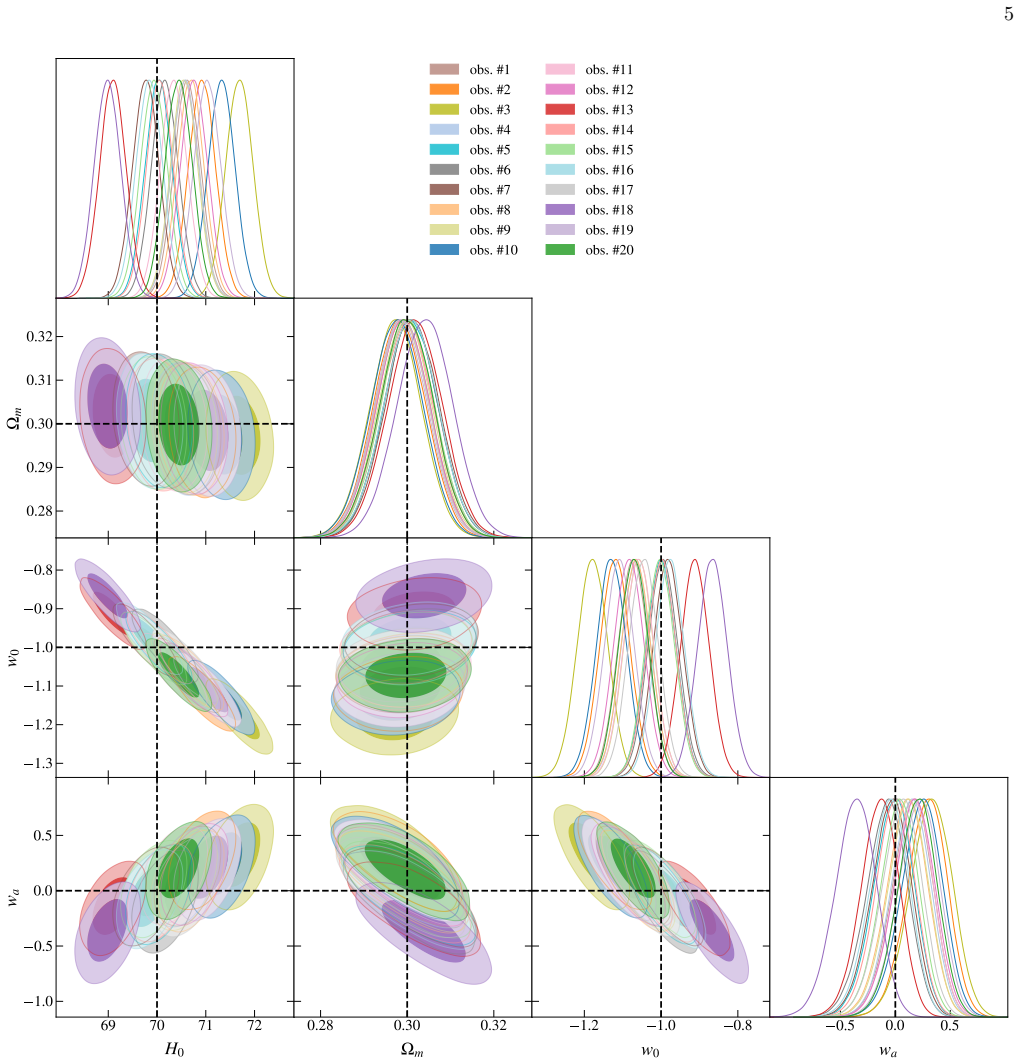
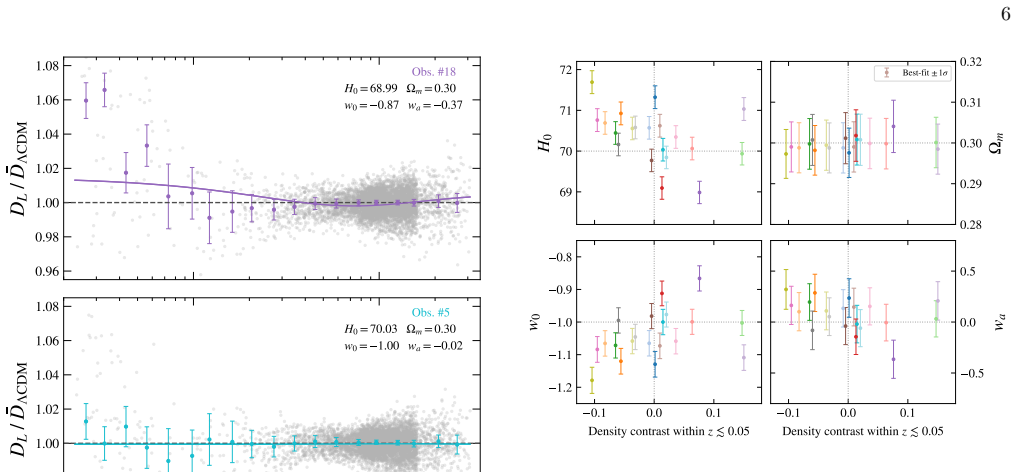
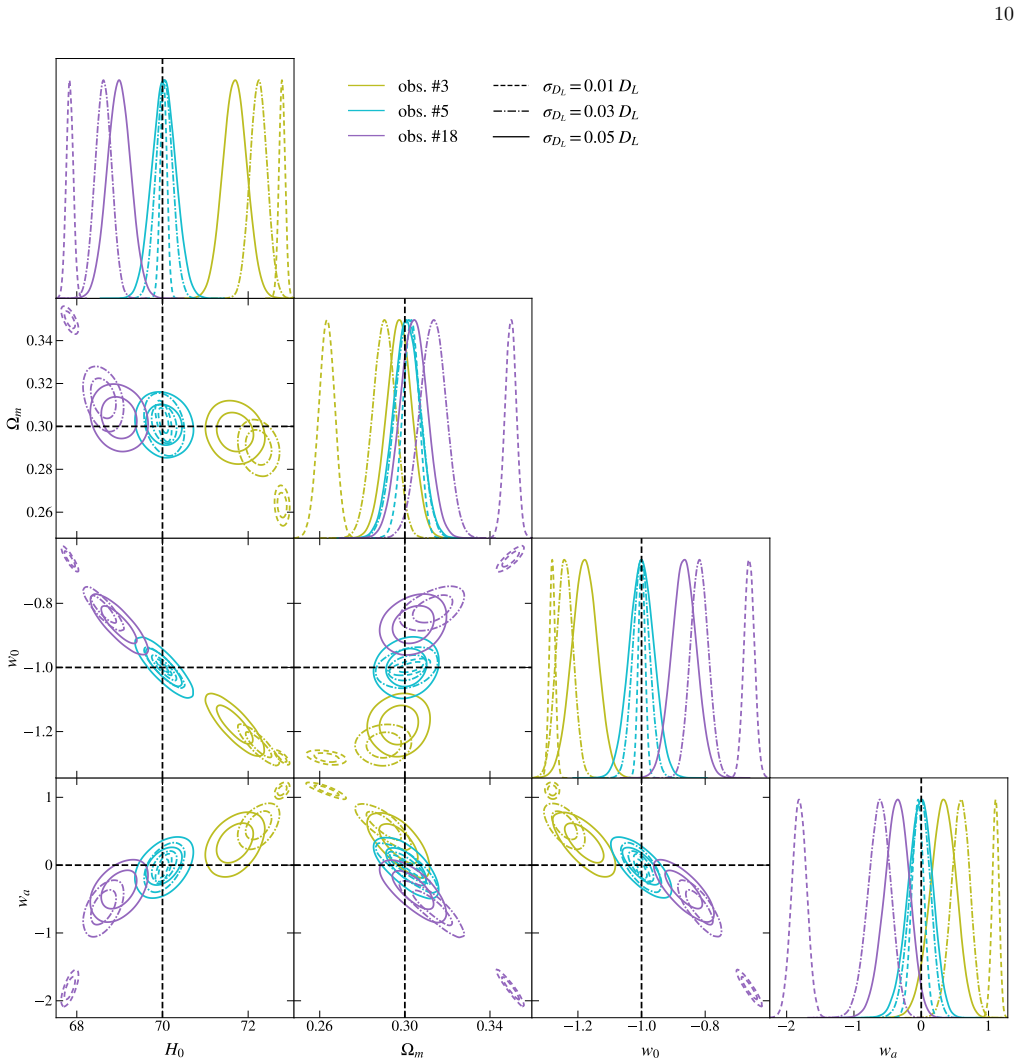
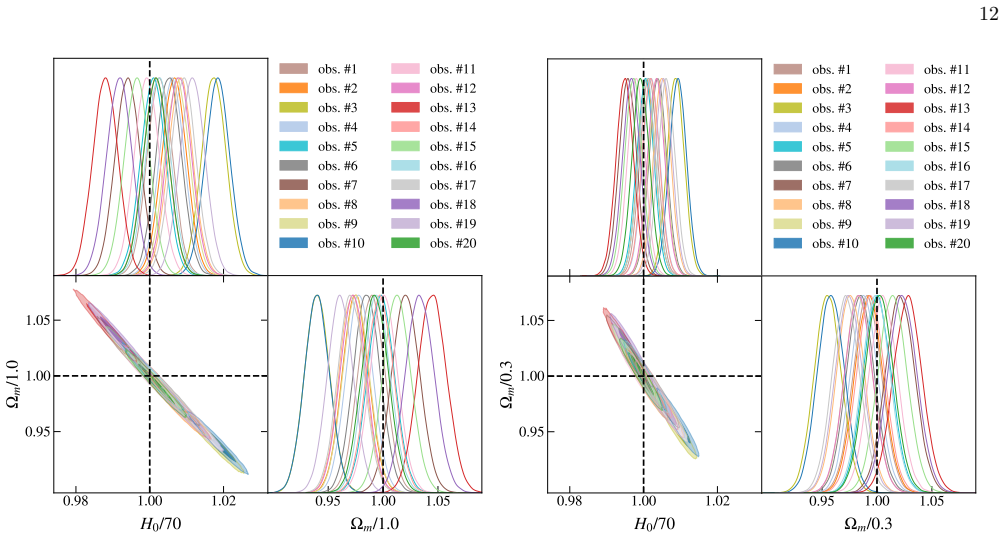
The central claim is that inhomogeneities can result in an apparent dynamical evolution of dark energy. Using numerical relativity simulations of large-scale structure formation combined with nonlinear general-relativistic ray tracing, the authors infer dark energy parameters for synthetic observers in a setup mimicking DESI plus supernovae and CMB constraints. In their small sample of 20 observers, one infers parameters consistent with the DESI values at 2-σ significance, demonstrating that it is possible for observers to infer significant non-LCDM parameters when their universe is well-described by a cosmological constant on average.
What carries the argument
Numerical relativity simulations of large-scale structure formation combined with nonlinear general-relativistic ray tracing applied to synthetic observers.
If this is right
- Observers at particular locations can measure apparent evolution in the dark-energy equation of state even when the average cosmology is Lambda-CDM.
- Inhomogeneity effects must be considered as a possible contributor when interpreting combined DESI, supernova, and CMB constraints.
- The rarity of such observers in the sample suggests the effect is not generic but can still arise in a fraction of locations.
- The result applies specifically to the simplified mock data designed to match current survey precision.
Where Pith is reading between the lines
- Survey analyses that assume a single global expansion history may need position-dependent corrections when inhomogeneity is taken into account.
- Similar ray-tracing methods could be used to test whether other cosmological tensions, such as the Hubble discrepancy, also appear in some observer locations.
- Extending the simulation volume or observer sample size would quantify how common the DESI-like inference is across the full range of possible locations.
Load-bearing premise
A simplified observational setup and a sample of only 20 observers are sufficient to demonstrate that the effect is possible in real data.
What would settle it
Finding that no observers in a larger set of simulations or in more realistic observational mocks recover DESI-like parameters at 2-sigma would show the reported possibility does not occur under those conditions.
Figures

read the original abstract
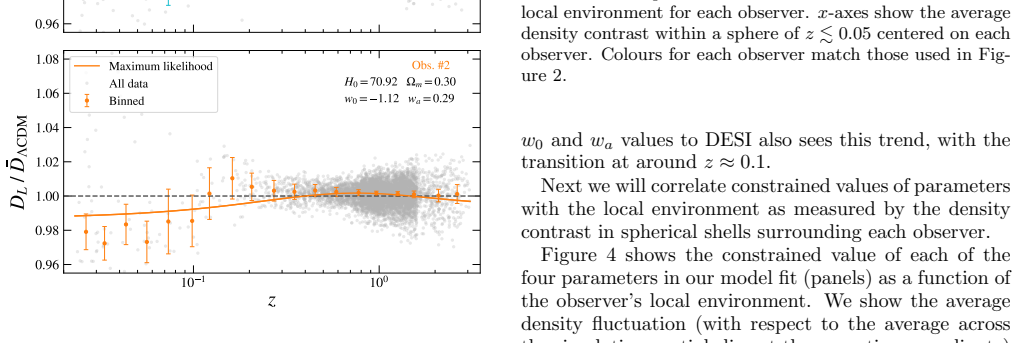
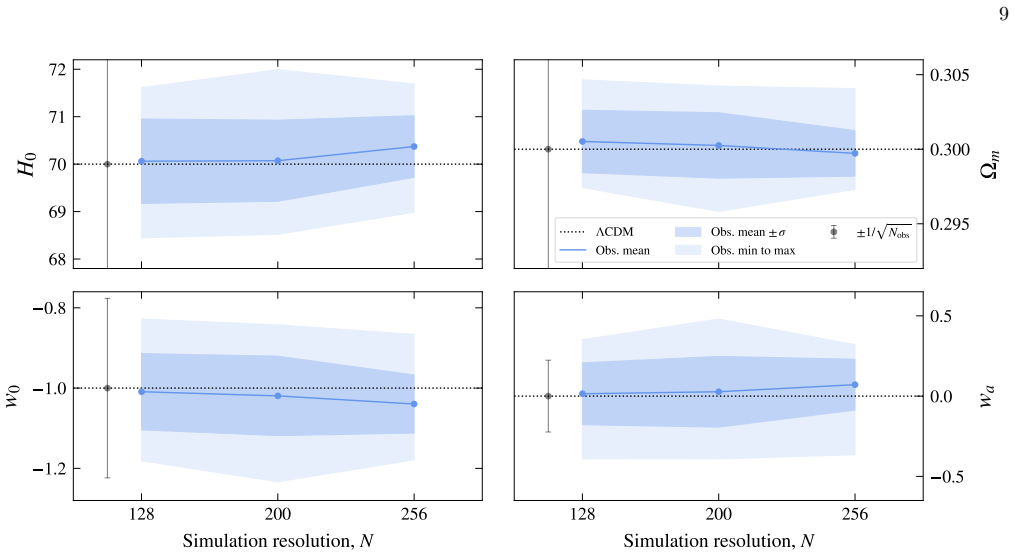
In this work we explore the ability of inhomogeneities to result in an apparent dynamical evolution of dark energy. The idea that inhomogeneities may alter the expansion history of the Universe is not a new one. However, with the current excitement surrounding the inferred time-evolution of the equation of state of dark energy by the Dark Energy Spectroscopic Instrument (DESI), combined with Cosmic Microwave Background (CMB) and supernovae observations, it is worth revisiting. We use numerical relativity simulations of large-scale structure formation combined with nonlinear general-relativistic ray tracing to infer dark energy parameters for synthetic observers. We adopt a simplified set-up to roughly mimic the observational properties of the DESI plus supernovae and CMB constraints. In our small sample of 20 observers, we find one who infers parameters consistent with the DESI values at 2-$\sigma$ significance. While it is rare in our limited sample size, we show that it is at least possible for observers to infer significant non-LCDM parameters when their universe is well-described by a cosmological constant on average.
Editorial analysis
A structured set of objections, weighed in public.
Referee Report
Summary. The paper claims that inhomogeneities in a universe that is on average well-described by ΛCDM can lead to synthetic observers inferring an evolving dark energy equation of state consistent with DESI results at 2σ. This is demonstrated using numerical relativity simulations of large-scale structure formation combined with nonlinear general-relativistic ray tracing, applied to 20 synthetic observers in a simplified setup that roughly mimics the observational properties of DESI BAO combined with supernovae and CMB constraints. The authors conclude that it is at least possible for such observers to infer significant non-ΛCDM parameters.
Significance. If the result holds, it would provide a concrete demonstration that apparent dynamical dark energy can arise from inhomogeneities without new physics, offering an important systematic consideration for the interpretation of DESI+SN+CMB data. The use of full numerical relativity and nonlinear ray tracing is a strength, as it avoids perturbative approximations and allows direct forward modeling of the effect.
major comments (2)
- [Methods] Methods section: The central claim that one observer infers parameters consistent with DESI at 2σ relies on the simplified setup adequately reproducing the statistical properties of real DESI+SN+CMB constraints. However, the manuscript provides no validation that the mock data vector, covariance, or likelihood match the actual survey systematics, redshift-dependent selection, or the precise BAO+supernova+Planck combination; this is load-bearing for interpreting the 2σ match as evidence of a physical effect rather than an artifact of the approximation.
- [Results] Results (discussion of the 20-observer sample): The observation of a single 2σ outlier in a sample of 20 is presented as demonstrating possibility, but the manuscript does not quantify the expected tail probability under the null (no inhomogeneity effect) or show that the outlier frequency would persist in a higher-fidelity forward model. With N=20 this single event is consistent with a ~5% tail probability and does not establish robustness for realistic observations.
minor comments (2)
- [Abstract] The abstract states the result is 'rare in our limited sample size' but does not quantify what 'rare' means or discuss how the simplified setup affects the claimed possibility; this could be clarified for readers.
- Figure captions (wherever the observer parameter contours are shown) should explicitly note the simplified nature of the mock likelihood to avoid over-interpretation of the 2σ agreement.
Simulated Author's Rebuttal
We thank the referee for their constructive comments, which help clarify the scope of our simplified demonstration. We address each major comment below and have made partial revisions to improve clarity on limitations without altering the core claim that inhomogeneities can produce apparent evolving dark energy in at least some observers.
read point-by-point responses
-
Referee: [Methods] Methods section: The central claim that one observer infers parameters consistent with DESI at 2σ relies on the simplified setup adequately reproducing the statistical properties of real DESI+SN+CMB constraints. However, the manuscript provides no validation that the mock data vector, covariance, or likelihood match the actual survey systematics, redshift-dependent selection, or the precise BAO+supernova+Planck combination; this is load-bearing for interpreting the 2σ match as evidence of a physical effect rather than an artifact of the approximation.
Authors: We agree the setup is simplified and provides no detailed validation against real survey systematics or covariances. The manuscript describes it explicitly as a 'simplified set-up to roughly mimic' the properties, with the goal of showing possibility rather than quantitative reproduction. We have revised the methods and discussion sections to state more explicitly that the mock likelihood is approximate and that the 2σ result should be interpreted only as an existence demonstration in this toy model, not as evidence calibrated to actual DESI+SN+CMB data. Full validation lies beyond the present scope. revision: partial
-
Referee: [Results] Results (discussion of the 20-observer sample): The observation of a single 2σ outlier in a sample of 20 is presented as demonstrating possibility, but the manuscript does not quantify the expected tail probability under the null (no inhomogeneity effect) or show that the outlier frequency would persist in a higher-fidelity forward model. With N=20 this single event is consistent with a ~5% tail probability and does not establish robustness for realistic observations.
Authors: The manuscript presents the result strictly as a demonstration of possibility ('at least possible' and 'rare in our limited sample size'), not as a frequency estimate or robustness claim. We do not quantify tail probabilities under the null or extrapolate to higher-fidelity models. We have revised the results and conclusions to emphasize that N=20 precludes statistical statements about occurrence rates and that the single outlier serves only to illustrate that 2σ deviations are attainable for some lines of sight. revision: partial
Circularity Check
No circularity: forward simulations of structure formation and ray tracing are independent of the target DESI inference result
full rationale
The paper's central result is obtained by running numerical relativity simulations of large-scale structure, performing nonlinear GR ray tracing to generate synthetic observables for 20 observers, and then applying a parameter inference pipeline to those mock data. This forward-modeling chain does not fit any parameter to the real DESI+SN+CMB dataset, nor does any equation reduce the reported 2σ outlier to an input by construction. The simplified observational mimicry is an explicit modeling choice whose adequacy is a separate question of realism, not a definitional or self-citation loop. No load-bearing step invokes a self-citation whose content is itself unverified or reduces to the present claim.
Axiom & Free-Parameter Ledger
Reference graph
Works this paper leans on
-
[1]
5 We use a continuous fluid approximation for dark matter and thus only sample scales above bound objects; see e.g
for a definition. 5 We use a continuous fluid approximation for dark matter and thus only sample scales above bound objects; see e.g. Macpher- son [49], Macphersonet al.[51]. 6 Publicly available athttps://data.desi.lbl.gov/public/dr1. We use DR1 data rather than DR2 since only the former is cur- rently public. 3 data. We combine the following DESI tracer...
-
[2]
This single observer is the only one who measuresboth a non-ΛCDMw 0 andw a at 2-σsignificance. Note that the observer who measuresw 0 >−1and wa <0 lies in the quadrant inw 0-wa space in which the DESI measurement also lies [4], with a constraint of w0 =−0.866±0.039 andw a =−0.37 +0.20 −0.17 (68% CI); consistent with [4] within 1-σ. We note that this ob- s...
-
[3]
P. Kumar Aluri, P. Cea, P. Chingangbam, M.-C. Chu, R. G. Clowes, D. Hutsem´ ekers, J. P. Kochappan, A. M. Lopez, L. Liu, N. C. M. Martens,et al., Is the observ- able Universe consistent with the cosmological princi- ple?, Classical and Quantum Gravity40, 094001 (2023), arXiv:2207.05765 [astro-ph.CO]
arXiv 2023
-
[4]
E. Abdalla, G. F. Abell´ an, A. Aboubrahim, A. Agnello, ¨O. Akarsu, Y. Akrami, G. Alestas, D. Aloni, L. Amen- dola, L. A. Anchordoqui, R. I. Anderson,et al., Cosmol- ogy intertwined: A review of the particle physics, astro- physics, and cosmology associated with the cosmological tensions and anomalies, Journal of High Energy Astro- physics34, 49 (2022), a...
Pith/arXiv arXiv 2022
-
[5]
L. Perivolaropoulos and F. Skara, Challenges for ΛCDM: An update, New A Rev.95, 101659 (2022), arXiv:2105.05208 [astro-ph.CO]
Pith/arXiv arXiv 2022
-
[6]
M. Abdul Karim, J. Aguilar, S. Ahlen, S. Alam, L. Allen, C. Allende Prieto, O. Alves, A. Anand, U. Andrade, E. Armengaud, A. Aviles,et al., DESI DR2 results. II. Measurements of baryon acoustic oscillations and cos- mological constraints, Phys. Rev. D112, 083515 (2025), arXiv:2503.14738 [astro-ph.CO]
Pith/arXiv arXiv 2025
-
[7]
K. Lodha, R. Calderon, W. L. Matthewson, A. Shafieloo, M. Ishak, J. Pan, C. Garcia-Quintero, D. Huterer, G. Valogiannis, L. A. Ure˜ na-L´ opez, N. V. Kamble, et al., Extended dark energy analysis using DESI DR2 BAO measurements, Phys. Rev. D112, 083511 (2025), arXiv:2503.14743 [astro-ph.CO]
Pith/arXiv arXiv 2025
-
[8]
C. Garcia-Quintero, H. E. Noriega, A. de Mattia, A. Aviles, K. Lodha, D. Chebat, J. Rohlf, S. Nadathur, W. Elbers, J. Aguilar, S. Ahlen,et al., Cosmological implications of DESI DR2 BAO measurements in light of the latest ACT DR6 CMB data, Phys. Rev. D112, 083529 (2025), arXiv:2504.18464 [astro-ph.CO]
arXiv 2025
-
[10]
M. S. Madhavacheril, F. J. Qu, B. D. Sherwin, N. MacCrann, Y. Li, I. Abril-Cabezas, P. A. R. Ade, S. Aiola, T. Alford, M. Amiri,et al., The Atacama Cosmology Telescope: DR6 Gravitational Lensing Map and Cosmological Parameters, ApJ962, 113 (2024), arXiv:2304.05203 [astro-ph.CO]
Pith/arXiv arXiv 2024
-
[11]
D. Scolnic, D. Brout, A. Carr, A. G. Riess, T. M. Davis, A. Dwomoh, D. O. Jones, N. Ali, P. Charvu, R. Chen, E. R. Peterson, B. Popovic, B. M. Rose, C. M. Wood, P. J. Brown, K. Chambers, D. A. Coulter, K. G. Dettman, G. Dimitriadis, A. V. Filippenko, R. J. Fo- ley, S. W. Jha, C. D. Kilpatrick, R. P. Kirshner, Y.- C. Pan, A. Rest, C. Rojas-Bravo, M. R. Sie...
Pith/arXiv arXiv 2022
-
[12]
D. Brout, D. Scolnic, B. Popovic, A. G. Riess, J. Zuntz, R. Kessler, A. Carr, T. M. Davis, S. Hinton, D. Jones, W. D. Kenworthy, E. R. Peterson, K. Said, G. Tay- lor, N. Ali, P. Armstrong, P. Charvu, A. Dwomoh, A. Palmese, H. Qu, B. M. Rose, C. W. Stubbs, M. Vin- cenzi, C. M. Wood, P. J. Brown, R. Chen, K. Cham- bers, D. A. Coulter, M. Dai, G. Dimitriadis...
Pith/arXiv arXiv 2022
-
[13]
D. Rubin, G. Aldering, M. Betoule, A. Fruchter, X. Huang, A. G. Kim, C. Lidman, E. Linder, S. Perl- mutter, P. Ruiz-Lapuente, and N. Suzuki, Union through UNITY: Cosmology with 2000 SNe Using a Unified Bayesian Framework, ApJ986, 231 (2025), arXiv:2311.12098 [astro-ph.CO]
Pith/arXiv arXiv 2000
-
[15]
DES Collaboration, T. M. C. Abbott, M. Adamow, M. Aguena, A. Alarcon, S. Allam, O. Alves, A. Amon, D. Anbajagane, F. Andrade-Oliveira, P. Armstrong, S. Avila,et al., Constraints on Dynamical Dark En- ergy from Multiple Probes in the Full Dark En- ergy Survey, arXiv e-prints , arXiv:2605.27221 (2026), arXiv:2605.27221 [astro-ph.CO]
Pith/arXiv arXiv 2026
-
[16]
B. Popovic, W. D. Kenworthy, M. Ginolin, A. Goo- bar, P. Shah, B. M. Boyd, A. Do, D. Brout, D. Scol- nic, M. Vincenzi, S. Dhawan, D. O. Jones, M. Smith, M. Rigault, B. Racine, E. E. Hayes, R. Chen, P. Wise- man, L. Galbany, M. Grayling, L. LaCroix, C. Barjou- Delayre, D. Kuhn, and C. Lemon, A Reassessment of the Pantheon+ and DES 5YR Calibration Uncertain...
arXiv 2025
-
[17]
W. Giar` e, T. Mahassen, E. D. Valentino, and S. Pan, An overview of what current data can (and cannot yet) say about evolving dark energy, Physics of the Dark Universe 48, 101906 (2025), arXiv:2502.10264 [astro-ph.CO]
arXiv 2025
-
[18]
S. Capozziello, H. Chaudhary, T. Harko, and G. Mustafa, Is dark energy dynamical in the DESI era? A critical review, Physics of the Dark Universe51, 102196 (2026), arXiv:2512.10585 [astro-ph.CO]
arXiv 2026
-
[19]
J. Khoury, M.-X. Lin, and M. Trodden, Apparent w-1 and a Lower S8 from Dark Axion and Dark Baryons Interactions, Phys. Rev. Lett.135, 181001 (2025), arXiv:2503.16415 [astro-ph.CO]
arXiv 2025
-
[20]
E. Chaussidon, M. White, A. de Mattia, R. Gsponer, S. Ahlen, D. Bianchi, D. Brooks, T. Claybaugh, S. Cole, A. Cuceu, A. de la Macorra, P. Doel, S. Ferraro, A. Font-Ribera, J. E. Forero-Romero, E. Gazta˜ naga, S. G. A. Gontcho, G. Gutierrez, J. Guy, C. Hahn, H. K. Herrera-Alcantar, K. Honscheid, M. Ishak, D. Kirkby, T. Kisner, A. Kremin, M. Landriau, L. Le...
arXiv 2025
-
[21]
J. Pan and G. Ye, Nonminimally coupled gravity con- straints from DESI DR2 data, Phys. Rev. D113, L041304 (2026), arXiv:2503.19898 [astro-ph.CO]
Pith/arXiv arXiv 2026
-
[22]
A. J. Shajib and J. A. Frieman, Scalar-field dark energy models: Current and forecast constraints, Phys. Rev. D 112, 063508 (2025), arXiv:2502.06929 [astro-ph.CO]
arXiv 2025
-
[23]
M. Ishak, J. Pan, R. Calderon, K. Lodha, G. Valogiannis, A. Aviles, G. Niz, L. Yi, C. Zheng, C. Garcia-Quintero, A. de Mattia, L. Medina-Varela,et al., Modified grav- ity constraints from the full shape modeling of clustering measurements from DESI 2024, J. Cosmology Astropart. Phys.2025, 053 (2025), arXiv:2411.12026 [astro-ph.CO]
arXiv 2024
-
[24]
A. Bedroya, G. Obied, C. Vafa, and D. H. Wu, Evolving Dark Sector and the Dark Dimension Scenario, arXiv e-prints , arXiv:2507.03090 (2025), arXiv:2507.03090 [astro-ph.CO]
Pith/arXiv arXiv 2025
-
[25]
S.-F. Chen and M. Zaldarriaga, It’s all Ok: curvature in light of BAO from DESI DR2, J. Cosmology Astropart. Phys.2025, 014 (2025), arXiv:2505.00659 [astro-ph.CO]
arXiv 2025
-
[26]
E. Fern´ andez-Garc´ ıa, R. Wojtak, F. Prada, J. L. Cervantes-Cota, O. Alves, G. Valogiannis, J. Aguilar, 13 S. Ahlen, S. BenZvi, D. Bianchi, D. Brooks, T. Clay- baugh, A. de la Macorra, P. Doel, E. Gazta˜ naga, S. Gontcho A Gontcho, G. Gutierrez, K. Honscheid, M. Ishak, S. Juneau, D. Kirkby, T. Kisner, M. Lan- driau, L. Le Guillou, M. E. Levi, T. S. Li, ...
arXiv 2025
- [27]
-
[28]
G. F. R. Ellis, Relativistic cosmology: its nature, aims and problems., inGeneral Relativity and Gravitation Conference, edited by B. Bertotti, F. de Felice, and A. Pascolini (1984) pp. 215–288
1984
-
[29]
G. F. R. Ellis and W. Stoeger, The ’fitting problem’ in cosmology, Classical and Quantum Gravity4, 1697 (1987)
1987
-
[30]
Futamase, Approximation scheme for constructing a clumpy universe in general relativity, Phys
T. Futamase, Approximation scheme for constructing a clumpy universe in general relativity, Phys. Rev. Lett. 61, 2175 (1988)
1988
-
[31]
N. V. Zotov and W. R. Stoeger, Averaging Einstein’s equations, Classical and Quantum Gravity9, 1023 (1992)
1992
-
[32]
T. Buchert, Dark Energy from structure: a status re- port, General Relativity and Gravitation40, 467 (2008), arXiv:0707.2153 [gr-qc]
Pith/arXiv arXiv 2008
-
[33]
T. Buchert and S. R¨ as¨ anen, Backreaction in Late-Time Cosmology, Annual Review of Nuclear and Particle Sci- ence62, 57 (2012), arXiv:1112.5335 [astro-ph.CO]
Pith/arXiv arXiv 2012
-
[34]
W. Hu, U. Seljak, M. White, and M. Zaldarriaga, Com- plete treatment of CMB anisotropies in a FRW universe, Phys. Rev. D57, 3290 (1998), arXiv:astro-ph/9709066 [astro-ph]
Pith/arXiv arXiv 1998
-
[35]
C. Bonvin, R. Durrer, and M. A. Gasparini, Fluctua- tions of the luminosity distance, Phys. Rev. D73, 023523 (2006), arXiv:astro-ph/0511183 [astro-ph]
Pith/arXiv arXiv 2006
-
[36]
L. Hui and P. B. Greene, Correlated fluctuations in lu- minosity distance and the importance of peculiar motion in supernova surveys, Phys. Rev. D73, 123526 (2006), arXiv:astro-ph/0512159 [astro-ph]
Pith/arXiv arXiv 2006
-
[37]
T. M. C. Abbott, M. Aguena, A. Alarcon, S. Allam, O. Alves, A. Amon, F. Andrade-Oliveira, J. Annis, S. Avila, D. Bacon, E. Baxter,et al., Dark Energy Sur- vey Year 3 results: Cosmological constraints from galaxy clustering and weak lensing, Phys. Rev. D105, 023520 (2022), arXiv:2105.13549 [astro-ph.CO]
Pith/arXiv arXiv 2022
-
[38]
A. H. Wright, B. St¨ olzner, M. Asgari, M. Bilicki, B. Giblin, C. Heymans, H. Hildebrandt, H. Hoekstra, B. Joachimi, K. Kuijken, S.-S. Li,et al., KiDS-Legacy: Cosmological constraints from cosmic shear with the complete Kilo-Degree Survey, A&A703, A158 (2025), arXiv:2503.19441 [astro-ph.CO]
Pith/arXiv arXiv 2025
-
[39]
K. Said, M. Colless, C. Magoulas, J. R. Lucey, and M. J. Hudson, Joint analysis of 6dFGS and SDSS peculiar ve- locities for the growth rate of cosmic structure and tests of gravity, MNRAS497, 1275 (2020), arXiv:2007.04993 [astro-ph.CO]
arXiv 2020
-
[40]
R. W. Pike and M. J. Hudson, Cosmological Parame- ters from the Comparison of the 2MASS Gravity Field with Peculiar Velocity Surveys, ApJ635, 11 (2005), arXiv:astro-ph/0511012 [astro-ph]
Pith/arXiv arXiv 2005
-
[41]
D. E. Holz and E. V. Linder, Safety in Numbers: Gravita- tional Lensing Degradation of the Luminosity Distance- Redshift Relation, ApJ631, 678 (2005), arXiv:astro- ph/0412173 [astro-ph]
arXiv 2005
-
[42]
N. Kaiser and J. A. Peacock, On the bias of the distance- redshift relation from gravitational lensing, MNRAS455, 4518 (2016), arXiv:1503.08506 [astro-ph.CO]
Pith/arXiv arXiv 2016
-
[43]
T. Clifton and J. Zuntz, Hubble diagram dispersion from large-scale structure, MNRAS400, 2185 (2009), arXiv:0902.0726 [astro-ph.CO]
Pith/arXiv arXiv 2009
-
[44]
K. Bolejko and P. G. Ferreira, Ricci focusing, shearing, and the expansion rate in an almost homogeneous Uni- verse, J. Cosmology Astropart. Phys.2012, 003 (2012), arXiv:1204.0909 [astro-ph.CO]
Pith/arXiv arXiv 2012
-
[45]
P. Fleury, H. Dupuy, and J.-P. Uzan, Interpretation of the Hubble diagram in a nonhomogeneous universe, Phys. Rev. D87, 123526 (2013), arXiv:1302.5308 [astro- ph.CO]
Pith/arXiv arXiv 2013
-
[46]
Y. B. Ginat and P. G. Ferreira, Apparent Dark- Energy Evolution from Cosmic Inhomogeneities, arXiv e-prints , arXiv:2601.20633 (2026), arXiv:2601.20633 [astro-ph.CO]
arXiv 2026
-
[47]
D. Camarena, K. Greene, J. Houghteling, and F.-Y. Cyr- Racine, Designing concordant distances in the age of pre- cision cosmology: The impact of density fluctuations, Phys. Rev. D112, 083526 (2025), arXiv:2507.17969 [astro-ph.CO]
arXiv 2025
-
[48]
A. Lewis, A. Challinor, and A. Lasenby, Efficient Compu- tation of Cosmic Microwave Background Anisotropies in Closed Friedmann-Robertson-Walker Models, ApJ538, 473 (2000), arXiv:astro-ph/9911177 [astro-ph]
Pith/arXiv arXiv 2000
-
[49]
J. T. Giblin, J. B. Mertens, G. D. Starkman, and A. R. Zentner, General relativistic corrections to the weak lensing convergence power spectrum, Phys. Rev. D96, 103530 (2017), arXiv:1707.06640 [astro-ph.CO]
Pith/arXiv arXiv 2017
-
[50]
H. J. Macpherson, Cosmological distances with general- relativistic ray tracing: framework and comparison to cosmographic predictions, J. Cosmology Astropart. Phys. 2023, 019 (2023), arXiv:2209.06775 [astro-ph.CO]
arXiv 2023
-
[51]
H. J. Macpherson, Large-scale weak lensing conver- gence in nonlinear general relativity, arXiv e-prints , arXiv:2603.24838 (2026), arXiv:2603.24838 [astro- ph.CO]
arXiv 2026
-
[52]
K. M. G´ orski, E. Hivon, A. J. Banday, B. D. Wan- delt, F. K. Hansen, M. Reinecke, and M. Bartelmann, HEALPix: A Framework for High-Resolution Discretiza- tion and Fast Analysis of Data Distributed on the Sphere, ApJ622, 759 (2005), arXiv:astro-ph/0409513 [astro-ph]
Pith/arXiv arXiv 2005
-
[53]
H. J. Macpherson, D. J. Price, and P. D. Lasky, Ein- stein’s Universe: Cosmological structure formation in numerical relativity, Phys. Rev. D99, 063522 (2019), arXiv:1807.01711 [astro-ph.CO]
Pith/arXiv arXiv 2019
-
[54]
H. J. Macpherson, P. D. Lasky, and D. J. Price, The Trouble with Hubble: Local versus Global Ex- pansion Rates in Inhomogeneous Cosmological Simula- tions with Numerical Relativity, ApJ865, L4 (2018), arXiv:1807.01714 [astro-ph.CO]
Pith/arXiv arXiv 2018
-
[55]
M.-A. Breton and P. Fleury, Theoretical and numerical perspectives on cosmic distance averages, A&A655, A54 (2021), arXiv:2012.07802 [astro-ph.CO]
arXiv 2021
-
[56]
H. J. Macpherson, S. Elgamal, and J. Frieman, Quan- 14 tification of bias in cosmological density parameters in numerical relativity simulations, in prep. (2026)
2026
-
[57]
DESI Collaboration, M. Abdul Karim, A. G. Adame, D. Aguado, J. Aguilar, S. Ahlen, S. Alam, G. Alder- ing, D. M. Alexander, R. Alfarsy, L. Allen, C. Allende Prieto, O. Alves,et al., Data Release 1 of the Dark Energy Spectroscopic Instrument, AJ171, 285 (2026), arXiv:2503.14745 [astro-ph.CO]
Pith/arXiv arXiv 2026
-
[58]
A. G. Riess, W. Yuan, L. M. Macri, D. Scolnic, D. Brout, S. Casertano, D. O. Jones, Y. Murakami, G. S. Anand, L. Breuval, T. G. Brink, A. V. Filippenko, S. Hoffmann, S. W. Jha, W. D’arcy Kenworthy, J. Mackenty, B. E. Stahl, and W. Zheng, A Comprehensive Measurement of the Local Value of the Hubble Constant with 1 km s −1 Mpc−1 Uncertainty from the Hubble ...
Pith/arXiv arXiv 2022
-
[59]
M. Chevallier and D. Polarski, Accelerating Universes with Scaling Dark Matter, International Journal of Mod- ern Physics D10, 213 (2001), arXiv:gr-qc/0009008 [gr- qc]
Pith/arXiv arXiv 2001
-
[60]
E. V. Linder, Exploring the Expansion History of the Universe, Phys. Rev. Lett.90, 091301 (2003), arXiv:astro-ph/0208512 [astro-ph]
Pith/arXiv arXiv 2003
-
[61]
Planck Collaboration, N. Aghanim, Y. Akrami, M. Ash- down, J. Aumont, C. Baccigalupi, M. Ballardini, A. J. Banday, R. B. Barreiro, N. Bartolo, S. Basak,et al., Planck 2018 results. VI. Cosmological parameters, A&A 641, A6 (2020), arXiv:1807.06209 [astro-ph.CO]
Pith/arXiv arXiv 2018
-
[62]
DES Collaboration, T. M. C. Abbott, M. Acevedo, M. Aguena, A. Alarcon, S. Allam, O. Alves, A. Amon, F. Andrade-Oliveira, J. Annis, P. Armstrong, J. Asorey, et al., The Dark Energy Survey: Cosmology Results with∼1500 New High-redshift Type Ia Supernovae Us- ing the Full 5 yr Data Set, ApJ973, L14 (2024), arXiv:2401.02929 [astro-ph.CO]
Pith/arXiv arXiv 2024
-
[63]
E. R. Peterson, W. D. Kenworthy, D. Scolnic, A. G. Riess, D. Brout, A. Carr, H. Courtois, T. Davis, A. Dwomoh, D. O. Jones, B. Popovic, B. M. Rose, and K. Said, The Pantheon+ Analysis: Evaluating Peculiar Velocity Corrections in Cosmological Analy- ses with Nearby Type Ia Supernovae, arXiv e-prints , arXiv:2110.03487 (2021), arXiv:2110.03487 [astro- ph.CO]
arXiv 2021
-
[64]
A. Carr, T. M. Davis, D. Scolnic, K. Said, D. Brout, E. R. Peterson, and R. Kessler, The Pantheon+ analysis: Improving the redshifts and peculiar velocities of Type Ia supernovae used in cosmological analyses, PASA39, e046 (2022), arXiv:2112.01471 [astro-ph.CO]
arXiv 2022
-
[65]
T. M. Davis, L. Hui, J. A. Frieman, T. Haugbølle, R. Kessler, B. Sinclair, J. Sollerman, B. Bassett, J. Mar- riner, E. M¨ ortsell, R. C. Nichol, M. W. Richmond, M. Sako, D. P. Schneider, and M. Smith, The Effect of Peculiar Velocities on Supernova Cosmology, ApJ741, 67 (2011), arXiv:1012.2912 [astro-ph.CO]
Pith/arXiv arXiv 2011
-
[66]
J. D. Neill, M. J. Hudson, and A. Conley, The Peculiar Velocities of Local Type Ia Supernovae and Their Impact on Cosmology, ApJ661, L123 (2007), arXiv:0704.1654 [astro-ph]
Pith/arXiv arXiv 2007
-
[67]
Heinesen, Bulk flows in the local Universe and the im- portance of relativistic effects, Phys
A. Heinesen, Bulk flows in the local Universe and the im- portance of relativistic effects, Phys. Rev. D108, 103530 (2023), arXiv:2305.16084 [astro-ph.CO]
arXiv 2023
-
[68]
A. Heinesen, Multipole decomposition of the general lu- minosity distance ’Hubble law’ – a new framework for ob- servational cosmology, arXiv e-prints , arXiv:2010.06534 (2020), arXiv:2010.06534 [astro-ph.CO]
arXiv 2010
-
[69]
P. Fleury, C. Clarkson, and R. Maartens, How does the cosmic large-scale structure bias the Hubble dia- gram?, J. Cosmology Astropart. Phys.2017, 062 (2017), arXiv:1612.03726 [astro-ph.CO]
Pith/arXiv arXiv 2017
-
[70]
S. J. Magnall, D. J. Price, P. D. Lasky, and H. J. Macpherson, Inhomogeneous cosmology using general relativistic smoothed particle hydrodynamics coupled to numerical relativity, Phys. Rev. D108, 103534 (2023), arXiv:2307.15194 [gr-qc]
arXiv 2023
discussion (0)
Sign in with ORCID, Apple, or X to comment. Anyone can read and Pith papers without signing in.