Dissipative Cosmology and the Nature of Dark Energy: Insights from Bulk Viscosity with DESI DR2 observations
Pith reviewed 2026-06-28 00:29 UTC · model grok-4.3
The pith
A bulk viscous fluid model for dark energy fits supernova, DESI, and CMB data better than the cosmological constant when non-minimal interactions are allowed.
A machine-rendered reading of the paper's core claim, the machinery that carries it, and where it could break.
Core claim
Dark energy modeled as a bulk viscous fluid, in minimally and non-minimally coupled scenarios, successfully mimics dynamical dark energy and produces improved fits to SNe Ia, DESI DR2 BAO, and Planck 2018 CMB data compared with Lambda CDM, especially when non-minimal interactions are included.
What carries the argument
The bulk viscous fluid, whose negative pressure arises from a dissipation term proportional to the expansion rate, providing the effective equation of state needed for acceleration.
If this is right
- Dissipative processes can replace the cosmological constant as the driver of acceleration in viable cosmological models.
- Non-minimal coupling between the viscous fluid and matter improves agreement with current combined datasets.
- The same viscous mechanism can be tested against future large-scale structure and supernova surveys.
- Models without a constant dark-energy density become competitive when dissipation is allowed.
Where Pith is reading between the lines
- Confirmation would encourage searches for microphysical sources of viscosity in dark-energy candidates.
- Similar dissipation terms might be applied to early-universe or modified-gravity scenarios.
- Tension between different cosmological probes could be re-examined under viscous rather than vacuum-energy assumptions.
Load-bearing premise
The bulk viscous fluid supplies a physically consistent description of dark energy whose fitted parameters remain free of unphysical values or conflicts with other observations.
What would settle it
Future data that force the viscosity coefficient to zero or produce parameter values that violate energy conditions or conflict with independent expansion-rate measurements.
Figures
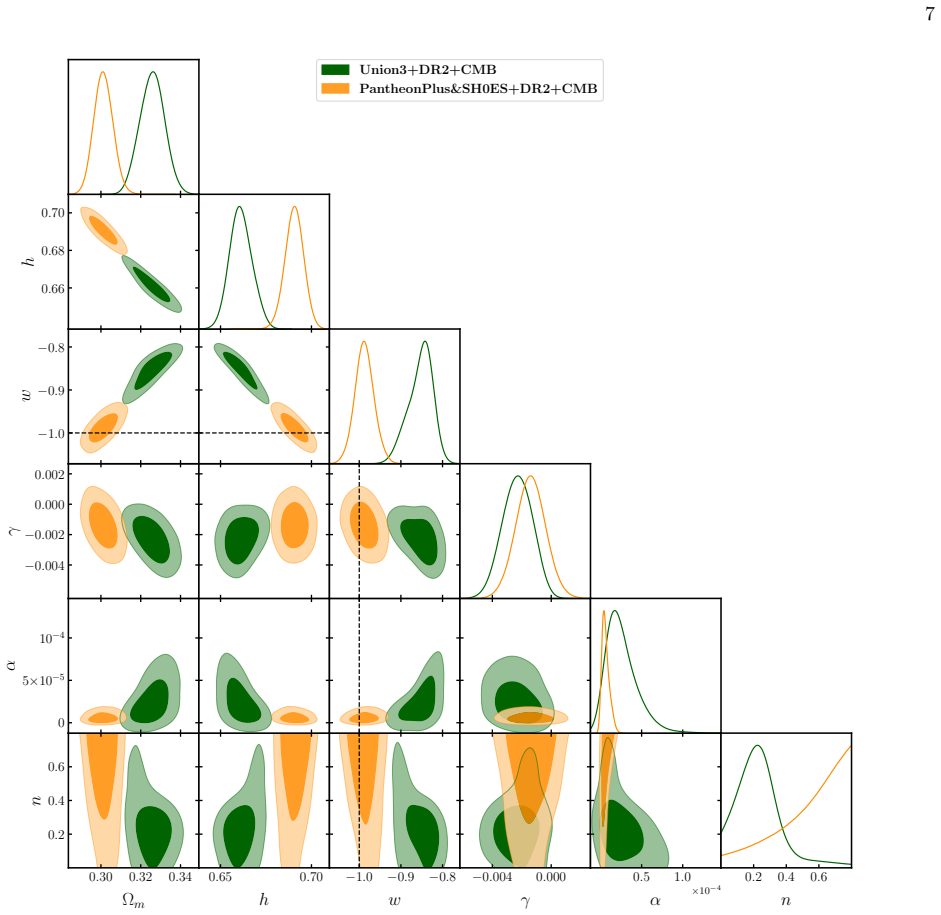
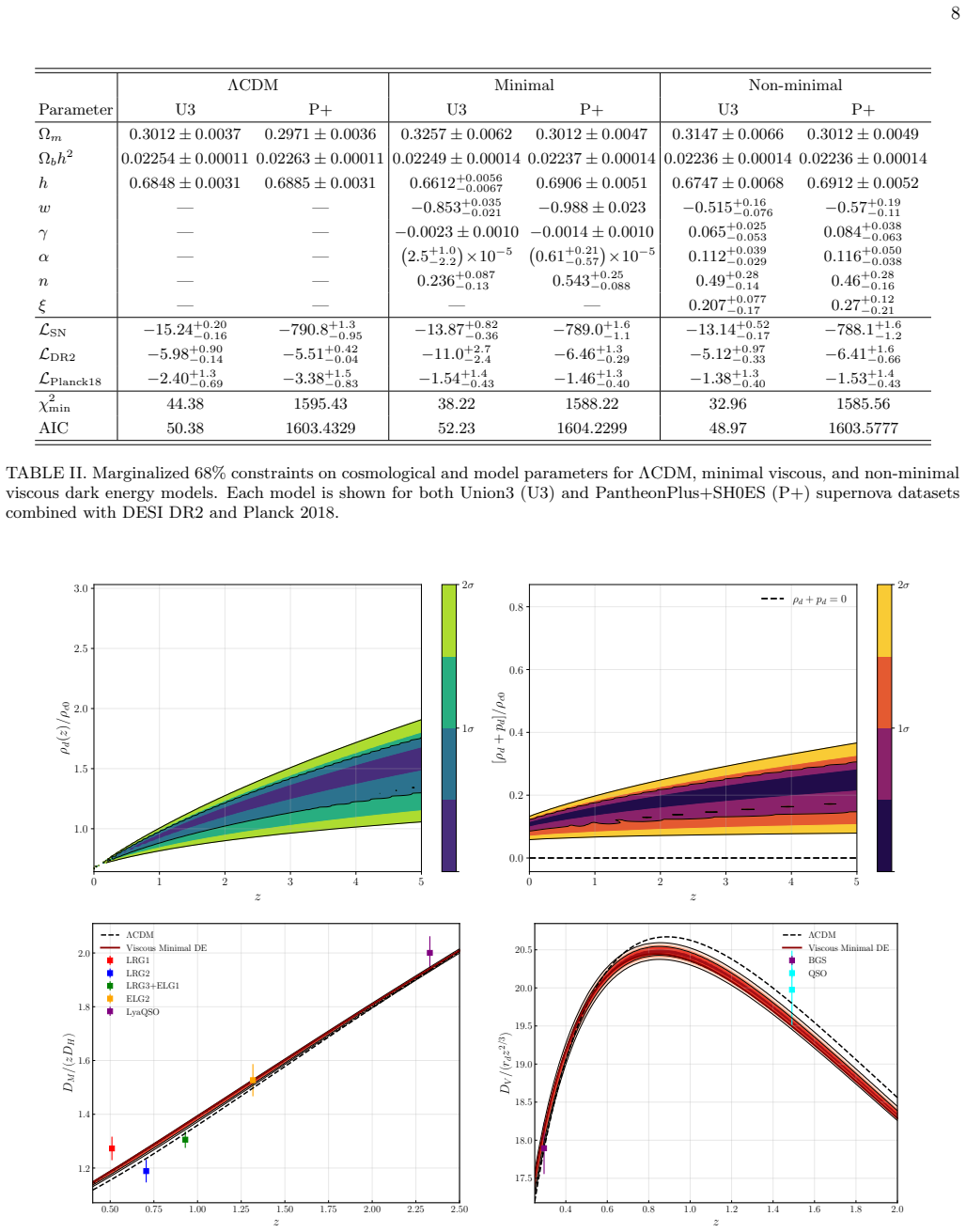
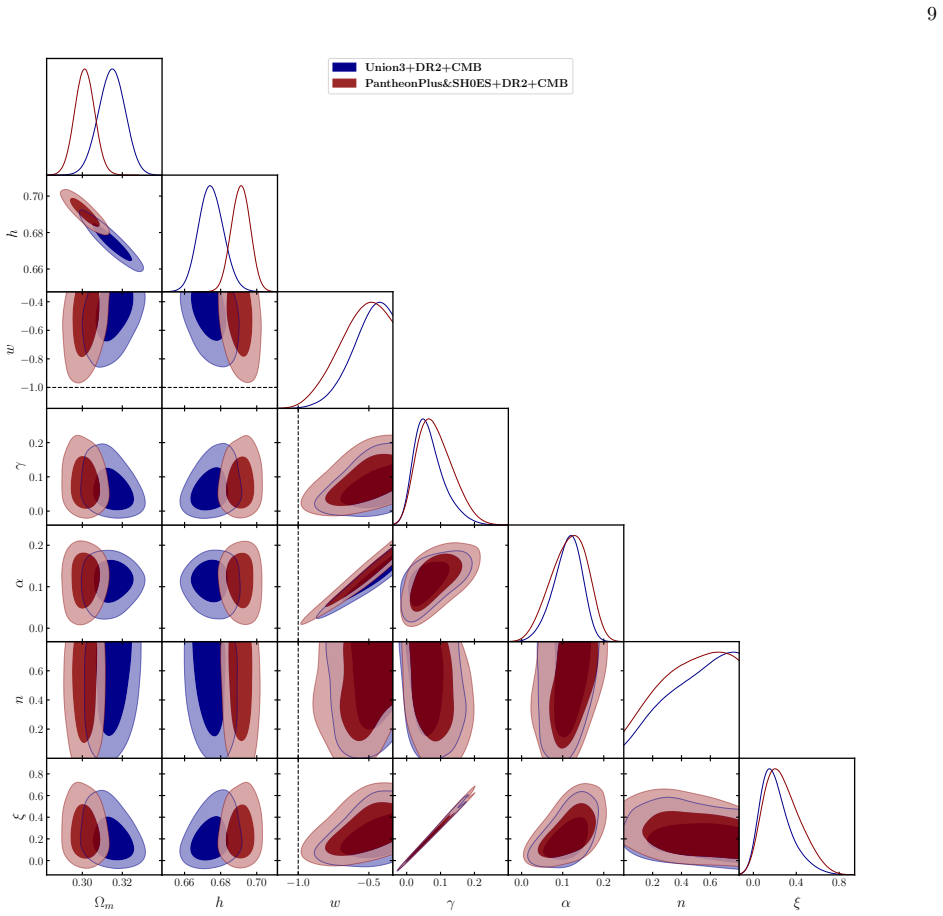
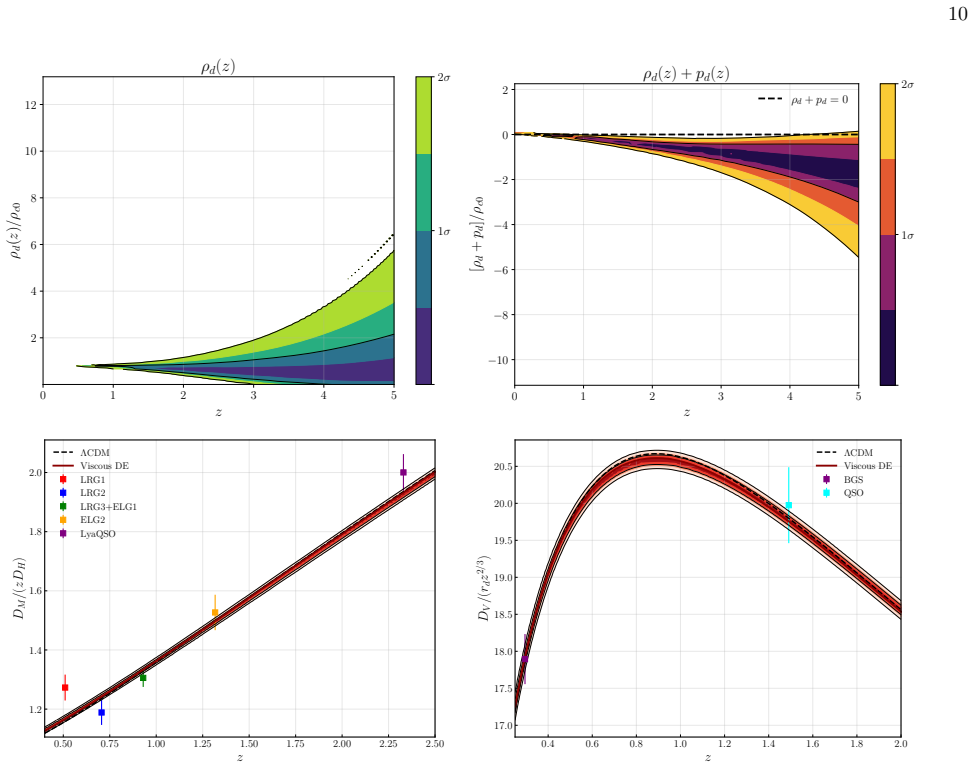
read the original abstract
We explore a cosmological model in which dark energy is described by a bulk viscous fluid, providing a dissipative mechanism for late-time cosmic acceleration. Considering both minimally and non-minimally coupled scenarios, we constrain the model using SNe Ia, DESI DR2 BAO, and Planck 2018 CMB data. We find that viscous effects can successfully mimic dynamical dark energy and yield improved fits over $\Lambda$CDM, particularly in the interacting non-minimal case. Our results demonstrate that dissipative processes offer a viable and physically motivated alternative to the cosmological constant in explaining the current accelerated expansion of the universe.
Editorial analysis
A structured set of objections, weighed in public.
Referee Report
Summary. The manuscript models dark energy as a bulk viscous fluid in minimally and non-minimally coupled scenarios (including an interacting case), derives the background evolution, and performs MCMC constraints using SNe Ia, DESI DR2 BAO, and Planck 2018 CMB data. It claims that viscous effects successfully mimic dynamical dark energy and produce improved fits relative to ΛCDM, particularly for the interacting non-minimal model.
Significance. If the quantitative fit improvements are shown to be statistically robust after penalizing for extra parameters and the model parameters remain free of unphysical consequences, the work would add to explorations of dissipative mechanisms as alternatives to the cosmological constant by incorporating the latest DESI DR2 observations.
major comments (2)
- [Abstract and results section] Abstract and results section: the central claim that viscous models yield 'improved fits' over ΛCDM is not supported by any reported χ² values, Δχ², AIC/BIC, or effective degrees of freedom in the provided description, despite the introduction of two additional free parameters; without these metrics the statistical preference cannot be assessed.
- [Methodology and discussion] Methodology and discussion: the physical viability of the bulk viscosity coefficient and non-minimal coupling as a dark energy description requires explicit checks that the best-fit parameters produce no violations of energy conditions or instabilities in the perturbation equations, as these directly affect the claim of a viable alternative.
minor comments (2)
- [Tables] Tables presenting MCMC posteriors should include the corresponding ΛCDM baseline values for direct comparison.
- [Evolution equations] Clarify the exact form of the interaction term in the non-minimal case to avoid ambiguity in the evolution equations.
Simulated Author's Rebuttal
We thank the referee for the constructive comments on our manuscript. We address each major point below and will revise the paper accordingly to strengthen the statistical and physical claims.
read point-by-point responses
-
Referee: [Abstract and results section] Abstract and results section: the central claim that viscous models yield 'improved fits' over ΛCDM is not supported by any reported χ² values, Δχ², AIC/BIC, or effective degrees of freedom in the provided description, despite the introduction of two additional free parameters; without these metrics the statistical preference cannot be assessed.
Authors: We agree that explicit reporting of χ², Δχ², AIC, and BIC is required to substantiate the claim of improved fits, especially given the two extra parameters. Although the MCMC analysis was performed and likelihood comparisons underlie the stated preference, these quantitative metrics were not tabulated in the results section. In the revised manuscript we will add a dedicated table (or subsection) presenting the minimum χ² values for each model, the differences relative to ΛCDM, and the corresponding AIC/BIC penalties, allowing readers to assess the statistical robustness directly. revision: yes
-
Referee: [Methodology and discussion] Methodology and discussion: the physical viability of the bulk viscosity coefficient and non-minimal coupling as a dark energy description requires explicit checks that the best-fit parameters produce no violations of energy conditions or instabilities in the perturbation equations, as these directly affect the claim of a viable alternative.
Authors: We concur that viability checks are essential. The current text focuses on background evolution and observational constraints but does not explicitly verify the null energy condition, dominant energy condition, or the absence of gradient instabilities/ghosts in the perturbation sector for the best-fit parameter values. In the revised version we will add a new subsection (or appendix) that evaluates these conditions at the posterior means and discusses the effective sound speed and perturbation equations for both the minimal and non-minimal cases, thereby confirming or qualifying the physical acceptability of the models. revision: yes
Circularity Check
No significant circularity detected
full rationale
The paper constrains a bulk-viscous dark-energy model via standard MCMC fits to external datasets (SNe Ia, DESI DR2 BAO, Planck 2018 CMB) and reports improved chi-squared relative to ΛCDM. No derivation step is shown to reduce by construction to a fitted input renamed as prediction, a self-definitional relation, or a load-bearing self-citation chain. The background evolution equations are conventional; the data combination is independent of the model parameters. This constitutes normal model comparison against external benchmarks rather than circular reasoning.
Axiom & Free-Parameter Ledger
free parameters (2)
- bulk viscosity coefficient
- non-minimal coupling strength
axioms (2)
- standard math FLRW metric and standard Friedmann equations govern background expansion
- domain assumption Bulk viscosity can be treated as an effective fluid description of dark energy
invented entities (1)
-
bulk viscous dark energy fluid
no independent evidence
Reference graph
Works this paper leans on
-
[1]
To explore the role of viscosity in the evolution of the universe, we consider two cases: minimal interaction and non-minimal interaction. A. Minimal Interaction In the minimal interaction scenario, the different com- ponents of the Universe (radiation, matter, and vis- cous dark energy), evolve independently and satisfy the standard conservation laws. Co...
arXiv 2018
-
[2]
A. G. R. et al., Observational Evidence from Supernovae for an Accelerating Universe and a Cosmological Con- stant, Astron. J.116, 1009 (1998), astro-ph/9805201
Pith/arXiv arXiv 1998
-
[4]
S. Alamet al.(eBOSS), Completed SDSS-IV extended Baryon Oscillation Spectroscopic Survey: Cosmological implications from two decades of spectroscopic surveys at the Apache Point Observatory, Phys. Rev. D103, 083533 (2021), 2007.08991
Pith/arXiv arXiv 2021
-
[5]
S. Aiola et al. (ACT), The Atacama Cosmology Tele- scope: DR4 maps and cosmological parameters, J. Cos- mol. Astropart. Phys.2020(12), 047, 2007.07288
arXiv 2020
-
[8]
S. Perlmutter, G. Aldering, G. Goldhaber, R. A. Knop, P. Nugent, P. G. Castro, S. Deustua, S. Fabbro, A. Goo- bar, D. E. Groom, I. M. Hook, A. G. Kim, M. Y. Kim, J. C. Lee, N. J. Nunes, R. Pain, C. R. Pennypacker, R. Quimby, C. Lidman, R. S. Ellis, M. Irwin, R. G. McMahon, P. Ruiz-Lapuente, N. Walton, B. Schaefer, B. J. Boyle, A. V. Filippenko, T. Matheso...
Pith/arXiv arXiv 1999
-
[9]
H. E. S. Velten, R. F. vom Marttens, and W. Zimdahl, Aspects of the cosmological “coincidence problem”, Eu- ropean Physical Journal C74, 3160 (2014), 1410.2509
Pith/arXiv arXiv 2014
- [10]
-
[11]
J. Sol` a Peracaula, The cosmological constant problem and running vacuum in the expanding universe, Philo- sophical Transactions of the Royal Society of London Series A380, 20210182 (2022), 2203.13757
arXiv 2022
-
[12]
I. L. Shapiro and J. Sol` a, Cosmological constant problems and the renormalization group, Journal of Physics A Mathematical General40, 6583 (2007), gr- qc/0611055
arXiv 2007
-
[13]
C. D. Huang, A. G. Riess, W. Yuan, L. M. Macri, N. L. Zakamska, S. Casertano, P. A. Whitelock, S. L. Hoffmann, A. V. Filippenko, and D. Scolnic, Hubble Space Telescope Observations of Mira Variables in the SN Ia Host NGC 1559: An Alternative Candle to Mea- sure the Hubble Constant, Astrophys. J.889, 5 (2020), 1908.10883
arXiv 2020
-
[14]
J. P. Blakeslee, J. B. Jensen, C.-P. Ma, P. A. Milne, and J. E. Greene, The Hubble Constant from Infrared Surface Brightness Fluctuation Distances, Astrophys. J. 911, 65 (2021), 2101.02221
arXiv 2021
-
[15]
P. Garnavich, C. M. Wood, P. Milne, J. B. Jensen, J. P. Blakeslee, P. J. Brown, D. Scolnic, B. Rose, and D. Brout, Connecting Infrared Surface Brightness Fluc- tuation Distances to Type Ia Supernova Hosts: Testing the Top Rung of the Distance Ladder, Astrophys. J. 953, 35 (2023), 2204.12060
arXiv 2023
-
[16]
T. de Jaeger, L. Galbany, A. G. Riess, B. E. Stahl, B. J. Shappee, A. V. Filippenko, and W. Zheng, A 5 per cent measurement of the Hubble-Lemaˆ ıtre constant from Type II supernovae, MNRAS514, 4620 (2022), 2203.08974
arXiv 2022
-
[17]
D. W. Pesce, J. A. Braatz, M. J. Reid, A. G. Riess, D. Scolnic, J. J. Condon, F. Gao, C. Henkel, C. M. V. Impellizzeri, C. Y. Kuo, and K. Y. Lo, The Megamaser Cosmology Project. XIII. Combined Hubble Constant Constraints, apjl891, L1 (2020), 2001.09213
arXiv 2020
-
[18]
E. Kourkchi, R. B. Tully, G. S. Anand, H. M. Cour- tois, A. Dupuy, J. D. Neill, L. Rizzi, and M. Seibert, Cosmicflows-4: The Calibration of Optical and Infrared Tully-Fisher Relations, Astrophys. J.896, 3 (2020), 2004.14499
arXiv 2020
-
[19]
D. Fern´ andez Arenas, E. Terlevich, R. Terlevich, J. Mel- nick, R. Ch´ avez, F. Bresolin, E. Telles, M. Plionis, and S. Basilakos, An independent determination of the local Hubble constant, MNRAS474, 1250 (2018), 1710.05951
Pith/arXiv arXiv 2018
- [20]
-
[21]
M. Moresco, L. Amati, L. Amendola, S. Birrer, J. P. Blakeslee, M. Cantiello, A. Cimatti, J. Darling, M. Della Valle, M. Fishbach, C. Grillo, N. Hamaus, D. Holz, L. Izzo, R. Jimenez, E. Lusso, M. Meneghetti, E. Piedipalumbo, A. Pisani, A. Pourtsidou, L. Pozzetti, M. Quartin, G. Risaliti, P. Rosati, and L. Verde, Un- veiling the Universe with emerging cosmo...
arXiv 2022
-
[22]
S. M. Ward, S. Thorp, K. S. Mandel, S. Dhawan, D. O. Jones, K. Taggart, R. J. Foley, G. Narayan, K. C. Cham- bers, D. A. Coulter, K. W. Davis, T. de Boer, K. de Soto, N. Earl, A. Gagliano, H. Gao, J. Hjorth, M. E. Hu- ber, L. Izzo, D. Langeroodi, E. A. Magnier, P. McGill, A. Rest, C. Rojas-Bravo, R. Wojtak, and Young Su- pernova Experiment, Relative Intri...
arXiv 2023
-
[23]
R. B. Tully, E. Kourkchi, H. M. Courtois, G. S. Anand, J. P. Blakeslee, D. Brout, T. d. Jaeger, A. Dupuy, D. Guinet, C. Howlett, J. B. Jensen, D. Pomar` ede, L. Rizzi, D. Rubin, K. Said, D. Scolnic, and B. E. Stahl, Cosmicflows-4, Astrophys. J.944, 94 (2023), 2209.11238
arXiv 2023
-
[24]
J. L. Sanders, The period-luminosity relation for Mira variables in the Milky Way using Gaia DR3: a fur- ther distance anchor for H 0, MNRAS523, 2369 (2023), 2304.01671
arXiv 2023
-
[25]
W. L. Freedman, Measurements of the Hubble Con- stant: Tensions in Perspective, Astrophys. J.919, 16 (2021), 2106.15656
arXiv 2021
-
[26]
G. S. Anand, R. B. Tully, L. Rizzi, A. G. Riess, and W. Yuan, Comparing Tip of the Red Giant Branch Distance Scales: An Independent Reduction of the Carnegie-Chicago Hubble Program and the Value of the Hubble Constant, Astrophys. J.932, 15 (2022), 2108.00007
arXiv 2022
-
[27]
A. J. Shajib, P. Mozumdar, G. C. F. Chen, T. Treu, M. Cappellari, S. Knabel, S. H. Suyu, V. N. Ben- nert, J. A. Frieman, D. Sluse, S. Birrer, F. Courbin, C. D. Fassnacht, L. Villafa˜ na, and P. R. Williams, TD- COSMO. XII. Improved Hubble constant measurement from lensing time delays using spatially resolved stel- lar kinematics of the lens galaxy, Astron...
arXiv 2023
-
[28]
D. Scolnic, A. G. Riess, J. Wu, S. Li, G. S. Anand, R. Beaton, S. Casertano, R. I. Anderson, S. Dhawan, and X. Ke, CATS: The Hubble Constant from Stan- dardized TRGB and Type Ia Supernova Measurements, apjl954, L31 (2023), 2304.06693
arXiv 2023
-
[29]
R. I. Anderson, N. W. Koblischke, and L. Eyer, Small- amplitude Red Giants Elucidate the Nature of the Tip of the Red Giant Branch as a Standard Candle, apjl 963, L43 (2024), 2303.04790
arXiv 2024
-
[30]
E. A. et al., Cosmology intertwined: A review of the particle physics, astrophysics, and cosmology associated with the cosmological tensions and anomalies, Journal 13 of High Energy Astrophysics34, 49 (2022), 2203.06142
Pith/arXiv arXiv 2022
-
[31]
L. Perivolaropoulos and F. Skara, Challenges for ΛCDM: An update, nar95, 101659 (2022), 2105.05208
Pith/arXiv arXiv 2022
-
[32]
E. D. V. et al, Cosmology Intertwined II: The hub- ble constant tension, Astroparticle Physics131, 102605 (2021), 2008.11284
arXiv 2021
-
[33]
L. Verde, T. Treu, and A. G. Riess, Tensions between the early and late Universe, Nature Astronomy3, 891 (2019), 1907.10625
Pith/arXiv arXiv 2019
-
[34]
L. Knox and M. Millea, Hubble constant hunter’s guide, Phys. Rev. D101, 043533 (2020), 1908.03663
arXiv 2020
-
[35]
K. Jedamzik, L. Pogosian, and G.-B. Zhao, Why re- ducing the cosmic sound horizon alone can not fully resolve the Hubble tension, Communications Physics4, 123 (2021), 2010.04158
arXiv 2021
-
[36]
E. Di Valentino, O. Mena, S. Pan, L. Visinelli, W. Yang, A. Melchiorri, D. F. Mota, A. G. Riess, and J. Silk, In the realm of the Hubble tension-a review of so- lutions, Classical and Quantum Gravity38, 153001 (2021), 2103.01183
Pith/arXiv arXiv 2021
-
[37]
P. Shah, P. Lemos, and O. Lahav, A buyer’s guide to the Hubble constant, aapr29, 9 (2021), 2109.01161
arXiv 2021
-
[38]
M. Kamionkowski and A. G. Riess, The Hubble Tension and Early Dark Energy, Annual Review of Nuclear and Particle Science73, 153 (2023), 2211.04492
Pith/arXiv arXiv 2023
-
[39]
T. M. C. A. et al. (DES), Dark Energy Survey Year 3 results: Cosmological constraints from galaxy clustering and weak lensing, Phys. Rev. D105, 023520 (2022), 2105.13549
Pith/arXiv arXiv 2022
-
[40]
T. M. C. A. et al. (DES), Dark Energy Survey Year 3 results: Constraints on extensions to Λ CDM with weak lensing and galaxy clustering, Phys. Rev. D107, 083504 (2023), 2207.05766
arXiv 2023
-
[41]
M. A. et al. (KiDS), KiDS-1000 cosmology: Cosmic shear constraints and comparison between two point statistics, Astron. & Astrophys.645, A104 (2021), 2007.15633
arXiv 2021
-
[42]
G. Dvali, G. Gabadadze, and M. Porrati, 4D gravity on a brane in 5D Minkowski space, Physics Letters B485, 208 (2000), hep-th/0005016
Pith/arXiv arXiv 2000
-
[43]
Deffayet, Cosmology on a brane in Minkowski bulk, Physics Letters B502, 199 (2001), hep-th/0010186
C. Deffayet, Cosmology on a brane in Minkowski bulk, Physics Letters B502, 199 (2001), hep-th/0010186
Pith/arXiv arXiv 2001
-
[44]
C. Deffayet, G. Dvali, and G. Gabadadze, Accelerated universe from gravity leaking to extra dimensions, Phys. Rev. D65, 044023 (2002), astro-ph/0105068
Pith/arXiv arXiv 2002
-
[45]
V. Sahni and Y. Shtanov, Braneworld models of dark en- ergy, J. Cosmol. Astropart. Phys.2003(11), 014, astro- ph/0202346
arXiv 2003
-
[46]
H. Zhang and Z.-H. Zhu, Interacting Chaplygin gas, Phys. Rev. D73, 043518 (2006), astro-ph/0509895
Pith/arXiv arXiv 2006
-
[47]
Li, A model of holographic dark energy, Physics Let- ters B603, 1 (2004), hep-th/0403127
M. Li, A model of holographic dark energy, Physics Let- ters B603, 1 (2004), hep-th/0403127
Pith/arXiv arXiv 2004
-
[48]
S. Nojiri and S. D. Odintsov, Unifying phantom infla- tion with late-time acceleration: scalar phantom-non- phantom transition model and generalized holographic dark energy, General Relativity and Gravitation38, 1285 (2006), hep-th/0506212
Pith/arXiv arXiv 2006
-
[49]
C. Gao, F. Wu, X. Chen, and Y.-G. Shen, Holographic dark energy model from Ricci scalar curvature, Phys. Rev. D79, 043511 (2009), 0712.1394
Pith/arXiv arXiv 2009
-
[50]
S. M. Carroll, V. Duvvuri, M. Trodden, and M. S. Turner, Is cosmic speed-up due to new gravitational physics?, Phys. Rev. D70, 043528 (2004), astro- ph/0306438
arXiv 2004
-
[51]
W. Hu and I. Sawicki, Models of f(R) cosmic acceler- ation that evade solar system tests, Phys. Rev. D76, 064004 (2007), 0705.1158
Pith/arXiv arXiv 2007
-
[52]
S. Nojiri and S. D. Odintsov, Modified f(R) gravity con- sistent with realistic cosmology: From a matter domi- nated epoch to a dark energy universe, Phys. Rev. D 74, 086005 (2006), hep-th/0608008
Pith/arXiv arXiv 2006
-
[53]
A. De Felice and S. Tsujikawa, f( R) Theories, Living Reviews in Relativity13, 3 (2010), 1002.4928
Pith/arXiv arXiv 2010
-
[54]
S. Alam, S. Sen, and S. Sengupta, Absence of antisym- metric tensor fields: Clue from f(R) model of gravity, Annals Phys.489, 170420 (2026), 2403.02771
arXiv 2026
-
[55]
Ratra and P
B. Ratra and P. J. E. Peebles, Cosmological Conse- quences of a Rolling Homogeneous Scalar Field, Phys. Rev. D37, 3406 (1988)
1988
-
[56]
P. J. E. Peebles and B. Ratra, The Cosmological Con- stant and Dark Energy, Rev. Mod. Phys.75, 559 (2003), astro-ph/0207347
Pith/arXiv arXiv 2003
-
[57]
A. Kamenshchik, U. Moschella, and V. Pasquier, An alternative to quintessence, Physics Letters B511, 265 (2001), gr-qc/0103004
Pith/arXiv arXiv 2001
-
[58]
Amendola, Coupled quintessence, Phys
L. Amendola, Coupled quintessence, Phys. Rev. D62, 043511 (2000), astro-ph/9908023
Pith/arXiv arXiv 2000
-
[59]
B. Wang, Y. Gong, and E. Abdalla, Transition of the dark energy equation of state in an interacting holo- graphic dark energy model, Physics Letters B624, 141 (2005), hep-th/0506069
Pith/arXiv arXiv 2005
-
[60]
J. C. Fabris, S. V. B. Goncalves, and P. E. de Souza, Fitting the Supernova Type Ia Data with the Chaplygin Gas, arXiv e-prints , astro-ph/0207430 (2002), astro- ph/0207430
Pith/arXiv arXiv 2002
-
[61]
N. Bili´ c, G. B. Tupper, and R. D. Viollier, inDark Matter in Astro- and Particle Physics, DARK 2002, edited by H. V. Klapdor-Kleingrothaus and R. D. Vio- llier (2002) pp. 306–311, astro-ph/0207423
Pith/arXiv arXiv 2002
-
[62]
M. C. Bento, O. Bertolami, and A. A. Sen, Generalized Chaplygin gas, accelerated expansion, and dark-energy- matter unification, Phys. Rev. D66, 043507 (2002), gr- qc/0202064
arXiv 2002
-
[63]
H. B. Benaoum, Accelerated Universe from Modified Chaplygin Gas and Tachyonic Fluid, arXiv e-prints , hep-th/0205140 (2002), hep-th/0205140
arXiv 2002
-
[64]
X.-M. Deng, A Modified Generalized Chaplygin Gas as the Unified Dark Matter-Dark Energy Revisited, Brazil- ian Journal of Physics41, 333 (2011), 1110.1913
Pith/arXiv arXiv 2011
-
[65]
A. G. Adameet al.(DESI), DESI 2024 VI: cosmological constraints from the measurements of baryon acoustic oscillations, JCAP2025(02), 021, 2404.03002
Pith/arXiv arXiv 2024
-
[66]
A. G´ omez-Valent, Z. Zheng, L. Amendola, V. Pettorino, and C. Wetterich, Early dark energy in the pre- and postrecombination epochs, Phys. Rev. D104, 083536 (2021), 2107.11065
arXiv 2021
-
[67]
A. G´ omez-Valent, Z. Zheng, L. Amendola, C. Wetterich, and V. Pettorino, Coupled and uncoupled early dark en- ergy, massive neutrinos, and the cosmological tensions, Phys. Rev. D106, 103522 (2022), 2207.14487
arXiv 2022
-
[68]
W. Giar` e, M. A. Sabogal, R. C. Nunes, and E. Di Valentino, Interacting Dark Energy after DESI Baryon Acoustic Oscillation Measurements, Phys. Rev. Lett.133, 251003 (2024), 2404.15232
arXiv 2024
-
[69]
K. V. Berghaus, J. A. Kable, and V. Miranda, Quanti- fying scalar field dynamics with DESI 2024 Y1 BAO measurements, Phys. Rev. D110, 103524 (2024), 2404.14341. 14
arXiv 2024
-
[70]
W. J. Wolf, C. Garc´ ıa-Garc´ ıa, and P. G. Ferreira, Ro- bustness of dark energy phenomenology across different parameterizations, JCAP2025(05), 034, 2502.04929
-
[71]
D. H. Lee, W. Yang, E. Di Valentino, S. Pan, and C. van de Bruck, The Shape of Dark Energy: Con- straining Its Evolution with a General Parametrization (2025), 2507.11432
arXiv 2025
-
[72]
K. Zhong and B. Jain, Tests of Evolving Dark En- ergy with Geometric Probes of the Late-Time Universe (2025), 2509.26480
arXiv 2025
-
[73]
Z. Yao, G. Ye, and A. Silvestri, A General Model for Dark Energy Crossing the Phantom Divide (2025), 2508.01378
arXiv 2025
-
[74]
F. J. Qu, K. M. Surrao, B. Bolliet, J. C. Hill, B. D. Sher- win, H. T. Jense, and A. La Posta, Accelerated inference on accelerated cosmic expansion: New constraints on axionlike early dark energy with DESI BAO and ACT DR6 CMB lensing, Phys. Rev. D111, 123507 (2025), 2404.16805
arXiv 2025
-
[75]
H. Wang and Y.-S. Piao, Dark energy in light of recent DESI BAO and Hubble tension (2024), 2404.18579
arXiv 2024
-
[76]
W. Giar` e, M. Najafi, S. Pan, E. Di Valentino, and J. T. Firouzjaee, Robust preference for Dynamical Dark En- ergy in DESI BAO and SN measurements, JCAP2024 (10), 035, 2407.16689
-
[77]
I. D. Gialamas, G. H¨ utsi, K. Kannike, A. Racioppi, M. Raidal, M. Vasar, and H. Veerm¨ ae, Interpreting DESI 2024 BAO: Late-time dynamical dark energy or a local effect?, Phys. Rev. D111, 043540 (2025), 2406.07533
arXiv 2024
-
[78]
D. Shlivko and P. J. Steinhardt, Assessing observational constraints on dark energy, Phys. Lett. B855, 138826 (2024), 2405.03933
Pith/arXiv arXiv 2024
-
[79]
G. Ye, M. Martinelli, B. Hu, and A. Silvestri, Hints of Nonminimally Coupled Gravity in DESI 2024 Baryon Acoustic Oscillation Measurements, Phys. Rev. Lett. 134, 181002 (2025), 2407.15832
arXiv 2024
-
[80]
S. Akthar and M. W. Hossain, General parametriza- tion for energy density of quintessence field, JCAP2025 (04), 024, 2411.15892
-
[81]
C.-G. Park and B. Ratra, Is excess smoothing of Planck CMB ansiotropy data partially responsible for evi- dence for dark energy dynamics in otherw(z)CDM parametrizations? (2025), 2501.03480
arXiv 2025
-
[82]
A. G. Ferrari, M. Ballardini, F. Finelli, and D. Paoletti, Scalar-tensor gravity and DESI 2024 BAO data, Phys. Rev. D111, 083523 (2025), 2501.15298
arXiv 2024
- [83]
discussion (0)
Sign in with ORCID, Apple, or X to comment. Anyone can read and Pith papers without signing in.