Dark asteroids exhibiting intermediate characteristics between C and X types
Pith reviewed 2026-06-27 23:52 UTC · model grok-4.3
The pith
Asteroids like 1093 Freda combine positive spectral slope with a shallow absorption band, bridging C- and dark X-types.
A machine-rendered reading of the paper's core claim, the machinery that carries it, and where it could break.
Core claim
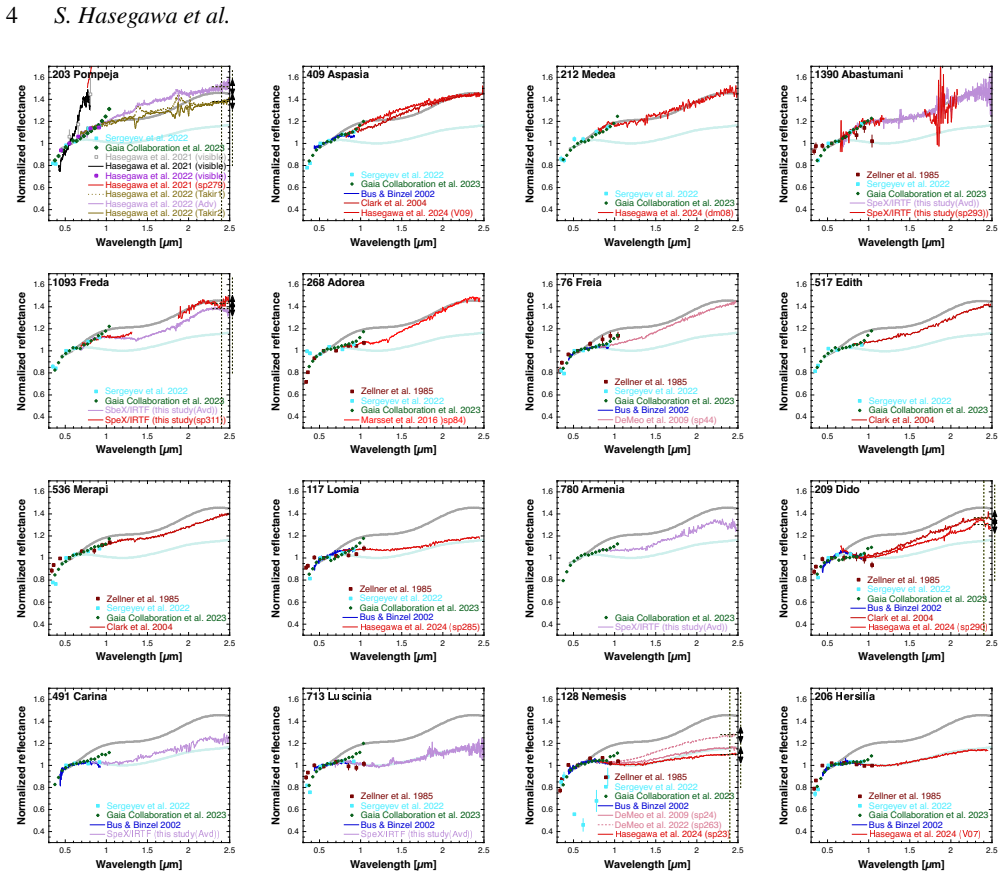
Large main-belt asteroids with visible geometric albedos below 0.1 are predominantly classified within the C- and X-complex spectroscopic classes. C-type and dark X-type asteroids typically exhibit flat to slightly negative and positive spectral slopes, respectively. They are further distinguished by the presence (for C-types) or absence (for dark X-types) of a shallow absorption feature near 1.0-1.3 micron. Asteroids such as 1093 Freda and 1390 Abastumani display spectral characteristics intermediate between these two classes, combining a positive visible-to-near-infrared spectral slope with a shallow absorption band. A search in the literature reveals additional asteroids with similar prop
What carries the argument
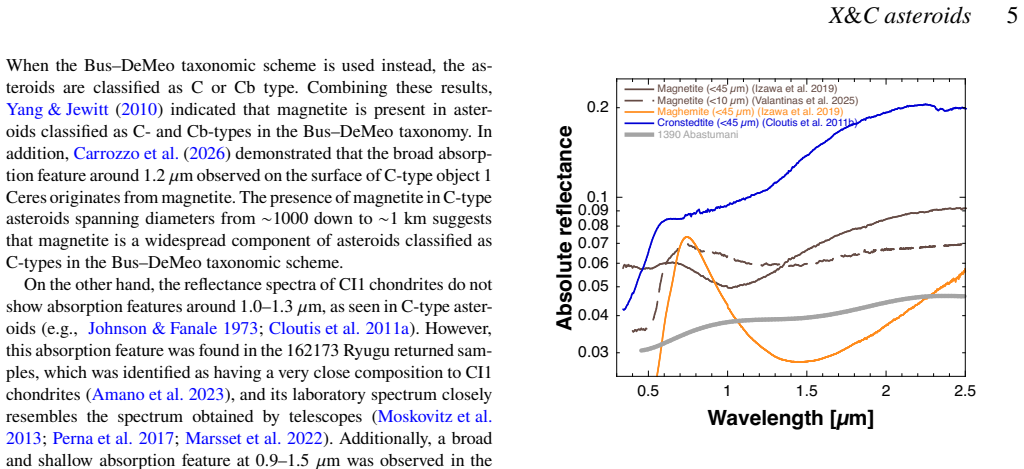
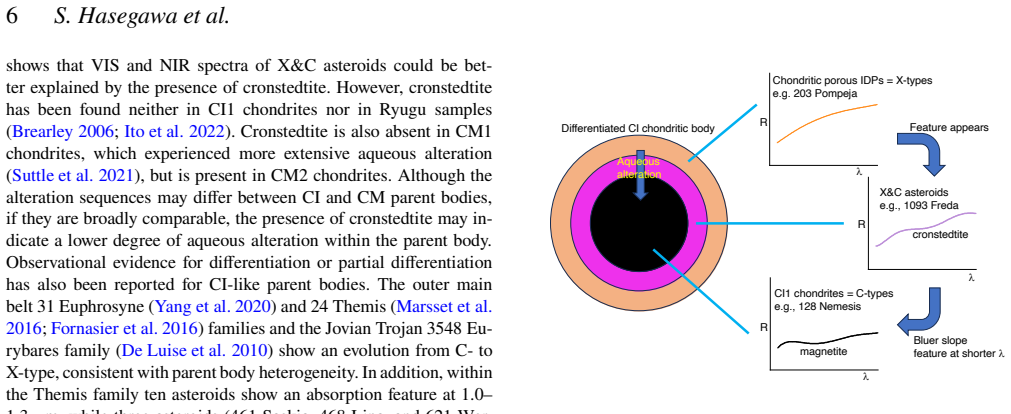
Intermediate spectral shape in low-albedo asteroids that merges the positive slope of dark X-types with the 1.0-1.3 micron absorption band of C-types, interpreted as evidence for a spectral continuum produced by cronstedtite.
If this is right
- C- and dark X-type asteroids are not discrete classes but ends of a continuous spectral sequence.
- Cronstedtite on asteroid surfaces can produce both the positive slope and the shallow absorption feature together.
- Additional objects with these intermediate spectra exist and support the idea of common genetic origins.
- Asteroid taxonomy may need adjustment to accommodate objects that combine slope and band traits.
Where Pith is reading between the lines
- Targeted near-infrared observations of other low-albedo asteroids could reveal more members of this intermediate group.
- If cronstedtite is the cause, these bodies may sample a specific region of the early solar nebula where iron-rich phyllosilicates formed.
- Spectral modeling that mixes cronstedtite with other minerals could predict which additional asteroids should show the same traits.
Load-bearing premise
The measured spectra of these asteroids accurately reflect their surface composition without significant effects from observational errors, space weathering, or misclassification, and cronstedtite is the mineral producing the observed combination of slope and absorption.
What would settle it
New high-quality spectra of 1093 Freda or 1390 Abastumani that show the absorption band disappearing or the slope becoming negative, or laboratory mixtures without cronstedtite that reproduce the exact observed shape, would undermine the continuum and mineral interpretation.
Figures

read the original abstract
Large main-belt asteroids with visible geometric albedos below 0.1 are predominantly classified within the C- and X-complex spectroscopic classes. C-type and dark X-type asteroids typically exhibit flat to slightly negative and positive spectral slopes, respectively. They are further distinguished by the presence (for C-types) or absence (for dark X-types) of a shallow absorption feature near 1.0-1.3 micron. We serendipitously discovered that the asteroids 1093 Freda and 1390 Abastumani display spectral characteristics intermediate between these two classes, combining a positive visible-to-near-infrared spectral slope with a shallow absorption band. A search in the literature reveals additional asteroids with similar properties. The existence of such objects, spanning a continuum of spectral shapes between C- and dark X-types, may point to a common genetic origin. Their spectral behavior could be explained by the presence of cronstedtite, an Fe-rich serpentine, on their surfaces.
Editorial analysis
A structured set of objections, weighed in public.
Referee Report
Summary. The manuscript reports a serendipitous discovery that asteroids 1093 Freda and 1390 Abastumani exhibit spectral slopes and a shallow 1.0–1.3 μm absorption band intermediate between the flat/negative slopes of C-types and the positive slopes of dark X-types. A literature search identifies additional objects with similar properties, leading to the suggestion of a spectral continuum that may imply a common genetic origin, with cronstedtite (Fe-rich serpentine) proposed as a possible surface mineral responsible for the combined spectral features.
Significance. If the reported spectra are confirmed as intrinsic and the intermediate classification holds, the work would document a previously under-recognized transitional population among low-albedo main-belt asteroids. This could refine the C/X taxonomic boundary and motivate targeted mineralogical studies of phyllosilicates on dark surfaces. The purely observational nature of the central claim (discovery plus literature compilation) is a strength, but the interpretive link to cronstedtite and genetic origin remains qualitative.
major comments (2)
- [Abstract] Abstract and discussion: the assertion that cronstedtite can explain the positive slope plus shallow 1 μm band is presented without any radiative-transfer calculations, laboratory reflectance spectra of cronstedtite mixtures, or quantitative comparison to alternative explanations (other phyllosilicates, grain-size effects, or space weathering). This leaves the mineralogical interpretation unsupported even if the two new spectra are real.
- [Results] The manuscript provides no error bars, measurement uncertainties, or full spectral plots for 1093 Freda and 1390 Abastumani, nor any description of the observational setup or data reduction. Without these, independent verification of the claimed intermediate classification is not possible from the text alone.
minor comments (2)
- Clarify whether the literature objects were re-reduced with the same pipeline or simply adopted from published classifications; this affects the strength of the claimed continuum.
- [Abstract] The abstract states that C-types show 'flat to slightly negative' slopes while dark X-types show 'positive' slopes; a brief quantitative definition of these slope ranges (e.g., in % per 100 nm) would aid readers.
Simulated Author's Rebuttal
We thank the referee for the detailed and constructive report. The comments highlight important areas for improvement in clarity and completeness. We address each major comment below and will revise the manuscript accordingly.
read point-by-point responses
-
Referee: [Abstract] Abstract and discussion: the assertion that cronstedtite can explain the positive slope plus shallow 1 μm band is presented without any radiative-transfer calculations, laboratory reflectance spectra of cronstedtite mixtures, or quantitative comparison to alternative explanations (other phyllosilicates, grain-size effects, or space weathering). This leaves the mineralogical interpretation unsupported even if the two new spectra are real.
Authors: We agree that the proposed link to cronstedtite is qualitative, relying on spectral similarity noted in the literature rather than new radiative-transfer modeling or laboratory mixtures. The original text uses tentative phrasing ('could be explained by'), but we acknowledge this may overstate the support. In revision we will explicitly frame the cronstedtite suggestion as a hypothesis, note the absence of quantitative modeling, briefly mention alternative explanations such as grain-size effects or other phyllosilicates, and recommend targeted laboratory and modeling studies. This change will be made in both the abstract and discussion sections. revision: yes
-
Referee: [Results] The manuscript provides no error bars, measurement uncertainties, or full spectral plots for 1093 Freda and 1390 Abastumani, nor any description of the observational setup or data reduction. Without these, independent verification of the claimed intermediate classification is not possible from the text alone.
Authors: We accept this criticism. Although the manuscript contains an observations section, it lacks sufficient detail on setup, reduction, uncertainties, and error bars, and does not display the full spectra with uncertainties. We will expand the methods and results sections to include these elements and add the spectral plots with error bars so that the intermediate classification can be independently assessed. revision: yes
Circularity Check
No circularity; purely observational report with qualitative interpretation
full rationale
The paper reports serendipitous discovery of two asteroids with intermediate spectral slopes and bands, notes similar objects in literature, and offers a qualitative suggestion that cronstedtite could explain the spectra and imply common origin. No equations, parameter fitting, predictive models, or self-citations appear in the provided text. The central claims are interpretive assertions without any derivation chain that reduces to inputs by construction. This matches the default expectation for non-circular observational papers.
Axiom & Free-Parameter Ledger
axioms (1)
- domain assumption Established definitions of C-type and X-type asteroid spectral classes from prior taxonomy
Reference graph
Works this paper leans on
-
[1]
doi:10.1051/0004-6361/202659352 , journal =
-
[2]
doi:10.1016/j.icarus.2026.117024 , eid =
, keywords =. doi:10.1016/j.icarus.2026.117024 , eid =
-
[3]
Primitive Meteorites and Asteroids , date-added =
Reflectance Spectroscopy of Chondrites , year =. Primitive Meteorites and Asteroids , date-added =. doi:10.1016/B978-0-12-813325-5.00004-5 , editor =
-
[4]
doi:10.1016/j.icarus.2013.03.005 , eprint =
, keywords =. doi:10.1016/j.icarus.2013.03.005 , eprint =
-
[5]
doi:10.1038/s41467-024-49310-0 , eid =
Nature Communications , month = jul, pages =. doi:10.1038/s41467-024-49310-0 , eid =
-
[6]
doi:10.1016/j.epsl.2026.119885 , eid =
Earth and Planetary Science Letters , keywords =. doi:10.1016/j.epsl.2026.119885 , eid =
-
[7]
doi:10.1051/0004-6361/201219584 , eid =
, keywords =. doi:10.1051/0004-6361/201219584 , eid =
-
[8]
doi:10.1111/j.1945-5100.1993.tb00755.x , journal =
-
[9]
doi:10.1006/icar.1993.1194 , journal =
-
[10]
Lunar and Planetary Science Conference , date-added =
-
[11]
54th Lunar and Planetary Science Conference , date-added =
-
[12]
doi:10.1016/j.gca.2024.03.032 , journal =
-
[13]
arXiv , author =:2511.00902 , journal =
doi:10.1051/0004-6361/202556827 , eid =. arXiv , author =:2511.00902 , journal =
-
[14]
doi:10.1073/pnas.1704461114 , journal =
-
[15]
doi:10.1038/s41550-019-0959-9 , journal =
-
[16]
doi:10.1038/s41550-025-02631-6 , journal =
-
[17]
doi:10.1038/s41550-024-02472-9 , journal =
-
[18]
doi:10.1038/s41586-024-08495-6 , journal =
-
[19]
doi:10.1038/s41561-025-01741-0 , journal =
-
[20]
doi:10.1126/sciadv.1701138 , eprint =
Science Advances , keywords =. doi:10.1126/sciadv.1701138 , eprint =
-
[21]
doi:10.1016/j.icarus.2012.11.039 , eprint =
, keywords =. doi:10.1016/j.icarus.2012.11.039 , eprint =
-
[22]
arXiv , author =:2312.05331 , journal =
doi:10.1016/j.icarus.2023.115910 , eid =. arXiv , author =:2312.05331 , journal =
-
[23]
arXiv , author =:2301.00699 , journal =
doi:10.1051/0004-6361/202245311 , eid =. arXiv , author =:2301.00699 , journal =
-
[24]
doi:10.1051/0004-6361/202349057 , eid =
, keywords =. doi:10.1051/0004-6361/202349057 , eid =
-
[25]
doi:10.1086/382907 , journal =
-
[26]
, keywords =. doi:10.1086/659636 , eprint =
-
[27]
arXiv , author =:2407.18221 , journal =
doi:10.3847/1538-4365/ad675c , eid =. arXiv , author =:2407.18221 , journal =
-
[28]
arXiv , author =:2404.18805 , journal =
doi:10.1016/j.icarus.2024.116110 , eid =. arXiv , author =:2404.18805 , journal =
-
[29]
arXiv , author =:2312.09406 , journal =
doi:10.1016/j.icarus.2023.115922 , eid =. arXiv , author =:2312.09406 , journal =
-
[30]
arXiv , author =:2311.16053 , journal =
doi:10.1016/j.epsl.2023.118521 , eid =. arXiv , author =:2311.16053 , journal =
-
[31]
The orbital distribution of trans-Neptunian objects beyond 50 au
doi:10.3847/2041-8205/827/2/L35 , eid =. arXiv , author =:1607.08279 , journal =
work page internal anchor Pith review Pith/arXiv arXiv doi:10.3847/2041-8205/827/2/l35 2041
-
[32]
Neptune's Orbital Migration Was Grainy, Not Smooth
doi:10.3847/0004-637X/825/2/94 , eid =. arXiv , author =:1602.06988 , journal =
work page internal anchor Pith review Pith/arXiv arXiv doi:10.3847/0004-637x/825/2/94
-
[33]
Dynamics and Transit Variations of Resonant Exoplanets
doi:10.3847/0004-637X/823/2/72 , eid =. arXiv , author =:1603.07306 , journal =
work page internal anchor Pith review Pith/arXiv arXiv doi:10.3847/0004-637x/823/2/72
-
[34]
The Evidence for Slow Migration of Neptune from the Inclination Distribution of Kuiper Belt Objects
doi:10.1088/0004-6256/150/3/73 , eid =. arXiv , author =:1504.06021 , journal =
work page internal anchor Pith review Pith/arXiv arXiv doi:10.1088/0004-6256/150/3/73
-
[35]
Jumping Neptune Can Explain the Kuiper Belt Kernel
doi:10.1088/0004-6256/150/3/68 , eid =. arXiv , author =:1506.06019 , journal =
work page internal anchor Pith review Pith/arXiv arXiv doi:10.1088/0004-6256/150/3/68
-
[36]
doi:10.2458/azu_uapress_9780816532131-ch016 , editor =
Asteroids IV , date-added =. doi:10.2458/azu_uapress_9780816532131-ch016 , editor =
-
[37]
doi:10.1111/maps.14374 , journal =
-
[38]
doi:10.1016/j.icarus.2013.10.019 , journal =
-
[39]
doi:10.1016/j.icarus.2011.12.005 , journal =
-
[40]
doi:10.1016/j.gca.2010.05.020 , journal =
-
[41]
doi:10.1016/j.gca.2012.04.041 , journal =
-
[42]
doi:10.1016/j.epsl.2025.119587 , eid =
Earth and Planetary Science Letters , keywords =. doi:10.1016/j.epsl.2025.119587 , eid =
-
[43]
doi:10.1051/0004-6361/201525994 , eid =
, keywords =. doi:10.1051/0004-6361/201525994 , eid =
-
[44]
doi:10.1111/maps.13411 , journal =
-
[45]
doi:10.1016/j.gca.2021.01.014 , journal =
-
[46]
doi:10.1016/j.icarus.2019.05.012 , eprint =
, keywords =. doi:10.1016/j.icarus.2019.05.012 , eprint =
-
[47]
doi:10.1016/j.polar.2021.100723 , eid =
Polar Science , keywords =. doi:10.1016/j.polar.2021.100723 , eid =
-
[48]
The 3 $\mu$m Spectrum of Jupiter's Irregular Satellite Himalia
doi:10.1088/2041-8205/793/2/L44 , eid =. arXiv , author =:1409.1261 , journal =
work page internal anchor Pith review Pith/arXiv arXiv doi:10.1088/2041-8205/793/2/l44 2041
-
[49]
doi:10.1038/s41550-022-01745-5 , journal =
-
[50]
doi:10.1111/maps.14371 , journal =
-
[51]
doi:10.1038/nature03539 , journal =
-
[52]
Meteorites and the Early Solar System II , date-added =
-
[53]
Dust in Planetary Systems , date-added =
-
[54]
doi:10.1029/2022GL100815 , eid =
, keywords =. doi:10.1029/2022GL100815 , eid =
-
[55]
doi:10.1016/0016-7037(96)00121-4 , journal =
-
[56]
doi:10.1016/j.icarus.2022.114921 , eid =
, keywords =. doi:10.1016/j.icarus.2022.114921 , eid =
-
[57]
doi:10.1016/j.icarus.2023.115507 , eid =
, keywords =. doi:10.1016/j.icarus.2023.115507 , eid =
-
[58]
doi:10.3847/PSJ/aced0c , eid =
, keywords =. doi:10.3847/PSJ/aced0c , eid =
-
[59]
arXiv , author =:2309.15230 , journal =
doi:10.1016/j.icarus.2024.116017 , eid =. arXiv , author =:2309.15230 , journal =
-
[60]
doi:10.1016/j.icarus.2006.01.011 , journal =
-
[61]
doi:10.1111/maps.14098 , journal =
-
[62]
arXiv , author =:2107.06255 , journal =
doi:10.3847/PSJ/ac4967 , eid =. arXiv , author =:2107.06255 , journal =
-
[63]
arXiv , author =:2103.08371 , journal =
doi:10.3847/PSJ/ac1591 , eid =. arXiv , author =:2103.08371 , journal =
-
[64]
doi:10.1111/maps.14224 , journal =
-
[65]
doi:10.1038/s41467-025-56970-z , eid =
Nature Communications , keywords =. doi:10.1038/s41467-025-56970-z , eid =
-
[66]
doi:10.1111/maps.14359 , journal =
-
[67]
doi:10.1051/0004-6361/202555084 , eid =
, keywords =. doi:10.1051/0004-6361/202555084 , eid =
-
[68]
doi:10.3847/PSJ/ae04dd , eid =
, keywords =. doi:10.3847/PSJ/ae04dd , eid =
-
[69]
doi:10.3847/PSJ/ad150b , eid =
, keywords =. doi:10.3847/PSJ/ad150b , eid =
-
[70]
doi:10.1016/j.icarus.2016.01.002 , eprint =
, keywords =. doi:10.1016/j.icarus.2016.01.002 , eprint =
-
[71]
doi:10.1016/0016-7037(53)90064-7 , journal =
-
[72]
doi:10.3847/PSJ/abbb98 , eid =
, keywords =. doi:10.3847/PSJ/abbb98 , eid =
-
[73]
doi:10.1016/j.gca.2012.04.036 , journal =
-
[74]
doi:10.1016/j.polar.2017.12.002 , journal =
-
[75]
doi:10.1016/j.gca.2024.07.007 , journal =
-
[76]
doi:10.3847/2041-8213/abfaa3 , eid =
, keywords =. doi:10.3847/2041-8213/abfaa3 , eid =
-
[77]
doi:10.1007/s11214-006-8315-7 , eprint =
, keywords =. doi:10.1007/s11214-006-8315-7 , eprint =
-
[78]
doi:10.1117/12.3016317 , editor =
Space Telescopes and Instrumentation 2024: Optical, Infrared, and Millimeter Wave , date-added =. doi:10.1117/12.3016317 , editor =
-
[79]
doi:10.1117/12.2567224 , editor =
Space Telescopes and Instrumentation 2020: Optical, Infrared, and Millimeter Wave , date-added =. doi:10.1117/12.2567224 , editor =. arXiv , author =:2404.11017 , keywords =
-
[80]
doi:10.1038/s41550-018-0564-3 , eprint =
Nature Astronomy , keywords =. doi:10.1038/s41550-018-0564-3 , eprint =
discussion (0)
Sign in with ORCID, Apple, or X to comment. Anyone can read and Pith papers without signing in.