Symmetries and overparametrization properties of Hamiltonian variational ansatzes for the (1+1)d mathbb{Z}₂ lattice gauge theory
Pith reviewed 2026-06-28 01:32 UTC · model grok-4.3
The pith
Symmetry-preserving Hamiltonian variational ansatzes for the (1+1)d Z2 lattice gauge theory show overparametrization that removes local minima from the VQE loss and makes loss decay scale linearly with parameter count.
A machine-rendered reading of the paper's core claim, the machinery that carries it, and where it could break.
Core claim
For the five studied Hamiltonian variational ansatzes based on the (1+1)d Z2 lattice gauge theory Hamiltonian, overparametrization coincides with the apparent disappearance of local minima in the VQE loss function, and the decay rate of the loss under gradient descent optimization scales linearly with the number of parameters in the ansatz.
What carries the argument
Hamiltonian variational ansatzes (HVA) that respect local and global symmetries of the Z2 lattice gauge theory, with generators formed from sums of weight-three Pauli operators, whose effective dimension is measured by dynamical Lie algebra dimension and quantum Fisher information matrix rank inside invariant subspaces.
If this is right
- Overparametrized symmetry-respecting ansatzes avoid local minima during VQE optimization for this lattice gauge model.
- Gradient-descent convergence speed increases linearly with parameter count once overparametrization is reached.
- Symmetry enforcement in the ansatz design directly influences the structure of the loss landscape in variational quantum algorithms.
- The results supply concrete guidance for constructing scalable variational circuits for lattice gauge theories.
Where Pith is reading between the lines
- The linear scaling may occur because overparametrization lets the circuit reach every direction inside the relevant invariant subspace without redundant parameters.
- Analogous overparametrization thresholds could appear in higher-dimensional or non-Abelian gauge theories provided the generators keep a comparable weight-three Pauli structure.
- The underexplored use of weight-three Pauli sums may be responsible for the clean transition between under- and over-parametrized regimes.
Load-bearing premise
The five chosen ansatzes and the specific (1+1)d Z2 model are representative enough that the observed overparametrization behavior and linear scaling will generalize to other gauge theories or ansatz families.
What would settle it
A numerical VQE run on a larger lattice or different gauge group in which an ansatz is overparametrized (DLA dimension or QFIM rank saturated) yet local minima remain visible in the loss landscape would falsify the reported coincidence.
Figures


read the original abstract
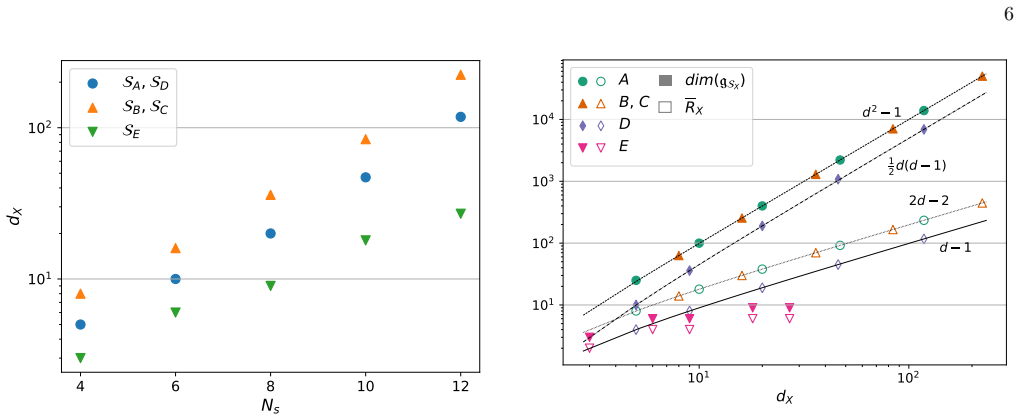
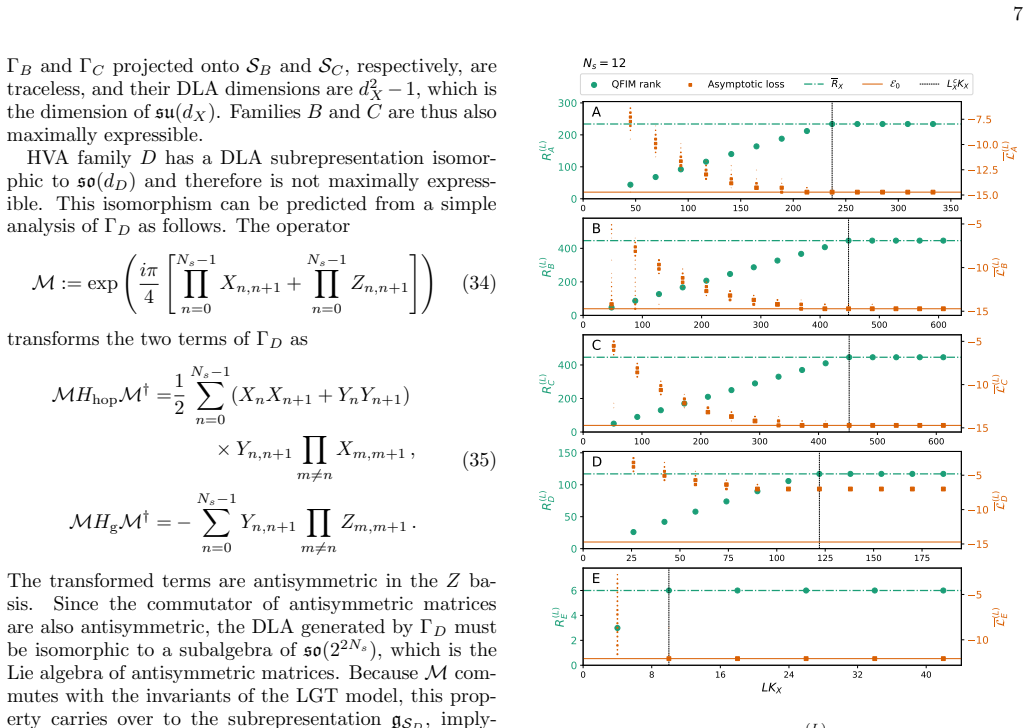
We perform detailed studies of five Hamiltonian variational ansatzes (HVA) based on the Hamiltonian of the $(1+1)$d $\mathbb{Z}_2$ lattice gauge theory. The ansatzes are designed to respect local and global symmetries of the original Hamiltonian and therefore act on a finely segmented state Hilbert space. Following Larocca et al. (2023), we numerically study the dimension of the dynamical Lie algebra (DLA) and the rank of the quantum Fisher information matrix (QFIM) of the ansatzes within specific invariant subspaces. The ansatzes all involve sums of weight-three Paulis in their generators, which is a feature that have so far been underexplored in this context. We also perform numerical experiments to determine the ground state energy of the original Hamiltonian via variational quantum eigensolver (VQE), and observe that overparametrization of the ansatzes coincides with the apparent disappearance of local minima in the loss function, in line with the finding in the reference. Finally, the decay rate of the VQE loss function under gradient descent optimization is revealed to scale linearly with the number of parameters in the ansatz. These results help to enrich the theory of overparameterization of quantum circuits and inform the design of scalable variational ansatzes.
Editorial analysis
A structured set of objections, weighed in public.
Referee Report
Summary. The paper numerically examines five symmetry-respecting Hamiltonian variational ansatzes (HVAs) constructed from weight-3 Pauli generators for the (1+1)d Z_2 lattice gauge theory. It computes the dimension of the dynamical Lie algebra (DLA) and the rank of the quantum Fisher information matrix (QFIM) inside invariant subspaces, then runs VQE experiments showing that overparametrization (via DLA dimension and QFIM rank) coincides with the apparent disappearance of local minima, while the gradient-descent decay rate of the loss scales linearly with the number of variational parameters.
Significance. If the reported linear scaling of optimization rate with parameter count holds beyond the specific model and ansatz family, the results would usefully inform the construction of scalable variational circuits for gauge-theory simulations. The work supplies concrete numerical data for a previously underexplored class of weight-3 generators and reproduces the overparametrization phenomenology of Larocca et al. (2023) in a gauge-theory setting; these are modest but genuine contributions to the empirical literature on quantum circuit overparametrization.
major comments (2)
- [Numerical VQE experiments] The central claim that the VQE loss decay rate under gradient descent scales linearly with parameter count rests entirely on numerical runs for five specific HVAs; no analytic derivation or scaling argument is supplied, and the manuscript provides no cross-model or cross-generator ablation (e.g., varying Pauli weight or spacetime dimension) that would test whether the linearity is an artifact of the chosen generators or the low-dimensional invariant subspaces.
- [Abstract and § on VQE results] The abstract and the description of the VQE runs do not report error bars, number of independent trials, shot-noise controls, or statistical tests for the linear scaling or for the disappearance of local minima; without these, the quantitative support for both empirical observations remains only moderate.
minor comments (2)
- [Ansatz construction] Notation for the five ansatzes (e.g., how the symmetry-invariant subspaces are segmented) should be introduced earlier and used consistently when reporting DLA dimensions and QFIM ranks.
- [Methods] The reference to Larocca et al. (2023) is appropriate, but a brief recap of the precise DLA/QFIM definitions employed would improve readability for readers outside the immediate subfield.
Simulated Author's Rebuttal
We thank the referee for the careful review and constructive comments on our manuscript. We address each major comment below, indicating where revisions will be incorporated and providing honest clarifications on the numerical scope of the work.
read point-by-point responses
-
Referee: [Numerical VQE experiments] The central claim that the VQE loss decay rate under gradient descent scales linearly with parameter count rests entirely on numerical runs for five specific HVAs; no analytic derivation or scaling argument is supplied, and the manuscript provides no cross-model or cross-generator ablation (e.g., varying Pauli weight or spacetime dimension) that would test whether the linearity is an artifact of the chosen generators or the low-dimensional invariant subspaces.
Authors: Our work is a numerical study focused on five symmetry-preserving HVAs for the specific (1+1)d Z2 lattice gauge theory using weight-3 generators. The linear scaling is observed consistently in the VQE experiments across these ansatzes. No analytic derivation is supplied because the primary contribution lies in the numerical exploration of overparametrization phenomenology in this gauge-theory setting, reproducing and extending Larocca et al. (2023). We did not perform cross-model ablations, which would be a natural extension but lies outside the manuscript's scope. We will revise to explicitly note the numerical character of the observation and list the absence of broader ablations as a limitation. revision: partial
-
Referee: [Abstract and § on VQE results] The abstract and the description of the VQE runs do not report error bars, number of independent trials, shot-noise controls, or statistical tests for the linear scaling or for the disappearance of local minima; without these, the quantitative support for both empirical observations remains only moderate.
Authors: We agree that reporting error bars, the number of independent trials, shot-noise considerations, and any statistical measures would improve the quantitative presentation. This information is available from our simulations but was omitted. We will revise the abstract and the VQE results section to include these details. revision: yes
- Analytic derivation or scaling argument for the linear scaling of the VQE loss decay rate with parameter count
- Cross-model or cross-generator ablations to test the generality of the observed linearity
Circularity Check
No circularity; all central claims rest on direct numerical experiments and external reference
full rationale
The paper performs numerical studies of DLA dimension, QFIM rank, VQE loss landscapes, and gradient-descent decay rates for five specific HVAs on the (1+1)d Z2 model. It explicitly follows the numerical protocol of Larocca et al. (2023) and reports observations 'in line with the finding in the reference.' No equation or result is shown to reduce by construction to a parameter fitted from the same data, no self-citation supplies a uniqueness theorem or ansatz, and no derivation is claimed to be first-principles. The linear scaling is presented as an empirical observation, not an analytic prediction derived from the paper's own definitions. This is the normal case of a self-contained numerical study.
Axiom & Free-Parameter Ledger
axioms (2)
- domain assumption The variational ansatzes are constructed to respect the local and global symmetries of the target Hamiltonian
- domain assumption Numerical VQE runs on finite systems faithfully indicate the absence of local minima in the infinite-parameter limit
Reference graph
Works this paper leans on
-
[1]
The ansatz unitaries in each family are elements of a representation of a subgroup ofSU(2 2Ns)
Consequently, it is also an eigenstate ofT 2 andCP witht= 0 andr= 0. The ansatz unitaries in each family are elements of a representation of a subgroup ofSU(2 2Ns). This represen- tation is reducible for all five families of our HVA, as is evident from the existence of invariants (quantum num- bers) discussed in the previous section, and our choice of HVA...
2000
-
[2]
M. Larocca, N. Ju, D. Garc´ ıa-Mart´ ın, P. J. Coles, and M. Cerezo, Theory of overparametrization in quan- tum neural networks, Nat Comput Sci3, 542 (2023), arXiv:2109.11676 [quant-ph]
arXiv 2023
-
[3]
J. R. McClean, S. Boixo, V. N. Smelyanskiy, R. Babbush, and H. Neven, Barren plateaus in quantum neural net- work training landscapes, Nat Commun9, 4812 (2018), arXiv:1803.11173 [quant-ph]
Pith/arXiv arXiv 2018
-
[4]
E. R. Anschuetz, Critical Points in Quantum Generative Models (2021), arXiv:2109.06957 [quant-ph]
arXiv 2021
-
[5]
J. Rivera-Dean, P. Huembeli, A. Ac´ ın, and J. Bowles, Avoiding local minima in Variational Quantum Algo- rithms with Neural Networks (2021), arXiv:2104.02955 [quant-ph]
arXiv 2021
-
[6]
D. Wierichs, C. Gogolin, and M. Kastoryano, Avoiding local minima in variational quantum eigensolvers with the natural gradient optimizer, Phys Rev Res2, 043246 (2020), arXiv:2004.14666 [quant-ph]
arXiv 2020
-
[7]
X. You and X. Wu, Exponentially many local minima in quantum neural networks, inProceedings of the 38th International Conference on Machine Learning, Proceed- ings of Machine Learning Research, Vol. 139, edited by M. Meila and T. Zhang (PMLR, 2021) pp. 12144–12155, arXiv:2110.02479 [quant-ph]
arXiv 2021
-
[8]
E. R. Anschuetz and B. T. Kiani, Quantum variational algorithms are swamped with traps, Nat Commun13, 7760 (2022), arXiv:2205.05786 [quant-ph]
arXiv 2022
-
[9]
M. Larocca, P. Czarnik, K. Sharma, G. Muraleedharan, P. J. Coles, and M. Cerezo, Diagnosing Barren Plateaus with Tools from Quantum Optimal Control, Quantum6, 824 (2022), arXiv:2105.14377 [quant-ph]
arXiv 2022
-
[10]
M. E. S. Morales, J. D. Biamonte, and Z. Zimbor´ as, On the universality of the quantum approximate optimiza- tion algorithm, Quantum Inf Process19, 291 (2020), arXiv:1909.03123 [quant-ph]
arXiv 2020
-
[11]
S. Kazi, M. Larocca, M. Farinati, P. J. Coles, M. Cerezo, and R. Zeier, Analyzing the quantum approximate opti- mization algorithm: Ans¨ atze, symmetries, and lie alge- bras, PRX Quantum6, 040345 (2025)
2025
-
[12]
R. Mao, P. Yuan, J. Allcock, and S. Zhang, QAOA- MaxCut has barren plateaus for almost all graphs (2025), arXiv:2512.24577 [quant-ph]
arXiv 2025
-
[13]
Matos, C
G. Matos, C. N. Self, Z. Papi´ c, K. Meichanetzidis, and H. Dreyer, Characterization of variational quantum algo- rithms using free fermions, Quantum7, 966 (2023)
2023
-
[14]
J. Allcock, M. Santha, P. Yuan, and S. Zhang, On the dy- namical Lie algebras of quantum approximate optimiza- tion algorithms (2024), arXiv:2407.12587 [quant-ph]
Pith/arXiv arXiv 2024
-
[15]
Kordonowy and H
S. Kordonowy and H. Leipold, The Lie algebra of XY- mixer topologies and warm starting QAOA for con- strained optimization, npj Quantum Inf12, 61 (2026)
2026
-
[16]
D. D’Alessandro and Y. Isik, Controllability of the periodic quantum Ising spin chain and the Onsager algebra, J Phys A: Math Theor58, 115202 (2025), arXiv:2405.00898 [quant-ph]
arXiv 2025
-
[17]
B. Tsvelikhovskiy, B. Bach, J. Falla, and I. Safro, Reductions of qaoa induced by classical symmetries: Theoretical insights and practical implications (2026), arXiv:2602.16141 [quant-ph]
Pith/arXiv arXiv 2026
-
[18]
L. Monbroussou, E. Z. Mamon, J. Landman, A. B. Grilo, R. Kukla, and E. Kashefi, Trainability and ex- pressivity of hamming-weight preserving quantum cir- cuits for machine learning, Quantum9, 1745 (2025), arXiv:2309.15547 [quant-ph]
arXiv 2025
-
[19]
Wiersema, E
R. Wiersema, E. K¨ okc¨ u, A. F. Kemper, and B. N. Bakalov, Classification of dynamical Lie algebras of 2- local spin systems on linear, circular and fully connected topologies, npj Quantum Inf.10, 110 (2024)
2024
-
[20]
K¨ okc¨ u, R
E. K¨ okc¨ u, R. Wiersema, A. F. Kemper, and B. N. Bakalov, Classification of dynamical lie algebras gener- ated by spin interactions on undirected graphs (2024)
2024
-
[21]
S. Lloyd, Quantum approximate optimization is compu- tationally universal (2018), arXiv:1812.11075 [quant-ph]
Pith/arXiv arXiv 2018
-
[22]
Controllability of Symmetric Spin Networks
F. Albertini and D. D’Alessandro, Controllability of symmetric spin networks, J Math Phys59, 10.1063/1.5004652 (2018), arXiv:1803.06689 [quant-ph]
work page internal anchor Pith review Pith/arXiv arXiv doi:10.1063/1.5004652 2018
-
[23]
S. Kazi, M. Larocca, and M. Cerezo, On the universality ofS n-equivariantk-body gates, New J Phys26, 053030 (2024), arXiv:2303.00728 [quant-ph]
arXiv 2024
-
[24]
L. Schatzki, M. Larocca, Q. T. Nguyen, F. Sauvage, and M. Cerezo, Theoretical guarantees for permutation- equivariant quantum neural networks, npj Quantum Inf 10 10, 12 (2024), arXiv:2210.09974 [quant-ph]
arXiv 2024
-
[25]
G. Adamatti Bridi, D. Lim, L. Pira, R. Azevedo Medeiros Santos, F. de Lima Marquezino, and S. Adhikary, Expressivity limits in quantum walk- based optimization, Phys Rev A113, 022423 (2026), arXiv:2508.05749 [quant-ph]
arXiv 2026
-
[26]
B. Tsvelikhovskiy, M. Nuyten, and B. N. Bakalov, Prov- able avoidance of barren plateaus for the Quantum Ap- proximate Optimization Algorithm with Grover mixers (2025), arXiv:2509.10424 [quant-ph]
arXiv 2025
-
[27]
G. Aguilar, S. Cichy, J. Eisert, and L. Bittel, Full clas- sification of Pauli Lie algebras (2024), arXiv:2408.00081 [quant-ph]
arXiv 2024
-
[28]
F. Azad, M. Inajetovic, S. K¨ uhn, and A. Pappa, Barren- plateau free variational quantum simulation of Z2 lattice gauge theories (2025), arXiv:2507.19203 [quant-ph]
arXiv 2025
-
[29]
G. Mazzola, S. V. Mathis, G. Mazzola, and I. Tavernelli, Gauge-invariant quantum circuits forU(1) and Yang- Mills lattice gauge theories, Phys Rev Res3, 043209 (2021), arXiv:2105.05870 [quant-ph]
arXiv 2021
-
[30]
C. Alexandrou, A. Athenodorou, K. Blekos, G. Polykratis, and S. K¨ uhn, Realizing string breaking dynamics in aZ 2 lattice gauge theory on quantum hard- ware, Phys Rev D112, 114506 (2025), arXiv:2504.13760 [hep-lat]
arXiv 2025
-
[31]
Kogut and L
J. Kogut and L. Susskind, Hamiltonian formulation of Wilson’s lattice gauge theories, Phys Rev D11, 395 (1975)
1975
-
[32]
J. Mildenberger, W. Mruczkiewicz, J. C. Halimeh, Z. Jiang, and P. Hauke, Confinement in aZ2 lattice gauge theory on a quantum computer, Nat Phys21, 312 (2025), arXiv:2203.08905 [quant-ph]
arXiv 2025
-
[33]
C. Charles, E. J. Gustafson, E. Hardt, F. Herren, N. Hogan, H. Lamm, S. Starecheski, R. S. Van de Water, and M. L. Wagman, SimulatingZ 2 lattice gauge theory on a quantum computer, Phys Rev E109, 015307 (2024), arXiv:2305.02361 [hep-lat]
arXiv 2024
-
[34]
J. Bringewatt, J. Kunjummen, and N. Mueller, Random- ized measurement protocols for lattice gauge theories, Quantum8, 1300 (2024), arXiv:2303.15519 [quant-ph]
arXiv 2024
- [35]
-
[36]
J.-Y. Desaules, T. Iadecola, and J. C. Halimeh, Mass- assisted local deconfinement in a confinedZ 2 lat- tice gauge theory, Phys Rev B112, 014301 (2025), arXiv:2404.11645 [cond-mat.quant-gas]
arXiv 2025
-
[37]
D. Wecker, M. B. Hastings, and M. Troyer, Progress towards practical quantum variational algorithms, Phys Rev A92, 042303 (2015), arXiv:1507.08969 [quant-ph]
Pith/arXiv arXiv 2015
-
[38]
W. W. Ho and T. H. Hsieh, Efficient variational simula- tion of non-trivial quantum states, SciPost Phys6, 029 (2019), arXiv:1803.00026 [cont-mat.str-el]
Pith/arXiv arXiv 2019
-
[39]
R. Wiersema, C. Zhou, Y. de Sereville, J. F. Car- rasquilla, Y. B. Kim, and H. Yuen, Exploring en- tanglement and optimization within the hamiltonian variational ansatz, PRX Quantum1, 020319 (2020), arXiv:2008.02941 [quant-ph]
arXiv 2020
-
[40]
J. Liu, K. Najafi, K. Sharma, F. Tacchino, L. Jiang, and A. Mezzacapo, Analytic theory for the dynamics of wide quantum neural networks, Phys Rev Lett130, 150601 (2023), arXiv:2203.16711 [quant-ph]
arXiv 2023
-
[41]
S. G. Schirmer, H. Fu, and A. I. Solomon, Complete con- trollability of quantum systems, Phys Rev A63, 063410 (2001), arXiv:quant-ph/0010031 [quant-ph]
Pith/arXiv arXiv 2001
-
[42]
H. R. Grimsley, S. E. Economou, E. Barnes, and N. J. Mayhall, An adaptive variational algorithm for exact molecular simulations on a quantum computer, Nat Com- mun10, 3007 (2019), arXiv:1812.11173 [quant-ph]
Pith/arXiv arXiv 2019
-
[43]
R. C. Farrell, M. Illa, A. N. Ciavarella, and M. J. Sav- age, Scalable circuits for preparing ground states on digital quantum computers: The schwinger model vac- uum on 100 qubits, PRX Quantum5, 020315 (2024), arXiv:2308.04481 [quant-ph]
arXiv 2024
-
[44]
D. Gross, K. Audenaert, and J. Eisert, Evenly distributed unitaries: On the structure of unitary designs, J Math Phys48, 052104 (2007), arXiv:quant-ph/0611002 [quant- ph]
Pith/arXiv arXiv 2007
-
[45]
Y. Nakata, Y. Takeuchi, M. Kliesch, and A. Dar- mawan, Computational complexity of unitary and state design properties, PRX Quantum6, 030345 (2025), arXiv:2410.23353 [quant-ph]. Appendix A: Bound on the rank of the QFIM from the number of degrees of freedom of the ansatz The proof of Eq. (26) is as follows. Let S= span{|ψ ⟨M⟩(θ)⟩ |θ∈R M , M∈N}(A1) be the ...
arXiv 2025
discussion (0)
Sign in with ORCID, Apple, or X to comment. Anyone can read and Pith papers without signing in.