Reconstructing dark energy with fewer assumptions
Pith reviewed 2026-06-28 00:05 UTC · model grok-4.3
The pith
Dark energy density rises to a local maximum before declining at late times, with the equation of state showing two oscillations around the cosmological constant value.
A machine-rendered reading of the paper's core claim, the machinery that carries it, and where it could break.
Core claim
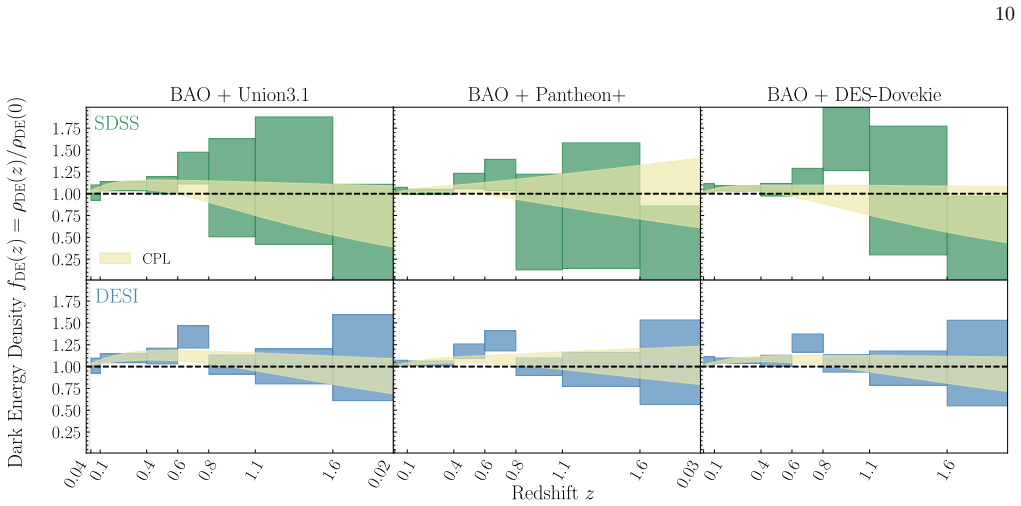
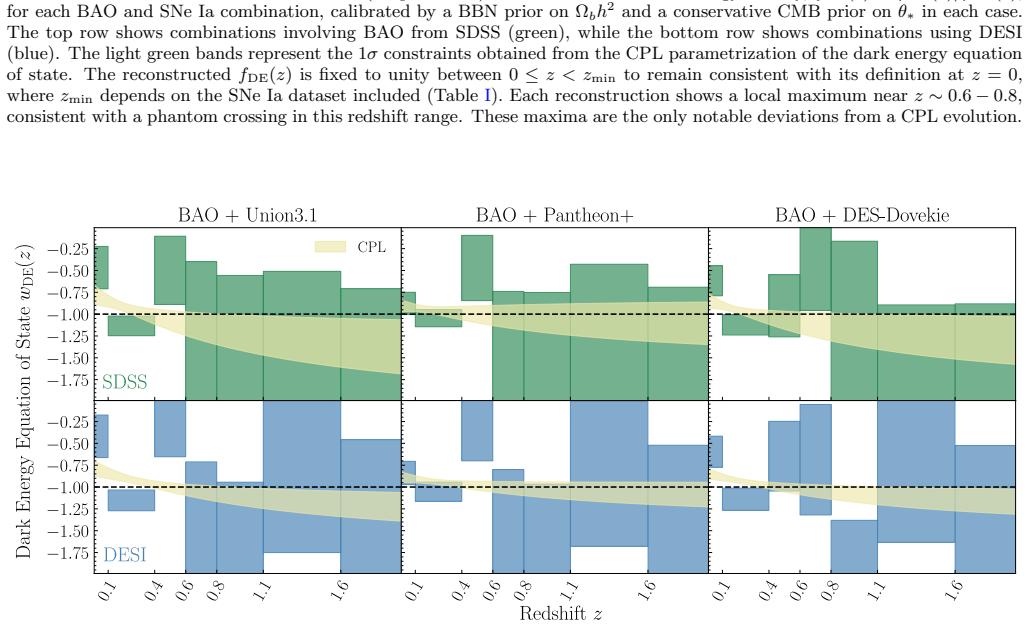
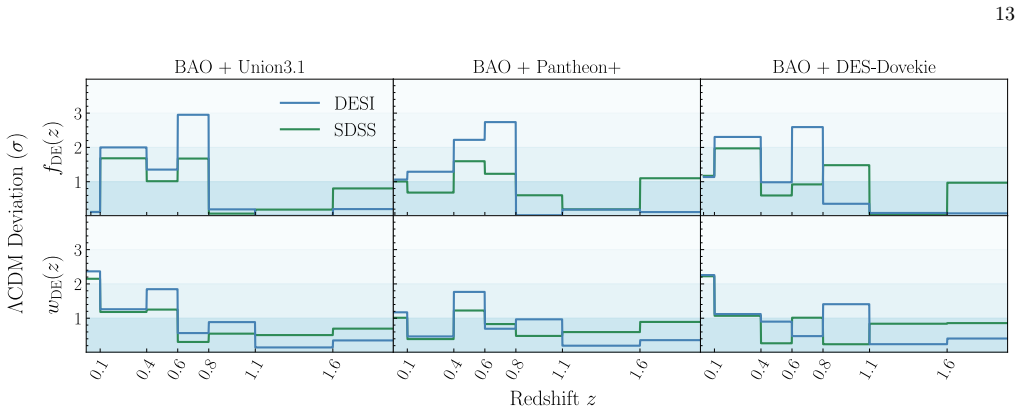
All combinations yield consistent reconstructed histories: a dark energy density that rises to a local maximum before decreasing at late times and an equation of state with two apparent oscillations around the cosmological constant limit. Both functions tentatively suggest a phantom crossing in the equation of state around z∼0.6-0.8.
What carries the argument
Minimalistic reconstruction of average evolution within seven redshift bins from z=0 to z=4.2, anchored solely by an acoustic-scale prior from the CMB.
If this is right
- The same density peak and equation-of-state oscillations appear in every combination of DESI, SDSS, Pantheon+, Union3.1, and DES-Dovekie data.
- Deviations from LambdaCDM in individual bins reach a maximum significance of 2.6-3 sigma.
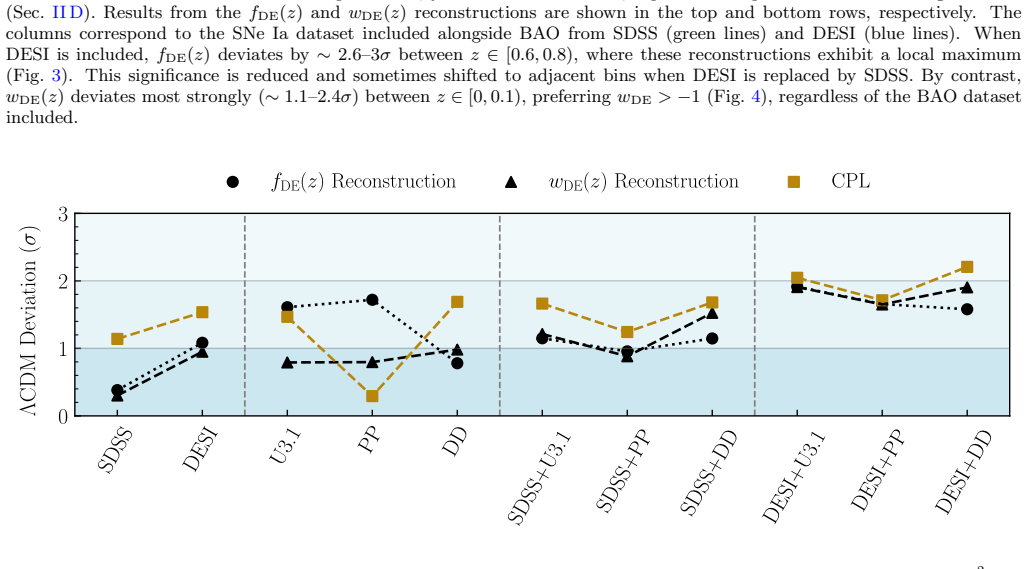
- The total chi-square difference between the reconstructions and LambdaCDM supplies up to 2 sigma support for the seven extra parameters.
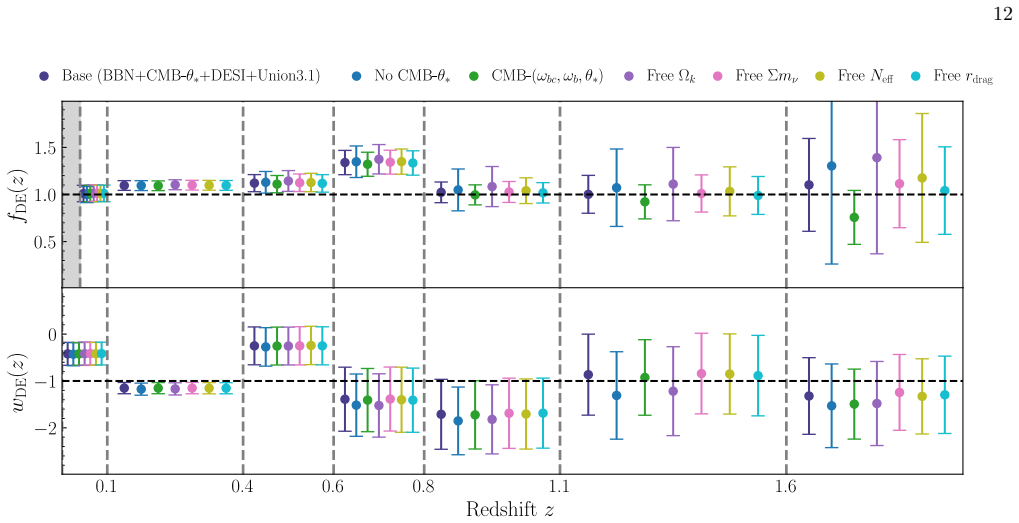
- The patterns remain unchanged when spatial curvature and neutrino mass are allowed to vary freely.
- Uncorrelated amplitudes from localized principal component analysis reproduce the same features.
Where Pith is reading between the lines
- If the oscillations are confirmed, they would require dynamical dark energy models that produce at least two crossings of the w=-1 line.
- The binning technique could be applied to other late-time observables to check whether similar consistencies emerge without early-universe anchors.
- Higher-precision measurements in the same redshift range could raise or lower the current 2-3 sigma deviations enough to decide whether the signal is statistical or physical.
- The moderate overall significance leaves open the possibility that the apparent features are still compatible with a constant dark energy once larger samples are analyzed.
Load-bearing premise
Restricting the CMB information to a single acoustic-scale prior is sufficient to anchor the absolute scale without introducing bias from early-universe physics or from the choice of which early-time data are omitted.
What would settle it
A future dataset with smaller errors that shows no local maximum in dark energy density and no oscillations in the equation of state across z=0 to 4.2 would contradict the reconstructed histories.
Figures



read the original abstract
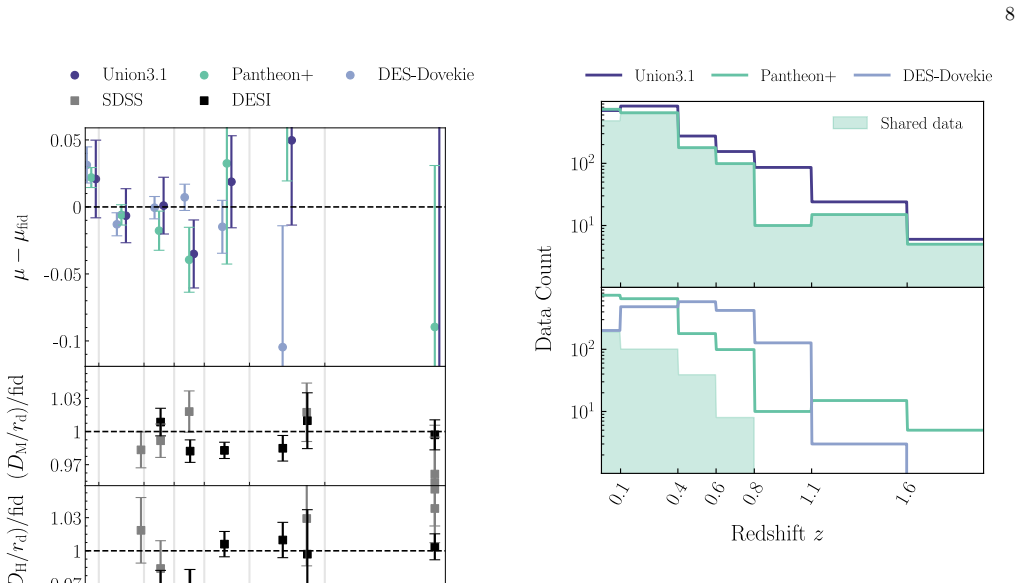
We perform minimalistic reconstructions of the dark energy density and equation of state using late-time distance measurements. Our methodology avoids assumptions that correlate the values of these functions over time and instead yields their approximate average evolution within seven redshift bins from $z=0$ to $z=4.2$. Constraints are obtained using combinations of BAO measurements from DESI and SDSS, alongside Type Ia supernovae measurements from Pantheon+ and the latest recalibrated samples, Union3.1 and DES-Dovekie. Only an acoustic scale prior is included from the CMB so that our results are insensitive to the possible matter density tension between early and late-time probes. All combinations yield consistent reconstructed histories: a dark energy density that rises to a local maximum before decreasing at late times and an equation of state with two apparent oscillations around the cosmological constant limit. Both functions tentatively suggest a phantom crossing in the equation of state around $z\sim0.6$-$0.8$. These patterns are robust to numerous parameter extensions, such as freely varying spatial curvature and neutrino mass, and they persist in the uncorrelated amplitudes obtained through localized principal component analysis. Deviations from $\Lambda$CDM in individual bins reach a maximum significance of $\sim2.6$-$3\sigma$, while the total chi-square difference between the reconstructions and this model provides up to $\sim2\sigma$ support for the seven additional parameters in the reconstructions. As these significances remain moderate, our main result is the level of consistency between combinations of the most widely used background-level observations. Our results suggest that the dark energy evolution signal is a persistent feature of the data and that it cannot be explained solely by fluctuations or systematics in individual measurements.
Editorial analysis
A structured set of objections, weighed in public.
Referee Report
Summary. The manuscript performs minimal-assumption, binned reconstructions of the dark energy density ρ_DE(z) and equation-of-state w(z) in seven redshift bins spanning z=0 to z=4.2. Using BAO measurements from DESI and SDSS together with Type Ia supernova samples (Pantheon+, Union3.1, DES-Dovekie), the analysis employs only an acoustic-scale prior from the CMB to set the absolute distance scale while deliberately omitting other early-universe information. Independent amplitudes are fit per bin; all data combinations produce qualitatively consistent histories in which ρ_DE rises to a local maximum before declining at low redshift and w(z) exhibits two oscillations about −1 with a tentative phantom crossing near z∼0.6–0.8. The patterns remain after allowing free curvature or neutrino mass and are recovered in localized principal-component analysis. Individual-bin deviations reach ∼2.6–3σ while the global Δχ² supplies up to ∼2σ support for the seven extra parameters relative to ΛCDM. The central claim is the robustness of these features across independent late-time datasets rather than a high-significance detection.
Significance. If the reconstructions are unbiased, the work demonstrates that the same qualitative dark-energy evolution appears across the most widely used background probes, thereby reducing the likelihood that the signal is an artifact of any single dataset or unaccounted systematic. The binned, uncorrelated approach together with the explicit robustness checks to parameter extensions and the use of localized PCA constitute genuine methodological strengths. The authors correctly emphasize that the moderate statistical significance makes consistency, not discovery, the primary result. This framing is proportionate and useful for guiding future analyses that seek to isolate late-time information.
major comments (2)
- [Methodology (acoustic-scale prior)] Methodology paragraph on the CMB prior: the assertion that a single acoustic-scale prior suffices to anchor the absolute scale without residual dependence on omitted early-universe physics is load-bearing for the entire consistency claim. No explicit test is presented showing that (i) the prior value is varied within its uncertainty or (ii) an alternative late-time anchor (e.g., a local H0 prior) yields the same qualitative ρ_DE and w(z) histories. Without such a test the reported agreement across data combinations could still be influenced by the shared prior rather than by the late-time measurements alone.
- [Results (χ² comparison)] Results section discussing global χ² differences: the statement that the total χ² improvement supplies “up to ∼2σ support for the seven additional parameters” requires a precise definition of the test statistic and degrees of freedom. If the quoted significance is obtained from Δχ² with 7 dof without accounting for the look-elsewhere effect across the seven bins or for the choice of bin boundaries, the quantitative preference for the extended model is overstated and undermines the claim that the patterns are robust.
minor comments (3)
- [Abstract / Methods] The seven bin boundaries (z=0 to z=4.2) are not listed explicitly; providing the exact edges in a table or equation would improve reproducibility.
- [Figure captions] Figure captions should uniformly indicate which data combination corresponds to each curve and whether the shaded regions represent 68 % or 95 % credible intervals.
- [Introduction] A brief comparison to earlier binned or PCA reconstructions (e.g., those using only Pantheon or SDSS BAO) would help readers assess how the new DESI and recalibrated supernova samples alter previous conclusions.
Simulated Author's Rebuttal
We thank the referee for the detailed and constructive report. The two major comments identify areas where additional clarification or tests would strengthen the presentation. We address each below and indicate the revisions we will make.
read point-by-point responses
-
Referee: Methodology paragraph on the CMB prior: the assertion that a single acoustic-scale prior suffices to anchor the absolute scale without residual dependence on omitted early-universe physics is load-bearing for the entire consistency claim. No explicit test is presented showing that (i) the prior value is varied within its uncertainty or (ii) an alternative late-time anchor (e.g., a local H0 prior) yields the same qualitative ρ_DE and w(z) histories. Without such a test the reported agreement across data combinations could still be influenced by the shared prior rather than by the late-time measurements alone.
Authors: The acoustic-scale prior is introduced only to set the absolute distance scale and is taken from the Planck measurement with its reported uncertainty; all other early-universe parameters are deliberately omitted. While the manuscript does not contain an explicit variation of this prior or a substitution with a local H0 anchor, the qualitative features remain consistent across independent combinations of BAO and supernova datasets, which would be unlikely if the prior alone were driving the result. To address the concern directly we will add, in revision, a one-parameter variation of the acoustic-scale prior within its 1σ uncertainty and report the resulting changes to the reconstructed functions. We retain the choice of the CMB acoustic scale rather than a local H0 prior because the latter would re-introduce the Hubble tension that our minimal-assumption approach is designed to avoid. revision: partial
-
Referee: Results section discussing global χ² differences: the statement that the total χ² improvement supplies “up to ∼2σ support for the seven additional parameters” requires a precise definition of the test statistic and degrees of freedom. If the quoted significance is obtained from Δχ² with 7 dof without accounting for the look-elsewhere effect across the seven bins or for the choice of bin boundaries, the quantitative preference for the extended model is overstated and undermines the claim that the patterns are robust.
Authors: The quoted figure is obtained from the raw Δχ² between the seven-bin reconstruction and ΛCDM, interpreted with 7 degrees of freedom. We agree that this simple conversion does not incorporate a look-elsewhere correction for bin placement or the number of bins, and that the resulting significance is therefore only indicative. In the revised manuscript we will report the exact Δχ² values for every data combination, state explicitly that the conversion assumes 7 dof without LEE correction, and reiterate that the primary result is the consistency of the reconstructed histories rather than the precise statistical preference for the extended model. revision: yes
Circularity Check
No circularity: binned amplitudes fitted directly to distance data with external anchor
full rationale
The paper fits independent amplitudes for dark energy density and equation of state in seven redshift bins directly to BAO and supernova distance measurements. The only external input is an acoustic-scale prior from the CMB, which is not derived from the same late-time data or reduced to the output by construction. No equations, self-citations, or steps in the provided abstract or methodology description equate the reconstructed histories to the inputs by definition or statistical forcing. The reported consistency and moderate deviations are presented as empirical outcomes of the fits.
Axiom & Free-Parameter Ledger
free parameters (2)
- dark energy density amplitude per redshift bin
- equation of state amplitude per redshift bin
axioms (2)
- domain assumption Late-time distance measurements alone, anchored only by the CMB acoustic scale, suffice to reconstruct average dark energy behavior without early-universe model assumptions.
- standard math The FLRW metric and standard distance-redshift relations hold across the redshift range 0 to 4.2.
Forward citations
Cited by 2 Pith papers
-
Data-Driven Discovery of a Simple Phantom-Crossing Dark Energy Parametrization
Bayesian reconstruction and exhaustive symbolic regression on CMB, BAO, and supernova data yield the one-parameter dark energy parametrization w(a) = w0 / sqrt(a) that fits observations comparably to CPL and better th...
-
Evolving Dark Energy Is Vacuum Energy After All
A QCD-vacuum-based model of dynamical dark energy fits Planck+ACT+SPT, DESI DR2, and supernova data while reproducing the late-time evolution favored by DESI.
Reference graph
Works this paper leans on
-
[1]
Removing the CMB-θ ∗ prior, testing whether the reconstruction is driven by acoustic-scale informa- tion inherited from the CMB, which depends on assumptions about the early Universe. 9
-
[2]
density, Ω bch2, from early-time anisotropies [74], replacing our baseline BBN and CMB-θ ∗ priors
Incorporating additional CMB information through a correlated Gaussian prior on Ω bh2, θ∗, and the total baryonic and cold dark matter 9For an example of alternative assumptions that significantly modify the CMB inference ofθ ∗, see self-interacting neutrinos [132]. density, Ω bch2, from early-time anisotropies [74], replacing our baseline BBN and CMB-θ ∗...
-
[3]
Allowing the spatial curvature parameter Ω k to vary with a uniform priorU(−0.3,0.3), testing the effect of assuming spatial flatness
-
[4]
Allowing the neutrino mass sum, P mν, to vary with a uniform priorU(0,5) eV, freeing this param- eter from the fiducial valueP mν = 0.06 eV, which lacks strong physical motivation
-
[5]
Following Ref
Allowing the effective number of relativistic species, Neff, to vary from the standard model valueN eff = 3.044. Following Ref. [5], we impose a correlated Gaussian prior onN eff and Ω bh2 derived from PRyMordial[111, 112]
-
[6]
Addressing observational 17 tensions in cosmology with systematics and fundamental physics (CosmoVerse)
Promoting the sound horizon at baryon drag,r d, to a free parameter, following the methodology of Ref. [131], rather than using the approximation in Eq. (4). This reduces dependence on the assumed ΛCDM recombination history, although some of this dependence persists in the CMB-θ ∗ prior. The results are shown in Fig. 5. In all cases, the re- constructedf ...
-
[7]
A. G. Riesset al.(Supernova Search Team), Observa- tional evidence from supernovae for an accelerating uni- verse and a cosmological constant, Astron. J.116, 1009 (1998), arXiv:astro-ph/9805201
Pith/arXiv arXiv 1998
-
[8]
S. Perlmutteret al.(Supernova Cosmology Project), Measurements of Omega and Lambda from 42 High Redshift Supernovae, Astrophys. J.517, 565 (1999), arXiv:astro-ph/9812133
Pith/arXiv arXiv 1999
-
[9]
Broutet al., The Pantheon+ Analysis: Cosmo- logical Constraints, Astrophys
D. Broutet al., The Pantheon+ Analysis: Cosmo- logical Constraints, Astrophys. J.938, 110 (2022), arXiv:2202.04077 [astro-ph.CO]
Pith/arXiv arXiv 2022
-
[10]
S. Alamet al.(eBOSS), Completed SDSS-IV extended Baryon Oscillation Spectroscopic Survey: Cosmological implications from two decades of spectroscopic surveys at the Apache Point Observatory, Phys. Rev. D103, 083533 (2021), arXiv:2007.08991 [astro-ph.CO]
Pith/arXiv arXiv 2021
-
[11]
Abdul Karimet al.(DESI), DESI DR2 results
M. Abdul Karimet al.(DESI), DESI DR2 results. II. Measurements of baryon acoustic oscillations and cos- mological constraints, Phys. Rev. D112, 083515 (2025), arXiv:2503.14738 [astro-ph.CO]
Pith/arXiv arXiv 2025
-
[12]
Aghanimet al.(Planck), Planck 2018 results
N. Aghanimet al.(Planck), Planck 2018 results. VI. Cosmological parameters, Astron. Astrophys.641, A6 (2020), [Erratum: Astron.Astrophys. 652, C4 (2021)], 19 FIG. 12. Reconstructions on each individual BAO and SNe Ia dataset. The BAO-only marginalizedf DE(z) posteriors show an upward bias, resulting from the BAO datasets’ sparse low-redshift measurements ...
Pith/arXiv arXiv 2018
-
[13]
T. Louiset al.(Atacama Cosmology Telescope), The Atacama Cosmology Telescope: DR6 power spectra, likelihoods and ΛCDM parameters, JCAP11, 062, arXiv:2503.14452 [astro-ph.CO]
-
[14]
E. Camphuiset al.(SPT-3G), SPT-3G D1: CMB temperature and polarization power spectra and cos- mology from 2019 and 2020 observations of the SPT- 3G main field, Phys. Rev. D113, 083504 (2026), arXiv:2506.20707 [astro-ph.CO]
Pith/arXiv arXiv 2019
-
[15]
A. H. Wrightet al., KiDS-Legacy: Cosmological con- straints from cosmic shear with the complete Kilo- Degree Survey, Astron. Astrophys.703, A158 (2025), arXiv:2503.19441 [astro-ph.CO]
Pith/arXiv arXiv 2025
-
[16]
T. M. C. Abbottet al.(DES), Dark Energy Survey Year 6 Results: Cosmological Constraints from Galaxy Clustering and Weak Lensing (2026), arXiv:2601.14559 [astro-ph.CO]
arXiv 2026
-
[17]
D. Huterer and D. L. Shafer, Dark energy two decades after: observables, probes, consistency tests, Rept. Prog. Phys.81, 016901 (2018), arXiv:1709.01091 [astro- ph.CO]
Pith/arXiv arXiv 2018
-
[18]
Weinberg, The Cosmological Constant Problem, Rev
S. Weinberg, The Cosmological Constant Problem, Rev. Mod. Phys.61, 1 (1989)
1989
-
[19]
S. M. Carroll, The Cosmological constant, Living Rev. Rel.4, 1 (2001), arXiv:astro-ph/0004075
Pith/arXiv arXiv 2001
-
[20]
P. J. E. Peebles and B. Ratra, The Cosmological Con- stant and Dark Energy, Rev. Mod. Phys.75, 559 (2003), arXiv:astro-ph/0207347
Pith/arXiv arXiv 2003
-
[21]
E. J. Copeland, M. Sami, and S. Tsujikawa, Dynamics of dark energy, Int. J. Mod. Phys. D15, 1753 (2006), arXiv:hep-th/0603057
Pith/arXiv arXiv 2006
-
[22]
J. Martin, Everything You Always Wanted To Know About The Cosmological Constant Problem (But Were Afraid To Ask), Comptes Rendus Physique13, 566 (2012), arXiv:1205.3365 [astro-ph.CO]
Pith/arXiv arXiv 2012
-
[23]
Aubourget al.(BOSS), Cosmological implications of baryon acoustic oscillation measurements, Phys
´E. Aubourget al.(BOSS), Cosmological implications of baryon acoustic oscillation measurements, Phys. Rev. D 92, 123516 (2015), arXiv:1411.1074 [astro-ph.CO]
Pith/arXiv arXiv 2015
-
[24]
T. M. C. Abbottet al.(DES), The Dark Energy Sur- vey: Cosmology Results with∼1500 New High-redshift Type Ia Supernovae Using the Full 5 yr Data Set, Astro- phys. J. Lett.973, L14 (2024), arXiv:2401.02929 [astro- ph.CO]
Pith/arXiv arXiv 2024
-
[25]
L. A. Escamilla, W. Giar` e, E. Di Valentino, R. C. Nunes, and S. Vagnozzi, The state of the dark energy equation of state circa 2023, JCAP05, 091, arXiv:2307.14802 [astro-ph.CO]
arXiv 2023
-
[26]
M. Chevallier and D. Polarski, Accelerating universes with scaling dark matter, Int. J. Mod. Phys. D10, 213 (2001), arXiv:gr-qc/0009008
Pith/arXiv arXiv 2001
-
[27]
E. V. Linder, Exploring the expansion history of the uni- verse, Phys. Rev. Lett.90, 091301 (2003), arXiv:astro- ph/0208512
arXiv 2003
-
[28]
D. Rubinet al., Union Through UNITY: Cosmology with 2,000 SNe Using a Unified Bayesian Framework, Astrophys. J.986, 231 (2025), arXiv:2311.12098 [astro- ph.CO]
Pith/arXiv arXiv 2025
-
[29]
W. Giar` e, T. Mahassen, E. Di Valentino, and S. Pan, An overview of what current data can (and cannot yet) say about evolving dark energy, Phys. Dark Univ.48, 101906 (2025), arXiv:2502.10264 [astro-ph.CO]
arXiv 2025
-
[30]
B. Popovicet al., A Reassessment of the Pantheon+ and DES 5YR Calibration Uncertainties: Dovekie (2025), arXiv:2506.05471 [astro-ph.CO]
arXiv 2025
-
[31]
B. Popovicet al.(DES), The Dark Energy Survey Su- pernova Program: A Reanalysis Of Cosmology Results And Evidence For Evolving Dark Energy With An Up- dated Type Ia Supernova Calibration, Mon. Not. Roy. Astron. Soc.548, stag632 (2026), arXiv:2511.07517 [astro-ph.CO]
Pith/arXiv arXiv 2026
-
[32]
T. J. Hoyt, D. Rubin, G. Aldering, S. Perlmutter, A. Cuceu, and R. Gupta, Union3.1: Self-consistent Mea- surements of Host Galaxy Properties for 2000 Type Ia Supernovae (2026), arXiv:2601.19424 [astro-ph.CO]. 20 FIG. 13. Full marginalized posteriors for the matter density Ω m, dimensionless Hubble rateh, and thef DE(z) bins from the direct reconstruction ...
arXiv 2000
- [33]
-
[34]
S. Bhattacharya, G. Borghetto, A. Malhotra, S. Parameswaran, G. Tasinato, and I. Zavala, Cosmo- logical constraints on curved quintessence, JCAP09, 073, arXiv:2405.17396 [astro-ph.CO]
-
[35]
Y. Carloni, O. Luongo, and M. Muccino, Does dark en- ergy really revive using DESI 2024 data?, Phys. Rev. D 111, 023512 (2025), arXiv:2404.12068 [astro-ph.CO]
arXiv 2024
-
[36]
C.-G. Park, J. de Cruz P´ erez, and B. Ratra, Us- ing non-DESI data to confirm and strengthen the DESI 2024 spatially flat w0waCDM cosmological parametrization result, Phys. Rev. D110, 123533 (2024), arXiv:2405.00502 [astro-ph.CO]
arXiv 2024
-
[37]
M. Cortˆ es and A. R. Liddle, Interpreting DESI’s evidence for evolving dark energy, JCAP12, 007, arXiv:2404.08056 [astro-ph.CO]
-
[38]
I. D. Gialamas, G. H¨ utsi, K. Kannike, A. Racioppi, M. Raidal, M. Vasar, and H. Veerm¨ ae, Interpreting DESI 2024 BAO: Late-time dynamical dark energy or a local effect?, Phys. Rev. D111, 043540 (2025), arXiv:2406.07533 [astro-ph.CO]. 21 FIG. 14. Full marginalized posteriors for the matter density Ω m, dimensionless Hubble rateh, and thew DE(z) bins from...
arXiv 2024
-
[39]
W. Giar` e, M. Najafi, S. Pan, E. Di Valentino, and J. T. Firouzjaee, Robust preference for Dynamical Dark En- ergy in DESI BAO and SN measurements, JCAP10, 035, arXiv:2407.16689 [astro-ph.CO]
-
[40]
W. Giar` e, Dynamical dark energy beyond Planck? Con- straints from multiple CMB probes, DESI BAO, and type-Ia supernovae, Phys. Rev. D112, 023508 (2025), arXiv:2409.17074 [astro-ph.CO]
arXiv 2025
- [41]
-
[42]
O. Luongo and M. Muccino, Model-independent cosmo- graphic constraints from DESI 2024, Astron. Astrophys. 690, A40 (2024), arXiv:2404.07070 [astro-ph.CO]
arXiv 2024
- [43]
-
[44]
J. Rebou¸ cas, D. H. F. de Souza, K. Zhong, V. Miranda, and R. Rosenfeld, Investigating late-time dark energy and massive neutrinos in light of DESI Y1 BAO, JCAP 22 02, 024, arXiv:2408.14628 [astro-ph.CO]
-
[45]
S. Roy Choudhury and T. Okumura, Updated Cos- mological Constraints in Extended Parameter Space with Planck PR4, DESI Baryon Acoustic Oscillations, and Supernovae: Dynamical Dark Energy, Neutrino Masses, Lensing Anomaly, and the Hubble Tension, Astrophys. J. Lett.976, L11 (2024), arXiv:2409.13022 [astro-ph.CO]
Pith/arXiv arXiv 2024
-
[46]
D. Shlivko and P. J. Steinhardt, Assessing observational constraints on dark energy, Phys. Lett. B855, 138826 (2024), arXiv:2405.03933 [astro-ph.CO]
Pith/arXiv arXiv 2024
-
[47]
Y. Tada and T. Terada, Quintessential interpretation of the evolving dark energy in light of DESI observations, Phys. Rev. D109, L121305 (2024), arXiv:2404.05722 [astro-ph.CO]
arXiv 2024
-
[48]
H. Wang and Y.-S. Piao, Dark energy in light of DESI DR1 and Hubble tension, Phys. Lett. B873, 140180 (2026), arXiv:2404.18579 [astro-ph.CO]
arXiv 2026
-
[49]
G. Ye, M. Martinelli, B. Hu, and A. Silvestri, Hints of Nonminimally Coupled Gravity in DESI 2024 Baryon Acoustic Oscillation Measurements, Phys. Rev. Lett. 134, 181002 (2025), arXiv:2407.15832 [astro-ph.CO]
arXiv 2024
-
[50]
H. Cheng, E. Di Valentino, and L. Visinelli, Cosmic strings as dynamical dark energy: Novel constraints, JHEAp53, 100610 (2026), arXiv:2505.22066 [astro- ph.CO]
Pith/arXiv arXiv 2026
- [51]
- [52]
-
[53]
A. Chudaykin, M. M. Ivanov, and O. H. E. Philcox, Re- analyzing DESI DR1. I. ΛCDM constraints from the power spectrum and bispectrum, Phys. Rev. D113, 063502 (2026), arXiv:2507.13433 [astro-ph.CO]
arXiv 2026
-
[54]
A. Chudaykin, M. M. Ivanov, and O. H. E. Philcox, Reanalyzing DESI DR1: 2. Constraints on Dark En- ergy, Spatial Curvature, and Neutrino Masses (2025), arXiv:2511.20757 [astro-ph.CO]
Pith/arXiv arXiv 2025
-
[55]
M. Cortˆ es and A. R. Liddle, On DESI’s DR2 exclusion of LCDM, Mon. Not. Roy. Astron. Soc.544, L121 (2025), arXiv:2504.15336 [astro-ph.CO]
arXiv 2025
-
[56]
E. Fazzari, W. Giar` e, and E. Di Valentino, Cosmo- graphic Footprints of Dynamical Dark Energy, Astro- phys. J. Lett.996, L5 (2026), arXiv:2509.16196 [astro- ph.CO]
arXiv 2026
-
[57]
L. Herold and T. Karwal, Bayesian and frequentist perspectives agree on dynamical dark energy (2025), arXiv:2506.12004 [astro-ph.CO]
arXiv 2025
-
[58]
M. Ishak and L. Medina-Varela, Persistent and serious challenge to the LCDM throne: Evidence for dynamical dark energy rising from combinations of different types of datasets (2025), arXiv:2507.22856 [astro-ph.CO]
arXiv 2025
-
[59]
R. E. Keeley, A. Shafieloo, and W. L. Matthewson, Could We Be Fooled about Phantom Crossing? (2025), arXiv:2506.15091 [astro-ph.CO]
arXiv 2025
-
[60]
D. A. Kessler, L. A. Escamilla, S. Pan, and E. Di Valentino, One-parameter dynamical dark energy: Hints for oscillations (2025), arXiv:2504.00776 [astro- ph.CO]
arXiv 2025
-
[61]
D. H. Lee, W. Yang, E. Di Valentino, S. Pan, and C. van de Bruck, Shape of dark energy: Constraining its evolution with a general parametrization, Phys. Rev. D113, 063554 (2026), arXiv:2507.11432 [astro-ph.CO]
arXiv 2026
- [62]
-
[63]
E. ¨Oz¨ ulker, E. Di Valentino, and W. Giar` e, Dark Energy Crosses the Line: Quantifying and Testing the Evidence for Phantom Crossing (2025), arXiv:2506.19053 [astro- ph.CO]
arXiv 2025
-
[64]
S. Roy Choudhury, Cosmology in Extended Parameter Space with DESI Data Release 2 Baryon Acoustic Oscil- lations: A 2σ+ Detection of Nonzero Neutrino Masses with an Update on Dynamical Dark Energy and Lensing Anomaly, Astrophys. J. Lett.986, L31 (2025), [Erra- tum: Astrophys.J.Lett. 1001, L25 (2026), Erratum: As- trophys.J. 1001, L25 (2026)], arXiv:2504.15...
arXiv 2025
-
[65]
F. B. M. d. Santos, J. Morais, S. Pan, W. Yang, and E. Di Valentino, A New Window on Dynamical Dark Energy: Combining DESI-DR2 BAO with future Grav- itational Wave Observations (2025), arXiv:2504.04646 [astro-ph.CO]
arXiv 2025
-
[66]
M. Scherer, M. A. Sabogal, R. C. Nunes, and A. De Fe- lice, Challenging the ΛCDM model: 5σevidence for a dynamical dark energy late-time transition, Phys. Rev. D112, 043513 (2025), arXiv:2504.20664 [astro-ph.CO]
arXiv 2025
- [67]
-
[68]
E. Specogna, S. A. Adil, E. Ozulker, E. Di Valentino, R. C. Nunes, O. Akarsu, and A. A. Sen, Updated con- straints on omnipotent dark energy: A comprehensive analysis with CMB and BAO data, Phys. Rev. D113, 103549 (2026), arXiv:2504.17859 [gr-qc]
Pith/arXiv arXiv 2026
-
[69]
W. J. Wolf, C. Garc´ ıa-Garc´ ıa, and P. G. Ferreira, Ro- bustness of dark energy phenomenology across differ- ent parameterizations, JCAP05, 034, arXiv:2502.04929 [astro-ph.CO]
-
[70]
M. G¨ ok¸ cen,¨O. Akarsu, and E. Di Valentino, Revisiting CPL with sign-switching density: To cross or not to cross the NECB, Phys. Dark Univ.52, 102273 (2026), arXiv:2602.21169 [astro-ph.CO]
arXiv 2026
- [71]
-
[72]
W. Yang, E. Di Valentino, E. V. Linder, S. Zhang, and S. Pan, When One-Parameter Dark Energy Makes Neu- trinos Physical Again (2026), arXiv:2603.15422 [astro- ph.CO]
arXiv 2026
-
[73]
R. Calderonet al.(DESI), DESI 2024: reconstructing dark energy using crossing statistics with DESI DR1 BAO data, JCAP10, 048, arXiv:2405.04216 [astro- ph.CO]
arXiv 2024
-
[74]
Lodhaet al.(DESI), Extended dark energy analy- sis using DESI DR2 BAO measurements, Phys
K. Lodhaet al.(DESI), Extended dark energy analy- sis using DESI DR2 BAO measurements, Phys. Rev. D 112, 083511 (2025), arXiv:2503.14743 [astro-ph.CO]. 23
Pith/arXiv arXiv 2025
- [75]
- [76]
-
[77]
X. Zhang, Y.-H. Xu, and Y. Sang, Reconstruction of dark energy using DESI DR2, Commun. Theor. Phys. 78, 035404 (2026), arXiv:2511.02220 [astro-ph.CO]
arXiv 2026
-
[78]
G. Guet al.(DESI), Dynamical dark energy in light of the DESI DR2 baryonic acoustic oscillations measure- ments, Nature Astron.9, 1879 (2025), [Erratum: Na- ture Astron. 9, 1898 (2025)], arXiv:2504.06118 [astro- ph.CO]
arXiv 2025
-
[79]
M. Vonlanthen, S. R¨ as¨ anen, and R. Durrer, Model- independent cosmological constraints from the CMB, JCAP08, 023, arXiv:1003.0810 [astro-ph.CO]
-
[80]
P. Lemos and A. Lewis, CMB constraints on the early Universe independent of late-time cosmology, Phys. Rev. D107, 103505 (2023), arXiv:2302.12911 [astro- ph.CO]
arXiv 2023
discussion (0)
Sign in with ORCID, Apple, or X to comment. Anyone can read and Pith papers without signing in.