No-go theorems on simulating uncertainty principle's signatures
Pith reviewed 2026-06-28 01:09 UTC · model grok-4.3
The pith
Strong signatures of the uncertainty principle cannot be simulated by any single measurement, even with quantum pre- or post-processing.
A machine-rendered reading of the paper's core claim, the machinery that carries it, and where it could break.
Core claim
Strong enough signatures of uncertainty principle cannot be simulated by a single measurement, even when assisted by quantum pre- or post-processing. This signature is modelled by complementary instruments. We completely characterise complementary instruments by a numerically feasible measure and show that they are necessary and sufficient resources for the advantage in an operational task that aims to unambiguously send classical information.
What carries the argument
Complementary instruments, which model the non-simulable signatures of the uncertainty principle and act as the exact resources required for operational advantage in unambiguous classical information transmission.
If this is right
- Complementary instruments are required for any advantage in the unambiguous classical information task that single measurements cannot match.
- The numerical measure provides a practical test for whether given instruments exhibit the non-simulable complementarity.
- The no-go results remain valid in the presence of noise, limiting what pre- and post-processing can achieve.
- Quantum advantages previously linked to uncertainty must rely on resources beyond any single measurement.
Where Pith is reading between the lines
- Experimental protocols aiming to exploit uncertainty-principle advantages should check for the presence of complementary instruments rather than uncertainty alone.
- The results suggest that other quantum features claimed to yield advantages may also require resources that resist single-measurement simulation.
- If the characterization holds, one could design information tasks whose performance directly quantifies the degree of complementarity present.
Load-bearing premise
Modeling the uncertainty principle's non-simulable features by complementary instruments accurately identifies what single measurements cannot reproduce.
What would settle it
An explicit construction of a single measurement (with or without quantum pre- or post-processing) that achieves the same unambiguous classical information transmission advantage as a pair of complementary instruments would refute the no-go theorems.
Figures

read the original abstract
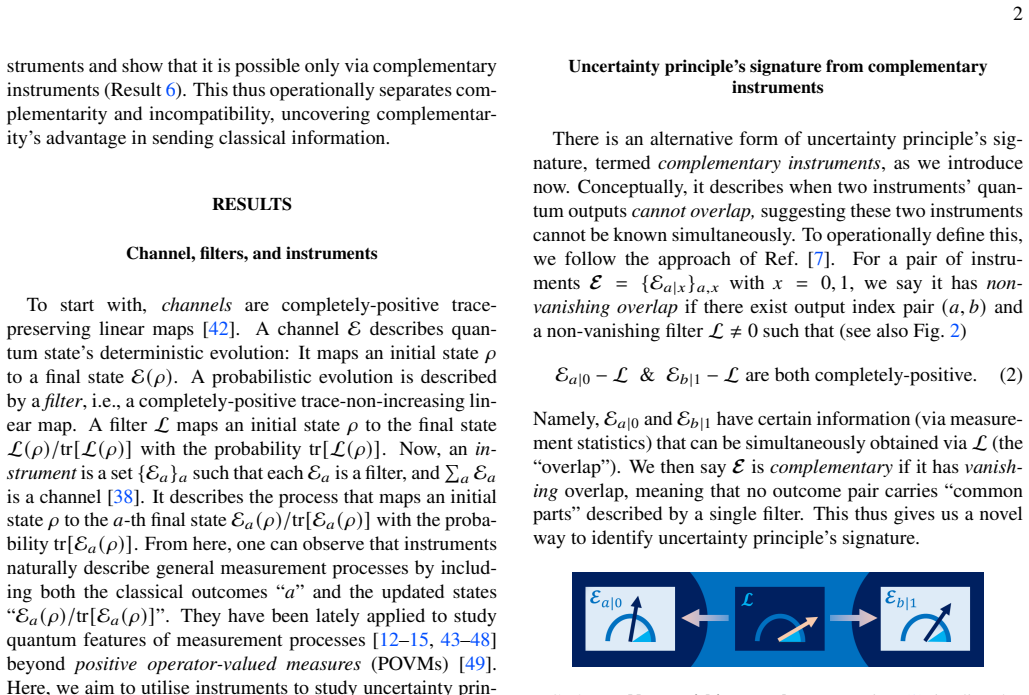
Uncertainty principle, one of the most iconic features of quantum mechanics, was originally viewed as a fundamental limitation. Since the inception of quantum information science, researchers began to use it to achieve quantum advantages. To better understand the origin of these advantages, an essential question is: To what extent can the uncertainty principle's signatures be simulated by a single measurement? As a single measurement clearly cannot demonstrate the uncertainty principle, such a simulation, if exists, implies the claimed advantages may either stem from other quantum features, or just be reproducible in a less resourceful way. In this work, we report a series of noise-robust no-go theorems, showing that strong enough signatures of uncertainty principle cannot be simulated by a single measurement, even when assisted by quantum pre- or post-processing. This signature is modelled by complementary instruments. We completely characterise complementary instruments by a numerically feasible measure and show that they are necessary and sufficient resources for the advantage in an operational task that aims to unambiguously send classical information.
Editorial analysis
A structured set of objections, weighed in public.
Referee Report
Summary. The paper establishes noise-robust no-go theorems showing that sufficiently strong signatures of the uncertainty principle—modeled via complementary instruments—cannot be simulated by any single measurement, even when assisted by quantum pre- or post-processing. It supplies a complete, numerically feasible characterization of complementary instruments and proves that these instruments are necessary and sufficient resources for an operational advantage in an unambiguous classical-information transmission task.
Significance. If the central claims hold, the work supplies a rigorous, operationally grounded separation between uncertainty-principle signatures and those reproducible by single measurements. The computable measure for complementarity and the necessity-sufficiency result for the communication task furnish concrete tools for distinguishing quantum resources, with direct relevance to quantum communication and measurement theory. The explicit noise-robustness strengthens applicability beyond idealised settings.
minor comments (2)
- [Abstract] The abstract states that complementary instruments are 'completely characterised by a numerically feasible measure,' yet the precise definition of this measure and the proof of its completeness are not referenced to a specific theorem or section in the provided abstract; a pointer to the relevant result (e.g., Theorem X in §4) would improve readability.
- [Abstract] The operational task is described as 'unambiguously send classical information,' but the precise figure of merit (success probability, error exponent, etc.) and how the advantage is quantified are not stated in the abstract; adding one sentence clarifying the task's payoff function would aid readers.
Simulated Author's Rebuttal
We thank the referee for the positive summary, significance assessment, and recommendation of minor revision. No specific major comments were raised in the report.
Circularity Check
No significant circularity in derivation chain
full rationale
The paper models uncertainty signatures via complementary instruments, provides a computable characterization of them, and proves they are necessary and sufficient for an operational advantage in unambiguous classical information transmission. This establishes noise-robust no-go results against single-measurement simulation (with pre/post-processing). The chain is self-contained: the modeling choice is tied directly to the operational task rather than asserted circularly, the characterization is derived from quantum instrument theory, and the necessity/sufficiency follows from standard quantum mechanics without reducing to fitted inputs, self-definitional loops, or load-bearing self-citations. No equations or steps in the provided structure collapse by construction to their own inputs.
Axiom & Free-Parameter Ledger
axioms (1)
- standard math Standard postulates of quantum mechanics and the operational framework for instruments and measurements
Reference graph
Works this paper leans on
-
[1]
pure state entanglement
They are Pauli𝑍and𝑋measure- ments, usually viewed as the maximally incompatible pair. Now, consider their noisy version,P (𝜖) := P (𝜖) 𝑎|𝑥 𝑎, 𝑥, with P (𝜖) 𝑎|𝑥 (·) :=(1−𝜖)E Pauli 𝑎|𝑥 (·) +𝜖D noise 𝑎 (·) ∀𝑎, 𝑥,(6) where0≤𝜖≤1indicates the amount of depolarising noise represented by the instrument{D noise 𝑎 (·) :=(I/4)tr(·)} 𝑎=0,1, namely, the quantum output...
-
[2]
I don’t know
≈0.1365, and from Eq. (7) we have ( √ 2−1)/ √ 2≈0.2929. Hence, more than46%of the interval for the parameter𝜖to admit incompatibleP (𝜖) [in Eq. (7)] are impossible to simulate viaJM post. Separating the effects of signalling and uncertainty principle in incompatible instruments In fact, Result 3 addresses a subtle conceptual ques- tion about the relation ...
2024
-
[3]
G ¨uhne, E
O. G ¨uhne, E. Haapasalo, T. Kraft, J.-P. Pellonp¨a¨a, and R. Uola, Colloquium: Incompatible measurements in quantum informa- tion science, Rev. Mod. Phys.95, 011003 (2023)
2023
-
[4]
Busch and C
P. Busch and C. Shilladay, Complementarity and uncertainty in mach–zehnder interferometry and beyond, Phys. Rep.435, 1 (2006)
2006
-
[5]
Busch, T
P. Busch, T. Heinonen, and P. Lahti, Heisenberg’s uncertainty principle, Physics Reports452, 155 (2007)
2007
-
[6]
Kiukas, P
J. Kiukas, P. Lahti, J.-P. Pellonp¨a¨a, and K. Ylinen, Complemen- tary observables in quantum mechanics, Found. Phys.49, 506 (2019)
2019
-
[7]
D. Saha, M. Oszmaniec, L. Czekaj, M. Horodecki, and R. Horodecki, Operational foundations for complementarity and uncertainty relations, Phys. Rev. A101, 052104 (2020)
2020
-
[8]
Huang, W.-B
S. Huang, W.-B. Liu, Y . Zhao, H.-L. Yin, Z.-B. Chen, and S. Wu, Quantum complementarity from a measurement-based perspective, Phys. Rev. A109, 022235 (2024)
2024
- [9]
- [10]
-
[11]
D. S. Starke, J. Maziero, M. L. W. Basso, and T. Qureshi, Bohr’s complementarity (2026), arXiv:2605.26375
Pith/arXiv arXiv 2026
-
[12]
Heinosaari, T
T. Heinosaari, T. Miyadera, and D. Reitzner, Strongly incom- patible quantum devices, Found. Phys.44, 34 (2014)
2014
-
[13]
Heinosaari, T
T. Heinosaari, T. Miyadera, and M. Ziman, An invitation to quantum incompatibility, J. Phys. A: Math. Theor.49, 123001 (2016)
2016
-
[14]
Buscemi, K
F. Buscemi, K. Kobayashi, S. Minagawa, P. Perinotti, and A. Tosini, Unifying different notions of quantum incompatibil- ity into a strict hierarchy of resource theories of communica- tion, Quantum7, 1035 (2023)
2023
-
[15]
J. Ghai and A. Mitra, Instrument-based quantum resources: quantification, hierarchies and towards constructing resource theories (2025), arXiv:2508.09134
arXiv 2025
-
[16]
Ji and E
K. Ji and E. Chitambar, Incompatibility as a resource for pro- grammable quantum instruments, PRX Quantum5, 010340 (2024)
2024
-
[17]
Hsieh and S.-L
C.-Y . Hsieh and S.-L. Chen, Thermodynamic approach to quan- tifying incompatible instruments, Phys. Rev. Lett.133, 170401 (2024)
2024
-
[18]
Brunner, D
N. Brunner, D. Cavalcanti, S. Pironio, V . Scarani, and S. Wehner, Bell nonlocality, Rev. Mod. Phys.86, 419 (2014)
2014
-
[19]
J. S. Bell, On the einstein podolsky rosen paradox, Physics Physique Fizika1, 195 (1964)
1964
-
[21]
Cavalcanti and P
D. Cavalcanti and P. Skrzypczyk, Quantum steering: A review with focus on semidefinite programming, Rep. Prog. Phys.80, 024001 (2016)
2016
-
[22]
R. Uola, A. C. S. Costa, H. C. Nguyen, and O. G¨uhne, Quantum steering, Rev. Mod. Phys.92, 015001 (2020)
2020
-
[23]
R. Uola, C. Budroni, O. G¨uhne, and J.-P. Pellonp¨a¨a, One-to-one mapping between steering and joint measurability problems, Phys. Rev. Lett.115, 230402 (2015)
2015
-
[24]
Ku, C.-Y
H.-Y . Ku, C.-Y . Hsieh, S.-L. Chen, Y .-N. Chen, and C. Budroni, Complete classification of steerability under local filters and its relation with measurement incompatibility, Nat. Commun.13, 4973 (2022)
2022
-
[25]
H.-Y . Ku, J. Kadlec, A. ˇCernoch, M. T. Quintino, W. Zhou, K. Lemr, N. Lambert, A. Miranowicz, S.-L. Chen, F. Nori, and Y .-N. Chen, Quantifying quantumness of channels without en- tanglement, PRX Quantum3, 020338 (2022)
2022
- [26]
-
[27]
C.-Y . Hsieh, H.-Y . Ku, and C. Budroni, Characterisation and fundamental limitations of irreversible stochastic steering dis- tillation (2023), arXiv:2309.06191
arXiv 2023
-
[28]
Skrzypczyk, I
P. Skrzypczyk, I. ˇSupi´c, and D. Cavalcanti, All sets of incom- patible measurements give an advantage in quantum state dis- crimination, Phys. Rev. Lett.122, 130403 (2019)
2019
-
[29]
Takagi and B
R. Takagi and B. Regula, General resource theories in quan- tum mechanics and beyond: Operational characterization via discrimination tasks, Phys. Rev. X9, 031053 (2019)
2019
-
[30]
R. Uola, T. Kraft, J. Shang, X.-D. Yu, and O. G ¨uhne, Quanti- fying quantum resources with conic programming, Phys. Rev. Lett.122, 130404 (2019)
2019
-
[31]
Hsieh, B
C.-Y . Hsieh, B. Stratton, C.-H. Wu, and H.-Y . Ku, Dynamical resource theory of incompatibility preservability, Phys. Rev. A 15 111, 022422 (2025)
2025
-
[32]
A. F. Ducuara and P. Skrzypczyk, Operational interpretation of weight-based resource quantifiers in convex quantum resource theories, Phys. Rev. Lett.125, 110401 (2020)
2020
-
[33]
R. Uola, T. Bullock, T. Kraft, J.-P. Pellonp ¨a¨a, and N. Brunner, All quantum resources provide an advantage in exclusion tasks, Phys. Rev. Lett.125, 110402 (2020)
2020
-
[34]
Carmeli, T
C. Carmeli, T. Heinosaari, and A. Toigo, Quantum incompati- bility witnesses, Phys. Rev. Lett.122, 130402 (2019)
2019
-
[35]
Oszmaniec and T
M. Oszmaniec and T. Biswas, Operational relevance of resource theories of quantum measurements, Quantum3, 133 (2019)
2019
-
[36]
Beyer, K
K. Beyer, K. Luoma, and W. T. Strunz, Steering heat engines: A truly quantum maxwell demon, Phys. Rev. Lett.123, 250606 (2019)
2019
-
[37]
W. Ji, Z. Chai, M. Wang, Y . Guo, X. Rong, F. Shi, C. Ren, Y . Wang, and J. Du, Spin quantum heat engine quantified by quantum steering, Phys. Rev. Lett.128, 090602 (2022)
2022
-
[38]
Biswas, C
T. Biswas, C. Datta, and L. P. Garc´ıa-Pintos, Quantum thermo- dynamic advantage in work extraction from steerable quantum correlations, Phys. Rev. Lett.135, 110402 (2025)
2025
-
[39]
C.-Y . Hsieh and M. Gessner, General quantum resources provide advantages in work extraction tasks (2025), arXiv:2403.18753
arXiv 2025
-
[40]
Busch, P
P. Busch, P. Lahti, J.-P. Pellonp ¨a¨a, and K. Ylinen,Quantum Measurement(Springer, 2016)
2016
-
[41]
[12] for a brief review)
Incompatibility considered in this work is also known astradi- tional incompatibilityin the literature (see, e.g., Ref. [12] for a brief review). This is different from theparallel incompatibil- ity[46–48], which is a notion more relevant to the no-cloning theorem
-
[42]
Watrous,The Theory of Quantum Information(Cambridge University Press, Cambridge, England, 2018)
J. Watrous,The Theory of Quantum Information(Cambridge University Press, Cambridge, England, 2018)
2018
-
[43]
Skrzypczyk and D
P. Skrzypczyk and D. Cavalcanti,Semidefinite Programming in Quantum Information Science, 2053-2563 (IOP Publishing, Bristol, 2023)
2053
-
[44]
M. A. Nielsen and I. L. Chuang,Quantum Computation and Quantum Information, 10th ed. (Cambridge University Press, 2010)
2010
-
[45]
C.-Y . Hsieh, A. Tavakoli, H.-Y . Ku, and P. Skrzypczyk, The resource theory of interactive quantum instruments (2026), arXiv:2603.27676
Pith/arXiv arXiv 2026
-
[46]
G. Cobucci, A. Bernal, R. Uola, and A. Tavakoli, Simulat- ing quantum measurements without using superposition (2026), arXiv:2602.17462
arXiv 2026
-
[47]
Khandelwal and A
S. Khandelwal and A. Tavakoli, Simulating quantum instru- ments with projective measurements and quantum postprocess- ing, Phys. Rev. Lett.135, 040202 (2025)
2025
-
[48]
Mitra and M
A. Mitra and M. Farkas, Compatibility of quantum instruments, Phys. Rev. A105, 052202 (2022)
2022
-
[49]
Mitra and M
A. Mitra and M. Farkas, Characterizing and quantifying the incompatibility of quantum instruments, Phys. Rev. A107, 032217 (2023)
2023
-
[50]
Lepp ¨aj¨arvi and M
L. Lepp ¨aj¨arvi and M. Sedl ´ak, Incompatibility of quantum in- struments, Quantum8, 1246 (2024)
2024
-
[51]
For an initial state𝜌, it produces the classical outcome𝑎with probabilitytr(𝜌𝐸 𝑎)
Formally, a POVM is a set of operators{𝐸 𝑎}𝑎 such that𝐸 𝑎 ≥0 ∀𝑎and Í 𝑎 𝐸𝑎 =I[42]. For an initial state𝜌, it produces the classical outcome𝑎with probabilitytr(𝜌𝐸 𝑎)
-
[52]
Then,L + eLis a channel, mean- ing that{L, eL}is an instrument
For any filterL (·)= Í 𝑖 𝐾𝑖 (·)𝐾† 𝑖 with Kraus operators𝐾 𝑖’s satisfyingΓ := Í 𝑖 𝐾 † 𝑖 𝐾𝑖 ≤I, we can define another filter eL (·) := √ I−Γ(·) √ I−Γ † . Then,L + eLis a channel, mean- ing that{L, eL}is an instrument. Hence, a filter can always be viewed as part of an instrument
-
[53]
Hsieh, Dynamical Landauer principle: Quantifying infor- mation transmission by thermodynamics, Phys
C.-Y . Hsieh, Dynamical Landauer principle: Quantifying infor- mation transmission by thermodynamics, Phys. Rev. Lett.134, 050404 (2025)
2025
-
[54]
Hsieh, Dynamical Landauer principle: Thermodynamic criteria of transmitting classical information, Phys
C.-Y . Hsieh, Dynamical Landauer principle: Thermodynamic criteria of transmitting classical information, Phys. Rev. A111, 022207 (2025)
2025
-
[55]
Hsieh, Communication, dynamical resource theory, and thermodynamics, PRX Quantum2, 020318 (2021)
C.-Y . Hsieh, Communication, dynamical resource theory, and thermodynamics, PRX Quantum2, 020318 (2021)
2021
-
[56]
Hsieh, Resource preservability, Quantum4, 244 (2020)
C.-Y . Hsieh, Resource preservability, Quantum4, 244 (2020)
2020
-
[57]
Choi, Completely positive linear maps on complex ma- trices, Linear Algebr
M.-D. Choi, Completely positive linear maps on complex ma- trices, Linear Algebr. Appl.10, 285 (1975)
1975
-
[58]
Jamiołkowski, Linear transformations which preserve trace and positive semidefiniteness of operators, Rep
A. Jamiołkowski, Linear transformations which preserve trace and positive semidefiniteness of operators, Rep. Math. Phys.3, 275 (1972)
1972
-
[59]
H. M. Wiseman, S. J. Jones, and A. C. Doherty, Steering, entan- glement, nonlocality, and the Einstein-Podolsky-Rosen para- dox, Phys. Rev. Lett.98, 140402 (2007)
2007
-
[60]
S. J. Jones, H. M. Wiseman, and A. C. Doherty, Entangle- ment, einstein-podolsky-rosen correlations, bell nonlocality, and steering, Phys. Rev. A76, 052116 (2007)
2007
-
[61]
Xiang, S
Y . Xiang, S. Cheng, Q. Gong, Z. Ficek, and Q. He, Quantum steering: Practical challenges and future directions, PRX Quan- tum3, 030102 (2022)
2022
-
[62]
M. F. Pusey, Negativity and steering: A stronger peres conjec- ture, Phys. Rev. A88, 032313 (2013)
2013
-
[63]
E. G. Cavalcanti, S. J. Jones, H. M. Wiseman, and M. D. Reid, Experimental criteria for steering and the Einstein-Podolsky- Rosen paradox, Phys. Rev. A80, 032112 (2009)
2009
discussion (0)
Sign in with ORCID, Apple, or X to comment. Anyone can read and Pith papers without signing in.