Bulk viscosity of a binary mixture: the role of the intra-species interaction
Pith reviewed 2026-06-28 00:43 UTC · model grok-4.3
The pith
The second-order Chapman-Enskog result for bulk viscosity in a binary mixture captures physical features missed at first order and agrees far better with numerical benchmarks.
A machine-rendered reading of the paper's core claim, the machinery that carries it, and where it could break.
Core claim
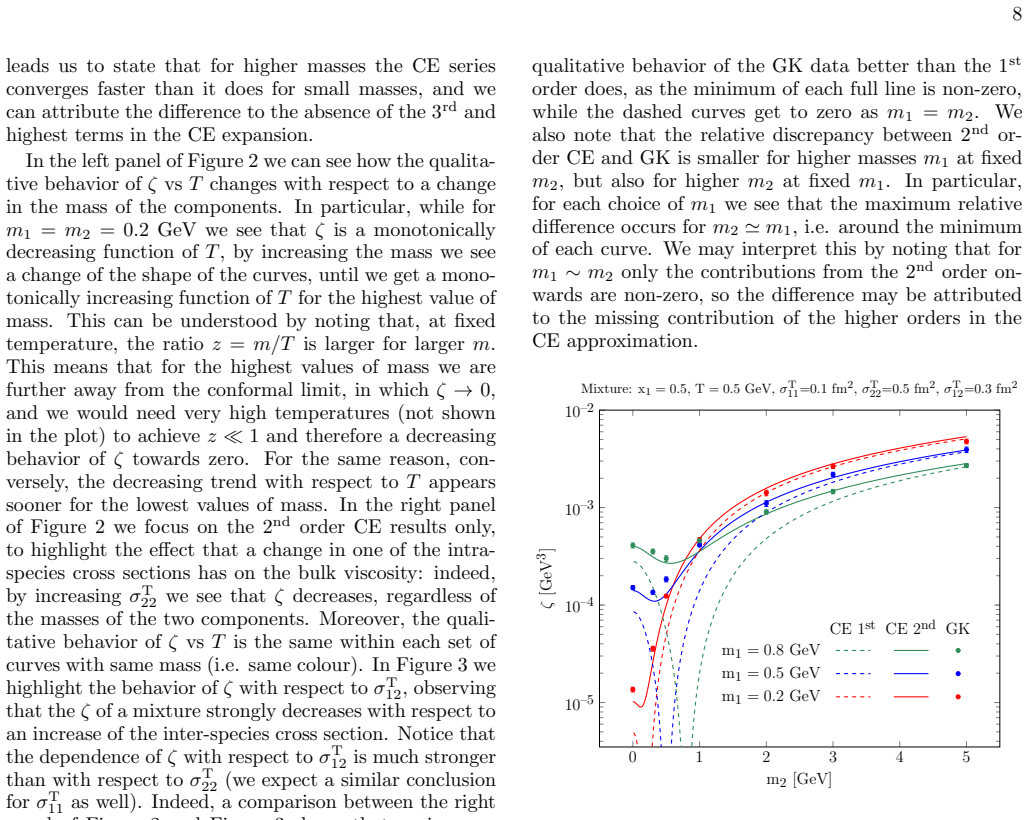
Within the Chapman-Enskog framework the bulk viscosity of a binary mixture is obtained at second order in the expansion. This result encodes physical properties absent from the first-order expression, in particular when the component masses are similar, and exhibits significantly improved quantitative agreement with the independent Green-Kubo evaluation computed from numerical solutions of the relativistic Boltzmann equation.
What carries the argument
The second-order correction in the Chapman-Enskog expansion of the single-particle distribution function for a binary mixture, which incorporates intra-species collision integrals into the expression for bulk viscosity.
If this is right
- When the two species have similar masses the second-order result differs qualitatively from the first-order result.
- The second-order expression incorporates the role of intra-species scattering that the first-order result omits.
- Agreement with the Green-Kubo benchmark improves substantially upon inclusion of the second-order terms.
- The improvement applies to relativistic binary mixtures governed by the Boltzmann equation.
Where Pith is reading between the lines
- The same second-order machinery could be applied to other transport coefficients such as shear viscosity or diffusion in the same mixture.
- In hydrodynamic simulations of systems with particle mixtures the choice between first- and second-order bulk viscosity may alter predicted flow observables.
- The method offers a route to analytic expressions for multi-component systems beyond two species once the expansion is carried to the same order.
Load-bearing premise
The second-order truncation of the Chapman-Enskog series remains accurate and the numerical Green-Kubo evaluation supplies a reliable independent benchmark.
What would settle it
Compute the analytic second-order bulk viscosity and the Green-Kubo value from Boltzmann-equation simulations for a binary mixture with equal masses; substantial disagreement between them would falsify the improvement claim.
Figures

read the original abstract
The bulk viscosity $\zeta$ is a transport coefficient which is of central importance for various areas of modern physics. In particular, its determination for a mixture of more than one fluid is challenging, since it involves a complex interplay of multiple microscopic processes that operate on different time scales. Within the Chapman-Enskog framework, based on a series expansion of the Boltzmann distribution function, many previous works have derived the 1$^{\text{st}}$ order result for the $\zeta$ of a mixture. However, such a result fails to reproduce relevant physical features of the system, especially when the masses of the two components are similar. In this work we improve the 1$^{\text{st}}$ order Chapman-Enskog result by deriving the $\zeta$ at the 2$^{\text{nd}}$ order in the expansion. We show that this improved formula encodes many physical properties that the 1$^{\text{st}}$ order result misses: under specific conditions, the 2$^{\text{nd}}$ order result can be qualitatively and quantitatively very different from the 1$^{\text{st}}$ order one. Moreover, this result is compared against the $\zeta$ evaluated within the Green-Kubo formalism, by means of a numerical solution of the Relativistic Boltzmann equation. The agreement with respect to this benchmark is significantly improved when moving from the 1$^{\text{st}}$ to the 2$^{\text{nd}}$ order CE result.
Editorial analysis
A structured set of objections, weighed in public.
Referee Report
Summary. The paper derives the bulk viscosity ζ of a binary relativistic mixture at second order in the Chapman-Enskog expansion of the Boltzmann equation. It argues that the second-order result captures physical features (especially when the two species have comparable masses) that are missed by the standard first-order expression, and reports that the second-order formula shows significantly improved quantitative agreement with an independent Green-Kubo evaluation obtained from numerical solution of the relativistic Boltzmann equation.
Significance. If the numerical benchmark is reliable, the work supplies a concrete analytic improvement over existing first-order results that is directly relevant to transport calculations in heavy-ion collisions and astrophysical plasmas. The explicit demonstration that intra-species interactions and higher-order terms in the expansion matter when masses are similar is a useful clarification for the community.
major comments (1)
- [Numerical comparison section] Numerical comparison section: the manuscript states that the Green-Kubo values are obtained from a numerical solution of the relativistic Boltzmann equation but supplies no information on discretization (grid size, time step), statistical sampling (particle number, run length), or convergence tests. Without quantified numerical uncertainties it is impossible to determine whether the reported improvement between first- and second-order CE results lies outside the numerical error.
Simulated Author's Rebuttal
We thank the referee for the careful reading of the manuscript and for the constructive comment. We address the point raised below.
read point-by-point responses
-
Referee: Numerical comparison section: the manuscript states that the Green-Kubo values are obtained from a numerical solution of the relativistic Boltzmann equation but supplies no information on discretization (grid size, time step), statistical sampling (particle number, run length), or convergence tests. Without quantified numerical uncertainties it is impossible to determine whether the reported improvement between first- and second-order CE results lies outside the numerical error.
Authors: We agree that the numerical implementation details and associated uncertainties must be documented to allow a proper assessment of the Green-Kubo benchmark. In the revised manuscript we will add a new subsection in the numerical comparison section that specifies the spatial and momentum discretization (grid sizes and time step), the statistical sampling parameters (particle number per run and total run length), the number of independent realizations, and the convergence tests performed with respect to these parameters. We will also report estimated numerical uncertainties on the extracted bulk viscosity values so that the improvement relative to the first-order result can be evaluated quantitatively. revision: yes
Circularity Check
Derivation chain is self-contained; no circular reductions
full rationale
The paper performs an independent analytic derivation of the second-order Chapman-Enskog bulk viscosity for a binary mixture, extending the standard first-order result via the usual expansion of the distribution function. This derivation stands on its own equations and does not reduce to fitted parameters, self-citations, or the Green-Kubo numerical benchmark. The subsequent comparison to the numerical Green-Kubo result (obtained from a separate relativistic Boltzmann solver) is presented as an external validation step, not as part of the derivation itself. No self-definitional loops, fitted-input predictions, or load-bearing self-citations are present in the claimed chain.
Axiom & Free-Parameter Ledger
Forward citations
Cited by 1 Pith paper
-
Transport coefficients of strongly interacting quark-gluon plasma including elastic and inelastic scattering within the dynamical quasiparticle model
Including radiative 2-to-3 channels in the DQPM moderately lowers all four transport coefficients relative to the elastic baseline while remaining compatible with lattice QCD at mu_B=0.
Reference graph
Works this paper leans on
-
[1]
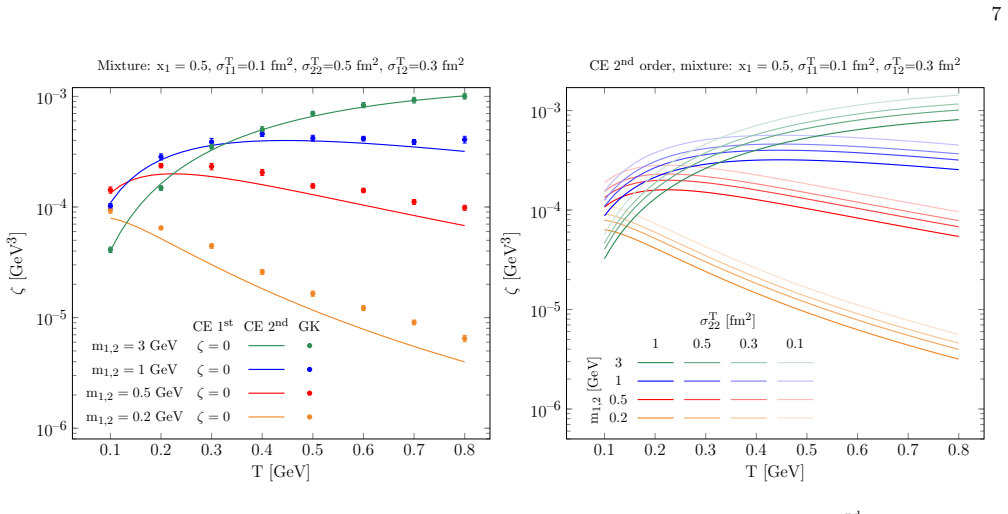
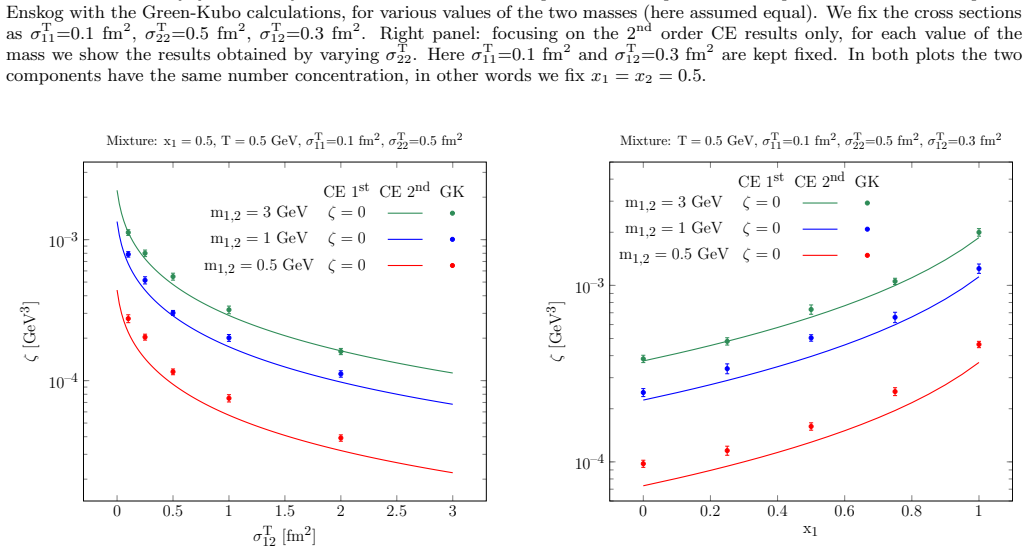
In both plots the two components have the same number concentration, in other words we fixx 1 =x 2 = 0.5
Hereσ T 11=0.1 fm 2 andσ T 12=0.3 fm 2 are kept fixed. In both plots the two components have the same number concentration, in other words we fixx 1 =x 2 = 0.5. 0 0.5 1 1.5 2 2.5 3 10–4 10–3 σ T 12 [fm2] ζ [GeV3] Mixture: x 1 = 0.5, T = 0.5 GeV, σT 11=0.1 fm 2, σT 22=0.5 fm 2 CE 1 st CE 2 nd GK m1,2 = 3 GeV ζ = 0 m1,2 = 1 GeV ζ = 0 m1,2 = 0.5 GeV ζ = 0 FI...
-
[2]
F. Karsch, D. Kharzeev, and K. Tuchin, Phys. Lett. B 663, 217 (2008), 0711.0914
Pith/arXiv arXiv 2008
-
[3]
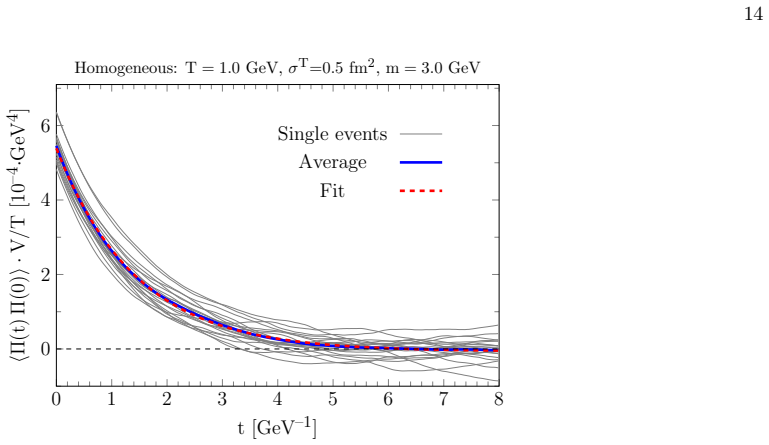
H. B. Meyer, Phys. Rev. Lett.100, 162001 (2008), 14 0 1 2 3 4 5 6 7 8 0 2 4 6 ⟨Π(t) Π(0)⟩·V/T [10–4·GeV4] t [GeV–1] Homogeneous: T = 1.0 GeV, σT=0.5 fm 2, m = 3.0 GeV Single events Average Fit FIG. 6: Time evolution of the (scaled) bulk pressure correlator for a single species interacting isotropically. Along with the single events reported as grey lines,...
Pith/arXiv arXiv 2008
-
[4]
S. Ryu, J. F. Paquet, C. Shen, G. S. Denicol, B. Schenke, S. Jeon, and C. Gale, Phys. Rev. Lett.115, 132301 (2015), 1502.01675
Pith/arXiv arXiv 2015
-
[5]
B. Schenke, C. Shen, and D. Teaney, Phys. Rev. C102, 034905 (2020), 2004.00690
arXiv 2020
-
[6]
M. G. Alford, S. Mahmoodifar, and K. Schwenzer, Phys. Rev. D85, 044051 (2012), 1103.3521
Pith/arXiv arXiv 2012
-
[7]
P. B. Jones, Phys. Rev. D64, 084003 (2001)
2001
-
[8]
Weinberg, Astrophys
S. Weinberg, Astrophys. J.168, 175 (1971)
1971
- [9]
- [10]
-
[11]
A. Wiranata and M. Prakash, Nucl. Phys. A830, 219C (2009), 0906.5592
Pith/arXiv arXiv 2009
-
[12]
W. Van Leeuwen, A. Kox, and S. de Groot, Physica A: Statistical Mechanics and its Appli- cations79, 233 (1975), ISSN 0378-4371, URL https://www.sciencedirect.com/science/article/ pii/0378437175901545
arXiv 1975
-
[13]
A. Dash, S. Samanta, and B. Mohanty, Phys. Rev. D 100, 014025 (2019), 1905.07130
arXiv 2019
-
[14]
S. R. De Groot, W. A. Van Leeuwen, and C. G. Van Weert, Relativistic Kinetic Theory. Principles and Applications (North-Holland Publishing Company, Netherlands, 1980)
1980
-
[15]
Jehring, S
L. Jehring, S. Chapman, and T. G. Cowling, ZAMM - Journal of Applied Mathematics and Mechanics/Zeitschrift f¨ ur Angewandte Math- ematik und Mechanik72, 610 (1992), URL https://onlinelibrary.wiley.com/doi/abs/10. 1002/zamm.19920721124
1992
-
[16]
W. Israel, Journal of Mathematical Physics4, 1163 (1963), https://doi.org/10.1063/1.1704047, URLhttps: //doi.org/10.1063/1.1704047
-
[17]
A. Wiranata and M. Prakash, Phys. Rev. C85, 054908 (2012), 1203.0281
Pith/arXiv arXiv 2012
-
[18]
Prakash, M
M. Prakash, M. Prakash, R. Venugopalan, and G. Welke, Phys. Rept.227, 321 (1993)
1993
-
[19]
G. S. Denicol, E. Moln´ ar, H. Niemi, and D. H. Rischke, Eur. Phys. J. A48, 170 (2012), 1206.1554
Pith/arXiv arXiv 2012
-
[20]
W. van Leeuwen, P. Polak, and S. de Groot, Physica63, 65 (1973), ISSN 0031-8914, URL https://www.sciencedirect.com/science/article/ pii/0031891473901791
arXiv 1973
-
[21]
A. Wiranata, V. Koch, M. Prakash, and X. N. Wang, Phys. Rev. C88, 044917 (2013), 1307.4681
Pith/arXiv arXiv 2013
-
[22]
M. S. Green, J. Chem. Phys.22, 398 (1954)
1954
-
[23]
R. Kubo, M. Yokota, and S. Nakajima, Journal of the Physical Society of Japan12, 1203 (1957), https://doi.org/10.1143/JPSJ.12.1203
-
[24]
S. Plumari, A. Puglisi, F. Scardina, and V. Greco, Phys. Rev. C86, 054902 (2012), 1208.0481
Pith/arXiv arXiv 2012
-
[25]
J. B. Rose, J. M. Torres-Rincon, and H. Elfner, J. Phys. G48, 015005 (2020), 2005.03647
arXiv 2020
-
[26]
Zubarev, V
D. Zubarev, V. Morozov, and G. R¨ opke, Relaxation and hydrodynamic processes, Statistical Mechanics of Nonequilibrium Processes (Akademie Verlag, 1996), ISBN 9783055017094
1996
-
[27]
G. Ferini, M. Colonna, M. Di Toro, and V. Greco, Phys. Lett. B670, 325 (2009), 0805.4814
Pith/arXiv arXiv 2009
-
[28]
F. Scardina, M. Colonna, S. Plumari, and V. Greco, Phys. Lett. B724, 296 (2013), 1202.2262
Pith/arXiv arXiv 2013
-
[29]
A. Puglisi, S. Plumari, and V. Greco, Phys. Rev. D90, 114009 (2014), 1408.7043
Pith/arXiv arXiv 2014
-
[30]
S. Plumari, G. L. Guardo, F. Scardina, and V. Greco, Phys. Rev. C92, 054902 (2015), 1507.05540
Pith/arXiv arXiv 2015
-
[31]
F. Scardina, S. K. Das, V. Minissale, S. Plumari, and V. Greco, Phys. Rev. C96, 044905 (2017), 1707.05452
Pith/arXiv arXiv 2017
-
[32]
S. Plumari, G. Coci, V. Minissale, S. K. Das, Y. Sun, and V. Greco, Phys. Lett. B805, 135460 (2020), 1912.09350
arXiv 2020
-
[33]
Y. Sun, S. Plumari, and V. Greco, Eur. Phys. J. C80, 16 (2020), 1907.11287
arXiv 2020
-
[34]
M. L. Sambataro, S. Plumari, and V. Greco, Eur. Phys. J. C80, 1140 (2020), 2005.14470
arXiv 2020
-
[35]
M. L. Sambataro, V. Minissale, S. Plumari, and V. Greco, Phys. Lett. B849, 138480 (2024), 2304.02953
arXiv 2024
- [36]
- [37]
- [38]
-
[39]
M. L. Sambataro, V. Greco, G. Parisi, and S. Plumari, Eur. Phys. J. C84, 881 (2024), 2404.17459
arXiv 2024
- [40]
-
[41]
S. Typel, G. Ropke, T. Klahn, D. Blaschke, and H. H. Wolter, Phys. Rev. C81, 015803 (2010), 0908.2344
Pith/arXiv arXiv 2010
-
[42]
R. Wang, Y.-G. Ma, L.-W. Chen, C. M. Ko, K.-J. Sun, and Z. Zhang, Phys. Rev. C108, L031601 (2023), 2305.02988
Pith/arXiv arXiv 2023
-
[43]
Parisi, G. (2026). Bulk viscosity of a binary mixture: the role of the intra-species interaction [Data set]. Zenodo. https://doi.org/10.5281/zenodo.20430253
- [44]
discussion (0)
Sign in with ORCID, Apple, or X to comment. Anyone can read and Pith papers without signing in.