An Adaptive Upper One-Sided Cumulative Sum Control Chart with Joint Parameter Optimization for Monitoring the Ratio of Two Normal Variables in Short Production Runs
Pith reviewed 2026-06-27 23:28 UTC · model grok-4.3
The pith
An adaptive CUSUM chart for the ratio of two normal variables jointly optimizes its reference value and decision interval to meet a target in-control run length while lowering out-of-control run length in short production runs.
A machine-rendered reading of the paper's core claim, the machinery that carries it, and where it could break.
Core claim
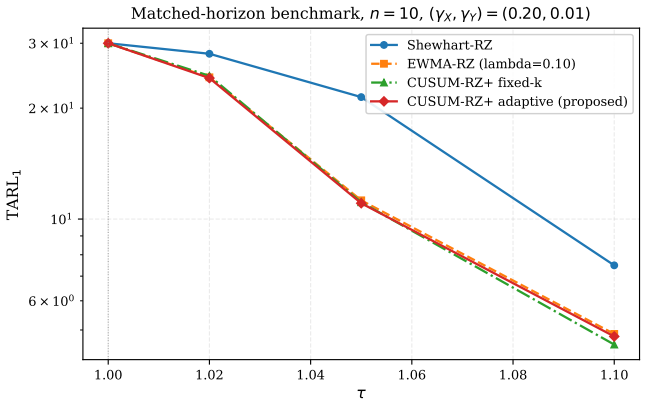
The adaptive CUSUM-RZ+ chart with joint optimization of k and h satisfies the target TARL0 equals I while achieving lower out-of-control TARL1 than fixed-k CUSUM-RZ+, Shewhart-RZ, and EWMA-RZ charts, and improves when correlation increases from Phase I to Phase II.
What carries the argument
Bilevel optimization that calibrates the decision interval h(k) by inner root-finding to enforce the TARL0 constraint and selects the optimal reference value k* by outer line search to minimize TARL1, all evaluated inside a finite-state Markov-chain framework with ratio approximation.
If this is right
- All memory-type charts outperform the Shewhart-RZ baseline under the same horizon.
- The adaptive design matches other memory charts when correlation stays stable across phases.
- Performance improves when correlation rises from Phase I to Phase II.
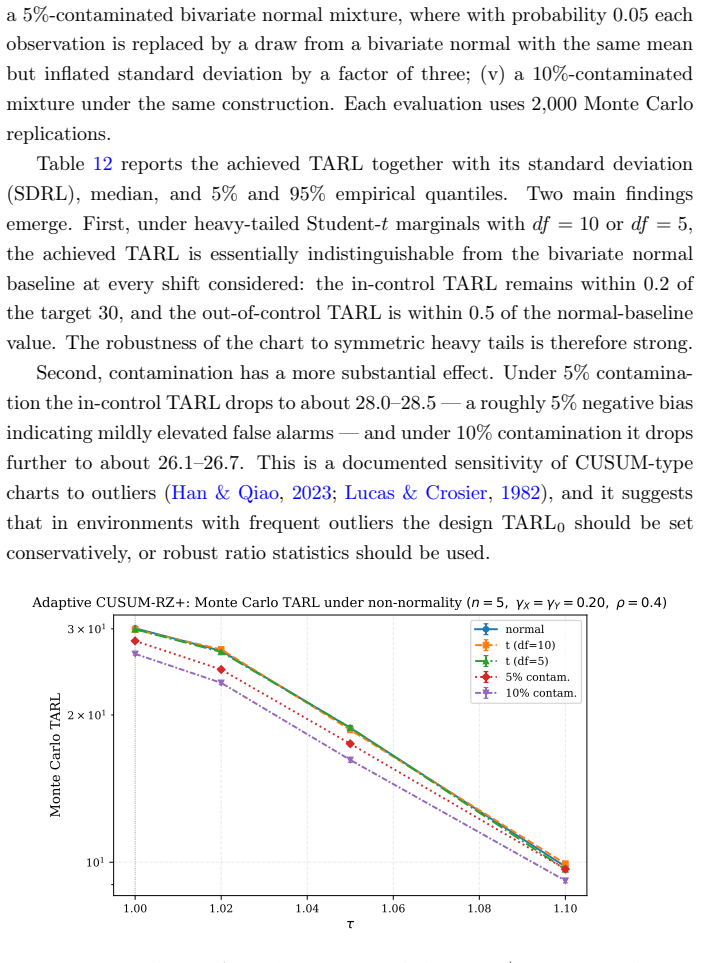
- The chart remains insensitive to symmetric heavy tails but becomes mildly anti-conservative under contamination.
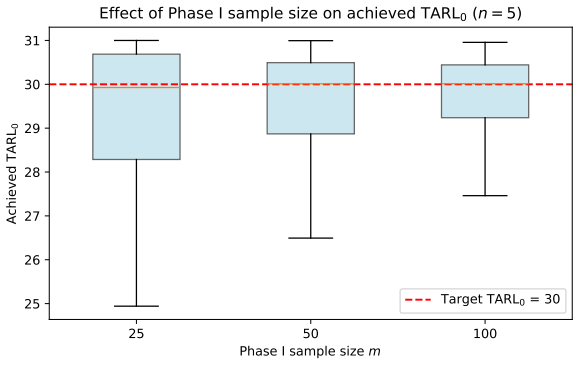
- At least 100 Phase I subgroups keep relative bias in TARL0 near one.
Where Pith is reading between the lines
- The same bilevel search could be applied to two-sided or lower-sided versions of the ratio chart.
- The Markov-chain framework might be reused for other ratio-based statistics in finite-horizon settings.
- The method suggests that joint parameter search can recover feasible designs even when single-parameter tuning hits boundary solutions.
Load-bearing premise
The finite-state Markov-chain model together with the ratio approximation correctly reproduces the run-length distribution of the CUSUM statistic for the ratio Z equals X over Y under bivariate normality.
What would settle it
Monte Carlo simulation of the actual TARL0 under the optimized k and h values that shows large deviation from the target I would falsify the claim that the bilevel procedure meets the in-control constraint.
Figures


read the original abstract
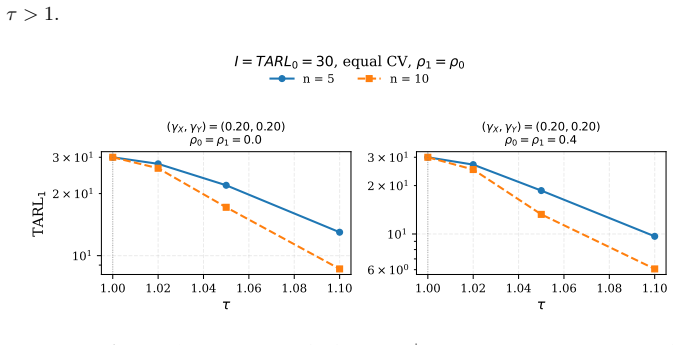
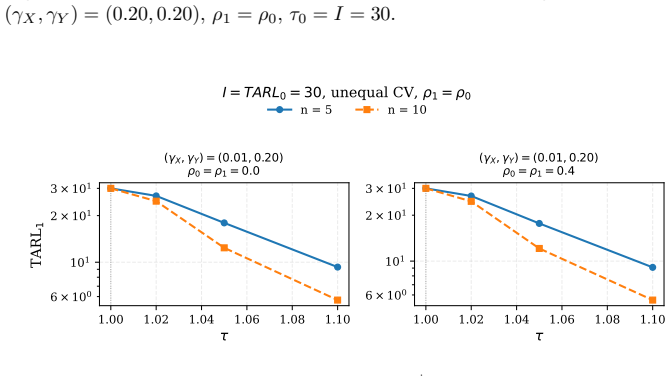
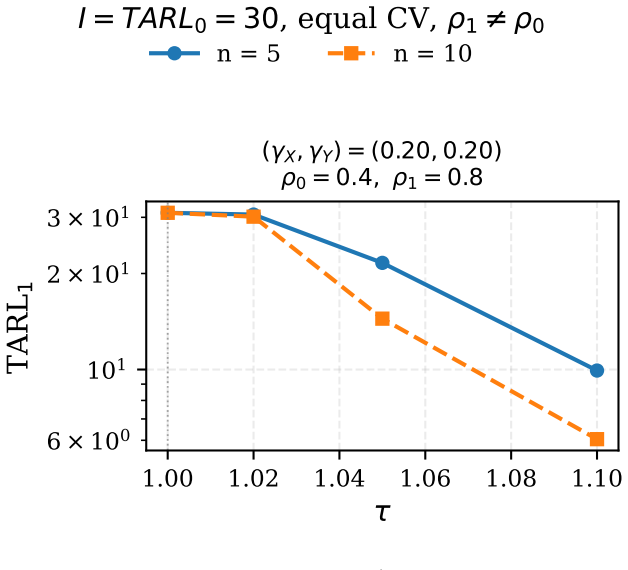
Monitoring the ratio of two correlated normal variables is increasingly important in statistical process control, since many quality characteristics are expressed in relative rather than absolute form. Memory-type ratio charts have mostly been developed for long production runs, while their finite-horizon counterparts rely on a fixed reference value $ k $ derived from a specified shift. Such fixed-$ k $ designs are not optimal at a given out-of-control magnitude and, in low-variability regimes, yield boundary solutions for which the in-control truncated average run length (TARL$ _0 $) is unattainable. This paper proposes an upper one-sided cumulative sum (CUSUM) control chart for the ratio $ Z = X/Y $ in short production runs, denoted CUSUM-RZ$ ^+ $ (RZ standing for the ratio $ Z $), with fully adaptive joint optimization of $ k $ and the decision interval $ h $. Given a target TARL$ _0 = I $ and a target shift $ \tau $, a bilevel problem calibrates $ h(k) $ by inner root-finding to satisfy the TARL$ _0 $ constraint and selects $ k^* $ by outer line search to minimize the out-of-control TARL$ _1 $. Both use a finite-state Markov-chain framework with an accurate ratio approximation; the inner step recovers boundary cases that fixed-$ k $ designs cannot. The chart is assessed through matched-horizon benchmarks against Shewhart-RZ, exponentially weighted moving average (EWMA-RZ), and fixed-$ k $ CUSUM-RZ$ ^+ $ charts, Monte Carlo robustness studies, and a Phase I estimation analysis. All memory-type charts outperform the Shewhart-RZ baseline; the adaptive design matches them under stable correlation and improves appreciably when correlation rises from Phase I to Phase II. It is insensitive to symmetric heavy tails yet mildly anti-conservative under contamination, and $ m \geq 100 $ subgroups keep the TARL$ _0 $ relative bias near 1%.
Editorial analysis
A structured set of objections, weighed in public.
Referee Report
Summary. The paper proposes an adaptive upper one-sided CUSUM chart (CUSUM-RZ+) for monitoring the ratio Z = X/Y of two correlated normal variables in short production runs. It formulates a bilevel optimization that, for a target TARL0 = I and shift τ, solves an inner root-finding problem for the decision interval h(k) via a finite-state Markov-chain model with ratio approximation, then performs an outer line search over k to minimize TARL1. The resulting adaptive design is benchmarked against Shewhart-RZ, EWMA-RZ, and fixed-k CUSUM-RZ+ charts on matched horizons, with additional Monte Carlo robustness checks and Phase-I estimation analysis; it is reported to recover boundary cases unattainable by fixed-k designs and to improve when correlation increases from Phase I to Phase II.
Significance. If the Markov-chain representation and ratio approximation are accurate, the joint optimization supplies a practical procedure that satisfies the in-control TARL0 constraint while delivering lower out-of-control TARL1 than fixed-parameter alternatives, particularly under correlation drift. The explicit recovery of boundary solutions and the use of the Markov chain to enforce the TARL0 = I constraint are concrete strengths that address a known limitation of memory-type ratio charts in finite-horizon settings.
major comments (1)
- [Abstract and bilevel-problem description] Abstract and the bilevel-problem description (paragraph beginning 'Given a target TARL0 = I'): the central performance claims rest on the finite-state Markov-chain framework together with the ratio approximation correctly yielding the TARL0 and TARL1 values that drive both the inner root-finding for h(k) and the outer search for k*. No derivation of the transition probabilities, no error analysis or bound on the ratio approximation, and no verification that the inner root-finding converges for all admissible k are supplied; these omissions are load-bearing because the reported superiority over fixed-k CUSUM-RZ+ and the other benchmarks is obtained directly from the TARL values produced by this model.
Simulated Author's Rebuttal
We thank the referee for the constructive feedback and for emphasizing the importance of methodological transparency in the bilevel optimization framework. We address the single major comment below.
read point-by-point responses
-
Referee: [Abstract and bilevel-problem description] Abstract and the bilevel-problem description (paragraph beginning 'Given a target TARL0 = I'): the central performance claims rest on the finite-state Markov-chain framework together with the ratio approximation correctly yielding the TARL0 and TARL1 values that drive both the inner root-finding for h(k) and the outer search for k*. No derivation of the transition probabilities, no error analysis or bound on the ratio approximation, and no verification that the inner root-finding converges for all admissible k are supplied; these omissions are load-bearing because the reported superiority over fixed-k CUSUM-RZ+ and the other benchmarks is obtained directly from the TARL values produced by this model.
Authors: We agree that the manuscript would benefit from greater explicit detail on the Markov-chain construction and ratio approximation to make the performance claims fully reproducible. In the revision we will insert a dedicated subsection that (i) derives the transition probabilities of the finite-state Markov chain from the distribution of the ratio of two correlated normals, (ii) supplies both an analytic error bound and accompanying numerical verification for the ratio approximation, and (iii) documents the convergence of the inner root-finding routine for h(k) over the admissible interval of k via additional tables or figures. These additions will directly support the reported superiority of the adaptive design. revision: yes
Circularity Check
No significant circularity; derivation self-contained
full rationale
The paper defines a bilevel optimization that uses an external finite-state Markov-chain model (with ratio approximation) to evaluate TARL0 and TARL1 as performance metrics. The inner root-finding enforces the target TARL0 constraint and the outer search minimizes TARL1; reported improvements are relative to benchmark charts under the same model. No step reduces a claimed prediction or result to a quantity defined by the fitted parameters themselves, nor relies on load-bearing self-citation or imported uniqueness. This is the standard non-circular workflow for control-chart design.
Axiom & Free-Parameter Ledger
axioms (2)
- domain assumption X and Y are jointly normal with constant correlation coefficient.
- domain assumption The finite-state Markov-chain model with ratio approximation yields accurate TARL values.
Reference graph
Works this paper leans on
-
[1]
Journal of Applied Statistics , volume =
Han, Dong and Qiao, Lei , title =. Journal of Applied Statistics , volume =. 2023 , doi =
2023
-
[2]
Reynolds, Marion R., Jr. , title =. Wiley StatsRef: Statistics Reference Online , year =. doi:10.1002/9781118445112.stat04055 , publisher =
-
[3]
and Evans, D
Brook, D. and Evans, D. A. , title =. Biometrika , volume =. 1972 , doi =
1972
-
[4]
The distribution of the ratio of jointly normal variables , journal =
Cedilnik, Anton and Ko. The distribution of the ratio of jointly normal variables , journal =. 2004 , doi =
2004
-
[5]
Quality and Reliability Engineering International , volume =
Celano, Giovanni and Castagliola, Philippe , title =. Quality and Reliability Engineering International , volume =. 2016 , doi =
2016
-
[6]
Quality and Reliability Engineering International , volume =
Celano, Giovanni and Castagliola, Philippe and Trovato, Emanuele and Fichera, Sergio , title =. Quality and Reliability Engineering International , volume =. 2011 , doi =
2011
-
[7]
Metrika , volume =
Del Castillo, Enrique , title =. Metrika , volume =. 1996 , doi =
1996
-
[8]
Quality and Reliability Engineering International , volume =
Faraz, Alireza and Castagliola, Philippe and Celano, Giovanni and Fichera, Sergio , title =. Quality and Reliability Engineering International , volume =. 2014 , doi =
2014
-
[9]
, title =
Farnum, Nicholas R. , title =. Journal of Quality Technology , volume =. 1992 , doi =
1992
-
[10]
Fieller, E. C. , title =. Biometrika , volume =. 1932 , doi =
1932
-
[11]
Geary, R. C. , title =. Journal of the Royal Statistical Society , volume =. 1930 , doi =
1930
-
[12]
Management Science , volume =
Hayya, Jack and Armstrong, Donald and Gressis, Nicolas , title =. Management Science , volume =. 1975 , doi =
1975
-
[13]
Hinkley, D. V. , title =. Biometrika , volume =. 1969 , doi =
1969
-
[14]
Computers & Industrial Engineering , volume =
Hu, XueLong and Sun, Jie and Tang, AnAn , title =. Computers & Industrial Engineering , volume =. 2024 , doi =
2024
-
[15]
Quality and Reliability Engineering International , volume =
Lin, Yu-Chang and Chou, Chao-Yu , title =. Quality and Reliability Engineering International , volume =. 2005 , doi =
2005
-
[16]
and Crosier, Ronald B
Lucas, James M. and Crosier, Ronald B. , title =. Communications in Statistics -- Theory and Methods , volume =. 1982 , doi =
1982
-
[17]
, title =
Montgomery, Douglas C. , title =. 2019 , isbn =
2019
-
[18]
and Polunchenko, Aleksey S
Moustakides, George V. and Polunchenko, Aleksey S. and Tartakovsky, Alexander G. , title =. Statistica Sinica , volume =. 2011 , doi =
2011
-
[19]
Khaw, Khai Wah and Khoo, Michael B. C. and Yeong, Wai Chung and Wu, Zhang , title =. Quality Engineering , volume =. 2023 , doi =
2023
-
[20]
Quality and Reliability Engineering International , volume =
Nguyen, Huu Du and Tran, Kim Phuc and Castagliola, Philippe and Celano, Giovanni , title =. Quality and Reliability Engineering International , volume =. 2019 , doi =
2019
-
[21]
1994 , doi =
Statistical process control by quotient: Application and analysis , journal =. 1994 , doi =
1994
-
[22]
and Turkkan, N
Pham-Gia, T. and Turkkan, N. and Marchand, E. , title =. Communications in Statistics -- Theory and Methods , volume =. 2006 , doi =
2006
-
[23]
and Stoumbos, Zachary G
Reynolds, Marion R., Jr. and Stoumbos, Zachary G. , title =. Journal of Quality Technology , volume =. 2004 , doi =
2004
-
[24]
Khoo, Michael B. C. and Yeong, Wai Chung and Khaw, Khai Wah and Lim, Sin Yin , title =. Quality and Reliability Engineering International , volume =. 2024 , doi =
2024
-
[25]
, title =
Spisak, Andrew W. , title =. Journal of Quality Technology , volume =. 1990 , doi =
1990
-
[26]
International Journal of Production Research , volume =
Tran, Kim Phuc and Castagliola, Philippe and Celano, Giovanni , title =. International Journal of Production Research , volume =. 2016 , doi =
2016
-
[27]
Quality and Reliability Engineering International , volume =
Tran, Kim Phuc and Castagliola, Philippe and Celano, Giovanni , title =. Quality and Reliability Engineering International , volume =. 2016 , doi =
2016
-
[28]
Statistical Papers , volume =
Tran, Kim Phuc and Castagliola, Philippe and Celano, Giovanni , title =. Statistical Papers , volume =. 2018 , doi =
2018
-
[29]
On the performance of one-sided control charts for monitoring the ratio of two normal random variables in short production runs , journal =
Tran, Kim Phuc and Heuchenne, C. On the performance of one-sided control charts for monitoring the ratio of two normal random variables in short production runs , journal =. 2021 , doi =
2021
-
[30]
, title =
Yang, Su-Fen and Lin, Jen-Shiou and Cheng, Smiley W. , title =. Computers & Industrial Engineering , volume =. 2025 , doi =
2025
discussion (0)
Sign in with ORCID, Apple, or X to comment. Anyone can read and Pith papers without signing in.