On the training of physics-informed neural operators for solving parametric partial differential equations
Pith reviewed 2026-06-28 03:13 UTC · model grok-4.3
The pith
A carefully designed physics-informed training pipeline for neural operators can match or outperform purely data-driven methods on parametric PDEs.
A machine-rendered reading of the paper's core claim, the machinery that carries it, and where it could break.
Core claim
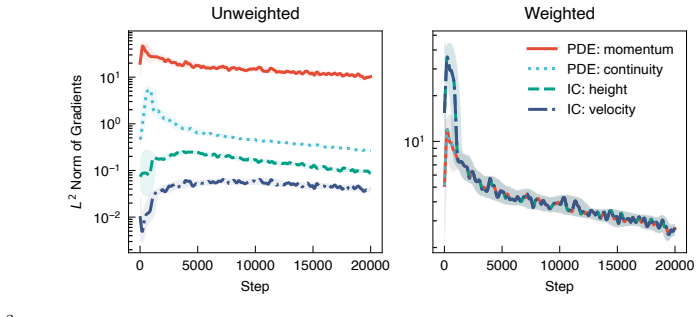
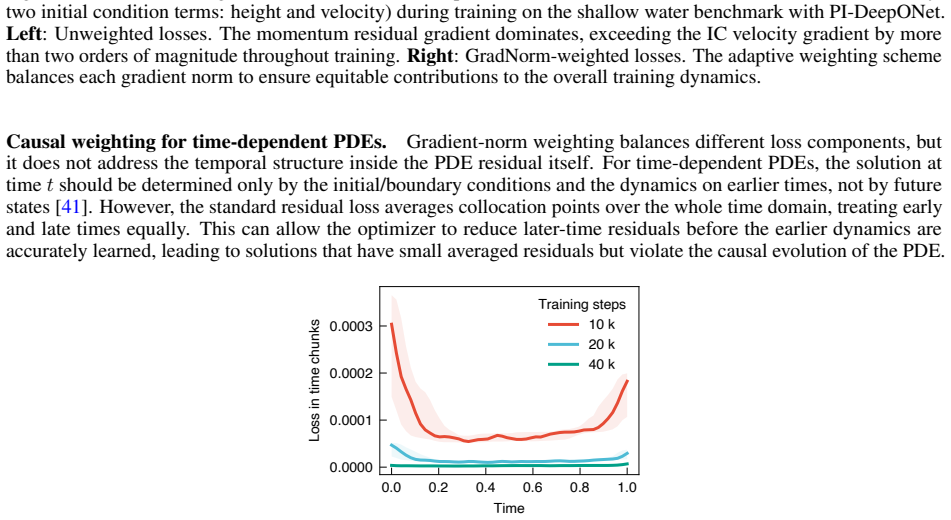
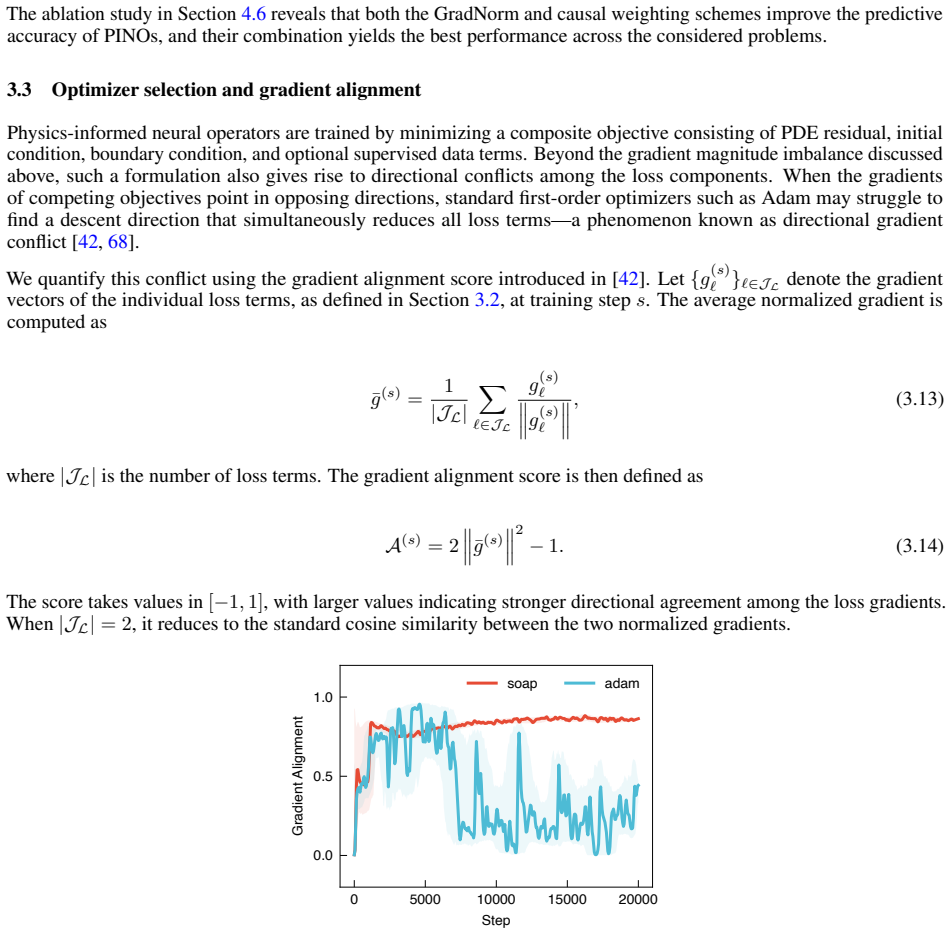
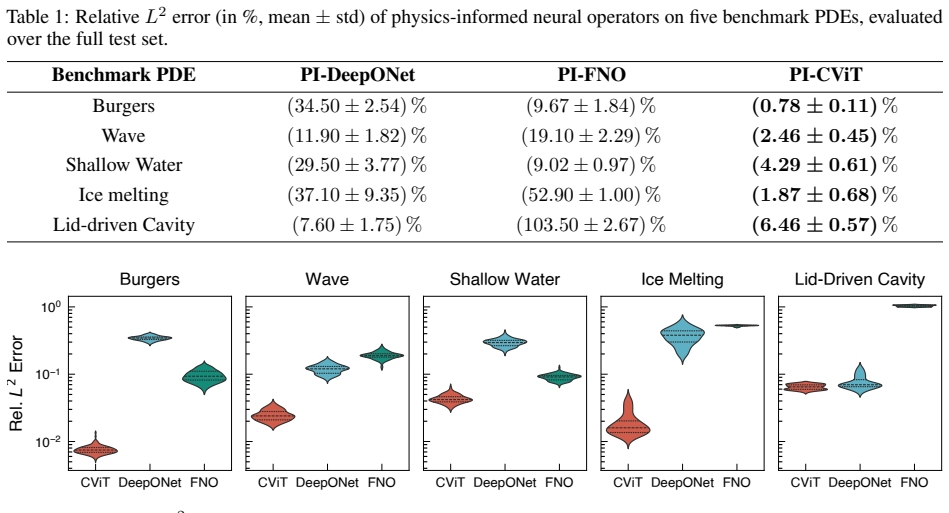
Across the tested backbones and PDE families, CViT delivers the most stable performance; standard mitigation methods for gradient conflicts and causal violations transfer directly to the operator setting; and a tuned physics-informed objective can equal or surpass data-driven neural operator accuracy under multiple data regimes.
What carries the argument
The physics-informed training pipeline that replaces paired input-output data with governing PDE residuals as the supervision signal, applied to neural operator architectures for learning parametric solution maps.
If this is right
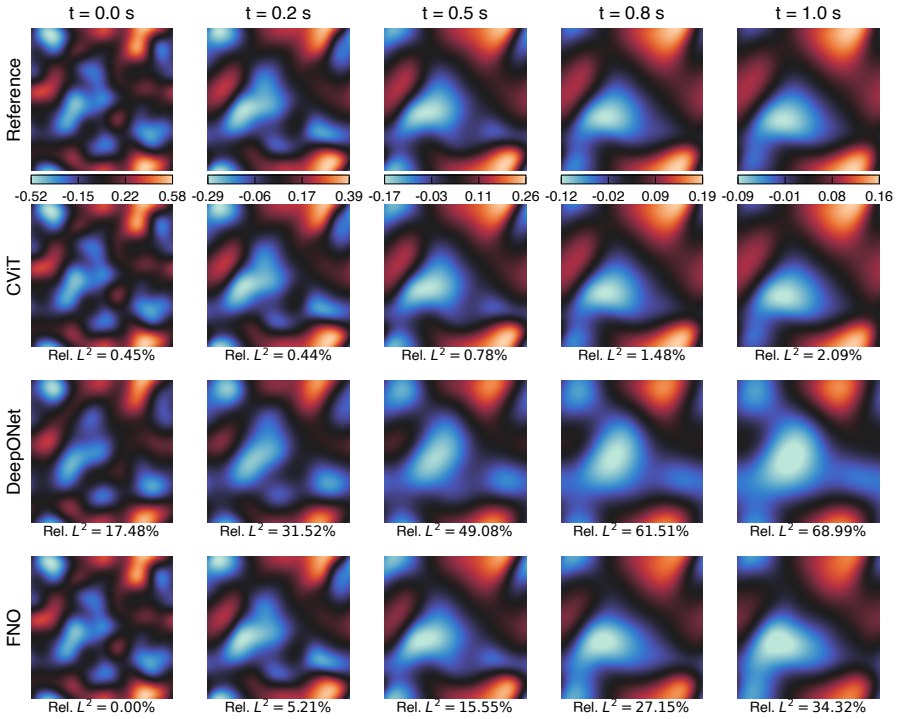
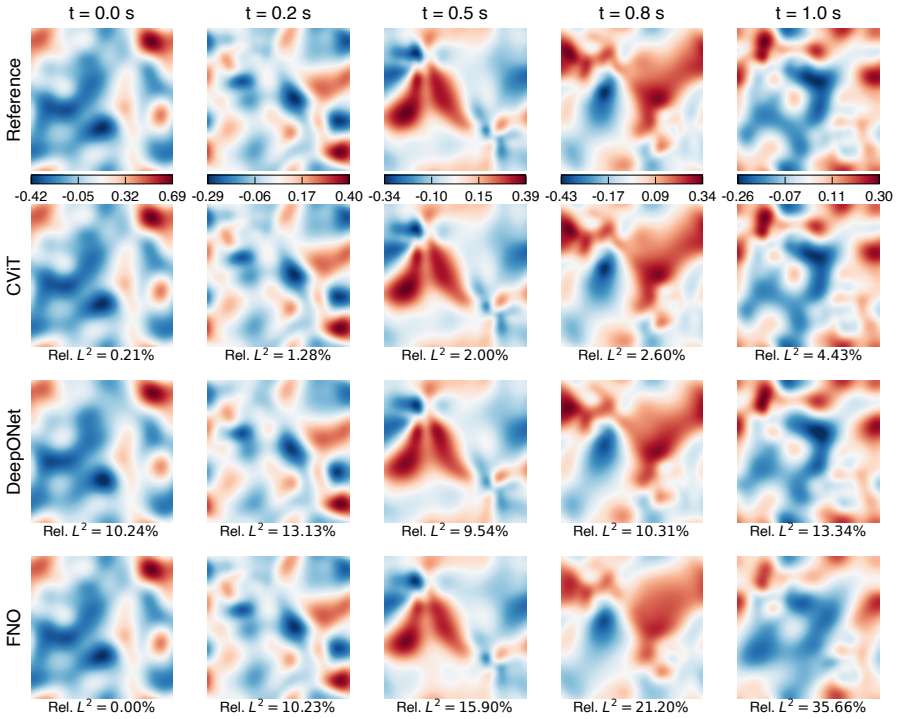
- CViT provides consistently strong and stable performance across the considered benchmarks.
- Mitigation algorithms developed for PINNs remain effective when training PINOs.
- Physics-informed training can match and in some cases outperform purely data-driven neural operators under different data regimes.
- The empirical findings supply a practical pipeline for efficient and robust physics-informed operator learning.
Where Pith is reading between the lines
- The same pipeline might reduce the need for expensive high-fidelity simulation data when learning operators for more complex or higher-dimensional PDEs.
- The transfer of mitigation techniques suggests the optimization challenges are largely architecture-independent within the neural-operator family.
- Future tests could check whether these patterns persist when the number of training instances or the model size is scaled significantly beyond the reported experiments.
Load-bearing premise
The five parametric PDE systems and benchmarks chosen are representative enough that the observed performance patterns and mitigation effectiveness will hold for other parametric PDE problems of practical interest.
What would settle it
On a new parametric PDE system outside the original five, applying the recommended pipeline and mitigations still yields lower accuracy than a data-driven baseline trained on the same number of simulation pairs.
Figures



read the original abstract
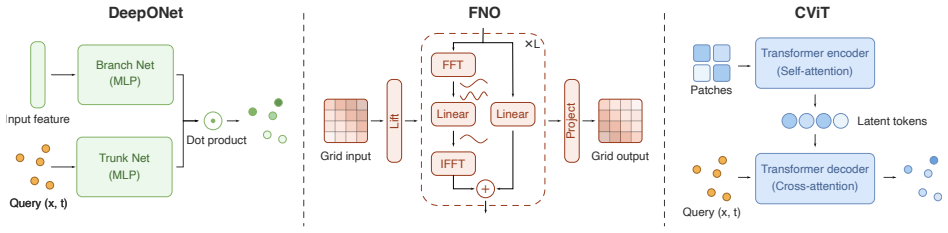
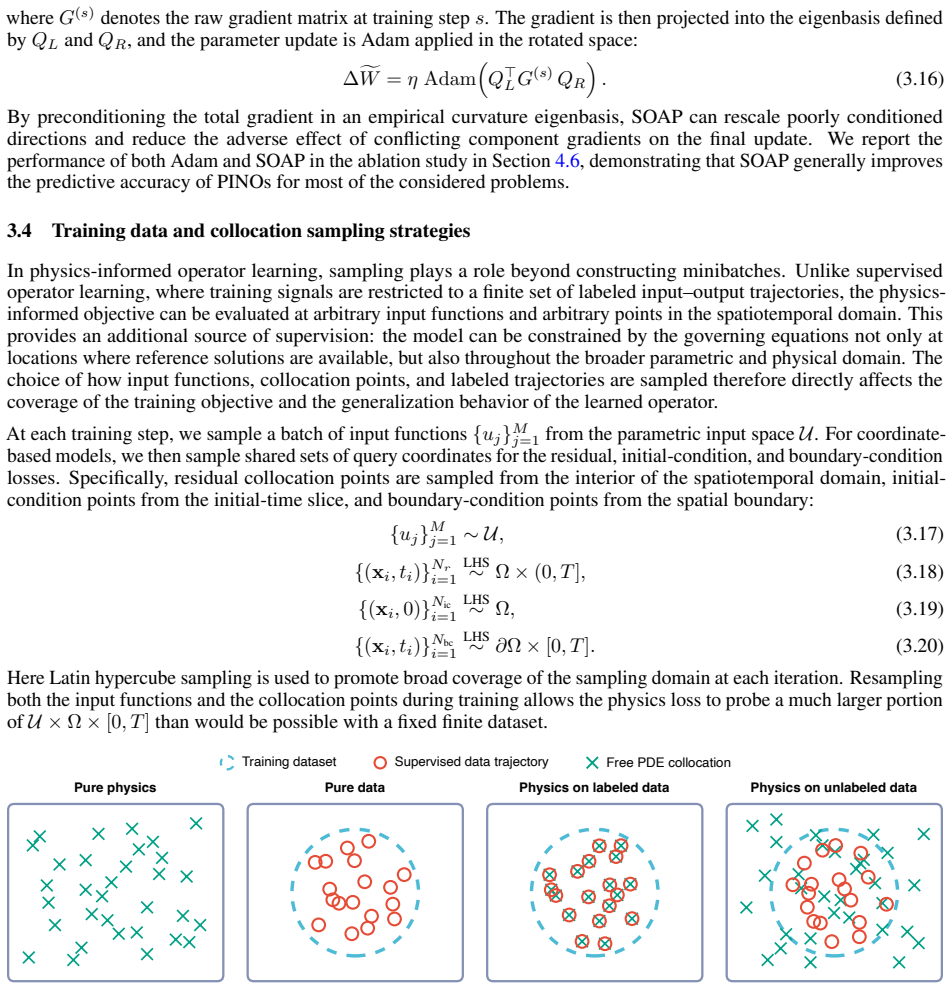
Physics-informed neural operators (PINOs) aim to learn solution operators for partial differential equations by using the governing physics as supervision, rather than relying solely on paired input-output simulation data. By incorporating physical constraints into the training objective, PINOs combine the cross-instance generalization of neural operators with the data efficiency of physics-informed learning. Despite this promise, how to train PINOs efficiently and robustly remains less well-understood than the training of either data-driven neural operators or physics-informed neural networks (PINNs). To bridge this gap, we examine key components of the PINO training pipeline, including architecture design, optimizer choice, loss balancing, and collocation-point sampling strategy. We study three representative operator backbones, Deep Operator Network (DeepONet), Fourier Neural Operator (FNO), and Continuous Vision Transformer (CViT), across five diverse parametric PDE systems. Our results show that CViT provides consistently strong and stable performance across the considered benchmarks. Beyond architecture, we find that several optimization pathologies previously identified in PINN training naturally arise in PINOs, including gradient conflicts and causal violation. We also find that mitigation algorithms developed for PINNs remain effective in the PINO setting. We further compare physics-informed and data-driven training under different data regimes, revealing that a carefully designed physics-informed training pipeline can match, and in some cases, outperform purely data-driven neural operators. Taken together, these findings provide a systematic empirical understanding of the optimization challenges in PINO training and inform a practical pipeline for efficient and robust physics-informed operator learning. Code and data are available at https://github.com/NanxiiChen/PI-CViT.
Editorial analysis
A structured set of objections, weighed in public.
Referee Report
Summary. The paper examines key components of the training pipeline for physics-informed neural operators (PINOs), including architecture design, optimizer choice, loss balancing, and collocation-point sampling. It evaluates three operator backbones—DeepONet, FNO, and CViT—across five parametric PDE systems, showing that CViT performs strongly, that PINN-like optimization issues arise and can be mitigated, and that a well-designed physics-informed approach can match or outperform data-driven training in some data regimes.
Significance. If the results hold, this provides a systematic empirical guide to training PINOs, highlighting effective practices and the potential for physics-informed methods to reduce reliance on simulation data. The release of code and data supports reproducibility and allows verification of the empirical claims.
major comments (1)
- [Abstract and experimental evaluation] The central claim that the physics-informed pipeline can match or outperform data-driven neural operators in general relies on the five chosen PDE systems being representative of the optimization challenges and generalization patterns in other parametric PDEs. The manuscript describes the systems as 'diverse' but provides no explicit argument or additional validation for why the observed performance patterns and mitigation effectiveness would transfer to other problems of practical interest. This is load-bearing for the broader conclusions.
minor comments (1)
- [Abstract] The abstract states that 'several optimization pathologies previously identified in PINN training naturally arise in PINOs'; it would be helpful to briefly name the specific pathologies (e.g., gradient conflicts, causal violation) already in the abstract for clarity.
Simulated Author's Rebuttal
We thank the referee for the constructive feedback and positive recommendation. We address the single major comment below.
read point-by-point responses
-
Referee: [Abstract and experimental evaluation] The central claim that the physics-informed pipeline can match or outperform data-driven neural operators in general relies on the five chosen PDE systems being representative of the optimization challenges and generalization patterns in other parametric PDEs. The manuscript describes the systems as 'diverse' but provides no explicit argument or additional validation for why the observed performance patterns and mitigation effectiveness would transfer to other problems of practical interest. This is load-bearing for the broader conclusions.
Authors: We agree that the broader conclusions depend on the representativeness of the five PDEs and that the manuscript provides only a high-level description of them as 'diverse' without an explicit justification or discussion of transferability. The systems were chosen to cover linear/nonlinear, time-dependent/steady-state, 1D/2D, and varying parameter dimensions, but we did not articulate selection criteria or limitations. In revision we will add a concise paragraph (likely in Section 3 or the experimental setup) that (i) states the selection criteria, (ii) notes the common optimization and generalization challenges they instantiate, and (iii) acknowledges that extrapolation to other PDE families remains an open question. This addresses the load-bearing concern without altering the empirical claims. revision: yes
Circularity Check
No circularity: purely empirical benchmark study
full rationale
The paper reports direct experimental comparisons of training pipelines for PINOs (DeepONet, FNO, CViT backbones) across five parametric PDE systems. No derivation, fitted parameter, or prediction is presented; all claims rest on observed performance metrics from explicit benchmarks. No self-definitional equations, no fitted inputs relabeled as predictions, and no load-bearing self-citations that reduce the central empirical claim to prior author work. The analysis is self-contained against external benchmarks.
Axiom & Free-Parameter Ledger
Reference graph
Works this paper leans on
-
[1]
Parametric free-form shape design with pde models and reduced basis method
Toni Lassila and Gianluigi Rozza. Parametric free-form shape design with pde models and reduced basis method. Computer Methods in Applied Mechanics and Engineering, 199(23):1583–1592, 2010
2010
-
[2]
Multi-objective aerodynamic optimization of high-speed train heads based on the pde parametric modeling.Structural and Multidisciplinary Optimization, 64(3):1285–1304, 2021
Shuangbu Wang, Ruibin Wang, Yu Xia, Zhenye Sun, Lihua You, and Jianjun Zhang. Multi-objective aerodynamic optimization of high-speed train heads based on the pde parametric modeling.Structural and Multidisciplinary Optimization, 64(3):1285–1304, 2021
2021
-
[3]
The high-throughput highway to computational materials design.Nature materials, 12(3):191–201, 2013
Stefano Curtarolo, Gus LW Hart, Marco Buongiorno Nardelli, Natalio Mingo, Stefano Sanvito, and Ohad Levy. The high-throughput highway to computational materials design.Nature materials, 12(3):191–201, 2013
2013
-
[4]
Commentary: The materials project: A materials genome approach to accelerating materials innovation.APL materials, 1(1), 2013
Anubhav Jain, Shyue Ping Ong, Geoffroy Hautier, Wei Chen, William Davidson Richards, Stephen Dacek, Shreyas Cholia, Dan Gunter, David Skinner, Gerbrand Ceder, et al. Commentary: The materials project: A materials genome approach to accelerating materials innovation.APL materials, 1(1), 2013
2013
-
[5]
Matthaios Chatzopoulos and Phaedon-Stelios Koutsourelakis. Physics-aware neural implicit solvers for multiscale, parametric pdes with applications in heterogeneous media.Computer Methods in Applied Mechanics and Engineering, 432:117342, 2024
2024
-
[6]
Surrogate- based modeling and dimension reduction techniques for multi-scale mechanics problems.Acta Mechanica Sinica, 27(6):845–865, 2011
Wei Shyy, Young-Chang Cho, Wenbo Du, Amit Gupta, Chien-Chou Tseng, and Ann Marie Sastry. Surrogate- based modeling and dimension reduction techniques for multi-scale mechanics problems.Acta Mechanica Sinica, 27(6):845–865, 2011
2011
-
[7]
Multiscale topology optimization using neural network surrogate models.Computer Methods in Applied Mechanics and Engineering, 346:1118–1135, 2019
Daniel A White, William J Arrighi, Jun Kudo, and Seth E Watts. Multiscale topology optimization using neural network surrogate models.Computer Methods in Applied Mechanics and Engineering, 346:1118–1135, 2019. 22
2019
-
[8]
Pinn-form: A new physics-informed neural network for reliability analysis with partial differential equation.Computer Methods in Applied Mechanics and Engineering, 414:116172, 2023
Zeng Meng, Qiaochu Qian, Mengqiang Xu, Bo Yu, Ali Rıza Yıldız, and Seyedali Mirjalili. Pinn-form: A new physics-informed neural network for reliability analysis with partial differential equation.Computer Methods in Applied Mechanics and Engineering, 414:116172, 2023
2023
-
[9]
Dynamic response and reliability analysis of structures with uncertain parameters
Jie Li and Jian-Bing Chen. Dynamic response and reliability analysis of structures with uncertain parameters. International Journal for Numerical Methods in Engineering, 62(2):289–315, 2005
2005
-
[10]
Matteo Tomasetto, Andrea Manzoni, and Francesco Braghin. Real-time optimal control of high-dimensional parametrized systems by deep learning-based reduced order models.International Journal for Numerical Methods in Engineering, 127(1):e70237, 2026
2026
-
[11]
Christophe Prud’Homme, Dimitrios V Rovas, Karen Veroy, and Anthony T Patera. A mathematical and com- putational framework for reliable real-time solution of parametrized partial differential equations.ESAIM: Mathematical Modelling and Numerical Analysis, 36(5):747–771, 2002
2002
-
[12]
Solving pde-constrained control problems using operator learning.Proceedings of the AAAI Conference on Artificial Intelligence, 36(4):4504–4512, Jun
Rakhoon Hwang, Jae Yong Lee, Jin Young Shin, and Hyung Ju Hwang. Solving pde-constrained control problems using operator learning.Proceedings of the AAAI Conference on Artificial Intelligence, 36(4):4504–4512, Jun. 2022
2022
-
[13]
Promising directions of machine learning for partial differential equations
Steven L Brunton and J Nathan Kutz. Promising directions of machine learning for partial differential equations. Nature Computational Science, 4(7):483–494, 2024
2024
-
[15]
Neural operators for accelerating scientific simulations and design.Nature Reviews Physics, 6(5):320–328, 2024
Kamyar Azizzadenesheli, Nikola Kovachki, Zongyi Li, Miguel Liu-Schiaffini, Jean Kossaifi, and Anima Anand- kumar. Neural operators for accelerating scientific simulations and design.Nature Reviews Physics, 6(5):320–328, 2024
2024
-
[16]
Neural Operator: Learning Maps Between Function Spaces with Applications to PDEs
Nikola Kovachki, Zongyi Li, Burigede Liu, Kamyar Azizzadenesheli, Kaushik Bhattacharya, Andrew Stuart, and Anima Anandkumar. Neural Operator: Learning Maps Between Function Spaces with Applications to PDEs. Journal of Machine Learning Research, 24(89):1–97, 2023
2023
-
[17]
Learning nonlinear operators via DeepONet based on the universal approximation theorem of operators.Nature Machine Intelligence, 3(3):218–229, March 2021
Lu Lu, Pengzhan Jin, Guofei Pang, Zhongqiang Zhang, and George Em Karniadakis. Learning nonlinear operators via DeepONet based on the universal approximation theorem of operators.Nature Machine Intelligence, 3(3):218–229, March 2021
2021
-
[18]
Fourier neural operator for parametric partial differential equations, May 2021
Zongyi Li, Nikola Kovachki, Kamyar Azizzadenesheli, Burigede Liu, Kaushik Bhattacharya, Andrew Stuart, and Anima Anandkumar. Fourier neural operator for parametric partial differential equations, May 2021
2021
-
[19]
Cvit: Continuous vision transformer for operator learning.arXiv preprint arXiv:2405.13998, 2024
Sifan Wang, Jacob H Seidman, Shyam Sankaran, Hanwen Wang, George J Pappas, and Paris Perdikaris. Cvit: Continuous vision transformer for operator learning.arXiv preprint arXiv:2405.13998, 2024
-
[20]
Gnot: A general neural operator transformer for operator learning
Zhongkai Hao, Zhengyi Wang, Hang Su, Chengyang Ying, Yinpeng Dong, Songming Liu, Ze Cheng, Jian Song, and Jun Zhu. Gnot: A general neural operator transformer for operator learning. InInternational conference on machine learning, pages 12556–12569. PMLR, 2023
2023
-
[21]
Zijie Li, Kazem Meidani, and Amir Barati Farimani. Transformer for partial differential equations’ operator learning.arXiv preprint arXiv:2205.13671, 2022
-
[22]
Laplace neural operator for solving differential equations.Nature Machine Intelligence, 6(6):631–640, 2024
Qianying Cao, Somdatta Goswami, and George Em Karniadakis. Laplace neural operator for solving differential equations.Nature Machine Intelligence, 6(6):631–640, 2024
2024
-
[23]
U-NO: U-shaped neural operators.arXiv preprint arXiv:2204.11127, 2022
Md Ashiqur Rahman, Zachary E Ross, and Kamyar Azizzadenesheli. U-no: U-shaped neural operators.arXiv preprint arXiv:2204.11127, 2022
-
[24]
Geometry-informed neural operator for large-scale 3d pdes.Advances in Neural Information Processing Systems, 36:35836–35854, 2023
Zongyi Li, Nikola Kovachki, Chris Choy, Boyi Li, Jean Kossaifi, Shourya Otta, Mohammad Amin Nabian, Maximilian Stadler, Christian Hundt, Kamyar Azizzadenesheli, et al. Geometry-informed neural operator for large-scale 3d pdes.Advances in Neural Information Processing Systems, 36:35836–35854, 2023
2023
-
[25]
Zhikai Wu, Sifan Wang, Shiyang Zhang, Sizhuang He, Min Zhu, Anran Jiao, Lu Lu, and David van Dijk. Tante: Time-adaptive operator learning via neural taylor expansion.arXiv preprint arXiv:2502.08574, 2025
-
[26]
Nomad: Nonlinear manifold decoders for operator learning.Advances in Neural Information Processing Systems, 35:5601–5613, 2022
Jacob Seidman, Georgios Kissas, Paris Perdikaris, and George J Pappas. Nomad: Nonlinear manifold decoders for operator learning.Advances in Neural Information Processing Systems, 35:5601–5613, 2022
2022
-
[27]
U-fno—an enhanced fourier neural operator-based deep-learning model for multiphase flow.Advances in Water Resources, 163:104180, 2022
Gege Wen, Zongyi Li, Kamyar Azizzadenesheli, Anima Anandkumar, and Sally M Benson. U-fno—an enhanced fourier neural operator-based deep-learning model for multiphase flow.Advances in Water Resources, 163:104180, 2022
2022
-
[28]
Fourier neural operator approach to large eddy simulation of three-dimensional turbulence.Theoretical and Applied Mechanics Letters, 12(6):100389, 2022
Zhijie Li, Wenhui Peng, Zelong Yuan, and Jianchun Wang. Fourier neural operator approach to large eddy simulation of three-dimensional turbulence.Theoretical and Applied Mechanics Letters, 12(6):100389, 2022. 23
2022
-
[29]
Prediction of turbulent channel flow using fourier neural operator-based machine-learning strategy.Physical Review Fluids, 9(8):084604, 2024
Yunpeng Wang, Zhijie Li, Zelong Yuan, Wenhui Peng, Tianyuan Liu, and Jianchun Wang. Prediction of turbulent channel flow using fourier neural operator-based machine-learning strategy.Physical Review Fluids, 9(8):084604, 2024
2024
-
[30]
Characterization and inverse design of stochastic mechanical metamaterials using neural operators.Advanced Materials, 37(29):2420063, 2025
Hanxun Jin, Boyu Zhang, Qianying Cao, Enrui Zhang, Aniruddha Bora, Sridhar Krishnaswamy, George Em Karniadakis, and Horacio D Espinosa. Characterization and inverse design of stochastic mechanical metamaterials using neural operators.Advanced Materials, 37(29):2420063, 2025
2025
-
[31]
Accelerating phase field simulations through a hybrid adaptive fourier neural operator with u-net backbone.npj Computational Materials, 11(1):14, 2025
Christophe Bonneville, Nathan Bieberdorf, Arun Hegde, Mark Asta, Habib N Najm, Laurent Capolungo, and Cosmin Safta. Accelerating phase field simulations through a hybrid adaptive fourier neural operator with u-net backbone.npj Computational Materials, 11(1):14, 2025
2025
-
[32]
Learning two-phase microstructure evolution using neural operators and autoencoder architectures.npj Computational Materials, 8(1):190, 2022
Vivek Oommen, Khemraj Shukla, Somdatta Goswami, Rémi Dingreville, and George Em Karniadakis. Learning two-phase microstructure evolution using neural operators and autoencoder architectures.npj Computational Materials, 8(1):190, 2022
2022
-
[33]
Deep learning operator network for plastic deformation with variable loads and material properties.Engineering with Computers, 40(2):917–929, 2024
Seid Koric, Asha Viswantah, Diab W Abueidda, Nahil A Sobh, and Kamran Khan. Deep learning operator network for plastic deformation with variable loads and material properties.Engineering with Computers, 40(2):917–929, 2024
2024
-
[34]
Jaideep Pathak, Shashank Subramanian, Peter Harrington, Sanjeev Raja, Ashesh Chattopadhyay, Morteza Mardani, Thorsten Kurth, David Hall, Zongyi Li, Kamyar Azizzadenesheli, et al. Fourcastnet: A global data-driven high- resolution weather model using adaptive fourier neural operators.arXiv preprint arXiv:2202.11214, 2022
work page internal anchor Pith review Pith/arXiv arXiv 2022
-
[35]
Raissi, P
M. Raissi, P. Perdikaris, and G. E. Karniadakis. Physics-informed neural networks: A deep learning framework for solving forward and inverse problems involving nonlinear partial differential equations.Journal of Computational Physics, 378:686–707, February 2019
2019
-
[36]
Understanding and mitigating gradient flow pathologies in physics-informed neural networks.SIAM Journal on Scientific Computing, 43(5):A3055–A3081, January 2021
Sifan Wang, Yujun Teng, and Paris Perdikaris. Understanding and mitigating gradient flow pathologies in physics-informed neural networks.SIAM Journal on Scientific Computing, 43(5):A3055–A3081, January 2021
2021
-
[37]
PirateNets: Physics-informed deep learning with residual adaptive networks, February 2024
Sifan Wang, Bowen Li, Yuhan Chen, and Paris Perdikaris. PirateNets: Physics-informed deep learning with residual adaptive networks, February 2024
2024
-
[38]
Yizheng Wang, Jia Sun, Jinshuai Bai, Cosmin Anitescu, Mohammad Sadegh Eshaghi, Xiaoying Zhuang, Timon Rabczuk, and Yinghua Liu. Kolmogorov–arnold-informed neural network: A physics-informed deep learning framework for solving forward and inverse problems based on kolmogorov–arnold networks.Computer Methods in Applied Mechanics and Engineering, 433:117518, 2025
2025
-
[39]
Chenxi Wu, Min Zhu, Qinyang Tan, Yadhu Kartha, and Lu Lu. A comprehensive study of non-adaptive and residual-based adaptive sampling for physics-informed neural networks.Computer Methods in Applied Mechanics and Engineering, 403:115671, January 2023
2023
-
[40]
Arka Daw, Jie Bu, Sifan Wang, Paris Perdikaris, and Anuj Karpatne. Rethinking the importance of sampling in physics-informed neural networks.arXiv preprint arXiv:2207.02338, 2022
-
[41]
Respecting causality for training physics-informed neural networks.Computer Methods in Applied Mechanics and Engineering, 421:116813, March 2024
Sifan Wang, Shyam Sankaran, and Paris Perdikaris. Respecting causality for training physics-informed neural networks.Computer Methods in Applied Mechanics and Engineering, 421:116813, March 2024
2024
-
[42]
Gradient Alignment in Physics-informed Neural Networks: A Second-Order Optimization Perspective, February 2025
Sifan Wang, Ananyae Kumar Bhartari, Bowen Li, and Paris Perdikaris. Gradient Alignment in Physics-informed Neural Networks: A Second-Order Optimization Perspective, February 2025
2025
-
[43]
Nanxi Chen, Chuanjie Cui, Rujin Ma, Airong Chen, and Sifan Wang. Sharp-pinns: staggered hard-constrained physics-informed neural networks for phase field modelling of corrosion.Computer Methods in Applied Mechanics and Engineering, 447:118346, 2025
2025
-
[44]
Enforcing hidden physics in physics- informed neural networks.arXiv preprint arXiv:2511.14348, 2025
Nanxi Chen, Sifan Wang, Rujin Ma, Airong Chen, and Chuanjie Cui. Enforcing hidden physics in physics- informed neural networks.arXiv preprint arXiv:2511.14348, 2025
-
[45]
Pao-Hsiung Chiu, Jian Cheng Wong, Chin Chun Ooi, Chang Wei, Yuchen Fan, and Yew-Soon Ong. Scale- pinn: Learning efficient physics-informed neural networks through sequential correction.arXiv preprint arXiv:2602.19475, 2026
-
[46]
Physics-informed neural networks (PINNs) for fluid mechanics: A review.Acta Mechanica Sinica, 37(12):1727–1738, December 2021
Shengze Cai, Zhiping Mao, Zhicheng Wang, Minglang Yin, and George Em Karniadakis. Physics-informed neural networks (PINNs) for fluid mechanics: A review.Acta Mechanica Sinica, 37(12):1727–1738, December 2021
2021
-
[47]
PF-PINNs: Physics-informed neural networks for solving coupled Allen-Cahn and Cahn-Hilliard phase field equations.Journal of Computational Physics, page 113843, 2025
Nanxi Chen, Sergio Lucarini, Rujin Ma, Airong Chen, and Chuanjie Cui. PF-PINNs: Physics-informed neural networks for solving coupled Allen-Cahn and Cahn-Hilliard phase field equations.Journal of Computational Physics, page 113843, 2025. 24
2025
-
[48]
Pinn enhanced extended multiscale finite element method for fast mechanical analysis of heterogeneous materials.Acta Mechanica, 235(7):4895–4913, 2024
Zhetong Wu, Hanbo Zhang, Hongfei Ye, Hongwu Zhang, Yonggang Zheng, and Xu Guo. Pinn enhanced extended multiscale finite element method for fast mechanical analysis of heterogeneous materials.Acta Mechanica, 235(7):4895–4913, 2024
2024
-
[49]
Physics-informed neural networks (pinn) for computational solid mechanics: Numerical frameworks and applications.Thin-Walled Structures, 205:112495, 2024
Haoteng Hu, Lehua Qi, and Xujiang Chao. Physics-informed neural networks (pinn) for computational solid mechanics: Numerical frameworks and applications.Thin-Walled Structures, 205:112495, 2024
2024
-
[50]
Deep learning the flow law of antarctic ice shelves.Science, 387(6739):1219–1224, 2025
Yongji Wang, Ching-Yao Lai, David J Prior, and Charlie Cowen-Breen. Deep learning the flow law of antarctic ice shelves.Science, 387(6739):1219–1224, 2025
2025
-
[51]
Physics-informed neural networks (pinns) for wave propagation and full waveform inversions.Journal of Geophysical Research: Solid Earth, 127(5):e2021JB023120, 2022
Majid Rasht-Behesht, Christian Huber, Khemraj Shukla, and George Em Karniadakis. Physics-informed neural networks (pinns) for wave propagation and full waveform inversions.Journal of Geophysical Research: Solid Earth, 127(5):e2021JB023120, 2022
2022
-
[52]
Learning the solution operator of parametric partial differential equations with physics-informed DeepONets.Science Advances, 7(40):eabi8605, September 2021
Sifan Wang, Hanwen Wang, and Paris Perdikaris. Learning the solution operator of parametric partial differential equations with physics-informed DeepONets.Science Advances, 7(40):eabi8605, September 2021
2021
-
[53]
Physics-Informed Neural Operator for Learning Partial Differential Equations.ACM/JMS Journal of Data Science, 1(3):1–27, 2024
Zongyi Li, Hongkai Zheng, Nikola Kovachki, David Jin, Haoxuan Chen, Burigede Liu, Kamyar Azizzadenesheli, and Anima Anandkumar. Physics-Informed Neural Operator for Learning Partial Differential Equations.ACM/JMS Journal of Data Science, 1(3):1–27, 2024
2024
-
[54]
Long-time integration of parametric evolution equations with physics-informed deeponets.Journal of Computational Physics, 475:111855, 2023
Sifan Wang and Paris Perdikaris. Long-time integration of parametric evolution equations with physics-informed deeponets.Journal of Computational Physics, 475:111855, 2023
2023
-
[55]
Seid Koric and Diab W Abueidda. Data-driven and physics-informed deep learning operators for solution of heat conduction equation with parametric heat source.International Journal of Heat and Mass Transfer, 203:123809, 2023
2023
-
[56]
Physics-informed neural operator solver and super-resolution for solid mechanics.Computer-Aided Civil and Infrastructure Engineering, 39(22):3435–3451, 2024
Chawit Kaewnuratchadasorn, Jiaji Wang, and Chul-Woo Kim. Physics-informed neural operator solver and super-resolution for solid mechanics.Computer-Aided Civil and Infrastructure Engineering, 39(22):3435–3451, 2024
2024
-
[57]
Physics-informed deep operator network for bending analysis of stiffened panels.Thin-Walled Structures, page 114765, 2026
Xuanxin Tian, Chunhua Wan, Feng Duan, Dan Wu, Liang Chang, and Xiaohua Nie. Physics-informed deep operator network for bending analysis of stiffened panels.Thin-Walled Structures, page 114765, 2026
2026
-
[58]
Variational physics-informed neural operator (vino) for solving partial differential equations.Computer Methods in Applied Mechanics and Engineering, 437:117785, 2025
Mohammad Sadegh Eshaghi, Cosmin Anitescu, Manish Thombre, Yizheng Wang, Xiaoying Zhuang, and Timon Rabczuk. Variational physics-informed neural operator (vino) for solving partial differential equations.Computer Methods in Applied Mechanics and Engineering, 437:117785, 2025
2025
-
[59]
An effective physics-informed neural operator framework for predicting wavefields
Xiao Ma and Tariq Alkhalifah. An effective physics-informed neural operator framework for predicting wavefields. Journal of Geophysical Research: Machine Learning and Computation, 3(2):e2025JH000899, 2026
2026
-
[60]
Nanxi Chen, Airong Chen, and Rujin Ma. Physics-informed neural operator for predictive parametric phase-field modelling.arXiv preprint arXiv:2603.09693, 2026
-
[61]
Sifan Wang, Hanwen Wang, and Paris Perdikaris. On the eigenvector bias of fourier feature networks: From regression to solving multi-scale PDEs with physics-informed neural networks.Computer Methods in Applied Mechanics and Engineering, 384:113938, October 2021
2021
-
[62]
Kevrekidis, Lu Lu, Paris Perdikaris, Sifan Wang, and Liu Yang
George Em Karniadakis, Ioannis G. Kevrekidis, Lu Lu, Paris Perdikaris, Sifan Wang, and Liu Yang. Physics- informed machine learning.Nature Reviews Physics, 3(6):422–440, June 2021
2021
-
[63]
Min Zhu, Shihang Feng, Youzuo Lin, and Lu Lu. Fourier-deeponet: Fourier-enhanced deep operator networks for full waveform inversion with improved accuracy, generalizability, and robustness.Computer Methods in Applied Mechanics and Engineering, 416:116300, 2023
2023
-
[64]
Mionet: Learning multiple-input operators via tensor product.SIAM Journal on Scientific Computing, 44(6):A3490–A3514, 2022
Pengzhan Jin, Shuai Meng, and Lu Lu. Mionet: Learning multiple-input operators via tensor product.SIAM Journal on Scientific Computing, 44(6):A3490–A3514, 2022
2022
-
[65]
Fourier Neural Operator with Learned Deformations for PDEs on General Geometries.Journal of Machine Learning Research, 24(388):1–26, 2023
Zongyi Li, Daniel Zhengyu Huang, Burigede Liu, and Anima Anandkumar. Fourier Neural Operator with Learned Deformations for PDEs on General Geometries.Journal of Machine Learning Research, 24(388):1–26, 2023
2023
-
[66]
Srinivasan, Ben Mildenhall, Sara Fridovich-Keil, Nithin Raghavan, Utkarsh Singhal, Ravi Ramamoorthi, Jonathan T
Matthew Tancik, Pratul P. Srinivasan, Ben Mildenhall, Sara Fridovich-Keil, Nithin Raghavan, Utkarsh Singhal, Ravi Ramamoorthi, Jonathan T. Barron, and Ren Ng. Fourier features let networks learn high frequency functions in low dimensional domains, June 2020
2020
-
[67]
GradNorm: Gradient Normalization for Adaptive Loss Balancing in Deep Multitask Networks
Zhao Chen, Vijay Badrinarayanan, Chen-Yu Lee, and Andrew Rabinovich. GradNorm: Gradient Normalization for Adaptive Loss Balancing in Deep Multitask Networks. InProceedings of the 35th International Conference on Machine Learning, pages 794–803. PMLR, July 2018
2018
-
[68]
Config: Towards conflict-free training of physics informed neural networks
Qiang Liu, Mengyu Chu, and Nils Thuerey. Config: Towards conflict-free training of physics informed neural networks. InInternational Conference on Learning Representations, volume 2025, pages 59531–59566, 2025. 25
2025
-
[69]
SOAP: Improving and Stabilizing Shampoo using Adam
Nikhil Vyas, Depen Morwani, Rosie Zhao, Mujin Kwun, Itai Shapira, David Brandfonbrener, Lucas Janson, and Sham Kakade. Soap: Improving and stabilizing shampoo using adam.arXiv preprint arXiv:2409.11321, 2024
work page internal anchor Pith review Pith/arXiv arXiv 2024
-
[70]
Gnn-film: Graph neural networks with feature-wise linear modulation
Marc Brockschmidt. Gnn-film: Graph neural networks with feature-wise linear modulation. InInternational conference on machine learning, pages 1144–1152. PMLR, 2020
2020
-
[71]
Characterizing possible failure modes in physics-informed neural networks.Advances in neural information processing systems, 34:26548–26560, 2021
Aditi Krishnapriyan, Amir Gholami, Shandian Zhe, Robert Kirby, and Michael W Mahoney. Characterizing possible failure modes in physics-informed neural networks.Advances in neural information processing systems, 34:26548–26560, 2021
2021
-
[72]
Phase-field modeling and numerical simulation for ice melting.Numerical Mathematics: Theory, Methods and Applications, 14(2):540–558, 2021
Jian Wang, Chaeyoung Lee, Hyun Geun Lee, Qimeng Zhang, Junxiang Yang, Sungha Yoon, Jintae Park, and Junseok Kim. Phase-field modeling and numerical simulation for ice melting.Numerical Mathematics: Theory, Methods and Applications, 14(2):540–558, 2021
2021
-
[73]
A reference finite-difference solver for the 2d lid-driven cavity flow, 2026
Kartikey Singh. A reference finite-difference solver for the 2d lid-driven cavity flow, 2026. GitHub repository, archived on Zenodo
2026
-
[74]
The numerical solution of parabolic and elliptic differential equations.Journal of the Society for industrial and Applied Mathematics, 3(1):28–41, 1955
Donald W Peaceman and Henry H Rachford, Jr. The numerical solution of parabolic and elliptic differential equations.Journal of the Society for industrial and Applied Mathematics, 3(1):28–41, 1955
1955
-
[75]
The flow past circular cylinders at low speeds.Proceedings of the Royal Society of London
Alexander Thom. The flow past circular cylinders at low speeds.Proceedings of the Royal Society of London. Series A, Containing Papers of a Mathematical and Physical Character, 141(845):651–669, 1933
1933
-
[76]
The road less scheduled, 2024
Aaron Defazio, Xingyu Yang, Harsh Mehta, Konstantin Mishchenko, Ahmed Khaled, and Ashok Cutkosky. The road less scheduled, 2024
2024
-
[77]
Applications of physics informed neural operators.Machine Learning: Science and Technology, 4(2):025022, 2023
Shawn G Rosofsky, Hani Al Majed, and EA Huerta. Applications of physics informed neural operators.Machine Learning: Science and Technology, 4(2):025022, 2023
2023
-
[78]
When PINNs Go Wrong: Pseudo-Time Stepping Against Spurious Solutions
Sifan Wang, Shawn Koohy, Yiping Lu, and Paris Perdikaris. When pinns go wrong: Pseudo-time stepping against spurious solutions.arXiv preprint arXiv:2604.23528, 2026. A Nomenclature Table A1: Notation used throughout the paper. Domain and geometry ΩSet Spatial domain ∂ΩSet Boundary of the spatial domain [0, T]Interval Temporal domain (x, t)Tuple Spatiotemp...
work page internal anchor Pith review Pith/arXiv arXiv 2026
discussion (0)
Sign in with ORCID, Apple, or X to comment. Anyone can read and Pith papers without signing in.