AKRA 3.0: A matrix-free Inversion Framework for Weak Lensing Mass Mapping and Its Application to DES Y3 Data
Pith reviewed 2026-06-27 23:54 UTC · model grok-4.3
The pith
AKRA 3.0 solves the normal equations for weak lensing convergence maps using conjugate gradient on the operator H without building or storing the matrix explicitly.
A machine-rendered reading of the paper's core claim, the machinery that carries it, and where it could break.
Core claim
In AKRA 3.0 the normal equations are written as H kappa = b where H = A^T N^{-1} A and solved by conjugate gradient iteration that applies the operator H on the fly using spherical harmonic transforms. This removes the need to construct H explicitly or to split scales, reducing cost to O(N_iter N^{3/2}) while still allowing reconstruction at HEALPix Nside=2048 on the DES Y3 METACALIBRATION catalog without any prior assumptions. The E-mode map produced this way supplies a convergence power spectrum that matches unbiased two-point measurements.
What carries the argument
The conjugate gradient solver applied iteratively to the linear operator H ≡ A^T N^{-1} A, which encodes the masked shear-to-convergence relation and is evaluated via spherical harmonic transforms.
If this is right
- High-resolution full-sky mass maps become feasible for Stage III and Stage IV surveys without quadratic memory scaling.
- Two-point statistics can be read straight from the reconstructed convergence map with no additional correction for bias.
- The public E-mode map enables direct measurement of higher-order moments and non-Gaussian statistics.
- Cross-correlations with external datasets can use the released map without re-deriving the inversion.
Where Pith is reading between the lines
- The same operator-plus-iteration structure could be tested on other inverse problems that involve masked spherical data.
- If the iteration count stays modest across different masks, the method might remove the need for scale-by-scale reconstructions in future pipelines.
- Public release of the map at Nside 2048 would let independent groups quantify any residual mask-induced bias in three-point or peak statistics.
Load-bearing premise
The conjugate gradient iteration applied to the operator H reaches an accurate unbiased solution for masked noisy shear data without extra regularization or scale splitting.
What would settle it
A side-by-side comparison of the power spectrum measured directly from the AKRA 3.0 map against an independent unbiased estimator on the same DES Y3 catalog, with disagreement at any scale serving as evidence against the claim.
Figures


read the original abstract
Weak gravitational lensing mass mapping offers a direct probe of the matter distribution. Accurate reconstruction of mass maps from masked shear catalogs remains challenging due to survey boundaries and spatially varying noise. In AKRA 2.0, we addressed the mask problem on the curved sky by constructing and inverting the normal-equation matrix $\bf{H} \equiv \mathbf{A}^\mathrm{T}\mathbf{N}^{-1} \mathbf{A}$ explicitly, necessitating a split-scale strategy that reconstructed different angular scales independently to reach high resolution. Here we present AKRA 3.0, in which $\mathbf{H}$ is treated as a linear operator and the normal equations are solved by the conjugate gradient (CG) method. This reformulation reduces the memory requirement from $O(N^2)$ to $O(N)$ and the inversion cost from $O(N^3)$ to $O(N_{\rm iter}N^{3/2}), N \sim \ell_{\rm{max}}^2$ for full-sky (SHT-based) operations. Such optimizations render high-resolution full-sky reconstruction tractable for Stage~III and Stage~IV surveys. Applying AKRA 3.0 to the DES Y3 \texttt{METACALIBRATION} catalog, we produce the highest-resolution convergence map of this dataset to date at HEALPix $N_{\rm{nside}}= 2048$ without imposing any prior assumptions. We extract the convergence power spectrum directly from the reconstructed map and demonstrate that unbiased two-point measurements can be obtained directly from the reconstructed map. The reconstructed E-mode convergence map will be publicly released as data products to enable future studies of non-Gaussian statistics, higher-order moments, and cross-correlations with external datasets.
Editorial analysis
A structured set of objections, weighed in public.
Referee Report
Summary. The paper introduces AKRA 3.0, a matrix-free reformulation of the normal equations for weak-lensing convergence mapping on the curved sky. Instead of explicitly constructing and inverting H ≡ AᵀN⁻¹A as in AKRA 2.0, the method treats H as a linear operator and solves Hκ = AᵀN⁻¹γ via conjugate gradient (CG). This is applied to the DES Y3 METACALIBRATION catalog to produce an E-mode convergence map at HEALPix Nside=2048 without priors; the power spectrum is extracted directly from the map, with the claim that unbiased two-point statistics are obtained. The map is to be released publicly.
Significance. If the numerical claims hold, the O(N) memory and O(N_iter N^{3/2}) scaling would make high-resolution, full-sky mass mapping practical for Stage-III and Stage-IV surveys, removing the need for scale-splitting. The public data product would directly support non-Gaussian and higher-order analyses. The work explicitly credits the matrix-free CG approach for the computational improvement over explicit inversion.
major comments (2)
- [Application to DES Y3 Data] Application to DES Y3 (and associated numerical validation section): the central claim that 'unbiased two-point measurements can be obtained directly from the reconstructed map' is load-bearing yet unsupported by reported evidence. No CG residual norms, iteration counts, convergence tolerances, or end-to-end simulation tests (recovering input C_ℓ after mask and noise) are provided to confirm that the CG solution of the singular/ill-conditioned H on the masked Nside=2048 sky yields an unbiased κ whose direct power spectrum matches the truth after mask correction.
- [Method] Method section (CG operator definition): while the reformulation Hκ = AᵀN⁻¹γ is standard, the manuscript does not address how the curved-sky mask renders H rank-deficient and whether any implicit regularization (early stopping, preconditioning) is applied; without this, the assertion of an exact, prior-free solution remains unverified for the reported resolution.
minor comments (2)
- Notation: the transition from the explicit-matrix AKRA 2.0 to the operator form in AKRA 3.0 would benefit from an explicit side-by-side complexity table (memory, operations, Nside scaling).
- [Data Release] The abstract states the public release of the E-mode map but the data-release section should specify the exact HEALPix format, mask, and any accompanying noise realizations.
Simulated Author's Rebuttal
We thank the referee for their careful reading and constructive comments. We respond point-by-point to the major concerns below.
read point-by-point responses
-
Referee: [Application to DES Y3 Data] Application to DES Y3 (and associated numerical validation section): the central claim that 'unbiased two-point measurements can be obtained directly from the reconstructed map' is load-bearing yet unsupported by reported evidence. No CG residual norms, iteration counts, convergence tolerances, or end-to-end simulation tests (recovering input C_ℓ after mask and noise) are provided to confirm that the CG solution of the singular/ill-conditioned H on the masked Nside=2048 sky yields an unbiased κ whose direct power spectrum matches the truth after mask correction.
Authors: We agree that the numerical evidence supporting the unbiased power-spectrum claim should be presented more explicitly. In the revised manuscript we will add a dedicated numerical validation subsection reporting CG residual norms, iteration counts, convergence tolerances, and end-to-end simulation results on mock catalogs that recover the input C_ℓ after mask correction. revision: yes
-
Referee: [Method] Method section (CG operator definition): while the reformulation Hκ = AᵀN⁻¹γ is standard, the manuscript does not address how the curved-sky mask renders H rank-deficient and whether any implicit regularization (early stopping, preconditioning) is applied; without this, the assertion of an exact, prior-free solution remains unverified for the reported resolution.
Authors: We will revise the method section to explicitly state that the mask renders H rank-deficient. No preconditioning, early stopping, or other regularization is applied; CG is iterated to a fixed residual tolerance, yielding the minimum-norm solution in the range of Aᵀ. This preserves the prior-free character of the reconstruction. We will also note that convergence is stable at the reported Nside=2048 resolution. revision: yes
Circularity Check
Minor self-citation to AKRA 2.0; CG reformulation of normal equations is independent
full rationale
The paper reformulates the normal equations H ≡ A^T N^{-1} A as a matrix-free operator solved via conjugate gradient, reducing memory from O(N^2) to O(N) and cost from O(N^3) to O(N_iter N^{3/2}). This is a standard numerical linear-algebra technique with no equations or results reducing to fitted parameters or self-citations by construction. The reference to AKRA 2.0 provides only historical context for the mask problem and is not load-bearing for the new claims of high-resolution reconstruction or unbiased C_ell extraction. The central result (map at Nside=2048 and direct power spectrum) follows from the mathematical equivalence of the CG solution to the explicit inverse when converged, without circular reduction.
Axiom & Free-Parameter Ledger
axioms (1)
- standard math The conjugate gradient method converges to the solution of the normal equations when H is treated as a linear operator.
Reference graph
Works this paper leans on
-
[1]
5) is computed explicitly for every pair of harmonic modes and stored as a dense matrix
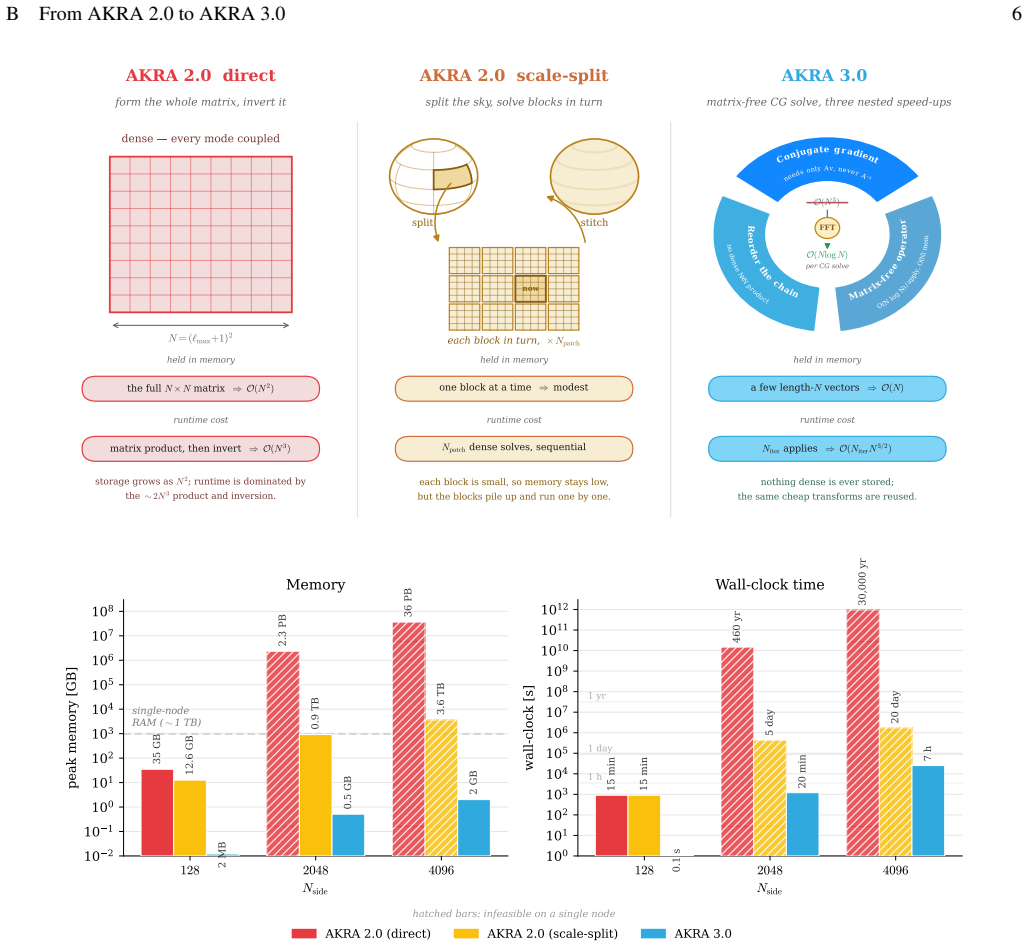
Calculation problem In AKRA 2.0 (on full sky, [49]), the mask transfer matrix ±2Mℓ1𝑚1, ℓ𝑚 (Eq. 5) is computed explicitly for every pair of harmonic modes and stored as a dense matrix. The normal- equation matrix H≡A TN−1A(11) is then assembled and inverted directly (via Cholesky decom- position or eigendecomposition) to yield ˆx=H −1b. However, the storag...
-
[2]
OPERATION 3
INPUT DATA 2. OPERATION 3. CG SOL VER 4. OUTPUT Shear Catalog {γi 1, γ i 2, w i, R i, z i phot, θ i RA, θ i Dec} Survey Mask M (θ) Binary HEALPix mask ( Nside) Noise Map σ2 n(θi) = σ2 e / (neff (θi) Apix) Pixelize to HEALPix Observed Data y y = [ γM 2,ℓ1 m1 , γ M − 2,ℓ1 m1 ]T length 2(ℓmax + 1)2 y = A x + n x = [ −κℓm] , n ∼ N (0, N) OPERATION A Matrix De...
2048
-
[3]
how do we store and invertH
AKRA 3.0: matrix-free Inversion framework The AKRA 3.0 framework overcomes traditional compu- tational hurdles through a fundamental shift in perspective. It combines three interdependent elements to entirely bypass explicit storage costs and eliminate the need for direct matrix inversion. 1.Conjugate gradient (CG).Rather than directly invert- ing the den...
2048
-
[4]
For comparison, direct inversion at this resolution would be infeasible (Figure 2)
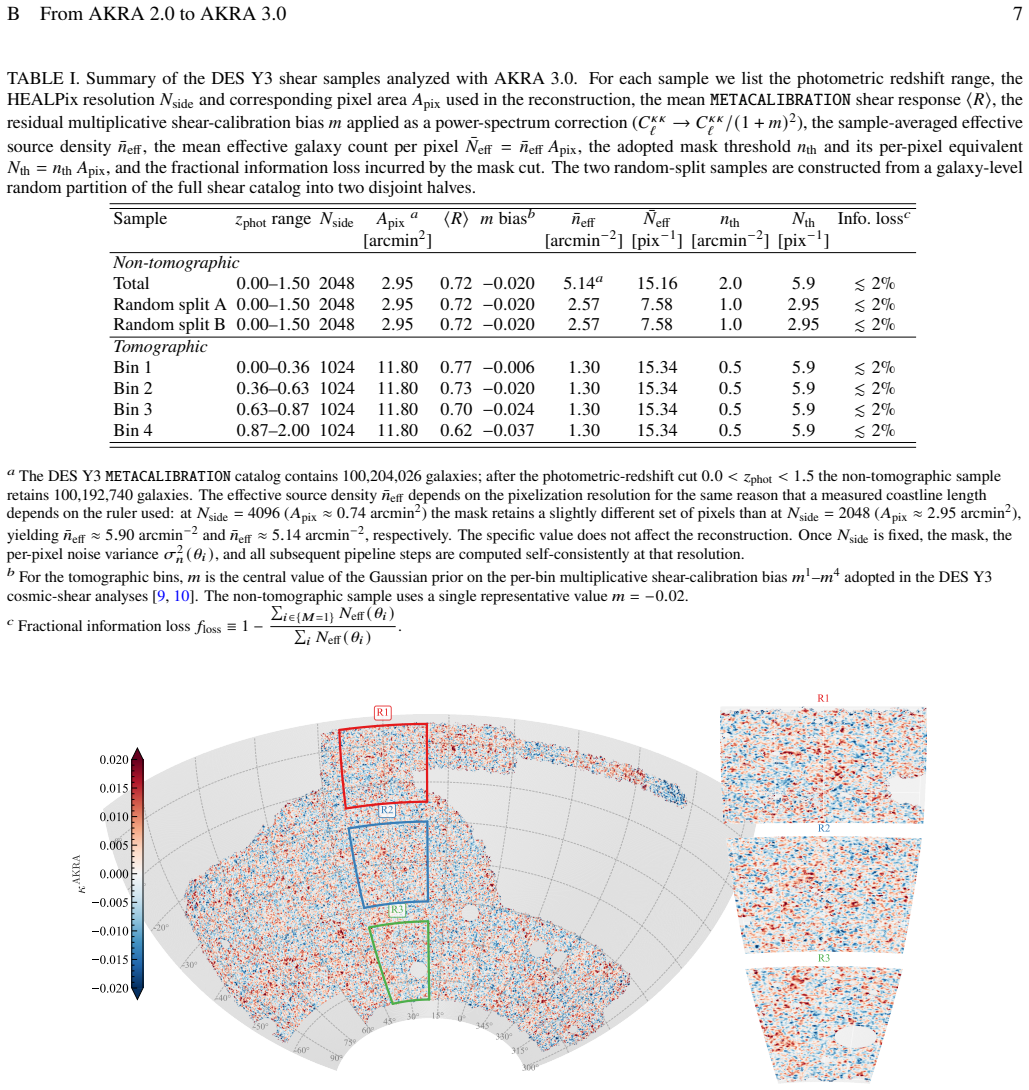
Non-tomographic map The reconstruction uses𝑁 side =2048, ℓ max =4096 and converges in∼80 CG iterations, taking∼0.5 hour on a single 72-CPU compute node. For comparison, direct inversion at this resolution would be infeasible (Figure 2). Figure 3 shows the resulting𝐸-mode convergence map over the full DES Y3 footprint, with three 10 ◦ ×10 ◦ zoom panels. Th...
2048
-
[5]
Figure 5 displays the four maps alongside the per-bin number density distributions and source redshift distributions𝑛(𝑧)
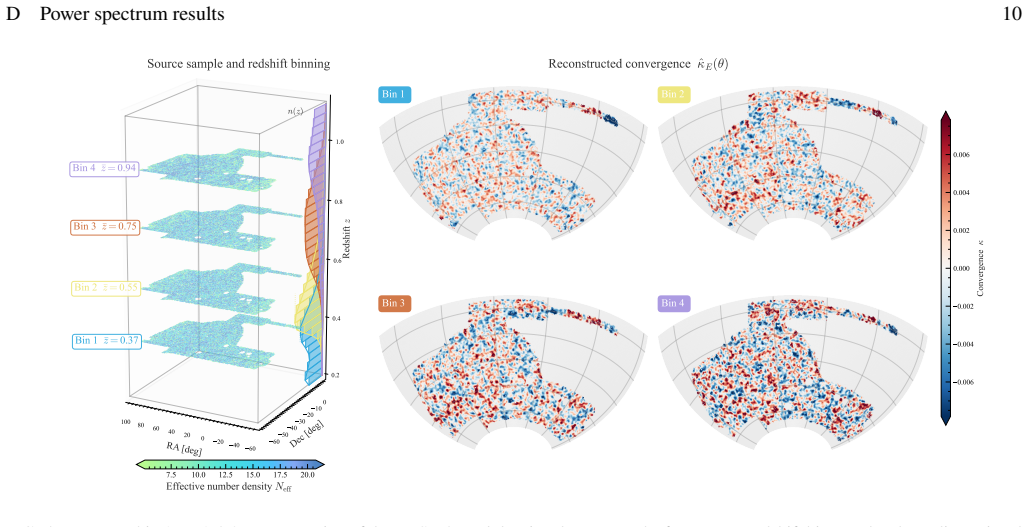
Tomographic maps Each of the four tomographic bins is reconstructed indepen- dently at𝑁 side =1024 up toℓ max =2048, using the bin-specific mask and effective number density. Figure 5 displays the four maps alongside the per-bin number density distributions and source redshift distributions𝑛(𝑧). The convergence amplitude increases from the lowest to the h...
2048
-
[6]
For the cross- spectrum (left) we randomly split the source catalog into two disjoint halves, reconstruct each independently and correlate the two maps (𝐶 𝜅𝐴𝜅𝐵 ℓ )
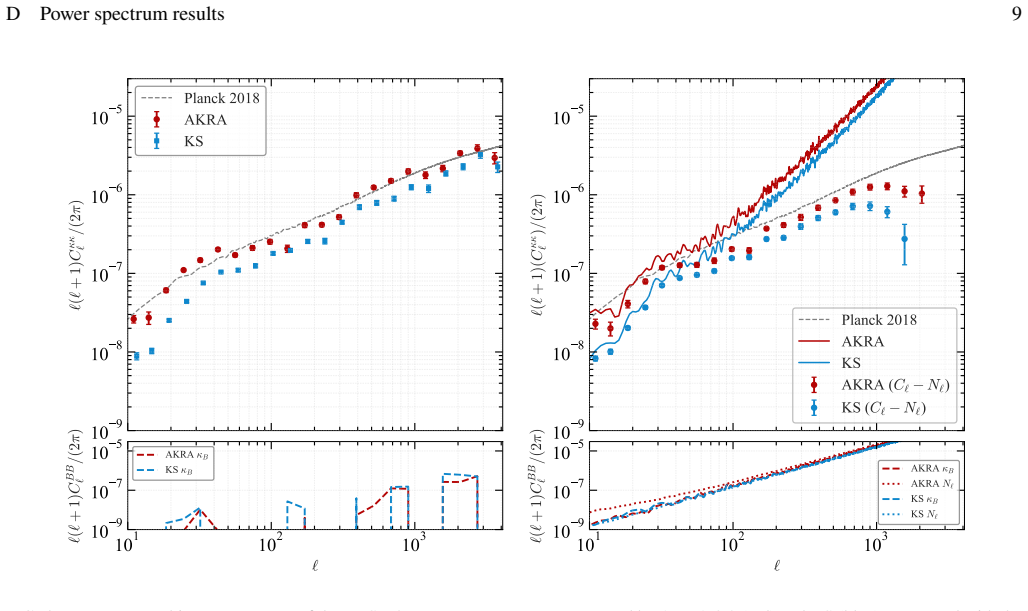
Non-tomographic power spectra Figure 4 shows the two measurements. For the cross- spectrum (left) we randomly split the source catalog into two disjoint halves, reconstruct each independently and correlate the two maps (𝐶 𝜅𝐴𝜅𝐵 ℓ ). For the auto-spectrum (right) we re- construct a single map from the full sample and subtract the shape-noise bias (𝐶 𝜅 𝜅 ℓ )...
2048
-
[7]
Tomographic power spectra From the four reconstructed tomographic maps, we extract all ten independent power spectra𝐶𝜅𝑖 𝜅 𝑗 ℓ (1≤𝑖≤𝑗≤4), which are displayed in Fig. 6. The high-redshift bins give the cleanest test. Forℓ≳200 the bin-3 and bin-4 spectra, together with the high signal- to-noise off-diagonal cross-spectra, track the fiducialΛCDM curve across ...
2018
-
[8]
M. Bartelmann and P. Schneider, Phys. Rep.340, 291 (2001), astro-ph/9912508
Pith/arXiv arXiv 2001
- [9]
-
[10]
R. Mandelbaum, Annu. Rev. Astron. Astrophys.56, 393 (2018), 1710.03235
Pith/arXiv arXiv 2018
-
[11]
D. H. Weinberg, M. J. Mortonson, D. J. Eisenstein, C. Hirata, A. G. Riess, and E. Rozo, Phys. Rep.530, 87 (2013), 1201.2434
Pith/arXiv arXiv 2013
-
[12]
The Dark Energy Survey Collaboration, Mon. Not. R. Astron. Soc.460, 1270 (2016), 1601.00329
Pith/arXiv arXiv 2016
- [13]
-
[14]
K. Kuijken et al., Astron. Astrophys.625, A2 (2019), 1902.11265
Pith/arXiv arXiv 2019
-
[15]
H. Aihara et al., Publ. Astron. Soc. Jpn.70, S4 (2018), 1704.05858
Pith/arXiv arXiv 2018
- [16]
-
[17]
L. F. Secco et al., Phys. Rev. D105, 023515 (2022), 2105.13544
arXiv 2022
-
[18]
DES Collaboration, T. M. C. Abbott, M. Aguena, A. Alar- con, O. Alves, A. Amon, D. Anbajagane, F. Andrade-Oliveira, W. d’ Assignies, S. Avila, et al., arXiv e-prints arXiv:2602.10065 (2026), 2602.10065
arXiv 2026
-
[19]
arXiv:2405.13491 (2024), 2405.13491
Euclid Collaboration, arXiv e-prints p. arXiv:2405.13491 (2024), 2405.13491
arXiv 2024
-
[20]
arXiv:0912.0201 (2009), 0912.0201
LSST Science Collaboration, arXiv e-prints p. arXiv:0912.0201 (2009), 0912.0201
Pith/arXiv arXiv 2009
-
[21]
ˇZ. Ivezi´c et al., Astrophys. J.873, 111 (2019), 0805.2366
Pith/arXiv arXiv 2019
-
[22]
Spergel et al., arXiv e-prints p
D. Spergel et al., arXiv e-prints p. arXiv:1503.03757 (2015), 1503.03757
Pith/arXiv arXiv 2015
-
[23]
Y. Gong, X. Liu, Y. Cao, X. Chen, Z. Fan, R. Li, X. D. Li, Z. Li, X. Zhang, and H. Zhan, ASTROPHYSICAL JOURNAL883 (2019), export Date: 30 March 2025; Cited By: 200
2019
-
[24]
Zhan, Kexue Tongbao/Chinese Science Bulletin66, 1290 (2021), ISSN 0023074X (ISSN), export Date: 15 September 2025; Cited By: 0
H. Zhan, Kexue Tongbao/Chinese Science Bulletin66, 1290 (2021), ISSN 0023074X (ISSN), export Date: 15 September 2025; Cited By: 0
2021
-
[25]
J. Yao, H. Shan, R. Li, Y. Xu, D. Fan, D. Liu, P. Zhang, Y. Yu, C. Wei, B. Hu, et al., Monthly Notices of the Royal Astronomical Society527, 5206 (2024), export Date: 30 March 2025; Cited By: 7
2024
-
[26]
C. Chang, A. Pujol, B. Mawdsley, D. Bacon, J. Elvin-Poole, P. Melchior, A. Kov´acs, B. Jain, B. Leistedt, T. Giannantonio, et al., Monthly Notices of the Royal Astronomical Society475, 3165 (2018), 1708.01535
Pith/arXiv arXiv 2018
-
[27]
A. Barthelemy, S. Codis, C. Uhlemann, F. Bernardeau, and R. Gavazzi, Mon. Not. R. Astron. Soc.492, 3420 (2020), 1909.02615
arXiv 2020
-
[28]
H. Shan, X. Liu, H. Hildebrandt, C. Pan, N. Martinet, Z. Fan, P. Schneider, M. Asgari, J. Harnois-D´eraps, H. Hoekstra, et al., Monthly Notices of the Royal Astronomical Society474, 1116 (2018), 1709.07651
Pith/arXiv arXiv 2018
-
[29]
N. Martinet, P. Schneider, H. Hildebrandt, H. Shan, M. Asgari, J. P. Dietrich, J. Harnois-D ´eraps, T. Erben, A. Grado, C. Hey- mans, et al., Monthly Notices of the Royal Astronomical Society 474, 712 (2018), 1709.07678
Pith/arXiv arXiv 2018
-
[30]
D. Z. Liu, X. M. Meng, X. Z. Er, Z. H. Fan, M. Kilbinger, G. L. Li, R. Li, T. Schrabback, D. Scognamiglio, H. Y. Shan, et al., Astronomy & Astrophysics669, A128 (2023), 2210.16341
arXiv 2023
-
[31]
L. Van Waerbeke, J. Benjamin, T. Erben, C. Heymans, H. Hilde- brandt, H. Hoekstra, T. D. Kitching, Y. Mellier, L. Miller, J. Coupon, et al., Monthly Notices of the Royal Astronomical Society433, 3373 (2013), 1303.1806
Pith/arXiv arXiv 2013
-
[32]
A. Petri, J. Liu, Z. Haiman, M. May, L. Hui, and J. M. Kra- tochvil, Physical Review D91, 103511 (2015), 1503.06214
Pith/arXiv arXiv 2015
-
[33]
J. M. Kratochvil, E. A. Lim, S. Wang, Z. Haiman, M. May, and K. Huffenberger, Physical Review D85, 103513 (2012), 1109.6334
Pith/arXiv arXiv 2012
-
[34]
M. Vicinanza, V. F. Cardone, R. Maoli, R. Scaramella, X. Er, and I. Tereno, Physical Review D99, 043534 (2019), 1905.00410
Pith/arXiv arXiv 2019
-
[35]
Z¨ urcher, J
D. Z¨ urcher, J. Fluri, R. Sgier, T. Kacprzak, and A. Refregier, Journal of Cosmology and Astroparticle Physics2021, 028–028 (2021), ISSN 1475-7516, URLhttp://dx.doi.org/10. 1088/1475-7516/2021/01/028
2021
-
[36]
Cheng, Y
S. Cheng, Y. S. Ting, B. Menard, and J. Bruna, MONTHLY NO- TICES OF THE ROYAL ASTRONOMICAL SOCIETY499, 5902 (2020), cited By :84 Export Date: 2 April 2025
2020
-
[37]
Cheng and B
S. Cheng and B. M ´enard, MONTHLY NOTICES OF THE ROYAL ASTRONOMICAL SOCIETY507, 1012 (2021), ISSN 0035-8711
2021
-
[38]
A. Gupta, J. M. Z. Matilla, D. Hsu, and Z. Haiman, Physical Review D97, 103515 (2018), 1802.01212
Pith/arXiv arXiv 2018
-
[39]
D. Ribli, B. ´A. Pataki, and I. Csabai, Nature Astronomy3, 93 (2019), 1806.05995
Pith/arXiv arXiv 2019
- [40]
-
[41]
T. Lu, Z. Haiman, and X. Li, Monthly Notices of the Royal Astronomical Society521, 2050 (2023), 2301.01354
arXiv 2050
-
[42]
A. J. Zhou, X. Li, S. Dodelson, and R. Mandelbaum, Phys. Rev. D110, 023539 (2024), URLhttps://link.aps.org/doi/ 10.1103/PhysRevD.110.023539
-
[43]
Zeghal, D
J. Zeghal, D. Lanzieri, F. Lanusse, A. Boucaud, G. Louppe, E. Aubourg, A. E. Bayer, and L. D. E. S. Collaboration, Astron- omy and Astrophysics699, A327 (2025), ISSN 0004-6361
2025
-
[44]
T. Baldauf, R. E. Smith, U. Seljak, and R. Mandelbaum, PHYS- ICAL REVIEW D81, 063531 (2010), 0911.4973
Pith/arXiv arXiv 2010
-
[45]
N. MacCrann, J. Blazek, B. Jain, and E. Krause, Mon. Not. Roy. Astron. Soc491, 5498 (2020), 1903.07101. 14
arXiv 2020
-
[46]
Y. Park, E. Rozo, and E. Krause, Physical Review Letters126, 021301 (2021), 2004.07504
arXiv 2021
-
[47]
J. Prat, J. Blazek, C. S ´anchez, I. Tutusaus, S. Pandey, J. Elvin- Poole, E. Krause, M. A. Troxel, L. F. Secco, A. Amon, et al., PHYSICAL REVIEW D105, 083528 (2022), 2105.13541
arXiv 2022
-
[48]
Kaiser and G
N. Kaiser and G. Squires, Astrophysical Journal404, 441 (1993), cited By :715 Export Date: 2 April 2025
1993
-
[49]
N. Jeffrey, M. Gatti, C. Chang, L. Whiteway, U. Demirbozan, A. Kovacs, G. Pollina, D. Bacon, N. Hamaus, T. Kacprzak, et al., Mon. Not. R. Astron. Soc.505, 4626 (2021), 2105.13539
arXiv 2021
-
[50]
N. Jeffrey, F. B. Abdalla, O. Lahav, F. Lanusse, J.-L. Starck, A. Leonard, D. Kirk, C. Chang, E. Baxter, T. Kacprzak, et al., Mon. Not. R. Astron. Soc.479, 2871 (2018), 1801.08945
Pith/arXiv arXiv 2018
-
[51]
A. Leonard, F. Lanusse, and J.-L. Starck, Mon. Not. R. Astron. Soc.440, 1281 (2014), 1308.1353
Pith/arXiv arXiv 2014
-
[52]
M. A. Price, J. D. McEwen, X. Cai, T. D. Kitching, and LSST Dark Energy Science Collaboration, Mon. Not. R. Astron. Soc. 489, 3236 (2019), 1812.04018
arXiv 2019
-
[53]
P. Fiedorowicz, E. Rozo, S. S. Boruah, C. Chang, and M. Gatti, Mon. Not. R. Astron. Soc.512, 73 (2022), 2105.14699
arXiv 2022
-
[54]
Tegmark, The Astrophysical Journal480, L87 (1997), URL https://doi.org/10.1086/310631
M. Tegmark, The Astrophysical Journal480, L87 (1997), URL https://doi.org/10.1086/310631
-
[55]
Y. Shi, P. Zhang, Z. Sun, and Y. Wang, Phys. Rev. D109, 123530 (2024), 2311.12353
arXiv 2024
-
[56]
Y. Shi, P. Zhang, F. Deng, S. Zhou, H. Cai, J. Yao, and Z. Sun, J. Cosmol. Astropart. Phys.2025, 038 (2025)
2025
- [57]
-
[58]
Y. Shi, P. Zhang, Z. Chen, J. Qin, L. Cui, F. Deng, and J. Yao, arXiv e-prints arXiv:2511.12488 (2025), 2511.12488
Pith/arXiv arXiv 2025
-
[59]
Pen, ApJ534, L19 (2000), astro-ph/9910502
U.-L. Pen, ApJ534, L19 (2000), astro-ph/9910502
Pith/arXiv arXiv 2000
- [60]
-
[61]
Saad, Iterative methods for sparse linear systems
Y. Saad, Iterative methods for sparse linear systems. (SIAM, 2003), ISBN 978-0-89871-534-7
2003
-
[62]
S. Belkner, A. J. Duivenvoorden, J. Carron, N. Schaeffer, and M. Reinecke, RAS Techniques and Instruments3, 711 (2024), 2406.14542
arXiv 2024
-
[63]
C. M. Cantalupo, J. D. Borrill, A. H. Jaffe, T. S. Kisner, and R. Stompor, ApJS187, 212 (2010), 0906.1775
Pith/arXiv arXiv 2010
-
[64]
H. K. Eriksen, I. J. O’Dwyer, J. B. Jewell, B. D. Wandelt, D. L. Larson, K. M. G ´orski, S. Levin, A. J. Banday, and P. B. Lilje, ApJS155, 227 (2004), astro-ph/0407028
Pith/arXiv arXiv 2004
-
[65]
J. Papeˇ z, L. Grigori, and R. Stompor, A&A620, A59 (2018), 1803.03462
Pith/arXiv arXiv 2018
-
[66]
E. S. Sheldon and E. M. Huff, Astrophys. J.841, 24 (2017), 1702.02601
Pith/arXiv arXiv 2017
- [67]
-
[68]
Planck Collaboration, N. Aghanim, Y. Akrami, M. Ashdown, J. Aumont, C. Baccigalupi, M. Ballardini, A. J. Banday, R. B. Barreiro, N. Bartolo, et al., A&A641, A6 (2020), 1807.06209
Pith/arXiv arXiv 2020
-
[69]
T. M. C. Abbott, M. Aguena, A. Alarcon, S. Allam, O. Alves, A. Amon, F. Andrade-Oliveira, J. Annis, S. Avila, D. Bacon, et al., Phys. Rev. D105, 023520 (2022), 2105.13549
Pith/arXiv arXiv 2022
-
[70]
N. E. Chisari, M. L. A. Richardson, J. Devriendt, Y. Dubois, A. Schneider, A. M. C. Le Brun, R. S. Beckmann, S. Peirani, A. Slyz, and C. Pichon, Mon. Not. R. Astron. Soc.480, 3962 (2018), 1801.08559
Pith/arXiv arXiv 2018
-
[71]
M. P. vanDaalen, I. G. McCarthy, and J. Schaye, Mon. Not. R. Astron. Soc.491, 2424 (2020), 1906.00968
arXiv 2020
-
[72]
Z. Chen, P. Zhang, and X. Yang, Astrophys. J.953, 188 (2023), 2201.12591
arXiv 2023
discussion (0)
Sign in with ORCID, Apple, or X to comment. Anyone can read and Pith papers without signing in.