Non-equilibrium thermodynamics of collapse models in the strongly non-Gaussian regime
Pith reviewed 2026-06-28 01:16 UTC · model grok-4.3
The pith
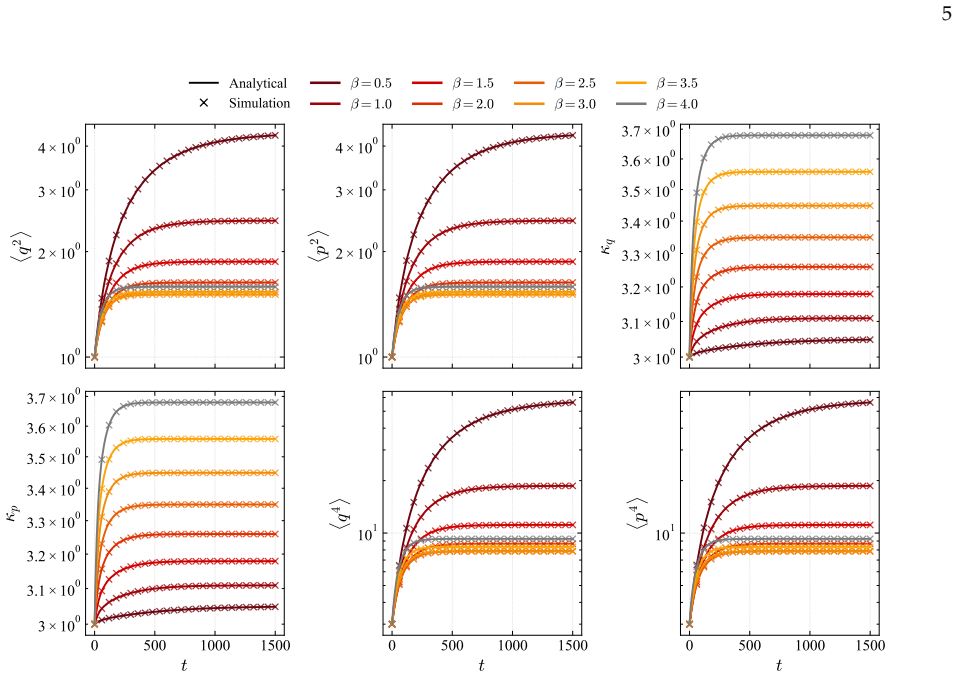
Dissipative modifications to collapse models drive systems to non-equilibrium steady states with non-Gaussianity scaling as the cube of the dissipation parameter.
A machine-rendered reading of the paper's core claim, the machinery that carries it, and where it could break.
Core claim
The dissipative Diósi-Penrose friction mechanism resolves the unphysical energy increase in objective collapse models by inducing a non-equilibrium steady state whose non-Gaussianity scales as the third power of the dissipation parameter. This holds across regimes when analyzed with exact numerical methods in the Wigner formalism, and the model's thermodynamic validity is verified through entropy production calculations.
What carries the argument
The linear friction mechanism of the dissipative Diósi-Penrose model extended to CSL, simulated exactly via pseudo-spectral methods in Wigner phase space to capture non-Gaussian dynamics.
If this is right
- The system settles into a non-equilibrium steady-state rather than thermal equilibrium.
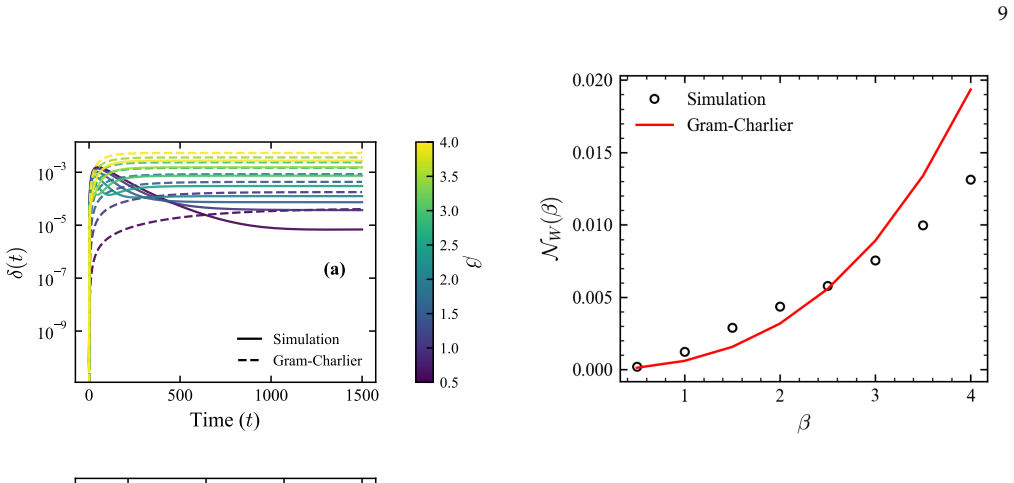
- Asymptotic non-Gaussianity scales as the third power of the dissipation parameter β.
- Thermodynamic consistency is confirmed by evaluating the Wigner entropy production.
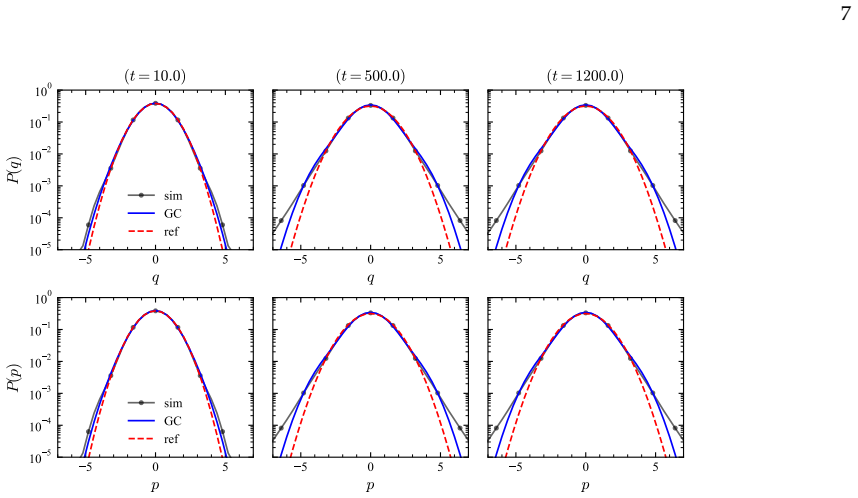
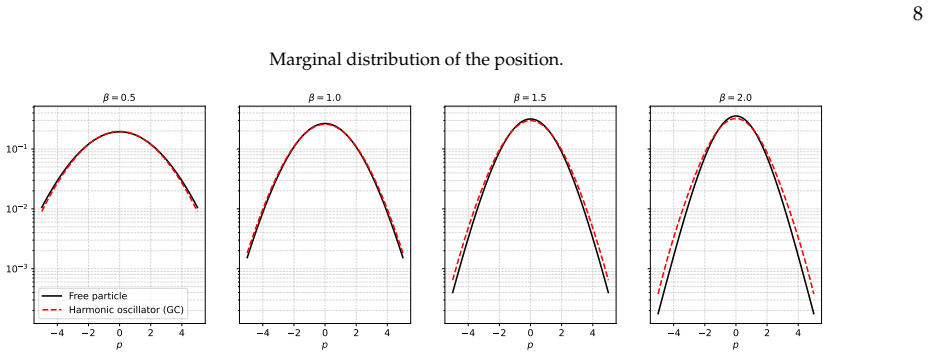
- Highly sensitive information-theoretic quantities require exact numerical methods to capture non-Gaussian tails accurately.
Where Pith is reading between the lines
- This non-Gaussian scaling could provide observable signatures in precision experiments on mesoscopic quantum systems.
- The approach might extend to other modified quantum dynamics models to check their thermodynamic properties.
- Exact simulation methods could become standard for analyzing strong dissipation in open quantum systems.
Load-bearing premise
The novel exact pseudo-spectral simulation approach correctly captures the full non-Gaussian dynamics under strong dissipation without introducing numerical artifacts.
What would settle it
An observation that the non-Gaussianity in the steady state does not scale proportionally to the cube of the dissipation parameter β, or that the Wigner entropy production becomes negative, would falsify the claim of thermodynamic consistency.
Figures
read the original abstract
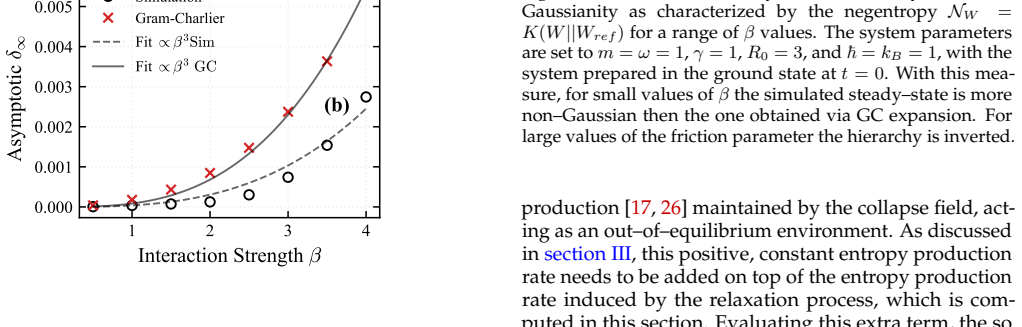
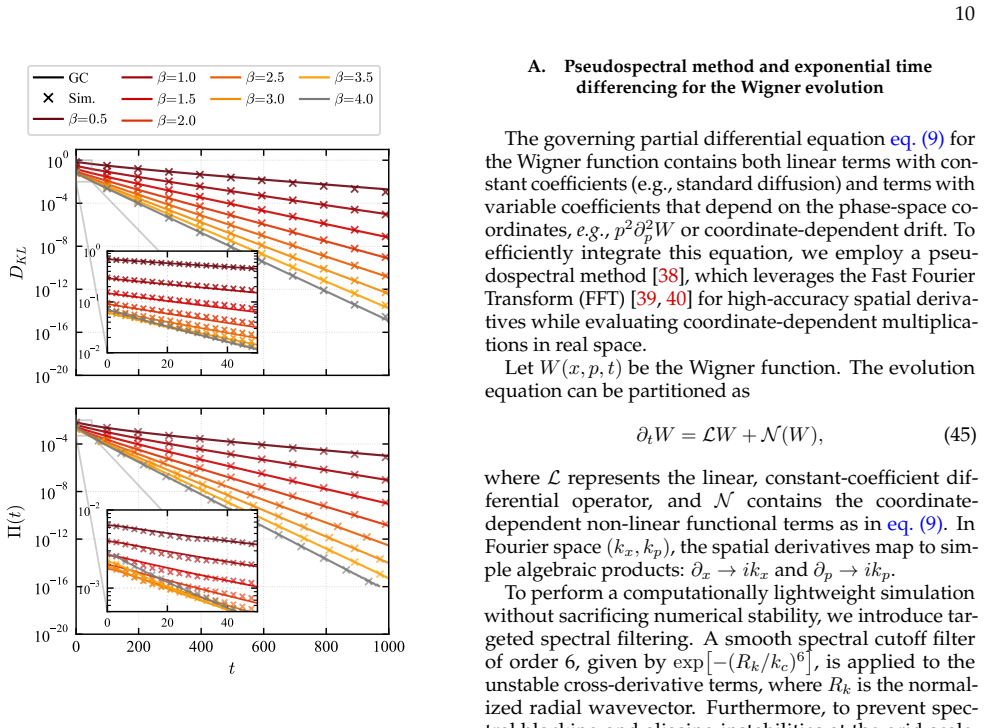
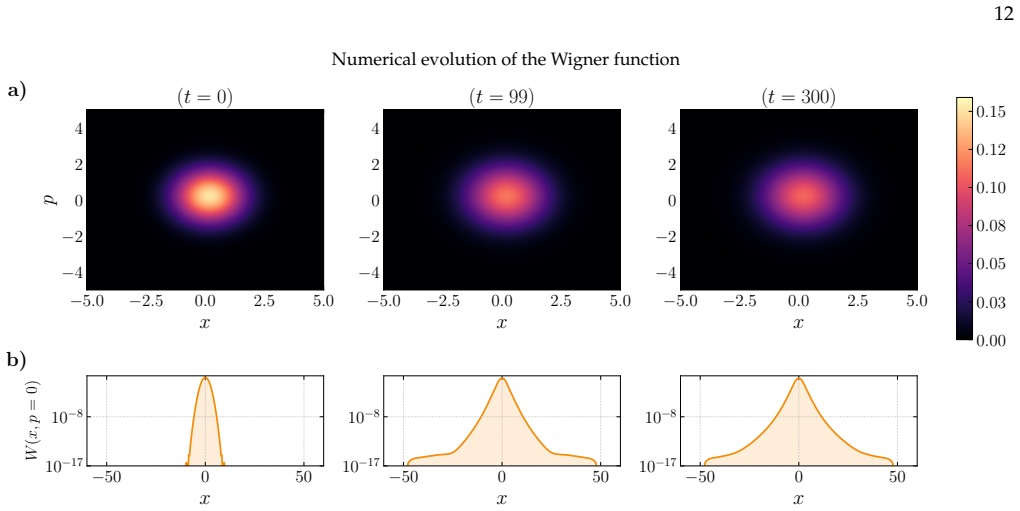
Standard objective collapse models offer a unified approach to the quantum measurement problem but predict an unphysical, indefinite increase in the energy of the system. The dissipative Di\'osi-Penrose (dDP) model resolves this heating issue by introducing a linear friction mechanism. However, this modification induces complex, non-Gaussian phase-space dynamics. We rigorously establish the thermodynamic consistency of this friction mechanism -- extended to the CSL model -- across both weakly and strongly non-Gaussian regimes. Using the Wigner phase-space formalism, we go significantly beyond the quadratic approximation and, to bypass the failure of perturbative methods under strong dissipation, introduce a novel exact pseudo-spectral simulation approach. Our analysis reveals that the system subjected to the dDP mechanism does not thermalize, but rather settles into a non-equilibrium steady-state (NESS) where the asymptotic non-Gaussianity scales as the third power of the dissipation parameter $\beta$. By evaluating the Wigner entropy production, we confirm the thermodynamic validity of the model and demonstrate that highly sensitive information-theoretic quantities require exact numerical methods to accurately capture the key non-Gaussian tails of the distribution.
Editorial analysis
A structured set of objections, weighed in public.
Referee Report
Summary. The paper claims that the dissipative Diósi-Penrose (dDP) friction mechanism, extended to the CSL model, is thermodynamically consistent in both weakly and strongly non-Gaussian regimes. Using the Wigner formalism, it introduces a novel exact pseudo-spectral method to simulate the dynamics beyond the quadratic approximation, showing that the system reaches a non-equilibrium steady state (NESS) rather than thermalizing, with asymptotic non-Gaussianity scaling as β³; Wigner entropy production is evaluated to confirm validity, and the work argues that exact numerics are required for sensitive information-theoretic quantities.
Significance. If the central numerical results hold, the work provides a concrete demonstration that dissipative objective collapse models reach a NESS with a specific β³ scaling of non-Gaussianity, together with an explicit check of thermodynamic consistency via entropy production. This extends prior Gaussian-regime analyses and underscores the limitations of perturbative approaches under strong dissipation.
major comments (2)
- [the section introducing the pseudo-spectral simulation approach] The load-bearing claim that the pseudo-spectral solver is exact, bypasses perturbative failure, and introduces no artifacts in the non-Gaussian tails (which dominate entropy production and the β³ scaling) lacks supporting evidence. No convergence tests with respect to grid size, spectral truncation, or time-stepping, nor direct comparison against the known weak-dissipation analytic expansion, are described.
- [the results section on the NESS and scaling] The reported β³ scaling of asymptotic non-Gaussianity and the entropy-production results in the NESS rest entirely on the unbenchmarked numerical output; without an independent cross-check in the regime where perturbation theory remains valid, it is not possible to assess whether truncation or discretization errors affect the higher moments.
Simulated Author's Rebuttal
We thank the referee for the careful reading and for identifying the need for explicit validation of the numerical method. The comments are well taken; we address each below and will revise the manuscript accordingly to include the requested benchmarks and cross-checks.
read point-by-point responses
-
Referee: The load-bearing claim that the pseudo-spectral solver is exact, bypasses perturbative failure, and introduces no artifacts in the non-Gaussian tails (which dominate entropy production and the β³ scaling) lacks supporting evidence. No convergence tests with respect to grid size, spectral truncation, or time-stepping, nor direct comparison against the known weak-dissipation analytic expansion, are described.
Authors: We agree that the manuscript as submitted does not present explicit convergence tests or a direct comparison to the weak-dissipation analytic expansion. In the revised version we will add a dedicated subsection reporting convergence with respect to grid size, spectral truncation, and time-step size, together with a quantitative comparison of the numerical non-Gaussianity and entropy production against the known perturbative expansion for small β. These additions will supply the requested evidence that discretization and truncation errors do not affect the reported tails or scaling. revision: yes
-
Referee: The reported β³ scaling of asymptotic non-Gaussianity and the entropy-production results in the NESS rest entirely on the unbenchmarked numerical output; without an independent cross-check in the regime where perturbation theory remains valid, it is not possible to assess whether truncation or discretization errors affect the higher moments.
Authors: We concur that an independent cross-check in the perturbative regime is required to validate the numerics. The revised manuscript will include a direct comparison, in the weak-dissipation limit, between the pseudo-spectral results and the analytic expansion for both the asymptotic non-Gaussianity and the Wigner entropy production. Agreement in this regime will confirm that the β³ scaling observed at stronger dissipation is not an artifact of the discretization. revision: yes
Circularity Check
No significant circularity; derivation is self-contained
full rationale
The paper's central claims rest on the standard Wigner phase-space formalism (not redefined here) and a newly introduced pseudo-spectral numerical solver whose validity is asserted via exactness claims rather than any reduction to fitted parameters or prior self-citations. No equations or results are shown to equal their inputs by construction, no uniqueness theorems are imported from the authors' own prior work, and entropy-production evaluation follows directly from established definitions without self-referential fitting. The analysis therefore remains independent of the target results.
Axiom & Free-Parameter Ledger
axioms (1)
- domain assumption The Wigner phase-space formalism provides an accurate representation of the quantum dynamics for the dissipative collapse model in the non-Gaussian regime.
Reference graph
Works this paper leans on
-
[1]
The linear operator is exponentiated in Fourier space to create the exact propagatorsE= exp(L∆t) andE 1/2 = exp(L∆t/2)
-
[2]
To evaluate N(W) , we transform the current state to Fourier space (W→ ˜W ), compute the necessary derivatives by multiplying by ikx or ikp, and apply the inverse 2D FFT to return to real space
-
[3]
The resultant Hamiltonian and dissipative 11 terms are summed and transformed back to Fourier space
Point-wise multiplications with the phase-space coordinate grids (e.g., x or p2) are performed in real space. The resultant Hamiltonian and dissipative 11 terms are summed and transformed back to Fourier space
-
[4]
The state is advanced by sequentially evaluating the four ETDRK4 sub-steps ( k1, k2, k3, k4). The fi- nal updated state in Fourier space is assembled by combining these steps with the exact exponen- tial propagators, and then transformed back to real space if required for data exportation. Despite the use of artificial hyperviscosity and spectral truncati...
2026
-
[5]
SA acknowledges Tobias Haas for his comments and insights
P .V .P acknowledges the Funda c ¸˜ao de Amparo `a Pesquisa do Estado do Rio de Janeiro (FAPERJ Pro- cess SEI-260003/000174/2024). SA acknowledges Tobias Haas for his comments and insights. MP is grateful to the Royal Society Wolfson Fellowship (RSWF/R3/183013), the Department for the Economy of Northern Ireland under the US-Ireland R&D Partnership Progra...
2024
-
[6]
G. C. Ghirardi, A. Rimini, and T. Weber, Unified dynamics for microscopic and macroscopic systems, Phys. Rev. D34, 470 (1986)
1986
-
[7]
G. C. Ghirardi, P . Pearle, and A. Rimini, Markov processes in hilbert space and continuous spontaneous localization of systems of identical particles, Phys. Rev. A42, 78 (1990)
1990
-
[8]
Pearle, Combining stochastic dynamical state-vector reduction with spontaneous localization, Phys
P . Pearle, Combining stochastic dynamical state-vector reduction with spontaneous localization, Phys. Rev. A39, 2277 (1989)
1989
-
[9]
Diosi, A universal master equation for the gravitational violation of quantum mechanics, Physics Letters A120, 377 (1987)
L. Diosi, A universal master equation for the gravitational violation of quantum mechanics, Physics Letters A120, 377 (1987)
1987
-
[10]
Di ´osi, Models for universal reduction of macroscopic quantum fluctuations, Phys
L. Di ´osi, Models for universal reduction of macroscopic quantum fluctuations, Phys. Rev. A40, 1165 (1989)
1989
-
[11]
Penrose, On gravity’s role in quantum state reduction, General relativity and gravitation28, 581 (1996)
R. Penrose, On gravity’s role in quantum state reduction, General relativity and gravitation28, 581 (1996)
1996
-
[12]
Carlesso, S
M. Carlesso, S. Donadi, L. Ferialdi, M. Paternostro, H. Ul- bricht, and A. Bassi, Present status and future challenges of non-interferometric tests of collapse models, Nature Physics18, 243 (2022)
2022
-
[13]
Carlesso and S
M. Carlesso and S. Donadi, Spon- taneous collapse models, in Encyclopedia of Mathematical Physics (Second Edition) (Academic Press, Oxford, 2025) 2nd ed., pp. 237–253
2025
-
[14]
Bassi and G
A. Bassi and G. Ghirardi, Dynamical reduction models, Physics Reports379, 257 (2003)
2003
-
[15]
Smirne and A
A. Smirne and A. Bassi, Dissipative continuous sponta- neous localization (csl) model, Scientific reports5, 12518 (2015)
2015
-
[16]
Bahrami, A
M. Bahrami, A. Smirne, and A. Bassi, Role of gravity in the collapse of a wave function: A probe into the di´osi-penrose model, Physical Review A90, 062105 (2014)
2014
-
[17]
Di Bartolomeo, M
G. Di Bartolomeo, M. Carlesso, K. Piscicchia, C. Curceanu, M. Derakhshani, and L. Di´osi, Linear-friction many-body equation for dissipative spontaneous wave-function col- lapse, Phys. Rev. A108, 012202 (2023)
2023
-
[18]
Artini and M
S. Artini and M. Paternostro, Characterizing the sponta- neous collapse of a wavefunction through entropy produc- tion, New Journal of Physics25, 123047 (2023)
2023
-
[19]
Artini, G
S. Artini, G. Lo Monaco, S. Donadi, and M. Paternos- tro, Nonequilibrium thermodynamics of gravitational objective-collapse models, Physical Review Research7, 043017 (2025)
2025
-
[20]
te Vrugt, G
M. te Vrugt, G. I. T´oth, and R. Wittkowski, Master equa- tions for wigner functions with spontaneous collapse and their relation to thermodynamic irreversibility, Journal of Computational Electronics20, 2209 (2021)
2021
-
[21]
Campbell, I
S. Campbell, I. D’Amico, M. A. Ciampini, J. Anders, N. Ares, S. Artini, A. Auff `eves, L. Bassman Oftelie, L. P . Bettmann, M. V . S. Bonan c ¸a, T. Busch, M. Camp- isi, M. F. Cavalcante, L. A. Correa, E. Cuestas, C. B. Dag, S. Dago, S. Deffner, A. Del Campo, A. Deutschmann- Olek, S. Donadi, E. Doucet, C. Elouard, K. Ensslin, P . Erker, N. Fabbri, F. Fede...
2026
-
[22]
G. T. Landi and M. Paternostro, Irreversible entropy pro- duction: From classical to quantum, Reviews of Modern Physics93, 035008 (2021)
2021
-
[23]
J. P . Santos, G. T. Landi, and M. Paternostro, Wigner en- tropy production rate, Phys. Rev. Lett.118, 220601 (2017)
2017
-
[24]
J. P . Santos, A. L. de Paula Jr, R. Drumond, G. T. Landi, and M. Paternostro, Irreversibility at zero temperature from 14 the perspective of the environment, Physical Review A97, 050101 (2018)
2018
-
[25]
S. Artini, G. L. Monaco, A. Imparato, M. Paternostro, and S. Donadi, Broken detailed balance and entropy production in cptp quantum brownian motion (2026), arXiv:2507.23322 [quant-ph]
Pith/arXiv arXiv 2026
-
[26]
Gisin, Stochastic quantum dynamics and relativity, Helv
N. Gisin, Stochastic quantum dynamics and relativity, Helv. Phys. Acta62, 363 (1989)
1989
-
[27]
G. A. Baker Jr, Formulation of quantum mechanics based on the quasi-probability distribution induced on phase space, Physical Review109, 2198 (1958)
1958
-
[28]
Adesso, D
G. Adesso, D. Girolami, and A. Serafini, Measuring gaus- sian quantum information and correlations using the r´enyi entropy of order 2, Phys. Rev. Lett.109, 190502 (2012)
2012
-
[29]
T. M. Cover and J. A. Thomas, Information theory and statistics, Elements of information theory1, 279 (1991)
1991
-
[30]
Deffner and E
S. Deffner and E. Lutz, Nonequilibrium entropy produc- tion for open quantum systems, Physical Review Letters 107, 140404 (2011)
2011
-
[31]
Seifert, Entropy production along a stochastic trajec- tory and an integral fluctuation theorem, Physical review letters95, 040602 (2005)
U. Seifert, Entropy production along a stochastic trajec- tory and an integral fluctuation theorem, Physical review letters95, 040602 (2005)
2005
-
[32]
M. J. de Oliveira, Quantum fokker-planck-kramers equa- tion and entropy production, Physical Review E94, 012128 (2016)
2016
-
[33]
M. J. de Oliveira, Quantum fokker-planck structure of the lindblad equation, Brazilian Journal of Physics53, 121 (2023)
2023
-
[34]
Breuer and F
H.-P . Breuer and F. Petruccione, The theory of open quantum systems (OUP Oxford, 2002)
2002
-
[35]
D. E. Barton and K. E. Dennis, The conditions under which gram-charlier and edgeworth curves are positive definite and unimodal, Biometrika39, 425 (1952)
1952
-
[36]
and Moessner, R., Expansions for nearly gaus- sian distributions, Astron
Blinnikov, S. and Moessner, R., Expansions for nearly gaus- sian distributions, Astron. Astrophys. Suppl. Ser.130, 193 (1998)
1998
-
[37]
Schenzle and H
A. Schenzle and H. Brand, Multiplicative stochastic pro- cesses in statistical physics, Physical Review A20, 1628 (1979)
1979
-
[38]
Livadiotis and D
G. Livadiotis and D. J. McComas, Understanding kappa distributions: A toolbox for space science and astrophysics, Space Science Reviews175, 183 (2013)
2013
-
[39]
Pierrard and M
V . Pierrard and M. Lazar, Kappa distributions: Theory and applications in space plasmas, Solar physics267, 153 (2010)
2010
-
[40]
T. S. Bir´o and A. Jakov´ac, Power-law tails from multiplica- tive noise, Physical review letters94, 132302 (2005)
2005
-
[41]
M. G. Genoni, M. G. Paris, and K. Banaszek, Quantifying the non-gaussian character of a quantum state by quantum relative entropy, Phys. Rev. A78, 060303 (2008)
2008
-
[42]
Brillouin, Science and information theory (Courier Cor- poration, 2013)
L. Brillouin, Science and information theory (Courier Cor- poration, 2013)
2013
-
[43]
J. P . Boyd,Chebyshev and Fourier Spectral Methods, 2nd ed. (Dover Publications, Mineola, NY, 2001)
2001
-
[44]
J. W. Cooley and J. W. Tukey, An algorithm for the ma- chine calculation of complex fourier series, Mathematics of Computation19, 297 (1965)
1965
-
[45]
Kosloff and D
R. Kosloff and D. Kosloff, Absorbing boundaries for wave propagation problems, Journal of Computational Physics 63, 363 (1986)
1986
-
[46]
Kassam and L
A.-K. Kassam and L. N. Trefethen, Fourth-order time- stepping for stiff PDEs, SIAM Journal on Scientific Com- puting26, 1214 (2005)
2005
discussion (0)
Sign in with ORCID, Apple, or X to comment. Anyone can read and Pith papers without signing in.