Diffusion of multiple conserved charges from entropy production
Pith reviewed 2026-06-28 00:32 UTC · model grok-4.3
The pith
Entropy production in a dissipative multi-charge system determines the full diffusion matrix for baryon number, electric charge and strangeness in relativistic hydrodynamics.
A machine-rendered reading of the paper's core claim, the machinery that carries it, and where it could break.
Core claim
Within the kinetic-theory framework the Chapman-Enskog expansion of the distribution function, constrained by the H-theorem, produces a diffusion matrix κ_qq′ whose diagonal and off-diagonal elements are fixed once the entropy-production condition is enforced at both first and second order in gradients; the resulting matrix governs the coupled diffusion of baryon number, electric charge and strangeness and is evaluated numerically for the quark-gluon plasma.
What carries the argument
Chapman-Enskog expansion of the distribution function around local equilibrium, with the entropy-production (H-theorem) constraint fixing the transport coefficients including the diffusion matrix κ_qq′.
If this is right
- The diffusion matrix supplies the necessary transport coefficients for hydrodynamic modeling of multi-component charge diffusion driven by initial-state baryon stopping.
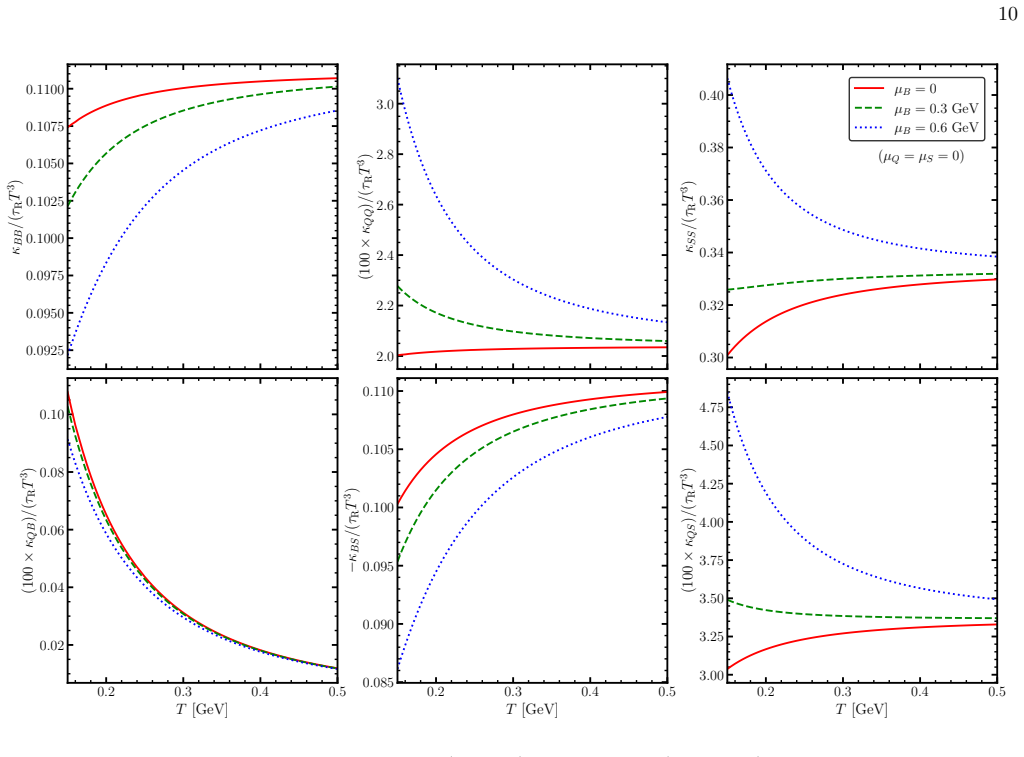
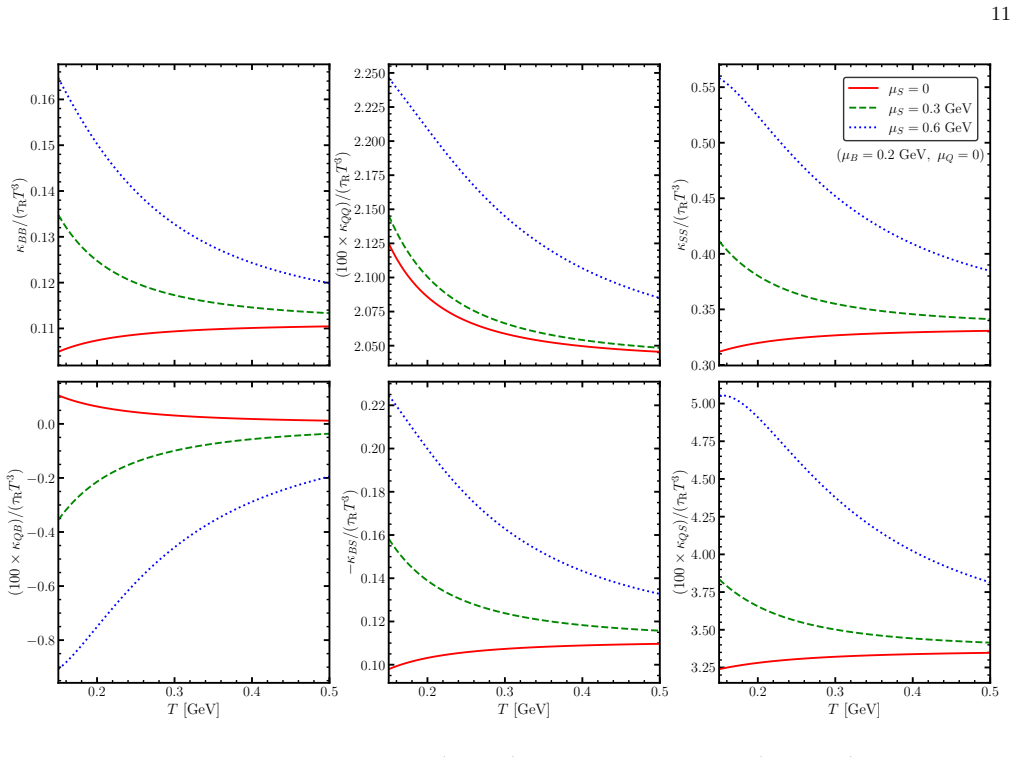
- Numerical estimates give the temperature and chemical-potential dependence of all nine elements of κ_qq′ for a (2+1)-flavor plasma.
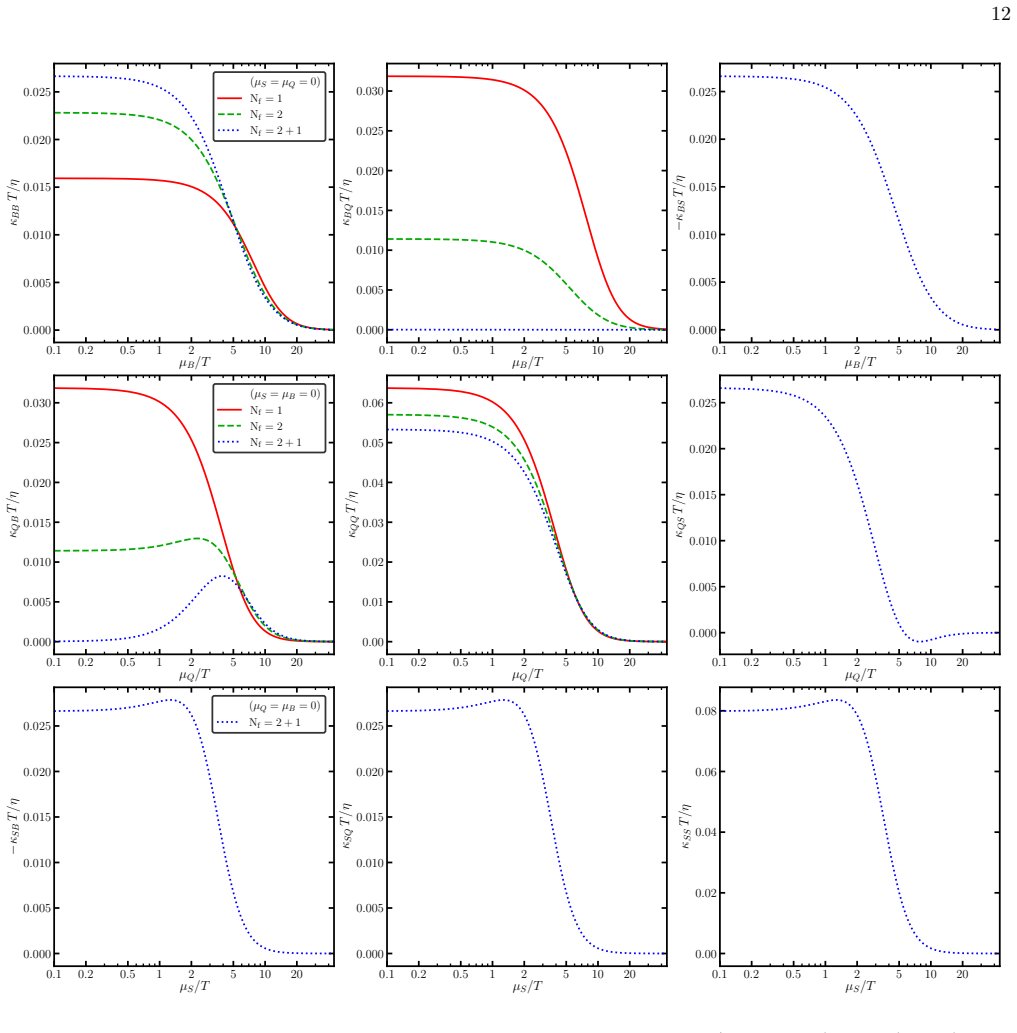
- The ratio κ_qq′ T / η quantifies when diffusion competes with or dominates shear viscosity in the hydrodynamic evolution.
Where Pith is reading between the lines
- The same entropy-production constraint can be applied to other collision kernels or to higher-order gradient expansions to generate consistent higher-order transport coefficients.
- The off-diagonal elements of κ_qq′ imply that gradients in one charge density can drive currents of the other two charges, altering predictions for net-charge fluctuations and flow.
- Embedding these matrix elements in event-by-event hydrodynamic simulations would allow quantitative tests against measured charge-dependent observables in heavy-ion data.
Load-bearing premise
The collision term is approximated by a momentum-independent relaxation time.
What would settle it
A direct lattice-QCD or experimental extraction of the diffusion matrix elements at a given temperature and chemical potential that deviates systematically from the entropy-production values obtained in the paper.
Figures
read the original abstract
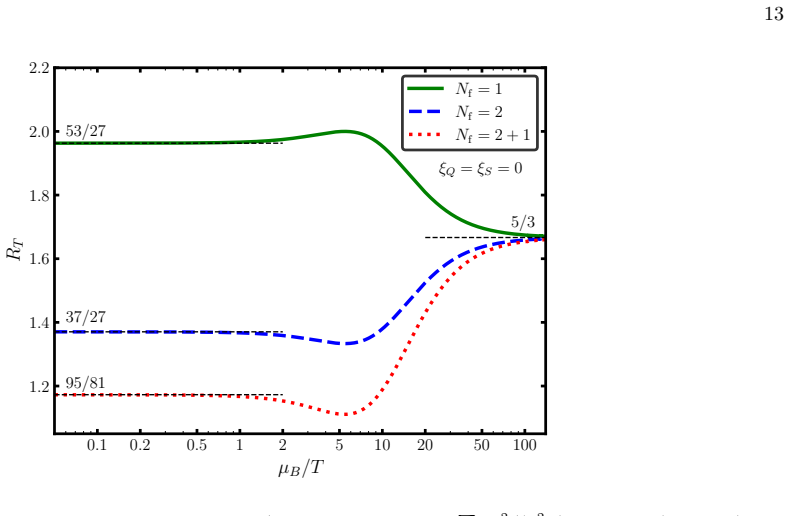
We derive dissipative relativistic hydrodynamic equations in the presence of multiple conserved charges, i.e., baryon number ($B$), electric charge ($Q$), and strangeness ($S$), using the Chapman-Enskog (CE) method within the kinetic theory approach. The relativistic Boltzmann equation is solved within the relaxation-time approximation with a momentum-independent relaxation time in the collision term. We derive both first-order (Navier-Stokes limit) and second-order dissipative hydrodynamic equations. Within the kinetic theory framework, using the Boltzmann's H-theorem, and by demanding that for a dissipative system, the entropy must be produced, we find different transport coefficients at the first-order and second-order gradient expansion of the out-of-equilibrium distribution function around the local equilibrium. Apart from the well-known transport coefficients, the shear ($\eta$) and the bulk ($\zeta$) viscosities , we also find the diffusion matrix elements ($\kappa_{qq^{\prime}}$) for the conserved charges $B$, $Q$ and $S$. The diffusion matrix elements ($\kappa_{qq^{\prime}}$) are important to model the multi-component diffusion dynamics sourced by inhomogeneous baryon stopping in the initial state of heavy-ion collisions. We estimate the temperature ($T$) and chemical potential dependence of diagonal and off-diagonal elements of the diffusion matrix elements for the (2+1) flavor quark-gluon plasma. We further estimate the ratio $\kappa_{qq^{\prime}}T/\eta$ for a wide range of temperature and chemical potentials to show the relative importance of the diffusion matrix elements compared to other transport coefficients.
Editorial analysis
A structured set of objections, weighed in public.
Referee Report
Summary. The manuscript derives first- and second-order dissipative relativistic hydrodynamic equations for a system with three conserved charges (baryon number B, electric charge Q, strangeness S) by applying the Chapman-Enskog expansion to the relativistic Boltzmann equation in the relaxation-time approximation. The collision term uses a single momentum-independent relaxation time τ. Transport coefficients, including the shear and bulk viscosities and the full diffusion matrix κ_qq', are fixed by imposing positive entropy production via the H-theorem. Numerical estimates of the T- and μ-dependence of the diagonal and off-diagonal κ_qq' elements, together with the ratios κ_qq'T/η, are presented for a (2+1)-flavor quark-gluon plasma.
Significance. If the central approximations hold, the work supplies explicit kinetic-theory expressions for multi-charge diffusion coefficients that are directly relevant to modeling baryon-stopping-driven diffusion in heavy-ion collisions. The use of the entropy-production constraint to obtain distinct coefficients at first and second order is a clear methodological strength and is credited here.
major comments (2)
- [Chapman-Enskog expansion and collision term] The solution of the Boltzmann equation employs a momentum-independent relaxation time in the RTA collision term. Because the diffusion currents are momentum-weighted integrals over the charge carriers, this choice directly determines the deviation δf and therefore fixes all elements of the diffusion matrix κ_qq' (both diagonal and off-diagonal). No estimate or bound on the systematic error introduced by the p-independent τ is given, which is load-bearing for the reported T- and μ-dependence and for the ratios κT/η.
- [Results on T- and μ-dependence] The numerical estimates of the diffusion matrix elements and their comparison to η rest on the same RTA assumption without any sensitivity analysis to a momentum-dependent relaxation time (as would arise from QCD scattering rates). This leaves the quantitative claims about the relative importance of diffusion untested against the dominant source of uncertainty in the derivation.
minor comments (2)
- [Abstract] The abstract states that 'different transport coefficients' are found at first and second order but does not indicate which coefficients (beyond the already-known viscosities) change or by how much.
- [Notation and definitions] Notation for the diffusion matrix κ_qq' should be cross-referenced to existing literature on multi-charge hydrodynamics to clarify the precise relation to the diffusion currents.
Simulated Author's Rebuttal
We thank the referee for the careful reading and constructive feedback on our manuscript. We address the major comments point by point below.
read point-by-point responses
-
Referee: [Chapman-Enskog expansion and collision term] The solution of the Boltzmann equation employs a momentum-independent relaxation time in the RTA collision term. Because the diffusion currents are momentum-weighted integrals over the charge carriers, this choice directly determines the deviation δf and therefore fixes all elements of the diffusion matrix κ_qq' (both diagonal and off-diagonal). No estimate or bound on the systematic error introduced by the p-independent τ is given, which is load-bearing for the reported T- and μ-dependence and for the ratios κT/η.
Authors: We agree that the momentum-independent relaxation time constitutes a central approximation whose consequences propagate directly into the diffusion matrix. This choice is made to obtain closed analytic expressions within the Chapman-Enskog expansion, consistent with many prior RTA studies. The T- and μ-dependence of κ_qq' is nevertheless driven primarily by the equilibrium distributions and thermodynamic quantities rather than by the constant value of τ itself. We acknowledge that no quantitative error bound is supplied. In the revised manuscript we will insert a dedicated paragraph discussing the limitations of the constant-τ assumption and citing works that employ momentum-dependent relaxation times extracted from QCD matrix elements. revision: yes
-
Referee: [Results on T- and μ-dependence] The numerical estimates of the diffusion matrix elements and their comparison to η rest on the same RTA assumption without any sensitivity analysis to a momentum-dependent relaxation time (as would arise from QCD scattering rates). This leaves the quantitative claims about the relative importance of diffusion untested against the dominant source of uncertainty in the derivation.
Authors: The reported numerical results are obtained strictly inside the constant-τ RTA framework described in the paper. Performing a systematic sensitivity analysis to a momentum-dependent τ would require an entirely different numerical implementation and lies outside the analytic scope of the present work. We will nevertheless revise the discussion of the ratios κ_qq'T/η to emphasize that the values are indicative within the adopted approximation and to caution that more microscopic calculations are needed for quantitative precision. revision: partial
Circularity Check
No significant circularity; derivation self-contained from Boltzmann equation
full rationale
The paper solves the relativistic Boltzmann equation in the relaxation-time approximation (RTA) with momentum-independent τ via Chapman-Enskog expansion, then applies the H-theorem and entropy-production requirement to obtain first- and second-order transport coefficients including the diffusion matrix κ_qq'. These coefficients emerge as explicit integrals over the deviation δf; they are not fitted to data, not renamed known results, and not justified by self-citation chains. The ratio κT/η is computed within the same model and cancels the common τ factor. No step reduces by construction to its own inputs, and the RTA is stated as an explicit approximation rather than smuggled in via citation. The derivation is therefore independent of the target quantities.
Axiom & Free-Parameter Ledger
free parameters (1)
- relaxation time τ
axioms (2)
- domain assumption The system is described by the relativistic Boltzmann equation
- domain assumption Boltzmann's H-theorem determines the sign of entropy production in the dissipative case
Reference graph
Works this paper leans on
-
[1]
P. F. Kolb, P. Huovinen, U. W. Heinz, and H. Heiselberg, Phys. Lett. B500, 232 (2001), arXiv:hep-ph/0012137. 20
Pith/arXiv arXiv 2001
-
[2]
J.-Y. Ollitrault, Eur. J. Phys.29, 275 (2008), arXiv:0708.2433 [nucl-th]
Pith/arXiv arXiv 2008
-
[3]
B. Schenke, S. Jeon, and C. Gale, Phys. Rev. Lett.106, 042301 (2011), arXiv:1009.3244 [hep-ph]
Pith/arXiv arXiv 2011
-
[4]
P. Romatschke, Int. J. Mod. Phys.E19, 1 (2010), arXiv:0902.3663 [hep-ph]
Pith/arXiv arXiv 2010
-
[5]
P. Huovinen and P. Petreczky, J. Phys. G38, 124103 (2011), arXiv:1106.6227 [nucl-th]
Pith/arXiv arXiv 2011
-
[6]
A. Jaiswal and V. Roy, Adv. High Energy Phys.2016, 9623034 (2016), arXiv:1605.08694 [nucl-th]
Pith/arXiv arXiv 2016
-
[7]
W. Florkowski, M. P. Heller, and M. Spalinski, Rept. Prog. Phys.81, 046001 (2018), arXiv:1707.02282 [hep-ph]
Pith/arXiv arXiv 2018
-
[8]
P. Romatschke and U. Romatschke,Relativistic Fluid Dynamics In and Out of Equilibrium, Cambridge Monographs on Mathematical Physics (Cambridge University Press, 2019) arXiv:1712.05815 [nucl-th]
Pith/arXiv arXiv 2019
-
[9]
J. A. Fotakis, M. Greif, C. Greiner, G. S. Denicol, and H. Niemi, Phys. Rev. D101, 076007 (2020), arXiv:1912.09103 [hep-ph]
arXiv 2020
-
[10]
R. S. Bhalerao, Eur. Phys. J. ST230, 635 (2021), arXiv:2009.09586 [nucl-th]
arXiv 2021
-
[11]
A. M. Halasz, A. D. Jackson, R. E. Shrock, M. A. Stephanov, and J. J. M. Verbaarschot, Phys. Rev. D58, 096007 (1998), arXiv:hep-ph/9804290
Pith/arXiv arXiv 1998
-
[12]
Y. Aoki, G. Endrodi, Z. Fodor, S. D. Katz, and K. K. Szabo, Nature443, 675 (2006), arXiv:hep-lat/0611014
Pith/arXiv arXiv 2006
-
[13]
S. Borsanyi, Z. Fodor, C. Hoelbling, S. D. Katz, S. Krieg, C. Ratti, and K. K. Szabo (Wuppertal-Budapest), JHEP09, 073 (2010), arXiv:1005.3508 [hep-lat]
Pith/arXiv arXiv 2010
-
[14]
A. Bazavovet al., Phys. Rev. D85, 054503 (2012), arXiv:1111.1710 [hep-lat]
Pith/arXiv arXiv 2012
-
[15]
K. Fukushima and C. Sasaki, Prog. Part. Nucl. Phys.72, 99 (2013), arXiv:1301.6377 [hep-ph]
Pith/arXiv arXiv 2013
-
[16]
K. Fukushima and T. Hatsuda, Rept. Prog. Phys.74, 014001 (2011), arXiv:1005.4814 [hep-ph]
Pith/arXiv arXiv 2011
-
[17]
M. A. Stephanov, K. Rajagopal, and E. V. Shuryak, Phys. Rev. Lett.81, 4816 (1998), arXiv:hep-ph/9806219
Pith/arXiv arXiv 1998
-
[18]
M. A. Stephanov, K. Rajagopal, and E. V. Shuryak, Phys. Rev. D60, 114028 (1999), arXiv:hep-ph/9903292
Pith/arXiv arXiv 1999
-
[19]
M. M. Aggarwalet al.(STAR), arXiv1007.2613
-
[20]
B. Mohanty (STAR), J. Phys. G38, 124023 (2011), arXiv:1106.5902 [nucl-ex]
Pith/arXiv arXiv 2011
-
[21]
J. T. Mitchell (PHENIX), Nucl. Phys. A904-905, 903c (2013), arXiv:1211.6139 [nucl-ex]
arXiv 2013
-
[22]
K. Rajagopal, G. Ridgway, R. Weller, and Y. Yin, Phys. Rev. D102, 094025 (2020), arXiv:1908.08539 [hep-ph]
arXiv 2020
-
[23]
M. Martinez, T. Sch¨ afer, and V. Skokov, Phys. Rev. D100, 074017 (2019), arXiv:1906.11306 [hep-ph]
arXiv 2019
-
[24]
T. Dore, J. Noronha-Hostler, and E. McLaughlin, Phys. Rev. D102, 074017 (2020), arXiv:2007.15083 [nucl-th]
arXiv 2020
- [25]
-
[26]
S. Jeon and L. G. Yaffe, Phys. Rev. D53, 5799 (1996), arXiv:hep-ph/9512263
Pith/arXiv arXiv 1996
-
[27]
G. S. Denicol, W. Florkowski, R. Ryblewski, and M. Strickland, Phys. Rev.C90, 044905 (2014), arXiv:1407.4767 [hep-ph]
Pith/arXiv arXiv 2014
-
[28]
A. Jaiswal, R. Ryblewski, and M. Strickland, Phys. Rev. C90, 044908 (2014), arXiv:1407.7231 [hep-ph]
Pith/arXiv arXiv 2014
-
[29]
W. Florkowski, B. Friman, A. Jaiswal, and E. Speranza, Phys. Rev. C97, 041901 (2018), arXiv:1705.00587 [nucl-th]
Pith/arXiv arXiv 2018
-
[30]
V. Mykhaylova, M. Bluhm, K. Redlich, and C. Sasaki, Phys. Rev. D100, 034002 (2019), arXiv:1906.01697 [hep-ph]
arXiv 2019
-
[31]
C. Plumberget al., Phys. Rev. C111, 044905 (2025), arXiv:2405.09648 [nucl-th]
arXiv 2025
-
[32]
A. Jaiswal, B. Friman, and K. Redlich, Phys. Lett. B751, 548 (2015), arXiv:1507.02849 [nucl-th]
Pith/arXiv arXiv 2015
-
[33]
G. S. Denicol, C. Gale, S. Jeon, A. Monnai, B. Schenke, and C. Shen, Phys. Rev. C98, 034916 (2018), arXiv:1804.10557 [nucl-th]
Pith/arXiv arXiv 2018
-
[34]
M. A. Stephanov, Prog. Theor. Phys. Suppl.153, 139 (2004), arXiv:hep-ph/0402115
Pith/arXiv arXiv 2004
-
[35]
J. Kapusta, B. Muller, and M. Stephanov, Phys. Rev. C85, 054906 (2012), arXiv:1112.6405 [nucl-th]
Pith/arXiv arXiv 2012
-
[36]
C. Young, J. I. Kapusta, C. Gale, S. Jeon, and B. Schenke, Phys. Rev. C91, 044901 (2015), arXiv:1407.1077 [nucl-th]
Pith/arXiv arXiv 2015
-
[37]
C. Nonaka and M. Asakawa, Phys. Rev. C71, 044904 (2005), arXiv:nucl-th/0410078
Pith/arXiv arXiv 2005
-
[38]
K. Paech and A. Dumitru, Phys. Lett. B623, 200 (2005), arXiv:nucl-th/0504003
Pith/arXiv arXiv 2005
-
[39]
C. Herold, M. Nahrgang, I. Mishustin, and M. Bleicher, Phys. Rev. C87, 014907 (2013), arXiv:1301.1214 [nucl-th]
Pith/arXiv arXiv 2013
-
[40]
S. Mukherjee, R. Venugopalan, and Y. Yin, Phys. Rev. C92, 034912 (2015), arXiv:1506.00645 [hep-ph]
Pith/arXiv arXiv 2015
-
[41]
B. Schenke, S. Jeon, and C. Gale, Phys. Rev. C82, 014903 (2010), arXiv:1004.1408 [hep-ph]
Pith/arXiv arXiv 2010
- [42]
-
[43]
A. Sch¨ afer, I. Karpenko, X.-Y. Wu, J. Hammelmann, and H. Elfner (SMASH), Eur. Phys. J. A58, 230 (2022), arXiv:2112.08724 [hep-ph]
arXiv 2022
-
[44]
L. Du, X. An, and U. Heinz, Phys. Rev. C104, 064904 (2021), arXiv:2107.02302 [hep-ph]
arXiv 2021
- [45]
- [46]
- [47]
-
[48]
M. Asakawa and M. Kitazawa, Prog. Part. Nucl. Phys.90, 299 (2016), arXiv:1512.05038 [nucl-th]
Pith/arXiv arXiv 2016
-
[49]
M. Asakawa, U. W. Heinz, and B. Muller, Phys. Rev. Lett.85, 2072 (2000), arXiv:hep-ph/0003169
Pith/arXiv arXiv 2072
-
[50]
M. Martinez, M. D. Sievert, D. E. Wertepny, and J. Noronha-Hostler, arXiv1911.10272
- [51]
-
[52]
R. Rougemont, J. Noronha, and J. Noronha-Hostler, Phys. Rev. Lett.115, 202301 (2015), arXiv:1507.06972 [hep-ph]
Pith/arXiv arXiv 2015
-
[53]
R. Rougemont, R. Critelli, J. Noronha-Hostler, J. Noronha, and C. Ratti, Phys. Rev. D96, 014032 (2017), arXiv:1704.05558 [hep-ph]
Pith/arXiv arXiv 2017
-
[54]
T. Dore, J. M. Karthein, I. Long, D. Mroczek, J. Noronha-Hostler, P. Parotto, C. Ratti, and Y. Yamauchi, Phys. Rev. D 106, 094024 (2022), arXiv:2207.04086 [nucl-th]
arXiv 2022
- [55]
-
[56]
M. Greif, J. A. Fotakis, G. S. Denicol, and C. Greiner, Phys. Rev. Lett.120, 242301 (2018), arXiv:1711.08680 [hep-ph]
Pith/arXiv arXiv 2018
-
[57]
J.-B. Rose, M. Greif, J. Hammelmann, J. A. Fotakis, G. S. Denicol, H. Elfner, and C. Greiner, Phys. Rev. D101, 114028 (2020), arXiv:2001.10606 [nucl-th]
arXiv 2020
-
[58]
J. A. Fotakis, O. Soloveva, C. Greiner, O. Kaczmarek, and E. Bratkovskaya, Phys. Rev. D104, 034014 (2021), arXiv:2102.08140 [hep-ph]
arXiv 2021
-
[59]
J. A. Fotakis, E. Moln´ ar, H. Niemi, C. Greiner, and D. H. Rischke, Phys. Rev. D106, 036009 (2022), arXiv:2203.11549 [nucl-th]
arXiv 2022
-
[60]
J. A. Fotakis, J. E. Lohr, and C. Greiner, Phys. Rev. C110, 025204 (2024), arXiv:2402.16552 [hep-ph]
arXiv 2024
-
[61]
A. Harutyunyan and A. Sedrakian, Symmetry15, 494 (2023), arXiv:2302.09596 [nucl-th]
arXiv 2023
-
[62]
S. Dey, A. Jaiswal, and H. Mishra, JHEP12, 192 (2024), arXiv:2404.18718 [hep-ph]
arXiv 2024
-
[63]
Jain, JHEP03, 101 (2010), arXiv:0912.2228 [hep-th]
S. Jain, JHEP03, 101 (2010), arXiv:0912.2228 [hep-th]
Pith/arXiv arXiv 2010
-
[64]
L. Gladden, V. Ivo, P. K. Kovtun, and A. O. Starinets, JHEP12, 173 (2025), arXiv:2507.21346 [hep-th]
arXiv 2025
-
[65]
I. Cordeiro, F. S. Bemfica, E. Speranza, and J. Noronha, Phys. Rev. D113, 045024 (2026), arXiv:2507.20064 [nucl-th]
arXiv 2026
-
[66]
G. S. Denicol, H. Niemi, E. Molnar, and D. H. Rischke, Phys. Rev. D85, 114047 (2012), [Erratum: Phys.Rev.D 91, 039902 (2015)], arXiv:1202.4551 [nucl-th]
Pith/arXiv arXiv 2012
-
[67]
K. Kushwah, G. S. Denicol, and C. V. P. de Brito, Phys. Rev. D113, 036021 (2026), arXiv:2511.14787 [physics.plasm-ph]
arXiv 2026
-
[68]
A. Jaiswal, Phys. Rev.C87, 051901 (2013), arXiv:1302.6311 [nucl-th]
Pith/arXiv arXiv 2013
-
[69]
S. R. De Groot,Relativistic Kinetic Theory. Principles and Applications, edited by W. A. Van Leeuwen and C. G. Van Weert (1980)
1980
-
[70]
P. Romatschke and U. Romatschke, Phys. Rev. Lett.99, 172301 (2007), arXiv:0706.1522 [nucl-th]
Pith/arXiv arXiv 2007
-
[71]
A. Das, H. Mishra, and R. K. Mohapatra, Phys. Rev. D106, 014013 (2022), arXiv:2109.01543 [nucl-th]
arXiv 2022
-
[72]
S. Bhadury, W. Florkowski, A. Jaiswal, and R. Ryblewski, Phys. Rev. C102, 064910 (2020), arXiv:2006.14252 [hep-ph]
arXiv 2020
-
[73]
A. Jaiswal, R. S. Bhalerao, and S. Pal, Phys. Rev. C87, 021901 (2013), arXiv:1302.0666 [nucl-th]
Pith/arXiv arXiv 2013
-
[74]
W. A. Hiscock and L. Lindblom, Annals Phys.151, 466 (1983)
1983
-
[75]
W. A. Hiscock and L. Lindblom, Phys.Rev.D31, 725 (1985)
1985
-
[76]
W. A. Hiscock and L. Lindblom, Phys. Rev. D35, 3723 (1987)
1987
-
[77]
Israel and J
W. Israel and J. M. Stewart, Annals Phys.118, 341 (1979)
1979
-
[78]
T. Koide, G. S. Denicol, P. Mota, and T. Kodama, Phys. Rev. C75, 034909 (2007), arXiv:hep-ph/0609117
Pith/arXiv arXiv 2007
-
[79]
R. Baier, P. Romatschke, D. T. Son, A. O. Starinets, and M. A. Stephanov, JHEP0804, 100 (2008), arXiv:0712.2451 [hep-th]
Pith/arXiv arXiv 2008
-
[80]
A. El, Z. Xu, and C. Greiner, Phys. Rev. C81, 041901 (2010), arXiv:0907.4500 [hep-ph]
Pith/arXiv arXiv 2010
discussion (0)
Sign in with ORCID, Apple, or X to comment. Anyone can read and Pith papers without signing in.