Wall Shear Stress Reconstruction from Concentration: Differentiable Physics and Physics-Informed Neural Networks
Pith reviewed 2026-06-27 23:27 UTC · model grok-4.3
The pith
Differentiable physics recovers accurate wall shear stress from concentration observations even with far-field measurements, while PINNs require near-wall data.
A machine-rendered reading of the paper's core claim, the machinery that carries it, and where it could break.
Core claim
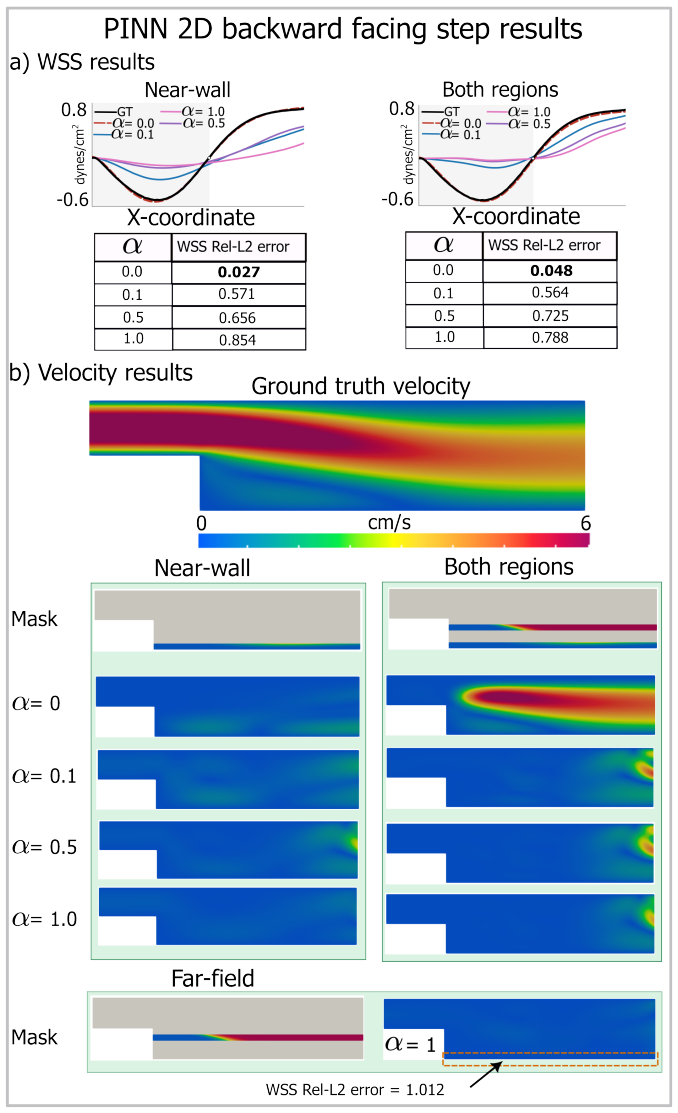
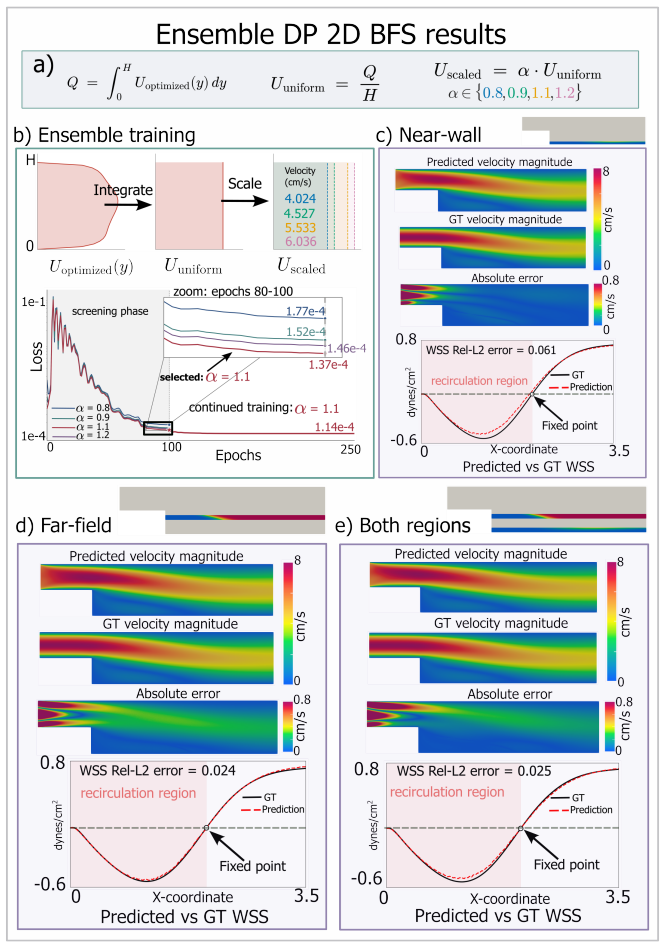
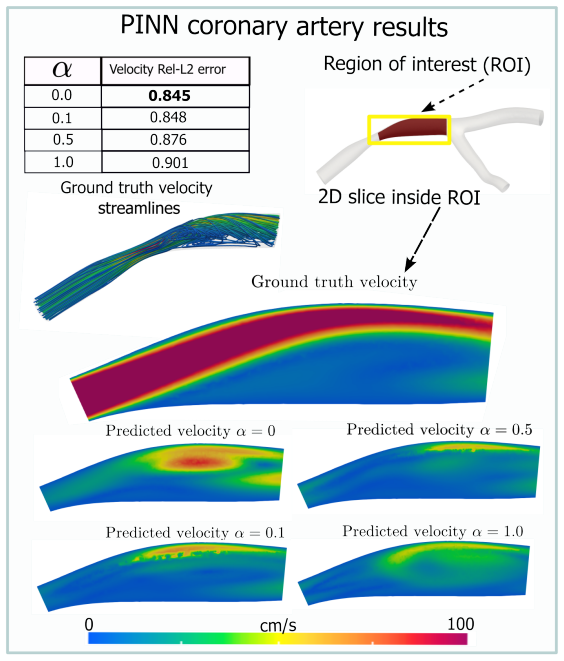
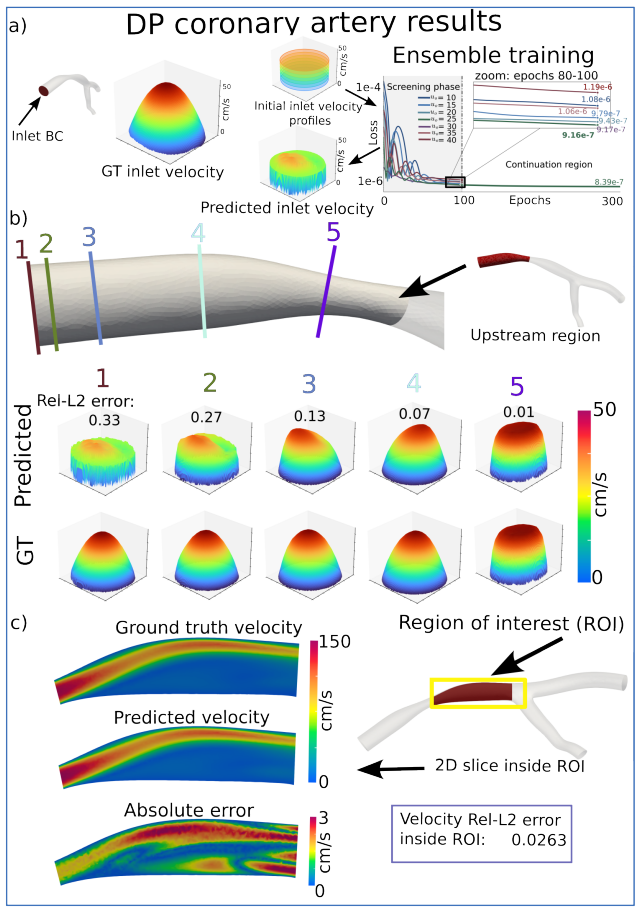
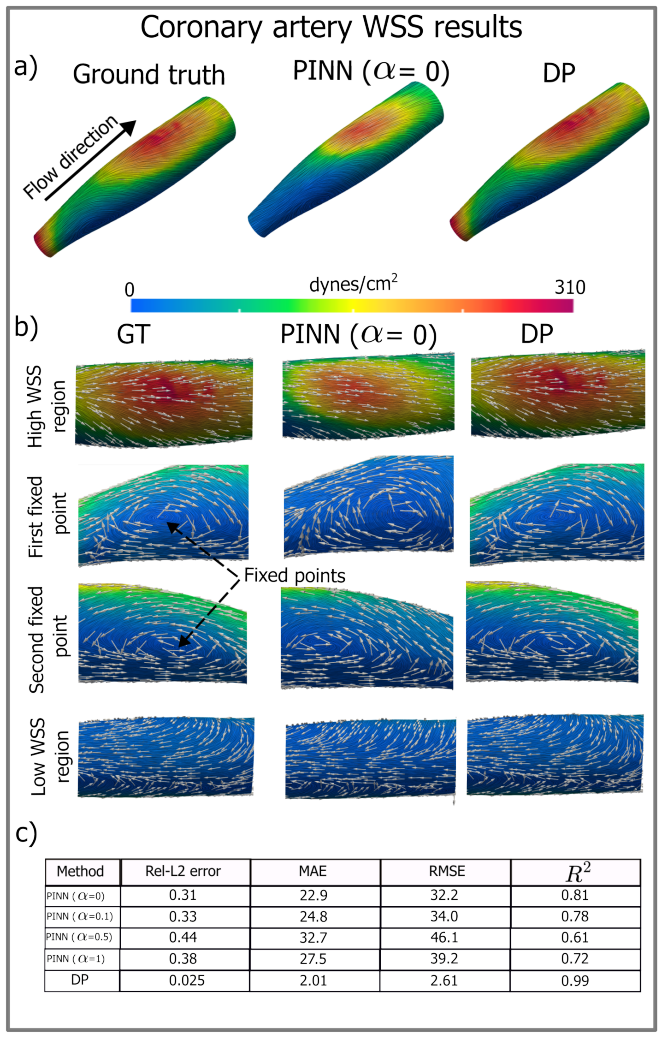
For the 2D backward-facing step, the differentiable physics framework recovers accurate wall shear stress under near-wall, far-field, and combined measurement scenarios, while PINNs achieve high accuracy only with near-wall data and fail with far-field measurements. In the 3D patient-specific stenotic coronary artery, the differentiable physics framework yields more accurate WSS reconstruction than PINNs.
What carries the argument
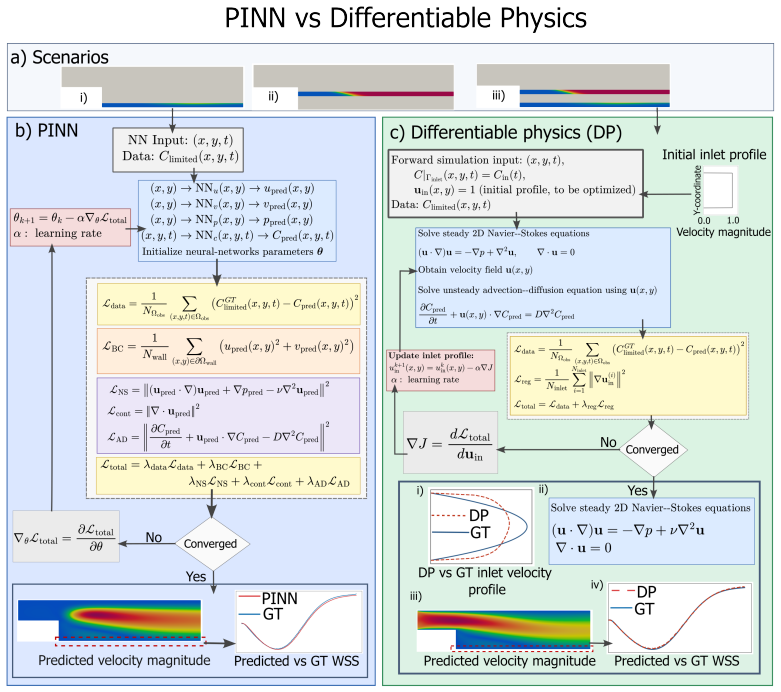
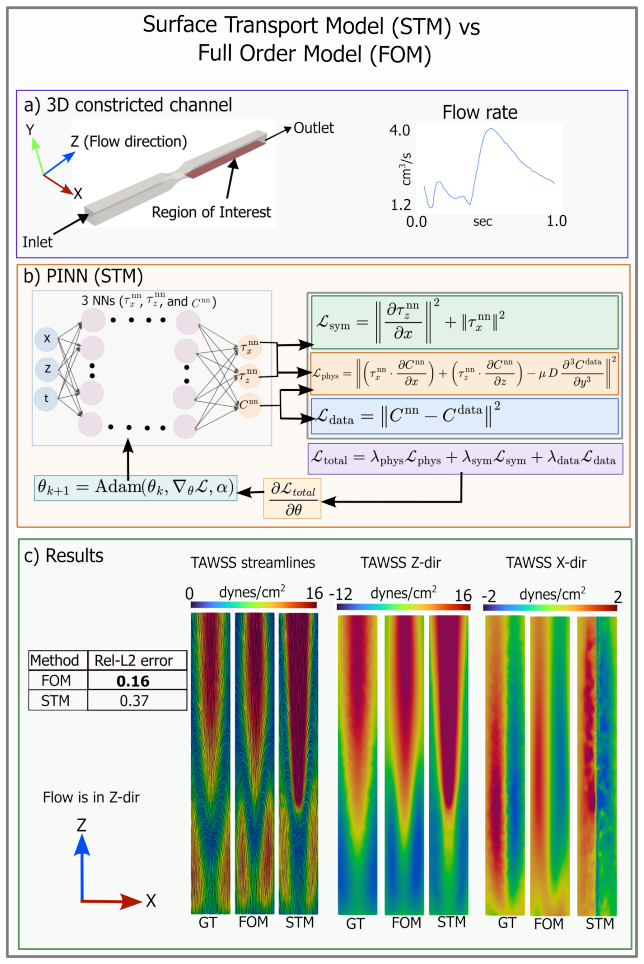
Discrete adjoint PDE-constrained optimization that enforces the advection-diffusion equation for the passive scalar as a hard constraint to recover the underlying velocity field and its near-wall gradients from concentration observations.
If this is right
- WSS can be inferred from scalar transport data without requiring velocity measurements near the wall.
- Hard enforcement of the advection-diffusion equation enables recovery of near-wall gradients from distant observations.
- The same reconstruction approach applies to both simple 2D benchmark flows and complex 3D patient-specific geometries.
Where Pith is reading between the lines
- The method may extend to temperature or other passive scalars in additional flow configurations where direct velocity data are sparse.
- Non-invasive imaging of contrast agents could supply the concentration fields needed for hemodynamic WSS estimation in clinical settings.
- Hybrid schemes that combine hard-constraint optimization with neural-network representations might improve robustness on noisy or incomplete data.
Load-bearing premise
The observed concentration field is produced by advection and diffusion under exactly the same velocity field that sets the wall shear stress.
What would settle it
In the 2D backward-facing step or 3D artery simulations, if the wall shear stress reconstructed from far-field concentration data shows large errors relative to the ground-truth values computed directly from the known velocity field, the claim does not hold.
Figures
read the original abstract
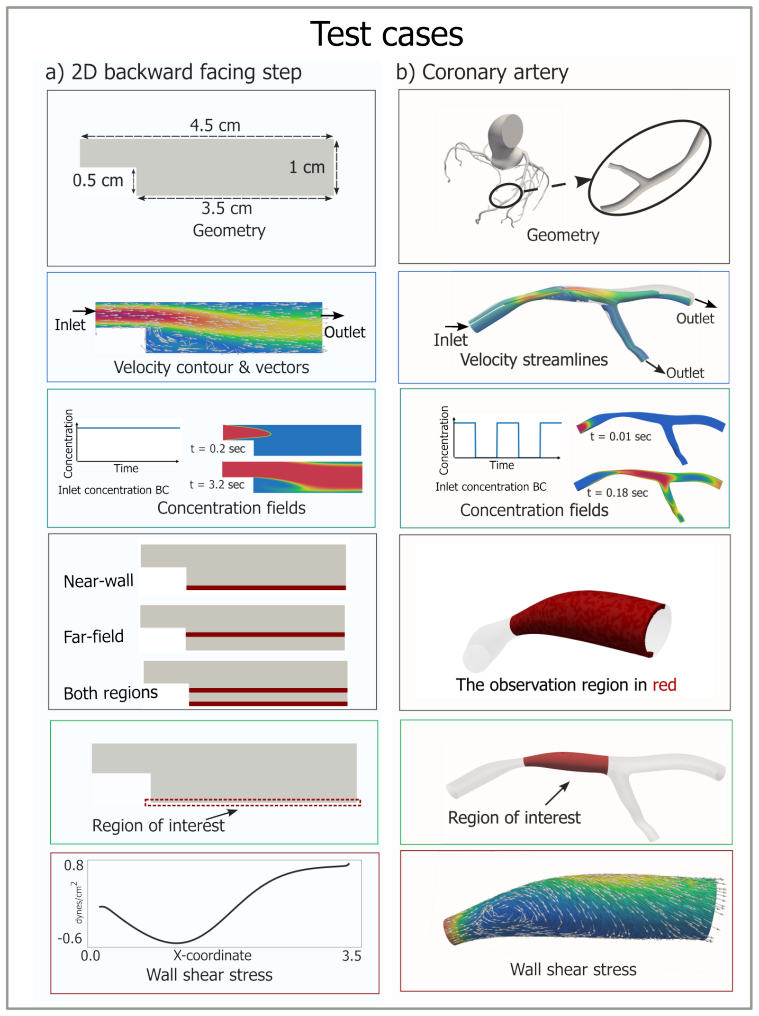
Wall shear stress (WSS) governs near-wall transport dynamics and is a key hemodynamic indicator in cardiovascular flows, yet remains difficult to infer accurately due to the need for precise computation of near-wall velocity gradients. Passive scalar fields, such as concentration or temperature, are advected by the same underlying velocity field and have the potential to uncover hidden flow physics metrics such as WSS. In this work, we demonstrate such reconstruction from spatially limited passive scalar observations using two fundamentally different inverse frameworks: a differentiable physics framework based on discrete adjoint, PDE-constrained optimization, which enforces the governing equations as hard constraints, and physics-informed neural networks (PINNs), which treat them as soft constraints. Benchmark problems include a 2D canonical backward-facing step (2D-BFS) and a 3D patient-specific stenotic coronary artery. For the 2D-BFS case, evaluated under three measurement scenarios (near-wall, far-field, and combined), PINN achieves high accuracy when near-wall data are available but fails when restricted to far-field measurements, whereas the differentiable physics approach recovers accurate WSS across all scenarios. In the 3D patient-specific case, the differentiable physics framework outperforms PINNs, yielding accurate WSS reconstruction. These results establish that measurement location and inverse formulation jointly determine reconstruction fidelity in scalar-based near-wall flow inference. The proposed framework opens a path toward estimation of near-wall hemodynamics from scalar transport data, with broader applicability to fluid flow problems where passive scalars can be observed.
Editorial analysis
A structured set of objections, weighed in public.
Referee Report
Summary. The manuscript proposes reconstructing wall shear stress (WSS) from passive scalar concentration observations using two inverse approaches: a differentiable physics method based on discrete adjoint PDE-constrained optimization (hard constraints) and physics-informed neural networks (soft constraints). It benchmarks both on a 2D backward-facing step (BFS) under near-wall, far-field, and combined measurement scenarios, plus a 3D patient-specific stenotic coronary artery. The central claim is that the differentiable physics framework recovers accurate WSS even from far-field data alone, while PINNs succeed only when near-wall data are available; the 3D case similarly favors the differentiable physics approach.
Significance. If the far-field reconstruction result holds with supporting quantitative evidence, the work would be significant for enabling inference of near-wall hemodynamics from scalar transport data in applications such as cardiovascular flows. The explicit comparison of hard versus soft enforcement of the advection-diffusion equations is a useful contribution to inverse problem methodology in fluid dynamics.
major comments (2)
- [Abstract] Abstract: the claim that the differentiable physics approach 'recovers accurate WSS across all scenarios' (including far-field only) is not supported by any quantitative error metrics, relative errors, or validation details against ground-truth WSS; without these, the performance difference versus PINNs cannot be assessed.
- [Results (2D-BFS far-field case)] The 2D-BFS far-field reconstruction result (central to the paper's novelty) lacks any sensitivity analysis, uniqueness discussion, or regularization study. In recirculating advection-dominated flow, far-field scalar observations may be insensitive to near-wall gradients; the manuscript provides no test (e.g., adjoint-based sensitivity or multiple initializations) confirming that the recovered WSS is determined by the data rather than being a non-unique solution consistent with far-field measurements alone.
minor comments (2)
- [Methods] Notation for the discrete adjoint and the concentration transport equation should be introduced with explicit equation numbers for reproducibility.
- [Figures] Figure captions for the 2D-BFS and 3D cases should include the specific error norms or visual comparison metrics used to support the 'high accuracy' statements.
Simulated Author's Rebuttal
We thank the referee for the constructive and detailed review. We address each major comment point-by-point below and indicate the revisions that will be incorporated.
read point-by-point responses
-
Referee: [Abstract] Abstract: the claim that the differentiable physics approach 'recovers accurate WSS across all scenarios' (including far-field only) is not supported by any quantitative error metrics, relative errors, or validation details against ground-truth WSS; without these, the performance difference versus PINNs cannot be assessed.
Authors: We agree that the abstract would benefit from explicit quantitative support. While the results section contains visual and comparative evidence, the abstract itself summarizes findings at a high level. We will revise the abstract to include relative L2 error metrics for WSS reconstruction under each measurement scenario (near-wall, far-field, combined) and note the corresponding errors for the PINN baseline, enabling direct quantitative assessment of the performance difference. revision: yes
-
Referee: [Results (2D-BFS far-field case)] The 2D-BFS far-field reconstruction result (central to the paper's novelty) lacks any sensitivity analysis, uniqueness discussion, or regularization study. In recirculating advection-dominated flow, far-field scalar observations may be insensitive to near-wall gradients; the manuscript provides no test (e.g., adjoint-based sensitivity or multiple initializations) confirming that the recovered WSS is determined by the data rather than being a non-unique solution consistent with far-field measurements alone.
Authors: We recognize that additional analysis would strengthen confidence in the far-field result. The differentiable physics formulation already employs the discrete adjoint for gradient computation within the PDE-constrained optimization; we will augment the manuscript with an explicit adjoint-based sensitivity study, results from multiple random initializations to demonstrate convergence to the same WSS field, and a brief regularization study. These additions will directly test whether the far-field data determine a unique near-wall solution consistent with the ground truth. revision: yes
Circularity Check
No circularity: independent numerical comparison of two inverse solvers
full rationale
The paper formulates and compares two distinct inverse frameworks (discrete-adjoint PDE-constrained optimization versus PINN soft-constraint enforcement) for recovering WSS from scalar transport data. Performance claims rest on direct numerical experiments across measurement scenarios on 2D-BFS and 3D artery geometries; neither framework is algebraically derived from the other, nor are any reported quantities obtained by fitting a parameter to a subset and then relabeling the fit as a prediction. No self-citation chain, uniqueness theorem, or ansatz smuggling appears in the provided text. The derivation chain is therefore self-contained and externally falsifiable via the reported benchmarks.
Axiom & Free-Parameter Ledger
Reference graph
Works this paper leans on
-
[1]
J. M. Tarbell. Shear stress and the endothelial transport barrier.Cardiovascular Research, 87(2):320– 330, 2010
2010
-
[2]
D. E. Conway and M. A. Schwartz. Flow-dependent cellular mechanotransduction in atherosclerosis. Journal of Cell Science, 126(22):5101–5109, 2013
2013
-
[3]
Chatterjee
S. Chatterjee. Endothelial mechanotransduction, redox signaling and the regulation of vascular inflam- matory pathways.Frontiers in Physiology, 9:524, 2018
2018
-
[4]
H. Meng, V. M. Tutino, J. Xiang, and A. Siddiqui. High WSS or low WSS? complex interactions of hemodynamics with intracranial aneurysm initiation, growth, and rupture: toward a unifying hypothe- sis.American Journal of Neuroradiology, 35(7):1254–1262, 2014
2014
-
[5]
Morel, S
S. Morel, S. Schilling, M. R. Diagbouga, M. Delucchi, M.-L. Bochaton-Piallat, S. Lemeille, S. Hirsch, and B. R. Kwak. Effects of low and high aneurysmal wall shear stress on endothelial cell behavior: differences and similarities.Frontiers in Physiology, 12:727338, 2021
2021
-
[6]
De Nisco, E
G. De Nisco, E. M. J. Hartman, E. Torta, J. Daemen, C. Chiastra, D. Gallo, U. Morbiducci, and J. J. Wentzel. Predicting lipid-rich plaque progression in coronary arteries using multimodal imaging and wall shear stress signatures.Arteriosclerosis, Thrombosis, and Vascular Biology, 44(4):976–986, 2024
2024
-
[7]
Mahmoudi, A
M. Mahmoudi, A. Farghadan, D. R. McConnell, A. J. Barker, J. J. Wentzel, M. J. Budoff, and A. Arzani. The story of wall shear stress in coronary artery atherosclerosis: biochemical transport and mechan- otransduction.Journal of Biomechanical Engineering, 143(4):041002, 2021
2021
-
[8]
Schlichting and J
H. Schlichting and J. Kestin.Boundary layer theory, volume 121. Springer, 1961
1961
-
[9]
Katritsis, L
D. Katritsis, L. Kaiktsis, A. Chaniotis, J. Pantos, E. P. Efstathopoulos, and V. Marmarelis. Wall shear stress: theoretical considerations and methods of measurement.Progress in cardiovascular diseases, 49(5):307–329, 2007
2007
-
[10]
H. Wang, Z. Yang, B. Li, and S. Wang. Predicting the near-wall velocity of wall turbulence using a neural network for particle image velocimetry.Physics of Fluids, 32(11), 2020
2020
-
[11]
T. G. Papaioannou and Christodoulos et al. Stefanadis. Vascular wall shear stress: basic principles and methods.Hellenic J. C., 46(1):9–15, 2005
2005
-
[12]
J. P. Crimaldi. Planar laser induced fluorescence in aqueous flows.Experiments in Fluids, 44(6):851–863, 2008
2008
-
[13]
Wang and H
G. Wang and H. Fiedler. On high spatial resolution scalar measurement with LIF part 1: photobleaching and thermal blooming: part 1: photobleaching and thermal blooming.Experiments in fluids, 29(3):257– 264, 2000
2000
-
[14]
A. D. Woodworth, D. M. Salazar, and T. Liu. Heat transfer and skin friction: beyond the reynolds analogy.International Journal of Heat and Mass Transfer, 206:123960, 2023
2023
-
[15]
X. Liao, Z. Cai, J. Chen, T. Liu, and J.-H. Lai. Physics-based optical flow estimation under varying illumination conditions.Signal processing: Image Communication, 117:117007, 2023
2023
-
[16]
Sharma, I
A. Sharma, I. I. Rypina, R. Musgrave, and G. Haller. Analytic reconstruction of a two-dimensional velocity field from an observed diffusive scalar.Journal of Fluid Mechanics, 871:755–774, 2019
2019
-
[17]
L. K. Su and W. J. Dahm. Scalar imaging velocimetry measurements of the velocity gradient tensor field in turbulent flows. i. assessment of errors.Physics of Fluids, 8(7):1869–1882, 1996. 27
1996
-
[18]
A. C. Lardo, A. A. Rahsepar, J. H. Seo, P. Eslami, F. Korley, S. Kishi, T. Abd, R. Mittal, and R. T. George. Estimating coronary blood flow using CT transluminal attenuation flow encoding: Formula- tion, preclinical validation, and clinical feasibility.Journal of Cardiovascular Computed Tomography, 9(6):559–566, 2015
2015
-
[19]
Eslami, J.-H
P. Eslami, J.-H. Seo, A. A. Rahsepar, R. George, A. C. Lardo, and R. Mittal. Computational study of computed tomography contrast gradients in models of stenosed coronary arteries.Journal of Biome- chanical Engineering, 137(9):091002, 2015
2015
-
[20]
Raissi, A
M. Raissi, A. Yazdani, and G. E. Karniadakis. Hidden fluid mechanics: Learning velocity and pressure fields from flow visualizations.Science, 367(6481):1026–1030, 2020
2020
-
[21]
M. D. Gunzburger.Perspectives in flow control and optimization. SIAM, 2002
2002
-
[22]
M. B. Giles and N. A. Pierce. An introduction to the adjoint approach to design.Flow, Turbulence and Combustion, 65(3):393–415, 2000
2000
-
[23]
G. K. Kenway, C. A. Mader, P. He, and J. R. Martins. Effective adjoint approaches for computational fluid dynamics.Progress in Aerospace Sciences, 110:100542, 2019
2019
-
[24]
McNamara, A
A. McNamara, A. Treuille, Z. Popović, and J. Stam. Fluid control using the adjoint method.ACM Transactions On Graphics (TOG), 23(3):449–456, 2004
2004
-
[25]
Raissi, P
M. Raissi, P. Perdikaris, and G. E. Karniadakis. Physics-informed neural networks: A deep learning framework for solving forward and inverse problems involving nonlinear partial differential equations. Journal of Computational Physics, 378:686–707, 2019
2019
-
[26]
Arzani, J
A. Arzani, J. Wang, and R. M. D’Souza. Uncovering near-wall blood flow from sparse data with physics-informed neural networks.Physics of Fluids, 33(7), 2021
2021
-
[27]
A. D. Jagtap, Z. Mao, N. Adams, and G. E. Karniadakis. Physics-informed neural networks for inverse problems in supersonic flows.Journal of Computational Physics, 466:111402, 2022
2022
-
[28]
Kim and J
D. Kim and J. Lee. A review of physics informed neural networks for multiscale analysis and inverse problems.Multiscale Science and Engineering, 6(1):1–11, 2024
2024
-
[29]
J. Mai, Y. Li, L. Long, Y. Huang, H. Zhang, and Y. You. Two-dimensional temperature field inversion of turbine blade based on physics-informed neural networks.Physics of Fluids, 36(3), 2024
2024
-
[30]
Gaidzik, S
F. Gaidzik, S. Pathiraja, S. Saalfeld, D. Stucht, O. Speck, D. Thévenin, and G. Janiga. Hemodynamic data assimilation in a subject-specific circle of willis geometry.Clinical Neuroradiology, 31(3):643–651, 2021
2021
-
[31]
Canuto, J
D. Canuto, J. L. Pantoja, J. Han, E. P. Dutson, and J. D. Eldredge. An ensemble kalman filter approach to parameter estimation for patient-specific cardiovascular flow modeling.Theoretical and Computational Fluid Dynamics, 34(4):521–544, 2020
2020
-
[32]
Kalnay.Atmospheric modeling, data assimilation and predictability
E. Kalnay.Atmospheric modeling, data assimilation and predictability. Cambridge University Press, 2003
2003
-
[33]
Talagrand and P
O. Talagrand and P. Courtier. Variational assimilation of meteorological observations with the adjoint vorticity equation. i: Theory.Quarterly Journal of the Royal Meteorological Society, 113(478):1311– 1328, 1987
1987
-
[34]
Evensen.Data assimilation: the ensemble Kalman filter
G. Evensen.Data assimilation: the ensemble Kalman filter. Springer, 2009
2009
-
[35]
Habibi, R
M. Habibi, R. M. D’Souza, S. T. M. Dawson, and A. Arzani. Integrating multi-fidelity blood flow data with reduced-order data assimilation.Computers in Biology and Medicine, 135:104566, 2021
2021
-
[36]
Elhadidy, R
M. Elhadidy, R. D’Souza, and A. Arzani. SLE-FNO: Single-layer extensions for task-agnostic continual learning in fourier neural operators.Physica Scripta, 2026. 28
2026
-
[37]
Buffoni and E
G. Buffoni and E. Cupini. The adjoint advection-diffusion equation in stationary and time dependent problems: a reciprocity relation.Rivista di Matematica Della Universita di Parma, 4:9–19, 2001
2001
-
[38]
J. J. Gillissen, A. Vilquin, H. Kellay, R. Bouffanais, and D. K. Yue. A space–time integral minimisation method for the reconstruction of velocity fields from measured scalar fields.Journal of Fluid Mechanics, 854:348–366, 2018
2018
-
[39]
Bakker, N
L. Bakker, N. Xiao, A. Van De Ven, M. Schaap, F. Van De Vosse, and C. Taylor. Image-based blood flow estimation using a semi-analytical solution to the advection–diffusion equation in cylindrical domains. Journal of Fluid Mechanics, 924:A18, 2021
2021
-
[40]
P. Liu, Y. Z. Lee, S. R. Aylward, and M. Niethammer. Perfusion imaging: an advection diffusion approach.IEEE Transactions on Medical Imaging, 40(12):3424–3435, 2021
2021
-
[41]
Huang, M
S. Huang, M. Sigovan, and B. Sixou. Reconstruction of vascular blood flow in a vessel from tomographic projections.Biomedical Physics & Engineering Express, 7(6):065032, 2021
2021
-
[42]
Riemer, E
K. Riemer, E. M. Rowland, J. Broughton-Venner, C. H. Leow, M. Tang, and P. Weinberg. Contrast agent-free assessment of blood flow and wall shear stress in the rabbit aorta using ultrasound image velocimetry.Ultrasound in Medicine & Biology, 48(3):437–449, 2022
2022
-
[43]
D. R. Allen, K. W. Hoppel, and D. D. Kuhl. Extraction of wind and temperature information from hybrid 4d-var assimilation of stratospheric ozone using navgem.Atmospheric Chemistry and Physics, 18(4):2999–3026, 2018
2018
-
[44]
Shusong, S
H. Shusong, S. Monica, and S. Bruno. Deep learning methods for blood flow reconstruction in a vessel with contrast enhanced x-ray computed tomography.International Journal for Numerical Methods in Biomedical Engineering, 40(1):e3785, 2024
2024
-
[45]
Sarabian, H
M. Sarabian, H. Babaee, and K. Laksari. Physics-informed neural networks for brain hemodynamic predictions using medical imaging.IEEE Transactions on Medical Imaging, 41(9):2285–2303, 2022
2022
- [46]
-
[47]
J. D. Toscano, Y. Guo, Z. Wang, M. Vaezi, Y. Mori, G. E. Karniadakis, K. A. Boster, and D. H. Kelley. MR-AIV reveals in vivo brain-wide fluid flow with physics-informed ai.bioRxiv, 2025
2025
-
[48]
A. P. Kalajahi, H. Csala, Z. B. Mamun, S. Yadav, O. Amili, A. Arzani, and R. M. D’Souza. Input parameterized physics informed neural networks for de noising, super-resolution, and imaging artifact mitigation in time resolved three dimensional phase-contrast magnetic resonance imaging.Engineering Applications of Artificial Intelligence, 150:110600, 2025
2025
- [49]
-
[50]
Arzani and S
A. Arzani and S. C. Shadden. Wall shear stress fixed points in cardiovascular fluid mechanics.Journal of Biomechanics, 73:145–152, 2018
2018
-
[51]
Y. Du, M. Wang, and T. A. Zaki. State estimation in minimal turbulent channel flow: A comparative study of 4DVar and PINN.International Journal of Heat and Fluid Flow, 99:109073, 2023
2023
-
[52]
Mitusch, S
S. Mitusch, S. Funke, and J. Dokken. dolfin-adjoint 2018.1: automated adjoints for FEniCS and Fire- drake.Journal of Open Source Software, 4(38):1292, 2019
2018
-
[53]
A. Arzani. Accounting for residence-time in blood rheology models: do we really need non-newtonian blood flow modelling in large arteries?Journal of The Royal Society Interface, 15(146), 2018. 29
2018
-
[54]
M. E. Fiadeiro and G. Veronis. Obtaining velocities from tracer distributions.Journal of Physical Oceanography, 14(11):1734–1746, 1984
1984
-
[55]
C. Wunsch. Can a tracer field be inverted for velocity?Journal of Physical Oceanography, 15(11):1521– 1531, 1985
1985
-
[56]
Decoupled Weight Decay Regularization
I. Loshchilov and F. Hutter. Decoupled weight decay regularization.arXiv preprint arXiv:1711.05101, 2017
work page internal anchor Pith review Pith/arXiv arXiv 2017
-
[57]
D. P. Kingma and J. Ba. Adam: A method for stochastic optimization.arXiv preprint arXiv:1412.6980, 2014
work page internal anchor Pith review Pith/arXiv arXiv 2014
-
[58]
B. Ramsundar, D. Krishnamurthy, and V. Viswanathan. Differentiable physics: A position piece.arXiv preprint arXiv:2109.07573, 2021
-
[59]
M. Blondel and V. Roulet. The elements of differentiable programming.arXiv preprint arXiv:2403.14606, 2024
-
[60]
P. E. Farrell, D. A. Ham, S. W. Funke, and M. E. Rognes. Automated derivation of the adjoint of high-level transient finite element programs.SIAM Journal on Scientific Computing, 35(4):C369–C393, 2013
2013
-
[61]
Tancik, P
M. Tancik, P. Srinivasan, B. Mildenhall, S. Fridovich-Keil, N. Raghavan, U. Singhal, R. Ramamoorthi, J. Barron, and R. Ng. Fourier features let networks learn high frequency functions in low dimensional domains.Advances in Neural Information Processing Systems, 33:7537–7547, 2020
2020
-
[62]
Sallam and M
O. Sallam and M. Fürth. On the use of fourier features-physics informed neural networks (ff-pinn) for forward and inverse fluid mechanics problems.Proceedings of the Institution of Mechanical Engineers, Part M: Journal of Engineering for the Maritime Environment, 237(4):846–866, 2023
2023
-
[63]
Rahimi and B
A. Rahimi and B. Recht. Random features for large-scale kernel machines.Advances in Neural Infor- mation Processing Systems, 20, 2007
2007
-
[64]
Farghadan and A
A. Farghadan and A. Arzani. The combined effect of wall shear stress topology and magnitude on cardiovascular mass transport.International Journal of Heat and Mass Transfer, 131:252–260, 2019
2019
-
[65]
Mirramezani, S
M. Mirramezani, S. L. Diamond, H. I. Litt, and S. C. Shadden. Reduced order models for transstenotic pressure drop in the coronary arteries.Journal of Biomechanical Engineering, 141(3):031005, 2019
2019
-
[66]
Updegrove, N
A. Updegrove, N. M. Wilson, J. Merkow, H. Lan, A. L. Marsden, and S. C. Shadden. SimVascular: an open source pipeline for cardiovascular simulation.Annals of Biomedical Engineering, 45(3):525–541, 2017
2017
-
[67]
Arzani, A
A. Arzani, A. M. Gambaruto, G. Chen, and S. C. Shadden. Lagrangian wall shear stress structures and near-wall transport in high-schmidt-number aneurysmal flows.Journal of Fluid Mechanics, 790:158–172, 2016
2016
-
[68]
K. B. Hansen and S. C. Shadden. A reduced-dimensional model for near-wall transport in cardiovascular flows.Biomechanics and Modeling in Mechanobiology, 15(3):713–722, 2016
2016
-
[69]
T. Chen, T. Liu, L. P. Wang, and S. Chen. Relations between skin friction and other surface quantities in viscous flows.Physics of Fluids, 31(10), 2019
2019
-
[70]
Ohashi, H
N. Ohashi, H. Cao, L. K. Hwang, P. K. Kang, and B. Kwon. Physics-informed neural networks with domain decomposition for inferring velocity fields from concentration fields.AI Thermal Fluids, page 100037, 2026
2026
-
[71]
J. I. Rawden, C. Vanderwel, and S. Symon. Physics-informed neural networks for passive scalar emission and transport.Physical Review Fluids, 11(2):024501, 2026. 30
2026
-
[72]
H. Yang, J. Zhang, B. K. Nallamothu, K. Garikipati, and C. A. Figueroa. Assessing coronary mi- crovascular dysfunction using angiography-based data-driven methods.Computer Methods in Applied Mechanics and Engineering, 452:118743, 2026
2026
-
[73]
Thawon, D
I. Thawon, D. Vo, T. Q. Bui, K. Rattanamongkhonkun, C. Chamroon, N. Tippayawong, Y. Mona, R. Wanison, and P. Suttakul. Physics-informed neural networks: Current progress and challenges in computational solid and structural mechanics.Computer Modeling in Engineering & Sciences (CMES), 146(2):1, 2026
2026
-
[74]
Curvature-Aware Optimization for High-Accuracy Physics-Informed Neural Networks
A. Jnini, E. Kiyani, K. Shukla, J. F. Urban, N. Ahmadi Daryakenari, J. Muller, M. Zeinhofer, and G. E. Karniadakis. Curvature-aware optimization for high-accuracy physics-informed neural networks.arXiv preprint arXiv:2604.05230, 2026
work page internal anchor Pith review Pith/arXiv arXiv 2026
- [75]
-
[76]
F. S. Costabal, S. Pezzuto, and P. Perdikaris.∆-PINNs: Physics-informed neural networks on complex geometries.Engineering Applications of Artificial Intelligence, 127:107324, 2024. 31
2024
discussion (0)
Sign in with ORCID, Apple, or X to comment. Anyone can read and Pith papers without signing in.