A closed system setting for quantum thermalisation in free fermions
Pith reviewed 2026-06-27 23:08 UTC · model grok-4.3
The pith
A closed tripartite free-fermion chain connected to boundary baths relaxes to the bath temperature without the Mpemba effect.
A machine-rendered reading of the paper's core claim, the machinery that carries it, and where it could break.
Core claim
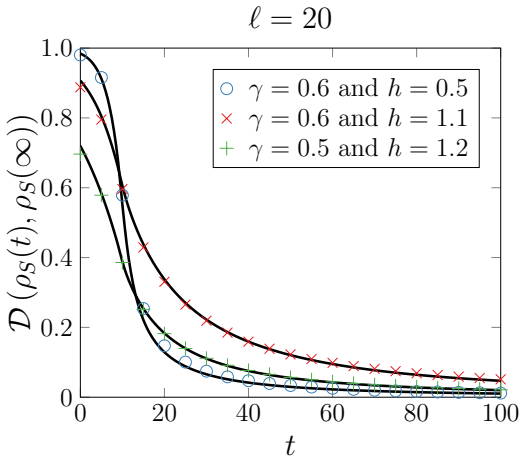
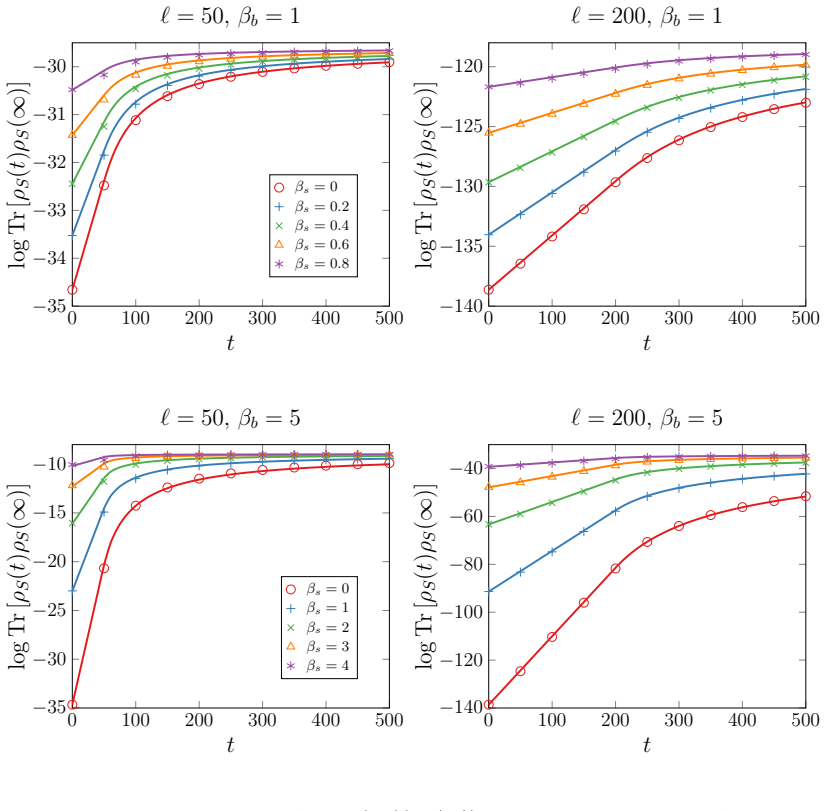
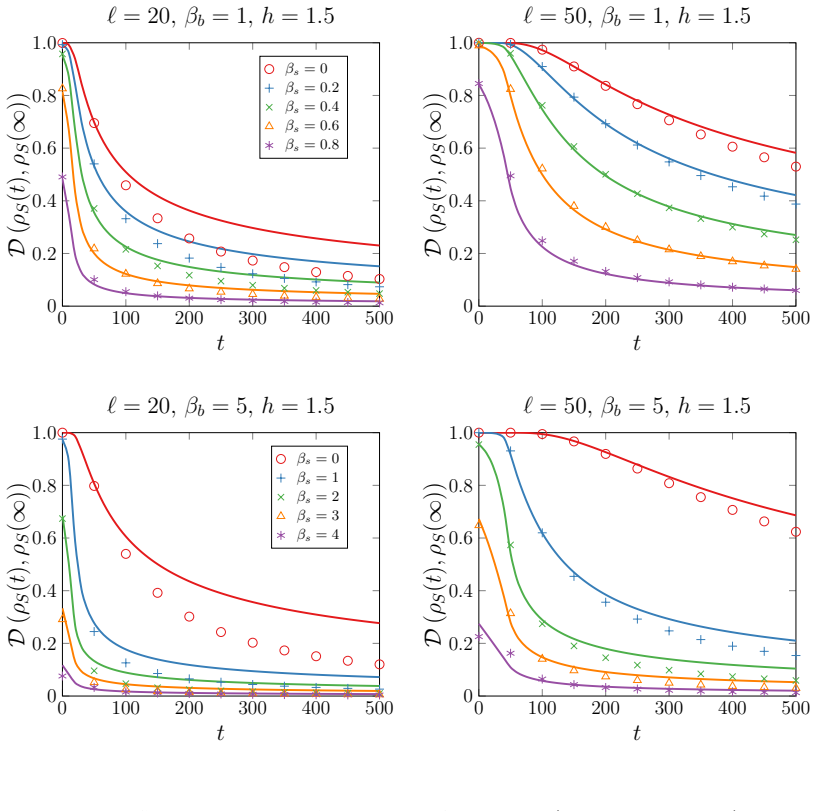
In the tripartite geometry the stationary state of the central subsystem is the thermal state at the bath temperature, and the time-dependent Frobenius distance to this state, expressed exactly via two-point correlation functions, decays without any Mpemba effect for both the XX chain and the transverse-field Ising chain; generalized hydrodynamics supplies closed-form predictions for the entire relaxation process in the hydrodynamic limit.
What carries the argument
The Frobenius distance of the central reduced density matrix to its thermal stationary state, written exactly in terms of two-point correlation functions and evaluated with generalized hydrodynamics.
If this is right
- The relaxation process admits a complete analytic description in the hydrodynamic limit for this family of boundary-driven protocols.
- No anomalous acceleration of equilibration occurs even though the dynamics are genuinely non-equilibrium.
- The result applies equally to models that preserve and break global U(1) symmetry.
- The stationary state reached by the central subsystem is precisely the thermal state at the bath temperature.
Where Pith is reading between the lines
- The same unitary-bath construction could be applied to other free-fermion models or to different initial temperature profiles to test the robustness of the no-Mpemba conclusion.
- Varying the length of the central chain or the temperature difference might reveal regimes where standard relaxation gives way to other transient behaviors.
- This closed-system realization clarifies how unitarity alone can enforce conventional thermalization rates without the anomalies sometimes reported in open-system treatments.
- Weakly interacting perturbations around these models could be studied numerically to see whether interactions introduce an Mpemba effect absent in the free case.
Load-bearing premise
The semi-infinite outer chains act as perfect thermal baths whose initial temperature difference alone fixes the long-time state of the central chain to the bath temperature under purely unitary evolution.
What would settle it
Numerical evaluation of the Frobenius distance for two different initial temperatures in the XX chain that shows faster decay from the state farther from equilibrium would contradict the absence of the Mpemba effect.
Figures
read the original abstract
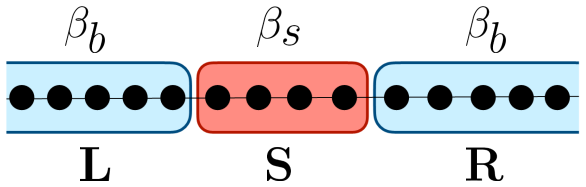
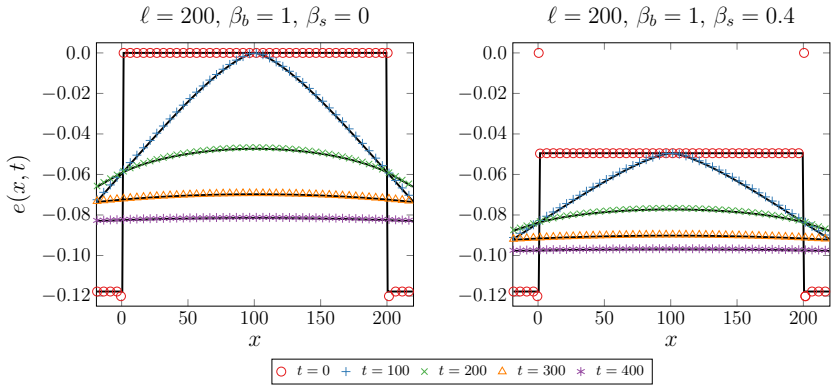
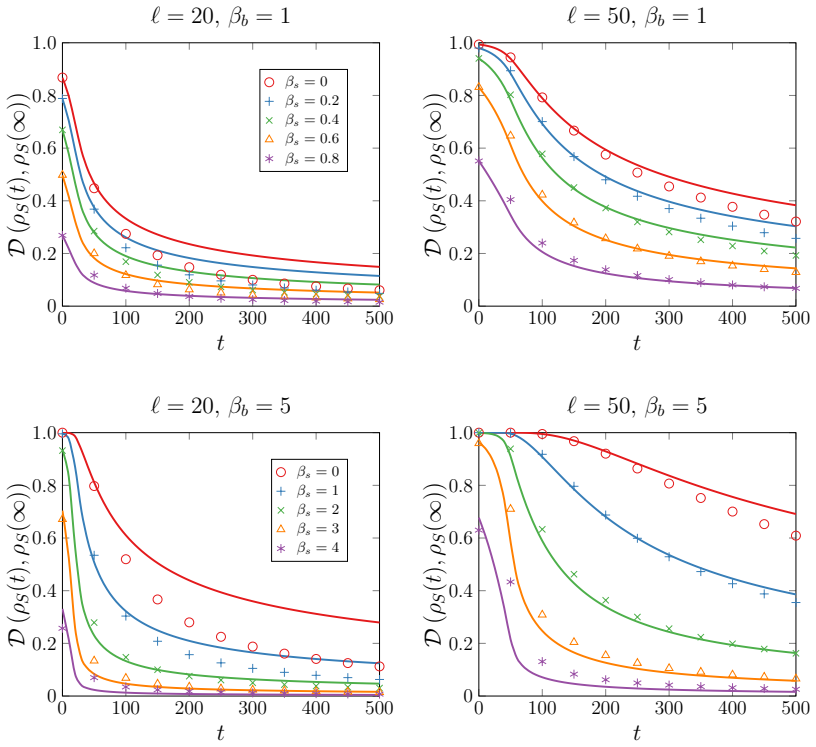
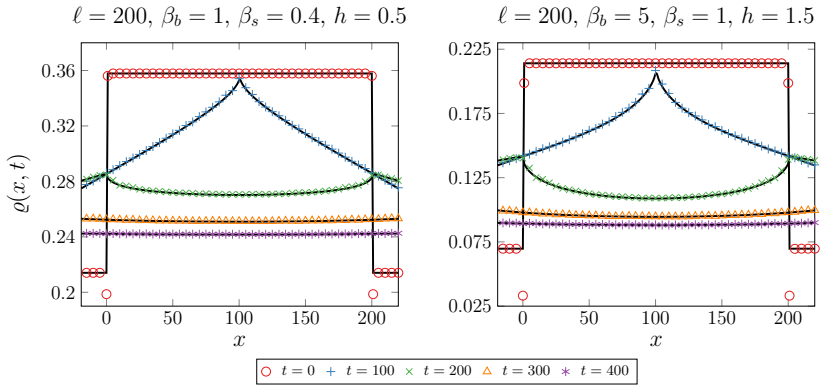
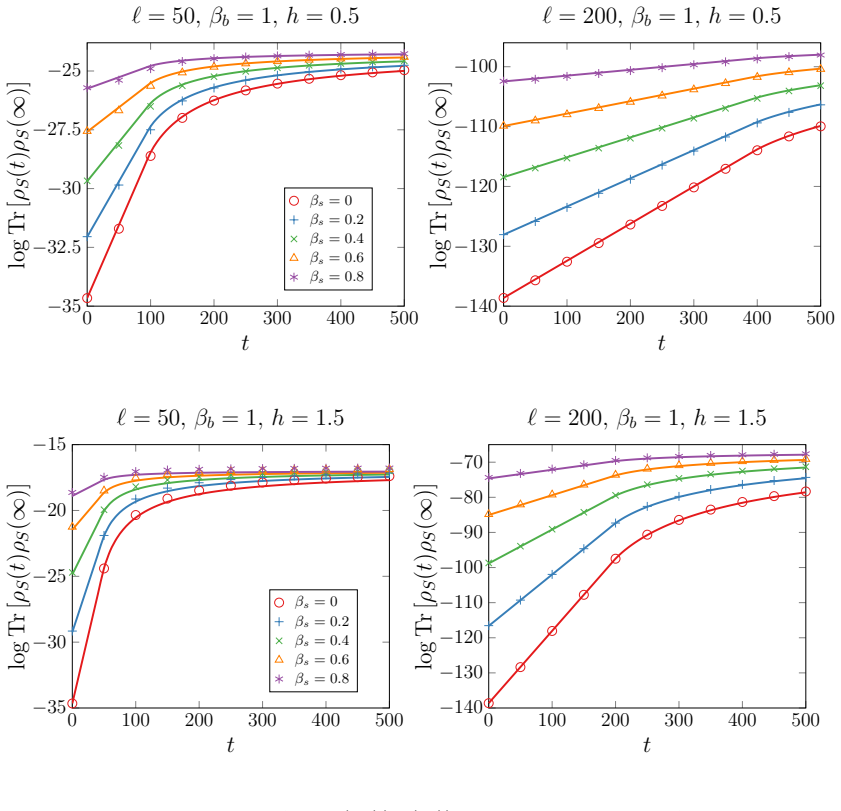
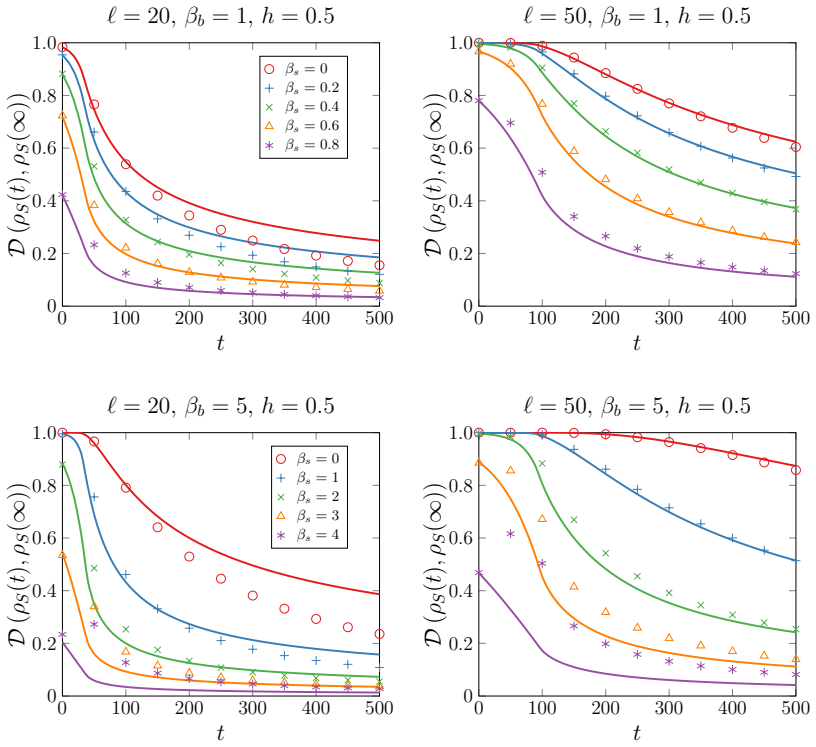
We study thermalisation and the possible occurrence of the Mpemba effect in a closed quantum setting that mimics the interaction of a system with thermal reservoirs coupled only at its boundaries. Specifically, we consider a tripartite geometry in which a finite chain, initially prepared at a finite temperature, is suddenly connected on both sides to two semi-infinite chains of the same nature held at a different temperature. These outer chains act as thermal baths, while the full system evolves unitarily under a homogeneous Hamiltonian. This setup provides a simple quantum realisation of a temperature quench and closely resembles the original scenario in which the classical Mpemba effect was first observed. We focus on two paradigmatic free-fermion models, the XX chain and the transverse-field Ising chain, which respectively preserve and break the global $U(1)$ particle-number symmetry. As a probe of relaxation, we consider the Frobenius distance between the time-evolved reduced density matrix of the central subsystem and its stationary state, which is the thermal state at the bath temperature. Exploiting the free-fermionic structure of both models, the dynamics remains Gaussian and the Frobenius distance can be expressed exactly in terms of two-point correlation functions. Combining this representation with generalised hydrodynamics, we derive analytical predictions for the Frobenius distance in the hydrodynamic limit, providing a complete characterisation of the thermalisation process. Using these results, we investigate the possible occurrence of the Mpemba effect. We find that, despite the genuine non-equilibrium dynamics displayed by the system, no Mpemba effect arises in this setting. Our analysis identifies a broad class of boundary-driven thermalisation protocols in which relaxation is fully characterised analytically and exhibits no anomalous acceleration of equilibration.
Editorial analysis
A structured set of objections, weighed in public.
Referee Report
Summary. The paper considers a closed tripartite free-fermion chain in which a finite central segment, prepared at temperature T1, is suddenly coupled at its boundaries to two semi-infinite chains held at temperature T2. The entire system evolves unitarily under a homogeneous Hamiltonian (XX or TFIM). The reduced state of the central segment is claimed to relax to the thermal Gibbs state at T2; the Frobenius distance to this state is expressed exactly via two-point correlators and analysed in the hydrodynamic limit with generalised hydrodynamics. The central result is that, despite genuine non-equilibrium dynamics, the Mpemba effect is absent for the class of boundary-driven protocols studied.
Significance. If the stationary-state identification and hydrodynamic analysis hold, the work supplies an analytically tractable, parameter-free example of quantum thermalisation in which relaxation is fully characterised by GHD applied to exact correlations and exhibits no anomalous acceleration. This identifies a broad class of integrable boundary-driven protocols free of the Mpemba effect and provides reproducible predictions that can be tested against exact numerics.
major comments (2)
- [Setup and stationary state] Setup section: the claim that the stationary reduced density matrix of the central subsystem is exactly the thermal Gibbs state at the bath temperature (rather than a GGE fixed by all conserved charges) is load-bearing for the Frobenius-distance analysis and the no-Mpemba conclusion. For the XX chain the U(1) charge and higher conserved quantities must match those of the target thermal state; the manuscript provides no explicit verification that the bath initial conditions enforce this matching for every charge.
- [Hydrodynamic limit and distance formula] Hydrodynamic analysis (around the GHD derivation of the distance): the hydrodynamic limit is invoked to obtain closed-form predictions, yet the manuscript does not state the precise scaling (e.g., t/L fixed, L o∞) nor demonstrate that sub-leading corrections to the two-point functions remain negligible for the distance observable at the times relevant to possible Mpemba crossings.
minor comments (2)
- [Probe of relaxation] Notation: the definition of the Frobenius distance should be written explicitly (e.g., as || ho(t)− ho_th||_F^2 = Tr[( ho(t)− ho_th)^2]) rather than left implicit when the distance is expressed via correlators.
- [Numerical comparisons] Figure captions: the hydrodynamic curves in the relaxation plots should indicate the system sizes used for the exact numerics against which they are compared.
Simulated Author's Rebuttal
We thank the referee for their careful reading of the manuscript and for the constructive comments, which help clarify key aspects of the analysis. We address each major comment below and outline the revisions we will make.
read point-by-point responses
-
Referee: [Setup and stationary state] Setup section: the claim that the stationary reduced density matrix of the central subsystem is exactly the thermal Gibbs state at the bath temperature (rather than a GGE fixed by all conserved charges) is load-bearing for the Frobenius-distance analysis and the no-Mpemba conclusion. For the XX chain the U(1) charge and higher conserved quantities must match those of the target thermal state; the manuscript provides no explicit verification that the bath initial conditions enforce this matching for every charge.
Authors: We agree that an explicit verification strengthens the presentation. In the setup, the semi-infinite baths are initialized in thermal states at temperature T2. For free-fermion models this fixes the occupation numbers of all quasiparticle modes (including the U(1) density and all higher conserved charges for the XX chain) to their thermal Fermi-Dirac values. Because the central segment is finite while the baths are infinite, the long-time reduced state is completely determined by the incoming quasiparticles whose distributions are thermal; hence the stationary reduced density matrix is the Gibbs state at T2 rather than a generic GGE. To make this matching explicit we will add, in the revised manuscript, a short calculation (or appendix) that evaluates the expectation values of the relevant conserved charges on the stationary state and confirms they coincide with those of the target thermal state. This addition does not alter the conclusions but improves clarity. revision: yes
-
Referee: [Hydrodynamic limit and distance formula] Hydrodynamic analysis (around the GHD derivation of the distance): the hydrodynamic limit is invoked to obtain closed-form predictions, yet the manuscript does not state the precise scaling (e.g., t/L fixed, L→∞) nor demonstrate that sub-leading corrections to the two-point functions remain negligible for the distance observable at the times relevant to possible Mpemba crossings.
Authors: We thank the referee for noting the need for a precise statement of the limit. The hydrodynamic predictions are derived in the Euler-scale limit L→∞ with t/L held fixed (standard for GHD). The Frobenius distance is an extensive observable obtained by integrating the two-point correlators over the central segment; in this scaling the leading hydrodynamic contribution dominates, while sub-leading corrections (arising from diffusive or higher-order terms) are O(1/L) or smaller and vanish uniformly on the timescales where Mpemba crossings could occur. We will revise the text to state the scaling explicitly and add a brief paragraph justifying the negligibility of corrections for the distance observable. revision: yes
Circularity Check
No significant circularity; derivation applies established GHD to free-fermion correlations
full rationale
The paper's central results follow from applying generalised hydrodynamics (an externally established framework) to the exact two-point correlation functions of the free-fermion models. The Frobenius distance is expressed directly from the Gaussian structure and its hydrodynamic evolution is computed analytically; the no-Mpemba conclusion is an output of those expressions rather than an input or fit. The stationary-state assumption (thermal Gibbs at bath temperature) is an interpretive premise of the setup, not a self-referential definition that forces the relaxation result. No load-bearing self-citations, fitted parameters renamed as predictions, or ansatz smuggling are present in the derivation chain.
Axiom & Free-Parameter Ledger
axioms (2)
- domain assumption The dynamics of free-fermion models remain Gaussian under unitary evolution with quadratic Hamiltonians.
- domain assumption Generalised hydrodynamics accurately describes the relaxation of the Frobenius distance in the hydrodynamic limit for this geometry.
Reference graph
Works this paper leans on
-
[1]
E. B. Mpemba and D. G. Osborne,Cool?Phys. Educ.4, 172 (1969)
1969
-
[2]
G. Teza, J. Bechhoefer, A. Lasanta, O. Raz, and M. Vucelja,Speedups in nonequilib- rium thermal relaxation: Mpemba and related effects, Phys. Rep.1164, 1 (2026)
2026
-
[3]
Y. H. Ahn, H. Kang, D. Y. Koh, and H. Lee,Experimental verifications of Mpemba-like behaviors of clathrate hydrates, Korean J. Chem. Eng.33, 1903 (2016). 31
1903
-
[4]
C. Hu, J. Li, S. Huang, H. Li, C. Luo, J. Chen, S. Jiang, and L. An,Conformation directed Mpemba effect on polylactide crystallization, Cryst. Growth Des.18, 5757 (2018)
2018
-
[5]
P. Chaddah, S. Dash, K. Kumar, and A. Banerjee,Overtaking while approaching equilibrium, arXiv:1011.3598
-
[6]
Greaney, G
A. Greaney, G. Lani, G. Cicero, and J. C. Grossman,Mpemba-like behavior in carbon nanotube resonators, Metall. Mater. Trans. A42, 3907 (2011)
2011
-
[7]
Lasanta, F
A. Lasanta, F. Vega Reyes, A. Prados, and A. Santos,When the hotter cools more quickly: Mpemba effect in granular fluids, Phys. Rev. Lett.119, 148001 (2017)
2017
-
[8]
Keller, V
T. Keller, V. Torggler, S. B. Jäger, S. Schutz, H. Ritsch, and G. Morigi,Quenches across the self-organization transition in multimode cavities, New J. Phys.20, 025004 (2018)
2018
-
[9]
Takada, H
S. Takada, H. Hayakawa and A. Santos,Mpemba effect in inertial suspensions, Phys. Rev. E103, 032901 (2021)
2021
-
[10]
Santos,Mpemba meets Newton: Exploring the Mpemba and Kovacs effects in the time-delayed cooling law, Phys
A. Santos,Mpemba meets Newton: Exploring the Mpemba and Kovacs effects in the time-delayed cooling law, Phys. Rev. E109, 044149 (2024)
2024
-
[11]
Y. Liu, T. Van Vu, R. Chétrite, F. van Wijland, and H. Hayakawa,Predicting the conditions for observing the Mpemba effect, arXiv:2606.03445
-
[12]
Lu and O
Z. Lu and O. Raz,Nonequilibrium thermodynamics of the Markovian Mpemba effect and its inverse, PNAS114, 5083 (2017)
2017
-
[13]
Klich, O
I. Klich, O. Raz, O. Hirschberg, and M. Vucelja,Mpemba Index and Anomalous Re- laxation, Phys. Rev. X9, 021060 (2019)
2019
-
[14]
Bechhoefer, A
J. Bechhoefer, A. Kumar, and R. Chétrite,A fresh understanding of the Mpemba effect, Nat. Rev. Phys.3, 534 (2021)
2021
-
[15]
G. Teza, R. Yaacoby, and O. Raz,Relaxation Shortcuts through Boundary Coupling Phys. Rev. Lett.131, 017101 (2023)
2023
-
[16]
M. R. Walker and M. Vucelja,Mpemba effect in terms of mean first passage time, arXiv:2212.07496
-
[17]
Van Vu and H
T. Van Vu and H. Hayakawa,Thermomajorization Mpemba Effect, Phys. Rev. Lett. 134, 107101 (2025)
2025
-
[18]
Kumar and J
A. Kumar and J. Bechhoefer,Exponentially faster cooling in a colloidal system, Nature 584, 64 (2020)
2020
-
[19]
Kumar, R
A. Kumar, R. Chetrite, and J. Bechhoefer,Anomalous heating in a colloidal system, PNAS119, e2118484119 (2022)
2022
-
[20]
F. Ares, P. Calabrese, and S. Murciano,The quantum Mpemba effects, Nat. Rev. Phys. 7, 451 (2025)
2025
-
[21]
Nava and M
A. Nava and M. Fabrizio,Lindblad dissipative dynamics in presence of phase coexis- tence, Phys. Rev. B100, 125102 (2019). 32
2019
-
[22]
Carollo, A
F. Carollo, A. Lasanta, and I. Lesanovsky,Exponentially accelerated approach to sta- tionarity in Markovian open quantum systems through the Mpemba effect, Phys. Rev. Lett.127, 060401 (2021)
2021
-
[23]
A. K. Chatterjee, S. Takada, and H. Hayakawa, Quantum Mpemba effect in a quantum dot with reservoirs, Phys. Rev. Lett.131, 080402 (2023)
2023
-
[24]
M.Moroder, O.Culhane, K.Zawadzki, andJ.Goold,Thermodynamics of the quantum Mpemba effect, Phys. Rev. Lett.133, 140404 (2024)
2024
-
[25]
Nava and R
A. Nava and R. Egger,Mpemba effects in open nonequilibrium quantum systems, Phys. Rev. Lett.133, 136302 (2024)
2024
-
[26]
D. J. Strachan, A. Purkayastha, and S. R. Clark,Non-Markovian Quantum Mpemba effect, Phys. Rev. Lett.134, 220403 (2025)
2025
-
[27]
Longhi,Mpemba effect and super-accelerated thermalization in the damped quantum harmonic oscillator, Quantum9, 1677 (2025)
S. Longhi,Mpemba effect and super-accelerated thermalization in the damped quantum harmonic oscillator, Quantum9, 1677 (2025)
2025
-
[28]
Nava and R
A. Nava and R. Egger,Pontus-Mpemba effects, Phys. Rev. Lett.135, 140404 (2025)
2025
-
[29]
Westhoff, S
P. Westhoff, S. Paeckel, and M. Moroder, Phys. Rev. A112, L061304 (2025)
2025
-
[30]
Beato and G
N. Beato and G. Teza,Relaxation Control of Open Quantum Systems, Phys. Rev. Lett.136, 070401 (2026)
2026
-
[31]
F. Ares, S. Murciano, and P. Calabrese,Entanglement asymmetry as a probe of sym- metry breaking, Nat. Comms.14, 2036 (2023)
2036
-
[32]
P.Calabrese,The quantum Mpemba effect in closed systems: from theory to experiment J. Stat. Mech. (2026) 034002
2026
-
[33]
C.Rylands, K.Klobas, F.Ares, P.Calabrese, S.Murciano, andB.Bertini,Microscopic Origin of the Quantum Mpemba Effect in Integrable Systems, Phys. Rev. Lett.133, 010401 (2024)
2024
-
[34]
Murciano, F
S. Murciano, F. Ares, I. Klich, and P. Calabrese,Entanglement asymmetry and quan- tum Mpemba effect in the XY spin chain, J. Stat. Mech. (2024) 013103
2024
-
[35]
Bertini, K
B. Bertini, K. Klobas, M. Collura, P. Calabrese, and C. Rylands,Dynamics of charge fluctuations from asymmetric initial states, Phys. Rev. B109, 184312 (2024)
2024
-
[36]
Chalas, F
K. Chalas, F. Ares, C. Rylands, and P. Calabrese,Multiple crossing during dynamical symmetry restoration and implications for the quantum Mpemba effect, J. Stat. Mech. (2024) 103101
2024
-
[37]
Rylands, E
C. Rylands, E. Vernier, and P. Calabrese,Dynamical symmetry restoration in the Heisenberg spin chain, J. Stat. Mech. (2024) 123102
2024
-
[38]
Klobas,Non-equilibrium dynamics of symmetry-resolved entanglement and entan- glement asymmetry: exact asymptotics in Rule 54, J
K. Klobas,Non-equilibrium dynamics of symmetry-resolved entanglement and entan- glement asymmetry: exact asymptotics in Rule 54, J. Phys. A57, 505001 (2024)
2024
-
[39]
Yamashika, F
S. Yamashika, F. Ares, and P. Calabrese,Entanglement asymmetry and quantum Mpemba effect in two-dimensional free-fermion systems, Phys. Rev. B110, 085126 (2024). 33
2024
-
[40]
Yamashika, P
S. Yamashika, P. Calabrese, and F. Ares,Quenching from superfluid to free bosons in two dimensions: entanglement, symmetries, and quantum Mpemba effect, Phys. Rev. A111, 043304 (2025)
2025
-
[41]
F. Ares, C. Rylands, and P. Calabrese,A simpler probe of the quantum Mpemba effect in closed systems, J. Phys. A58, 445302 (2025)
2025
-
[42]
S. Yamashika, S. Endo, and H. Tajima,Quantum Fisher information as a measure of symmetry breaking in quantum many-body systems, arXiv:2509.07468
-
[43]
Gibbins, A
M. Gibbins, A. Gammon-Smith, and B. Bertini,Translation symmetry restoration in integrable systems: the noninteracting casePhys. Rev. B112, L180307 (2025)
2025
-
[44]
Parez and V
G. Parez and V. Alba,Reduced fidelities for free fermions out of equilibrium: From dynamical quantum phase transitions to Mpemba effect, J. Stat. Mech. (2026) 013103
2026
-
[45]
R. Travaglino and P. Calabrese,A Gaussian asymmetry measure, arXiv:2604.26878
-
[46]
R. Senese and F. H. L. Essler,Non-equilibrium quantum dynamics of interacting inte- grable models by Monte Carlo sampling Lehmann representations, arXiv:2605.20065
-
[47]
Liu, H.-K
S. Liu, H.-K. Zhang, S. Yin, and S.-X. Zhang,Symmetry Restoration and Quantum Mpemba Effect in Symmetric Random Circuits, Phys. Rev. Lett.133, 140405 (2024)
2024
-
[48]
Turkeshi, P
X. Turkeshi, P. Calabrese, and A. De Luca,Quantum Mpemba Effect in Random Circuits, Phys. Rev. Lett.135, 040403 (2025)
2025
-
[49]
Foligno, P
A. Foligno, P. Calabrese, and B. Bertini,Non-equilibrium dynamics of charged dual- unitary circuits, PRX Quantum6, 010324 (2025)
2025
-
[50]
Yu, Z.-X
H. Yu, Z.-X. Li, and S.-X. Zhang,Symmetry breaking dynamics in quantum many-body systems, Chinese Phys. Lett.42, 110602 (2025)
2025
-
[51]
H. Yu, S. Liu, and S.-X. Zhang,Quantum Mpemba Effects from Symmetry Perspec- tives, AAPPS Bull.35, 17 (2025)
2025
- [52]
-
[53]
Bhore, L
T. Bhore, L. Su, I. Martin, A. A. Clerk, and Z. Papić,Quantum Mpemba effect without global symmetries, Phys. Rev. B112, L121109 (2025)
2025
-
[54]
Y. Yu, T. Jin, L. Zhang, K. Xu, and H. Fan,Tuning the quantum Mpemba effect in an isolated system by initial-state engineering, Phys. Rev. B112, 094315 (2025)
2025
-
[55]
Yamashika and F
S. Yamashika and F. Ares,The quantum Mpemba effect in long-range spin systems, Phys. Rev. Lett.136, 090402 (2026)
2026
-
[56]
A. J. McRoberts,Integrability-breaking-induced Mpemba effect in spin chains, arXiv:2603.10164
-
[57]
S. Yamashika and R. Hamazaki,Quantum many-body Mpemba effect through reso- nancesarXiv:2603.11788
-
[58]
T. M. Müller, S. Pappalardi, and R. Fazio,Quantum Mpemba effect in chaotic systems with conservation laws, arXiv:2604.11876. 34
-
[59]
Caceffo, S
F. Caceffo, S. Murciano, and V. Alba,Entangled multiplets, asymmetry, and quantum Mpemba effect in dissipative systems, J. Stat. Mech. (2024) 063103
2024
-
[60]
F. Ares, V. Vitale, and S. Murciano,The quantum Mpemba effect in free-fermionic mixed states, Phys. Rev. B111, 104312 (2025)
2025
-
[61]
Di Giulio, X
G. Di Giulio, X. Turkeshi, and S. Murciano,Measurement-induced symmetry restora- tion and quantum Mpemba effect, Entropy27, 407 (2025)
2025
-
[62]
Russotto, F
A. Russotto, F. Ares, P. Calabrese, and V. Alba,Dynamics of entanglement fluctua- tions and quantum Mpemba effect in theν= 1QSSEP modelJ. Stat. Mech. (2026) 033103
2026
-
[63]
Banerjee, S
T. Banerjee, S. Das, and K. Sengupta,Entanglement asymmetry in periodically driven quantum systems, SciPost Phys.19, 051 (2025)
2025
-
[64]
Klobas, C
K. Klobas, C. Rylands, and B. Bertini,Translation symmetry restoration under ran- dom unitary dynamics, Phys. Rev. B111, L140304 (2025)
2025
-
[65]
Benini, V
F. Benini, V. Godet, and A. H. Singh,Entanglement asymmetry in conformal field theory and holography, Prog. Theor. Exp. Phys. 063B05 (2025)
2025
-
[66]
Liu, H.-K
S. Liu, H.-K. Zhang, S. Yin, S.-X. Zhang, H. Yao, Symmetry restoration and quantum Mpemba effect in many-body localization systems, Sci. Bull.70, 3991 (2026)
2026
-
[67]
L. K. Joshi, J. Franke, A. Rath, F. Ares, S. Murciano, F. Kranzl, R. Blatt, P. Zoller, B. Vermersch, P. Calabrese, C. F. Roos, and M. K. Joshi,Observing the Quantum Mpemba Effect in Quantum Simulations, Phys. Rev. Lett.133, 010402 (2024)
2024
-
[68]
S. A. Shapira, Y. Shapira, J. Markov, G. Teza, N. Akerman, O. Raz, and R. Ozeri, The inverse Mpemba effect demonstrated on a single trapped ion qubit, Phys. Rev. Lett.133, 010403 (2024)
2024
-
[69]
Zhang, G
J. Zhang, G. Xia, C.-W. Wu, T. Chen, Q. Zhang, Y. Xie, W.-B. Su, W. Wu, C.-W. Qiu, P.-X. Chen, W. Li, H. Jing, and Y.-L. Zhou,Observation of quantum strong Mpemba effect, Nature Comms.16, 301 (2025)
2025
-
[70]
Y. Xu, C.-P. Fang, B.-J. Chen, et al.,Observation and Modulation of the Quantum Mpemba Effect on a Superconducting Quantum Processor, arXiv:2508.07707
-
[71]
Summer, M
A. Summer, M. Moroder, L. P. Bettmann, X. Turkeshi, I. Marvian, and J. Goold,A resource theoretical unification of Mpemba effects: classical and quantum, Phys. Rev. X16, 011065 (2026)
2026
-
[72]
Fagotti and F
M. Fagotti and F. H. L. Essler,Reduced density matrix after a quantum quench, Phys. Rev. B87, 245107 (2013)
2013
-
[73]
O. A. Castro-Alvaredo, B. Doyon, and T. Yoshimura,Emergent hydrodynamics in integrable quantum systems out of equilibrium, Phys. Rev. X6, 041065 (2016)
2016
-
[74]
Bertini, M
B. Bertini, M. Collura, J. De Nardis, and M. Fagotti,Transport in Out-of-Equilibrium XXZ Chains: Exact Profiles of Charges and Currents, Phys. Rev. Lett.117, 207201 (2016)
2016
-
[75]
Bastianello, B
A. Bastianello, B. Bertini, B. Doyon, and R. Vasseur,Introduction to the special issue on emergent hydrodynamics in integrable many-body systems, J. Stat. Mech. 014001 (2022). 35
2022
-
[76]
F. H. L. Essler,A short introduction to Generalized Hydrodynamics, Physica A631, 127572 (2022)
2022
-
[77]
Doyon,Lecture Notes On Generalised Hydrodynamics, SciPost Phys
B. Doyon,Lecture Notes On Generalised Hydrodynamics, SciPost Phys. Lect. Notes 18(2020)
2020
-
[78]
Doyon, S
B. Doyon, S. Gopalakrishnan, F. Møller, J. Schmiedmayer, and R. Vasseur,General- ized hydrodynamics: A perspective, Phys. Rev. X15, 010501 (2025)
2025
-
[79]
Piroli, J
L. Piroli, J. De Nardis, M. Collura, B. Bertini, and M. Fagotti,Transport in out-of- equilibrium XXZ chains: Nonballistic behavior and correlation functions, Phys. Rev. B96, 115124 (2017)
2017
-
[80]
V. B. Bulchandani, R. Vasseur, C. Karrasch, and J. E. Moore,Solvable Hydrodynamics of Quantum Integrable Systems, Phys. Rev. Lett.119, 220604 (2017)
2017
discussion (0)
Sign in with ORCID, Apple, or X to comment. Anyone can read and Pith papers without signing in.