The Atacama Cosmology Telescope: Probing new signatures of ultralight axions with gravitational lensing
Pith reviewed 2026-06-27 23:50 UTC · model grok-4.3
The pith
CMB lensing data limit ultralight axions to under 1.5 percent of dark matter at 10^{-26} eV.
A machine-rendered reading of the paper's core claim, the machinery that carries it, and where it could break.
Core claim
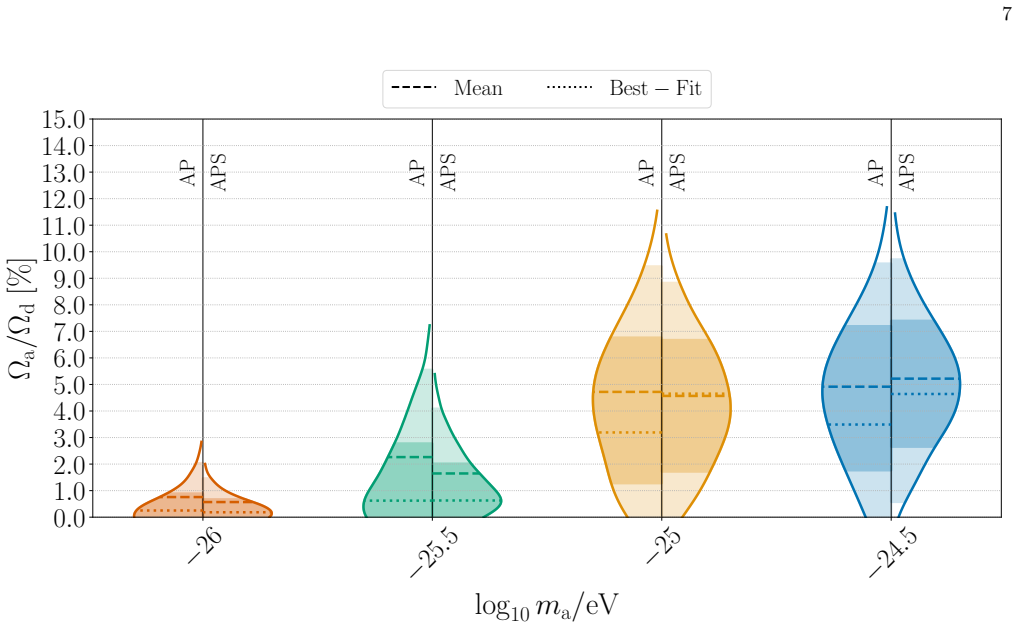
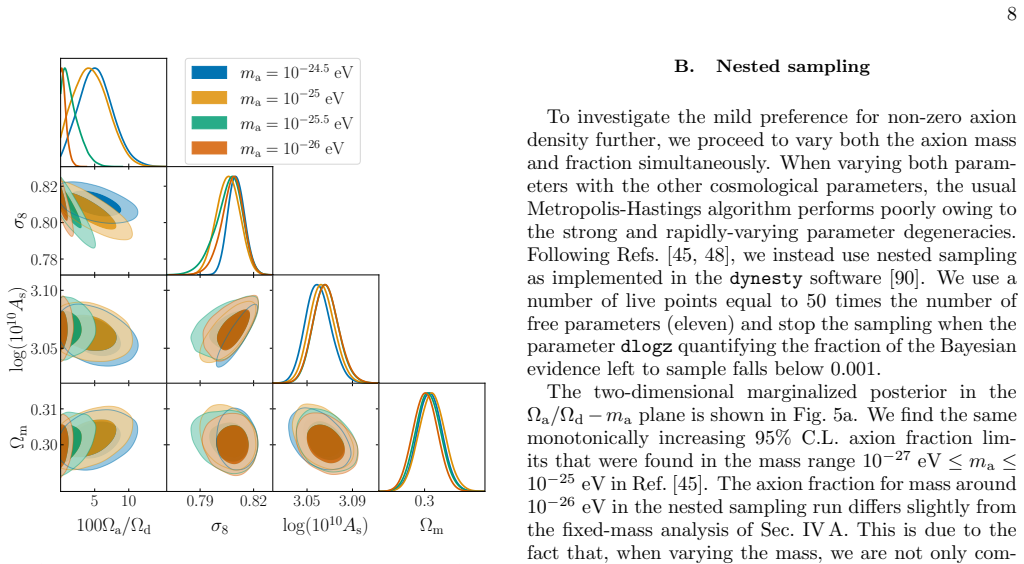
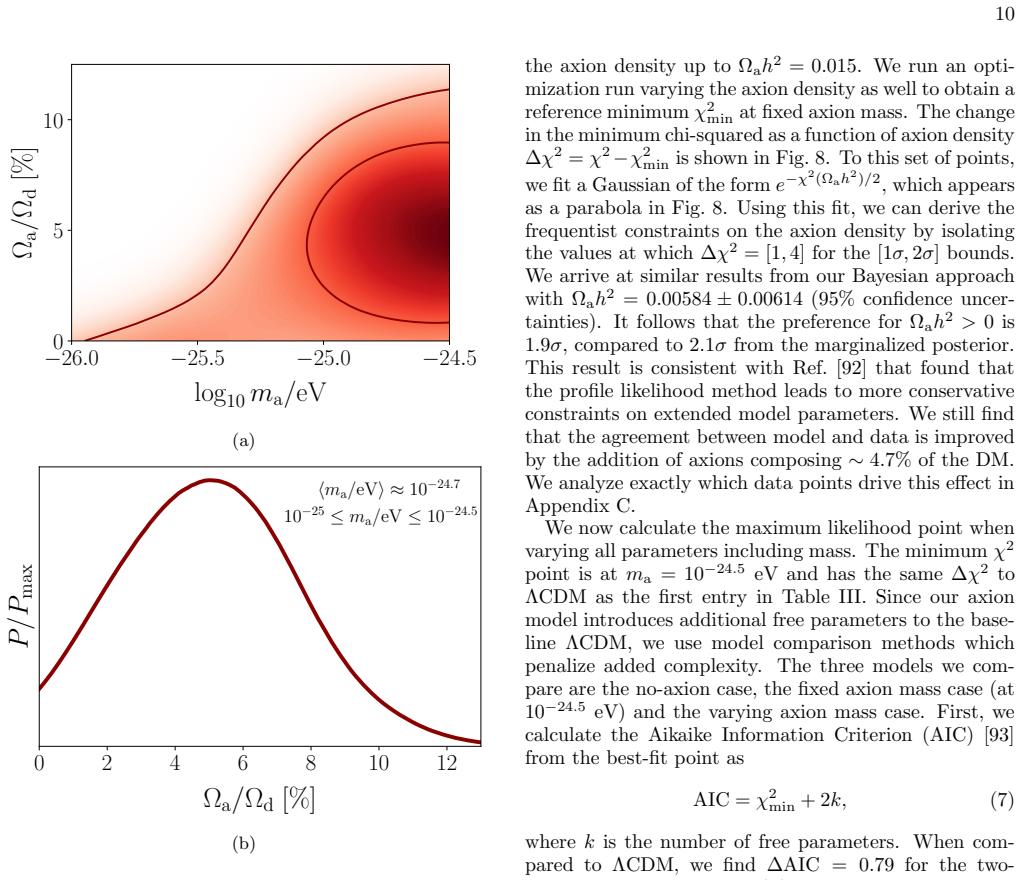
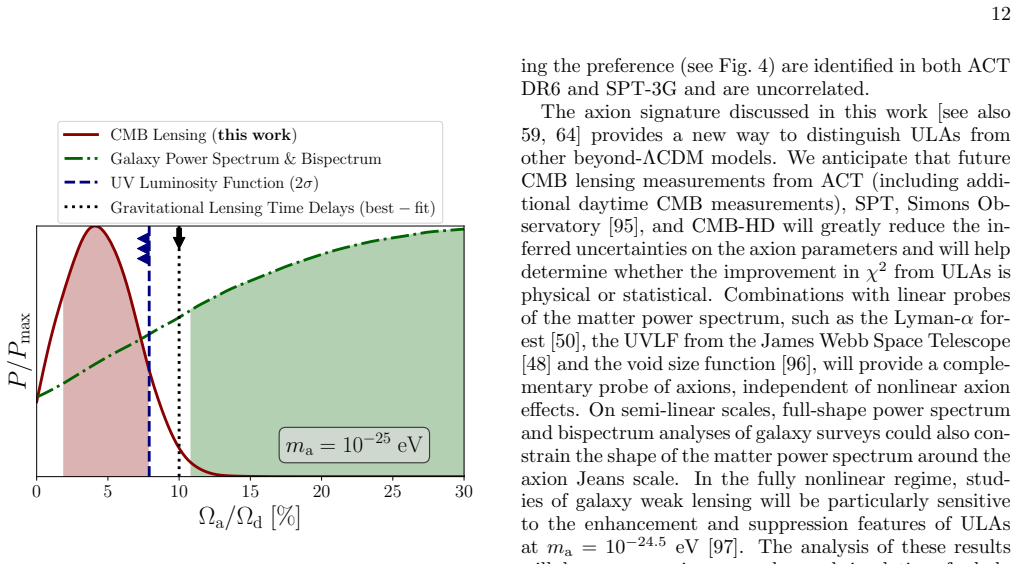
Fitting CMB lensing data with a simulation-calibrated nonlinear clustering model for ultralight axions yields the strongest constraints to date in the 10^{-26} eV to 10^{-24.5} eV mass range, with ULAs at 10^{-26} eV making up less than 1.5 percent of dark matter and those at 10^{-25} eV less than 9 percent at 95 percent , plus a 2.1 sigma preference for nonzero density at 10^{-24.5} eV that requires further checks on nonlinear modeling.
What carries the argument
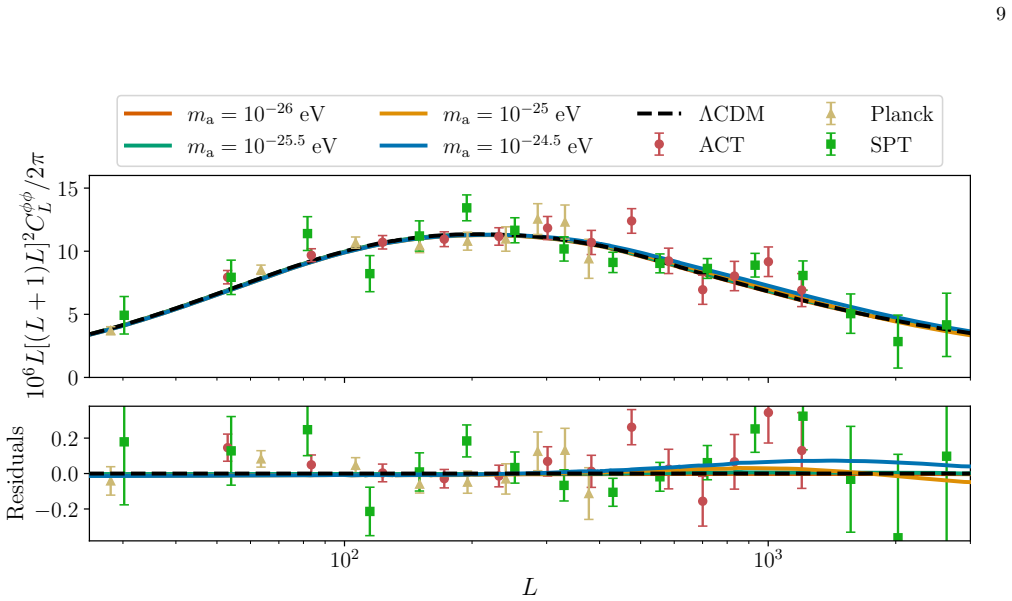
A state-of-the-art simulation-calibrated nonlinear clustering model for ultralight axions applied to combined Planck, ACT, and SPT-3G gravitational lensing measurements.
If this is right
- ULAs at 10^{-26} eV cannot exceed 1.5 percent of the total dark matter density.
- ULAs at 10^{-25} eV cannot exceed 9 percent of the total dark matter density.
- A 2.1 sigma hint for nonzero ULA density exists at 10^{-24.5} eV but appears driven by limited data points.
- Further investigation of nonlinear ULA physics is required to confirm or rule out any signal.
Where Pith is reading between the lines
- These limits reduce the parameter space in which ULAs could alleviate tensions between different measures of matter clustering.
- Future high-resolution lensing surveys could test whether the mild preference at 10^{-24.5} eV persists.
- Independent checks on the nonlinear clustering model would strengthen or weaken the derived bounds.
Load-bearing premise
The simulation-calibrated nonlinear clustering model for ultralight axions accurately describes the lensing data in the fitted mass range without unmodeled systematics that could produce the reported preference.
What would settle it
New lensing measurements or refined nonlinear simulations that remove the 2.1 sigma preference at 10^{-24.5} eV or produce significantly tighter upper limits on the axion fraction.
Figures




read the original abstract
Ultralight axions (ULAs) are well-motivated dark matter particle candidates that arise in many extensions of the Standard Model of particle physics. ULAs with mass $m_\mathrm{a} \lesssim 10^{-27}$ eV have been strongly constrained by cosmic microwave background (CMB) observations in temperature and polarization. We fit recent measurements of gravitational lensing of the CMB from \textit{Planck}, the Atacama Cosmology Telescope (ACT) and the South Pole Telescope (SPT-3G) using a state-of-the-art simulation-calibrated nonlinear clustering model for ULAs. We derive the strongest constraints on ULAs in the mass range $10^{-26}\;\mathrm{eV}\leq m_\mathrm{a}\leq 10^{-24.5}\;\mathrm{eV}$. ULAs of this mass have been shown to alleviate tensions between inferences of the matter clustering if they compose a few percent of the total dark matter content of the Universe. We conclude that ULAs with a mass of $10^{-26}$ eV make up less than 1.5\% of the dark matter and $10^{-25}$ eV axions make less than 9\% (both at 95\% confidence level). We identify a slight preference for non-zero axion density at $10^{-24.5}$ eV at $2.1\sigma$. We find that the preference for ULAs is largely driven by a few data points and that further investigation of non-linear ULA physics is needed to confirm or rule out this signal.
Editorial analysis
A structured set of objections, weighed in public.
Referee Report
Summary. The manuscript fits recent CMB lensing power spectrum measurements from Planck, ACT, and SPT-3G to a simulation-calibrated nonlinear clustering model for ultralight axions (ULAs). It derives 95% CL upper limits on the ULA dark matter fraction f_a of <1.5% at m_a = 10^{-26} eV and <9% at m_a = 10^{-25} eV, reports a 2.1σ preference for nonzero f_a at m_a = 10^{-24.5} eV, and notes that this preference is largely driven by a few data points while calling for further validation of the nonlinear ULA physics.
Significance. If the nonlinear model holds, the work supplies the tightest constraints to date on ULAs in the 10^{-26}–10^{-24.5} eV window, a range where even a few-percent ULA fraction has been proposed to ease the S8 tension. The combination of three independent lensing datasets and the use of a simulation-calibrated nonlinear prescription represent clear technical strengths that extend beyond linear-theory CMB bounds on lighter axions.
major comments (1)
- [Abstract] Abstract: The 2.1σ preference for nonzero axion density at 10^{-24.5} eV is presented together with the explicit statement that it 'is largely driven by a few data points' and that 'further investigation of non-linear ULA physics is needed to confirm or rule out this signal.' Because this caveat directly affects the interpretation of the reported preference, the manuscript should either supply the requested robustness tests (e.g., alternative nonlinear prescriptions or linear-theory comparisons in the relevant mass range) or relegate the preference to a tentative indication rather than a highlighted result.
Simulated Author's Rebuttal
We thank the referee for their careful reading of the manuscript and for the constructive feedback. We respond to the major comment below.
read point-by-point responses
-
Referee: [Abstract] Abstract: The 2.1σ preference for nonzero axion density at 10^{-24.5} eV is presented together with the explicit statement that it 'is largely driven by a few data points' and that 'further investigation of non-linear ULA physics is needed to confirm or rule out this signal.' Because this caveat directly affects the interpretation of the reported preference, the manuscript should either supply the requested robustness tests (e.g., alternative nonlinear prescriptions or linear-theory comparisons in the relevant mass range) or relegate the preference to a tentative indication rather than a highlighted result.
Authors: We agree with the referee that the 2.1σ preference must be presented with appropriate caution given the explicit caveats already noted in the abstract. While the current abstract states that the signal is largely driven by a few data points and requires further investigation of nonlinear ULA physics, we will revise the abstract to relegate this preference to a tentative indication rather than a highlighted result, with the upper limits emphasized as the primary findings. We will also expand the discussion section to provide additional context on the limitations of the nonlinear model in this mass range. We do not have additional robustness tests (such as alternative nonlinear prescriptions or direct linear-theory comparisons) available to include at this stage. revision: yes
Circularity Check
No significant circularity: constraints derived from external model fit to independent data
full rationale
The paper obtains ULA density upper limits and a marginal preference by fitting Planck+ACT+SPT-3G lensing data to a pre-existing simulation-calibrated nonlinear clustering model. This is a standard parameter estimation step whose outputs are not equivalent to the model inputs by construction, nor do they rely on load-bearing self-citations or ansatzes imported from the authors' prior work. The abstract explicitly flags the need for further model validation, confirming the result is data-driven rather than tautological.
Axiom & Free-Parameter Ledger
free parameters (2)
- ULA mass m_a
- ULA density fraction f_a
axioms (2)
- domain assumption Standard Lambda-CDM cosmology modified by ULA clustering
- domain assumption Simulation-calibrated nonlinear ULA clustering model is accurate
Reference graph
Works this paper leans on
-
[1]
and the void size function [96], will provide a comple- mentary probe of axions, independent of nonlinear axion effects. On semi-linear scales, full-shape power spectrum and bispectrum analyses of galaxy surveys could also con- strain the shape of the matter power spectrum around the axion Jeans scale. In the fully nonlinear regime, stud- ies of galaxy we...
2025
-
[2]
R. D. Peccei and H. R. Quinn, Phys. Rev. Lett.38, 1440 (1977)
1977
-
[3]
Preskill, M
J. Preskill, M. B. Wise, and F. Wilczek, Physics Letters B120, 127 (1983)
1983
-
[4]
L. F. Abbott and P. Sikivie, Physics Letters B120, 133 (1983)
1983
-
[5]
Dine and W
M. Dine and W. Fischler, Physics Letters B120, 137 (1983)
1983
-
[6]
Weinberg, Phys
S. Weinberg, Phys. Rev. Lett.40, 223 (1978)
1978
-
[7]
Wilczek, Phys
F. Wilczek, Phys. Rev. Lett.40, 279 (1978)
1978
-
[8]
Witten, Physics Letters B149, 351 (1984)
E. Witten, Physics Letters B149, 351 (1984)
1984
-
[9]
P. Svrcek and E. Witten, Journal of High Energy Physics2006, 051 (2006), hep-th/0605206
Pith/arXiv arXiv 2006
-
[10]
A. Arvanitaki, S. Dimopoulos, S. Dubovsky, N. Kaloper, and J. March-Russell, Phys. Rev. D 81, 123530 (2010), 0905.4720
Pith/arXiv arXiv 2010
-
[11]
B. Samir Acharya, K. Bobkov, and P. Kumar, Journal of High Energy Physics2010, 105 (2010), 1004.5138
Pith/arXiv arXiv 2010
-
[12]
J. P. Conlon, Journal of High Energy Physics2006, 078 (2006), hep-th/0602233
Pith/arXiv arXiv 2006
-
[13]
M. Cicoli, M. D. Goodsell, and A. Ringwald, Journal of High Energy Physics2012, 146 (2012), 1206.0819
Pith/arXiv arXiv 2012
- [14]
-
[15]
V. M. Mehta, M. Demirtas, C. Long, D. J. E. Marsh, L. McAllister, and M. J. Stott, J. Cosmology Astropart. Phys.2021, 033 (2021), 2103.06812
arXiv 2021
-
[16]
N. Gendler, D. J. E. Marsh, L. McAllister, and J. Moritz, J. Cosmology Astropart. Phys.2024, 071 (2024), 2309.13145
arXiv 2024
-
[17]
M. Demirtas, A. Rios-Tascon, and L. McAllister, arXiv e-prints arXiv:2211.03823 (2022), 2211.03823
arXiv 2022
-
[18]
T. C. Bachlechner, K. Eckerle, O. Janssen, and M. Kle- ban, Phys. Rev. D98, 061301 (2018)
2018
-
[19]
E. Sheridan, F. Carta, N. Gendler, M. Jain, D. J. E. Marsh, L. McAllister, N. Righi, K. K. Rogers, and A. Schachner, JHEP09, 016 (2025), 2412.12012
arXiv 2025
-
[20]
M. Demirtas, C. Long, L. McAllister, and M. Stillman, arXiv e-prints arXiv:1808.01282 (2018), 1808.01282
Pith/arXiv arXiv 2018
-
[21]
N. Gendler and D. J. E. Marsh, arXiv e-prints arXiv:2407.07143 (2024), 2407.07143
arXiv 2024
-
[22]
M. Demirtas, N. Gendler, C. Long, L. McAllister, and J. Moritz, Journal of High Energy Physics2023, 92 (2023), 2112.04503
arXiv 2023
-
[23]
J. N. Benabou, K. Fraser, M. Reig, and B. R. Safdi, Phys. Rev. D112, 066003 (2025), 2505.15884
arXiv 2025
-
[24]
J. Cheng and N. Gendler, Journal of High Energy Physics2025, 12 (2025), 2507.12516
arXiv 2025
-
[25]
Z. Yin, H. Cheng, E. Di Valentino, N. Gendler, D. J. E. Marsh, and L. Visinelli, arXiv e-prints arXiv:2507.03535 (2025), 2507.03535
arXiv 2025
-
[26]
N. MacFadden, A. Schachner, and E. Sheridan, Fortschritte der Physik74, 70060 (2026), 2405.08871
Pith/arXiv arXiv 2026
-
[27]
S. Vander Ploeg Fallon, J. Halverson, L. McAllister, and Y. Zhu, arXiv e-prints arXiv:2511.20458 (2025), 2511.20458
arXiv 2025
-
[28]
M. Jain, E. Sheridan, D. J. E. Marsh, E. Heyes, K. K. Rogers, and A. Schachner, arXiv e-prints arXiv:2512.00144 (2025), 2512.00144
arXiv 2025
- [29]
-
[30]
V. Irˇ siˇ c, M. Viel, M. G. Haehnelt, J. S. Bolton, and G. D. Becker, Phys. Rev. Lett.119, 031302 (2017), 1703.04683
Pith/arXiv arXiv 2017
-
[31]
E. Armengaud, N. Palanque-Delabrouille, C. Y` eche, D. J. E. Marsh, and J. Baur, MNRAS471, 4606 (2017), 1703.09126
Pith/arXiv arXiv 2017
-
[32]
K. K. Rogers and H. V. Peiris, Phys. Rev. D103, 043526 (2021), 2007.13751
arXiv 2021
-
[33]
K. K. Rogers and H. V. Peiris, Phys. Rev. Lett.126, 071302 (2021), 2007.12705
arXiv 2021
-
[34]
M. Dentler, D. J. E. Marsh, R. Hloˇ zek, A. Lagu¨ e, K. K. Rogers, and D. Grin, MNRAS515, 5646 (2022), 2111.01199
arXiv 2022
- [35]
-
[36]
E. O. Nadler, R. An, V. Gluscevic, A. Benson, and X. Du, ApJ986, 127 (2025), 2410.03635
arXiv 2025
-
[37]
A. X. Gonz´ alez-Morales, D. J. E. Marsh, J. Pe˜ narrubia, and L. A. Ure˜ na-L´ opez, MNRAS472, 1346 (2017), 1609.05856
Pith/arXiv arXiv 2017
-
[38]
D. J. E. Marsh and J. C. Niemeyer, Phys. Rev. Lett. 123, 051103 (2019), 1810.08543
arXiv 2019
-
[39]
T. Zimmermann, J. Alvey, D. J. E. Marsh, M. Fairbairn, and J. I. Read, Phys. Rev. Lett.134, 151001 (2025), 14 2405.20374
arXiv 2025
-
[40]
L. Teodori, A. Caputo, and K. Blum, Phys. Rev. D113, 023055 (2026), 2501.07631
arXiv 2026
-
[41]
E. O. Nadler, M. A. Amin, R. H. Wechsler, M. S. Delos, A. Benson, and V. Gluscevic, arXiv e-prints arXiv:2605.15371 (2026), 2605.15371
Pith/arXiv arXiv 2026
- [42]
-
[43]
S. May, N. Dalal, and A. Kravtsov, arXiv e-prints arXiv:2509.02781 (2025), 2509.02781
arXiv 2025
-
[44]
M. A. Amin and M. Mirbabayi, Phys. Rev. Lett.132, 221004 (2024), 2211.09775
arXiv 2024
-
[45]
M. J. Stott, D. J. E. Marsh, C. Pongkitivanichkul, L. C. Price, and B. S. Acharya, Phys. Rev. D96, 083510 (2017), 1706.03236
Pith/arXiv arXiv 2017
-
[46]
R. Hlozek, D. Grin, D. J. E. Marsh, and P. G. Ferreira, Phys. Rev. D91, 103512 (2015), 1410.2896
Pith/arXiv arXiv 2015
-
[47]
A. Lagu¨ e, J. R. Bond, R. Hloˇ zek, K. K. Rogers, D. J. E. Marsh, and D. Grin, J. Cosmology Astropart. Phys. 2022, 049 (2022), 2104.07802
arXiv 2022
-
[48]
K. K. Rogers, R. Hloˇ zek, A. Lagu¨ e, M. M. Ivanov, O. H. E. Philcox, G. Cabass, K. Akitsu, and D. J. E. Marsh, J. Cosmology Astropart. Phys.2023, 023 (2023), 2301.08361
arXiv 2023
- [49]
-
[50]
T. Kobayashi, R. Murgia, A. De Simone, V. Irˇ siˇ c, and M. Viel, Phys. Rev. D96, 123514 (2017), 1708.00015
Pith/arXiv arXiv 2017
-
[51]
K. K. Rogers and V. Poulin, Phys. Rev. Res.7, L012018 (2025), 2311.16377
arXiv 2025
-
[52]
K. Perez Sarmiento, A. Lagu¨ e, M. S. Madhavacheril, B. Jain, and B. Sherwin, Phys. Rev. D112, 063510 (2025), 2502.06687
arXiv 2025
-
[53]
A. Amon and G. Efstathiou, Monthly Notices of the Royal Astronomical Society516, 5355 (2022), ISSN 0035-8711, https://academic.oup.com/mnras/article- pdf/516/4/5355/46130148/stac2429.pdf, URL https://doi.org/10.1093/mnras/stac2429
- [54]
-
[55]
L. Bigwood, A. Amon, A. Schneider, J. Salcido, I. G. McCarthy, C. Preston, D. Sanchez, D. Sijacki, E. Schaan, S. Ferraro, et al., MNRAS534, 655 (2024), 2404.06098
arXiv 2024
- [56]
-
[57]
N. Dalal, C.-H. To, C. Hirata, T. Hyeon-Shin, M. Hilton, S. Pandey, and J. Richard Bond, J. Cosmology As- tropart. Phys.2026, 036 (2026), 2507.04476
arXiv 2026
-
[58]
P. Popesso, A. Biviano, I. Marini, K. Dolag, S. Vladutescu-Zopp, B. Csizi, V. Biffi, G. Lamer, A. Robothan, M. Bravo, et al., A&A707, A362 (2026), 2411.16555
arXiv 2026
-
[59]
A. H. Wright, B. St¨ olzner, M. Asgari, M. Bilicki, B. Giblin, C. Heymans, H. Hildebrandt, H. Hoekstra, B. Joachimi, K. Kuijken, et al., A&A703, A158 (2025), 2503.19441
Pith/arXiv arXiv 2025
-
[60]
L. Gaughan, A. M. Green, and A. Moss, arXiv e-prints arXiv:2605.12054 (2026), 2605.12054
Pith/arXiv arXiv 2026
-
[61]
E. Calabrese, J. C. Hill, H. T. Jense, A. La Posta, I. Abril-Cabezas, G. E. Addison, P. A. R. Ade, S. Aiola, T. Alford, D. Alonso, et al., J. Cosmology Astropart. Phys.2025, 063 (2025), 2503.14454
Pith/arXiv arXiv 2025
-
[62]
D. J. E. Marsh and J. Silk, MNRAS437, 2652 (2014), 1307.1705
Pith/arXiv arXiv 2014
-
[63]
A. Lagu¨ e, B. Schwabe, R. Hloˇ zek, D. J. E. Marsh, and K. K. Rogers, Phys. Rev. D109, 043507 (2024), 2310.20000
arXiv 2024
-
[64]
S. M. L. Vogt, D. J. E. Marsh, and A. Lagu¨ e, Phys. Rev. D107, 063526 (2023), 2209.13445
arXiv 2023
-
[65]
T. Dome, S. May, A. Lagu¨ e, D. J. E. Marsh, S. John- ston, S. Bose, A. Tocher, and A. Fialkov, MNRAS537, 252 (2025), 2409.11469
arXiv 2025
-
[66]
F. McCarthy, J. C. Hill, and M. S. Madhavacheril, Phys. Rev. D105, 023517 (2022), 2103.05582
arXiv 2022
-
[67]
C. Trendafilova, A. R. Khalife, and S. Galli, J. Cosmol- ogy Astropart. Phys.2025, 094 (2025), 2502.19383
arXiv 2025
-
[68]
R. Liu, W. Hu, and D. Grin, Phys. Rev. D112, 023513 (2025), 2412.15192
arXiv 2025
-
[69]
A. J. Mead, S. Brieden, T. Tr¨ oster, and C. Heymans, Monthly Notices of the Royal Astronomical Society502, 1401–1422 (2021), ISSN 1365-2966, URLhttp://dx. doi.org/10.1093/mnras/stab082
-
[70]
E. Massara, F. Villaescusa-Navarro, and M. Viel, J. Cos- mology Astropart. Phys.2014, 053 (2014), 1410.6813
Pith/arXiv arXiv 2014
-
[71]
Johnston (2026), in preparation
S. Johnston (2026), in preparation
2026
-
[72]
B. Schwabe, J. C. Niemeyer, and J. F. Engels, Phys. Rev. D94, 043513 (2016), 1606.05151
Pith/arXiv arXiv 2016
-
[73]
Y. F. Wang, arXiv e-prints arXiv:2604.06038 (2026), 2604.06038
Pith/arXiv arXiv 2026
- [74]
-
[75]
A. Lewis and A. Challinor, Phys. Rep.429, 1 (2006), astro-ph/0601594
Pith/arXiv arXiv 2006
-
[76]
A. Spurio Mancini, D. Piras, J. Alsing, B. Joachimi, and M. P. Hobson, MNRAS511, 1771 (2022), 2106.03846
arXiv 2022
-
[77]
Planck Collaboration, N. Aghanim, Y. Akrami, M. Ash- down, J. Aumont, C. Baccigalupi, M. Ballardini, A. J. Banday, R. B. Barreiro, N. Bartolo, et al., A&A641, A5 (2020), 1907.12875
Pith/arXiv arXiv 2020
-
[78]
T. Louis, A. La Posta, Z. Atkins, H. T. Jense, I. Abril- Cabezas, G. E. Addison, P. A. R. Ade, S. Aiola, T. Al- ford, D. Alonso, et al., J. Cosmology Astropart. Phys. 2025, 062 (2025), 2503.14452
Pith/arXiv arXiv 2025
-
[79]
S. Naess et al. (Atacama Cosmology Telescope), JCAP 11, 061 (2025), 2503.14451
arXiv 2025
-
[80]
L. Pagano, J.-M. Delouis, S. Mottet, J.-L. Puget, and L. Vibert, A&A635, A99 (2020), 1908.09856
arXiv 2020
discussion (0)
Sign in with ORCID, Apple, or X to comment. Anyone can read and Pith papers without signing in.