A superconducting surface-code processor with lattice-surgery logical operations
Pith reviewed 2026-06-28 00:36 UTC · model grok-4.3
The pith
Lattice surgery is realized between two distance-three surface-code logical qubits on a superconducting processor, enabling logical Bell states, a logical Deutsch-Jozsa algorithm, and non-Clifford rotations.
A machine-rendered reading of the paper's core claim, the machinery that carries it, and where it could break.
Core claim
The authors experimentally realize lattice-surgery operations between two distance-three surface-code logical qubits on a planar superconducting processor. During repeated syndrome extraction cycles the logical qubits exhibit per-cycle error rates of 0.0365(2) and 0.0282(1) after leakage events are rejected. By leveraging joint initialization and lattice splitting they deterministically prepare a logical Bell state and confirm genuine bipartite entanglement via error-corrected logical state fidelity. They further execute a two-qubit Deutsch-Jozsa algorithm at the logical level and implement magic-state injection and gate teleportation to realize continuous non-Clifford rotations about the lo
What carries the argument
Lattice surgery, the merging and splitting of surface-code patches to perform logical entangling operations and measurements between logical qubits.
If this is right
- Logical Bell states can be prepared deterministically with verified genuine bipartite entanglement at the logical level.
- A two-qubit algorithm can be executed entirely at the logical level inside a fault-tolerant framework.
- Continuous non-Clifford rotations about the logical X axis become accessible through magic-state injection and gate teleportation.
- Per-cycle logical error rates near 0.03 are achieved after leakage rejection during syndrome extraction.
- Lattice surgery functions as a practical method for logical computation in near-term surface-code superconducting architectures.
Where Pith is reading between the lines
- The same lattice-surgery protocol could be extended to entangle three or more logical qubits without requiring fundamentally new hardware.
- Unconditioned error rates would need separate reporting to determine whether the conditioned fidelities translate to always-on operation.
- Repeating the logical Deutsch-Jozsa experiment with larger code distances could test how the observed error rates scale with code size.
- The achieved per-cycle rates suggest that modest reductions in physical leakage could bring the system closer to the surface-code threshold.
Load-bearing premise
That post-selection by rejecting leakage events and conditioning on the absence of detected errors does not introduce significant bias into the reported logical error rates and gate fidelities.
What would settle it
A measurement showing that the reported logical gate fidelity for R_X(π/4) falls below 0.9 when all runs are retained without leakage rejection or conditioning on detected errors.
Figures

read the original abstract
Fault-tolerant logical operations are fundamental for scalable quantum computation. Here, we report the experimental realization of lattice-surgery operations between a pair of distance-three surface-code logical qubits on a planar superconducting processor. During repeated syndrome extraction cycles, the logical qubits exhibit per-cycle error rates of $0.0365(2)$ and $0.0282(1)$, respectively, after leakage events are rejected. By leveraging joint initialization and lattice splitting, we deterministically prepare a logical Bell state, confirming genuine bipartite entanglement via the error-corrected logical state fidelity. We further execute a two-qubit Deutsch-Jozsa algorithm at the logical level to demonstrate algorithmic utility in a fault-tolerant framework. Finally, to achieve universal control, we implement magic-state injection and gate teleportation to realize continuous non-Clifford rotations about the logical $X$ axis. For the logical $R_{X}(\pi/4)$ gate, we achieve a logical gate fidelity of $0.943_{-9}^{+10}$ conditioned on the absence of detected errors. These results establish lattice surgery as a practical and versatile paradigm for logical computation in near-term surface-code architectures, representing a critical milestone toward scalable fault-tolerant quantum advantage in superconducting circuits.
Editorial analysis
A structured set of objections, weighed in public.
Referee Report
Summary. The manuscript reports an experimental demonstration of lattice-surgery operations between two distance-3 surface-code logical qubits on a superconducting processor. Key results include per-cycle logical error rates of 0.0365(2) and 0.0282(1) after leakage rejection, deterministic preparation of a logical Bell state with verified entanglement, execution of a logical Deutsch-Jozsa algorithm, and magic-state injection plus gate teleportation realizing a logical R_X(π/4) rotation with reported fidelity 0.943_{-9}^{+10} conditioned on the absence of detected errors.
Significance. If the post-selection does not introduce bias, the work provides a concrete experimental milestone for lattice-surgery-based logical operations and non-Clifford gates in superconducting surface codes, advancing the practical implementation of fault-tolerant primitives on near-term hardware.
major comments (2)
- [Abstract] Abstract (final paragraph): The headline logical gate fidelity of 0.943_{-9}^{+10} for the magic-state-injected R_X(π/4) is reported only after conditioning on the absence of detected errors (and after rejecting leakage events). No retained-shot fraction, no unconditional fidelity, and no model of undetected errors are provided, so it is impossible to assess whether the conditioning correlates with the logical outcome and inflates the quoted value.
- [Abstract] Abstract (penultimate paragraph): The per-cycle logical error rates 0.0365(2) and 0.0282(1) are stated only after leakage rejection. Without the fraction of shots retained or a comparison of error rates with versus without rejection, the fault-tolerance claims rest on an unquantified post-selection assumption that is load-bearing for the overall narrative of practical lattice surgery.
Simulated Author's Rebuttal
We thank the referee for their careful reading of the manuscript and for highlighting the need for greater transparency around post-selection in the abstract. We address each comment below and will revise the abstract accordingly.
read point-by-point responses
-
Referee: [Abstract] Abstract (final paragraph): The headline logical gate fidelity of 0.943_{-9}^{+10} for the magic-state-injected R_X(π/4) is reported only after conditioning on the absence of detected errors (and after rejecting leakage events). No retained-shot fraction, no unconditional fidelity, and no model of undetected errors are provided, so it is impossible to assess whether the conditioning correlates with the logical outcome and inflates the quoted value.
Authors: We agree that the abstract should explicitly state the retained-shot fraction and the nature of the conditioning so that readers can evaluate potential bias. In the revised version we will add the retained fraction (after leakage rejection and error detection) to the final paragraph of the abstract together with a short clause noting that the fidelity is conditioned on the absence of detected errors. The main text already reports the retained fraction and shows that the logical outcome is not correlated with the detection events beyond the expected heralding; we do not compute an unconditional fidelity because the experiment is designed to operate in the regime where detected errors are rejected, consistent with fault-tolerant operation. A full model of undetected errors lies outside the scope of the present work but is not required for the reported conditioned result. revision: yes
-
Referee: [Abstract] Abstract (penultimate paragraph): The per-cycle logical error rates 0.0365(2) and 0.0282(1) are stated only after leakage rejection. Without the fraction of shots retained or a comparison of error rates with versus without rejection, the fault-tolerance claims rest on an unquantified post-selection assumption that is load-bearing for the overall narrative of practical lattice surgery.
Authors: We accept that the abstract must quantify the post-selection. The revised abstract will include the fraction of shots retained after leakage rejection. The main text already provides both the retained fraction and a direct comparison of logical error rates with and without leakage rejection, demonstrating that the improvement is consistent with removal of leakage-induced errors rather than an artificial bias. These data support the fault-tolerance narrative while making the post-selection explicit. revision: yes
Circularity Check
No circularity: experimental reporting of measured fidelities and error rates
full rationale
The paper reports direct experimental outcomes from a superconducting processor, including per-cycle logical error rates after leakage rejection and a conditioned logical gate fidelity for R_X(π/4). No derivation chain, equations, or first-principles results are present that reduce any claimed quantity to a fitted parameter or self-citation by construction. The central results are raw measurements with statistical uncertainties; post-selection conditioning is an explicit experimental choice rather than a hidden definitional loop. This matches the default expectation of a non-circular experimental manuscript.
Axiom & Free-Parameter Ledger
Forward citations
Cited by 1 Pith paper
-
Vine Codes: Low-Overhead Quantum LDPC Codes on a Planar Square Grid
Vine codes generalize directional codes to open planar boundaries, delivering up to 28% fewer data/measure qubits at circuit distance 7 and better simulated performance than the surface code at 10^{-3} noise while usi...
Reference graph
Works this paper leans on
-
[1]
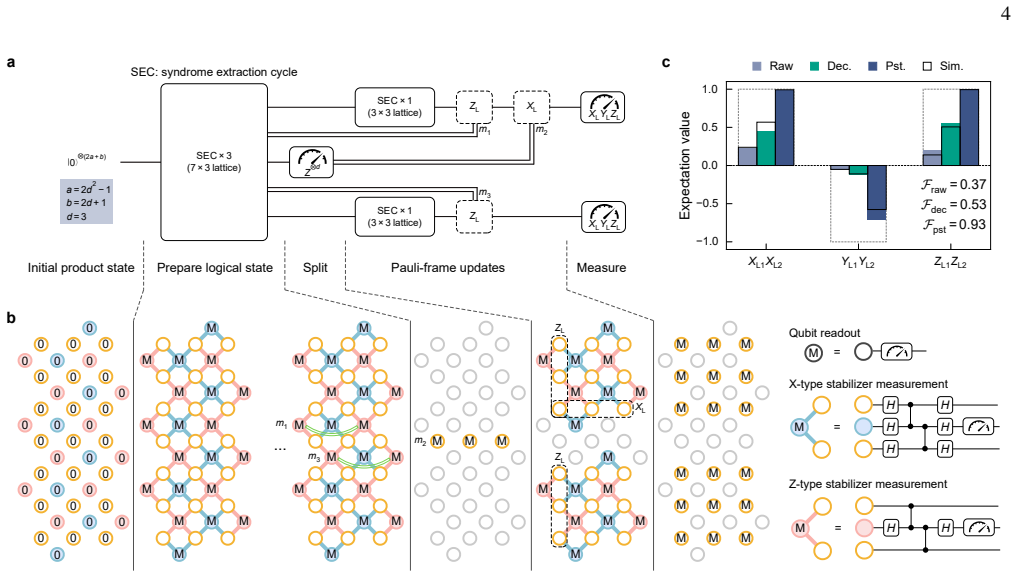
To characterize the fidelity of the generated Bell state, we measure the expectation values of three two-qubit logical op- eratorsX L1XL2,Y L1YL2, andZ L1ZL2 (Fig
Given our initialization in the state|0 L3⟩, which corresponds toα=β= 1/ √ 2in the logicalXbasis, the resulting state is a logical Bell state, |Φ+ L ⟩= (|0 L10L2⟩+|1 L11L2⟩)/ √ 2. To characterize the fidelity of the generated Bell state, we measure the expectation values of three two-qubit logical op- eratorsX L1XL2,Y L1YL2, andZ L1ZL2 (Fig. 2c). The stat...
-
[2]
P. W. Shor, Scheme for reducing decoherence in quantum com- puter memory, Phys. Rev. A52, R2493 (1995)
1995
-
[3]
A. R. Calderbank and P. W. Shor, Good quantum error- correcting codes exist, Phys. Rev. A54, 1098 (1996)
1996
-
[4]
A. M. Steane, Error correcting codes in quantum theory, Phys. Rev. Lett.77, 793 (1996)
1996
-
[5]
Knill and R
E. Knill and R. Laflamme, Theory of quantum error-correcting codes, Phys. Rev. A55, 900 (1997)
1997
-
[6]
B. M. Terhal, Quantum error correction for quantum memories, Rev. Mod. Phys.87, 307 (2015)
2015
-
[7]
Ni et al., Beating the break-even point with a discrete- variable-encoded logical qubit, Nature616, 56 (2023)
Z. Ni et al., Beating the break-even point with a discrete- variable-encoded logical qubit, Nature616, 56 (2023)
2023
-
[8]
N. P. Breuckmann and J. N. Eberhardt, Quantum low-density parity-check codes, PRX Quantum2, 040101 (2021)
2021
-
[9]
Bravyi et al., High-threshold and low-overhead fault-tolerant quantum memory, Nature627, 778 (2024)
S. Bravyi et al., High-threshold and low-overhead fault-tolerant quantum memory, Nature627, 778 (2024)
2024
-
[10]
Wang et al., Demonstration of low-overhead quantum error correction codes, Nat
K. Wang et al., Demonstration of low-overhead quantum error correction codes, Nat. Phys.22, 308 (2026). 7
2026
-
[11]
Kitaev, Fault-tolerant quantum computation by anyons, Ann
A. Kitaev, Fault-tolerant quantum computation by anyons, Ann. Phys.303, 2 (2003)
2003
-
[12]
S. B. Bravyi and A. Y . Kitaev, Quantum codes on a lattice with boundary (1998), arXiv:quant-ph/9811052
Pith/arXiv arXiv 1998
-
[14]
A. G. Fowler, M. Mariantoni, J. M. Martinis, and A. N. Cleland, Surface codes: Towards practical large-scale quantum compu- tation, Phys. Rev. A86, 032324 (2012)
2012
-
[15]
Krinner et al., Realizing repeated quantum error correction in a distance-three surface code, Nature605, 669 (2022)
S. Krinner et al., Realizing repeated quantum error correction in a distance-three surface code, Nature605, 669 (2022)
2022
-
[16]
Acharya et al., Suppressing quantum errors by scaling a sur- face code logical qubit, Nature614, 676 (2023)
R. Acharya et al., Suppressing quantum errors by scaling a sur- face code logical qubit, Nature614, 676 (2023)
2023
-
[17]
He et al., Experimental quantum error correction below the surface code threshold via all-microwave leakage suppression, Phys
T. He et al., Experimental quantum error correction below the surface code threshold via all-microwave leakage suppression, Phys. Rev. Lett.135, 260601 (2025)
2025
-
[18]
Acharya et al., Quantum error correction below the surface code threshold, Nature638, 920 (2025)
R. Acharya et al., Quantum error correction below the surface code threshold, Nature638, 920 (2025)
2025
-
[19]
Zhang et al., Demonstrating quantum error mitigation on logical qubits, Nat
A. Zhang et al., Demonstrating quantum error mitigation on logical qubits, Nat. Commun.17, 1021 (2026)
2026
-
[20]
Ryan-Anderson et al., High-fidelity teleportation of a logical qubit using transversal gates and lattice surgery, Science385, 1327 (2024)
C. Ryan-Anderson et al., High-fidelity teleportation of a logical qubit using transversal gates and lattice surgery, Science385, 1327 (2024)
2024
-
[21]
Bluvstein et al., Logical quantum processor based on recon- figurable atom arrays, Nature626, 58 (2024)
D. Bluvstein et al., Logical quantum processor based on recon- figurable atom arrays, Nature626, 58 (2024)
2024
-
[22]
Bluvstein et al., A fault-tolerant neutral-atom architecture for universal quantum computation, Nature649, 39 (2026)
D. Bluvstein et al., A fault-tolerant neutral-atom architecture for universal quantum computation, Nature649, 39 (2026)
2026
-
[23]
P. W. Shor, Fault-tolerant quantum computation (1997), arXiv:quant-ph/9605011 [quant-ph]
Pith/arXiv arXiv 1997
-
[24]
Krantz, M
P. Krantz, M. Kjaergaard, F. Yan, T. P. Orlando, S. Gustavsson, and W. D. Oliver, A quantum engineer’s guide to superconduct- ing qubits, Appl. Phys. Rev.6, 021318 (2019)
2019
-
[25]
Kjaergaard et al., Superconducting qubits: Current state of play, Annu
M. Kjaergaard et al., Superconducting qubits: Current state of play, Annu. Rev. Condens. Matter Phys.11, 369 (2020)
2020
-
[26]
Horsman, A
D. Horsman, A. G. Fowler, S. Devitt, and R. V . Meter, Surface code quantum computing by lattice surgery, New J. Phys.14, 123011 (2012)
2012
-
[27]
Litinski, A game of surface codes: Large-scale quantum computing with lattice surgery, Quantum3, 128 (2019)
D. Litinski, A game of surface codes: Large-scale quantum computing with lattice surgery, Quantum3, 128 (2019)
2019
-
[28]
Erhard et al., Entangling logical qubits with lattice surgery, Nature589, 220 (2021)
A. Erhard et al., Entangling logical qubits with lattice surgery, Nature589, 220 (2021)
2021
-
[29]
Lacroix et al., Scaling and logic in the colour code on a su- perconducting quantum processor, Nature645, 614 (2025)
N. Lacroix et al., Scaling and logic in the colour code on a su- perconducting quantum processor, Nature645, 614 (2025)
2025
-
[30]
Besedin et al., Lattice surgery realized on two distance-three repetition codes with superconducting qubits, Nat
I. Besedin et al., Lattice surgery realized on two distance-three repetition codes with superconducting qubits, Nat. Phys.22, 189 (2026)
2026
-
[31]
Gulde et al., Implementation of the deutsch-jozsa algorithm on an ion-trap quantum computer, Nature421, 48 (2003)
S. Gulde et al., Implementation of the deutsch-jozsa algorithm on an ion-trap quantum computer, Nature421, 48 (2003)
2003
-
[33]
Ye et al., Logical magic state preparation with fidelity be- yond the distillation threshold on a superconducting quantum processor, Phys
Y . Ye et al., Logical magic state preparation with fidelity be- yond the distillation threshold on a superconducting quantum processor, Phys. Rev. Lett.131, 210603 (2023)
2023
-
[34]
Gühne and G
O. Gühne and G. Tóth, Entanglement detection, Phys. Rep.474, 1 (2009)
2009
-
[36]
H. Xie, N. Yoshioka, K. Tsubouchi, and Y . Li, Simple, efficient, and generic post-selection decoding for qldpc codes (2026), arXiv:2601.17757 [quant-ph]
arXiv 2026
-
[37]
Hutter, J
A. Hutter, J. R. Wootton, and D. Loss, Efficient Markov chain Monte Carlo algorithm for the surface code, Phys. Rev. A89, 022326 (2014)
2014
-
[38]
Bombín, M
H. Bombín, M. Pant, S. Roberts, and K. I. Seetharam, Fault- Tolerant Postselection for Low-Overhead Magic State Prepara- tion, PRX Quantum5, 010302 (2024)
2024
- [39]
-
[40]
S. C. Smith, B. J. Brown, and S. D. Bartlett, Mitigating errors in logical qubits, Commun. Phys.7, 386 (2024)
2024
-
[41]
Bravyi and A
S. Bravyi and A. Kitaev, Universal quantum computation with ideal clifford gates and noisy ancillas, Phys. Rev. A71, 022316 (2005)
2005
-
[42]
Litinski, Magic State Distillation: Not as Costly as You Think, Quantum3, 205 (2019)
D. Litinski, Magic State Distillation: Not as Costly as You Think, Quantum3, 205 (2019)
2019
-
[43]
S. T. Merkel, J. M. Gambetta, J. A. Smolin, S. Poletto, A. D. Córcoles, B. R. Johnson, C. A. Ryan, and M. Steffen, Self- consistent quantum process tomography, Phys. Rev. A87, 062119 (2013)
2013
-
[44]
J. F. Marques et al., Logical-qubit operations in an error- detecting surface code, Nat. Phys.18, 80 (2022)
2022
-
[45]
Magnard et al., Fast and unconditional all-microwave reset of a superconducting qubit, Phys
P. Magnard et al., Fast and unconditional all-microwave reset of a superconducting qubit, Phys. Rev. Lett.121, 060502 (2018)
2018
-
[46]
McEwen et al., Removing leakage-induced correlated er- rors in superconducting quantum error correction, Nat
M. McEwen et al., Removing leakage-induced correlated er- rors in superconducting quantum error correction, Nat. Com- mun.12, 1761 (2021)
2021
-
[47]
J. F. Marques et al., All-microwave leakage reduction units for quantum error correction with superconducting transmon qubits, Phys. Rev. Lett.130, 250602 (2023)
2023
-
[48]
X. Tan, F. Zhang, R. Chao, Y . Shi, and J. Chen, Scalable surface-code decoders with parallelization in time, PRX Quan- tum4, 040344 (2023)
2023
-
[49]
Skoric, D
L. Skoric, D. E. Browne, K. M. Barnes, N. I. Gillespie, and E. T. Campbell, Parallel window decoding enables scalable fault tol- erant quantum computation, Nat. Commun.14, 7040 (2023)
2023
-
[50]
Dennis, A
E. Dennis, A. Kitaev, A. Landahl, and J. Preskill, Topological quantum memory, J. Math. Phys.43, 4452 (2002)
2002
-
[51]
L. Caune et al., Demonstrating real-time and low-latency quantum error correction with superconducting qubits (2024), arXiv:2410.05202 [quant-ph]
arXiv 2024
-
[52]
Bäumer, Efficient long-range entanglement using dynamic circuits, PRX Quantum5, 030339 (2024)
E. Bäumer, Efficient long-range entanglement using dynamic circuits, PRX Quantum5, 030339 (2024)
2024
-
[53]
Y . Zou et al., Teleportation transition of surface codes on a superconducting quantum processor (2026), arXiv:2602.21293 [quant-ph]
arXiv 2026
-
[54]
A superconducting surface-code processor with lattice-surgery logical operations
P. Sales Rodriguez et al., Experimental demonstration of logical magic state distillation, Nature645, 620 (2025). Supplementary Information for “A superconducting surface-code processor with lattice-surgery logical operations” Yanzhe Wang,1,∗ Fanhao Shen,1,∗ Haipeng Xie,2 Aosai Zhang,1 Yu Gao,1 Chuanyu Zhang,1 Xuhao Zhu,1 Feitong Jin,1 Yiren Zou,1 Ning Wa...
2025
-
[55]
We then perform a destructiveX-basis measurementM X on the ancilla and post-select on the outcomeM X = +1
To teleport the gate operation onto the target qubit, we first apply a CNOT gate to entangle the target qubit with the ancilla. We then perform a destructiveX-basis measurementM X on the ancilla and post-select on the outcomeM X = +1. If the target qubit is initially in an arbitrary state |ψ⟩=α|+⟩+β|−⟩, the final state becomes |ψ′⟩= Tr A h P + X,A U A→T C...
-
[56]
Shenet al., A bucket-brigade quantum random access memory, Nat
F. Shenet al., A bucket-brigade quantum random access memory, Nat. Phys.22, 745 (2026)
2026
-
[57]
Meiboom and D
S. Meiboom and D. Gill, Modified spin-echo method for measuring nuclear relaxation times, Review of Scientific Instruments29, 688 (1958)
1958
-
[58]
Motzoi, J
F. Motzoi, J. M. Gambetta, P. Rebentrost, and F. K. Wilhelm, Simple pulses for elimination of leakage in weakly nonlinear qubits, Phys. Rev. Lett.103, 110501 (2009)
2009
-
[59]
Aruteet al., Quantum supremacy using a programmable superconducting processor, Nature574, 505 (2019)
F. Aruteet al., Quantum supremacy using a programmable superconducting processor, Nature574, 505 (2019)
2019
-
[60]
Acharyaet al., Suppressing quantum errors by scaling a surface code logical qubit, Nature614, 676 (2023)
R. Acharyaet al., Suppressing quantum errors by scaling a surface code logical qubit, Nature614, 676 (2023)
2023
-
[61]
Gidney, Stim: a fast stabilizer circuit simulator, Quantum5, 497 (2021)
C. Gidney, Stim: a fast stabilizer circuit simulator, Quantum5, 497 (2021)
2021
-
[62]
Higgott, T
O. Higgott, T. C. Bohdanowicz, A. Kubica, S. T. Flammia, and E. T. Campbell, Improved decoding of circuit noise and fragile boundaries of tailored surface codes, Phys. Rev. X13, 031007 (2023)
2023
-
[63]
McEwenet al., Removing leakage-induced correlated errors in superconducting quantum error correction, Nat
M. McEwenet al., Removing leakage-induced correlated errors in superconducting quantum error correction, Nat. Commun.12, 1761 (2021)
2021
-
[64]
J. F. Marqueset al., All-microwave leakage reduction units for quantum error correction with superconducting transmon qubits, Phys. Rev. Lett.130, 250602 (2023)
2023
-
[65]
A. G. Fowler, M. Mariantoni, J. M. Martinis, and A. N. Cleland, Surface codes: Towards practical large-scale quantum computation, Phys. Rev. A86, 032324 (2012)
2012
discussion (0)
Sign in with ORCID, Apple, or X to comment. Anyone can read and Pith papers without signing in.