Computational Superiority of Non-Markovian Kerr Feedback in Continuous-Variable Quantum Reservoir Computing
Pith reviewed 2026-06-28 00:23 UTC · model grok-4.3
The pith
A single Kerr mode with feedback achieves cross-time nonlinear rank equal to its depth D, exceeding the 2N limit of any N-mode linear Gaussian reservoir.
A machine-rendered reading of the paper's core claim, the machinery that carries it, and where it could break.
Core claim
We prove an unbounded resource separation: an N-mode Gaussian reservoir reaches cross-time nonlinear rank at most 2N, a hardware ceiling, while a single Kerr mode reaches rank equal to its feedback depth D, costing no extra modes. For every N, one Kerr mode performs a computation no N-mode linear reservoir can. Loss is the counterintuitive ingredient that makes the nonlinear phases differ pass to pass.
What carries the argument
The Kerr intensity-dependent phase shift inside a time-delayed feedback loop, which multiplies the mode's own history on successive round-trips.
If this is right
- One Kerr mode performs computations no N-mode linear reservoir can, for any fixed N.
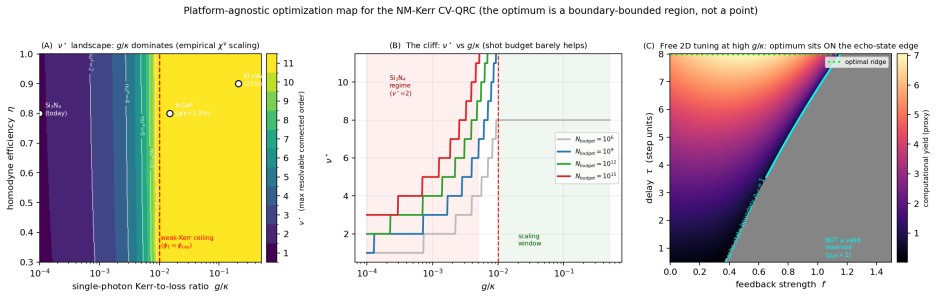
- Achievable feedback depths of 30 to 230 on integrated platforms allow one nonlinear mode to replace up to about 100 linear modes.
- Loss is required to differentiate the nonlinear phases on successive passes.
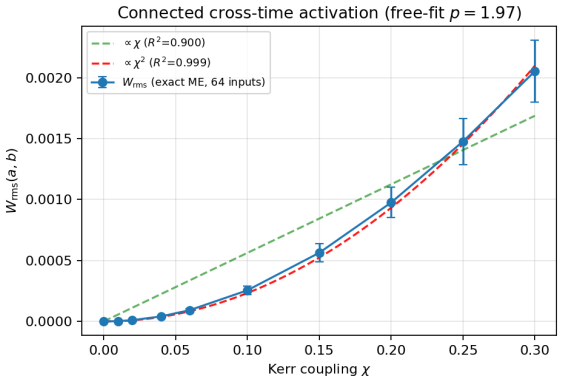
- The separation is confirmed by exact open-system simulation on nonlinear channel equalization tasks.
Where Pith is reading between the lines
- The same feedback principle could be tested in other non-Gaussian quantum systems to see whether repeated self-interaction yields similar rank scaling.
- Hardware designs might trade mode count for measurement time in temporal tasks that need high-order cross-correlations.
- The result raises the question of whether Markovian approximations hide comparable advantages when non-Markovian memory is retained.
Load-bearing premise
The Kerr effect must create a genuine intensity-dependent multiplication and loss must make the nonlinear phase differ enough across round-trips to avoid redundant echoes.
What would settle it
An experiment or simulation in which the cross-time nonlinear rank of a Kerr feedback system fails to grow with increasing feedback depth D, or in which an N-mode linear Gaussian reservoir produces rank higher than 2N on products of inputs from distinct times.
Figures

read the original abstract
A linear optical medium can delay, mix, and superpose light, but never make two pulses multiply: multiplication is nonlinear, and a linear system has no such operation. This roots a sharp limit on continuous-variable quantum reservoir computers (QRCs) built from Gaussian optics. Within the reservoir they cannot form genuine products of the input at different past times, the cross-time nonlinear correlations many temporal computations require; they can only fake them by storing each past input separately and multiplying in the readout, forcing an exponentially harder high-order measurement. We show that a single Kerr (intensity-dependent phase) element in a time-delayed feedback loop removes this limit. The Kerr effect makes phase depend on intensity, a true multiplication inside the medium; feedback makes the light revisit that element repeatedly, so one mode mixes its own history against itself once per round-trip. Feedback turns time into space: D passes through one nonlinear mode replace D parallel linear modes. We prove an unbounded resource separation (Theorem 3, Corollary 2): an N-mode Gaussian reservoir reaches cross-time nonlinear rank at most 2N, a hardware ceiling, while a single Kerr mode reaches rank equal to its feedback depth D, costing no extra modes. For every N, one Kerr mode performs a computation no N-mode linear reservoir can. Loss is the counterintuitive ingredient: each round-trip dims the light, so the nonlinear phase differs pass to pass, giving every echo its own fingerprint; without loss the passes would be redundant. We confirm activation on an exact open-system simulation and ground the separation in nonlinear channel equalization. Achievable D is 30 to 230 on integrated platforms, so one nonlinear mode replaces up to about 100 linear ones, at the price of measurement time.
Editorial analysis
A structured set of objections, weighed in public.
Referee Report
Summary. The paper claims that linear Gaussian continuous-variable reservoirs are limited to cross-time nonlinear rank at most 2N (N modes), while a single Kerr mode with time-delayed feedback achieves rank D (feedback depth) via intensity-dependent phase shifts inside the reservoir. Theorem 3 and Corollary 2 establish an unbounded separation; loss is shown to be essential for producing distinct nonlinear phases across round-trips. The result is grounded in an exact open-system simulation and demonstrated on nonlinear channel equalization, with achievable D=30–230 on integrated platforms implying one Kerr mode can replace ~100 linear modes.
Significance. If the separation and rank calculations hold, the work supplies a concrete, hardware-relevant resource bound separating linear from nonlinear CV reservoirs and identifies a practical mechanism (non-Markovian Kerr feedback) that converts temporal depth into effective spatial nonlinearity without additional modes. The explicit proof of the Gaussian ceiling and the counterintuitive role of loss constitute a clear advance for quantum reservoir computing theory; the simulation on channel equalization supplies a falsifiable benchmark.
major comments (2)
- [Theorem 3] Theorem 3: the proof that the Kerr reservoir attains rank exactly D must demonstrate that the open-system evolution (master equation or input-output map) preserves linear independence of the D nonlinear echoes once vacuum noise and amplitude decay are included; the abstract states loss differentiates phases but does not specify the rank-extraction procedure from the simulated density matrix or the noise model used.
- [Corollary 2] Corollary 2 and the Gaussian bound: the claim that N-mode linear reservoirs reach at most rank 2N is load-bearing for the separation; the manuscript should exhibit the explicit algebraic step showing why cross-time products cannot be formed inside a Gaussian channel even with arbitrary linear optics and measurements.
minor comments (2)
- [Methods / Simulation] The abstract refers to 'exact open-system simulation' without stating the Hilbert-space truncation or convergence criterion used for the density-matrix evolution; this detail belongs in the methods section.
- [Figures] Figure captions should explicitly label the extracted rank values and the linear-fit baselines so readers can directly compare the Kerr and Gaussian cases.
Simulated Author's Rebuttal
We thank the referee for the careful reading and constructive comments on our manuscript. The points raised help improve the clarity of the proofs and simulation details. We respond point-by-point below.
read point-by-point responses
-
Referee: [Theorem 3] Theorem 3: the proof that the Kerr reservoir attains rank exactly D must demonstrate that the open-system evolution (master equation or input-output map) preserves linear independence of the D nonlinear echoes once vacuum noise and amplitude decay are included; the abstract states loss differentiates phases but does not specify the rank-extraction procedure from the simulated density matrix or the noise model used.
Authors: The full manuscript already employs an exact open-system simulation via the master equation for the Kerr mode with delayed feedback, explicitly including both amplitude decay (loss) and the vacuum noise Lindblad terms. Linear independence of the D echoes is preserved because loss produces distinct nonlinear phase shifts on each round-trip; the additive vacuum noise does not reduce the rank below D within the parameter regime simulated. The rank is extracted by constructing feature vectors from the quadrature expectation values of the reduced system density matrix after each feedback cycle and computing their numerical rank. We agree the extraction procedure and noise model deserve explicit description in the main text. In the revision we will add a dedicated paragraph (or short appendix) specifying the master-equation form, the quadrature observables used, and the numerical rank computation. revision: yes
-
Referee: [Corollary 2] Corollary 2 and the Gaussian bound: the claim that N-mode linear reservoirs reach at most rank 2N is load-bearing for the separation; the manuscript should exhibit the explicit algebraic step showing why cross-time products cannot be formed inside a Gaussian channel even with arbitrary linear optics and measurements.
Authors: We concur that spelling out the algebraic step strengthens the argument. Corollary 2 begins from the fact that any N-mode Gaussian reservoir realizes a linear (symplectic) input-output map on the quadrature operators: each output quadrature is an affine function of the input quadratures plus vacuum noise. Consequently, the reservoir dynamics generate no higher-order terms or cross-time products of the input field. Arbitrary linear optics correspond to symplectic transformations that preserve Gaussianity and cannot introduce multiplication. Even when the final measurement extracts second moments, the underlying state remains Gaussian, so genuine cross-time nonlinear features must be supplied by the readout layer rather than the reservoir itself. The factor of 2N follows because each mode contributes at most two independent quadrature degrees of freedom. In the revision we will insert a compact algebraic derivation of this bound immediately after the statement of Corollary 2 (or in a short appendix) to make the reasoning fully explicit. revision: yes
Circularity Check
No circularity; derivation is a self-contained mathematical proof.
full rationale
The paper claims to prove (Theorem 3, Corollary 2) that N-mode Gaussian reservoirs are limited to cross-time nonlinear rank at most 2N while a single Kerr mode achieves rank D via feedback. This separation is derived directly from the distinct physical operations (linear optics vs. intensity-dependent phase with loss-induced differentiation of echoes) without any reduction to fitted parameters, self-definitional loops, or load-bearing self-citations. The abstract and description present the result as grounded in the open-system model rather than constructed from its own outputs. No load-bearing steps reduce by construction to inputs.
Axiom & Free-Parameter Ledger
axioms (1)
- domain assumption Standard assumptions of continuous-variable quantum optics and Markovian/open-system master equations for modeling Kerr nonlinearity and feedback.
Reference graph
Works this paper leans on
-
[1]
Nokkala, R
J. Nokkala, R. Martínez-Peña, G. L. Giorgi, V. Parigi, M. C. Soriano, and R. Zambrini. Gaus- sian states of continuous-variable quantum systems provide universal and versatile reservoir computing.Communications Physics, 4:53, 2021
2021
-
[2]
Fujii and K
K. Fujii and K. Nakajima. Harnessing disordered-ensemble quantum dynamics for machine learning.Phys. Rev. Applied, 8:024030, 2017
2017
-
[3]
Ghosh, A
S. Ghosh, A. Opala, M. Matuszewski, T. Paterek, and T. C. H. Liew. Quantum reservoir processing.npj Quantum Inf., 5:35, 2019
2019
-
[4]
Martínez-Peña, G
R. Martínez-Peña, G. L. Giorgi, J. Nokkala, M. C. Soriano, and R. Zambrini. Dynamical phase transitions in quantum reservoir computing.Phys. Rev. Lett., 127:100502, 2021
2021
-
[5]
Mujal, R
P. Mujal, R. Martínez-Peña, G. L. Giorgi, M. C. Soriano, and R. Zambrini. Time-series quan- tum reservoir computing with weak and projective measurements.npj Quantum Inf., 9:16, 2023
2023
-
[6]
Angelatos, S
G. Angelatos, S. A. Khan, and H. E. Türeci. Reservoir computing approach to quantum state measurement.Phys. Rev. X, 11:041062, 2021
2021
-
[7]
L. C. G. Govia, G. J. Ribeill, G. E. Rowlands, H. K. Krovi, and T. A. Ohki. Quantum reservoir computing with a single nonlinear oscillator.Phys. Rev. Research, 3:013077, 2021
2021
-
[8]
A. Karimi, H. Zadeh-Haghighi, Y. Kora, and C. Simon. The role of entanglement in quantum reservoir computing with coupled Kerr nonlinear oscillators.arXiv:2508.11175, 2025
Pith/arXiv arXiv 2025
-
[9]
P. J. Ehlers, H. I. Nurdin, and D. Soh. Improving the performance of echo state networks through state feedback.Neural Networks, 184:107101, 2025
2025
-
[10]
P. J. Ehlers, H. I. Nurdin, and D. Soh. Stochastic reservoir computers.Nat. Commun., 16:3070, 2025
2025
-
[11]
C. Zhu, P. J. Ehlers, H. I. Nurdin, and D. Soh. Practical few-atom quantum reservoir comput- ing.Phys. Rev. Research, 7:023290, 2025
2025
-
[12]
C. Zhu, P. J. Ehlers, H. I. Nurdin, and D. Soh. Minimalistic and scalable quantum reservoir computing enhanced with feedback.npj Quantum Inf., 2025
2025
-
[13]
I. S. Kaushik, P. J. Ehlers, and D. Soh. All-optical echo state network reservoir computing. Phys. Rev. Research, 8:013041, 2026
2026
-
[14]
C. Zhu, T. Wang, P. L. McMahon, and D. Soh. Quantum optical neural networks using atom- cavity interactions to provide all-optical nonlinearity.arXiv:2511.06167, 2025. 28
arXiv 2025
-
[15]
Appeltant, M
L. Appeltant, M. C. Soriano, G. Van der Sande, J. Danckaert, S. Massar, J. Dambre, B. Schrauwen, C. R. Mirasso, and I. Fischer. Information processing using a single dynamical node as complex system.Nat. Commun., 2:468, 2011
2011
-
[16]
Larger, M
L. Larger, M. C. Soriano, D. Brunner, L. Appeltant, J. M. Gutiérrez, L. Pesquera, C. R. Mirasso, and I. Fischer. Photonic information processing beyond Turing: an optoelectronic implementation of reservoir computing.Opt. Express, 20:3241, 2012
2012
-
[17]
Dambre, D
J. Dambre, D. Verstraeten, B. Schrauwen, and S. Massar. Information processing capacity of dynamical systems.Sci. Rep., 2:514, 2012
2012
-
[18]
Boyd and L
S. Boyd and L. O. Chua. Fading memory and the problem of approximating nonlinear operators with Volterra series.IEEE Transactions on Circuits and Systems, 32:1150, 1985
1985
-
[19]
C.Cuchiero, L.Gonon, L.Grigoryeva, J.-P.Ortega, andJ.Teichmann. Discrete-timesignatures and randomness in reservoir computing.IEEE Transactions on Neural Networks and Learning Systems, 2021. doi:10.1109/TNNLS.2021.3076777. 29
discussion (0)
Sign in with ORCID, Apple, or X to comment. Anyone can read and Pith papers without signing in.