Lightfall: An API-first, LLM-addressable control platform for synchrotron beamlines
Pith reviewed 2026-06-27 22:37 UTC · model grok-4.3
The pith
Lightfall lets beamline scientists modify control interfaces through natural language to an embedded LLM agent.
A machine-rendered reading of the paper's core claim, the machinery that carries it, and where it could break.
Core claim
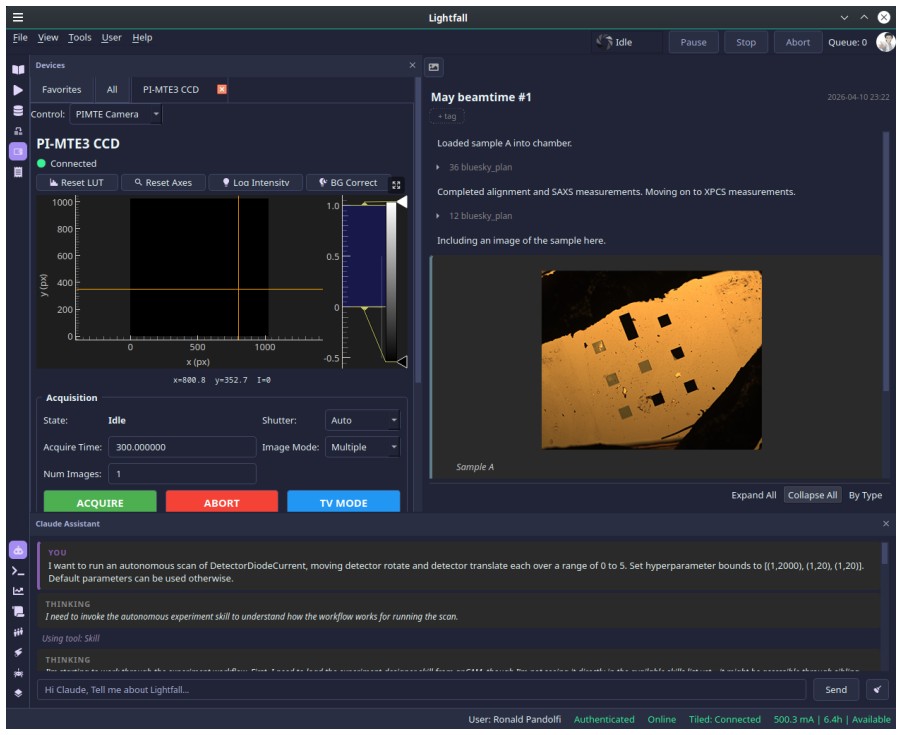
Lightfall exposes every panel, device, and scan plan through a single uniform addressable interface. An embedded language-model agent drives experiments from single moves to autonomous scans, while beamline staff extend the interface during operation via skills—plugin modules the agent invokes to compose and modify panels in the running application. This produces a closed development loop in which a scientist authors a panel change in natural language, the agent emits and applies it, and the commit lands in the beamline's plugin repository.
What carries the argument
The uniform addressable interface together with skills plugin modules that the embedded LLM agent can invoke to modify panels in the running application.
If this is right
- Beamline scientists can author and apply interface changes directly in their own time.
- The per-iteration cost of customization shifts from facility developer hours to the scientist's own effort.
- Every control element becomes addressable to the LLM agent for driving experiments.
- Interface modifications accumulate as reusable plugins in the beamline repository.
Where Pith is reading between the lines
- The same API-first plus LLM-agent pattern could reduce customization delays at other large-scale experimental facilities.
- If the agent handles more complex reasoning, the approach could support higher levels of experiment autonomy.
- Deployment data from the COSMIC-Scattering beamline would allow direct measurement of how often manual corrections are still needed.
Load-bearing premise
The embedded language-model agent can reliably interpret natural language instructions to compose and modify panels without introducing errors that require manual correction.
What would settle it
A beamline scientist issues a sequence of natural language requests to add or alter panels and records whether each resulting interface functions correctly without any subsequent developer fixes.
Figures



read the original abstract
Synchrotron beamlines differ in hardware, technique, and workflow, making customized control interfaces necessary; bespoke per-beamline graphical user interfaces (GUIs) do not scale well, one-size-fits-all facility software forces compromises that leave most of the interface unused, and even recent component-library approaches keep per-scientist tweaks on a developer's queue. We present Lightfall, a control platform designed for facility-wide use, whose API-first architecture exposes every panel, device, and scan plan through a single uniform addressable interface. An embedded language-model agent drives experiments through that interface, from a single move-and-read to a Gaussian-process-driven autonomous scan, while beamline staff extend the interface during operation via skills: plugin modules the agent invokes to compose and modify panels in the running application. The result is a closed development loop: a beamline scientist authors a panel change in natural language, the agent emits and applies it, and the commit lands in the beamline's plugin repository as a side effect. The per-iteration cost of a scientist-driven change is then fixed in the scientist's own time rather than in developer hours the facility must supply. Lightfall is in testing at the COSMIC-Scattering beamline at the Advanced Light Source.
Editorial analysis
A structured set of objections, weighed in public.
Referee Report
Summary. The paper presents Lightfall, an API-first control platform for synchrotron beamlines whose uniform addressable interface exposes panels, devices, and scan plans. An embedded LLM agent drives experiments (from single moves to Gaussian-process autonomous scans) while beamline staff extend the running application via skills (plugin modules the agent invokes to compose and modify panels). This produces a closed development loop in which a scientist authors a natural-language change, the agent applies it, and the result is committed to the plugin repository, fixing per-iteration cost in scientist time rather than developer hours. The system is reported to be in testing at the COSMIC-Scattering beamline.
Significance. If the architecture and LLM-driven extension mechanism operate as described, the platform could materially reduce the developer overhead that currently limits per-scientist customization of beamline interfaces, offering a scalable alternative to both bespoke GUIs and monolithic facility software across diverse synchrotron techniques.
major comments (2)
- [Abstract] Abstract: the central claim that 'the per-iteration cost of a scientist-driven change is then fixed in the scientist's own time rather than in developer hours the facility must supply' is load-bearing yet unsupported; the manuscript states only that the system 'is in testing' at COSMIC-Scattering and supplies no success rates, error frequencies, correction overhead, or time measurements.
- [Abstract] Abstract / testing description: the reliability assumption that the embedded LLM agent can 'reliably interpret natural language instructions to compose and modify panels ... without introducing errors that require manual correction' is unvalidated; no quantitative evaluation of agent performance on panel-composition tasks is reported, directly undercutting the closed-loop claim.
minor comments (1)
- [Abstract] The abstract would benefit from a single sentence naming the concrete API framework and LLM model(s) employed, to give readers an immediate sense of implementation scope.
Simulated Author's Rebuttal
We thank the referee for their careful reading and for highlighting the need for the abstract to be supported by the evidence presented. We address the two major comments point by point below and will revise the manuscript accordingly.
read point-by-point responses
-
Referee: [Abstract] Abstract: the central claim that 'the per-iteration cost of a scientist-driven change is then fixed in the scientist's own time rather than in developer hours the facility must supply' is load-bearing yet unsupported; the manuscript states only that the system 'is in testing' at COSMIC-Scattering and supplies no success rates, error frequencies, correction overhead, or time measurements.
Authors: We agree that the manuscript supplies no quantitative data (success rates, time measurements, or error frequencies) to support the claim. The text describes the architectural mechanism that is intended to produce this outcome, but because the system is described as being in testing, no empirical validation of the cost reduction is provided. We will revise the abstract to present the fixed per-iteration cost as a design objective of the closed-loop architecture rather than an established result. revision: yes
-
Referee: [Abstract] Abstract / testing description: the reliability assumption that the embedded LLM agent can 'reliably interpret natural language instructions to compose and modify panels ... without introducing errors that require manual correction' is unvalidated; no quantitative evaluation of agent performance on panel-composition tasks is reported, directly undercutting the closed-loop claim.
Authors: We agree that the manuscript contains no quantitative evaluation of the LLM agent's performance on panel-composition tasks. The work focuses on the API-first architecture and the skill-based extension mechanism; it does not include a benchmark study of agent reliability. We will revise the abstract to remove or qualify the word 'reliably' and the implication that the closed loop operates without manual correction. revision: yes
Circularity Check
No circularity: system description without derivations or fitted predictions
full rationale
The manuscript describes an API-first control platform and an embedded LLM agent for panel composition. No equations, parameter fits, predictions of derived quantities, or self-citation chains appear in the provided text. The central claim (per-iteration cost fixed in scientist time) is presented as a consequence of the architecture rather than a quantity obtained by fitting or by reducing to prior self-authored results. No load-bearing step reduces by construction to its own inputs.
Axiom & Free-Parameter Ledger
axioms (2)
- domain assumption An LLM agent can accurately translate natural language into correct API calls that modify a running graphical interface without introducing runtime errors.
- domain assumption A single uniform API can expose every panel, device, and scan plan across beamlines that differ in hardware and workflow.
invented entities (1)
-
skills plugin modules
no independent evidence
Reference graph
Works this paper leans on
-
[1]
Xi-cam: a versatile interface for data visualization and analysis
Ronald J. Pandolfi, Daniel B. Allan, Elke Arenholz, et al. “Xi-cam: a versatile interface for data visualization and analysis”. In:Journal of Synchrotron Radiation25.4 (2018), pp. 1261–1270. doi:10.1107/S1600577518005787
-
[2]
Building Mathematics, Algorithms, and Software for Experimental Facilities
H. Chang et al. “Building Mathematics, Algorithms, and Software for Experimental Facilities”. In:Handbook on Big Data and Machine Learning in the Physical Sciences. World Scientific, 2020, pp. 189–240.doi:10.1142/9789811204579_0012
-
[3]
diamond.ac.uk/OpenGDA/
Diamond Light Source.GDA: Diamond’s Generic Data Acquisition framework.https://www. diamond.ac.uk/OpenGDA/. 2024
2024
-
[4]
CS-Studio Community.Phoebus: the Control System Studio successor.https://control- system-studio.readthedocs.io/. 2024
2024
-
[5]
Blu-Ice and the Distributed Control System: software for data acquisition and instrument control at macromolecular crystallography beamlines
T. M. McPhillips, S. E. McPhillips, H.-J. Chiu, et al. “Blu-Ice and the Distributed Control System: software for data acquisition and instrument control at macromolecular crystallography beamlines”. In:Journal of Synchrotron Radiation9.6 (2002), pp. 401–406.doi:10.1107/ S0909049502015170. 19
2002
-
[6]
J. Gabadinho et al. “MxCuBE: a synchrotron beamline control environment customized for macromolecular crystallography experiments”. In:Journal of Synchrotron Radiation17.5 (2010), pp. 700–707.doi:10.1107/S0909049510020005
-
[7]
Maintainable web interfaces at beamlines
Seij De Leon et al. “Maintainable web interfaces at beamlines”. In:JACoWICALEPCS2025 (2025). Paper code THPD088., pp. 1795–1800.doi: 10 . 18429 / JACoW - ICALEPCS2025 - THPD088
2025
-
[8]
ReAct: Synergizing Reasoning and Acting in Language Models
Shunyu Yao et al. “ReAct: Synergizing Reasoning and Acting in Language Models”. In: International Conference on Learning Representations (ICLR). 2023.url:https://arxiv. org/abs/2210.03629
Pith/arXiv arXiv 2023
-
[9]
Anthropic.Tool use with Claude.https://platform.claude.com/docs/en/docs/agents- and-tools/tool-use/overview. 2024
2024
-
[10]
Shray Mathur et al. “VISION: a modular AI assistant for natural human-instrument interaction at scientific user facilities”. In:Machine Learning: Science and Technology6.2 (2025), p. 025051. doi:10.1088/2632-2153/add9e4
-
[11]
D. Allan et al. “Bluesky’s Ahead: A Multi-Facility Collaboration for an a la Carte Software Project for Data Acquisition and Management”. In:Synchrotron Radiation News32.3 (2019), pp. 19–22.doi:10.1080/08940886.2019.1608121
-
[12]
Toward Unified Autonomous Scattering Experiments: A Cross-Facility Case Study at ALS and PETRA III
Wiebke Koepp et al. “Toward Unified Autonomous Scattering Experiments: A Cross-Facility Case Study at ALS and PETRA III”. In:Photon Science(2026). Article photonsci.5c00044; volume/issue numbering forthcoming.doi:10.1021/photonsci.5c00044
-
[13]
NSLS-II.Ophyd: a hardware abstraction library for Python.https://blueskyproject.io/ ophyd/. 2024
2024
-
[14]
https://blueskyproject.io/tiled/
Bluesky Project.Tiled: a data access service for data-aware portals and data science tools. https://blueskyproject.io/tiled/. 2024
2024
-
[15]
EPICS Collaboration.EPICS: Experimental Physics and Industrial Control System.https: //epics-controls.org/. 2024
2024
-
[16]
Red Hat.Keycloak: Open source identity and access management.https://www.keycloak. org/. 2024
2024
-
[17]
Synadia Communications.NATS: A connective technology for distributed systems.https: //nats.io/. 2024
2024
-
[18]
On-the-Fly Data Assessment for High-Throughput X-ray Diffraction Measure- ments
F. Ren et al. “On-the-Fly Data Assessment for High-Throughput X-ray Diffraction Measure- ments”. In:ACS Combinatorial Science19.6 (2017), pp. 377–385.doi:10.1021/acscombsci. 7b00015
-
[19]
Toolformer: Language Models Can Teach Themselves to Use Tools
Timo Schick et al. “Toolformer: Language Models Can Teach Themselves to Use Tools”. In: Advances in Neural Information Processing Systems (NeurIPS). 2023.url:https://arxiv. org/abs/2302.04761
Pith/arXiv arXiv 2023
-
[20]
The Rise and Potential of Large Language Model Based Agents: A Survey
Zhiheng Xi et al. “The Rise and Potential of Large Language Model Based Agents: A Survey”. In:arXiv preprint arXiv:2309.07864(2023).url:https://arxiv.org/abs/2309.07864
Pith/arXiv arXiv 2023
-
[21]
The FAIR Guiding Principles for scientific data management and stewardship
Mark D. Wilkinson, Michel Dumontier, IJsbrand Jan Aalbersberg, et al. “The FAIR Guiding Principles for scientific data management and stewardship”. In:Scientific Data3 (2016), p. 160018.doi:10.1038/sdata.2016.18. 20
-
[22]
The NOMAD laboratory: from data sharing to artificial intelligence
Claudia Draxl and Matthias Scheffler. “The NOMAD laboratory: from data sharing to artificial intelligence”. In:Journal of Physics: Materials2.3 (2019), p. 036001.doi:10.1088/2515- 7639/ab13bb
-
[23]
Gaussian processes for autonomous data acquisition at large-scale synchrotron and neutron facilities
Marcus M. Noack et al. “Gaussian processes for autonomous data acquisition at large-scale synchrotron and neutron facilities”. In:Nature Reviews Physics3.10 (2021), pp. 685–697.doi: 10.1038/s42254-021-00345-y
-
[24]
Compactly-Supported Nonstationary Kernels for Computing Exact Gaussian Processes on Big Data
Mark D. Risser et al. “Compactly-Supported Nonstationary Kernels for Computing Exact Gaussian Processes on Big Data”. In:Environmetrics36.8 (2025), e70054.doi:10.1002/env. 70054
work page doi:10.1002/env 2025
-
[25]
Thermodynamic phase transitions of nematic order in magnetic helices
Zoey Tumbleson et al. “Thermodynamic phase transitions of nematic order in magnetic helices”. In:Science Advances11.25 (2025), eadt5680.doi:10.1126/sciadv.adt5680
-
[26]
Ergodicity transitions in spin spiral domains in amorphous FeGe thin films
Arnab Singh et al. “Ergodicity transitions in spin spiral domains in amorphous FeGe thin films”. In:Physical Review B110.22 (2024), p. L220406.doi:10.1103/PhysRevB.110.L220406
-
[27]
Arnab Singh et al. “Characterizing Temporal Heterogeneity by Quantifying Nanoscale Fluctu- ations in Amorphous Fe–Ge Magnetic Films”. In:Advanced Functional Materials33.29 (2023), p. 2300224.doi:10.1002/adfm.202300224
-
[28]
Exocortex Network for AI-Augmented Human-Led Scientific Expedition
Esther H. R. Tsai and Kevin G. Yager. “Exocortex Network for AI-Augmented Human-Led Scientific Expedition”. In:Photon Science1.2 (2025), pp. 68–76.doi:10.1021/photonsci. 5c00009. 21
discussion (0)
Sign in with ORCID, Apple, or X to comment. Anyone can read and Pith papers without signing in.