Regular and chaotic dynamics of nonlinear optomechanical systems controlled by modulated light
Pith reviewed 2026-06-27 21:57 UTC · model grok-4.3
The pith
Cubic photon-vibration interaction suppresses chaos to quasi-periodic motion in modulated optomechanical systems
A machine-rendered reading of the paper's core claim, the machinery that carries it, and where it could break.
Core claim
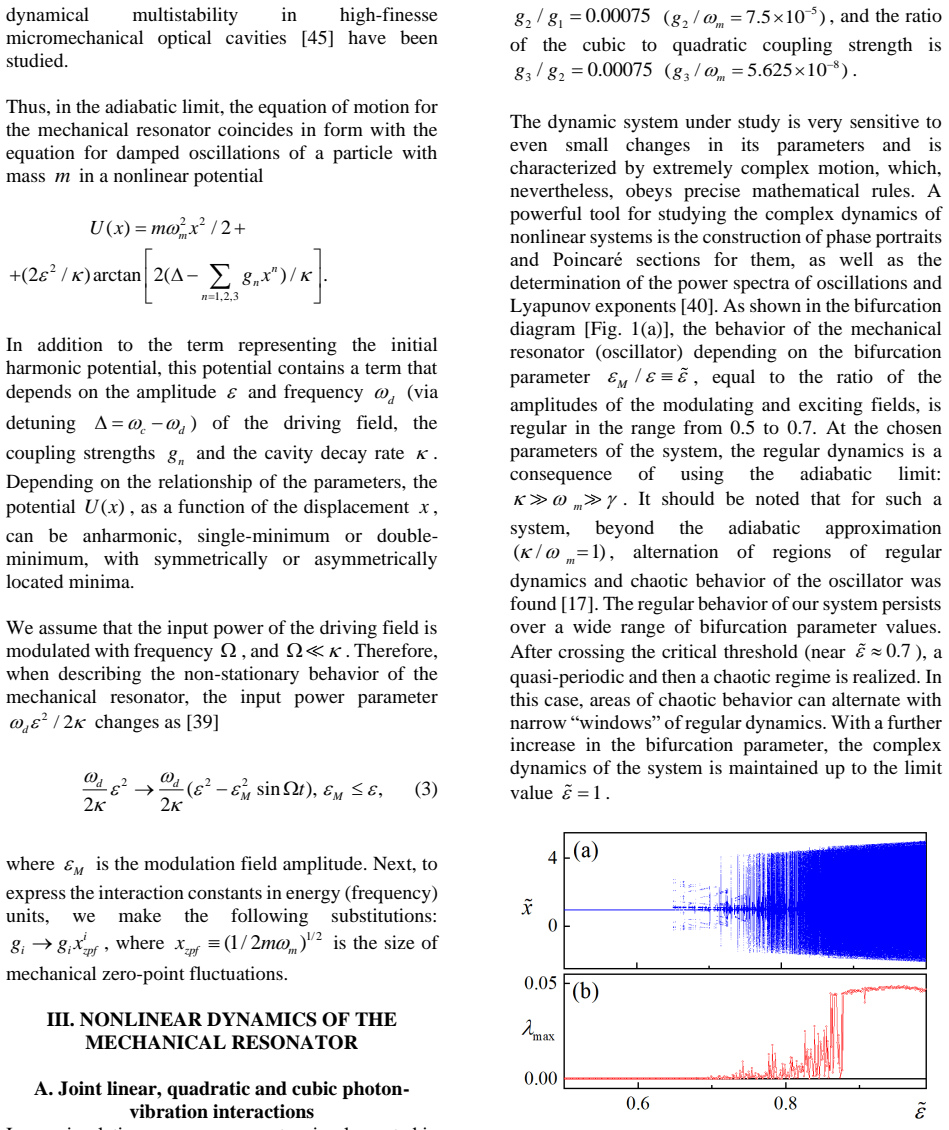
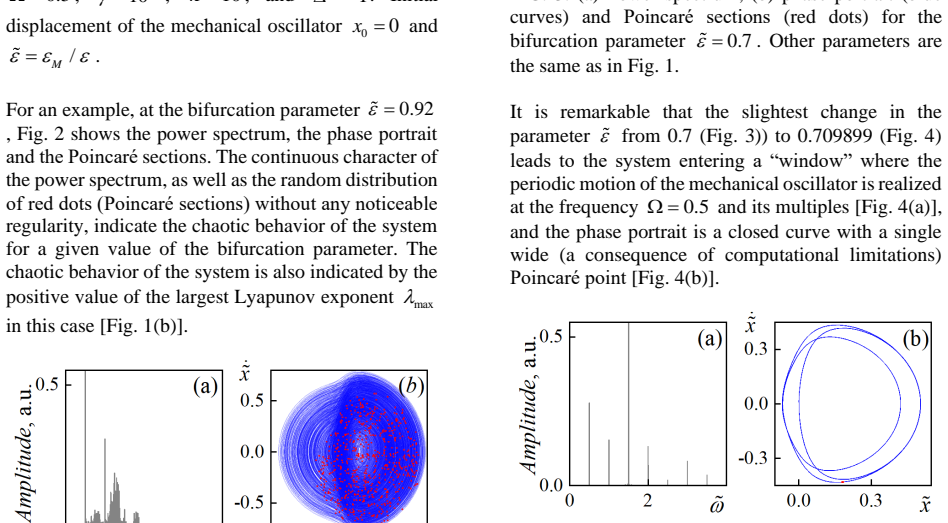
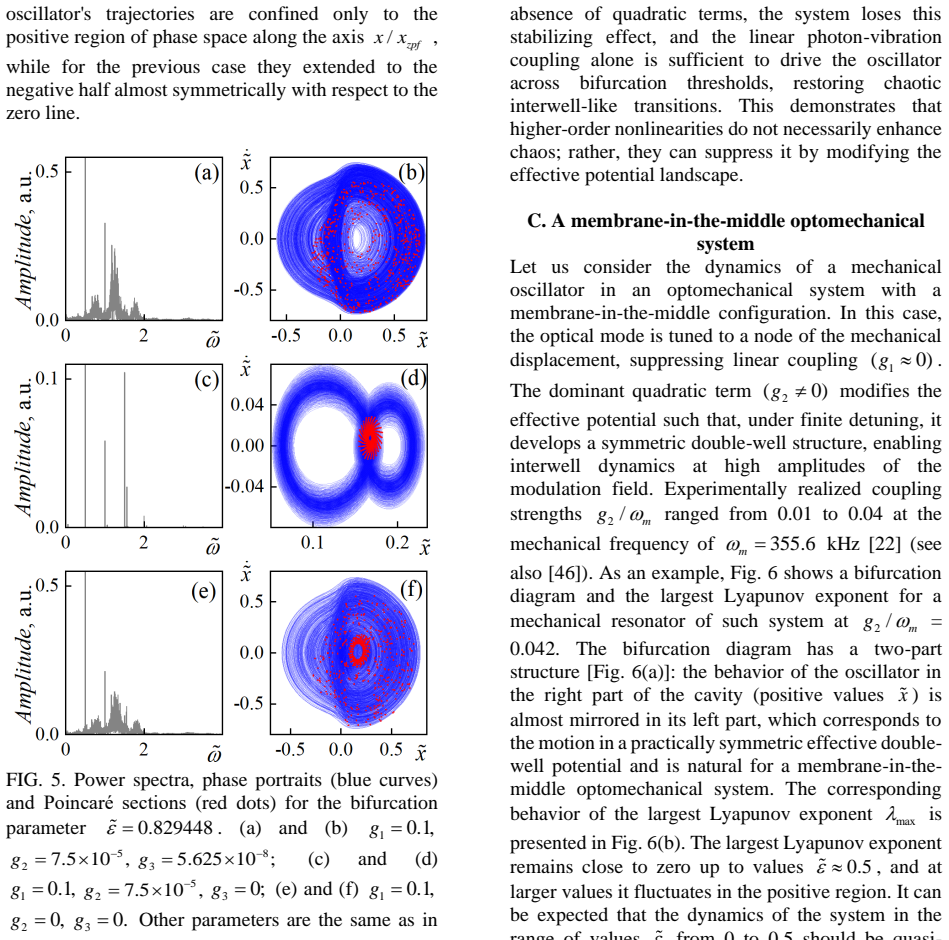
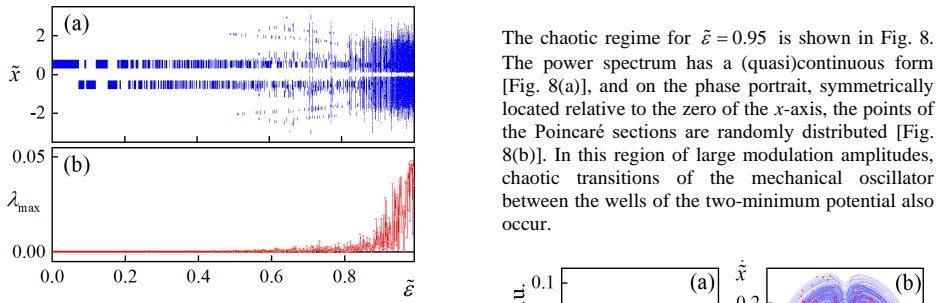
In the presence of linear, quadratic and cubic interactions, chaotic dynamics of the mechanical resonator is realized at certain modulation amplitudes; this is replaced by quasi-periodic oscillations when the cubic interaction is absent, and the system returns to chaotic behavior when only linear interaction remains. The non-monotonic dependence of chaotic dynamics on the order of nonlinearity originates from the interplay between parametric driving and effective potential reshaping. For an optomechanical system in a membrane-in-the-middle configuration with only quadratic interaction, small modulation amplitudes produce quasi-periodic motion in each well of a symmetric two-minimum potential
What carries the argument
The effective mechanical equation of motion after adiabatic elimination of the optical field, whose regular or chaotic character is diagnosed by bifurcation diagrams of the mechanical coordinate and the largest Lyapunov exponent versus modulation amplitude together with power spectra, phase portraits and Poincaré sections.
If this is right
- Chaos can be toggled on or off by selective inclusion of the cubic interaction at fixed modulation amplitude.
- The transition between intra-well quasi-periodic motion and inter-well chaos is controlled by modulation amplitude when only quadratic interaction is active.
- Nonlinearity order does not monotonically increase the likelihood of chaos; specific combinations favor regular motion instead.
- The same diagnostic tools (Lyapunov exponent, Poincaré sections) apply across the full hierarchy of interaction orders.
- The effective potential reshaping competes with parametric driving to determine the dominant regime.
- pith_inferences=[
Load-bearing premise
The adiabatic elimination of the optical field remains valid across the range of modulation amplitudes and interaction strengths considered.
What would settle it
Direct measurement of the largest Lyapunov exponent or power spectrum of the mechanical coordinate at the modulation amplitude where the non-monotonic transition is predicted, performed once with all three interactions present and once with the cubic term removed.
Figures
read the original abstract
The nonlinear dynamics of a mechanical resonator in an optomechanical system with linear, quadratic and cubic photon-vibration interactions (with respect to mechanical displacements) in a modulated driving field under conditions of adiabatic elimination of the optical field is studied. Based on the constructed bifurcation diagrams of the mechanical coordinate and the largest Lyapunov exponent as a function of the modulation amplitude, as well as power spectra, phase portraits and Poincare sections, regions of regular and chaotic dynamics of the optomechanical system are identified. It is also shown that for a certain modulation amplitude in the presence of all three types of interactions, chaotic dynamics of the mechanical resonator (oscillator) is realized, which is replaced by quasi-periodic oscillations in the absence of cubic interaction, and the system returns to chaotic behavior if only linear interaction remains. This non-monotonic dependence of chaotic dynamics on the order of nonlinearity originates from the interplay between parametric driving and effective potential reshaping and manifests that nonlinearity does not always enhance chaos. For an optomechanical system in a membrane-in-the-middle configuration, where only quadratic photon-vibration interaction is present, it is demonstrated that at small modulation amplitudes the mechanical oscillator exhibits quasi-periodic motion in each of the wells of a symmetric two-minimum potential, whereas large modulation amplitudes lead to chaotic motion, involving interwell transitions.
Editorial analysis
A structured set of objections, weighed in public.
Referee Report
Summary. The paper examines the nonlinear dynamics of a mechanical resonator in an optomechanical system with linear, quadratic, and cubic photon-vibration interactions driven by a modulated field, under the assumption of adiabatic elimination of the optical field. It constructs bifurcation diagrams of the mechanical coordinate and largest Lyapunov exponent versus modulation amplitude, supplemented by power spectra, phase portraits, and Poincaré sections, to delineate regions of regular and chaotic motion. The central result is a non-monotonic dependence: for a specific modulation amplitude, chaos appears with all three interactions, gives way to quasi-periodic motion without the cubic term, and returns to chaos with only the linear term; this is ascribed to the competition between parametric driving and reshaping of the effective potential. A separate membrane-in-the-middle case with only quadratic coupling is shown to exhibit intra-well quasi-periodicity at small amplitudes and inter-well chaos at large amplitudes.
Significance. If the adiabatic reduction is valid across the explored modulation range, the reported non-monotonic effect of nonlinearity order on chaos constitutes a concrete counter-example to the expectation that higher-order terms generically promote chaos, and the explicit mapping to parametric driving versus potential reshaping supplies a mechanistic explanation that could guide experimental design in modulated optomechanics.
major comments (1)
- [Abstract / model section] Abstract and the model-reduction step: the non-monotonic chaos claim is obtained exclusively from numerical integration of the adiabatically eliminated mechanical equation. No derivation of that effective equation, no numerical values for the optical decay rate relative to mechanical frequency or modulation frequency, and no direct comparison of full two-mode versus reduced dynamics are supplied for the modulation amplitudes at which the chaos–quasiperiodic–chaos sequence occurs. Without such validation the observed interplay may be an artifact of the approximation rather than a property of the physical system.
minor comments (1)
- [Abstract] The abstract states that the study is performed “under conditions of adiabatic elimination” but does not quantify those conditions (e.g., decay-rate ratios) or cite the regime of validity; adding an explicit statement of the parameter window would improve clarity.
Simulated Author's Rebuttal
We thank the referee for the careful reading and for highlighting the need to strengthen the justification of the adiabatic elimination. We address the single major comment below and will revise the manuscript accordingly.
read point-by-point responses
-
Referee: [Abstract / model section] Abstract and the model-reduction step: the non-monotonic chaos claim is obtained exclusively from numerical integration of the adiabatically eliminated mechanical equation. No derivation of that effective equation, no numerical values for the optical decay rate relative to mechanical frequency or modulation frequency, and no direct comparison of full two-mode versus reduced dynamics are supplied for the modulation amplitudes at which the chaos–quasiperiodic–chaos sequence occurs. Without such validation the observed interplay may be an artifact of the approximation rather than a property of the physical system.
Authors: We agree that the manuscript relies on the adiabatically eliminated equation without an explicit derivation or validation in the presented parameter range. In the revised version we will (i) derive the effective mechanical equation from the full optomechanical Hamiltonian under the stated assumptions, (ii) supply concrete ratios κ/ω_m and modulation frequency relative to ω_m that justify the elimination, and (iii) include a short numerical comparison of the full two-mode and reduced dynamics at representative modulation amplitudes inside the chaos–quasiperiodic–chaos interval. These additions will confirm that the reported non-monotonic dependence is not an artifact of the reduction. revision: yes
Circularity Check
No circularity; results from direct numerical integration of reduced model
full rationale
The paper constructs an effective single-degree-of-freedom mechanical equation under the stated adiabatic-elimination condition, then obtains all reported bifurcation diagrams, Lyapunov exponents, power spectra, phase portraits, and Poincaré sections by direct numerical integration of that equation. No parameter is fitted to a data subset and then relabeled as a prediction, no quantity is defined in terms of itself, and no load-bearing step reduces to a self-citation or ansatz smuggled from prior work by the same authors. The observed non-monotonic dependence of chaotic versus quasi-periodic regimes on the presence of linear/quadratic/cubic terms is an output of the integration, not an input by construction. The derivation is therefore self-contained against external numerical benchmarks.
Axiom & Free-Parameter Ledger
axioms (1)
- domain assumption Adiabatic elimination of the optical field is valid under the modulation conditions studied
Reference graph
Works this paper leans on
-
[1]
S. Aubry and G. Abramovici, Physica D: Nonlinear Phenomena 43, 199 (1990), DOI: 10.1016/0167-2789(90)90133-A
-
[2]
X. Hu, P. Wu, S. Wang, H. Cao, T. Yang, and Z. Pei, Int. J. Bifurcation Chaos 36, 1 (2026), DOI: 10.1142/S0218127426500355
-
[3]
W. Kong, L. Liu, B. Song, G. Zhang, Q. Chen, and Y. Shi, Chaos, Solitons & Fractals 202, 117566 (2026), DOI: 10.1016/j.chaos.2025.117566
-
[4]
E. N. Bulgakov, K. N. Pichugin, and D. N. Maksimov, Physical review. E 113, 44216 (2026), DOI: 10.1103/fj7q-vm5b. 8
-
[5]
M.-Q. Gao, S. -h. Li, X. Li, X. Li, J. Cheng, and W. Li, Arxiv preprint, arXiv:2601.10147, DOI: 10.48550/arXiv.2601.10147
-
[6]
M. Aspelmeyer, T. J. Kippenberg, and F. Marquardt, Rev. Mod. Phys. 86, 1391 (2014), DOI: 10.1103/RevModPhys.86.1391
-
[7]
M. Aspelmeyer, P. Meystre, and K. Schwab, Physics Today 65, 29 (2012), DOI: 10.1063/PT.3.1640
-
[8]
S. Barzanjeh, A. Xuereb, S. Gröblacher, M. Paternostro, C. A. Regal, and E. M. Weig, Nat. Phys. 18, 15 (2022), DOI: 10.1038/s41567 -021- 01402-0
-
[9]
F. Marquardt, J. P. Chen, A. A. Clerk, and S. M. Girvin, Phys. Rev. Lett. 99, 93902 (2007), DOI: 10.1103/PhysRevLett.99.093902
-
[10]
J. Yang, S. Fang, B. Xiong, and X. Wang, Physics Letters A 554, 130758 (2025), DOI: 10.1016/j.physleta.2025.130758
-
[11]
F. Massel, T. T. Heikkilä, J. -M. Pirkkalainen, S. U. Cho, H. Saloniemi, P. J. Hakonen, and M. A. Sillanpää, Nature 480, 351 (2011), DOI: 10.1038/nature10628
-
[12]
M. Hosseini, G. Guccione, H. J. Slatyer, B. C. Buchler, and P. K. Lam, Nature communications 5, 4663 (2014), DOI: 10.1038/ncomms5663
-
[13]
O. Arcizet, P. -F. Cohadon, T. Briant, M. Pinard, A. Heidmann, J. -M. Mackowski, C. Michel, L. Pinard, O. Français, and L. Rousseau, Phys. Rev. Lett. 97, 133601 (2006), DOI: 10.1103/PhysRevLett.97.133601
-
[14]
J. Chaste, A. Eichler, J. Moser, G. Ceballos, R. Rurali, and A. Bachtold, Nature Nanotechnology 7, 301 (2012), DOI: 10.1038/nnano.2012.42
-
[15]
S. Qvarfort, A. Serafini, P. F. Barker, and S. Bose, Nature communications 9, 3690 (2018), DOI: 10.1038/s41467-018-06037-z
-
[16]
S. Bose, A. Mazumdar, G. W. Morley, H. Ulbricht, M. Toroš, M. Paternostro, A. A. Geraci, P. F. Barker, M. S. Kim, and G. Milburn, Physical review letters 119, 240401 (2017), DOI: 10.1103/PhysRevLett.119.240401
-
[17]
L. Bakemeier, A. Alvermann, and H. Fehske, Phys. Rev. Lett. 114, 13601 (2015), DOI: 10.1103/PhysRevLett.114.013601
-
[18]
D. Cattiaux, X. Zhou, S. Kumar, I. Golokolenov, R. R. Gazizulin, A. Luck, L. M. de Lépinay, M. Sillanpää, A. D. Armour, A. Fefferman, and E. Collin, Phys. Rev. Research 2, 33480 (2020), DOI: 10.1103/PhysRevResearch.2.033480
-
[19]
M. Gao, F. -C. Lei, C. -G. Du, and G. -L. Long, Phys. Rev. A 91, 13833 (2015), DOI: 10.1103/PhysRevA.91.013833
-
[20]
A. P. Saiko, R. Fedaruk, and S. A. Markevich, Jetp Lett. 113, 487 (2021), DOI: 10.1134/S002136402107002X
-
[21]
A. P. Saiko, G. A. Rusetsky, S. A. Markevich, and R. Fedaruk, Physics Letters A, 130462 (2025), DOI: 10.1016/j.physleta.2025.130462
-
[22]
M. Karuza, C. Biancofiore, M. Bawaj, C. Molinelli, M. Galassi, R. Natali, P. Tombesi, G. Di Giuseppe, and D. Vitali, Phys. Rev. A 88, 13804 (2013), DOI: 10.1103/PhysRevA.88.013804
-
[23]
G.-L. Zhu, C. -S. Hu, Y. Wu, and X. -Y. Lü, Fundamental research 3, 63 (2023), DOI: 10.1016/j.fmre.2022.07.012
-
[24]
A. P. Saiko, G. A. Rusetsky, S. A. Markevich, and R. Fedaruk, J. Phys. A: Math. Theor. 59, 55703 (2026), DOI: 10.1088/1751-8121/ae3ee7
-
[25]
T. Carmon, H. Rokhsari, L. Yang, T. J. Kippenberg, and K. J. Vahala, Physical review letters 94, 223902 (2005), DOI: 10.1103/PhysRevLett.94.223902
-
[26]
T. Carmon, M. C. Cross, and K. J. Vahala, Physical review letters 98, 167203 (2007), DOI: 10.1103/PhysRevLett.98.167203
-
[27]
F. Marino and F. Marin, Physical review. E, Statistical, nonlinear, and soft matter physics 87, 52906 (2013), DOI: 10.1103/PhysRevE.87.052906
-
[28]
F. Monifi, J. Zhang, Ş. K. Özdemir, B. Peng, Y. - x. Liu, F. Bo, F. Nori, and L. Yang, Nature Photonics 10, 399 (2016), DOI: 10.1038/nphoton.2016.73
-
[29]
J. Wu, S.-W. Huang, Y. Huang, H. Zhou, J. Yang, J.-M. Liu, M. Yu, G. Lo, D. -L. Kwong, S. Duan, and C. Wei Wong, Nature communications 8, 15570 (2017), DOI: 10.1038/ncomms15570
-
[30]
D. Navarro -Urrios, N. E. Capuj, M. F. Colombano, P. D. García, M. Sledzinska, F. Alzina, A. Griol, A. Martínez, and C. M. Sotomayor-Torres, Nature communications 8, 14965 (2017), DOI: 10.1038/ncomms14965
-
[31]
G. Madiot, F. Correia, S. Barbay, and R. Braive, Phys. Rev. A 104, 23525 (2021), DOI: 10.1103/PhysRevA.104.023525
-
[32]
P. Chen, N. Yang, A. Couvertier, Q. Ding, R. Chatterjee, and T. Yu, Entropy (Basel, Switzerland) 26 (2024), DOI: 10.3390/e26090742
-
[33]
Y. Yang, L. Liu, L. Yu, W. Kong, H. Jiao, X. Deng, and X. Li, Chinese Phys. B (2025), DOI: 10.1088/1674-1056/add509
-
[34]
M. Dangish, A. B. Gemta, A. G. Kumela, U. Sherefedin, and R. Birhanu, AIP Advances 15, 327 (2025), DOI: 10.1063/5.0241558
-
[35]
M. Wang, X.-Y. Lü, J.-Y. Ma, H. Xiong, L.-G. Si, and Y. Wu, Scientific reports 6, 22705 (2016), DOI: 10.1038/srep22705. 9
-
[36]
S. Mondal, M. S. Baptista, and K. Debnath, Phys. Rev. A 110 (2024), DOI: 10.1103/PhysRevA.110.023509
-
[37]
X. Liu, W. Liu, Z. Ren, Y. Ma, B. Dong, G. Zhou, and C. Lee, International Journal of Optomechatronics 15, 120 (2021), DOI: 10.1080/15599612.2021.1986612
-
[38]
C. Xin, Y. Xu, Z. Zhang, and M. Li, Micromachines 15, 1011 (2024), DOI: 10.3390/mi15081011
-
[39]
H. Seok, E. M. Wright, and P. Meystre, Phys. Rev. A 90, 43840 (2014), DOI: 10.1103/PhysRevA.90.043840
-
[40]
Y.-S. Tang, X.-W. Xu, J.-Q. Liao, H. Jing, and L.-M. Kuang, Arxiv preprint, arXiv.2501.03586, DOI: 10.48550/arXiv.2501.03586
-
[41]
M.-A. Miri, G. D’Aguanno, and A. Alù, New J. Phys. 20, 43013 (2018), DOI: 10.1088/1367 - 2630/aab5c6
-
[42]
S. Christou, V. Kovanis, A. E. Giannakopoulos, and Y. Kominis, Phys. Rev. A 103, 53513 (2021), DOI: 10.1103/PhysRevA.103.053513
-
[43]
X. Gu, J. Zhang, S. Ding, X. Jiang, B. He, and Q. Lin, Photon. Res. 12, 1981 (2024), DOI: 10.1364/PRJ.525432
-
[44]
J. Zhang, M. Orszag, M. Xiao, X. Jiang, Q. Lin, and B. He, Phys. Rev. Lett. 133, 103602 (2024), DOI: 10.1103/PhysRevLett.133.103602
-
[45]
F. Marquardt, J. G. E. Harris, and S. M. Girvin, Physical review letters 96, 103901 (2006), DOI: 10.1103/PhysRevLett.96.103901
-
[46]
X. Fu, S. Wu, C. Li, M. Xie, Z. Duan, and B. Fan, Chaos, Solitons & Fractals 199, 116652 (2025), DOI: 10.1016/j.chaos.2025.116652
discussion (0)
Sign in with ORCID, Apple, or X to comment. Anyone can read and Pith papers without signing in.