Light-tunable quantum metric non-linear Hall response in Berry dipole semimetals
Pith reviewed 2026-06-27 21:14 UTC · model grok-4.3
The pith
Light creates tunable asymmetry in the quantum metric dipole of Berry dipole semimetals, allowing direct control and reversal of the nonlinear Hall response.
A machine-rendered reading of the paper's core claim, the machinery that carries it, and where it could break.
Core claim
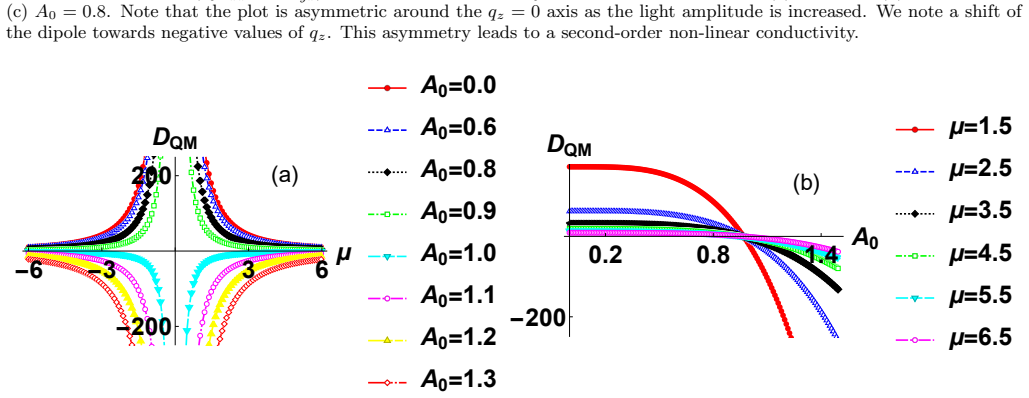
Light induces a tunable asymmetry in the off-diagonal part of the quantum metric, manifested by an asymmetry in the quantum metric dipole. The nonlinear response can be tuned directly by the light amplitude, and the direction of the nonlinear Hall signal changes when the light amplitude is increased beyond a threshold value.
What carries the argument
light-induced asymmetry in the off-diagonal quantum metric dipole
If this is right
- The nonlinear Hall conductivity varies continuously with light amplitude.
- The Hall signal direction reverses when light amplitude exceeds a threshold.
- The response remains intrinsic and quantum-metric mediated under illumination.
- Light acts as an external knob for quantum geometric transport in topological semimetals.
Where Pith is reading between the lines
- Device architectures could use focused light beams to locally switch Hall polarity without changing material composition.
- The same light-tuning principle might extend to other dipole responses driven by quantum geometry, such as nonlinear optics or thermoelectric effects.
- Candidate materials could be screened by computing how their quantum metric dipole evolves under a time-periodic vector potential.
Load-bearing premise
The light-induced change in quantum metric asymmetry dominates the nonlinear Hall conductivity without competing contributions from other light-induced effects such as heating or photocarrier generation.
What would settle it
Measuring the sign and magnitude of the nonlinear Hall voltage in a Berry dipole semimetal while ramping light intensity and checking for reversal exactly at the predicted amplitude threshold.
Figures



read the original abstract
We investigate the effect of light on quantum metric-mediated intrinsic nonlinear Hall conductivity in Berry dipole semimetals. We discover that light induces a tunable asymmetry in the off-diagonal part of the quantum metric, which is manifested by an asymmetry in the quantum metric dipole. We show that the nonlinear response can be tuned directly by the light amplitude. In particular, we note that the direction of the nonlinear Hall signal changes when the light amplitude is increased beyond a threshold value. Light thus emerges as a promising stimulus to control the quantum geometric response in topological semimetals.
Editorial analysis
A structured set of objections, weighed in public.
Referee Report
Summary. The manuscript investigates light-induced effects on the quantum metric-mediated intrinsic nonlinear Hall conductivity in Berry dipole semimetals. It claims that coherent light driving produces a tunable asymmetry in the off-diagonal components of the quantum metric, which appears as an asymmetry in the quantum metric dipole; this allows direct tuning of the nonlinear Hall response by light amplitude, including a reversal in the sign of the Hall conductivity above a critical drive strength.
Significance. If the central model result holds, the work supplies a concrete, amplitude-tunable mechanism for optical control of quantum-geometric nonlinear transport in topological semimetals. The derivation is internal to an effective time-periodic treatment and yields a falsifiable prediction (sign reversal of the nonlinear Hall signal) that can be tested in candidate materials without additional fitting parameters.
minor comments (2)
- [Abstract] The abstract states that the nonlinear response 'can be tuned directly by the light amplitude' but does not specify whether the driving is treated in the Floquet or perturbative regime; a brief statement of the approximation used would clarify the range of validity.
- [Abstract] The closing sentence describes light as a 'promising stimulus'; this interpretive claim should be supported by at least one explicit comparison (e.g., to gate or strain tuning) or moved to the discussion section.
Simulated Author's Rebuttal
We thank the referee for the positive assessment of our work on light-tunable quantum metric nonlinear Hall response in Berry dipole semimetals and for recommending minor revision. No major comments appear in the report, so we have no specific points to address point-by-point. We will incorporate any minor suggestions during revision.
Circularity Check
No significant circularity
full rationale
The paper performs a model calculation on the Berry-dipole Hamiltonian under coherent light driving using time-periodic perturbation or Floquet methods. The claimed tunable asymmetry in the off-diagonal quantum metric and the sign reversal of its dipole (hence of the nonlinear Hall conductivity) above a drive threshold are direct outputs of that internal derivation. No load-bearing step reduces to a fitted parameter renamed as prediction, a self-citation chain, or a self-definitional ansatz. The abstract and skeptic summary confirm the central result is a mathematical consequence of the stated Hamiltonian and driving term, not a re-expression of its inputs.
Axiom & Free-Parameter Ledger
Reference graph
Works this paper leans on
-
[1]
Sodemann, and L
I. Sodemann, and L. Fu,Quantum nonlinear Hall effect induced by Berry curvature dipole in time-reversal invari- ant materials, Phys. Rev. Lett. 115, 216806 (2015). 8
2015
-
[2]
Yang Zhang, Yan Sun, and Binghai Yan,Berry curvature dipole in Weyl semimetal materials: An ab initio study, Phys. Rev. B 97, 041101(R), (2018)
2018
-
[3]
Z. Z. Du, Hai-Zhou Lu and X. C. Xie,Nonlinear Hall effects, Nature Reviews Physics,3, 744, (2021)
2021
-
[4]
Ortix,Nonlinear Hall Effect with Time-Reversal Sym- metry: Theory and Material Realizations, Adv
C. Ortix,Nonlinear Hall Effect with Time-Reversal Sym- metry: Theory and Material Realizations, Adv. Quantum Technol.,4, 2100056 , (2021)
2021
-
[5]
Bandyopadhyay, N
A. Bandyopadhyay, N. B. Joseph, A. Narayan,Non- linear Hall effects: Mechanisms and materials, Materials Today Electronics,8, 100101, (2024)
2024
-
[6]
Z.Z. Du, C.M. Wang, Hai-Zhou Lu and X.C. XieBand signatures for strong nonlinear Hall effect in bilayer W T e2, Phys. Rev. Lett. 121, 266601 (2018)
2018
-
[7]
Z. Liao, H. Zeng, E. Wang, H. Huang,Berry Curvature Dipole and Nonlinear Hall Effect in Type-II Semi-Dirac Systems, Small,21, 2409691, (2025)
2025
-
[8]
Provost and G
P. Provost and G. Vallee,Riemannian Structure on Man- ifolds of Quantum States, Commun. Math. Phys.76, 289- 301 (1980)
1980
-
[9]
Verma, P
N. Verma, P. J. W. Moll, T. Holder and R. Queiroz, Quantum geometry and the hidden scales in materials, Nature Reviews Physics8, 226 (2026)
2026
- [10]
-
[11]
P¨ aivi T¨ orm¨ a,Essay: Where Can Quantum Geometry Lead Us?, Phys. Rev. Lett.131, 240001, (2023)
2023
-
[12]
Liu, Xiao-Bin Qiang, Hai-Zhou Lu, and X
T. Liu, Xiao-Bin Qiang, Hai-Zhou Lu, and X. C. Xie, Quantum geometry in condensed matter, National Sci- ence Review,12, nwae334, (2025)
2025
-
[13]
S. Wang, W. Niu, Yue-W. Fang,Nonlinear Hall effect in two-dimensional materials, Microstructures,5, 2025060, (2025)
2025
-
[14]
Ezawa,Intrinsic nonlinear conductivity induced by quantum geometry in altermagnets and measurement of the in-plane N´ eel vector, Phys
M. Ezawa,Intrinsic nonlinear conductivity induced by quantum geometry in altermagnets and measurement of the in-plane N´ eel vector, Phys. Rev. B110, L241405, (2024)
2024
-
[15]
K. Das, S. Lahiri, R. B. Atencia, D. Culcer, and A. Agarwal,Intrinsic nonlinear conductivities induced by the quantum metric, Phys. Rev. B108, L201405 (2023)
2023
-
[16]
H. Yu, X. Li, Ya-Q. Bie, L. Yan, L. Zhou, P. Yu and G. Yang,Quantum metric third-order nonlinear Hall effect in a non-centrosymmetric ferromagnet, Nature Commu- nications16, 7698 (2025)
2025
-
[17]
Quantum Metric and Nonlinear Hall Effect of Photons
K. Akiba, N. Yamamoto,Quantum Metric and Nonlinear Hall Effect of Photons, arXiv:2604.27751
work page internal anchor Pith review Pith/arXiv arXiv
-
[18]
Ulrich, J
Y. Ulrich, J. Mitscherling, Laura Classen and A. P. Schnyder,Quantum geometric origin of the intrinsic non- linear Hall effect, Phys. Rev. B113, L201107, (2026)
2026
-
[19]
Qiang, T
X.-B. Qiang, T. Liu, Zi-X. Gao, Hai-Z. Lu, X. C. Xie, A Clarification on Quantum-Metric-Induced Nonlinear Transport, Adv. Sci.13, e14818, (2026)
2026
-
[20]
Gaoet al.,Quantum metric nonlinear Hall effect in a topological antiferromagnetic heterostructure, Science, 381, 181, (2023)
A. Gaoet al.,Quantum metric nonlinear Hall effect in a topological antiferromagnetic heterostructure, Science, 381, 181, (2023)
2023
-
[21]
Wang et al.,Quantum metric-induced nonlinear trans- port in a topological antiferromagnet, Nature (London) 621, 487 (2023)
N. Wang et al.,Quantum metric-induced nonlinear trans- port in a topological antiferromagnet, Nature (London) 621, 487 (2023)
2023
-
[22]
Hung-Ju Tien, Hsin Lin, Liang Fu, Tay-Rong Chang, Quantum metric non-linear Hall effect in an antiferro- magnetic topological insulator thin-filmEuSn 2As2, Ma- terials Today Quantum,5, 100027, (2025)
2025
-
[23]
C. Jin, S. Park, Y. Jeung, Y. Chung and K. Su Kim,Ex- perimental measurements of the quantum metric, Nature Reviews Physics,8, 192, (2026)
2026
-
[24]
Dixit, P
A. Dixit, P. K. Sivakumar, K. Manna, C. Felser and S. S. P. Parkin,A chiral fermionic valve driven by quantum geometry, Nature volume649, 47 (2026)
2026
-
[25]
J. Han, T. Uchimura, Y. Araki, J.-Y. Yoon, Y. Takeuchi, Y. Yamane, S. Kanai, J. i. Ieda, H. Ohno, and S. Fukami, Room-temperature flexible manipulation of the quantum- metric structure in a topological chiral antiferromagnet, Nat. Phys.20, 1110 (2024)
2024
-
[26]
Hao Yu, Xinjie Li, Ya-Qing Bie, Luo Yan, Liujiang Zhou, Peng Yu and Guowei Yang,Quantum metric third-order nonlinear Hall effect in a non-centrosymmetric ferromag- net, Nature Communications16, 7698 (2025)
2025
-
[27]
Zheng-Yang Zhuang, Chaoyi Zhang, Xiao-Jiao Wang, and Zhongbo Yan,Berry-dipole semimetals, Phys. Rev. B110, L121122 (2024)
2024
-
[28]
Nelson, T
A. Nelson, T. Neupert, A. Alexandradinata, and T. Bzduˇ sek,Delicate topology protected by rotation symme- try: Crystalline Hopf insulators and beyond, Phys. Rev. B106, 075124 (2022)
2022
-
[29]
Sun, S.-C
X.-Q. Sun, S.-C. Zhang, and T. Bzduˇ sek,Conversion rules for Weyl points and nodal lines in topological me- dia,Phys. Rev. Lett.121, 106402 (2018)
2018
-
[30]
Q. Mo, S. Liang, X. Lan, J. Zhu, and S. Zhang,Demon- stration of Returning Thouless Pump in a Berry Dipole System, Phys. Rev. Lett. 135, 206603, (2025)
2025
-
[31]
Oka and H
T. Oka and H. Aoki,Photovoltaic Hall effect in graphene, Phys. Rev. B79, 081406(R) (2009)
2009
-
[32]
Cayssol, B
J. Cayssol, B. D´ ora, F. Simon, and R. Moessner,Floquet topological insulators, Phys. Status Solidi RRL7, 101 (2013)
2013
-
[33]
N. H. Lindner, G. Refael, and V. Galitski,Floquet topo- logical insulator in semiconductor quantum wells, Nat. Phys.7, 490 (2011)
2011
-
[34]
M. C. Rechtsman, J. M. Zeuner, Y. Plotnik, Y. Lumer, D. Podolsky, F. Dreisow, S. Nolte, M. Segev, and A. Szameit,Photonic Floquet topological insulators, Nature (London)496, 196 (2013)
2013
-
[35]
Y. Wang, H. Steinberg, P. Jarillo-Herrero, and N. Gedik, Observation of Floquet-Bloch States on the Surface of a Topological Insulator, Science,342, 453 (2013)
2013
- [36]
-
[37]
Narayan,Floquet dynamics in two-dimensional semi- Dirac semimetals and three-dimensional Dirac semimet- als, Phys
A. Narayan,Floquet dynamics in two-dimensional semi- Dirac semimetals and three-dimensional Dirac semimet- als, Phys. Rev. B91, 205445 (2015)
2015
-
[38]
Yan and Z
Z. Yan and Z. Wang,Tunable Weyl Points in Periodically Driven Nodal Line Semimetals, Phys. Rev. Lett.117, 087402 (2016)
2016
-
[39]
C. K. Chanet al.,Type-II Weyl cone transitions in driven semimetals, Phys. Rev. B94, 121106 (2016)
2016
-
[40]
Narayan,Tunable point nodes from line-node semimet- als via application of light, Phys
A. Narayan,Tunable point nodes from line-node semimet- als via application of light, Phys. Rev. B94, 041409(R) (2016)
2016
-
[41]
Taguchi, D
K. Taguchi, D. Xu, A. Yamakage, and K. T. Law,Pho- tovoltaic anomalous Hall effect in line-node semimetals, Phys. Rev. B94, 155206 (2016)
2016
-
[42]
Yan and Z
Z. Yan and Z. Wang,Floquet multi-Weyl points in crossing-nodal-line semimetals, Phys. Rev. B96, 041206(R) (2017)
2017
-
[43]
Takashi Oka, and Sota Kitamura,Floquet Engineering of Quantum Materials, Annual Review Condensed Matter Physics.10, 387, (2019). 9
2019
-
[44]
Ikeda,Floquet Theory and Applications in Open Quantum and Classical Systems, J
Masahiro Sato, Tatsuhiko N. Ikeda,Floquet Theory and Applications in Open Quantum and Classical Systems, J. Phys. Soc. Jpn.94, 111007 (2025)
2025
- [45]
-
[46]
R. Chen, B. Zhou, D.-H. Xu,Floquet Weyl semimetals in light-irradiated type-II and hybrid line-node semimetals, Phys. Rev. B97, 155152 (2018)
2018
-
[47]
C.-K. Chan, P. A. Lee, K. S. Burch, J. H. Han, and Y. Ran,When Chiral Photons Meet Chiral Fermions: Pho- toinduced Anomalous Hall Effects in Weyl Semimetals, Phys. Rev. Lett.116, 026805 (2016)
2016
-
[48]
Ezawa,Analytic approach to quantum metric and op- tical conductivity in Dirac models with parabolic mass in arbitrary dimensions, Phys
M. Ezawa,Analytic approach to quantum metric and op- tical conductivity in Dirac models with parabolic mass in arbitrary dimensions, Phys. Rev. B110, 195437, (2024)
2024
-
[49]
Eckardt and E
A. Eckardt and E. Anisimovas,High-frequency approx- imation for periodically driven quantum systems from a Floquet-space perspective, New J. Phys.17093039, (2015)
2015
discussion (0)
Sign in with ORCID, Apple, or X to comment. Anyone can read and Pith papers without signing in.