Macroscopic Quantum Interference in Dark Matter Wave Scattering with MICROSCOPE
Pith reviewed 2026-06-27 22:03 UTC · model grok-4.3
The pith
Amplitudes from MICROSCOPE's concentric cylinders interfere and redistribute the dark-matter-induced force.
A machine-rendered reading of the paper's core claim, the machinery that carries it, and where it could break.
Core claim
The nested test masses of MICROSCOPE realize such an interferometer for dark-matter wave scattering. Amplitudes from the two concentric cylinders interfere and redistribute the induced force between them. This effect produces unique and rotation-modulated signals set by the target geometry. Developing the theoretical framework and applying it to MICROSCOPE data, we obtain leading constraints on quadratic dark-matter--nucleon coupling for masses 10^{-3}--10^{-2} eV, reaching cross sections of order 10^{-52} cm².
What carries the argument
Interference of scattering amplitudes from the two concentric cylinders, which redistributes the induced force and generates rotation-modulated signals.
If this is right
- The interference produces unique rotation-modulated signals determined by the target geometry.
- These signals enable leading constraints on quadratic dark-matter-nucleon coupling from existing MICROSCOPE data.
- The constraints reach cross sections of order 10^{-52} cm² for masses in the 10^{-3} to 10^{-2} eV range.
Where Pith is reading between the lines
- The rotation modulation could serve as a distinctive handle to separate the dark matter effect from other backgrounds in precision force measurements.
- The same interference approach might apply to other experiments that use multiple or nested test masses if coherence conditions hold.
- Future data from similar satellite missions could tighten the limits if the signal is present at the predicted level.
Load-bearing premise
The dark matter field remains fully coherent across the scale of the nested test masses, and no other systematic effects produce rotation-modulated signals that could mimic the interference pattern.
What would settle it
A calculation or measurement showing that the dark matter coherence length is shorter than the radial separation of the concentric cylinders, or a reanalysis of the MICROSCOPE data that finds no rotation-modulated force signal after accounting for known systematics.
Figures

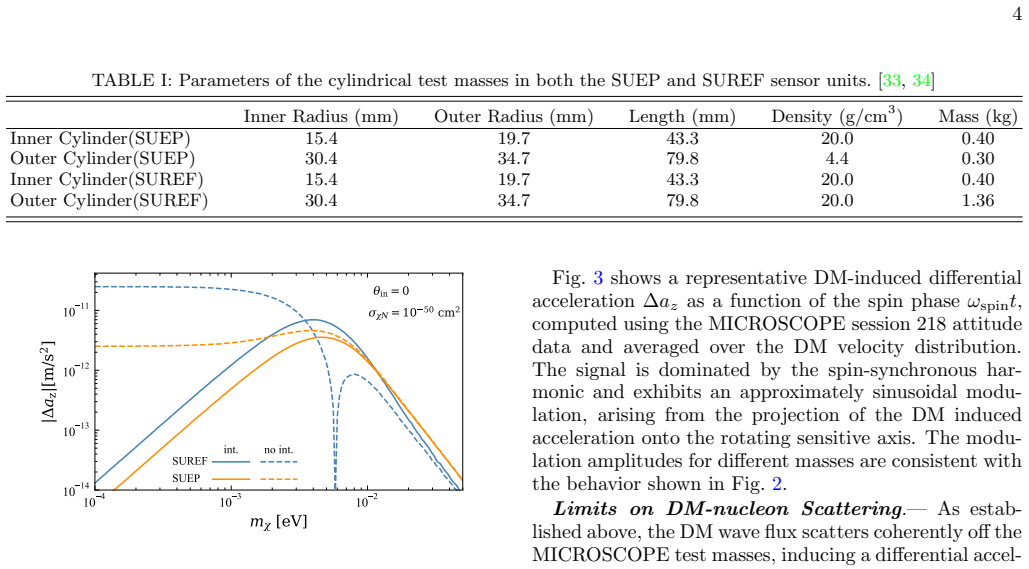
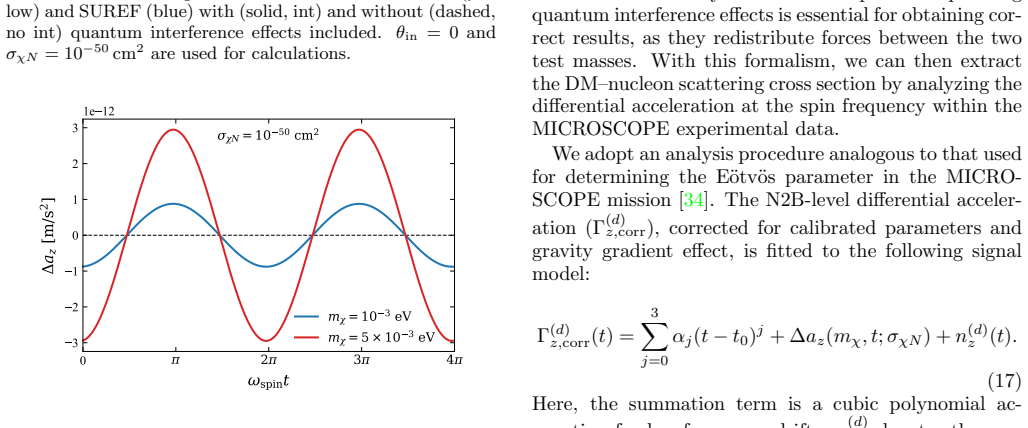
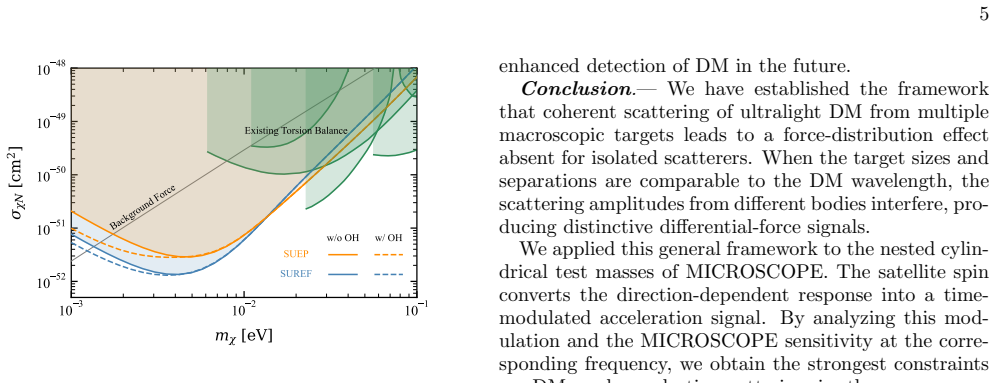
read the original abstract
Ultralight dark matter behaves as a coherent wave, yet its quantum interference effects of elastic scattering with multiple targets have remained unexplored. We show that the nested test masses of MICROSCOPE realize such an ``interferometer'' for dark-matter wave scattering. Amplitudes from the two concentric cylinders interfere and redistribute the induced force between them. This effect produces unique and rotation-modulated signals set by the target geometry. Developing the theoretical framework and applying it to MICROSCOPE data, we obtain leading constraints on quadratic dark-matter--nucleon coupling for masses $10^{-3}$--$10^{-2}\,$eV, reaching cross sections of order $10^{-52}$ cm$^2$.
Editorial analysis
A structured set of objections, weighed in public.
Referee Report
Summary. The manuscript claims that the nested cylindrical test masses in the MICROSCOPE satellite experiment realize a macroscopic interferometer for ultralight dark matter waves. Scattering amplitudes from the two concentric cylinders interfere, redistributing the induced force between them and generating unique, rotation-modulated signals fixed by the target geometry. The authors develop the corresponding theoretical framework and apply it to existing MICROSCOPE data, obtaining leading constraints on quadratic dark-matter--nucleon couplings for masses in the range 10^{-3}--10^{-2} eV at cross sections of order 10^{-52} cm².
Significance. If the central result holds, the work demonstrates a novel use of quantum interference in elastic DM scattering on macroscopic targets and extracts new constraints from archival data in a mass range where quadratic couplings have been weakly bounded. The geometric origin of the rotation-modulated signal is a distinctive feature of the analysis.
major comments (1)
- [Theoretical framework (plane-wave interference derivation)] The derivation of the interference term relies on a monochromatic plane-wave description of the DM field (implicit in the amplitude interference between the two cylinders). For the quoted masses, the coherence length ħ/(m v) with v ≈ 220 km/s is ~20 cm at 10^{-3} eV and ~2 cm at 10^{-2} eV, comparable to the O(cm) cylinder radii and gaps. The manuscript does not incorporate velocity dispersion or finite wave-packet size, which would suppress the relative-phase coherence required for the redistribution effect. This assumption is load-bearing for both the uniqueness of the rotation-modulated signal and the quoted constraints.
minor comments (1)
- [Abstract] The abstract states that the interference effect 'has remained unexplored'; adding one or two references to prior literature on DM wave scattering or coherence in direct-detection contexts would clarify the precise novelty.
Simulated Author's Rebuttal
We thank the referee for their careful reading and constructive comments on our manuscript. The major comment identifies an important assumption in our theoretical framework. We address it point-by-point below and will revise the manuscript accordingly.
read point-by-point responses
-
Referee: [Theoretical framework (plane-wave interference derivation)] The derivation of the interference term relies on a monochromatic plane-wave description of the DM field (implicit in the amplitude interference between the two cylinders). For the quoted masses, the coherence length ħ/(m v) with v ≈ 220 km/s is ~20 cm at 10^{-3} eV and ~2 cm at 10^{-2} eV, comparable to the O(cm) cylinder radii and gaps. The manuscript does not incorporate velocity dispersion or finite wave-packet size, which would suppress the relative-phase coherence required for the redistribution effect. This assumption is load-bearing for both the uniqueness of the rotation-modulated signal and the quoted constraints.
Authors: We agree that the plane-wave approximation is an idealization and that the quoted coherence lengths are comparable to the apparatus size, which could lead to partial suppression from velocity dispersion. The manuscript employs this description to derive the geometric interference and rotation-modulated signal. In the revised manuscript we will add a dedicated subsection estimating the coherence length, discussing the impact of a finite wave-packet description, and providing a qualitative assessment of the resulting suppression factor on the signal amplitude and derived constraints. This will clarify the robustness of the results while preserving the central claim that the nested-cylinder geometry produces a distinctive modulated signature. revision: yes
Circularity Check
No circularity detected; derivation self-contained at abstract level
full rationale
The abstract outlines a theoretical framework applying quantum interference of ultralight DM waves to MICROSCOPE's concentric cylinders, producing rotation-modulated signals and constraints on quadratic couplings. No equations, fitted parameters, or self-citations are visible that would reduce any prediction to an input by construction. The central claim rests on standard coherent wave scattering applied to the apparatus geometry, with no load-bearing steps that collapse to self-definition or renamed fits. Full text inspection is not possible from the given placeholder, but nothing in the provided content triggers any of the enumerated circularity patterns.
Axiom & Free-Parameter Ledger
axioms (1)
- domain assumption Ultralight dark matter behaves as a coherent wave whose de Broglie wavelength is large compared with the apparatus size.
Reference graph
Works this paper leans on
-
[1]
Particle dark matter: Evidence, candidates and constraints,
G. Bertone, D. Hooper, and J. Silk, “Particle dark matter: Evidence, candidates and constraints,”Phys. Rept.405(2005) 279–390, [arXiv:hep-ph/0404175]
Pith/arXiv arXiv 2005
-
[2]
M. Bauer and T. Plehn,Yet Another Introduction to Dark Matter: The Particle Physics Approach, vol. 959 ofLecture Notes in Physics. Springer, 2019. [arXiv:1705.01987[hep-ph]]
Pith/arXiv arXiv 2019
-
[3]
M. Cirelli, A. Strumia, and J. Zupan, “Dark Matter,” [arXiv:2406.01705[hep-ph]]
-
[4]
Die Rotverschiebung von extragalaktischen Nebeln,
F. Zwicky, “Die Rotverschiebung von extragalaktischen Nebeln,”Helv. Phys. Acta6(1933) 110–127
1933
-
[5]
Rotational properties of 21 SC galaxies with a large range of luminosities and radii, from NGC 4605 /R = 4kpc/ to UGC 2885 /R = 122 kpc/,
V. C. Rubin, N. Thonnard, and W. K. Ford, Jr., “Rotational properties of 21 SC galaxies with a large range of luminosities and radii, from NGC 4605 /R = 4kpc/ to UGC 2885 /R = 122 kpc/,”Astrophys. J.238 (1980) 471
1980
-
[6]
A direct empirical proof of the existence of dark matter,
D. Clowe, M. Bradac, A. H. Gonzalez, M. Markevitch, S. W. Randall, C. Jones, and D. Zaritsky, “A direct empirical proof of the existence of dark matter,” Astrophys. J. Lett.648(2006) L109–L113, [arXiv:astro-ph/0608407]. [7]PlanckCollaboration, N. Aghanimet al., “Planck 2018 results. VI. Cosmological parameters,”Astron. Astrophys.641(2020) A6, [arXiv:1807....
Pith/arXiv arXiv 2006
-
[7]
US Cosmic Visions: New Ideas in Dark Matter 2017: Community Report,
M. Battaglieriet al., “US Cosmic Visions: New Ideas in Dark Matter 2017: Community Report,” inU.S. Cosmic Visions: New Ideas in Dark Matter. 7, 2017. [arXiv:1707.04591[hep-ph]]
Pith/arXiv arXiv 2017
-
[8]
Direct detection of dark matter—APPEC committee report*,
J. Billardet al., “Direct detection of dark matter—APPEC committee report*,”Rept. Prog. Phys. 85no. 5, (2022) 056201, [arXiv:2104.07634[hep-ex]]
arXiv 2022
-
[9]
D. J. E. Marsh, “Axion Cosmology,”Phys. Rept.643 (2016) 1–79, [arXiv:1510.07633[astro-ph.CO]]
Pith/arXiv arXiv 2016
-
[10]
Ultralight scalars as cosmological dark matter,
L. Hui, J. P. Ostriker, S. Tremaine, and E. Witten, “Ultralight scalars as cosmological dark matter,”Phys. Rev. D95no. 4, (2017) 043541, [arXiv:1610.08297 [astro-ph.CO]]
Pith/arXiv arXiv 2017
-
[11]
E. G. M. Ferreira, “Ultra-light dark matter,”Astron. Astrophys. Rev.29no. 1, (2021) 7, [arXiv:2005.03254 [astro-ph.CO]]
arXiv 2021
-
[12]
New Horizons: Scalar and Vector Ultralight Dark Matter,
D. Antypaset al., “New Horizons: Scalar and Vector Ultralight Dark Matter,” [arXiv:2203.14915[hep-ex]]
-
[13]
D. F. J. Kimball and K. van Bibber, eds.,The Search for Ultralight Bosonic Dark Matter. Springer, 2023
2023
-
[14]
Ultralight fuzzy dark matter review,
A. Eberhardt and E. G. M. Ferreira, “Ultralight fuzzy dark matter review,” [arXiv:2507.00705[astro-ph.CO]]
-
[15]
Detectability of Certain Dark Matter Candidates,
M. W. Goodman and E. Witten, “Detectability of Certain Dark Matter Candidates,”Phys. Rev. D31 (1985) 3059
1985
-
[16]
Review of mathematics, numerical factors, and corrections for dark matter experiments based on elastic nuclear recoil,
J. D. Lewin and P. F. Smith, “Review of mathematics, numerical factors, and corrections for dark matter experiments based on elastic nuclear recoil,”Astropart. Phys.6(1996) 87–112
1996
-
[17]
Cosmology of the Invisible Axion,
J. Preskill, M. B. Wise, and F. Wilczek, “Cosmology of the Invisible Axion,”Phys. Lett. B120(1983) 127–132
1983
-
[18]
A Cosmological Bound on the Invisible Axion,
L. F. Abbott and P. Sikivie, “A Cosmological Bound on the Invisible Axion,”Phys. Lett. B120(1983) 133–136
1983
-
[19]
The Not So Harmless Axion,
M. Dine and W. Fischler, “The Not So Harmless Axion,”Phys. Lett. B120(1983) 137–141
1983
-
[20]
Direct Detection of Ultralight Dark Matter via Astronomical Ephemeris,
H. Fukuda, S. Matsumoto, and T. T. Yanagida, “Direct Detection of Ultralight Dark Matter via Astronomical Ephemeris,”Phys. Lett. B789(2019) 220–227, [arXiv:1801.02807[hep-ph]]
Pith/arXiv arXiv 2019
-
[21]
E. Akhmedov, G. Arcadi, M. Lindner, and S. Vogl, “Coherent scattering and macroscopic coherence: Implications for neutrino, dark matter and axion detection,”JHEP10(2018) 045, [arXiv:1806.10962 [hep-ph]]
Pith/arXiv arXiv 2018
-
[22]
Coherent Scattering of Low Mass Dark Matter from Optically Trapped Sensors,
G. Afek, D. Carney, and D. C. Moore, “Coherent Scattering of Low Mass Dark Matter from Optically Trapped Sensors,”Phys. Rev. Lett.128no. 10, (2022) 101301, [arXiv:2111.03597[physics.ins-det]]
arXiv 2022
-
[23]
Detection of QCD axion dark matter by coherent scattering,
H. Fukuda and S. Shirai, “Detection of QCD axion dark matter by coherent scattering,”Phys. Rev. D105no. 9, (2022) 095030, [arXiv:2112.13536[hep-ph]]
arXiv 2022
-
[24]
Blowing in the dark matter wind,
H. Day, D. Liu, M. A. Luty, and Y. Zhao, “Blowing in the dark matter wind,”JHEP07(2024) 136, [arXiv:2312.13345[hep-ph]]
arXiv 2024
-
[25]
Detecting meV-scale dark matter via coherent scattering with an asymmetric torsion balance,
P. Luo, S. Matsumoto, J. Sheng, C.-Y. Xing, L. Zhu, and Z.-J. Zhuge, “Detecting meV-scale dark matter via coherent scattering with an asymmetric torsion balance,”Phys. Rev. D112no. 7, (2025) 075023, [arXiv:2409.09950[hep-ph]]
arXiv 2025
-
[26]
Torsion Balance Experiments Enable Direct Detection of Sub-eV Dark Matter,
S. Matsumoto, J. Sheng, C.-Y. Xing, and L. Zhu, “Torsion Balance Experiments Enable Direct Detection of Sub-eV Dark Matter,”Phys. Rev. Lett.136no. 12, (2026) 121803, [arXiv:2506.07763[hep-ph]]
arXiv 2026
-
[27]
Detecting ultralight dark matter with matter effect,
X. Gan, D. Liu, D. Liu, X. Luo, and B. Yu, “Detecting ultralight dark matter with matter effect,”JHEP02 (2026) 043, [arXiv:2504.11522[hep-ph]]
arXiv 2026
-
[28]
Coherence from Randomness: Sub-keV Dark Matter Scattering off Random, Heterogeneous Materials,
Z.-H. Liu, S. Matsumoto, J. Sheng, and C.-Y. Xing, “Coherence from Randomness: Sub-keV Dark Matter Scattering off Random, Heterogeneous Materials,” [arXiv:2512.16451[hep-ph]]
-
[29]
Test of the equivalence principle using a rotating torsion balance,
S. Schlamminger, K. Y. Choi, T. A. Wagner, J. H. Gundlach, and E. G. Adelberger, “Test of the equivalence principle using a rotating torsion balance,” Phys. Rev. Lett.100(2008) 041101, [arXiv:0712.0607 [gr-qc]]
Pith/arXiv arXiv 2008
-
[30]
Torsion-balance tests of the weak equivalence principle,
T. A. Wagner, S. Schlamminger, J. H. Gundlach, and E. G. Adelberger, “Torsion-balance tests of the weak equivalence principle,”Class. Quant. Grav.29(2012) 184002, [arXiv:1207.2442[gr-qc]]
Pith/arXiv arXiv 2012
-
[31]
MICROSCOPE Mission: First Results of a Space Test of the Equivalence Principle,
P. Touboulet al., “MICROSCOPE Mission: First Results of a Space Test of the Equivalence Principle,” Phys. Rev. Lett.119no. 23, (2017) 231101, [arXiv:1712.01176[astro-ph.IM]]. [33]MICROSCOPECollaboration, P. Touboulet al., “Space test of the Equivalence Principle: first results of the MICROSCOPE mission,”Class. Quant. Grav.36 no. 22, (2019) 225006, [arXiv:...
Pith/arXiv arXiv 2017
-
[32]
Violation of the equivalence principle from light scalar dark matter,
A. Hees, O. Minazzoli, E. Savalle, Y. V. Stadnik, and P. Wolf, “Violation of the equivalence principle from light scalar dark matter,”Phys. Rev. D98no. 6, (2018) 064051, [arXiv:1807.04512[gr-qc]]
Pith/arXiv arXiv 2018
-
[33]
Constraints on 9 ultralight scalar dark matter with quadratic couplings,
T. Bouley, P. Sørensen, and T.-T. Yu, “Constraints on 9 ultralight scalar dark matter with quadratic couplings,” JHEP03(2023) 104, [arXiv:2211.09826[hep-ph]]
arXiv 2023
-
[34]
The phenomenology of quadratically coupled ultra light dark matter,
A. Banerjee, G. Perez, M. Safronova, I. Savoray, and A. Shalit, “The phenomenology of quadratically coupled ultra light dark matter,”JHEP10(2023) 042, [arXiv:2211.05174[hep-ph]]
arXiv 2023
-
[35]
Wake forces in a background of quadratically coupled mediators,
K. Van Tilburg, “Wake forces in a background of quadratically coupled mediators,”Phys. Rev. D109 no. 9, (2024) 096036, [arXiv:2401.08745[hep-ph]]
arXiv 2024
-
[36]
C. Burrage, A. Macdonald, and E. Todarello, “Using the Pericentre Precession of LAGEOS II to Constrain Quadratically Coupled Ultralight Dark Matter,” [arXiv:2605.28248[hep-ph]]
-
[37]
Variational Principles for Scattering Processes. I,
B. A. Lippmann and J. Schwinger, “Variational Principles for Scattering Processes. I,”Phys. Rev.79 (1950) 469–480
1950
-
[38]
Bemerkung ¨ uber die angen¨ aherte G¨ ultigkeit der klassischen Mechanik innerhalb der Quantenmechanik,
P. Ehrenfest, “Bemerkung ¨ uber die angen¨ aherte G¨ ultigkeit der klassischen Mechanik innerhalb der Quantenmechanik,”Z. Phys.45no. 7-8, (1927) 455–457
1927
-
[39]
Refinement of the standard halo model for dark matter searches in light of the Gaia Sausage,
N. W. Evans, C. A. J. O’Hare, and C. McCabe, “Refinement of the standard halo model for dark matter searches in light of the Gaia Sausage,”Phys. Rev. D99 no. 2, (2019) 023012, [arXiv:1810.11468 [astro-ph.GA]]
Pith/arXiv arXiv 2019
-
[40]
Recommended conventions for reporting results from direct dark matter searches,
D. Baxteret al., “Recommended conventions for reporting results from direct dark matter searches,”Eur. Phys. J. C81no. 10, (2021) 907, [arXiv:2105.00599 [hep-ex]]
arXiv 2021
-
[41]
Microscope: systematic errors,
M. Rodrigues, P. Touboul, G. Metris, A. Robert, O. Dhuicque, J. Berge, Y. Andre, D. Boulanger, R. Chhun, B. Christophe,et al., “Microscope: systematic errors,”Classical and Quantum Gravity39 no. 20, (2022) 204006
2022
-
[42]
Background-induced forces from dark relics,
S. Barbosa and S. Fichet, “Background-induced forces from dark relics,”JHEP01(2025) 021, [arXiv:2403.13894[hep-ph]]
arXiv 2025
-
[43]
Axion forces in axion backgrounds,
Y. Grossman, B. Yu, and S. Zhou, “Axion forces in axion backgrounds,” [arXiv:2504.00104[hep-ph]]
-
[44]
Background-Enhanced Axion Force by Axion Dark Matter,
Y. Cheng and S. Ge, “Background-Enhanced Axion Force by Axion Dark Matter,” [arXiv:2504.02702 [hep-ph]]
-
[45]
Improvement for Testing the Gravitational Inverse-Square Law at the Submillimeter Range,
W.-H. Tanet al., “Improvement for Testing the Gravitational Inverse-Square Law at the Submillimeter Range,”Phys. Rev. Lett.124no. 5, (2020) 051301
2020
-
[46]
Result of the microscope weak equivalence principle test,
P. Touboul, G. Metris, M. Rodrigues, J. Berge, A. Robert, Q. Baghi, Y. Andre, J. Bedouet, D. Boulanger, S. Bremer,et al., “Result of the microscope weak equivalence principle test,”Classical and Quantum Gravity39no. 20, (2022) 204009
2022
-
[47]
The earth’s velocity for direct detection experiments,
C. McCabe, “The earth’s velocity for direct detection experiments,”Journal of Cosmology and Astroparticle Physics2014no. 02, (2014) 027
2014
discussion (0)
Sign in with ORCID, Apple, or X to comment. Anyone can read and Pith papers without signing in.