Mechanical distribution of the pseudoscalar charmonium and bottomonium on the light-front
Pith reviewed 2026-06-27 22:00 UTC · model grok-4.3
The pith
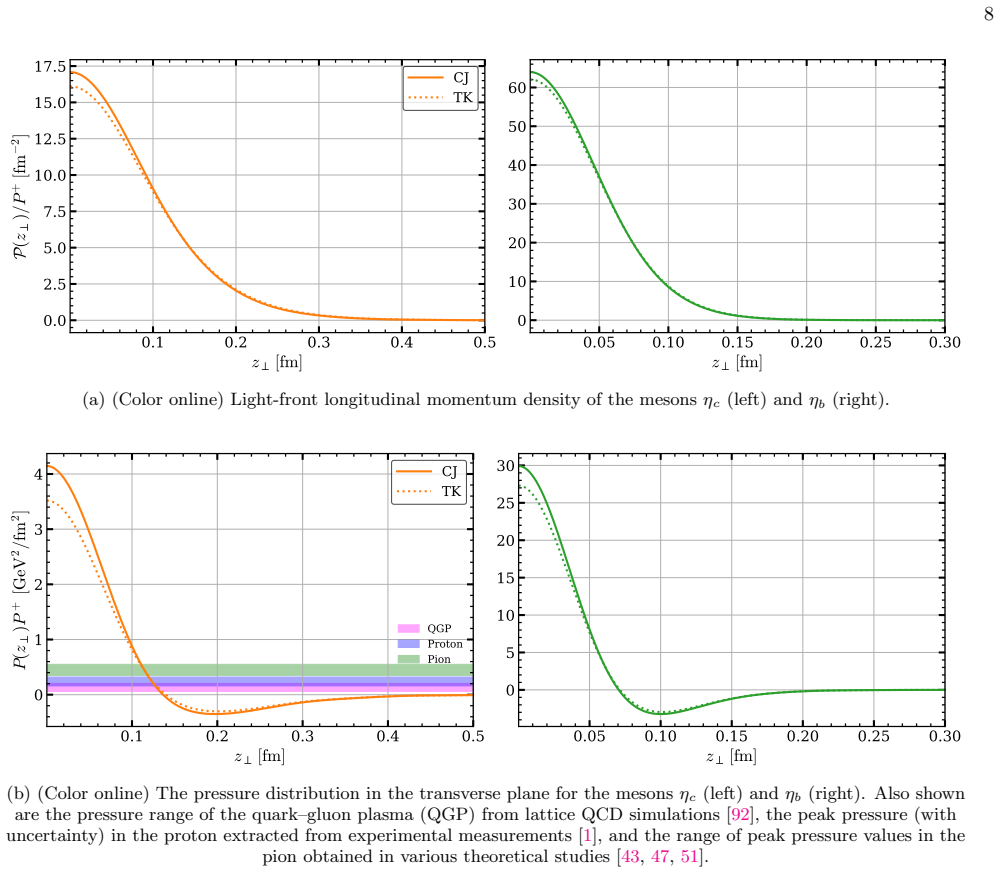
Pressure in pseudoscalar charmonium and bottomonium changes from repulsive to attractive at larger transverse distances.
A machine-rendered reading of the paper's core claim, the machinery that carries it, and where it could break.
Core claim
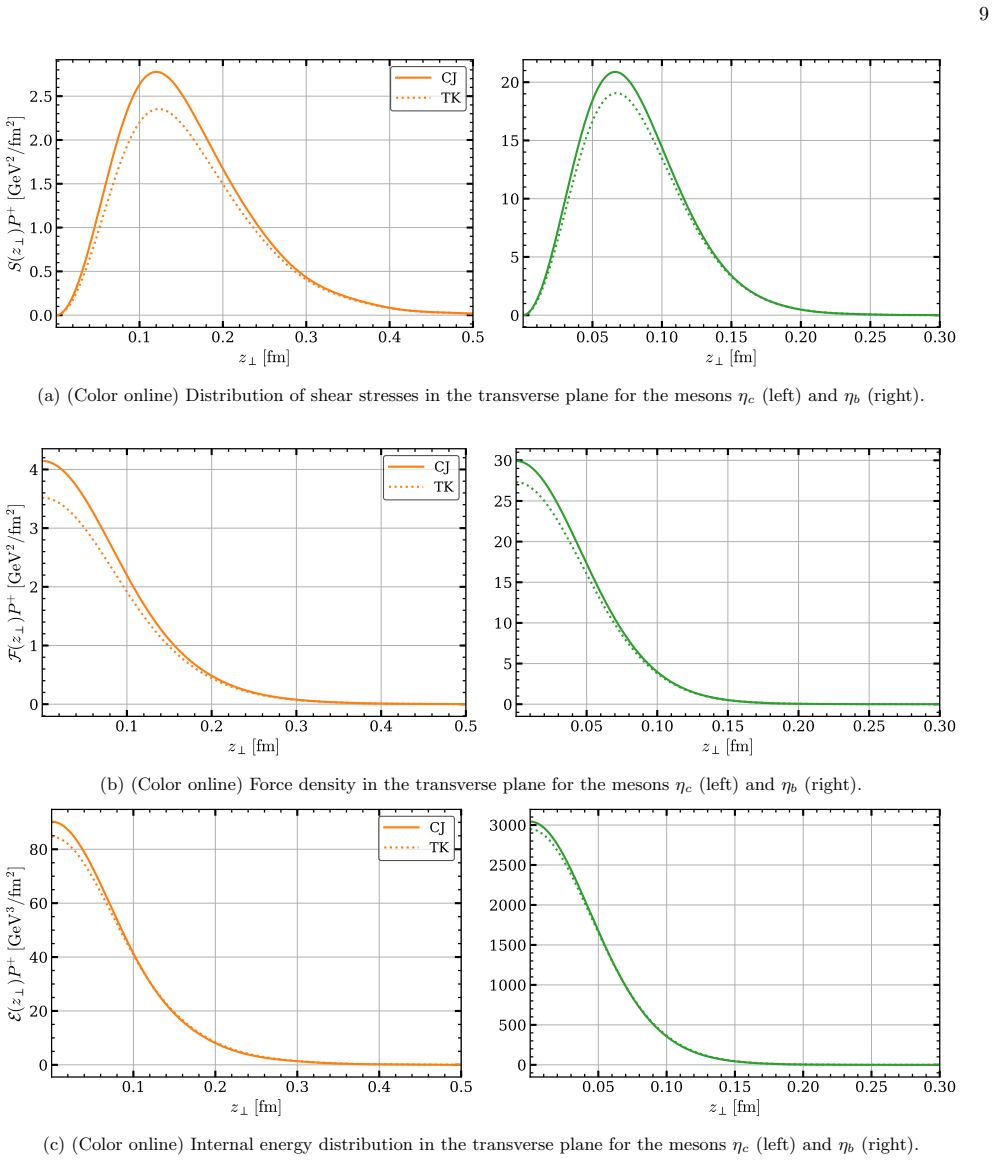
In the light-front quark model the gravitational form factors A and D are computed directly from the light-front wave functions of pseudoscalar charmonium and bottomonium. Their Fourier transforms produce transverse-plane distributions in which pressure changes sign from positive (repulsive) to negative (attractive) with increasing transverse distance, the force density remains positive throughout the plane, and most distributions except shear stress are sensitive to wave-function choice near the center but become insensitive at larger radii.
What carries the argument
Gravitational form factors A and D extracted from light-front wave functions, Fourier-transformed to yield transverse mechanical distributions of pressure, force, shear stress and energy density.
If this is right
- Force remaining positive throughout the transverse plane supports the stability condition proposed in earlier studies.
- Pressure changes sign once, becoming attractive beyond a certain transverse radius.
- Most spatial distributions are sensitive to wave-function choice near the meson center but insensitive at the periphery.
- Shear stress shows noticeable sensitivity to wave function in the intermediate transverse region.
- Internal energy density and momentum density follow the same center-sensitive, periphery-insensitive pattern as pressure.
Where Pith is reading between the lines
- The location of the pressure node may set a characteristic transverse size that can be compared with other radius measures such as the charge radius.
- Similar sign-changing pressure profiles might appear in lighter mesons if the same light-front framework is applied.
- The insensitivity at large radii suggests that peripheral mechanical properties are largely model-independent within this class of wave functions.
Load-bearing premise
The light-front quark model with the two chosen Gaussian forms for the spatial wave function accurately represents the quark-antiquark distribution inside the pseudoscalar charmonium and bottomonium for computing the energy-momentum tensor and its Fourier transforms.
What would settle it
A computation of the same GFFs with a qualitatively different spatial wave function that produces no sign-changing node in the pressure distribution would falsify the reported feature.
Figures
read the original abstract
We investigate the energy-momentum tensor of pseudoscalar charmonium and bottomonium within the framework of the light-front quark model. The gravitational form factors (GFFs), namely the $A$ and $D$-terms, are evaluated in terms of the light-front wave functions. The corresponding spatial mechanical distributions in the transverse plane are obtained through the Fourier transform of these GFFs. To examine the sensitivity of the results to the internal quark-antiquark distribution inside the meson, two distinct Gaussian forms are employed for the spatial part of the wave function. We analyze several mechanical properties in the transverse plane, including the momentum density, pressure distribution, shear stress, force density, and internal energy density. The pressure distribution exhibits a node where it changes sign from positive (repulsive) to negative (attractive) with increasing transverse distance. The force distribution remains positive throughout the transverse plane, supporting the stability condition proposed in earlier studies. Most of the spatial distributions, except for the shear stress, are found to be sensitive to the choice of the spatial wave function near the center of the meson, while they become nearly insensitive toward the periphery. In contrast, the shear stress distribution exhibits noticeable sensitivity to the choice of wave function in the intermediate transverse region.
Editorial analysis
A structured set of objections, weighed in public.
Referee Report
Summary. The manuscript computes the gravitational form factors A and D for pseudoscalar charmonium and bottomonium in the light-front quark model, using two distinct Gaussian forms for the spatial wave function. These GFFs are Fourier-transformed to obtain transverse-plane mechanical distributions (momentum density, pressure, shear stress, force density, internal energy density). The central results are a node in the pressure distribution (sign change from positive/repulsive to negative/attractive) and a strictly positive force distribution throughout the plane, interpreted as supporting a stability condition from prior work; most distributions (except shear) are sensitive to wave-function choice near r=0 but insensitive at large r.
Significance. If the model wave functions are shown to be reliable for the relevant EMT matrix elements, the work supplies a concrete light-front illustration of mechanical properties in heavy quarkonia, including the pressure node and the positive force that satisfies the stability criterion. The explicit comparison of two Gaussian ansätze provides a built-in sensitivity test that strengthens the qualitative claim of peripheral insensitivity.
major comments (1)
- [Abstract and wave-function section] The location of the pressure node and the sign of the integrated force are direct outputs of the chosen Gaussian radial forms (Abstract and the section describing the two wave functions). No comparison is presented to independent determinations of the D-term (lattice GFFs, Bethe-Salpeter solutions, or potential-model wave functions) at the momentum transfers that control the Fourier transform; without such a benchmark the node position remains an artifact of the ansatz rather than a robust prediction.
minor comments (2)
- The manuscript does not report numerical stability checks, convergence tests for the Fourier transforms, or quantitative uncertainties on the extracted node position and force values.
- Parameter values for the two Gaussian widths and the precise fitting procedure to meson masses or decay constants are not tabulated, making reproduction of the quoted distributions difficult.
Simulated Author's Rebuttal
We thank the referee for the careful review and the positive remarks on the significance of our study. We address the major comment below.
read point-by-point responses
-
Referee: [Abstract and wave-function section] The location of the pressure node and the sign of the integrated force are direct outputs of the chosen Gaussian radial forms (Abstract and the section describing the two wave functions). No comparison is presented to independent determinations of the D-term (lattice GFFs, Bethe-Salpeter solutions, or potential-model wave functions) at the momentum transfers that control the Fourier transform; without such a benchmark the node position remains an artifact of the ansatz rather than a robust prediction.
Authors: We agree with the referee that the quantitative location of the pressure node depends on the specific form of the wave function. The manuscript uses two different Gaussian parametrizations precisely to assess this sensitivity, as stated in the abstract and the wave-function section. Key qualitative results, including the existence of the node and the strictly positive force distribution, are reproduced with both choices. We note that independent lattice determinations of the D-term for charmonium and bottomonium are not yet available at the low momentum transfers that dominate the Fourier transform to transverse distributions. Bethe-Salpeter or potential-model calculations could in principle be compared, but would require a separate study. Our work is a model calculation within the light-front quark model, and we will revise the text to more explicitly state the model dependence of the node position while emphasizing the robustness of the positive force. revision: partial
Circularity Check
No significant circularity; model computation is self-contained
full rationale
The paper evaluates GFFs A and D directly from light-front wave functions (two Gaussian spatial forms) and obtains mechanical distributions via Fourier transform of those GFFs. Parameters in the wave functions are selected to represent the meson, but the reported pressure node, sign change, and positive force density are explicit outputs of the model's integral expressions rather than inputs or fits that are renamed as predictions. No self-citation chain, uniqueness theorem, or ansatz smuggling is quoted as load-bearing; the derivation chain remains independent of the target mechanical quantities.
Axiom & Free-Parameter Ledger
free parameters (1)
- Gaussian width parameter for spatial wave function
axioms (2)
- domain assumption The light-front quark model provides a valid description of the energy-momentum tensor for pseudoscalar heavy mesons
- standard math Fourier transform of GFFs yields the correct transverse-plane mechanical distributions
Reference graph
Works this paper leans on
-
[1]
+ +” and “ +−
Evaluation of the quark contribution Using Eqs. (B14) and (B15) we write the quark contribution as ⟨ ˆT µν q ⟩= Z dx d 2⃗k⊥ 2(2π)3 φ∗(x, ⃗k′ ⊥)φ(x, ⃗k⊥)S µν q , S µν q = X λq,λ′q,λ2 S ∗ λ′qλ2(x, ⃗k′ ⊥)U µν λ′qλq Sλqλ2(x, ⃗k⊥).(B19) Apart from space wave functions (which are model-dependent), this contribution is directly proportional to the spin trace for...
-
[2]
(B16) and (B17) to the quark contribution 17 provided in Eqs
Connecting the anti-quark contribution to the quark contribution In this section, we connect the anti-quark contribu- tion to the matrix element of the EMT operator pro- vided in Eqs. (B16) and (B17) to the quark contribution 17 provided in Eqs. (B14) and (B15). Even though we are only dealing with a symmetric mass system (quarkonia), we keep the discussi...
-
[3]
V. D. Burkert, L. Elouadrhiri, and F. X. Girod, The pressure distribution inside the proton, Nature557, 396 (2018)
2018
-
[4]
M. V. Polyakov, Generalized parton distributions and strong forces inside nucleons and nuclei, Phys. Lett. B 555, 57 (2003), arXiv:hep-ph/0210165
Pith/arXiv arXiv 2003
-
[5]
M. V. Polyakov and P. Schweitzer, Forces inside hadrons: pressure, surface tension, mechanical radius, and all that, Int. J. Mod. Phys. A33, 1830025 (2018), arXiv:1805.06596 [hep-ph]
Pith/arXiv arXiv 2018
-
[6]
V. D. Burkert, L. Elouadrhiri, F. X. Girod, C. Lorc´ e, P. Schweitzer, and P. E. Shanahan, Colloquium: Gravi- tational form factors of the proton, Rev. Mod. Phys.95, 041002 (2023), arXiv:2303.08347 [hep-ph]
arXiv 2023
-
[7]
Ji, Deeply virtual Compton scattering, Phys
X.-D. Ji, Deeply virtual Compton scattering, Phys. Rev. D55, 7114 (1997), arXiv:hep-ph/9609381
Pith/arXiv arXiv 1997
-
[8]
Burkardt, Impact parameter space interpretation for generalized parton distributions, Int
M. Burkardt, Impact parameter space interpretation for generalized parton distributions, Int. J. Mod. Phys. A 18, 173 (2003), arXiv:hep-ph/0207047
Pith/arXiv arXiv 2003
-
[9]
Diehl, Generalized parton distributions, Phys
M. Diehl, Generalized parton distributions, Phys. Rept. 388, 41 (2003), arXiv:hep-ph/0307382
Pith/arXiv arXiv 2003
-
[10]
A. V. Belitsky and A. V. Radyushkin, Unraveling hadron structure with generalized parton distributions, Phys. Rept.418, 1 (2005), arXiv:hep-ph/0504030
Pith/arXiv arXiv 2005
-
[11]
C. Lorc´ e, A. Metz, B. Pasquini, and P. Schweitzer, Parton Distribution Functions and their Generalizations (2025) arXiv:2507.12664 [hep-ph]
arXiv 2025
-
[12]
A. Accardiet al., Electron Ion Collider: The Next QCD Frontier: Understanding the glue that binds us all, Eur. Phys. J. A52, 268 (2016), arXiv:1212.1701 [nucl-ex]
Pith/arXiv arXiv 2016
-
[13]
R. Abiret al., The case for an EIC Theory Alliance: The- oretical Challenges of the EIC (2023), arXiv:2305.14572 [hep-ph]
arXiv 2023
-
[14]
R. Abdul Khaleket al., Science Requirements and De- tector Concepts for the Electron-Ion Collider: EIC Yellow Report, Nucl. Phys. A1026, 122447 (2022), arXiv:2103.05419 [physics.ins-det]
Pith/arXiv arXiv 2022
-
[15]
Ji, QCD analysis of the mass structure of the nucleon, Phys
X. Ji, QCD analysis of the mass structure of the nucleon, Phys. Rev. Lett.74, 1071 (1995)
1995
-
[16]
K. Goeke, J. Grabis, J. Ossmann, M. V. Polyakov, P. Schweitzer, A. Silva, and D. Urbano, Nucleon form- factors of the energy momentum tensor in the chiral quark-soliton model, Phys. Rev. D75, 094021 (2007), arXiv:hep-ph/0702030
Pith/arXiv arXiv 2007
-
[17]
C. Cebulla, K. Goeke, J. Ossmann, and P. Schweitzer, The Nucleon form-factors of the energy momentum ten- sor in the Skyrme model, Nucl. Phys. A794, 87 (2007), arXiv:hep-ph/0703025
Pith/arXiv arXiv 2007
-
[18]
H.-C. Kim, P. Schweitzer, and U. Yakhshiev, Energy- momentum tensor form factors of the nucleon in nuclear matter, Phys. Lett. B718, 625 (2012), arXiv:1205.5228 [hep-ph]
Pith/arXiv arXiv 2012
-
[19]
P. E. Shanahan and W. Detmold, Pressure Distribution and Shear Forces inside the Proton, Phys. Rev. Lett.122, 072003 (2019), arXiv:1810.07589 [nucl-th]
arXiv 2019
-
[20]
C. Lorc´ e, H. Moutarde, and A. P. Trawi´ nski, Revisiting the mechanical properties of the nucleon, Eur. Phys. J. C79, 89 (2019), arXiv:1810.09837 [hep-ph]
Pith/arXiv arXiv 2019
-
[21]
D. Chakrabarti, C. Mondal, A. Mukherjee, S. Nair, and X. Zhao, Gravitational form factors and mechanical prop- erties of proton in a light-front quark-diquark model, Phys. Rev. D102, 113011 (2020), arXiv:2010.04215 [hep- ph]
arXiv 2020
- [22]
-
[23]
A. Freese and G. A. Miller, Genuine empirical pressure within the proton, Phys. Rev. D104, 014024 (2021), arXiv:2104.03213 [hep-ph]
arXiv 2021
- [24]
-
[25]
P. Choudhary, B. Gurjar, D. Chakrabarti, and A. Mukherjee, Gravitational form factors and mechanical properties of the proton: Connections between distribu- tions in 2D and 3D, Phys. Rev. D106, 076004 (2022), arXiv:2206.12206 [hep-ph]
arXiv 2022
-
[26]
A. Garcia Martin-Caro, M. Huidobro, and Y. Hatta, Gravitational form factors of nuclei in the Skyrme model, Phys. Rev. D108, 034014 (2023), arXiv:2304.05994 [nucl-th]
arXiv 2023
-
[27]
A. Garc´ ıa Mart´ ın-Caro, M. Huidobro, and Y. Hatta, Nu- clear mass radius and pressure in the Skyrme model, Phys. Rev. D110, 034002 (2024), arXiv:2312.12984 [hep- ph]
arXiv 2024
-
[28]
D. C. Hackett, D. A. Pefkou, and P. E. Shanahan, Grav- itational Form Factors of the Proton from Lattice QCD, Phys. Rev. Lett.132, 251904 (2024), arXiv:2310.08484 [hep-lat]
arXiv 2024
- [29]
-
[30]
S. Nair, C. Mondal, S. Xu, X. Zhao, A. Mukherjee, and J. P. Vary (BLFQ), Gravitational form factors and me- chanical properties of quarks in protons: A basis light- front quantization approach, Phys. Rev. D110, 056027 (2024), arXiv:2403.11702 [hep-ph]
arXiv 2024
-
[31]
Y. Guo, F. Yuan, and W. Zhao, Bayesian Inferring Nu- cleon Gravitational Form Factors via Near-Threshold J/ψPhotoproduction, Phys. Rev. Lett.135, 111902 (2025), arXiv:2501.10532 [hep-ph]
arXiv 2025
-
[32]
M. Goharipour, H. Hashamipour, H. Fatehi, F. Irani, K. Azizi, and S. V. Goloskokov (MMGPDs), Mechani- cal properties of the nucleon from the generalized par- ton distributions, Phys. Rev. D112, 014016 (2025), arXiv:2501.16257 [hep-ph]
arXiv 2025
- [33]
-
[34]
Sugimoto and T
S. Sugimoto and T. Tsukamoto, Energy-momentum ten- sor and d-term of baryons in top-down holographic qcd, Progress of Theoretical and Experimental Physics2025, 083B01 (2025), https://academic.oup.com/ptep/article- pdf/2025/8/083B01/63766251/ptaf094.pdf
2025
-
[35]
M. Tanaka, D. Fujii, and M. Kawaguchi, Gravitational form factors of the nucleon in the Skyrme model based on scale-invariant chiral perturbation theory, Phys. Rev. D112, 054048 (2025), arXiv:2507.21220 [hep-ph]
Pith/arXiv arXiv 2025
- [36]
-
[37]
J. Deng and D. Hou, Proton Structure from a Soft-Wall Holographic QCD Model: Mass Spectrum, Form Factors, and Mechanical Properties (2025), arXiv:2512.17554 [hep-ph]
Pith/arXiv arXiv 2025
-
[38]
K. Fukushima and T. Uji, Pseudogauge ambiguity in the distributions of energy density, pressure, and shear force inside the nucleon, Phys. Rev. D113, 016025 (2026), arXiv:2509.10223 [hep-ph]
arXiv 2026
-
[39]
K. Fukushima and T. Uji, Energy-momentum tensor form factors and spin density distribution in the nu- cleon calculated in a quantized Skyrme model with vector mesons (2026), arXiv:2603.11704 [hep-ph]
arXiv 2026
-
[40]
J. Deng and D. Hou, Exploring Nucleon Structure and the Proton Mass Problem through Holographic QCD (2026), arXiv:2603.04794 [hep-ph]
arXiv 2026
-
[41]
R. Stegeman and R. Zwicky, Gravitational D-form factor: theσ-meson as a dilaton confronted with lattice QCD data I, JHEP03, 184, arXiv:2508.18537 [hep-ph]
-
[42]
X.-H. Cao, F.-K. Guo, Q.-Z. Li, B.-W. Wu, and D.- L. Yao, Gravitational form factors of pions, kaons and nucleons from dispersion relations, Eur. Phys. J. Spec. Top 10.1140/epjs/s11734-025-02025-9 (2025), arXiv:2507.05375 [hep-ph]
-
[43]
W. Broniowski and E. Ruiz Arriola, Gravitational and higher-order form factors of the pion in chiral quark mod- els, Phys. Rev. D78, 094011 (2008), arXiv:0809.1744 [hep-ph]
Pith/arXiv arXiv 2008
-
[44]
A. Freese and I. C. Clo¨ et, Gravitational form factors of light mesons, Phys. Rev. C100, 015201 (2019), [Erra- tum: Phys.Rev.C 105, 059901 (2022)], arXiv:1903.09222 [nucl-th]
arXiv 2019
-
[45]
W.-Y. Liu, E. Shuryak, and I. Zahed, Pion gravitational form factors in the QCD instanton vacuum. II, Phys. Rev. D110, 054022 (2024), arXiv:2405.16269 [hep-ph]
arXiv 2024
-
[46]
W.-Y. Liu, E. Shuryak, C. Weiss, and I. Zahed, Pion gravitational form factors in the QCD instanton vacuum. I, Phys. Rev. D110, 054021 (2024), arXiv:2405.14026 [hep-ph]
arXiv 2024
-
[47]
D. C. Hackett, P. R. Oare, D. A. Pefkou, and P. E. Shanahan, Gravitational form factors of the pion from lattice QCD, Phys. Rev. D108, 114504 (2023), arXiv:2307.11707 [hep-lat]
arXiv 2023
-
[48]
A. F. Krutov and V. E. Troitsky, Pion gravitational form factors in a relativistic theory of composite particles, Phys. Rev. D103, 014029 (2021), arXiv:2010.11640 [hep- ph]
arXiv 2021
-
[49]
Y.-Z. Xu, M. Ding, K. Raya, C. D. Roberts, J. Rodr´ ıguez- Quintero, and S. M. Schmidt, Pion and kaon electromag- netic and gravitational form factors, Eur. Phys. J. C84, 191 (2024), arXiv:2311.14832 [hep-ph]
arXiv 2024
- [50]
- [51]
-
[52]
W. Broniowski and E. Ruiz Arriola, Gravitational form factors of the pion and meson dominance, Phys. Lett. B 859, 139138 (2024), arXiv:2405.07815 [hep-ph]
arXiv 2024
-
[53]
Y. Choi, H.-D. Son, and H.-M. Choi, Gravitational form factors of the pion in the self-consistent light- front quark model, Phys. Rev. D112, 014043 (2025), arXiv:2504.14997 [hep-ph]
arXiv 2025
-
[54]
M. A. Sultan, Z. Xing, K. Raya, A. Bashir, and L. Chang, Gravitational form factors of pseudoscalar mesons in a contact interaction, Phys. Rev. D110, 054034 (2024), arXiv:2407.10437 [hep-ph]
arXiv 2024
-
[55]
S. Xu, X. Cao, T. Hu, Y. Li, X. Zhao, and J. P. Vary, Gravitational form factors of charmonia, Phys. Rev. D 109, 114024 (2024), arXiv:2404.06259 [hep-ph]
arXiv 2024
-
[56]
H.-M. Choi and C.-R. Ji, Mixing angles and electromag- netic properties of ground state pseudoscalar and vector meson nonets in the light cone quark model, Phys. Rev. D59, 074015 (1999), arXiv:hep-ph/9711450
Pith/arXiv arXiv 1999
-
[57]
A. Freese and G. A. Miller, Forces within hadrons on the light front, Phys. Rev. D103, 094023 (2021), arXiv:2102.01683 [hep-ph]
arXiv 2021
-
[58]
A. Freese and G. A. Miller, Unified formalism for electro- magnetic and gravitational probes: Densities, Phys. Rev. D105, 014003 (2022), arXiv:2108.03301 [hep-ph]
arXiv 2022
-
[59]
A. Freese and G. A. Miller, Convolution formalism for defining densities of hadrons, Phys. Rev. D108, 034008 (2023), arXiv:2210.03807 [hep-ph]
arXiv 2023
-
[60]
Ma, Spin structure of the pion in a light cone representation, Z
B.-Q. Ma, Spin structure of the pion in a light cone representation, Z. Phys. A345, 321 (1993), arXiv:hep- ph/9305283
arXiv 1993
-
[61]
Choi and C.-R
H.-M. Choi and C.-R. Ji, Relations among the light cone quark models with the invariant meson mass scheme and the model prediction of eta - eta-prime mixing angle, Phys. Rev. D56, 6010 (1997)
1997
-
[62]
S. J. Brodsky, H.-C. Pauli, and S. S. Pinsky, Quan- tum chromodynamics and other field theories on the light cone, Phys. Rept.301, 299 (1998), arXiv:hep- ph/9705477
arXiv 1998
-
[63]
H. J. Melosh, Quarks: Currents and constituents, Phys. Rev. D9, 1095 (1974)
1974
-
[64]
B.-W. Xiao, X. Qian, and B.-Q. Ma, The Kaon form- factor in the light cone quark model, Eur. Phys. J. A15, 523 (2002), arXiv:hep-ph/0209138
Pith/arXiv arXiv 2002
-
[65]
Jaus, Relativistic constituent quark model of elec- troweak properties of light mesons, Phys
W. Jaus, Relativistic constituent quark model of elec- troweak properties of light mesons, Phys. Rev. D44, 2851 (1991)
1991
-
[66]
S. J. Brodsky, T. Huang, and G. P. Lepage, Hadronic wave functions and high momentum transfer interactions in quantum chromodynamics, Conf. Proc. C810816, 143 (1981)
1981
-
[67]
S. J. Brodsky, T. Huang, and G. P. Lepage, The Hadronic Wave Function in Quantum Chromodynamics (1980)
1980
-
[68]
S. J. Brodsky, T. Huang, and G. P. Lepage, Hadronic and nuclear interactions in QCD, Springer Tracts Mod. Phys.100, 81 (1982)
1982
-
[69]
Chung, F
P. Chung, F. Coester, and W. Polyzou, Charge form fac- tors of quark-model pions, Physics Letters B205, 545 (1988)
1988
-
[70]
Coester and W
F. Coester and W. N. Polyzou, Charge form factors of quark-model pions, Phys. Rev. C71, 028202 (2005)
2005
-
[71]
H.-M. Choi and C.-R. Ji, Kaon electroweak form-factors in the light front quark model, Phys. Rev. D59, 034001 (1999), arXiv:hep-ph/9807500
Pith/arXiv arXiv 1999
-
[72]
H.-M. Choi, C.-R. Ji, and L. S. Kisslinger, Light front quark model analysis of rare B —>K l+ l- decays, Phys. Rev. D65, 074032 (2002), arXiv:hep-ph/0110222
Pith/arXiv arXiv 2002
-
[73]
H.-M. Choi and C.-R. Ji, Distribution amplitudes and decay constants for (pi, K, rho, K*) mesons in light-front quark model, Phys. Rev. D75, 034019 (2007), arXiv:hep- ph/0701177. 22
arXiv 2007
-
[74]
H.-M. Choi, C.-R. Ji, Z. Li, and H.-Y. Ryu, Varia- tional analysis of mass spectra and decay constants for ground state pseudoscalar and vector mesons in the light- front quark model, Phys. Rev. C92, 055203 (2015), arXiv:1502.03078 [hep-ph]
Pith/arXiv arXiv 2015
- [75]
- [76]
-
[77]
R. Acharyya, S. Puhan, H. Dahiya, and N. Kumar, Spectroscopy of excited quarkonium states in the light- front quark model*, Chin. Phys. C49, 023104 (2025), arXiv:2408.07715 [hep-ph]
arXiv 2025
-
[78]
M. V. Terentev, On the Structure of Wave Functions of Mesons as Bound States of Relativistic Quarks, Sov. J. Nucl. Phys.24, 106 (1976)
1976
-
[79]
J. Carbonell, B. Desplanques, V. A. Karmanov, and J. F. Mathiot, Explicitly covariant light front dynamics and relativistic few body systems, Phys. Rept.300, 215 (1998), arXiv:nucl-th/9804029
Pith/arXiv arXiv 1998
-
[80]
Karmanov, Relativistic deuteron wave function on the light front, Nuclear Physics A362, 331 (1981)
V. Karmanov, Relativistic deuteron wave function on the light front, Nuclear Physics A362, 331 (1981)
1981
discussion (0)
Sign in with ORCID, Apple, or X to comment. Anyone can read and Pith papers without signing in.