External-Field-Assisted Muon Reactivation in Muon-Catalyzed Fusion: A Rate-Network Criterion for Reducing Alpha Sticking
Pith reviewed 2026-06-27 20:36 UTC · model grok-4.3
The pith
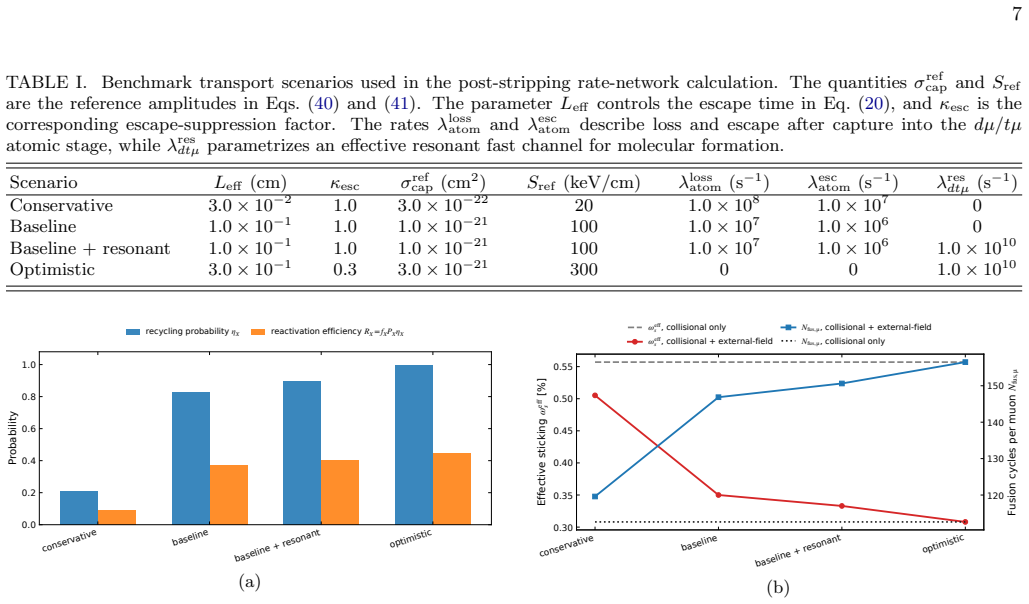
An external field can raise the muon-catalyzed fusion cycle yield from 112.6 to 156.5 by adding a stripping channel that recycles stuck muons more effectively than collisions alone.
A machine-rendered reading of the paper's core claim, the machinery that carries it, and where it could break.
Core claim
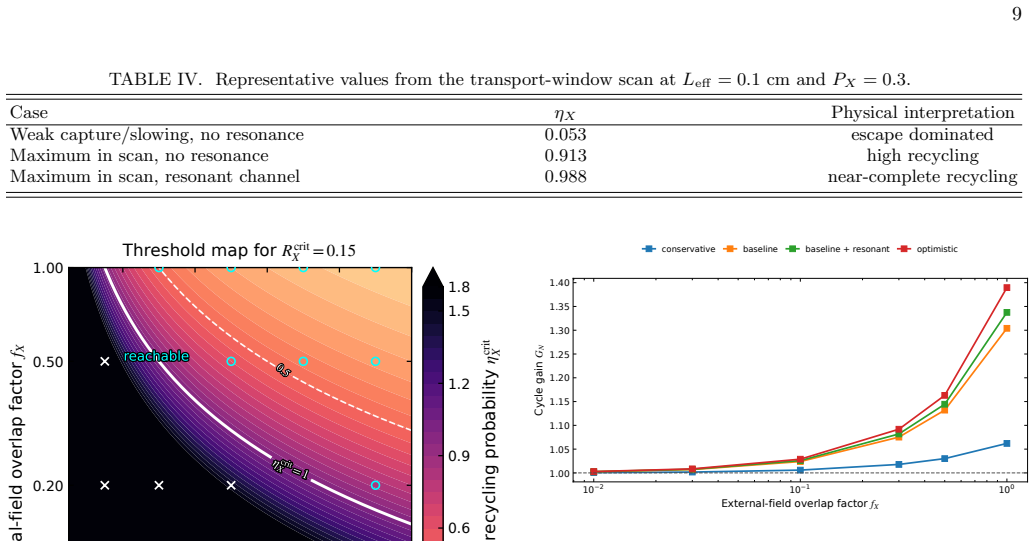
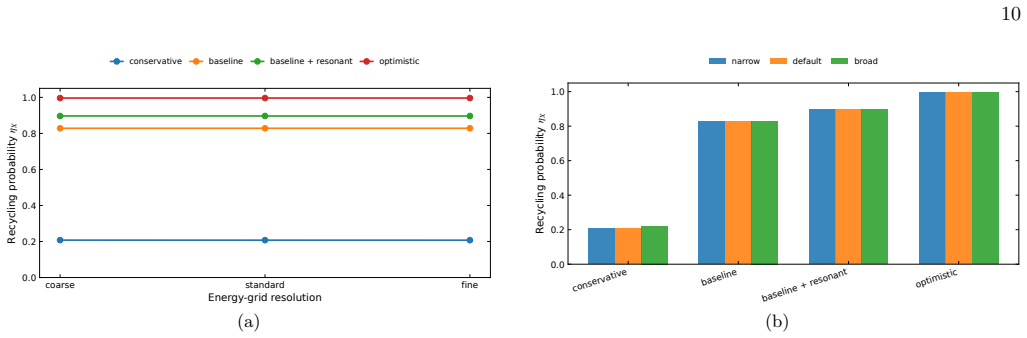
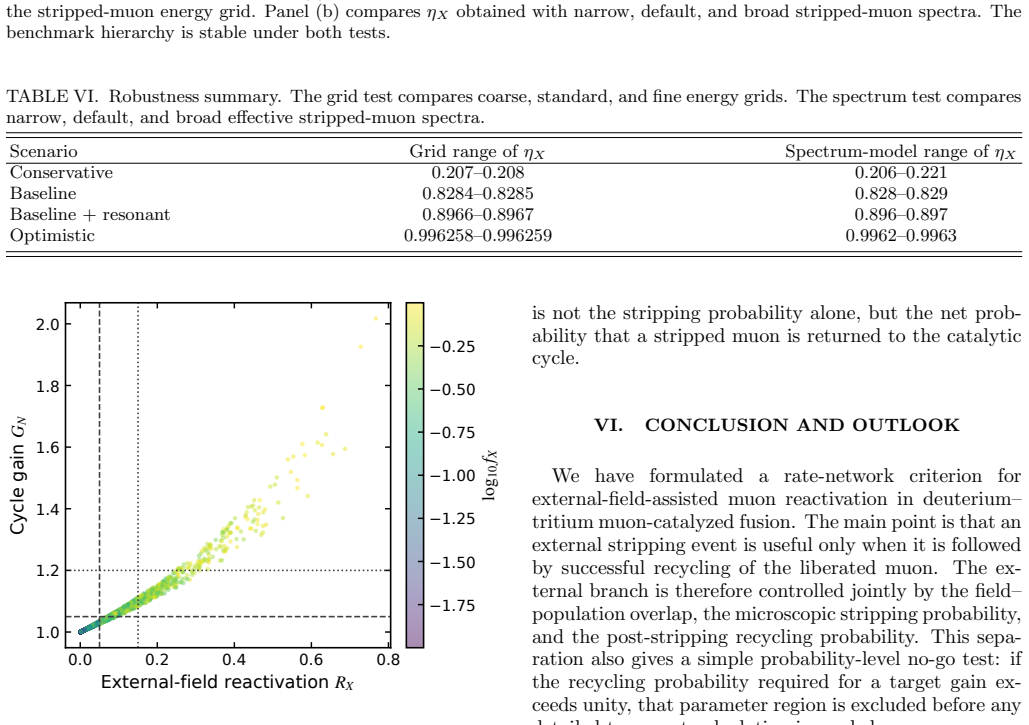
The effective sticking probability is given by ω_S^eff = ω_S^0 (1-R_col)(1-R_X) with R_X = f_X P_X η_X. A post-stripping rate network that includes slowing down, atomic capture, free escape, muon decay, atomic-stage loss, ordinary molecular formation, and resonant dtμ formation shows that the useful regime is a transport window in which the stripped muon must be confined and recycled efficiently. With the reference inputs used here, the best-performing scenario increases the cycle yield from N_fus,μ=112.6 in the collision-only case to N_fus,μ=156.5. Resonant molecular formation suppresses atomic-stage loss and broadens the high-recycling region, but cannot compensate for prompt escape or poo
What carries the argument
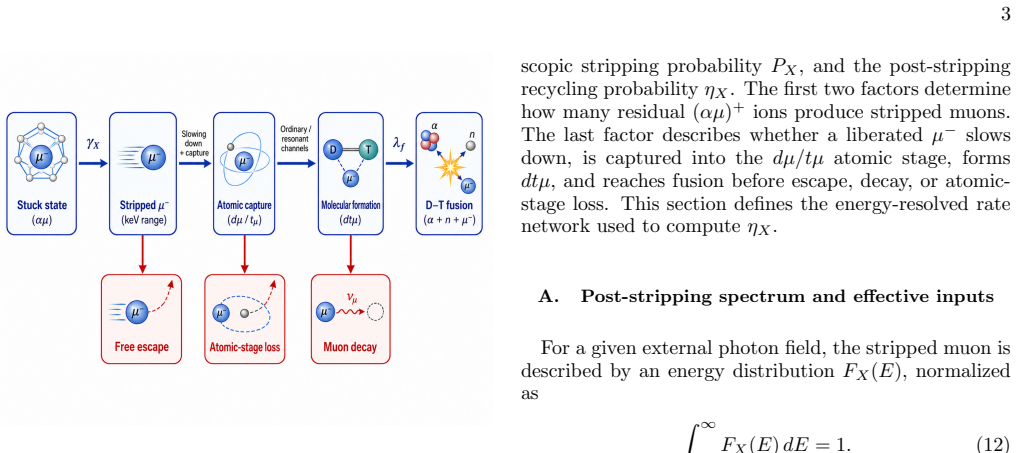
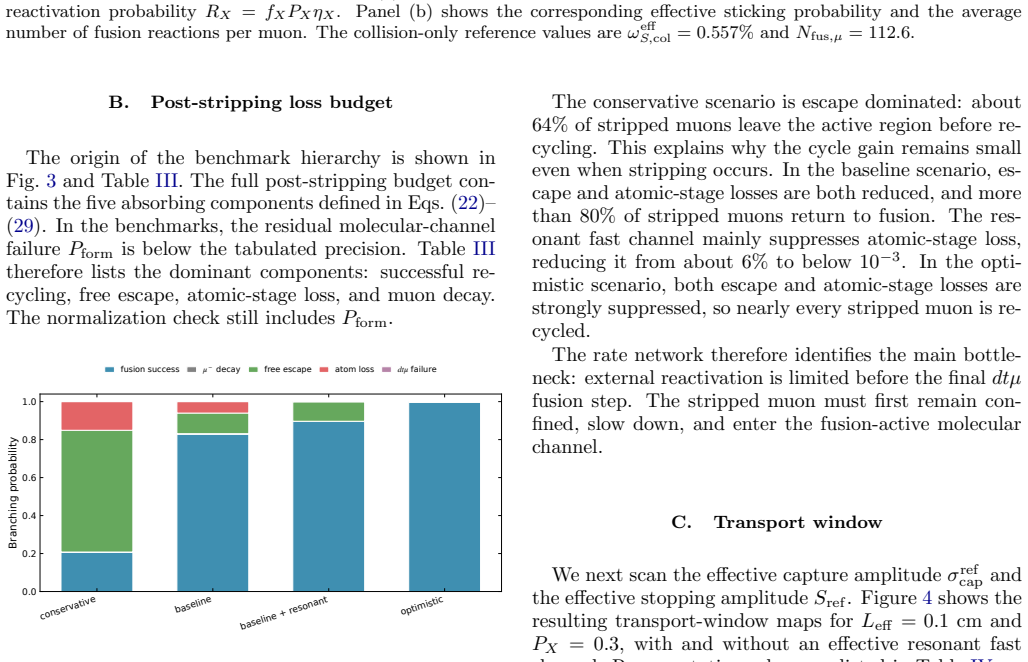
The external reactivation term R_X = f_X P_X η_X together with the energy-resolved post-stripping rate network that computes the return probability η_X under competing loss channels.
If this is right
- The cycle yield can reach 156.5 when the transport window is realized.
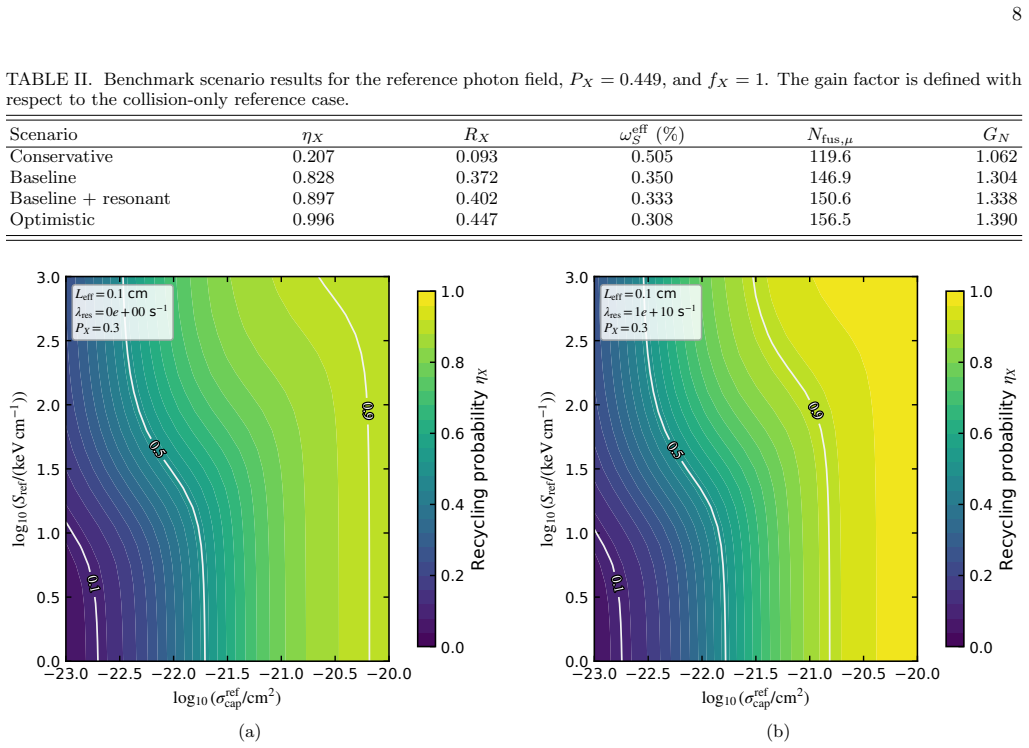
- Resonant molecular formation broadens the high-recycling region by suppressing atomic-stage loss.
- The no-go condition η_X^crit > 1 must not be violated, or no net improvement is possible.
- Prompt escape and poor overlap set hard limits that resonant formation alone cannot overcome.
Where Pith is reading between the lines
- Field designs would need to maintain overlap with the stuck population while preserving the conditions for resonant molecular formation.
- The same rate-network approach could be applied to other muon-catalyzed reactions or non-DT mixtures to map their own transport windows.
- If the overlap and confinement conditions prove achievable, the model predicts a concrete upper bound on the improvement factor set by the product (1-R_col)(1-R_X).
Load-bearing premise
The space-time overlap, stripping probability, and muon return probability can be realized simultaneously without the required return probability exceeding one.
What would settle it
A measurement in a deuterium-tritium target that applies a calibrated external field and records whether the observed fusions per muon exceed 112.6 while the individual loss channels (escape, decay, atomic capture) remain consistent with the network predictions.
Figures

read the original abstract
Alpha sticking is a major loss channel in deuterium--tritium muon-catalyzed fusion. We study whether an additional external-field-assisted stripping channel can reduce the residual sticking loss after conventional collisional reactivation. The external contribution is written as $R_X=f_XP_X\eta_X$, where $f_X$ is the space--time overlap between the external field and the residual stuck $(\alpha\mu)^+$ population, $P_X$ is the microscopic stripping probability, and $\eta_X$ is the probability that the stripped $\mu^-$ is returned to the $d\mu/t\mu\to dt\mu$ fusion cycle before escape or decay. This gives $\omega_S^{\rm eff}=\omega_S^0(1-R_{\rm col})(1-R_X)$ and leads directly to a probability-level no-go condition, $\eta_X^{\rm crit}>1$, for any target improvement requiring more recycling than is probabilistically available. We construct an energy-resolved post-stripping rate network including slowing down, atomic capture, free escape, muon decay, atomic-stage loss, ordinary molecular formation, and an effective resonant $dt\mu$ channel. Benchmark scans show that the useful regime is a transport window: the stripped muon must be confined and recycled efficiently. With the reference inputs used here, the best-performing scenario increases the cycle yield from $N_{\rm fus,\mu}=112.6$ in the collision-only case to $N_{\rm fus,\mu}=156.5$. Resonant molecular formation suppresses atomic-stage loss and broadens the high-recycling region, but it cannot compensate for prompt escape or poor field--population overlap. The rate network therefore identifies the transport and overlap conditions required for external-field-assisted reactivation to reduce residual alpha sticking.
Editorial analysis
A structured set of objections, weighed in public.
Referee Report
Summary. The manuscript proposes an external-field-assisted stripping channel to reduce residual alpha sticking in DT muon-catalyzed fusion after conventional collisional reactivation. It defines R_X = f_X P_X η_X, derives the effective sticking ω_S^eff = ω_S^0 (1-R_col)(1-R_X) and a probability-level no-go condition η_X^crit >1, constructs an energy-resolved post-stripping rate network (slowing-down, capture, escape, decay, molecular formation), and reports that benchmark scans with reference inputs raise the cycle yield from N_fus,μ=112.6 (collision-only) to 156.5 inside a narrow transport window.
Significance. If the required overlap, stripping, and return probabilities can be realized simultaneously without violating the no-go bound, the work identifies a concrete set of transport and field-population conditions that could increase fusion yield per muon. The derivation of the no-go condition and the rate-network identification of the transport window are useful, even if the numerical improvement is illustrative rather than benchmarked against experiment.
major comments (2)
- [Abstract / rate network section] Abstract and rate-network description: the manuscript supplies no explicit rate equations for the energy-resolved network (slowing-down, atomic capture, free escape, muon decay, atomic-stage loss, ordinary and resonant molecular formation) nor the derivation or literature sources of the reference inputs used in the benchmark scans; without these the reported increase from 112.6 to 156.5 cannot be independently verified.
- [Benchmark scans / no-go condition] Benchmark scans and no-go condition: the quantitative claim that a useful regime exists inside the transport window rests on a specific set of reference values for f_X, P_X, η_X whose simultaneous physical realizability is asserted but not demonstrated by the network itself; the no-go condition η_X^crit >1 is derived yet the best-performing scenario approaches or may exceed the probabilistic bound without external validation.
minor comments (1)
- [Introduction / definitions] Notation: the definition of R_X and its insertion into ω_S^eff should be written as an explicit equation with a numbered label for later reference.
Simulated Author's Rebuttal
We thank the referee for the constructive comments and the recommendation for major revision. We address each major comment point by point below, indicating where revisions will be made to improve verifiability and clarity.
read point-by-point responses
-
Referee: Abstract and rate-network description: the manuscript supplies no explicit rate equations for the energy-resolved network (slowing-down, atomic capture, free escape, muon decay, atomic-stage loss, ordinary and resonant molecular formation) nor the derivation or literature sources of the reference inputs used in the benchmark scans; without these the reported increase from 112.6 to 156.5 cannot be independently verified.
Authors: We agree that explicit rate equations and sources for the reference inputs are necessary for independent verification. The full manuscript describes the network processes but does not list the differential equations or tabulate the input values with citations. In the revised manuscript we will add an appendix containing the complete set of rate equations for slowing-down, atomic capture, free escape, muon decay, atomic-stage loss, ordinary molecular formation, and the effective resonant dtμ channel, together with the numerical reference values and their literature sources. This will allow direct reproduction of the benchmark results. revision: yes
-
Referee: Benchmark scans and no-go condition: the quantitative claim that a useful regime exists inside the transport window rests on a specific set of reference values for f_X, P_X, η_X whose simultaneous physical realizability is asserted but not demonstrated by the network itself; the no-go condition η_X^crit >1 is derived yet the best-performing scenario approaches or may exceed the probabilistic bound without external validation.
Authors: The rate network maps the required transport efficiencies (η_X) and overlap/stripping parameters to identify the window in which external assistance can increase yield, subject to the derived no-go bound η_X^crit >1. The benchmark uses a fixed set of reference inputs to illustrate that a useful regime exists inside that window; it does not simulate the simultaneous physical realization of f_X, P_X, and η_X, which would require separate modeling of the external-field geometry and atomic physics. We will revise the text to state explicitly that the reported increase to 156.5 is obtained with these reference inputs and is therefore illustrative of the transport conditions needed, while confirming that all scanned scenarios remain within the probabilistic bound. Additional external validation of the field parameters lies outside the present scope. revision: partial
Circularity Check
No significant circularity; model evaluation with explicit reference inputs
full rationale
The derivation defines R_X = f_X P_X η_X by construction, substitutes into ω_S^eff = ω_S^0 (1-R_col)(1-R_X), derives the algebraic no-go η_X^crit >1 from the same probabilities, and then evaluates N_fus,μ for chosen reference values of the three parameters inside an energy-resolved rate network. The reported increase (112.6 → 156.5) is therefore the direct numerical output of those chosen inputs, not a fitted quantity renamed as prediction, not a self-referential definition, and not dependent on any self-citation. The rate network serves only to map the transport window consistent with the chosen parameters and the no-go bound; it does not supply the parameter values themselves. No ansatz smuggling, uniqueness theorem, or renaming of empirical patterns occurs. The calculation is therefore self-contained against its stated assumptions.
Axiom & Free-Parameter Ledger
free parameters (2)
- f_X, P_X, η_X
- reference inputs for slowing-down, capture, escape, and resonant formation rates
axioms (1)
- domain assumption Standard rate equations govern the post-stripping processes of slowing down, atomic capture, free escape, muon decay, atomic-stage loss, ordinary molecular formation, and resonant dtμ formation.
Reference graph
Works this paper leans on
-
[1]
Frank, Nature160, 525 (1947)
F. Frank, Nature160, 525 (1947)
1947
-
[2]
J. D. Jackson, Physical Review106, 330 (1957)
1957
-
[3]
L. W. Alvarezet al., Phys. Rev.105, 1127 (1957)
1957
-
[4]
Ponomarev, Contemporary Physics31, 219 (1990)
L. Ponomarev, Contemporary Physics31, 219 (1990)
1990
-
[5]
Froelich, Advances in Physics41, 405 (1992)
P. Froelich, Advances in Physics41, 405 (1992)
1992
-
[6]
Petitjean, Nucl
C. Petitjean, Nucl. Phys. A543, 79 (1992)
1992
-
[7]
M. Kamimura, Y. Kino, and T. Yamashita, Phys. Rev. C107, 034607 (2023), arXiv:2112.08399 [nucl-th]
arXiv 2023
- [8]
-
[9]
Iiyoshi, Y
A. Iiyoshi, Y. Kino, M. Sato, Y. Tanahashi, N. Ya- mamoto, S. Nakatani, T. Yamashita, M. Tendler, and O. Motojima, inAIP Conference Proceedings, Vol. 2179 (AIP Publishing LLC, 2019) p. 020010
2019
-
[10]
Yamashita, Y
T. Yamashita, Y. Kino, K. Okutsu, S. Okada, and M. Sato, Sci. Rep.12, 6393 (2022)
2022
-
[11]
T. Yamashita, K. Yasuda, and Y. Kino, Phys. Rev. A 111, 012811 (2025), arXiv:2407.01756 [physics.atom-ph]
arXiv 2025
-
[12]
Y. Toyama, T. Azuma, D. A. Bennett, W. B. Doriese, M. S. Durkin, J. W. Fowler, J. D. Gard, T. Hashimoto, R. Hayakawa, Y. Ichinohe, K. Ishida, S. Kanda, N. Kawa- mura, Y. Kino, R. Konishi, Y. Miyake, K. M. Morgan, R. Nakashima, H. Natori, H. Noda, G. O’Neil, S. Okada, T. Okumura, K. Okutsu, C. D. Reintsema, K. Sasaki, T. Sato, D. R. Schmidt, K. Shimomura, ...
-
[13]
S. Kimura and A. Bonasera, Radiation Effects and Defects in Solids163, 287 (2008), arXiv:0811.4038 [physics.atom-ph]
Pith/arXiv arXiv 2008
-
[14]
S. Liu, D. Ye, and J. Liu, Phys. Rev. C106, 064611 (2022)
2022
-
[15]
Mori, Progress of Theoretical and Ex- perimental Physics2021, 093G01 (2021), https://academic.oup.com/ptep/article- pdf/2021/9/093G01/42617572/ptab111.pdf
Y. Mori, Progress of Theoretical and Ex- perimental Physics2021, 093G01 (2021), https://academic.oup.com/ptep/article- pdf/2021/9/093G01/42617572/ptab111.pdf
2021
-
[16]
Chapman and T
S. Chapman and T. G. Cowling,The mathematical theory of non-uniform gases: an account of the kinetic theory of viscosity, thermal conduction and diffusion in gases (Cambridge university press, 1990)
1990
-
[17]
Bethe, Annalen Phys.5, 325 (1930)
H. Bethe, Annalen Phys.5, 325 (1930)
1930
-
[18]
Danckwerts, Chemical Engineering Science50, 3857 (1995), frontiers of Chemical Engineering Science
P. Danckwerts, Chemical Engineering Science50, 3857 (1995), frontiers of Chemical Engineering Science
1995
-
[19]
Navaset al.(Particle Data Group), Phys
S. Navaset al.(Particle Data Group), Phys. Rev. D110, 030001 (2024)
2024
-
[20]
Brunelli and G
B. Brunelli and G. G. Leotta, eds.,Muon-Catalyzed Fu- sion and Fusion with Polarized Nuclei, Ettore Majorana International Science Series, Vol. 33 (Springer, Boston, MA, 1987)
1987
-
[21]
Ackerbaueret al., Nucl
P. Ackerbaueret al., Nucl. Phys. A652, 311 (1999)
1999
-
[22]
V. Bom, A. Demin, D. Demin, C. Van Eijk, M. Faifman, V. Filchenkov, A. Golubkov, N. Grafov, S. Grishechkin, K. Gritsaj,et al., Journal of Experimental and Theoret- ical Physics100, 663 (2005)
2005
-
[23]
H. E. Rafelski, B. Muller, J. Rafelski, D. Trautmann, and R. D. Viollier, Prog. Part. Nucl. Phys.22, 279 (1989)
1989
-
[24]
Fano and J
U. Fano and J. W. Cooper, Rev. Mod. Phys.40, 441 (1968), [Addendum: Rev.Mod.Phys. 41, 724–725 (1969)]
1968
-
[25]
H. A. Bethe and E. E. Salpeter,Quantum Mechanics of One- and Two-Electron Atoms(1957)
1957
-
[26]
T. G. Mayerh¨ ofer, S. Pahlow, and J. Popp, ChemPhysChem21, 2029 (2020)
2029
-
[27]
J. S. Cohen and M. Leon, Phys. Rev. Lett.55, 52 (1985)
1985
-
[28]
M. C. Fujiwaraet al.(TRIUMF Muonic Hydrogen), Phys. Rev. Lett.85, 1642 (2000), arXiv:nucl-ex/0008002
Pith/arXiv arXiv 2000
-
[29]
Shimomuraet al., Hyperfine Interact.245, 31 (2024)
K. Shimomuraet al., Hyperfine Interact.245, 31 (2024). 12
2024
-
[30]
Y. Xuet al., Phys. Rev. Accel. Beams28, 053401 (2025), arXiv:2502.20915 [physics.acc-ph]
arXiv 2025
-
[31]
H.-J. Caiet al., Phys. Rev. Accel. Beams27, 023403 (2024), arXiv:2309.01520 [physics.acc-ph]
arXiv 2024
-
[32]
Deckinget al., Nature Photon.14, 391 (2020)
W. Deckinget al., Nature Photon.14, 391 (2020)
2020
-
[33]
Rini, Physics16, 160 (2023)
M. Rini, Physics16, 160 (2023)
2023
-
[34]
T. Liu, N. Huang, H. Yang, Z. Qi, K. Zhang, Z. Gao, S. Chen, C. Feng, W. Zhang, H. Luo, X. Fu, H. Liu, B. Faatz, H. Deng, B. Liu, D. Wang, and Z. Zhao, Frontiers in PhysicsVolume 11 - 2023, 10.3389/fphy.2023.1172368 (2023)
-
[35]
Extreme Light Infrastructure ERIC, Extreme Light Infrastructure: High-power, high-intensity, and short- pulsed laser systems,https://up.eli-laser.eu/ lasers
discussion (0)
Sign in with ORCID, Apple, or X to comment. Anyone can read and Pith papers without signing in.