Projector Quantum Variational Ansatz
Pith reviewed 2026-06-27 21:43 UTC · model grok-4.3
The pith
A projector-based variational ansatz converges to ground states using shallower circuits than standard ADAPT-VQE.
A machine-rendered reading of the paper's core claim, the machinery that carries it, and where it could break.
Core claim
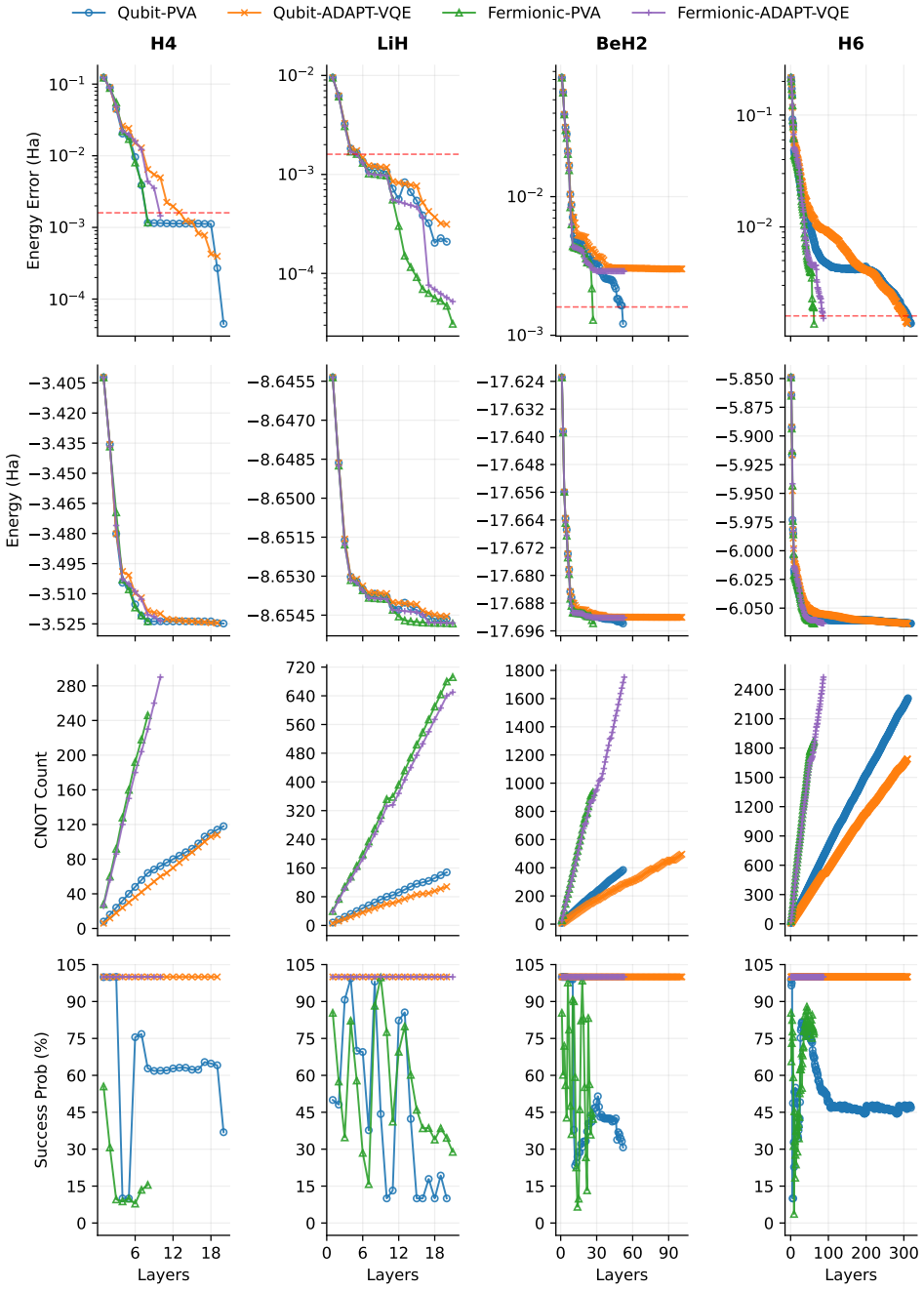
The Projector Variational Ansatz constructs a variational circuit that applies a parametrized projector to identify the ground state of a Hamiltonian, and experimental results demonstrate that this structure converges with a shallower ansatz than the usual ADAPT-VQE.
What carries the argument
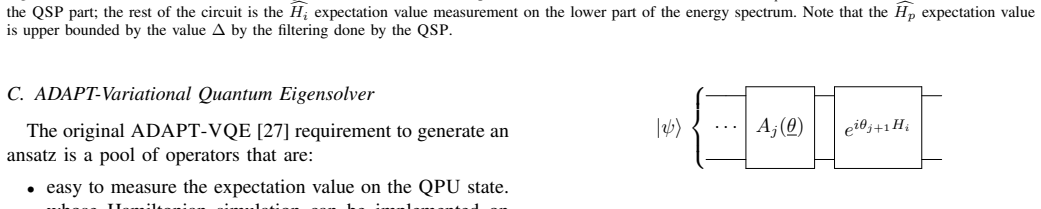
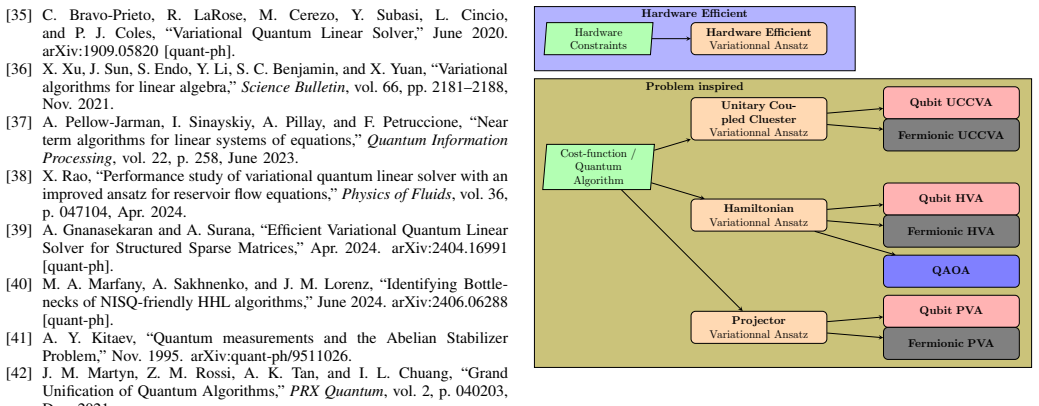
The Projector Variational Ansatz (PVA), a parametrized circuit that applies a projector-like operation to flag the ground state, which can be tuned to reproduce either ISQ-QSP or ADAPT-VQE circuit structures.
If this is right
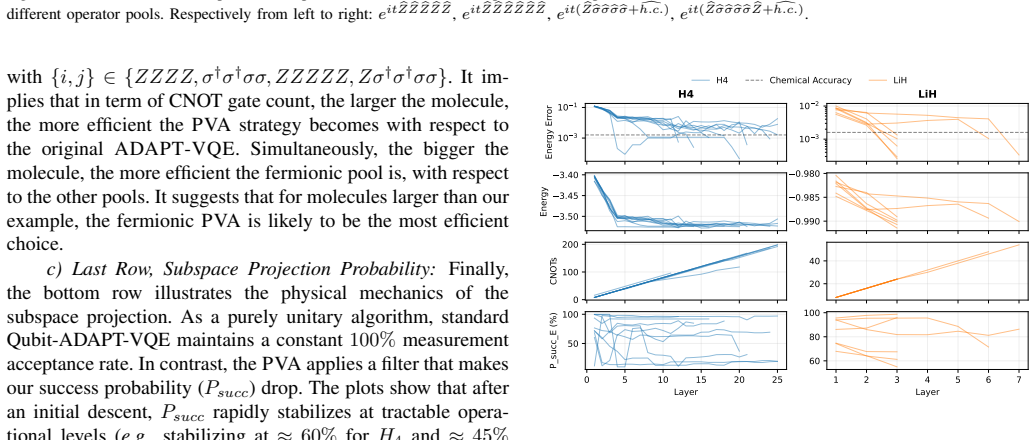
- PVA achieves ground-state convergence with reduced circuit depth relative to ADAPT-VQE on the tested Hamiltonians.
- The same ansatz structure can be reparametrized to match the circuit layout of intermediate-scale quantum signal processing.
- Iterative ansatz growth guided by projector operators yields shallower final circuits than derivative-assembled pseudo-Trotter growth.
- The projector form allows direct comparison between variational and fault-tolerant projector techniques within a single VQE framework.
Where Pith is reading between the lines
- If the depth advantage persists across broader Hamiltonians, PVA could extend practical VQE calculations to modestly larger molecular systems on current hardware.
- The structural similarity to fault-tolerant projectors suggests a route for gradually incorporating non-variational elements into VQE workflows.
- Measuring the total resource cost including ancillary qubit overhead would clarify whether the depth saving translates into an overall resource gain.
Load-bearing premise
The projector parametrization delivers the observed depth reduction without hidden increases in measurement overhead or optimization difficulty that would cancel the benefit.
What would settle it
A benchmark on a system where the PVA requires equal or greater circuit depth than ADAPT-VQE to reach the same energy accuracy within a fixed measurement budget.
Figures




read the original abstract
Quantum computing offers several algorithms to compute the ground state of a problem Hamiltonian. The most desirable algorithms belong to the Fault Tolerant QuantumComputing (FTQC) regime, such as quantum algorithms with repetitive structure like Quantum Phase Estimation (QPE) and Quantum Signal Processing (QSP). However, in the Noisy In-termediate Scale Quantum (NISQ) regime, the most realistic approaches involve Variational Quantum Eigensolver (VQE) algorithms and their variants. VQE is an algorithm that searches for a parametrized unitary matrix called an ansatz whose purposeis to transform an easily prepared initial state into the groundstate of a given Hamiltonian. Adaptive Derivative-AssembledPseudo-Trotter (ADAPT)-VQE is a variant of VQE that im-proves this approach by constructing the ansatz iteratively so that the associated quantum circuit is as shallow as possible. A major difference between FTQC (i.e. not variational) algorithms and VQE is that FTQC algorithms do not construct a state transitiondirectly. Instead, they construct a projector that identifies the ground state using ancillary qubits that flag the good solution. The desired state is then obtained via amplitude amplification orpost-selection. In this work, we propose a VQE ansatz whose structure is more similar to that of an FTQC algorithm. Depending on its parametrization, this ansatz can be equivalent to either an Intermediate Scale Quantum (ISQ)-QSP or to an ADAPT-VQE quantum circuit structure. Our experimental results show that this first proposal of Projector Variational Ansatz (PVA) converges with a shallower ansatz than the usual ADAPT-VQE.
Editorial analysis
A structured set of objections, weighed in public.
Referee Report
Summary. The manuscript introduces the Projector Variational Ansatz (PVA), a VQE-style ansatz whose structure mimics FTQC projector methods by using ancillary qubits to flag the ground state, with post-selection or amplitude amplification to extract it. Depending on parametrization, PVA reduces to either ISQ-QSP or ADAPT-VQE circuit structure. The central experimental claim is that PVA reaches convergence using a shallower ansatz than standard ADAPT-VQE.
Significance. If the reported depth reduction is shown to yield a genuine net resource saving after all costs are tallied, the work would provide a concrete bridge between variational NISQ methods and projector-based FTQC primitives, with the parametrization equivalence offering a useful unification. The manuscript would then merit attention for opening a new ansatz family whose performance can be directly compared to both VQE and QSP lineages.
major comments (2)
- [Abstract] The abstract states that PVA 'converges with a shallower ansatz than the usual ADAPT-VQE,' yet the comparison metrics are not specified. If the experiments track only gate depth or iteration count while omitting ancillary-qubit count, post-selection success probability, or the number of shots required to evaluate the projector, the headline claim of improved performance does not follow.
- [Experimental Results] The skeptic note correctly identifies that the projector construction necessarily introduces ancillary qubits and post-selection. Without an explicit resource table (circuit depth + measurement overhead + success probability) comparing PVA to ADAPT-VQE on the same Hamiltonians, the central experimental result cannot be assessed as a net improvement.
minor comments (2)
- Define the precise parametrization choices that recover ADAPT-VQE versus ISQ-QSP, ideally with a short table or diagram showing the operator pool and measurement protocol in each limit.
- Clarify whether the PVA projector is evaluated via direct measurement on the ancilla or via post-selection, and state the associated sampling overhead explicitly.
Simulated Author's Rebuttal
We thank the referee for the constructive comments on resource accounting and metric clarity. We agree that the headline claim requires explicit qualification and that a full resource comparison is needed to substantiate net improvement. We will revise the manuscript accordingly.
read point-by-point responses
-
Referee: [Abstract] The abstract states that PVA 'converges with a shallower ansatz than the usual ADAPT-VQE,' yet the comparison metrics are not specified. If the experiments track only gate depth or iteration count while omitting ancillary-qubit count, post-selection success probability, or the number of shots required to evaluate the projector, the headline claim of improved performance does not follow.
Authors: We agree the abstract should specify the metrics. The reported 'shallower ansatz' refers specifically to the reduced number of variational layers/gates in the primary register needed for convergence to a target accuracy, as measured in our experiments. Ancilla overhead and post-selection costs were not folded into that particular comparison. We will revise the abstract to state this explicitly and add a brief discussion of the ancillary and post-selection trade-offs. revision: yes
-
Referee: [Experimental Results] The skeptic note correctly identifies that the projector construction necessarily introduces ancillary qubits and post-selection. Without an explicit resource table (circuit depth + measurement overhead + success probability) comparing PVA to ADAPT-VQE on the same Hamiltonians, the central experimental result cannot be assessed as a net improvement.
Authors: We accept this assessment. The current experiments emphasize ansatz depth but omit a consolidated resource table. We will add an explicit comparison table for the same Hamiltonians that includes total circuit depth (with ancillas), estimated post-selection success probability, measurement overhead, and shot-count estimates. This will allow readers to judge net resource savings directly. revision: yes
Circularity Check
No circularity: PVA proposal is a novel construction with external experimental comparison
full rationale
The manuscript proposes PVA as a projector-based variational ansatz that, depending on parametrization, reduces to ISQ-QSP or ADAPT-VQE structures. The central result is an experimental demonstration of shallower circuit convergence versus ADAPT-VQE. No equations, fitted parameters, or predictions are shown that reduce to inputs by construction. No self-citations, uniqueness theorems, or ansatzes smuggled via prior author work appear in the text. The derivation chain is therefore self-contained and does not exhibit any of the enumerated circularity patterns.
Axiom & Free-Parameter Ledger
Reference graph
Works this paper leans on
-
[1]
Variational quantum algorithms,
M. Cerezo, A. Arrasmith, R. Babbush, S. C. Benjamin, S. Endo, K. Fujii, J. R. McClean, K. Mitarai, X. Yuan, L. Cincio, and P. J. Coles, “Variational quantum algorithms,”Nature Reviews Physics, vol. 3, pp. 625–644, Sept. 2021
2021
-
[2]
Patterns for Hybrid Quantum Algorithms,
M. Weigold, J. Barzen, F. Leymann, and D. Vietz, “Patterns for Hybrid Quantum Algorithms,” inService-Oriented Computing(J. Barzen, ed.), vol. 1429, pp. 34–51, Cham: Springer International Publishing, 2021. Series Title: Communications in Computer and Information Science
2021
-
[3]
A variational eigenvalue solver on a (photonic) quantum processor,
A. Peruzzo, J. McClean, P. Shadbolt, M.-H. Yung, X.-Q. Zhou, P. J. Love, A. Aspuru-Guzik, and J. L. O’Brien, “A variational eigenvalue solver on a (photonic) quantum processor,”Nature Communications, vol. 5, p. 4213, July 2014. arXiv:1304.3061 [physics, physics:quant- ph]
Pith/arXiv arXiv 2014
-
[4]
From transistor to trapped-ion com- puters for quantum chemistry,
M.-H. Yung, J. Casanova, A. Mezzacapo, J. McClean, L. Lamata, A. Aspuru-Guzik, and E. Solano, “From transistor to trapped-ion com- puters for quantum chemistry,”Scientific Reports, vol. 4, p. 3589, Jan. 2014
2014
-
[5]
The theory of variational hybrid quantum-classical algorithms,
J. R. McClean, J. Romero, R. Babbush, and A. Aspuru-Guzik, “The theory of variational hybrid quantum-classical algorithms,”New Journal of Physics, vol. 18, p. 023023, Feb. 2016
2016
-
[6]
VQE method: a short survey and recent developments,
D. A. Fedorov, B. Peng, N. Govind, and Y . Alexeev, “VQE method: a short survey and recent developments,”Materials Theory, vol. 6, p. 2, Jan. 2022
2022
-
[7]
Variational quantum eigensolvers by variance minimization,
D.-B. Zhang, Z.-H. Yuan, and T. Yin, “Variational quantum eigensolvers by variance minimization,” June 2020. arXiv:2006.15781 [quant-ph]
arXiv 2020
-
[8]
Hardware-efficient variational quantum eigensolver for small molecules and quantum magnets,
A. Kandala, A. Mezzacapo, K. Temme, M. Takita, M. Brink, J. M. Chow, and J. M. Gambetta, “Hardware-efficient variational quantum eigensolver for small molecules and quantum magnets,”Nature, vol. 549, pp. 242–246, Sept. 2017
2017
-
[9]
Quantum implementation of the unitary coupled cluster for simulating molecular electronic structure,
Y . Shen, X. Zhang, S. Zhang, J.-N. Zhang, M.-H. Yung, and K. Kim, “Quantum implementation of the unitary coupled cluster for simulating molecular electronic structure,”Physical Review A, vol. 95, p. 020501, Feb. 2017
2017
-
[10]
Low-Depth Quantum Simulation of Materials,
R. Babbush, N. Wiebe, J. McClean, J. McClain, H. Neven, and G. K.-L. Chan, “Low-Depth Quantum Simulation of Materials,”Physical Review X, vol. 8, p. 011044, Mar. 2018
2018
-
[11]
Quantum algorithms for electronic structure calculations: Particle-hole Hamiltonian and optimized wave-function expansions,
P. K. Barkoutsos, J. F. Gonthier, I. Sokolov, N. Moll, G. Salis, A. Fuhrer, M. Ganzhorn, D. J. Egger, M. Troyer, A. Mezzacapo, S. Filipp, and I. Tavernelli, “Quantum algorithms for electronic structure calculations: Particle-hole Hamiltonian and optimized wave-function expansions,” Physical Review A, vol. 98, p. 022322, Aug. 2018
2018
-
[12]
Efficient symmetry-preserving state preparation circuits for the variational quantum eigensolver algorithm,
B. T. Gard, L. Zhu, G. S. Barron, N. J. Mayhall, S. E. Economou, and E. Barnes, “Efficient symmetry-preserving state preparation circuits for the variational quantum eigensolver algorithm,”npj Quantum Informa- tion, vol. 6, p. 10, Jan. 2020
2020
-
[13]
A diagrammatic approach to variational quantum ansatz construction,
Y . Herasymenko and T. E. O’Brien, “A diagrammatic approach to variational quantum ansatz construction,”Quantum, vol. 5, p. 596, Dec
-
[14]
arXiv:1907.08157 [quant-ph]
arXiv 1907
-
[15]
Quantum-optimal-control-inspired ansatz for variational quantum algorithms,
A. Choquette, A. Di Paolo, P. K. Barkoutsos, D. S ´en´echal, I. Tavernelli, and A. Blais, “Quantum-optimal-control-inspired ansatz for variational quantum algorithms,”Physical Review Research, vol. 3, p. 023092, May
-
[16]
arXiv:2008.01098 [quant-ph]
arXiv 2008
-
[17]
Quantum Compu- tation by Adiabatic Evolution,
E. Farhi, J. Goldstone, S. Gutmann, and M. Sipser, “Quantum Compu- tation by Adiabatic Evolution,” Jan. 2000. arXiv:quant-ph/0001106
Pith/arXiv arXiv 2000
-
[18]
Progress towards practical quantum variational algorithms,
D. Wecker, M. B. Hastings, and M. Troyer, “Progress towards practical quantum variational algorithms,”Physical Review A, vol. 92, p. 042303, Oct. 2015
2015
-
[19]
Strategies for solving the Fermi-Hubbard model on near-term quantum computers,
C. Cade, L. Mineh, A. Montanaro, and S. Stanisic, “Strategies for solving the Fermi-Hubbard model on near-term quantum computers,” Physical Review B, vol. 102, p. 235122, Dec. 2020
2020
-
[20]
Finding the ground state of the Hubbard model by variational methods on a quantum computer with gate errors,
J.-M. Reiner, F. Wilhelm-Mauch, G. Sch ¨on, and M. Marthaler, “Finding the ground state of the Hubbard model by variational methods on a quantum computer with gate errors,”Quantum Science and Technology, vol. 4, p. 035005, July 2019
2019
-
[21]
Hamiltonian variational ansatz without barren plateaus,
C.-Y . Park and N. Killoran, “Hamiltonian variational ansatz without barren plateaus,”Quantum, vol. 8, p. 1239, Feb. 2024. arXiv:2302.08529 [quant-ph]
arXiv 2024
-
[22]
Exploring entanglement and optimization within the Hamiltonian Variational Ansatz,
R. Wiersema, C. Zhou, Y . d. Sereville, J. F. Carrasquilla, Y . B. Kim, and H. Yuen, “Exploring entanglement and optimization within the Hamiltonian Variational Ansatz,”PRX Quantum, vol. 1, p. 020319, Dec
-
[23]
arXiv:2008.02941 [quant-ph]
arXiv 2008
-
[24]
Efficient variational simulation of non- trivial quantum states,
W. W. Ho and T. H. Hsieh, “Efficient variational simulation of non- trivial quantum states,”SciPost Physics, vol. 6, p. 029, Mar. 2019. arXiv:1803.00026 [cond-mat]
Pith/arXiv arXiv 2019
-
[25]
A Quantum Approximate Optimization Algorithm,
E. Farhi, J. Goldstone, and S. Gutmann, “A Quantum Approximate Optimization Algorithm,” Nov. 2014. arXiv:1411.4028 [quant-ph]
Pith/arXiv arXiv 2014
-
[26]
Quantum Supremacy through the Quantum Approximate Optimization Algorithm,
E. Farhi and A. W. Harrow, “Quantum Supremacy through the Quantum Approximate Optimization Algorithm,” Oct. 2019. arXiv:1602.07674 [quant-ph]
arXiv 2019
-
[27]
A Review on Quantum Approximate Optimization Algorithm and its Variants,
K. Blekos, D. Brand, A. Ceschini, C.-H. Chou, R.-H. Li, K. Pandya, and A. Summer, “A Review on Quantum Approximate Optimization Algorithm and its Variants,”Physics Reports, vol. 1068, pp. 1–66, June
-
[28]
arXiv:2306.09198 [quant-ph]
-
[29]
From the Quantum Approximate Optimization Algorithm to a Quantum Alternating Operator Ansatz,
S. Hadfield, Z. Wang, B. O’Gorman, E. G. Rieffel, D. Venturelli, and R. Biswas, “From the Quantum Approximate Optimization Algorithm to a Quantum Alternating Operator Ansatz,”Algorithms, vol. 12, p. 34, Feb. 2019
2019
-
[30]
Fermionic quantum approximate optimization algorithm,
T. Yoshioka, K. Sasada, Y . Nakano, and K. Fujii, “Fermionic quantum approximate optimization algorithm,”Physical Review Research, vol. 5, p. 023071, May 2023
2023
-
[31]
An adaptive variational algorithm for exact molecular simulations on a quantum computer,
H. R. Grimsley, S. E. Economou, E. Barnes, and N. J. Mayhall, “An adaptive variational algorithm for exact molecular simulations on a quantum computer,”Nature Communications, vol. 10, p. 3007, July 2019
2019
-
[32]
H. L. Tang, V . O. Shkolnikov, G. S. Barron, H. R. Grimsley, N. J. Mayhall, E. Barnes, and S. E. Economou, “qubit-ADAPT-VQE: An adaptive algorithm for constructing hardware-efficient ansatze on a quantum processor,”PRX Quantum, vol. 2, p. 020310, Apr. 2021. arXiv:1911.10205 [quant-ph]
arXiv 2021
-
[33]
Overlap-ADAPT-VQE: practical quantum chemistry on quantum com- puters via overlap-guided compact Ans ¨atze,
C. Feniou, M. Hassan, D. Traor ´e, E. Giner, Y . Maday, and J.-P. Piquemal, “Overlap-ADAPT-VQE: practical quantum chemistry on quantum com- puters via overlap-guided compact Ans ¨atze,”Communications Physics, vol. 6, p. 192, July 2023
2023
-
[34]
How to really measure operator gradients in ADAPT-VQE,
P. G. Anastasiou, N. J. Mayhall, E. Barnes, and S. E. Economou, “How to really measure operator gradients in ADAPT-VQE,” Sept. 2023. arXiv:2306.03227 [quant-ph]
Pith/arXiv arXiv 2023
-
[35]
Y . Viswanathan, O. Adjoua, C. Feniou, S. Badreddine, and J.-P. Pique- mal, “An Optimal Framework for Constructing Lie-Algebra Generator Pools: Application to Variational Quantum Eigensolvers for Chemistry,” Dec. 2025. arXiv:2511.22593 [quant-ph]
arXiv 2025
-
[36]
Reducing the resources required by ADAPT- VQE using coupled exchange operators and improved subroutines,
M. Ram ˆoa, P. G. Anastasiou, L. P. Santos, N. J. Mayhall, E. Barnes, and S. E. Economou, “Reducing the resources required by ADAPT- VQE using coupled exchange operators and improved subroutines,”npj Quantum Information, vol. 11, no. 1, p. 86, 2025
2025
-
[37]
TETRIS-ADAPT-VQE: An adaptive algorithm that yields shallower, denser circuit ans ¨atze,
P. G. Anastasiou, Y . Chen, N. J. Mayhall, E. Barnes, and S. E. Economou, “TETRIS-ADAPT-VQE: An adaptive algorithm that yields shallower, denser circuit ans ¨atze,”Physical Review Research, vol. 6, no. 1, p. 013254, 2024
2024
-
[38]
Geo-ADAPT-VQE: Quantum infor- mation metric-aware circuit optimization for quantum chemistry,
M. A. Sohail and T. Koike-Akino, “Geo-ADAPT-VQE: Quantum infor- mation metric-aware circuit optimization for quantum chemistry,” 2026
2026
-
[39]
Variational Quantum Linear Solver,
C. Bravo-Prieto, R. LaRose, M. Cerezo, Y . Subasi, L. Cincio, and P. J. Coles, “Variational Quantum Linear Solver,” June 2020. arXiv:1909.05820 [quant-ph]
arXiv 2020
-
[40]
Variational algorithms for linear algebra,
X. Xu, J. Sun, S. Endo, Y . Li, S. C. Benjamin, and X. Yuan, “Variational algorithms for linear algebra,”Science Bulletin, vol. 66, pp. 2181–2188, Nov. 2021
2021
-
[41]
Near term algorithms for linear systems of equations,
A. Pellow-Jarman, I. Sinayskiy, A. Pillay, and F. Petruccione, “Near term algorithms for linear systems of equations,”Quantum Information Processing, vol. 22, p. 258, June 2023
2023
-
[42]
Performance study of variational quantum linear solver with an improved ansatz for reservoir flow equations,
X. Rao, “Performance study of variational quantum linear solver with an improved ansatz for reservoir flow equations,”Physics of Fluids, vol. 36, p. 047104, Apr. 2024
2024
-
[43]
Efficient Variational Quantum Linear Solver for Structured Sparse Matrices,
A. Gnanasekaran and A. Surana, “Efficient Variational Quantum Linear Solver for Structured Sparse Matrices,” Apr. 2024. arXiv:2404.16991 [quant-ph]
arXiv 2024
-
[44]
Identifying Bottle- necks of NISQ-friendly HHL algorithms,
M. A. Marfany, A. Sakhnenko, and J. M. Lorenz, “Identifying Bottle- necks of NISQ-friendly HHL algorithms,” June 2024. arXiv:2406.06288 [quant-ph]
arXiv 2024
-
[45]
Quantum measurements and the Abelian Stabilizer Problem,
A. Y . Kitaev, “Quantum measurements and the Abelian Stabilizer Problem,” Nov. 1995. arXiv:quant-ph/9511026
Pith/arXiv arXiv 1995
-
[46]
Grand Unification of Quantum Algorithms,
J. M. Martyn, Z. M. Rossi, A. K. Tan, and I. L. Chuang, “Grand Unification of Quantum Algorithms,”PRX Quantum, vol. 2, p. 040203, Dec. 2021
2021
-
[47]
Y . Dong, L. Lin, and Y . Tong, “Ground state preparation and energy estimation on early fault-tolerant quantum computers via quantum eigenvalue transformation of unitary matrices,”PRX Quantum, vol. 3, p. 040305, Oct. 2022. arXiv:2204.05955 [physics, physics:quant-ph]
arXiv 2022
-
[48]
Quantum Signal Processing Based Grover’s Adaptative Search Oracle for High Order Unconstrained Binary Optimization Problems,
R. OLLIVE and S. LOUISE, “Quantum Signal Processing Based Grover’s Adaptative Search Oracle for High Order Unconstrained Binary Optimization Problems,” in2024 IEEE International Conference on Quantum Computing and Engineering (QCE), vol. 02, pp. 256–261, Sept. 2024
2024
-
[49]
Numerical Error Extraction by Quantum Measurement Algorithm,
C. Ronfaut, R. Ollive, and S. Louise, “Numerical Error Extraction by Quantum Measurement Algorithm,” Feb. 2026. arXiv:2602.01927 [quant-ph]
arXiv 2026
-
[50]
Gate Efficient Composition of Hamiltonian Simulation and Block-Encoding with its Application on HUBO, Chem- istry and Finite Difference Method,
R. Ollive and S. Louise, “Gate Efficient Composition of Hamiltonian Simulation and Block-Encoding with its Application on HUBO, Chem- istry and Finite Difference Method,” in2025 IEEE International Parallel and Distributed Processing Symposium Workshops (IPDPSW), pp. 519– 528, June 2025
2025
-
[51]
A Theory of Trotter Error with Commutator Scaling,
A. M. Childs, Y . Su, M. C. Tran, N. Wiebe, and S. Zhu, “A Theory of Trotter Error with Commutator Scaling,”Physical Review X, vol. 11, p. 011020, Feb. 2021. arXiv:1912.08854 [cond-mat, physics:physics, physics:quant-ph]
arXiv 2021
-
[52]
Coupled-cluster theory in quantum chemistry,
R. J. Bartlett and M. Musiał, “Coupled-cluster theory in quantum chemistry,”Reviews of Modern Physics, vol. 79, pp. 291–352, Feb. 2007
2007
-
[53]
Quantum approximate optimization is computationally uni- versal,
S. Lloyd, “Quantum approximate optimization is computationally uni- versal,” Dec. 2018. arXiv:1812.11075 [quant-ph]
Pith/arXiv arXiv 2018
-
[54]
On the univer- sality of the quantum approximate optimization algorithm,
M. MORALES, J. BIAMONTE, and Z. ZIMBORAS, “On the univer- sality of the quantum approximate optimization algorithm,”Quantum Information Processing, Aug. 2020. APPENDIX A. Cost-Function Structure By linearity, the expectation value of the operator on a quantum state (or the inner product of two states around the operator) can be computed via a weighted sum...
2020
-
[55]
The original proposal shows instances for which it behaves well
Quantum Approximate Optimization Algorithm:QAOA is a specific case for binary optimization problems. The original proposal shows instances for which it behaves well
-
[56]
It uses the mixing Hamiltonian dHM =Pnbqb−1 i=0 bXi and cHp a diagonal Hamiltonian, often corresponding to an Ising problem
and [23] provided complexity-theoretic explanations of the hardness of modeling this algorithm classically. It uses the mixing Hamiltonian dHM =Pnbqb−1 i=0 bXi and cHp a diagonal Hamiltonian, often corresponding to an Ising problem. These two Hamiltonians can be implemented exactly. QAOA is one of the most studied VQA. [24, Table 1] provides a summary of ...
-
[57]
Hamiltonian Variational Ansatz:Is the generalization of the previous technique to arbitrary Hamiltonians: initially for quantum systems (Fermi-Hubbard) diagonalization [16], asso- ciate resource estimation [17], impact of errors [18], optimiza- tion guarantee [19], more general problems [20], and quantum state preparation [21]. When applied to a chemical ...
-
[58]
We implemented the quantum circuit construction and statevector simulations using the Qiskit and Qiskit Nature software stacks
System Generation and Software Stack:To compute all electronic structure quantities and the Hartree-Fock method, we used the classical PySCF driver. We implemented the quantum circuit construction and statevector simulations using the Qiskit and Qiskit Nature software stacks. For the finite-shot executions, we used Qiskit’s V2 Primitives (SamplerV2) and t...
-
[59]
For the Fermionic-ADAPT-VQE, we kept all excitations as an Hamiltonian simulated operator
Operator Pools:The adaptive pools were derived from Unitary Coupled-Cluster Singles and Doubles (UCCSD) ex- citation operators. For the Fermionic-ADAPT-VQE, we kept all excitations as an Hamiltonian simulated operator. For the Qubit-ADAPT-VQE, we decomposed the fermionic operators to extract individual Pauli strings. To optimize the pool size, we discarde...
-
[60]
For the shot simulation, we used the SPSA optimizer
Optimisation and measurement strategies:For the exact- statevector simulations, the parameter optimization (θ, ϕ, δ) was performed globally at each iteration using the L-BFGS- B algorithm with a gradient tolerance of10 −5. For the shot simulation, we used the SPSA optimizer. The SPSA algorithm was configured with automatic calibration of the learning rate...
discussion (0)
Sign in with ORCID, Apple, or X to comment. Anyone can read and Pith papers without signing in.