High-Speed Observations of Lunar Impact Flashes
Pith reviewed 2026-06-27 21:06 UTC · model grok-4.3
The pith
High-speed imaging of lunar impacts shows the initial vapour plume intensity has far less variance than total energy and no correlation with it.
A machine-rendered reading of the paper's core claim, the machinery that carries it, and where it could break.
Core claim
The authors state that their 200-250 FPS observations of four confirmed lunar impact flashes demonstrate that initial flash intensity, interpreted as the vapour plume, exhibits significantly less variance across events than the total luminous energy, and that the two quantities show no statistical correlation, implying the mechanism of initial vapour expansion may be physically decoupled from the longer-duration glow produced by cooling ejecta.
What carries the argument
High-frame-rate photometry that separates the initial vapour-plume flash from the subsequent incandescent ejecta phase.
If this is right
- High temporal resolution is essential to distinguish the vapour plume from the cooling ejecta phase when estimating impactor properties.
- Simple exponential-decay models are insufficient for some observed light-curve morphologies.
- Simultaneous lower-frame-rate data can integrate over the rapid initial drop, leading to different measured brightness evolution.
- A significantly larger dataset is needed to constrain the proposed decoupling of mechanisms.
Where Pith is reading between the lines
- Monitoring programs that rely on standard 25-60 FPS cameras may systematically blend the two phases and therefore mis-estimate meteoroid fluxes.
- If the decoupling holds, flash brightness scaling laws could be derived separately for each phase rather than from total energy alone.
- The approach could be extended to other airless-body impacts where rapid vapour and ejecta phases coexist.
Load-bearing premise
That the light curves of the four events accurately capture the impact physics and are not dominated by instrumental or atmospheric effects, and that this small sample supports claims of lower variance and absent correlation.
What would settle it
A larger set of high-speed events in which initial and total energies show a clear statistical correlation or comparable variance levels.
Figures





read the original abstract
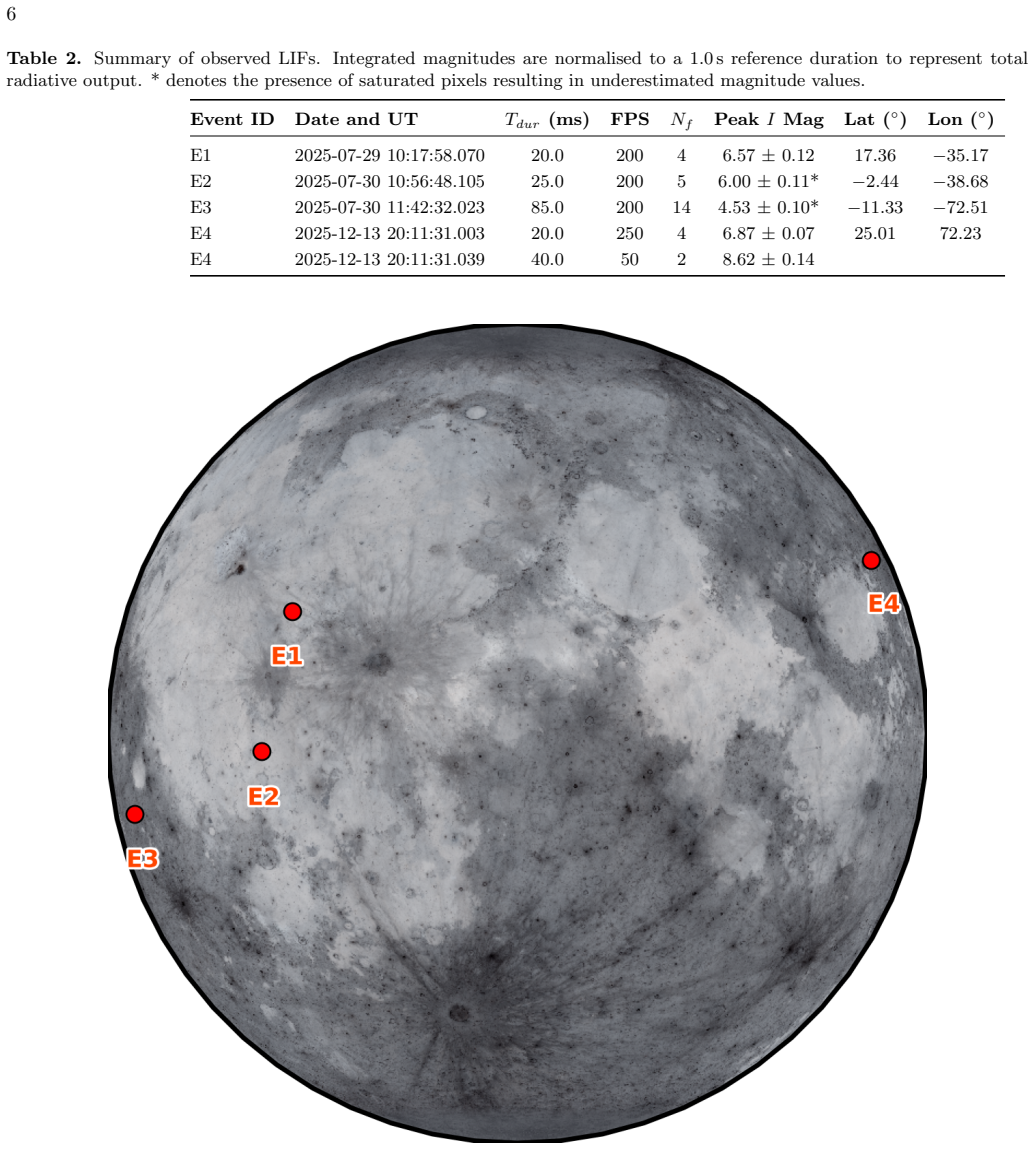
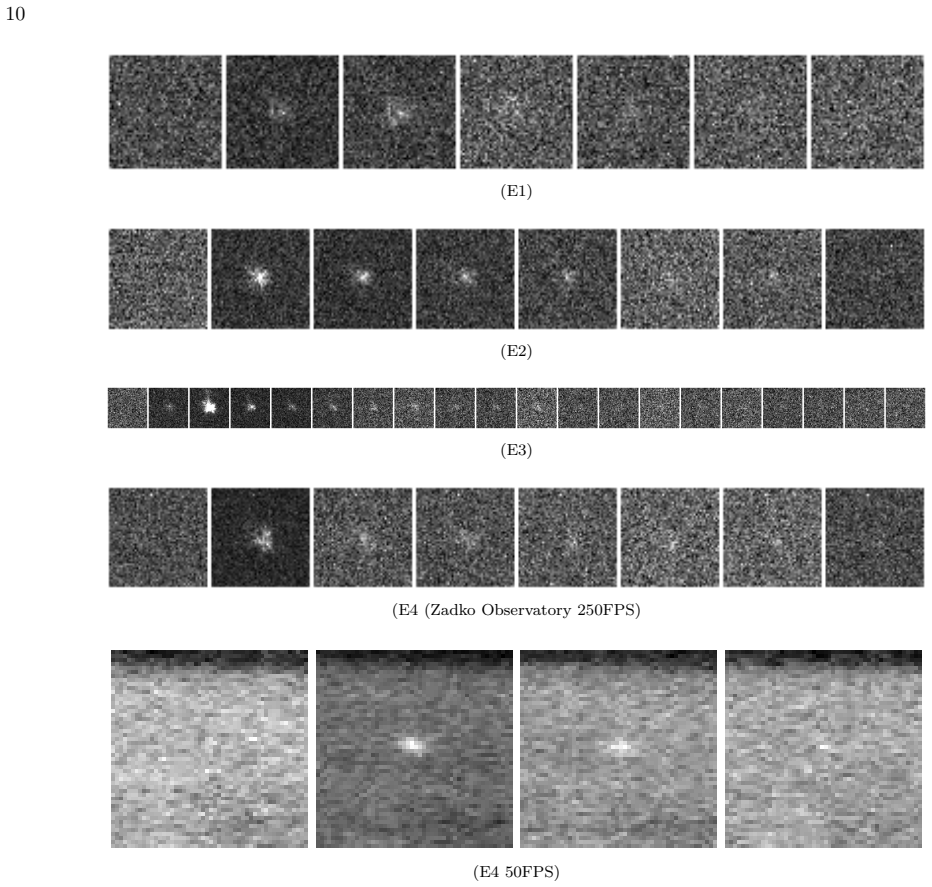
Lunar impact flashes provide a direct means of estimating the flux of centimetre-sized meteoroids impacting the lunar surface. However, 25-60 frames per second imaging typical of most monitoring programs limit the ability to resolve the rapid temporal evolution of the impact process, while the integration of Earthshine background restricts the detection of faint flashes. In this work, we present high-speed observations of lunar impact flashes captured at 200 and 250 FPS using the Zadko Telescope in Western Australia. We resolve the light curves of four confirmed events, revealing complex morphologies, some of which are not well modelled by simple exponential decays. One event was simultaneously detected by a second observer using a 50 FPS system, revealing a significantly faster brightness drop in the high-speed data that cannot be explained by spectral differences alone, indicating temporal integration of the vapour plume and subsequent ejecta. Our data also indicates that the initial flash intensity (representing the vapour plume) exhibits significantly less variance across events than the total luminous energy. Furthermore, we found no statistical correlation between the initial luminous energy and the total integrated energy of the flashes in this data, suggesting that the physical mechanism driving the initial vapour expansion may be physically decoupled from the longer-duration glow driven by the cooling ejecta. High temporal resolution combined with high sensitivity are therefore essential for accurately characterising the physical properties of the impactor and distinguishing the initial vapour plume from the subsequent incandescent cooling phase, although a significantly larger dataset is required to definitively constrain these mechanisms.
Editorial analysis
A structured set of objections, weighed in public.
Referee Report
Summary. The manuscript reports high-speed (200-250 FPS) observations of four confirmed lunar impact flashes with the Zadko Telescope, resolving complex light-curve morphologies not well fit by simple exponentials. One event was simultaneously detected at 50 FPS, showing a faster initial decay in the high-speed data attributed to reduced temporal integration of the vapor plume. The authors state that initial-flash intensity exhibits significantly lower variance than total luminous energy and report no statistical correlation between the two quantities, suggesting physical decoupling of the initial plume from later ejecta cooling; they note that a significantly larger dataset is required to constrain the mechanisms.
Significance. The simultaneous high- versus low-speed detection provides direct evidence that temporal integration affects measured decay rates, supporting the value of high-FPS observations for accurate impact characterization. If the variance and correlation findings are robust in larger samples, the work would strengthen arguments for distinguishing vapor-plume and ejecta phases in lunar flash photometry and for refining meteoroid flux estimates.
major comments (2)
- [Results / statistical comparisons] The central statistical claims (significantly lower variance in initial intensity; absence of correlation with total energy) rest on a sample of four events. The manuscript should specify the exact tests performed (e.g., F-test, Levene’s test, Pearson or Spearman correlation), report the resulting p-values or confidence intervals, and include measurement uncertainties on the derived energies so that readers can assess whether the conclusions survive modest errors or single-point leverage.
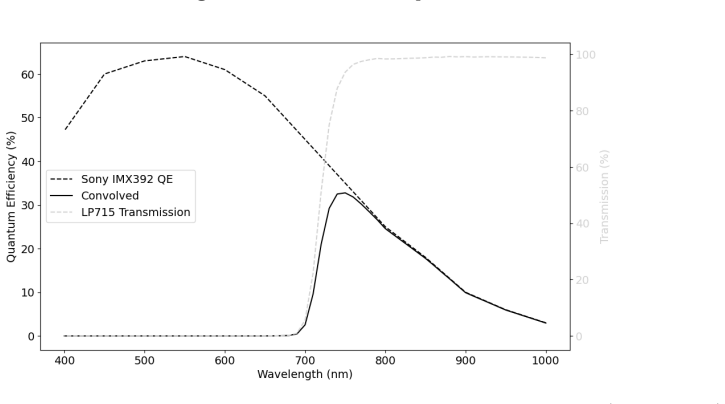
- [Simultaneous detection analysis] The statement that the simultaneous detection “cannot be explained by spectral differences alone” is load-bearing for the temporal-integration interpretation. The manuscript should quantify the expected spectral contribution (filter transmission curves, assumed black-body temperatures, or color indices) and show that the observed difference exceeds that contribution.
minor comments (2)
- Add error bars or uncertainty estimates to all tabulated energies and to the light-curve figures.
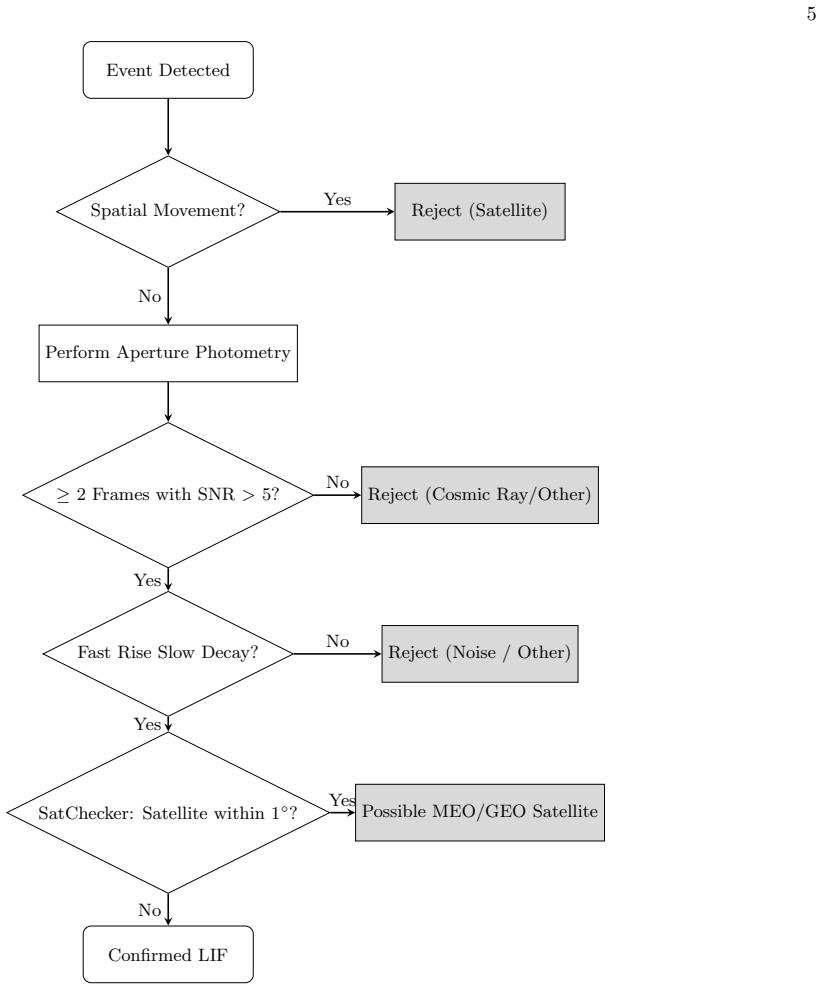
- Clarify the precise confirmation criteria (astrometric, temporal, or multi-station) used to classify the four flashes as lunar impacts.
Simulated Author's Rebuttal
We thank the referee for their constructive review and recommendation for minor revision. We address each major comment below.
read point-by-point responses
-
Referee: [Results / statistical comparisons] The central statistical claims (significantly lower variance in initial intensity; absence of correlation with total energy) rest on a sample of four events. The manuscript should specify the exact tests performed (e.g., F-test, Levene’s test, Pearson or Spearman correlation), report the resulting p-values or confidence intervals, and include measurement uncertainties on the derived energies so that readers can assess whether the conclusions survive modest errors or single-point leverage.
Authors: We agree that the statistical methods and results must be reported explicitly. In the revised manuscript we will state that variance equality was assessed with Levene’s test and correlation with Spearman’s rank test, include the resulting p-values and confidence intervals, and add the measurement uncertainties on the derived energies. We already note in the text that the sample is small and that a larger dataset is required; the added details will allow readers to evaluate robustness directly. revision: yes
-
Referee: [Simultaneous detection analysis] The statement that the simultaneous detection “cannot be explained by spectral differences alone” is load-bearing for the temporal-integration interpretation. The manuscript should quantify the expected spectral contribution (filter transmission curves, assumed black-body temperatures, or color indices) and show that the observed difference exceeds that contribution.
Authors: We will add a quantitative estimate of the spectral contribution in the revised manuscript. Using the filter transmission curves of both instruments and plausible black-body temperatures for the initial plume, we will compute the expected flux ratio and demonstrate that the observed difference in initial decay exceeds the spectral effect. If the calculation shows the spectral contribution is non-negligible, we will qualify the original statement accordingly. revision: yes
Circularity Check
No circularity: purely observational data and direct statistical summaries
full rationale
The paper reports raw high-speed photometric measurements of four lunar impact flashes and computes simple sample statistics (variance comparison and correlation test) directly on those measured quantities. No equations, fitted models, predictions, or derivations are present that could reduce to inputs by construction. No self-citations are invoked as load-bearing premises for any claim. The central assertions are statistical descriptions of the observed sample, with the authors themselves noting the small n limits definitive conclusions. This is self-contained observational reporting with no circular structure.
Axiom & Free-Parameter Ledger
Reference graph
Works this paper leans on
-
[1]
The Astropy Project: Sustaining and Growing a Community-oriented Open-source Project and the Latest Major Release (v5.0) of the Core Package. , keywords =. doi:10.3847/1538-4357/ac7c74 , archivePrefix =. 2206.14220 , primaryClass =
work page internal anchor Pith review Pith/arXiv arXiv doi:10.3847/1538-4357/ac7c74
-
[2]
Ernst, C. M. and Schultz, P. H. , month = mar, year =. Effects of. 39th
-
[3]
Ernst, C. M. and Schultz, P. H. , month = mar, year =. Effect of. Lunar and
-
[4]
Ernst, C. M. and Barnouin, O. S. and Schultz, P. H. , month = mar, year =. High-. 41st
-
[5]
Artemieva, N. A. and Shuvalov, V. V. and Trubetskaya, I. A. , month = mar, year =. Lunar. 31st
-
[6]
arXiv.org , author =
You. arXiv.org , author =
-
[7]
Detection of an atmosphere on a trans-
Arimatsu, Ko and Yoshida, Fumi and Hayamizu, Tsutomu and Takita, Satoshi and Hosoi, Katsumasa and Ootsubo, Takafumi and Watanabe, Jun-ichi , month = may, year =. Detection of an atmosphere on a trans-. Nature Astronomy , publisher =. doi:10.1038/s41550-026-02846-1 , abstract =
-
[8]
Atmospheric Research , author =
The. Atmospheric Research , author =. 2013 , keywords =. doi:10.1016/j.atmosres.2013.01.006 , abstract =
-
[9]
doi:10.1093/mnras/stab2130 , eprint =
Monthly Notices of the Royal Astronomical Society , author =. 2021 , pages =. doi:10.1093/mnras/stab2130 , abstract =
-
[10]
MNRAS , archivePrefix = "arXiv", eprint =
Monthly Notices of the Royal Astronomical Society , author =. 2007 , pages =. doi:10.1111/j.1365-2966.2007.11881.x , abstract =
-
[11]
2025, , 699, L3, 10.1051/0004-6361/202555481
Sheward, D. and Delbo, M. and Avdellidou, C. and Cook, A. and Lognonné, P. , month = jul, year =. Detection of small fresh craters on the. Astronomy and Astrophysics , publisher =. doi:10.1051/0004-6361/202555481 , abstract =
-
[12]
Kurlander, Jacob A. and Bernardinelli, Pedro H. and Schwamb, Megan E. and Jurić, Mario and Murtagh, Joseph and Chandler, Colin Orion and Merritt, Stephanie R. and Nesvorný, David and Vokrouhlický, David and Jones, R. Lynne and Fedorets, Grigori and Cornwall, Samuel and Holman, Matthew J. and Eggl, Siegfried and Oldag, Drew and West, Maxine and Kubica, Jer...
-
[13]
The Astronomical Journal , author =
Exploration of the. The Astronomical Journal , author =. 2006 , pages =. doi:10.1086/505623 , abstract =
-
[14]
Publications of the Astronomical Society of Japan , author =
Multi-chord observation of stellar occultation by the near-. Publications of the Astronomical Society of Japan , author =. 2023 , pages =. doi:10.1093/pasj/psac096 , abstract =
-
[15]
Roques, F. and Moncuquet, M. and Lavillonière, N. and Auvergne, M. and Chevreton, M. and Colas, F. and Lecacheux, J. , month = sep, year =. A. The Astrophysical Journal , publisher =. doi:10.1086/378576 , abstract =
-
[16]
Zhang, Z.-W. and Lehner, M. J. and Wang, J.-H. and Wen, C.-Y. and Wang, S.-Y. and King, S.-K. and Granados, Á. P. and Alcock, C. and Axelrod, T. and Bianco, F. B. and Byun, Y.-I. and Chen, W. P. and Coehlo, N. K. and Cook, K. H. and de Pater, I. and Kim, D.-W. and Lee, T. and Lissauer, J. J. and Marshall, S. L. and Protopapas, P. and Rice, J. A. and Schwa...
-
[17]
Asteroid albedos deduced from stellar occultations , volume =. Icarus , author =. 2006 , keywords =. doi:10.1016/j.icarus.2006.04.006 , abstract =
-
[18]
Direct determination of asteroid diameters from occultation observations. , url =. Asteroids , author =. 1979 , note =
1979
-
[20]
Tagliaferri, E. and Spalding, R. and Jacobs, C. and Ceplecha, Z. , month = jan, year =. Analysis of the. Earth Moon and Planets , publisher =. doi:10.1007/BF00671553 , abstract =
-
[21]
Deam, Sophie E. and Devillepoix, Hadrien A. R. and Nesvorný, David and Shober, Patrick M. and Sansom, Eleanor K. and Albers, Jim and Anderson, Eric and Benkhaldoun, Zouhair and Brown, Peter G. and Daly, Luke and DiBattista, George and Chennaoui Aoudjehane, Hasnaa and Herd, Christopher D. K. and Herring, Tom and Horner, Jonathan and Jenniskens, Peter and P...
-
[22]
Borovička, J. and Spurný, P. and Brown, P. , month = jan, year =. Small. Asteroids. doi:10.2458/azu_uapress_9780816532131-ch014 , abstract =
-
[23]
Meteoritics & Planetary Science , author =
Review of asteroid, meteor, and meteorite-type links , volume =. Meteoritics & Planetary Science , author =. 2025 , note =. doi:10.1111/maps.14321 , abstract =
-
[24]
Brown, P. G. and Assink, J. D. and Astiz, L. and Blaauw, R. and Boslough, M. B. and Borovička, J. and Brachet, N. and Brown, D. and Campbell-Brown, M. and Ceranna, L. and Cooke, W. and de Groot-Hedlin, C. and Drob, D. P. and Edwards, W. and Evers, L. G. and Garces, M. and Gill, J. and Hedlin, M. and Kingery, A. and Laske, G. and Le Pichon, A. and Mialle, ...
-
[25]
Decameter-sized. Icarus , author =. 2025 , keywords =. doi:10.1016/j.icarus.2024.116444 , abstract =
-
[26]
The population of near-earth asteroids revisited and updated , volume =. Icarus , author =. 2021 , keywords =. doi:10.1016/j.icarus.2021.114452 , abstract =
-
[27]
Elliot, J. L. and Dunham, E. and Mink, D. , month = may, year =. The rings of. Nature , publisher =. doi:10.1038/267328a0 , abstract =
-
[28]
Meteoritics & Planetary Science , author =
The “. Meteoritics & Planetary Science , author =. 1998 , pages =. doi:10.1111/j.1945-5100.1998.tb01606.x , abstract =
-
[29]
Popova, Olga and Boroviĉka, Jiri and Campbell-Brown, Margaret , year =. Modelling the. Meteoroids:. doi:10.1017/9781108606462.005 , urldate =
-
[30]
Journal of Geophysical Research: Planets , author =
Optical observations of meteors generating infrasound:. Journal of Geophysical Research: Planets , author =. 2015 , note =. doi:10.1002/2014JE004680 , abstract =
-
[31]
Publications of the Astronomical Society of Australia , author =
Photometry of fireballs using high frame rate cameras , volume =. Publications of the Astronomical Society of Australia , author =. 2026 , keywords =. doi:10.1017/pasa.2026.10162 , abstract =
-
[32]
Identification of meteorite source regions in the. Icarus , author =. 2018 , keywords =. doi:10.1016/j.icarus.2018.04.012 , abstract =
-
[33]
Buchan, Stuart R. G. and Howie, Robert M. and Paxman, Jonathan and Devillepoix, Hadrien A. R. , month = jan, year =. Developing a. doi:10.48550/arXiv.1907.12807 , abstract =
-
[34]
and Turčinov, R
Vida, D. and Turčinov, R. and Šegon, D. and Silađi, E. , month = jan, year =. Low-cost meteor radiometer , url =
-
[35]
A little tour across the wonderful realm of meteor radiometry , url =
Rault, Jean-Louis , month = jan, year =. A little tour across the wonderful realm of meteor radiometry , url =. doi:10.48550/arXiv.1911.04290 , abstract =
-
[36]
Publications of the Astronomical Society of Australia , author =
The. Publications of the Astronomical Society of Australia , author =. 2017 , keywords =. doi:10.1017/pasa.2016.61 , abstract =
-
[37]
Meteoritics & Planetary Science , author =
The. Meteoritics & Planetary Science , author =. 2024 , note =. doi:10.1111/maps.13977 , abstract =
-
[38]
Meteoritics & Planetary Science , author =
The instrumentally recorded fall of the. Meteoritics & Planetary Science , author =. 2015 , pages =. doi:10.1111/maps.12469 , abstract =
-
[39]
Low dispersion spectra of lunar impact flashes , issn =. Icarus , author =. 2025 , keywords =. doi:10.1016/j.icarus.2025.116480 , abstract =
-
[40]
Liakos, A. and Bonanos, A. Z. and Xilouris, E. M. and Koschny, D. and Bellas-Velidis, I. and Boumis, P. and Maroussis, A. and Moissl, R. , month = jul, year =. Astronomy & Astrophysics , publisher =. doi:10.1051/0004-6361/202449542 , abstract =
-
[41]
Meteoroid rotation and quasi-periodic brightness variation of meteor light curves , volume =
Mancuso, Salvatore and Barghini, Dario and Gardiol, Daniele , month = mar, year =. Meteoroid rotation and quasi-periodic brightness variation of meteor light curves , volume =. Astronomy & Astrophysics , publisher =. doi:10.1051/0004-6361/202348358 , abstract =
-
[42]
Spalding, Richard and Tencer, John and Sweatt, William and Conley, Benjamin and Hogan, Roy and Boslough, Mark and Gonzales, GiGi and Spurný, Pavel , month = feb, year =. Photoacoustic. Scientific Reports , publisher =. doi:10.1038/srep41251 , abstract =
-
[43]
The. Icarus , author =. 2014 , keywords =. doi:10.1016/j.icarus.2014.04.032 , abstract =
-
[44]
Planetary and Space Science , author =
Simultaneous radar and video meteors—. Planetary and Space Science , author =. 2013 , keywords =. doi:10.1016/j.pss.2013.03.012 , abstract =
-
[45]
Spurný, P. and Ceplecha, Z. , month = oct, year =. Is electric charge separation the main process for kinetic energy transformation into the meteor phenomenon? , volume =. Astronomy & Astrophysics , publisher =. doi:10.1051/0004-6361:200810069 , abstract =
-
[46]
Meteoritics and Planetary Science , author =
Fragmentation model of meteoroid motion, mass loss, and radiation in the atmosphere , volume =. Meteoritics and Planetary Science , author =. 2005 , keywords =. doi:10.1111/j.1945-5100.2005.tb00363.x , urldate =
-
[47]
SpurnÝ, Pavel and BoroviČka, JiŘÍ and Koten, Pavel , editor =. Multi-. Modern. 2005 , keywords =. doi:10.1007/1-4020-5075-5_52 , abstract =
-
[48]
Meteoritics & Planetary Science , author =
The. Meteoritics & Planetary Science , author =. 2003 , note =. doi:10.1111/j.1945-5100.2003.tb00296.x , abstract =
-
[49]
Meteor. Space Science Reviews , author =. 1998 , keywords =. doi:10.1023/A:1005069928850 , abstract =
-
[50]
Spurný, Pavel and Shrbený, Lukáš , editor =. Exceptional. Advances in. 2008 , keywords =. doi:10.1007/978-0-387-78419-9_21 , abstract =
-
[51]
Space Science Reviews , author =
Expectations for. Space Science Reviews , author =. 2005 , keywords =. doi:10.1007/s11214-005-3383-7 , abstract =
-
[52]
Spurný, Pavel and Borovička, Jiří , month = nov, year =
-
[53]
Ernst, C. M. and Schultz, P. H. , month = mar, year =. Effect of
-
[54]
Assessment of meteoroid pre-atmospheric diameter from brightness measurements prior to fragmentation , volume =. Icarus , author =. 2024 , keywords =. doi:10.1016/j.icarus.2023.115807 , abstract =
-
[55]
Astronomy & Astrophysics , author =
Analysis of. Astronomy & Astrophysics , author =. 2015 , keywords =. doi:10.1051/0004-6361/201525656 , abstract =
-
[56]
Meteoritics & Planetary Science , author =
Analysis of a “flickering”. Meteoritics & Planetary Science , author =. 2003 , pages =. doi:10.1111/j.1945-5100.2003.tb00297.x , abstract =
-
[57]
Meteoritics & Planetary Science , author =
Impact flash evolution of. Meteoritics & Planetary Science , author =. 2020 , note =. doi:10.1111/maps.13581 , abstract =
-
[58]
Impact flash evolution of
-
[59]
Earth, Planets and Space , author =
A low-dispersion spectral video camera for observing lunar impact flashes , volume =. Earth, Planets and Space , author =. 2022 , keywords =. doi:10.1186/s40623-022-01575-9 , abstract =
-
[60]
Monthly Notices of the Royal Astronomical Society , author =
The first observations to determine the temperature of a lunar impact flash and its evolution , volume =. Monthly Notices of the Royal Astronomical Society , author =. 2018 , pages =. doi:10.1093/mnras/sty1862 , abstract =
-
[61]
Howell, Steve B. , month = jun, year =. Two-. Publications of the Astronomical Society of the Pacific , publisher =. doi:10.1086/132477 , abstract =
-
[62]
Computer Vision, Graphics, and Image Processing , author =
Topological structural analysis of digitized binary images by border following , volume =. Computer Vision, Graphics, and Image Processing , author =. 1985 , pages =. doi:10.1016/0734-189X(85)90016-7 , abstract =
-
[63]
Egal, Auriane and Vida, Denis and Colas, François and Zanda, Brigitte and Bouley, Sylvain and Steinhausser, Asma and Vernazza, Pierre and Ferrière, Ludovic and Gattacceca, Jérôme and Birlan, Mirel and Vaubaillon, Jérémie and Antier, Karl and Anghel, Simon and Desmars, Josselin and Baillié, Kévin and Maquet, Lucie and Bouquillon, Sébastien and Malgoyre, Ad...
-
[64]
Meteoritics & Planetary Science , author =
The Žďár nad. Meteoritics & Planetary Science , author =. 2020 , note =. doi:10.1111/maps.13444 , abstract =
-
[65]
The first confirmed. Icarus , author =. 2006 , keywords =. doi:10.1016/j.icarus.2006.01.004 , abstract =
-
[66]
Physics of meteor generated shock waves in the. Advances in Space Research , author =. 2018 , keywords =. doi:10.1016/j.asr.2018.05.010 , abstract =
-
[67]
Drolshagen, E. and Ott, T. and Koschny, D. and Drolshagen, G. and Vaubaillon, J. and Colas, F. and Zanda, B. and Bouley, S. and Jeanne, S. and Malgoyre, A. and Birlan, M. and Vernazza, P. and Gardiol, D. and Nedelcu, D. A. and Rowe, J. and Forcier, M. and Trigo-Rodriguez, J. M. and Peña-Asensio, E. and Lamy, H. and Ferrière, L. and Barghini, D. and Carbog...
-
[68]
Estimating the terminal mass of large meteoroids , volume =. Doklady Physics , author =. 2008 , keywords =. doi:10.1134/S1028335808110098 , language =
-
[69]
Constraining the luminous efficiency of meteors , volume =. Icarus , author =. 2011 , keywords =. doi:10.1016/j.icarus.2011.01.033 , abstract =
-
[70]
Publications of the Astronomical Society of Australia , author =
The. Publications of the Astronomical Society of Australia , author =. 2010 , keywords =. doi:10.1071/AS09078 , abstract =
-
[71]
Meteoritics & Planetary Science , author =
Detection of meteoroid impacts by the. Meteoritics & Planetary Science , author =. 2018 , note =. doi:10.1111/maps.13137 , abstract =
-
[72]
Meteoritics & Planetary Science , author =
The. Meteoritics & Planetary Science , author =. 2023 , note =. doi:10.1111/maps.14100 , abstract =
-
[73]
First holistic modelling of meteoroid ablation and fragmentation:. Icarus , author =. 2024 , keywords =. doi:10.1016/j.icarus.2023.115842 , abstract =
-
[74]
Robitaille, Thomas P. and Tollerud, Erik J. and Greenfield, Perry and Droettboom, Michael and Bray, Erik and Aldcroft, Tom and Davis, Matt and Ginsburg, Adam and Price-Whelan, Adrian M. and Kerzendorf, Wolfgang E. and Conley, Alexander and Crighton, Neil and Barbary, Kyle and Muna, Demitri and Ferguson, Henry and Grollier, Frédéric and Parikh, Madhura M. ...
-
[75]
Moser, D. E. and Suggs, R. M. and Swift, W. R. and Suggs, R. J. and Cooke, W. J. and Diekmann, A. M. and Koehler, H. M. , month = jul, year =. Luminous
-
[76]
Dunham, D. W. and Cudnik, B. and Palmer, D. M. and Sada, P. V. and Melosh, J. and Beech, M. and Pellerin, L. and Asher, D. and R, Frankenberger and R, Venable , month = mar, year =. The
-
[77]
and Moser, D
Swift, Wesley R. and Moser, D. E. and Suggs, Robb M. and Cooke, W. J. , month = may, year =. An
-
[78]
Journal of Geophysical Research: Planets , author =
Moon meteoritic seismic hum:. Journal of Geophysical Research: Planets , author =. 2009 , note =. doi:10.1029/2008JE003294 , abstract =
-
[79]
Planetary and Space Science , author =
Optimisation of seismic network design:. Planetary and Space Science , author =. 2011 , keywords =. doi:10.1016/j.pss.2010.12.007 , abstract =
-
[80]
Ernst, C. M. and Schultz, P. H. , month = mar, year =. Early-
-
[81]
Spectroscopic measurements of vapor clouds due to oblique impacts -
discussion (0)
Sign in with ORCID, Apple, or X to comment. Anyone can read and Pith papers without signing in.