Oscillatory-nonnormal decomposition of dissipation in Ornstein-Uhlenbeck processes
Pith reviewed 2026-07-02 22:52 UTC · model grok-4.3
The pith
Entropy production in Ornstein-Uhlenbeck processes decomposes into oscillatory and nonnormal contributions, each linked to its own trade-off.
A machine-rendered reading of the paper's core claim, the machinery that carries it, and where it could break.
Core claim
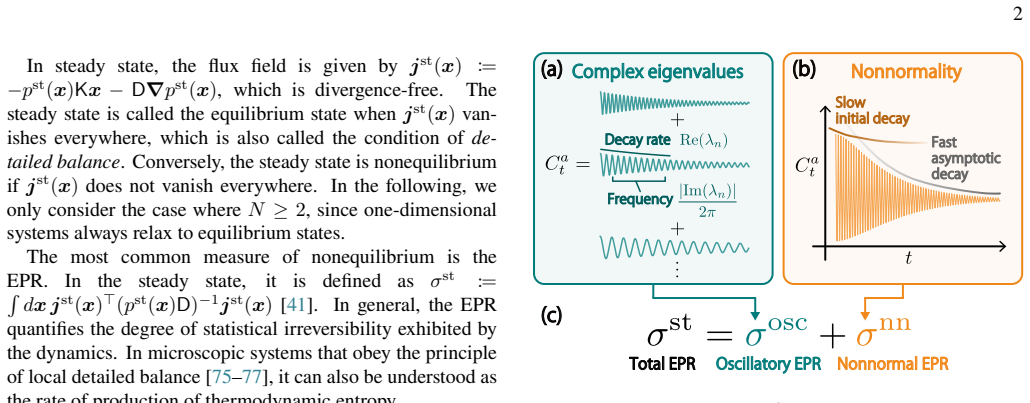
We provide a decomposition of the steady-state entropy production rate associated with an Ornstein-Uhlenbeck process into two contributions: one associated with oscillatory behavior and one associated with nonnormality. We also show that each contribution is associated with a different fundamental trade-off. The oscillatory contribution leads to the dissipation-coherence trade-off for noise-induced oscillations, which bounds the entropy production per oscillatory period by the number of oscillations within one correlation time. Notably, the tradeoff is twice as strict as those conjectured or derived for other systems. The nonnormal contribution leads to a trade-off between entropy production
What carries the argument
The oscillatory-nonnormal decomposition of the steady-state entropy production rate, which separates contributions from oscillatory dynamics and nonnormal matrix properties.
If this is right
- The oscillatory contribution implies that entropy production per period cannot exceed the number of oscillations possible within the system's correlation time.
- This oscillatory bound is twice as strict as similar bounds derived for other systems.
- The nonnormal contribution implies that higher entropy production enables faster relaxation to steady state.
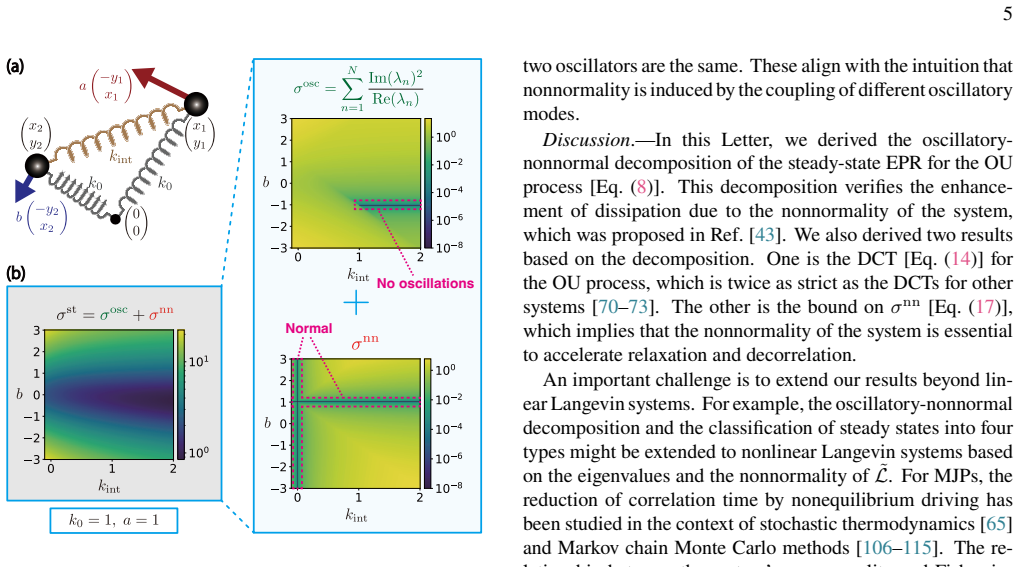
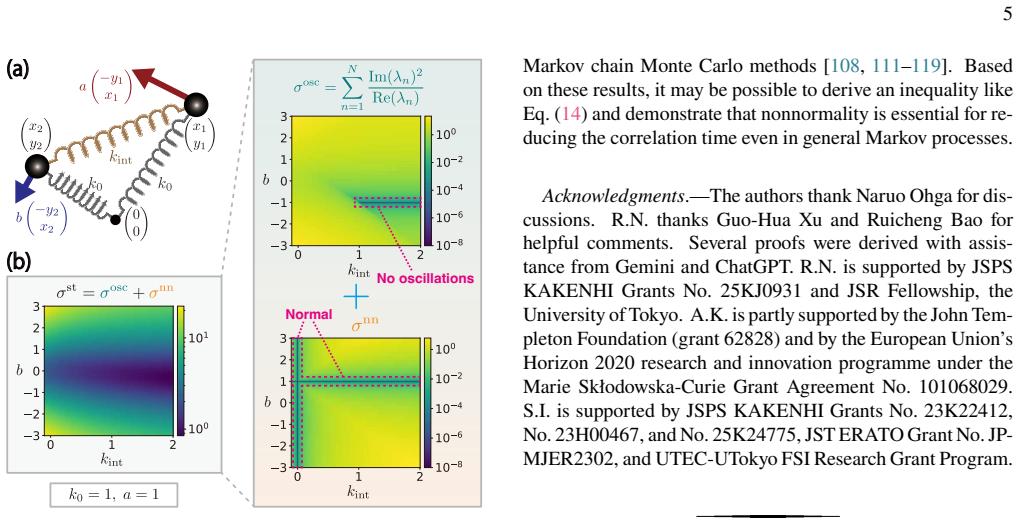
- The decomposition holds for the simple bead-spring model used as demonstration.
Where Pith is reading between the lines
- This separation could guide the design of stochastic systems to minimize unwanted dissipation while preserving desired oscillations.
- The approach might extend to other linear stochastic processes where nonnormality and oscillations coexist.
- Experimental tests in physical systems like colloidal beads could verify the stricter bound on dissipation-coherence.
Load-bearing premise
The steady-state entropy production rate of an Ornstein-Uhlenbeck process can be cleanly split additively into oscillatory and nonnormal contributions that each match independent physical trade-offs.
What would settle it
A numerical simulation of an Ornstein-Uhlenbeck process where the sum of the proposed oscillatory and nonnormal entropy production contributions fails to equal the total computed entropy production rate.
Figures
read the original abstract
We provide a decomposition of the steady-state entropy production rate associated with an Ornstein-Uhlenbeck process into two contributions: one associated with oscillatory behavior and one associated with nonnormality. We also show that each contribution is associated with a different fundamental trade-off. The oscillatory contribution leads to the dissipation-coherence trade-off for noise-induced oscillations, which bounds the entropy production per oscillatory period by the number of oscillations within one correlation time. Notably, the tradeoff is twice as strict as those conjectured or derived for other systems. The nonnormal contribution leads to a trade-off between entropy production and acceleration of relaxation. We also demonstrate the decomposition using a simple bead-spring model.
Editorial analysis
A structured set of objections, weighed in public.
Referee Report
Summary. The manuscript claims to decompose the steady-state entropy production rate of an Ornstein-Uhlenbeck process into an oscillatory contribution (from imaginary parts of drift matrix eigenvalues) and a nonnormal contribution (from non-normality of the matrix). Each part is associated with a fundamental trade-off: the oscillatory part yields a dissipation-coherence trade-off bounding entropy production per oscillatory period by the number of oscillations in one correlation time, claimed to be twice as strict as prior results; the nonnormal part yields a trade-off between entropy production and acceleration of relaxation. The decomposition is demonstrated on a bead-spring model.
Significance. If valid, this provides a useful algebraic decomposition of dissipation in linear diffusions based on the Lyapunov equation and standard entropy production formula, allowing separate bounding of contributions from oscillations and non-normality. The stricter trade-off for oscillatory dissipation and the relaxation trade-off could be relevant for systems with noise-induced oscillations or transient non-normal dynamics. The numerical confirmation in the bead-spring example supports the split.
minor comments (1)
- [Abstract] Abstract: The statement that the oscillatory tradeoff is 'twice as strict as those conjectured or derived for other systems' would benefit from explicit citation of the compared works and a brief indication of how the factor of two arises in the derivation.
Simulated Author's Rebuttal
We thank the referee for the positive assessment of our work, the recognition of its potential utility, and the recommendation for minor revision. No specific major comments were raised in the report.
Circularity Check
No significant circularity; algebraic split from standard OU equations
full rationale
The central decomposition of steady-state entropy production follows directly from the Lyapunov equation for the covariance matrix and the standard expression for entropy production rate in linear diffusions. The oscillatory/nonnormal split is obtained by algebraic rearrangement of these quantities (imaginary parts of eigenvalues vs. non-normality measure of the drift matrix). No fitted parameters are renamed as predictions, no self-citations are load-bearing for the additivity or trade-off bounds, and the bead-spring example serves only as numerical confirmation. The derivation is self-contained against external benchmarks and does not reduce to its inputs by construction.
Axiom & Free-Parameter Ledger
axioms (1)
- domain assumption Ornstein-Uhlenbeck processes possess a well-defined steady-state entropy production rate that can be decomposed additively.
Reference graph
Works this paper leans on
-
[1]
The four eigenvalues are expressed with(s1, s2)∈ {+1,−1} 2 as λs1,s2 =k 0 +k int +s 1 r k2 int − (a−b) 2 4 + is2 a+b 2
This is verified by computing the eigenvalues ofK. The four eigenvalues are expressed with(s1, s2)∈ {+1,−1} 2 as λs1,s2 =k 0 +k int +s 1 r k2 int − (a−b) 2 4 + is2 a+b 2 . (17) Whenb=−a,λ s1,s2 is complex-valued only ifk2 int <(a− b)2/4, so that the square root becomes imaginary. Thus, if the coupling is sufficiently strong (|kint| ≥ |a−b|/2) and b=−a, al...
2020
-
[2]
G. E. Uhlenbeck and L. S. Ornstein, On the theory of the Brownian motion, Phys. Rev.36, 823 (1930)
1930
-
[3]
M. C. Wang and G. E. Uhlenbeck, On the theory of the Brow- nian motion II, Rev. Mod. Phys.17, 323 (1945)
1945
-
[4]
Risken,The Fokker-Planck Equation: Methods of Solution and Applications(Springer Berlin Heidelberg, 1996)
H. Risken,The Fokker-Planck Equation: Methods of Solution and Applications(Springer Berlin Heidelberg, 1996)
1996
-
[5]
Gardiner,Stochastic Methods: A Handbook for the Natural and Social Sciences(Springer Berlin, Heidelberg, 2009)
C. Gardiner,Stochastic Methods: A Handbook for the Natural and Social Sciences(Springer Berlin, Heidelberg, 2009)
2009
-
[6]
Lax, Fluctuations from the nonequilibrium steady state, Rev
M. Lax, Fluctuations from the nonequilibrium steady state, Rev. Mod. Phys.32, 25 (1960)
1960
-
[7]
Schmiedl and U
T. Schmiedl and U. Seifert, Efficiency at maximum power: An analytically solvable model for stochastic heat engines, Europhys. Lett.81, 20003 (2008)
2008
-
[8]
Phys.8, 143 (2012)
V.BlickleandC.Bechinger,Realizationofamicrometre-sized stochastic heat engine, Nat. Phys.8, 143 (2012)
2012
-
[9]
R.VanZon,S.Ciliberto,andE.Cohen,Powerandheatfluctu- ationtheoremsforelectriccircuits,Phys.Rev.Lett.92,130601 (2004)
2004
-
[10]
Ciliberto, A
S. Ciliberto, A. Imparato, A. Naert, and M. Tanase, Heat flux andentropyproducedbythermalfluctuations,Phys.Rev.Lett. 110, 180601 (2013)
2013
-
[11]
Chiang, C.-L
K.-H. Chiang, C.-L. Lee, P.-Y. Lai, and Y.-F. Chen, Electri- cal autonomous Brownian gyrator, Phys. Rev. E96, 032123 (2017)
2017
-
[12]
Melanson, M
D. Melanson, M. Abu Khater, M. Aifer, K. Donatella, M. Hunter Gordon, T. Ahle, G. Crooks, A. J. Martinez, F. Sbahi, and P. J. Coles, Thermodynamic computing system for AI applications, Nat. Commun.16, 3757 (2025)
2025
-
[13]
F. Mura, G. Gradziuk, and C. P. Broedersz, Nonequilibrium scaling behavior in driven soft biological assemblies, Phys. Rev. Lett.121, 038002 (2018)
2018
-
[14]
Commun.10, 1666 (2019)
J.Li,J.M.Horowitz,T.R.Gingrich,andN.Fakhri,Quantify- ing dissipation using fluctuating currents, Nat. Commun.10, 1666 (2019)
2019
-
[15]
Van Vu, V
T. Van Vu, V. T. Vo, and Y. Hasegawa, Entropy production estimation with optimal current, Phys. Rev. E101, 042138 (2020)
2020
-
[16]
1 (Elsevier, 1992)
N.G.VanKampen,Stochasticprocessesinphysicsandchem- istry, Vol. 1 (Elsevier, 1992). 6
1992
-
[17]
Kubo, The fluctuation-dissipation theorem, Reports on progress in physics29, 255 (1966)
R. Kubo, The fluctuation-dissipation theorem, Reports on progress in physics29, 255 (1966)
1966
-
[18]
C. Kwon, P. Ao, and D. J. Thouless, Structure of stochastic dynamics near fixed points, Proc. Natl. Acad. Sci. USA102, 13029 (2005)
2005
-
[19]
K.Hasselmann,StochasticclimatemodelspartI.Theory,Tel- lus28, 473 (1976)
1976
-
[20]
Aslyamov, K
T. Aslyamov, K. Ptaszyński, and M. Esposito, Macroscopic fluctuation-responsetheoryanditsuseforgeneregulatorynet- works, Phys. Rev. Lett.136, 067102 (2026)
2026
-
[21]
K.TomitaandH.Tomita,Irreversiblecirculationoffluctuation, Prog. Theor. Phys.51, 1731 (1974)
1974
-
[22]
P. J. Thomas and B. Lindner, Phase descriptions of a mul- tidimensional Ornstein-Uhlenbeck process, Phys. Rev. E99, 062221 (2019)
2019
-
[23]
A. J. McKane and T. J. Newman, Predator-prey cycles from resonantamplificationofdemographicstochasticity,Phys.Rev. Lett.94, 218102 (2005)
2005
-
[24]
A. J. McKane, J. D. Nagy, T. J. Newman, and M. O. Stefanini, Amplifiedbiochemicaloscillationsincellularsystems,J.Stat. Phys.128, 165 (2007)
2007
-
[25]
P. O. Westermark, D. K. Welsh, H. Okamura, and H. Herzel, Quantificationofcircadianrhythmsinsinglecells,PLOSCom- put. Biol.5, e1000580 (2009)
2009
-
[26]
E.Wallace,M.Benayoun,W.VanDrongelen,andJ.D.Cowan, Emergent oscillations in networks of stochastic spiking neu- rons, PLOS ONE6, e14804 (2011)
2011
-
[27]
Gilson, E
M. Gilson, E. Tagliazucchi, and R. Cofré, Entropy production of multivariate Ornstein-Uhlenbeck processes correlates with consciousness levels in the human brain, Phys. Rev. E107, 024121 (2023)
2023
-
[28]
Sekizawa, S
D. Sekizawa, S. Ito, and M. Oizumi, Decomposing thermody- namic dissipation of linear Langevin systems via oscillatory modesanditsapplicationtoneuraldynamics,Phys.Rev.X14, 041003 (2024)
2024
-
[29]
Nartallo-Kaluarachchi, M
R. Nartallo-Kaluarachchi, M. Kringelbach, G. Deco, R. Lam- biotte, and A. Goriely, Nonequilibrium physics of brain dy- namics, Phys. Rep.1152, 1 (2026)
2026
-
[30]
Dinis, P
L. Dinis, P. Martin, J. Barral, J. Prost, and J. Joanny, Fluctuation-response theorem for the active noisy oscillator of the hair-cell bundle, Phys. Rev. Lett.109, 160602 (2012)
2012
-
[31]
Alonso, A
D. Alonso, A. J. McKane, and M. Pascual, Stochastic amplifi- cation in epidemics, J. R. Soc. Interface4, 575 (2007)
2007
-
[32]
R.Kuske,L.F.Gordillo,andP.Greenwood,Sustainedoscilla- tions via coherence resonance in SIR, J. Theor. Biol.245, 459 (2007)
2007
-
[33]
C.A.LugoandA.J.McKane,Quasicyclesinaspatialpredator- prey model, Phys. Rev. E78, 051911 (2008)
2008
-
[34]
Hwang, S.-Y
C.-R. Hwang, S.-Y. Hwang-Ma, and S.-J. Sheu, Accelerating gaussian diffusions, Ann. Appl. Probab.3, 897 (1993)
1993
-
[35]
T.Lelievre,F.Nier,andG.A.Pavliotis,Optimalnon-reversible lineardriftfortheconvergencetoequilibriumofadiffusion,J. Stat. Phys.152, 237 (2013)
2013
-
[36]
J. B. Weiss, Coordinate invariance in stochastic dynamical systems, Tellus A55, 208 (2003)
2003
-
[37]
Y. V. Fyodorov, E. Gudowska-Nowak, M. A. Nowak, and W. Tarnowski, Nonorthogonal eigenvectors, fluctuation- dissipation relations, and entropy production, Phys. Rev. Lett. 134, 087102 (2025)
2025
-
[38]
Goriely, and R
R.Nartallo-Kaluarachchi,M.Asllani,G.Deco,M.L.Kringel- bach, A. Goriely, and R. Lambiotte, Broken detailed balance andentropyproductionindirectednetworks,Phys.Rev.E110, 034313 (2024)
2024
- [39]
-
[40]
V. Troude and D. Sornette, Pseudo-coherence and stochastic synchronization: A non-normal route to collective dynamics without oscillators, arXiv preprint arXiv:2603.07206 (2026)
-
[41]
Sekimoto,Stochastic Energetics(Springer Berlin Heidel- berg, 2010)
K. Sekimoto,Stochastic Energetics(Springer Berlin Heidel- berg, 2010)
2010
-
[42]
Seifert, Stochastic thermodynamics, fluctuation theorems and molecular machines, Rep
U. Seifert, Stochastic thermodynamics, fluctuation theorems and molecular machines, Rep. Prog. Phys.75, 126001 (2012)
2012
-
[43]
Shiraishi,An Introduction to Stochastic Thermodynamics: From Basic to Advanced(Springer Nature Singapore, 2023)
N. Shiraishi,An Introduction to Stochastic Thermodynamics: From Basic to Advanced(Springer Nature Singapore, 2023)
2023
-
[44]
Falasco and M
G. Falasco and M. Esposito, Macroscopic stochastic thermo- dynamics, Rev. Mod. Phys.97, 015002 (2025)
2025
-
[45]
A.C.BaratoandU.Seifert,Coherenceofbiochemicaloscilla- tions is bounded by driving force and network topology, Phys. Rev. E95, 062409 (2017)
2017
-
[46]
Uhl and U
M. Uhl and U. Seifert, Affinity-dependent bound on the spec- trum of stochastic matrices, J. Phys. A52, 405002 (2019)
2019
-
[47]
N. Ohga, S. Ito, and A. Kolchinsky, Thermodynamic bound on the asymmetry of cross-correlations, Phys. Rev. Lett.131, 077101 (2023)
2023
- [48]
-
[49]
Cycle affinity and winding localize eigenvalues of Markov generators
A. Kolchinsky, N. Ohga, and S. Ito, Cycle affinity and wind- ing localize eigenvalues of Markov generators, arXiv preprint arXiv:2605.15884 (2026)
work page internal anchor Pith review Pith/arXiv arXiv 2026
-
[50]
H.QianandM.Qian,Pumpedbiochemicalreactions,nonequi- librium circulation, and stochastic resonance, Phys. Rev. Lett. 84, 2271 (2000)
2000
-
[51]
Nguyen, U
B. Nguyen, U. Seifert, and A. C. Barato, Phase transition in thermodynamically consistent biochemical oscillators, J. Chem. Phys.149, 045101 (2018)
2018
-
[52]
Oberreiter, U
L. Oberreiter, U. Seifert, and A. C. Barato, Subharmonic os- cillations in stochastic systems under periodic driving, Phys. Rev. E100, 012135 (2019)
2019
-
[53]
Marsland III, W
R. Marsland III, W. Cui, and J. M. Horowitz, The thermody- namic uncertainty relation in biochemical oscillations, J. R. Soc. Interface16, 20190098 (2019)
2019
-
[54]
Del Junco and S
C. Del Junco and S. Vaikuntanathan, Robust oscillations in multi-cyclic Markov state models of biochemical clocks, J. Chem. Phys.152, 055101 (2020)
2020
-
[55]
Del Junco and S
C. Del Junco and S. Vaikuntanathan, High chemical affinity increasestherobustnessofbiochemicaloscillations,Phys.Rev. E101, 012410 (2020)
2020
-
[56]
Oberreiter, U
L. Oberreiter, U. Seifert, and A. C. Barato, Stochastic discrete time crystals: Entropy production and subharmonic synchro- nization, Phys. Rev. Lett.126, 020603 (2021)
2021
-
[57]
Remlein, V
B. Remlein, V. Weissmann, and U. Seifert, Coherence of os- cillations in the weak-noise limit, Phys. Rev. E105, 064101 (2022)
2022
-
[58]
Shiraishi, Entropy production limits all fluctuation oscilla- tions, Phys
N. Shiraishi, Entropy production limits all fluctuation oscilla- tions, Phys. Rev. E108, L042103 (2023)
2023
-
[59]
Kolchinsky, N
A. Kolchinsky, N. Ohga, and S. Ito, Thermodynamic bound on spectral perturbations, with applications to oscillations and relaxation dynamics, Phys. Rev. Res.6, 013082 (2024)
2024
-
[60]
Pietzonka and F
P. Pietzonka and F. Coghi, Thermodynamic cost for precision of general counting observables, Phys. Rev. E109, 064128 (2024)
2024
-
[61]
Gao, H.-M
Q. Gao, H.-M. Chun, and J. M. Horowitz, Thermodynamic constraints on kinetic perturbations of homogeneous driven diffusions, Europhys. Lett.146, 31001 (2024)
2024
-
[62]
Zheng and E
C. Zheng and E. Tang, A topological mechanism for robust and efficient global oscillations in biological networks, Nat. Commun.15, 6453 (2024). 7
2024
-
[63]
Hänggi and H
P. Hänggi and H. Thomas, Stochastic processes: Time evo- lution, symmetries and linear response, Phys. Rep.88, 207 (1982)
1982
-
[64]
Oberreiter, U
L. Oberreiter, U. Seifert, and A. C. Barato, Universal minimal cost of coherent biochemical oscillations, Phys. Rev. E106, 014106 (2022)
2022
-
[65]
Santolin and G
D. Santolin and G. Falasco, Dissipation bounds the coherence ofstochasticlimitcycles,Phys.Rev.Lett.135,057101(2025)
2025
-
[66]
R. Nagayama and S. Ito, Duality between dissipation- coherence trade-off and thermodynamic speed limit based on thermodynamicuncertaintyrelationforstochasticlimitcycles, arXiv preprint arXiv:2509.06421 (2025)
work page internal anchor Pith review Pith/arXiv arXiv 2025
-
[67]
Elementary derivation of the dissipation-coherence bound for stochastic oscillators
A. Kolchinsky, Elementary derivation of the dissipation– coherence bound for stochastic oscillators, arXiv preprint arXiv:2510.14101 (2025)
work page internal anchor Pith review Pith/arXiv arXiv 2025
-
[68]
L. N. Trefethen and M. Embree,Spectra and pseudospectra: the behavior of nonnormal matrices and operators(Princeton University Press, 2020)
2020
-
[69]
B.F.FarrellandP.J.Ioannou,Variancemaintainedbystochas- tic forcing of non-normal dynamical systems associated with linearly stable shear flows, Phys. Rev. Lett.72, 1188 (1994)
1994
-
[70]
Penland and P
C. Penland and P. D. Sardeshmukh, The optimal growth of tropical sea surface temperature anomalies, J. Clim.8, 1999 (1995)
1999
-
[71]
Hennequin, T
G. Hennequin, T. P. Vogels, and W. Gerstner, Non-normal amplification in random balanced neuronal networks, Phys. Rev. E86, 011909 (2012)
2012
-
[72]
Biancalani, F
T. Biancalani, F. Jafarpour, and N. Goldenfeld, Giant amplifi- cation of noise in fluctuation-induced pattern formation, Phys. Rev. Lett.118, 018101 (2017)
2017
-
[73]
B. F. Farrell and P. J. Ioannou, Generalized stability theory. Part I: Autonomous operators, J. Atmos. Sci.53, 2025 (1996)
2025
-
[74]
Ahmadian, F
Y. Ahmadian, F. Fumarola, and K. D. Miller, Properties of networks with partially structured and partially random con- nectivity, Phys. Rev. E91, 012820 (2015)
2015
-
[75]
Polettini and M
M. Polettini and M. Esposito, Nonconvexity of the relative entropyforMarkovdynamics: AFisherinformationapproach, Phys. Rev. E88, 012112 (2013)
2013
-
[76]
Kondepudi and I
D. Kondepudi and I. Prigogine,Modern thermodynamics: fromheatenginestodissipativestructures(JohnWiley&Sons, 2014)
2014
-
[77]
D. A. Beard and H. Qian, Relationship between thermody- namicdrivingforceandone-wayfluxesinreversibleprocesses, PLOS ONE2, e144 (2007)
2007
-
[78]
Maes, Local detailed balance, SciPost Phys
C. Maes, Local detailed balance, SciPost Phys. Lect. Notes , 32 (2021)
2021
-
[79]
G.T.Landi,T.Tomé,andM.J.DeOliveira,Entropyproduction in linear Langevin systems, J. Phys. A46, 395001 (2013)
2013
-
[80]
Godrèche and J.-M
C. Godrèche and J.-M. Luck, Characterising the nonequilib- rium stationary states of Ornstein–Uhlenbeck processes, J. Phys. A52, 035002 (2018)
2018
discussion (0)
Sign in with ORCID, Apple, or X to comment. Anyone can read and Pith papers without signing in.