Static Effective Hamiltonians for Molecular Systems through RPA-based downfolding
Pith reviewed 2026-06-27 20:24 UTC · model grok-4.3
The pith
cRPA downfolding produces static effective Hamiltonians that capture dynamical and strong correlations for benzene bond dissociation.
A machine-rendered reading of the paper's core claim, the machinery that carries it, and where it could break.
Core claim
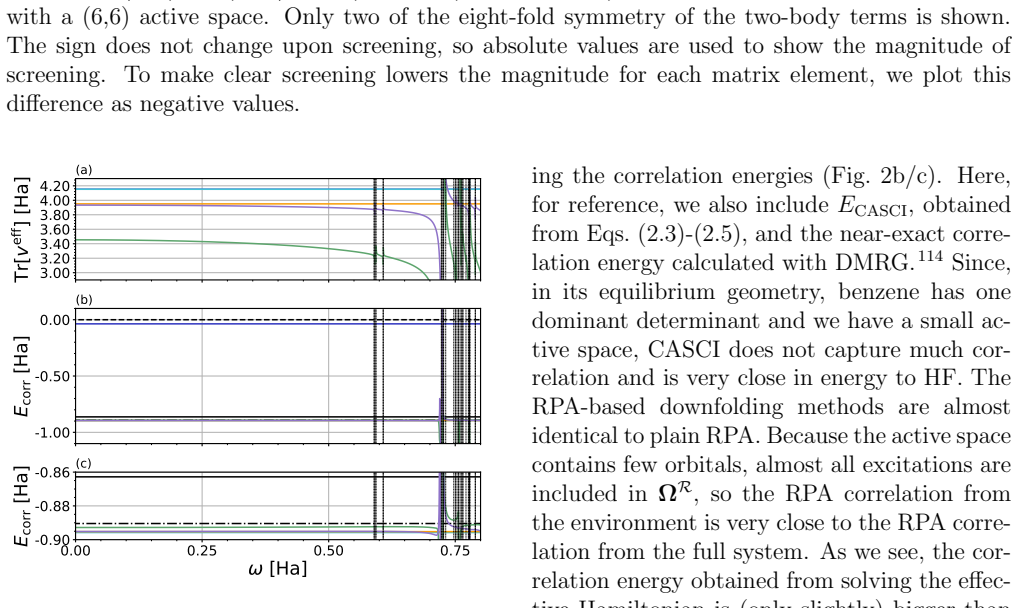
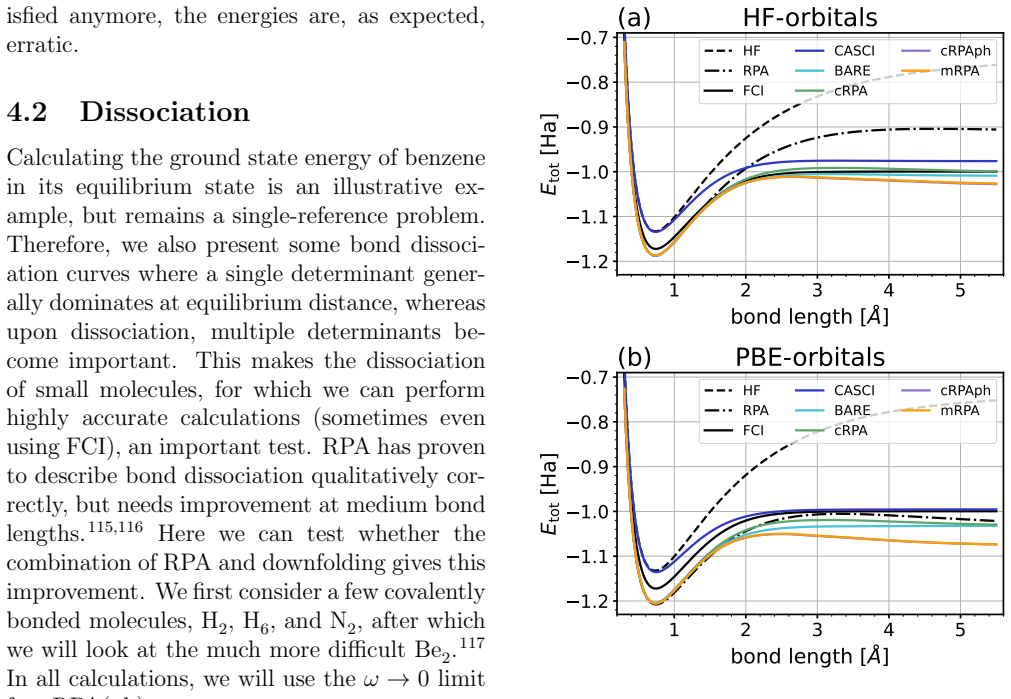
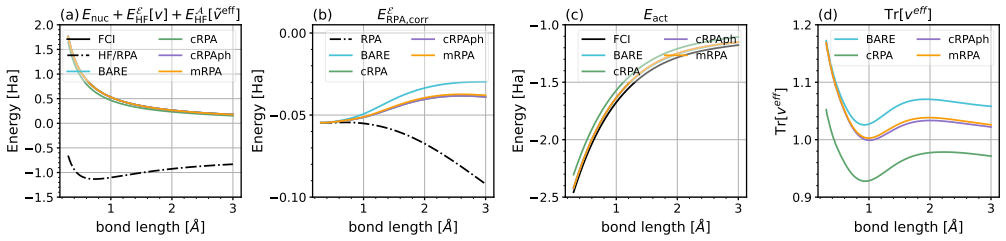
Downfolding using cRPA constructs static effective Hamiltonians that accurately describe both dynamical and strong correlation in benzene, including its bond dissociation curves, while mRPA and particle-hole-restricted cRPA fail due to an overdominant dynamical correlation term; in the static limit the methods are almost indistinguishable.
What carries the argument
cRPA and mRPA screening applied to generate effective one- and two-body interactions in a reduced active space, with double-counting corrections to remove environment contributions already accounted for.
If this is right
- cRPA-derived static Hamiltonians can be diagonalized or used in subsequent calculations to obtain ground-state energies that match the full system's behavior for both equilibrium and dissociated geometries.
- mRPA and restricted cRPA versions produce effective Hamiltonians whose dissociation curves deviate because the dynamical correlation term is not properly balanced.
- When all frequency dependence is removed, cRPA and mRPA effective Hamiltonians yield essentially the same ground-state properties.
- The approach separates the environment screening from the active-space problem while preserving the essential correlation physics needed for bond breaking.
Where Pith is reading between the lines
- The method could be applied to larger molecules where full calculations become prohibitive, provided the active-space choice remains valid.
- The near-identity of cRPA and mRPA in the static limit indicates that the frequency dependence retained in cRPA is responsible for its better performance on strong correlation.
- Similar downfolding tests on other molecules with varying bond orders would reveal whether the dynamical-correlation dominance seen in mRPA is a general feature.
Load-bearing premise
That RPA-based screening together with the double-counting corrections produces an effective Hamiltonian whose ground-state properties faithfully reflect the original system's dynamical and strong correlations.
What would settle it
A numerical comparison of the benzene bond-dissociation energy curve obtained from the cRPA-derived effective Hamiltonian against the curve from the full many-body calculation would directly test whether the downfolded model captures the required correlations.
Figures


read the original abstract
Green's function-based downfolding methods construct effective Hamiltonians of reduced dimension that capture dynamical correlations of an electronic environment through effective potentials acting on the active space only. Using methods based on the constrained random phase approximation (cRPA) and moment RPA (mRPA), we construct static effective Hamiltonians that include screening through the environment. We derive expressions for the energy contribution from the environment and for the effective one- and two-body terms, taking into account double-counting corrections. cRPA requires additional consideration due to its frequency dependence, while mRPA provides a static Hamiltonian by construction. For the ground state energy of benzene and bond dissociation curves, we discuss the differences and similarities between the different flavors of RPA-based screening. We show that downfolding using cRPA describes both dynamical and strong correlation well, while mRPA and cRPA restricted to screening the particle-hole matrix elements can fail to describe bond dissociation due to a dominating dynamical correlation term. In the static limit, these two methods are shown to be almost indistinguishable.
Editorial analysis
A structured set of objections, weighed in public.
Referee Report
Summary. The manuscript develops static effective Hamiltonians for molecular systems via Green's function downfolding based on constrained RPA (cRPA) and moment RPA (mRPA). It derives expressions for the environment energy contribution together with effective one- and two-body terms that incorporate double-counting corrections. cRPA is treated in its static limit because of frequency dependence, while mRPA is static by construction. The methods are applied to the ground-state energy of benzene and to its bond-dissociation curves; the authors conclude that cRPA captures both dynamical and strong correlation, that mRPA and particle-hole-restricted cRPA fail because of a dominating dynamical-correlation term, and that the two approaches become nearly indistinguishable in the static limit.
Significance. If the central claims are substantiated, the work supplies a concrete route to static effective Hamiltonians that embed environmental screening for active-space calculations on molecular systems exhibiting strong correlation. The derivations of the effective interaction and environment-energy terms are presented as parameter-free, which is a methodological strength. The comparison between cRPA and mRPA also clarifies the role of dynamical correlation in bond dissociation, a point of practical interest for downfolding techniques.
major comments (2)
- [Abstract and derivation of effective terms] The central claim that the cRPA-derived static Hamiltonian reproduces the full-system bond-dissociation curve of benzene rests on the accuracy of the double-counting corrections and the environment-energy term; the manuscript supplies no independent verification (e.g., comparison against full-system benchmarks or explicit quantification of residual dynamical contamination after the static-limit projection) that these corrections have removed dynamical contributions rather than compensating through active-space choice. This verification is load-bearing for the performance distinction drawn between cRPA and mRPA.
- [Benzene results and discussion of dynamical correlation] The statement that mRPA (and restricted cRPA) fails because of a “dominating dynamical correlation term” is not accompanied by an explicit numerical decomposition or table showing the magnitude of that term for the benzene dissociation curve; without such data the attribution remains untested and directly affects the cross-method comparison.
minor comments (2)
- [Abstract] The abstract would be strengthened by inclusion of at least one quantitative benchmark (energy difference or dissociation energy) together with a reference to the relevant figure or table.
- [Method section] Notation for the screened interaction and double-counting subtraction should be introduced once with an explicit equation number and then used consistently; several symbols appear without prior definition in the early sections.
Simulated Author's Rebuttal
We thank the referee for the constructive feedback and positive assessment of the work's significance. We address each major comment below and will revise the manuscript to incorporate additional clarifications and data as outlined.
read point-by-point responses
-
Referee: [Abstract and derivation of effective terms] The central claim that the cRPA-derived static Hamiltonian reproduces the full-system bond-dissociation curve of benzene rests on the accuracy of the double-counting corrections and the environment-energy term; the manuscript supplies no independent verification (e.g., comparison against full-system benchmarks or explicit quantification of residual dynamical contamination after the static-limit projection) that these corrections have removed dynamical contributions rather than compensating through active-space choice. This verification is load-bearing for the performance distinction drawn between cRPA and mRPA.
Authors: The bond-dissociation curves provide direct comparison to full-system results, as the effective Hamiltonian energies are benchmarked against the complete molecular calculations at each geometry. The double-counting corrections are derived from the same Green's function framework to analytically subtract active-space contributions from the environment terms. We agree, however, that an explicit quantification of any residual dynamical contamination would strengthen the distinction between methods and will add a supplementary analysis comparing static projections to frequency-dependent cRPA results at selected points along the curve. revision: partial
-
Referee: [Benzene results and discussion of dynamical correlation] The statement that mRPA (and restricted cRPA) fails because of a “dominating dynamical correlation term” is not accompanied by an explicit numerical decomposition or table showing the magnitude of that term for the benzene dissociation curve; without such data the attribution remains untested and directly affects the cross-method comparison.
Authors: We will add an explicit decomposition table in the revised manuscript that isolates the dynamical correlation contribution (estimated via the difference between the static effective Hamiltonian and the frequency-dependent reference) for multiple points on the benzene dissociation curve. This will allow direct numerical comparison of the term's magnitude across cRPA, mRPA, and restricted cRPA. revision: yes
Circularity Check
No circularity: derivations of effective terms and double-counting corrections are presented as explicit constructions from RPA screening, not reductions to inputs.
full rationale
The abstract and described claims center on deriving expressions for environment energy, effective one- and two-body terms, and double-counting corrections from cRPA/mRPA screening. These are forward constructions applied to benzene dissociation curves, with explicit comparisons between methods. No quoted step reduces a 'prediction' to a fitted parameter by construction, invokes a self-citation as the sole justification for a uniqueness claim, or renames an input as an output. The performance claims rest on numerical results rather than tautological equivalence, making the derivation chain self-contained.
Axiom & Free-Parameter Ledger
axioms (1)
- domain assumption The random phase approximation (cRPA and mRPA) supplies a sufficiently accurate description of screening by the electronic environment.
Reference graph
Works this paper leans on
-
[1]
Bohm, David and Pines, David , number =. 1953 , journal =. doi:10.1103/PhysRev.92.609 , issn =
-
[2]
Roos, Björn O. and Taylor, Peter R. and Sigbahn, Per E.M. , number =. 1980 , journal =. doi:10.1016/0301-0104(80)80045-0 , issn =
-
[3]
Knowles, Peter J. and Handy, Nicholas C. , number =. 1989 , journal =. doi:10.1016/0010-4655(89)90033-7 , issn =
-
[4]
and Lee, Joonho and Takeshita, Tyler Y
Tubman, Norm M. and Lee, Joonho and Takeshita, Tyler Y. and Head-Gordon, Martin and Whaley, K. Birgitta , number =. 2016 , journal =. doi:10.1063/1.4955109 , issn =
-
[5]
Evangelista, Francesco A. , number =. 2014 , journal =. doi:10.1063/1.4890660 , issn =
-
[6]
Raghavachari, Krishnan and Trucks, Gary W. and Pople, John A. and Head-Gordon, Martin , number =. 1989 , journal =. doi:10.1016/S0009-2614(89)87395-6 , issn =
-
[7]
and Malmqvist, Per-Åke , number =
Ghigo, Giovanni and Roos, Björn O. and Malmqvist, Per-Åke , number =. 2004 , journal =. doi:10.1016/j.cplett.2004.08.032 , issn =
-
[8]
Williams-Young, David B. and Tubman, Norm M. and Mejuto-Zaera, Carlos and de Jong, Wibe A. , number =. 2023 , journal =. doi:10.1063/5.0148650 , issn =
-
[9]
Neuscamman, Eric and Yanai, Takeshi and Chan, Garnet Kin-Lic , number =. 2010 , journal =. doi:10.1080/01442351003620540 , issn =
-
[10]
and Stella, Martina and Goodpaster, Jason D
Manby, Frederick R. and Stella, Martina and Goodpaster, Jason D. and Miller, Thomas F. , number =. 2012 , journal =. doi:10.1021/ct300544e , issn =
-
[11]
Yalouz, Saad and Senjean, Bruno and G. 2021 , journal =. doi:10.1088/2058-9565/abd334 , issn =
-
[12]
Scott, Charles J. C. and Backhouse, Oliver J. and Booth, George H. , number =. 2023 , journal =. doi:10.1063/5.0143291 , issn =
-
[13]
Bockstedte, Michel and Sch. 2018 , journal =. doi:10.1038/s41535-018-0103-6 , issn =
-
[14]
Hirayama, Motoaki and Yamaji, Youhei and Misawa, Takahiro and Imada, Masatoshi , number =. 2018 , journal =. doi:10.1103/PhysRevB.98.134501 , issn =
-
[15]
Ohgoe, Takahiro and Hirayama, Motoaki and Misawa, Takahiro and Ido, Kota and Yamaji, Youhei and Imada, Masatoshi , number =. 2020 , journal =. doi:10.1103/PhysRevB.101.045124 , issn =
-
[16]
Shinaoka, Hiroshi and Troyer, Matthias and Werner, Philipp , number =. 2015 , journal =. doi:10.1103/PhysRevB.91.245156 , issn =
-
[17]
Daniel and Sauer, Joachim , number =
Boese, A. Daniel and Sauer, Joachim , number =. 2013 , journal =. doi:10.1039/c3cp52321g , issn =
-
[18]
Tamukong, Patrick K. and Khait, Yuriy G. and Hoffmann, Mark R. , number =. 2017 , journal =. doi:10.1021/acs.jpca.6b09909 , issn =
-
[19]
Chen, Siyuan and Yu, Victor Wen-zhe and Jin, Yu and Govoni, Marco and Galli, Giulia , number =. 2025 , journal =. doi:10.1021/acs.jctc.5c00559 , issn =
-
[20]
Harrison, Robert J. , number =. 1991 , journal =. doi:10.1063/1.460537 , issn =
-
[21]
Bruneval, Fabien , number =. 2019 , journal =. doi:10.1021/acs.jctc.9b00333 , issn =
-
[22]
El Khatib, Muammar and Bendazzoli, Gian Luigi and Evangelisti, Stefano and Helal, Wissam and Leininger, Thierry and Tenti, Lorenzo and Angeli, Celestino , number =. 2014 , journal =. doi:10.1021/jp503145u , issn =
-
[23]
Merritt, Jeremy M. and Bondybey, Vladimir E. and Heaven, Michael C. , number =. 2009 , journal =. doi:10.1126/science.1174326 , issn =
-
[24]
Gaggioli, Carlo Alberto and Stoneburner, Samuel J. and Cramer, Christopher J. and Gagliardi, Laura , number =. 2019 , journal =. doi:10.1021/acscatal.9b01775 , issn =
-
[25]
Aryasetiawan, F. and Karlsson, K. and Jepsen, O. and Sch. 2006 , journal =. doi:10.1103/PhysRevB.74.125106 , issn =
-
[26]
Bulik, Ireneusz W. and Henderson, Thomas M. and Scuseria, Gustavo E. , number =. 2015 , journal =. doi:10.1021/acs.jctc.5b00422 , issn =
-
[27]
Yanai, Takeshi and Chan, Garnet Kin-Lic , number =. 2006 , journal =. doi:10.1063/1.2196410 , issn =
-
[28]
Levine, Benjamin G. and Durden, Andrew S. and Esch, Michael P. and Liang, Fangchun and Shu, Yinan , number =. 2021 , journal =. doi:10.1063/5.0042147 , issn =
-
[29]
Alessio, Maristella and Usvyat, Denis and Sauer, Joachim , number =. 2019 , journal =. doi:10.1021/acs.jctc.8b01122 , issn =
-
[30]
Lan, Tran Nguyen and Kananenka, Alexei A. and Zgid, Dominika , number =. 2015 , journal =. doi:10.1063/1.4938562 , issn =
-
[31]
Baym, Gordon and Kadanoff, Leo P. , number =. 1961 , journal =. doi:10.1103/PhysRev.124.287 , issn =
-
[32]
Gull, Emanuel and Millis, Andrew J. and Lichtenstein, Alexander I. and Rubtsov, Alexey N. and Troyer, Matthias and Werner, Philipp , number =. 2011 , journal =. doi:10.1103/RevModPhys.83.349 , issn =
-
[33]
Duchemin, Ivan and Blase, Xavier , number =. 2021 , journal =. doi:10.1021/acs.jctc.1c00101 , issn =
-
[34]
Knizia, Gerald and Chan, Garnet Kin-Lic , number =. 2012 , journal =. doi:10.1103/PhysRevLett.109.186404 , issn =
-
[35]
Knizia, Gerald and Chan, Garnet Kin-Lic , number =. 2013 , journal =. doi:10.1021/ct301044e , issn =
-
[36]
Beran, Pavel and Matou. 2021 , journal =. doi:10.1021/acs.jctc.1c00896 , issn =
-
[37]
White, Steven R. , number =. 1993 , journal =. doi:10.1103/PhysRevB.48.10345 , issn =
-
[38]
Fuchs, M. and Niquet, Y.-M. and Gonze, X. and Burke, K. , number =. 2005 , journal =. doi:10.1063/1.1858371 , issn =
-
[39]
Furche, Filipp , number =. 2008 , journal =. doi:10.1063/1.2977789 , issn =
-
[40]
Gao, Hong and Imamura, Satoshi and Kasagi, Akihiko and Yoshida, Eiji , number =. 2024 , journal =. doi:10.1021/acs.jctc.3c01190 , issn =
-
[41]
Chang, Yueqing and van Loon, Erik G. C. P. and Eskridge, Brandon and Busemeyer, Brian and Morales, Miguel A. and Dreyer, Cyrus E. and Millis, Andrew J. and Zhang, Shiwei and Wehling, Tim O. and Wagner, Lucas K. and R. 2024 , journal =. doi:10.1038/s41524-024-01314-6 , issn =
-
[42]
Park, Jae Woo , number =. 2023 , journal =. doi:10.1021/acs.jctc.3c00688 , issn =
-
[43]
Dvorak, Marc and Rinke, Patrick , number =. 2019 , journal =. doi:10.1103/PhysRevB.99.115134 , issn =
-
[44]
Romanova, Mariya and Weng, Guorong and Apelian, Arsineh and Vl. 2023 , journal =. doi:10.1038/s41524-023-01078-5 , issn =
-
[45]
Turkowski, Volodymyr and Kabir, Alamgir and Nayyar, Neha and Rahman, Talat S. , number =. 2012 , journal =. doi:10.1063/1.3692613 , issn =
-
[46]
Lin, Nan and Marianetti, C. A. and Millis, Andrew J. and Reichman, David R. , number =. 2011 , journal =. doi:10.1103/PhysRevLett.106.096402 , issn =
-
[47]
Zgid, Dominika and Chan, Garnet Kin-Lic , number =. 2011 , journal =. doi:10.1063/1.3556707 , issn =
-
[48]
Georges, Antoine and Kotliar, Gabriel and Krauth, Werner and Rozenberg, Marcelo J. , number =. 1996 , journal =. doi:10.1103/RevModPhys.68.13 , issn =
-
[49]
Werner, Philipp and Sakuma, Rei and Nilsson, Fredrik and Aryasetiawan, Ferdi , number =. 2015 , journal =. doi:10.1103/PhysRevB.91.125142 , issn =
-
[50]
Nilsson, F. and Karlsson, K. and Aryasetiawan, F. , number =. 2019 , journal =. doi:10.1103/PhysRevB.99.075135 , issn =
-
[51]
Hirayama, Motoaki and Misawa, Takahiro and Ohgoe, Takahiro and Yamaji, Youhei and Imada, Masatoshi , number =. 2019 , journal =. doi:10.1103/PhysRevB.99.245155 , issn =
-
[52]
Kotliar, G. and Savrasov, S. Y. and Haule, K. and Oudovenko, V. S. and Parcollet, O. and Marianetti, C. A. , number =. 2006 , journal =. doi:10.1103/RevModPhys.78.865 , issn =
-
[53]
Kaledin, L.A and Kaledin, A.L and Heaven, M.C and Bondybey, V.E , month =. 1999 , journal =. doi:10.1016/S0166-1280(98)00425-4 , issn =
-
[54]
Libisch, Florian and Huang, Chen and Carter, Emily A. , number =. 2014 , journal =. doi:10.1021/ar500086h , issn =
-
[55]
Scott, Charles J. C. and Booth, George H. , number =. 2021 , journal =. doi:10.1103/PhysRevB.104.245114 , issn =
-
[56]
Biermann, S. and Aryasetiawan, F. and Georges, A. , number =. 2003 , journal =. doi:10.1103/PhysRevLett.90.086402 , issn =
-
[57]
Aryasetiawan, F. and Imada, M. and Georges, A. and Kotliar, G. and Biermann, S. and Lichtenstein, A. I. , number =. 2004 , journal =. doi:10.1103/PhysRevB.70.195104 , issn =
-
[58]
Wesolowski, Tomasz Adam and Warshel, Arieh , number =. 1993 , journal =. doi:10.1021/j100132a040 , issn =
-
[59]
Dunning, Thom. H. , number =. 1971 , journal =. doi:10.1063/1.1676139 , issn =
-
[60]
and Burke, Kieron and Ernzerhof, Matthias , number =
Perdew, John P. and Burke, Kieron and Ernzerhof, Matthias , number =. 1996 , journal =. doi:10.1103/PhysRevLett.77.3865 , issn =
-
[61]
Wang, Yuqi and Fang, Wei-Hai and Li, Zhendong , number =. 2025 , journal =. doi:10.1021/acs.jpclett.5c00258 , issn =
-
[62]
Lan, Tran Nguyen and Zgid, Dominika , number =. 2017 , journal =. doi:10.1021/acs.jpclett.7b00689 , issn =
-
[63]
Sheng, Nan and Vorwerk, Christian and Govoni, Marco and Galli, Giulia , number =. 2022 , journal =. doi:10.1021/acs.jctc.2c00240 , issn =
-
[64]
Chan, Garnet Kin-Lic and Head-Gordon, Martin , number =. 2002 , journal =. doi:10.1063/1.1449459 , issn =
-
[65]
Bruneval, Fabien , number =. 2019 , journal =. doi:10.1103/PhysRevB.99.041118 , issn =
-
[66]
Hohenberg, P. and Kohn, W. , number =. 1964 , journal =. doi:10.1103/PhysRev.136.B864 , issn =
-
[67]
Angeli, C. and Cimiraglia, R. and Evangelisti, S. and Leininger, T. and Malrieu, J.-P. , number =. 2001 , journal =. doi:10.1063/1.1361246 , issn =
-
[68]
Huron, B. and Malrieu, J. P. and Rancurel, P. , number =. 1973 , journal =. doi:10.1063/1.1679199 , issn =
-
[69]
and Werner, Philipp , number =
Honerkamp, Carsten and Shinaoka, Hiroshi and Assaad, Fakher F. and Werner, Philipp , number =. 2018 , journal =. doi:10.1103/PhysRevB.98.235151 , issn =
-
[70]
Kaltak, Merzuk and Klime. 2014 , journal =. doi:10.1021/ct5001268 , issn =
-
[71]
Hirayama, Motoaki and Miyake, Takashi and Imada, Masatoshi and Biermann, Silke , number =. 2017 , journal =. doi:10.1103/PhysRevB.96.075102 , issn =
-
[72]
F. 2020 , journal =. doi:10.1021/acs.jctc.0c00693 , issn =
-
[73]
Yeh, Chia-Nan and Morales, Miguel A. , number =. 2023 , journal =. doi:10.1021/acs.jctc.3c00615 , issn =
-
[74]
Tubman, Norm M. and Freeman, C. Daniel and Levine, Daniel S. and Hait, Diptarka and Head-Gordon, Martin and Whaley, K. Birgitta , number =. 2020 , journal =. doi:10.1021/acs.jctc.8b00536 , issn =
-
[75]
and Shao, Meiyue and Yang, Chao and Neaton, Jeffrey B
Bruneval, Fabien and Rangel, Tonatiuh and Hamed, Samia M. and Shao, Meiyue and Yang, Chao and Neaton, Jeffrey B. , month =. 2016 , journal =. doi:10.1016/j.cpc.2016.06.019 , issn =
-
[76]
and Luo, Sijie and Ma, Dongxia and Olsen, Jeppe and Truhlar, Donald G
Li Manni, Giovanni and Carlson, Rebecca K. and Luo, Sijie and Ma, Dongxia and Olsen, Jeppe and Truhlar, Donald G. and Gagliardi, Laura , number =. 2014 , journal =. doi:10.1021/ct500483t , issn =
-
[77]
Lyakh, Dmitry I. and Musia. 2012 , journal =. doi:10.1021/cr2001417 , issn =
-
[78]
Zhai, Huanchen and Lee, Seunghoon and Cui, Zhi-Hao and Cao, Lili and Ryde, Ulf and Chan, Garnet Kin-Lic , number =. 2023 , journal =. doi:10.1021/acs.jpca.3c06142 , issn =
-
[79]
Li, Chenyang and Evangelista, Francesco A. , number =. 2019 , journal =. doi:10.1146/annurev-physchem-042018-052416 , issn =
-
[80]
and Hu, Weifeng and Sun, Qiming and Chan, Garnet Kin-Lic , number =
Guo, Sheng and Watson, Mark A. and Hu, Weifeng and Sun, Qiming and Chan, Garnet Kin-Lic , number =. 2016 , journal =. doi:10.1021/acs.jctc.5b01225 , issn =
discussion (0)
Sign in with ORCID, Apple, or X to comment. Anyone can read and Pith papers without signing in.