Coherent versus stochastic error injection on a repetition-code logical qubit in superconducting hardware
Pith reviewed 2026-06-27 21:39 UTC · model grok-4.3
The pith
Experiment on superconducting repetition codes finds no difference in logical fidelity between coherent and stochastic error injection.
A machine-rendered reading of the paper's core claim, the machinery that carries it, and where it could break.
Core claim
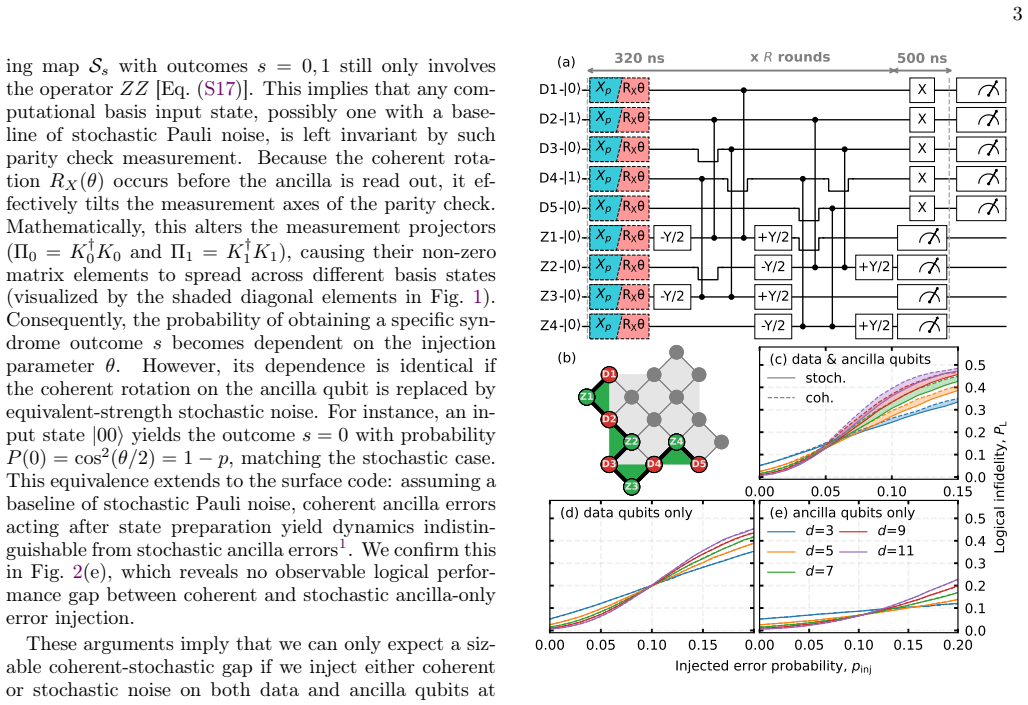
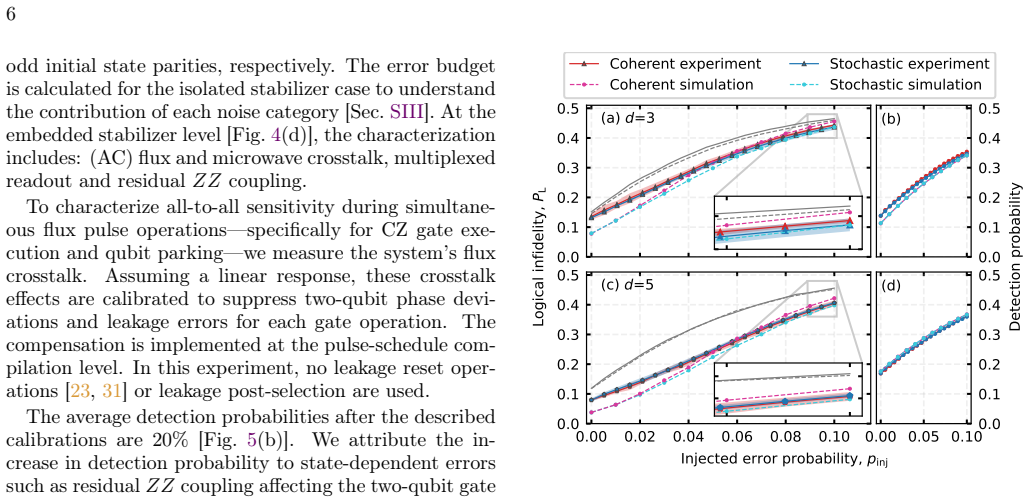
In the experiment, we do not observe the difference in logical fidelity predicted by simulation for either the distance-3 or distance-5 repetition codes. We hypothesize that this discrepancy could be explained by small drifts in qubit frequencies, which introduce phase-coherent noise that 'stochastifies' the injected coherent errors.
What carries the argument
Bitflip repetition code on transmon hardware, with coherent error injection tested against stochastic injection and compared via free-fermion simulation plus subset sampling.
If this is right
- Coherent errors may be effectively converted to stochastic noise by typical hardware drifts, altering expected QEC thresholds.
- Repetition-code logical fidelity under coherent injection matches stochastic injection once real-device effects are present.
- Understanding coherent-error impact on experimental QEC requires models that include frequency-drift conversion.
- Scalable simulation techniques for repetition codes can be validated against hardware when noise-type distinctions are tested.
Where Pith is reading between the lines
- Tighter frequency control or dynamical decoupling during error injection could restore the theoretically predicted fidelity gap.
- The same stochastification mechanism may operate in surface-code experiments and other QEC architectures on similar hardware.
- QEC threshold calculations that assume pure coherent noise may overestimate performance penalties unless hardware drifts are quantified.
- Future experiments could inject errors at varying drift rates to map the crossover from coherent to stochastic behavior.
Load-bearing premise
The injected coherent errors remain phase-coherent throughout circuit execution and are not turned into stochastic noise by unmodeled qubit-frequency drifts or hardware imperfections.
What would settle it
Repeating the experiment with active qubit-frequency stabilization that eliminates drifts during the circuit and then observing the simulated fidelity gap between coherent and stochastic injections.
Figures


read the original abstract
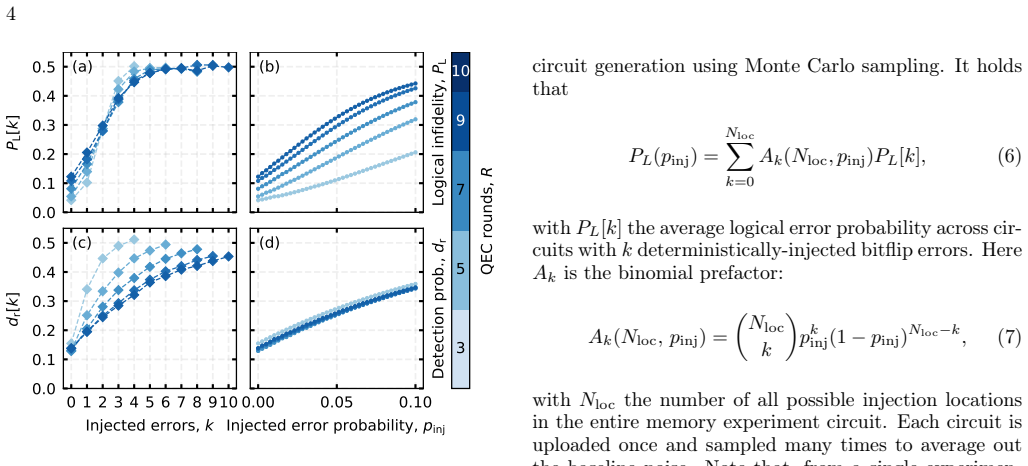
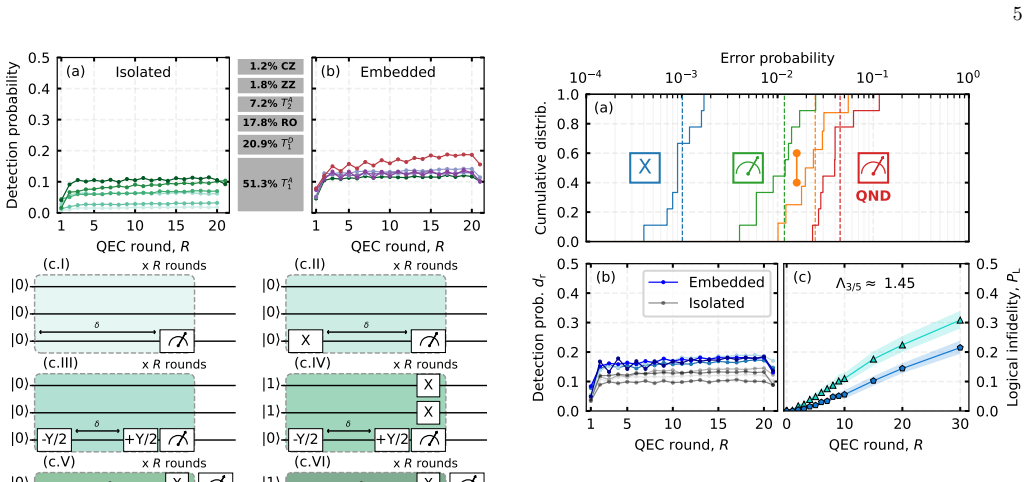
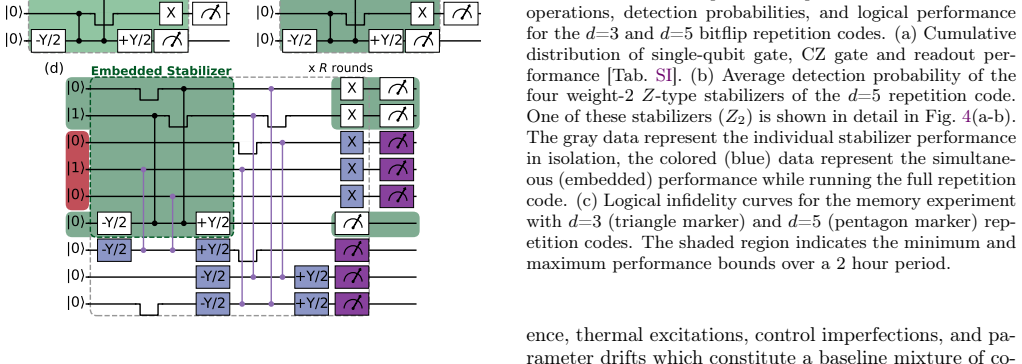
The performance of quantum error correction (QEC) codes is limited by the underlying physical noise. Theoretical studies show that coherent and stochastic noise have different effects when performing QEC with either surface or repetition codes. We use the bitflip repetition code, realized in a transmon quantum processor, as a testbed to experimentally study the impact of injecting coherent versus stochastic errors on the logical performance. We adapt a scalable free-fermion simulator to simulate the experiments and we modify a subset sampling technique to efficiently sample stochastic noise in the quantum circuit. In the experiment, we do not observe the difference in logical fidelity predicted by simulation for either the distance-3 or distance-5 repetition codes. We hypothesize that this discrepancy could be explained by small drifts in qubit frequencies, which introduce phase-coherent noise that `stochastifies' the injected coherent errors. Our work contributes to advancing an understanding of how coherent errors affect experimental QEC.
Editorial analysis
A structured set of objections, weighed in public.
Referee Report
Summary. The manuscript reports an experimental comparison of coherent versus stochastic error injection into distance-3 and distance-5 bit-flip repetition codes on a superconducting transmon processor. Free-fermion simulations predict a difference in logical fidelity between the two noise types, but the hardware experiment observes no such difference. The authors hypothesize that small qubit-frequency drifts convert the injected coherent errors into effectively stochastic noise, and they present adapted simulation techniques including a modified subset-sampling method for stochastic circuits.
Significance. If the injected errors remain verifiably phase-coherent over the full syndrome-extraction circuit, the null result would indicate that repetition-code logical fidelity is insensitive to the coherent/stochastic distinction under realistic hardware conditions, with direct implications for QEC benchmarking. The scalable simulation framework is a methodological strength that could be reused for other codes.
major comments (2)
- [Discussion] Discussion section (paragraph on discrepancy with simulation): The hypothesis that qubit frequency drifts 'stochastify' the coherent errors is offered to explain the null result, yet no measured drift spectrum, bound on frequency stability, or direct coherence check (e.g., Ramsey or echo sequence performed with the injection pulse present) is reported. This assumption is load-bearing for interpreting the experimental observation as a property of the code rather than an artifact of imperfect coherent injection.
- [Experimental methods] Experimental methods / hardware implementation section: Pulse parameters, timing, and calibration details for the coherent error injection are not specified at a level that permits independent verification that phase coherence is preserved throughout the multi-round syndrome extraction; without this, the central claim that the experiment tests coherent versus stochastic behavior cannot be fully assessed.
minor comments (2)
- Figure captions and axis labels could more explicitly indicate which curves correspond to coherent versus stochastic injection for each distance.
- [Simulation methods] The description of the subset-sampling modification for stochastic noise would benefit from a short pseudocode block or explicit reference to the original technique being altered.
Simulated Author's Rebuttal
We thank the referee for their constructive comments. We address each major point below, indicating planned revisions to the manuscript where the concerns can be met by additional text or clarification.
read point-by-point responses
-
Referee: [Discussion] Discussion section (paragraph on discrepancy with simulation): The hypothesis that qubit frequency drifts 'stochastify' the coherent errors is offered to explain the null result, yet no measured drift spectrum, bound on frequency stability, or direct coherence check (e.g., Ramsey or echo sequence performed with the injection pulse present) is reported. This assumption is load-bearing for interpreting the experimental observation as a property of the code rather than an artifact of imperfect coherent injection.
Authors: We agree that the hypothesis would be more robust with direct experimental bounds on frequency stability. No such dedicated measurements (Ramsey or echo sequences with the injection pulse) were performed in this run. In revision we will expand the discussion to cite typical transmon drift rates from the literature and estimate the accumulated phase variance over the circuit duration, while explicitly noting that the hypothesis remains plausible rather than definitively proven by our data. revision: partial
-
Referee: [Experimental methods] Experimental methods / hardware implementation section: Pulse parameters, timing, and calibration details for the coherent error injection are not specified at a level that permits independent verification that phase coherence is preserved throughout the multi-round syndrome extraction; without this, the central claim that the experiment tests coherent versus stochastic behavior cannot be fully assessed.
Authors: We will revise the experimental methods section to supply the missing details: pulse amplitudes and durations used for the coherent rotation, the relative timing of the injection pulse within each syndrome-extraction round, and the calibration protocol employed to set the target rotation angle. These additions should enable readers to evaluate whether phase coherence is maintained across rounds. revision: yes
Circularity Check
Experimental measurement with independent simulation comparison; no derivation reduces to inputs by construction
full rationale
The paper's central result is an experimental observation of logical fidelity under coherent versus stochastic error injection on hardware repetition codes, contrasted with free-fermion simulation. No load-bearing step equates a claimed prediction to a fitted parameter, self-citation chain, or definitional renaming. The offered hypothesis about frequency drifts is presented as an unverified explanation for the null result rather than a derived claim. The work is self-contained against external hardware benchmarks and does not invoke uniqueness theorems or ansatzes from prior self-citations as forcing the outcome.
Axiom & Free-Parameter Ledger
Reference graph
Works this paper leans on
-
[1]
Gottesman,Stabilizer codes and quantum error cor- rection(California Institute of Technology, 1997)
D. Gottesman,Stabilizer codes and quantum error cor- rection(California Institute of Technology, 1997)
1997
-
[2]
The Heisenberg Representation of Quantum Computers
D. Gottesman, The Heisenberg Representation of Quan- tum Computers (1998), arXiv:quant-ph/9807006 [quant- ph]
work page internal anchor Pith review Pith/arXiv arXiv 1998
-
[3]
Wootters, Mixed-state entanglement and quantum error correction, Phys
C.H.Bennett, D.P.DiVincenzo, J.A.Smolin,andW.K. Wootters, Mixed-state entanglement and quantum error correction, Phys. Rev. A54, 3824 (1996)
1996
-
[4]
Kitaev, A
A. Kitaev, A. Shen, and M. Vyalyi,Classical and Quantum Computation(American Mathematical Soci- ety, 2002)
2002
-
[5]
Y. R. Sanders, J. J. Wallman, and B. C. Sanders, Bound- ing quantum gate error rate based on reported average fidelity, New J. Phys.18, 012002 (2015)
2015
-
[6]
Suzuki, K
Y. Suzuki, K. Fujii, and M. Koashi, Efficient simulation of quantum error correction under coherent error based on the nonunitary free-fermionic formalism, Phys. Rev. Lett.119, 190503 (2017)
2017
-
[7]
Dennis, A
E. Dennis, A. Kitaev, A. Landahl, and J. Preskill, Topo- logical quantum memory, J. Math. Phys.43(2002)
2002
-
[8]
C. Wang, J. Harrington, and J. Preskill, Confinement- Higgs transition in a disordered gauge theory and the accuracy threshold for quantum memory, Ann. Phys. (N.Y.)303, 31 (2003)
2003
-
[9]
See supplemental material
-
[10]
Bravyi, M
S. Bravyi, M. Englbrecht, R. König, and N. Peard, Cor- recting coherent errors with surface codes, npj Quantum Inf.4, 55 (2018)
2018
-
[11]
F.Venn, J.Behrends,andB.Béri,Coherent-errorthresh- old for surface codes from Majorana delocalization, Phys. Rev. Lett.131, 060603 (2023)
2023
-
[12]
Hakkaku, S
K. Hakkaku, S. Mitarai and K. Fujii, Sampling-based quasiprobability simulation for fault-tolerant quantum error correction on the surface codes under coherent noise, Phys. Rev. Res.3, 043130 (2021)
2021
-
[13]
Bravyi, M
S. Bravyi, M. Suchara, and A. Vargo, Efficient algorithms for maximum likelihood decoding in the surface code, Phys. Rev. A90, 032326 (2014)
2014
-
[14]
Á.MártonandJ.K.Asbóth,Coherenterrorsandreadout errors in the surface code, Quantum7, 1116 (2023)
2023
-
[15]
E. Takou and K. R. Brown, Estimating and decoding coherent errors of QEC experiments with detector error models (2025), arXiv:2510.23797 [quant-ph]
-
[16]
Google Quantum A.I.et al., Quantum error correction belowthesurfacecodethreshold,Nature638,920(2025)
2025
-
[17]
Greenbaum and Z
D. Greenbaum and Z. Dutton, Modeling coherent errors in quantum error correction, Quantum Sci. Technol.3, 015007 (2017)
2017
-
[18]
J. K. Iverson and J. Preskill, Coherence in logical quan- tum channels, New J. Phys.22, 073066 (2020)
2020
-
[20]
Kelly, R
J. Kelly, R. Barends, A. G. Fowler, A. Megrant, E. Jef- frey, T.White, D.Sank, J.Mutus, B.Campbell, Y.Chen, B. Chiaro, A. Dunsworth, I.-C. Hoi, C. Neill, P. J. J. O’Malley, C. Quintana, P. Roushan, A. Vainsencher, A. N. Cleland, J. Wenner, and J. M. Martinis, State preservation by repetitive error detection in a supercon- ducting quantum circuit, Nature51...
2015
-
[21]
Putterman, K
H. Putterman, K. Noh, C. T. Hann, G. S. MacCabe, S. Aghaeimeibodi, R. N. Patel, M. Lee, W. M. Jones, H. Moradinejad, R. Rodriguez,et al., Hardware-efficient quantum error correction via concatenated bosonic qubits, Nature638, 927 (2025)
2025
-
[22]
Versluis, S
R. Versluis, S. Poletto, N. Khammassi, B. Tarasinski, N. Haider, D. J. Michalak, A. Bruno, K. Bertels, and L. DiCarlo, Scalable quantum circuit and control for a superconducting surface code, Phys. Rev. A8, 034021 (2017)
2017
-
[23]
J. F. Marques, H. Ali, B. M. Varbanov, M. Finkel, H. M. Veen, S. L. M. van der Meer, S. Valles-Sanclemente, N. Muthusubramanian, M. Beekman, N. Haider, B. M. Terhal, and L. DiCarlo, All-microwave leakage reduction 10 units for quantum error correction with superconducting transmon qubits, Phys. Rev. Lett.130, 250602 (2023)
2023
-
[24]
Vallés-Sanclemente, S
S. Vallés-Sanclemente, S. L. M. van der Meer, M. Finkel, N. Muthusubramanian, M. Beekman, H. Ali, J. F. Mar- ques, C.Zachariadis, H.M.Veen, T.Stavenga, N.Haider, and L. DiCarlo, Post-fabrication frequency trimming of coplanar-waveguide resonators in circuit QED quantum processors, App. Phys. Lett.123, 034004 (2023)
2023
-
[25]
Krinner, N
S. Krinner, N. Lacroix, A. Remm, D. P. Agustin, E. Genois, C. Leroux, C. Hellings, S. Lazar, F. Swiadek, J. Herrmann, G. J. Norris, C. K. Andersen, M. Müller, A. Blais, C. Eichler, and A. Wallraff, Realizing repeated quantum error correction in a distance-three surface code, Nature605, 669 (2022)
2022
-
[26]
P. Zhao, K. Linghu, Z. Li, P. Xu, R. Wang, G. Xue, Y. Jin, and H. Yu, Quantum crosstalk analysis for si- multaneous gate operations on superconducting qubits, Phys. Rev. X Quantum3, 020301 (2022)
2022
-
[27]
N. Fruitwala, A. Hashim, A. D. Rajagopala, Y. Xu, J. Hines, R. K. Naik, I. Siddiqi, K. Klymko, G. Huang, and K. Nowrouzi, Hardware-efficient randomized compil- ing (2024), arXiv:2406.13967 [quant-ph]
-
[28]
J.-S. Kim, L. S. Bishop, A. D. Córcoles, S. Merkel, J. A. Smolin, and S. Sheldon, Hardware-efficient random cir- cuits to classify noise in a multiqubit system, Phys. Rev. A104, 022609 (2021)
2021
-
[29]
C.Gidney,Stim: afaststabilizercircuitsimulator,Quan- tum5, 497 (2021)
2021
-
[30]
Google Quantum A.I.et al., Suppressing quantum errors by scaling a surface code logical qubit, Nature614, 676 (2023)
2023
-
[31]
Y. Xin, S. L. M. van der Meer, M. Serra-Peralta, T. H. F. Vroomans, M. Finkel, H. M. Veen, M. W. Beekman, and L. DiCarlo, Improved error correction with leakage re- duction units built into qubit measurement in a super- conducting quantum processor (2025), arXiv:2511.17460 [quant-ph]
-
[32]
Google Quantum A.I.et al., Exponential suppression of bit or phase errors with cyclic error correction, Nature 595, 383 (2021)
2021
-
[33]
T.E.O’Brien, B.M.Tarasinski,andL.DiCarlo,Density- matrix simulation of small surface codes under current and projected experimental noise, npj Quantum Inf.3 (2017)
2017
-
[34]
P. V. Klimov, J. Kelly, Z. Chen, M. Neeley, A. Megrant, B. Burkett, R. Barends, K. Arya, B. Chiaro,et al., Fluc- tuations of energy-relaxation times in superconducting qubits, Phys. Rev. Lett.121, 090502 (2018)
2018
-
[35]
Schlör, J
S. Schlör, J. Lisenfeld, C. Müller, A. Bilmes, A. Schnei- der, D. P. Pappas, A. V. Ustinov, and M. Weides, Cor- relating decoherence in transmon qubits: Low frequency noise by single fluctuators, Phys. Rev. Lett.123, 190502 (2019)
2019
- [36]
-
[37]
Gutiérrez, M
M. Gutiérrez, M. Müller, and A. Bermúdez, Transversal- ity and lattice surgery: Exploring realistic routes toward coupled logical qubits with trapped-ion quantum proces- sors, Phys. Rev. A99, 022330 (2019)
2019
-
[38]
Heußen, D
S. Heußen, D. Winter, M. Rispler, and M. Müller, Dy- namical subset sampling of quantum error-correcting protocols, Phys. Rev. Res.6, 013177 (2024)
2024
-
[39]
H. Ali, J. Marques, O. Crawford, J. Majaniemi, M. Serra- Peralta, D. Byfield, B. Varbanov, B. M. Terhal, L. Di- Carlo, and E. T. Campbell, Reducing the error rate of a superconducting logical qubit using analog readout in- formation, Phys. Rev. A22, 044031 (2024)
2024
-
[40]
B. Pato, Q. Miao, and K. R. Brown, Optimal decod- ing of 2d compass codes under coherent noise, in2024 IEEE International Conference on Quantum Computing and Engineering (QCE), Vol. 2 (IEEE, 2024) pp. 448– 449
2024
-
[41]
O. Higgott, Pymatching: A python package for de- coding quantum codes with minimum-weight perfect matching, ACM T. Quantum Comput.3, 1 (2022), arXiv:2105.13082 [quant-ph]
-
[42]
B. M. Tarasinski, V. P. Ostroukh, X. Bonet-Monroig, T. E. O’Brien, and B. M. Varbanov, quantumsim,https: //gitlab.com/quantumsim(2016)
2016
-
[43]
B. M. Varbanov, F. Battistel, B. M. Tarasinski, V. P. Ostroukh, T. E. O’Brien, L. DiCarlo, and B. M. Terhal, Leakage detection for a transmon-based surface code, npj Quantum Inf.6, 102 (2020)
2020
-
[44]
Battistel,Mitigating leakage and noise in supercon- ducting quantum computing, PhD dissertation, Technis- che Universiteit Delft (2022)
F. Battistel,Mitigating leakage and noise in supercon- ducting quantum computing, PhD dissertation, Technis- che Universiteit Delft (2022)
2022
-
[45]
Bravyi, Lagrangian representation for fermionic linear optics, Quantum Information & Computation5, 216–238 (2005)
S. Bravyi, Lagrangian representation for fermionic linear optics, Quantum Information & Computation5, 216–238 (2005)
2005
- [46]
-
[47]
Hebenstreit, R
M. Hebenstreit, R. Jozsa, B. Kraus, S. Strelchuk, and M. Yoganathan, All pure fermionic non-Gaussian states are magic states for matchgate computations, Phys. Rev. Lett.123, 080503 (2019)
2019
-
[48]
Dias and R
B. Dias and R. Koenig, Classical simulation of non- Gaussian fermionic circuits, Quantum8, 1350 (2024)
2024
-
[49]
COHERENT VERSUS STOCHASTIC ERROR INJECTION ON A REPETITION-CODE LOGICAL QUBIT IN SUPERCONDUCTING HARDWARE
O. Reardon-Smith, M. Oszmaniec, and K. Korzekwa, Im- proved simulation of quantum circuits dominated by free fermionic operations, Quantum8, 1549 (2024). 11 SUPPLEMENTARY MATERIAL FOR “COHERENT VERSUS STOCHASTIC ERROR INJECTION ON A REPETITION-CODE LOGICAL QUBIT IN SUPERCONDUCTING HARDWARE” This supplementary material provides additional in- formation sup...
2024
-
[50]
Each highlighted bar represents the contribution that the category brings to the detection probability of that particular noise configuration
The largest contributing category (ancilla qubitT A 1 ) is highlighted. Each highlighted bar represents the contribution that the category brings to the detection probability of that particular noise configuration. the six characterization circuits. Not all noise parame- ters are fitted simultaneously. First, circuits c.I, II and III are used to fit ancil...
-
[51]
[S43, S44]
CZ gate The CZ gates are modeled using thequantumsimim- plementation for this operation, which follows Ref. [S43, S44]. This model includes leakage as an exchange be- tween the|11⟩and|02⟩states given by |11⟩ → p 1−4L 1 |11⟩+e iϕp L1 |02⟩, |02⟩ → −e −iϕp L1 |11⟩+ p 1−4L 1 |02⟩, (S7) withL 1 the leakage probability (L1 ∼1−2%in our device, see Table SI), and...
-
[52]
We model the measurement opera- tions using the assignment matrix and the state-transfer matrix [S23]
Measurement The simulated circuits only contain single-qubitZ- basis measurements. We model the measurement opera- tions using the assignment matrix and the state-transfer matrix [S23]. The assignment matrix corresponds to Passign(mout| |s⟩in)withm out the measured qutrit out- come and|s⟩in the input state. The state-transfer matrix corresponds toP QND(|s...
-
[53]
compute the ideal probabilities of each outcome m∈ {0,1,2}usingP ideal(m) := Tr(Π mρ)/Tr(ρ), withΠ m =|m⟩ ⟨m|,
-
[54]
sample an ideal outcome state|s⟩ideal from the dis- tributionP ideal of step 1,
-
[55]
sample a noisy outcomemout from the distribution Passign(mout| |s⟩ideal)and set it as the measurement outcome,
-
[56]
sample a noisy outgoing state|s⟩out from the dis- tributionP QND(|s⟩out | |s⟩ideal),
-
[57]
and project the state toΠsρΠs/Tr(Πsρ)
-
[58]
Choice of noise parameters For the most detailed density-matrix simulation, one could directly use the noise parameters extracted from the experimental characterization, such as a Ramsey ex- periment or randomized benchmarking. We have ob- served that these parameters are underestimating the ac- tual noise, leading to simulated detection probabilities and...
-
[59]
[S6] described in the previous section to not include ancilla-qubit resets during the QEC rounds
No reset modification We have adapted the method from Ref. [S6] described in the previous section to not include ancilla-qubit resets during the QEC rounds. First,consider the outcome of theZZchecks in Eq. (S17) to bemfor measurement in- stead ofs. Then, we insert in the model for the next QEC round anXgate depending onm= 0orm= 1after the ancilla qubit is...
-
[60]
S5(a) for all simulations trying to capture the performance of the experiment
Matching the experimental performance We have used the phenomenological noise model de- picted in Fig. S5(a) for all simulations trying to capture the performance of the experiment. In principle, a more detailed simulation option, see also Sec. SVC, would be to pick parameters to match the per- formance of a single parity-check measurement, which is 19 0....
discussion (0)
Sign in with ORCID, Apple, or X to comment. Anyone can read and Pith papers without signing in.