Proton and Neutron Elastic Scattering on He Targets from textit{Ab Initio} SA-NCSM Optical Potentials
Pith reviewed 2026-06-27 20:18 UTC · model grok-4.3
The pith
Ab initio optical potentials from SA-NCSM/GF reproduce experimental proton and neutron scattering data on helium targets at low energies.
A machine-rendered reading of the paper's core claim, the machinery that carries it, and where it could break.
Core claim
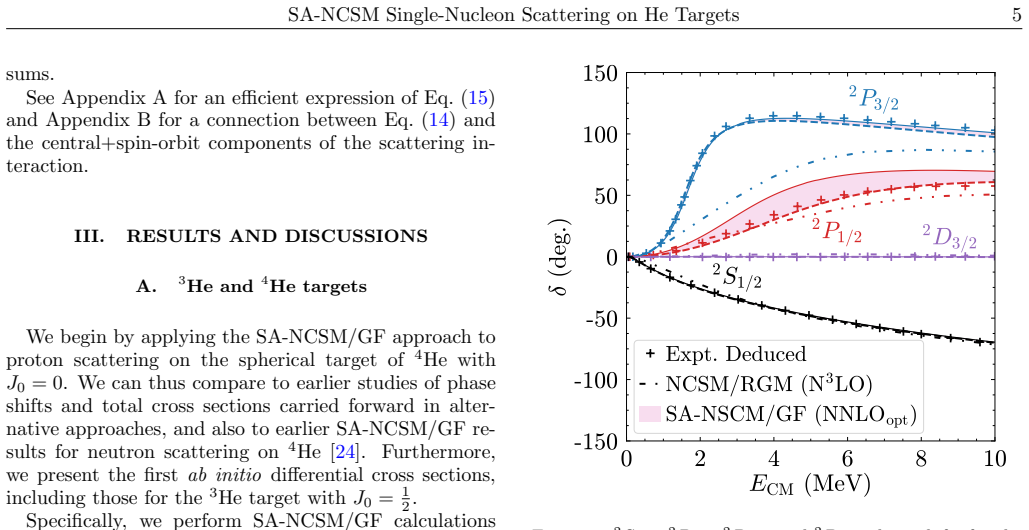
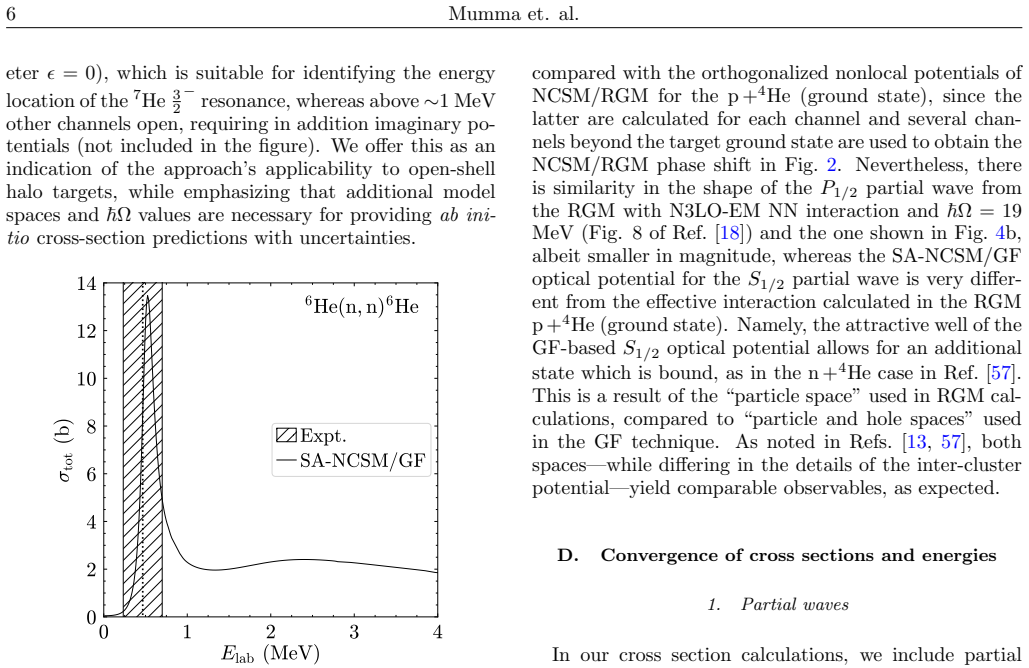
The SA-NCSM/GF optical potentials for 3,4,6He targets reproduce experimental differential cross sections and phase shifts for proton and neutron elastic scattering remarkably well, yielding nonlocal, energy-dependent, and dispersive potentials suitable for low energies and exotic nuclei.
What carries the argument
The SA-NCSM/GF approach, which combines the symmetry-adapted no-core shell model with the Green's function technique to generate optical potentials from first principles.
If this is right
- The potentials apply directly to low-energy scattering without phenomenological adjustments.
- They provide predictions for exotic nuclei where experiments are difficult.
- The method yields nonlocal and energy-dependent forms that incorporate dispersion relations.
- Extension to nonzero-spin targets enables broader use in nuclear reaction calculations.
Where Pith is reading between the lines
- Similar constructions could supply optical potentials for other light nuclei beyond the helium chain.
- The approach may reduce dependence on fitted global potentials in reaction modeling for astrophysical processes.
- Testing on additional observables like reaction cross sections could further validate the potentials.
Load-bearing premise
The SA-NCSM/GF framework, after extension to proton scattering and nonzero-spin targets, accurately captures the relevant many-body dynamics and produces potentials that can be compared directly to data.
What would settle it
A comparison in which the calculated differential cross sections or phase shifts for proton or neutron scattering on one of the 3,4,6He targets deviate substantially from experimental measurements at low energies.
Figures



read the original abstract
We construct and discuss $\textit{ab initio}$ nucleon-nucleus optical potentials at low energies for $^{3,4,6}$He targets. In this work, we use the $\textit{ab initio}$ SA-NCSM/GF approach that combines the $\textit{ab initio}$ symmetry-adapted no-core shell model with the Green's function technique to construct optical potentials, and extend this formulation to proton scattering and targets with nonzero spin. We show that these optical potentials reproduce experimental differential cross sections and phase shifts for proton and neutron elastic scattering remarkably well. The $\textit{ab initio}$ SA-NCSM/GF approach provides nonlocal, energy dependent and dispersive optical potentials, suitable for the astrophysically relevant regime of low energies and for exotic nuclei, where experiments are difficult and data is often unavailable.
Editorial analysis
A structured set of objections, weighed in public.
Referee Report
Summary. The manuscript constructs ab initio optical potentials for low-energy proton and neutron elastic scattering on ^{3,4,6}He targets by combining the symmetry-adapted no-core shell model (SA-NCSM) with the Green's function (GF) technique. The formulation is extended to proton scattering and nonzero-spin targets. The central claim is that the resulting nonlocal, energy-dependent, dispersive potentials reproduce experimental differential cross sections and phase shifts remarkably well in a parameter-free manner, making them suitable for astrophysically relevant regimes and exotic nuclei.
Significance. If the reproduction of data holds under quantitative scrutiny, the work supplies a first-principles route to optical potentials without adjustable parameters. This is valuable for light nuclei and for systems where data are scarce, and the explicit extension to protons and nonzero spin broadens the method's reach. The parameter-free character and direct data comparisons (once examined) are strengths.
major comments (1)
- [Abstract] Abstract: the assertion that the potentials 'reproduce experimental differential cross sections and phase shifts ... remarkably well' supplies no quantitative metrics, error bars, or comparison details. The results section must be checked for explicit figures/tables with data overlays, χ^{2} values, or percentage deviations to substantiate the central claim; without these the strength of the reproduction cannot be assessed.
Simulated Author's Rebuttal
We thank the referee for their review and the opportunity to address this point. We respond to the single major comment below.
read point-by-point responses
-
Referee: [Abstract] Abstract: the assertion that the potentials 'reproduce experimental differential cross sections and phase shifts ... remarkably well' supplies no quantitative metrics, error bars, or comparison details. The results section must be checked for explicit figures/tables with data overlays, χ² values, or percentage deviations to substantiate the central claim; without these the strength of the reproduction cannot be assessed.
Authors: The abstract is intended as a concise summary. The results sections (III and IV) contain the detailed comparisons: multiple figures overlay the calculated differential cross sections directly on experimental data points for p+³,⁴,⁶He and n+³,⁴,⁶He at several energies below 20 MeV, and additional figures or tables compare the corresponding phase shifts. These overlays demonstrate the level of agreement that justifies the phrasing 'remarkably well.' We have not computed or reported χ² values or percentage deviations, as the work emphasizes the parameter-free construction rather than statistical fitting metrics. We are prepared to add a brief quantitative statement (e.g., typical deviation ranges) to the abstract or results if the referee considers it necessary. revision: partial
Circularity Check
No significant circularity detected
full rationale
The paper constructs ab initio optical potentials via the SA-NCSM/GF method (extended to protons and nonzero-spin targets) and directly compares the resulting nonlocal, energy-dependent potentials to experimental cross sections and phase shifts. No load-bearing step reduces by construction to a fit, self-definition, or self-citation chain; the reported agreement with data is presented as an external validation of the parameter-free framework rather than an input. The derivation chain remains self-contained against the stated many-body inputs and the Green's function formalism.
Axiom & Free-Parameter Ledger
Reference graph
Works this paper leans on
-
[1]
Partial waves In our cross section calculations, we include partial waves up to a given maximumℓ max and corresponding Jmax =ℓ max − 1
-
[2]
To provideab initiopredictions, we ex- plore the convergence of cross sections with partial waves, which we illustrate here for the p +4He elastic scattering (Fig. 5). We include at mostJ max = 7 2, but find that only the first few partial waves affect scattering observables as is shown in Fig. 5 for the p + 4He differential cross sec- tion. An explanatio...
-
[3]
We calculate the SA- NCSM energies of 2,3H, 3−7He, and 5Li (see Fig
Model space Convergence of results with respect to the basis param- etersN max andℏΩ is needed forab initiodescriptions in no-core shell-model calculations. We calculate the SA- NCSM energies of 2,3H, 3−7He, and 5Li (see Fig. 6 for the 3H and 4He ground states and the lowest-lying resonances in 5Li). TheA±1 ground state and excitation energies are importa...
-
[4]
I. J. Thompson and F. Nunes,Nuclear reactions for as- trophysics: Principles, calculation and applications of low-energy reactions(Cambridge University Press, Cam- bridge, 2009)
2009
-
[5]
Feshbach, Unified theory of nuclear reactions, Ann
H. Feshbach, Unified theory of nuclear reactions, Ann. Phys.5, 357 (1958)
1958
-
[6]
Feshbach,Theoretical nuclear physics: Nuclear reac- tions, Wiley classics library, Vol
H. Feshbach,Theoretical nuclear physics: Nuclear reac- tions, Wiley classics library, Vol. 2 (John Wiley & Sons, Incorporated, 1992)
1992
-
[7]
W. H. Dickhoff and D. Van Neck,Many-body theory ex- posed!, 2nd ed. (WORLD SCIENTIFIC, 2008)
2008
-
[8]
Koning and J
A. Koning and J. Delaroche, Local and global nucleon optical models from 1 keV to 200 MeV, Nucl. Phys. A 713, 231 (2003)
2003
-
[9]
Johnsonet al., White paper: from bound states to the continuum, J
C. Johnsonet al., White paper: from bound states to the continuum, J. Phys. G47, 123001 (2020)
2020
-
[10]
Lovell and F
A. Lovell and F. Nunes, Systematic uncertainties in direct reaction theories, J. Phys. G42, 034014 (2015)
2015
-
[11]
Arconeset al., White paper on nuclear astrophysics and low energy nuclear physics Part 1: Nuclear astro- physics, Prog
A. Arconeset al., White paper on nuclear astrophysics and low energy nuclear physics Part 1: Nuclear astro- physics, Prog. Part. Nucl. Phys.94, 1 (2017)
2017
-
[12]
Arnould and S
M. Arnould and S. Goriely, Astronuclear physics: A tale of the atomic nuclei in the skies, Prog. Part. Nucl. Phys. 112, 103766 (2020)
2020
-
[13]
Descouvemont, Nuclear reactions of astrophysi- cal interest, Front
P. Descouvemont, Nuclear reactions of astrophysi- cal interest, Front. Astron. Space Sci.7, 10.3389/fs- pas.2020.00009 (2020)
work page doi:10.3389/fs- 2020
-
[14]
Navr´ atilet al., Unifiedab initioapproaches to nu- clear structure and reactions, Physica Scripta91, 053002 (2016)
P. Navr´ atilet al., Unifiedab initioapproaches to nu- clear structure and reactions, Physica Scripta91, 053002 (2016)
2016
-
[15]
Bacca and S
S. Bacca and S. Pastore, Electromagnetic reactions on light nuclei, J. Phys. G41, 123002 (2014)
2014
-
[16]
K. D. Launey, G. H. Sargsyan, A. Mercenne, J. E. Es- cher, and D. C. Mumma,Ab initiosymmetry-adapted approaches to nuclear reactions, Progress in Particle and Nuclear Physics148, 104233 (2026)
2026
-
[17]
Nollett, S
K. Nollett, S. Pieper, R. Wiringa, J. Carlson, and G. Hale, Quantum Monte Carlo calculations of neutron- alpha scattering, Phys. Rev. Lett.99, 022502 (2007)
2007
-
[18]
Hagen, D
G. Hagen, D. Dean, M. Hjorth-Jensen, and T. Papen- brock, Complex coupled-cluster approach to anab-initio description of open quantum systems, Phys. Lett. B656, 169 (2007)
2007
-
[19]
Quaglioni and P
S. Quaglioni and P. Navr´ atil,Ab Initiomany-body cal- culations of n− 3H, n− 4He, p− 3,4He, and n− 10Be scat- tering, Phys. Rev. Lett.101, 092501 (2008)
2008
-
[20]
Elhatisari, D
S. Elhatisari, D. Lee, G. Rupak, E. Epelbaum,et al.,Ab initioalpha-alpha scattering, Nature528, 111 (2015)
2015
-
[21]
Quaglioni and P
S. Quaglioni and P. Navr´ atil,Ab initiomany-body cal- culations of nucleon-nucleus scattering, Phys. Rev. C79, 044606 (2009)
2009
-
[22]
Mercenne, K
A. Mercenne, K. Launey, T. Dytrych, J. Escher, S. Quaglioni, G. Sargsyan, D. Langr, and J. Draayer, Effi- cacy of the symmetry-adapted basis forab initionucleon- nucleus interactions for light- and intermediate-mass nu- clei, Comp. Phys. Commun.280, 108476 (2022)
2022
-
[23]
A. R. Flores and K. M. Nollett, Variational Monte Carlo calculations of n+ 3H scattering, Phys. Rev. C108, 034001 (2023)
2023
-
[24]
Kravvaris, P
K. Kravvaris, P. Navr´ atil, S. Quaglioni, C. Hebborn, and G. Hupin,Ab initioinformed evaluation of the radiative capture of protons on 7Be, Phys. Lett. B845, 138156 (2023)
2023
-
[25]
Kravvaris, S
K. Kravvaris, S. Quaglioni, G. Hupin, and P. Navr´ atil, Ab initioframework for nuclear scattering and reactions induced by light projectiles, Phys. Lett. B856, 138930 (2024)
2024
-
[26]
Kravvaris, S
K. Kravvaris, S. Quaglioni, and P. Navr´ atil, Tunable- fidelity wave functions for theab initiodescription of scattering and reactions, Phys. Rev. C109, 054603 (2024)
2024
-
[27]
Burrows, K
M. Burrows, K. D. Launey, A. Mercenne, R. B. Baker, G. H. Sargsyan, T. Dytrych, and D. Langr,Ab initio translationally invariant nucleon-nucleus optical poten- tials, Phys. Rev. C109, 014616 (2024)
2024
-
[28]
Atkinson, K
M. Atkinson, K. Kravvaris, S. Quaglioni, and P. Navr´ atil, Ab initiocalculation of the 3He(α, γ)7Be astrophysicalS factor with chiral two- and three-nucleon forces, Phys. Lett. B860, 139189 (2025)
2025
-
[29]
A. R. Flores, K. M. Nollett, and M. Piarulli, Quantum Monte Carlo calculations of neutron-αscattering via an integral relation, Phys. Rev. C112, 014008 (2025)
2025
-
[30]
Sargsyan, K
G. Sargsyan, K. Yoshida, K. Ogata, K. Launey, J. Es- cher, D. Langr, and T. Dytrych,Ab initioinformed 20Ne(p,pα) 16O reaction elucidates the emergence of al- pha clustering from chiral potentials, Phys. Lett. B866, 139563 (2025)
2025
-
[31]
Vorabbi, M
M. Vorabbi, M. Gennari, P. Finelli, C. Giusti, and P. Navr´ atil, Toward a microscopic description of nucleus- nucleus collisions, Phys. Rev. Lett.135, 172501 (2025)
2025
-
[32]
P. F. Bedaque and U. van Kolck, Effective field theory for few-nucleon systems, Annu. Rev. Nucl. Part. Sci.52, 339 (2002)
2002
-
[33]
D. R. Entem and R. Machleidt, Accurate charge- dependent nucleon-nucleon potential at fourth order of chiral perturbation theory, Phys. Rev. C68, 041001(R) (2003)
2003
-
[34]
E. Epelbaum, H. Krebs, and U. G. Meißner, Preci- sion nucleon-nucleon potential at fifth order in the chi- ral expansion, Phys. Rev. Lett.115, 122301 (2015), arXiv:1412.4623 [nucl-th]
Pith/arXiv arXiv 2015
-
[35]
Hammer, S
H.-W. Hammer, S. K¨ onig, and U. van Kolck, Nuclear effective field theory: Status and perspectives, Rev. Mod. Phys.92, 025004 (2020)
2020
-
[36]
Capuzzi and C
F. Capuzzi and C. Mahaux, Relationship between Fes- hbach’s and Green’s function theories of the nucleon- nucleus mean field, Ann. Phys.281, 223 (2000)
2000
-
[37]
Mahaux, H
C. Mahaux, H. Ngo, and G. R. Satchler, Causality and the threshold anomaly of the nucleus-nucleus potential, Nucl. Phys. A449, 354 (1986)
1986
-
[38]
Mahaux and R
C. Mahaux and R. Sartor, Single-particle motion in nu- clei, inAdvances in nuclear physics, edited by J. W. 12 Mumma et. al. Negele and E. Vogt (Springer US, Boston, MA, 1991) pp. 1–223
1991
-
[39]
Rotureau, P
J. Rotureau, P. Danielewicz, G. Hagen, F. Nunes, and T. Papenbrock, Optical potential from first principles, Phys. Rev. C95, 024315 (2017)
2017
-
[40]
Rotureau, P
J. Rotureau, P. Danielewicz, G. Hagen, G. Jansen, and F. Nunes, Microscopic optical potentials for calcium iso- topes, Phys. Rev. C98, 044625 (2018)
2018
-
[41]
Idini, C
A. Idini, C. Barbieri, and P. Navr´ atil,Ab Initiooptical potentials and nucleon scattering on medium mass nuclei, Phys. Rev. Lett.123, 092501 (2019)
2019
-
[42]
Bostr¨ om, J
J. Bostr¨ om, J. Rotureau, B. G. Carlsson, and A. Idini, Nuclear cross sections from low-energy interactions, Phys. Rev. C112, L051602 (2025)
2025
-
[43]
G. H. Sargsyan, G. Potel, K. Kravvaris, and J. E. Escher, Microscopic optical potentials from a Green’s function approach, Phys. Rev. C112, 054606 (2025)
2025
-
[44]
K. D. Launey, A. Mercenne, and T. Dytrych, Nuclear dy- namics and reactions in theab initiosymmetry-adapted framework, Annu. Rev. Nucl. Part. Sci.71, 253 (2021)
2021
-
[45]
Burrows, R
M. Burrows, R. B. Baker, S. Bacca, K. D. Launey, T. Dytrych, and D. Langr, Response functions and gi- ant monopole resonances for light to medium-mass nu- clei from theab initiosymmetry-adapted no-core–shell model, J. of Phys. G52, 035107 (2025)
2025
-
[46]
K. D. Launey, T. Dytrych, and J. P. Draayer, Symmetry- guided large-scale shell-model theory, Prog. Part. Nucl. Phys.89, 101 (review) (2016)
2016
-
[47]
M. C. Birse and C. F. Clement, Effects of the n-n poten- tial core on the spectroscopic sum rules for one-nucleon transfer, Nucl. Phys. A351, 112 (1981)
1981
-
[48]
Descouvemont and D
P. Descouvemont and D. Baye, The R-matrix theory, Rep. Prog. Phys.73, 3 (2010)
2010
-
[49]
S. M. Austin, H. H. Barschall, and R. E. Shamu, Scat- tering of neutrons byαparticles, Phys. Rev.126, 1532 (1962)
1962
-
[50]
R. E. Shamu and J. G. Jenkin, Neutron-alpha scattering in the 20-MeV range, Phys. Rev.135, B99 (1964)
1964
-
[51]
Barnard, C
A. Barnard, C. Jones, and J. Weil, Elastic scattering of 2–11 MeV protons by 4He, Nucl. Phys.50, 604 (1964)
1964
-
[52]
Kraus and I
L. Kraus and I. Linck, Study ofP 3/2 andP 1/2 states for nuclei 5He and 5Li by measurement of n + 4He and p + 4He differential cross section, Nucl. Phys. A224, 45 (1974)
1974
-
[53]
D. G. McDonald, W. Haeberli, and L. W. Morrow, Po- larization and cross section of protons scattered by 3He from 4 to 13 MeV, Phys. Rev.133, B1178 (1964)
1964
-
[54]
J. M. Blatt and L. C. Biedenharn, The angular distribu- tion of scattering and reaction cross sections, Rev. Mod. Phys.24, 258 (1952)
1952
-
[55]
Ekstr¨ om, G
A. Ekstr¨ om, G. Baardsen, C. Forss´ en, G. Ha- gen, M. Hjorth-Jensen, G. R. Jansen, R. Machleidt, W. Nazarewicz,et al., An optimized chiral nucleon- nucleon interaction at next-to-next-to-leading order, Phys. Rev. Lett.110, 192502 (2013)
2013
-
[56]
G. M. Hale, (private communication)
-
[57]
A. M. Shirokov, A. I. Mazur, I. A. Mazur, E. A. Mazur, I. J. Shin, Y. Kim, L. D. Blokhintsev, and J. P. Vary, Nucleon-αscattering and resonances in 5He and 5Li with JISP16 and Daejeon16NNinteractions, Phys. Rev. C98, 044624 (2018)
2018
-
[58]
Shirokov, J
A. Shirokov, J. Vary, A. Mazur, and T. Weber, Realistic Nuclear Hamiltonian:Ab ExituApproach, Phys. Lett. B 644, 33 (2007)
2007
-
[59]
Rotureau, P
J. Rotureau, P. Danielewicz, G. Hagen, F. M. Nunes, and T. Papenbrock, Optical potential from first principles, Phys. Rev. C95, 024315 (2017)
2017
-
[60]
Burrows,Ab Initio Leading Order Effective Interac- tions for Scattering of Nucleons from Light Nuclei, Ph.D
M. Burrows,Ab Initio Leading Order Effective Interac- tions for Scattering of Nucleons from Light Nuclei, Ph.D. thesis, Ohio University (2020)
2020
-
[61]
Shanks, Non-linear transformations of divergent and slowly convergent sequences, Journal of Mathematics and Physics34, 1 (1955)
D. Shanks, Non-linear transformations of divergent and slowly convergent sequences, Journal of Mathematics and Physics34, 1 (1955)
1955
-
[62]
Dytrych, K
T. Dytrych, K. D. Launey, J. P. Draayer, D. J. Rowe, J. L. Wood, G. Rosensteel, C. Bahri, D. Langr, and R. B. Baker, Physics of nuclei: Key role of an emergent sym- metry, Phys. Rev. Lett.124, 042501 (2020)
2020
discussion (0)
Sign in with ORCID, Apple, or X to comment. Anyone can read and Pith papers without signing in.