Exploring the landscape of compact magic-state distillation factories
Pith reviewed 2026-06-27 21:25 UTC · model grok-4.3
The pith
Magic-state distillation protocols map exactly onto classical error-correcting codes, enabling SAT-based discovery of minimal-qubit factories and no-go theorems.
A machine-rendered reading of the paper's core claim, the machinery that carries it, and where it could break.
Core claim
Exploiting the specific noise structure present in magic state distillation protocols, classical error-correcting codes offer a simpler framework for deriving these protocols. This formulation is particularly well suited to systematic numerical and analytical studies of distillation protocols involving a fixed number of qubits. A SAT solver derives no-go theorems that relate the number of qubits, the protocol depth, the factory distance, and the prefactor in the output error rate. Any T-to-T state distillation protocol using fewer than eight qubits can detect at most three errors, while any T-to-CCZ state distillation protocol using fewer than eight qubits can detect at most two errors. New
What carries the argument
The exact and lossless mapping of magic-state distillation noise onto classical error-correcting codes, searchable by SAT solver for fixed qubit counts.
Load-bearing premise
The noise structure in these distillation protocols allows an exact, lossless mapping to classical error-correcting codes.
What would settle it
A T-to-T distillation protocol using seven or fewer qubits that detects four or more errors would disprove the no-go theorem.
Figures

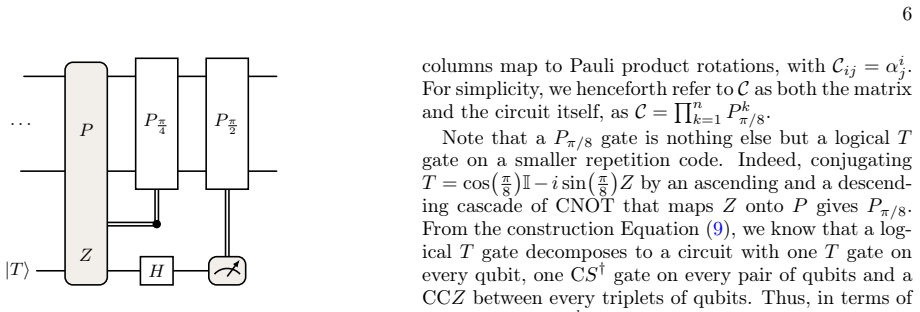
read the original abstract
Producing high-fidelity magic states using the smallest possible amount of physical qubits and operations stands as a very important challenge to achieve fault-tolerant quantum computation at scale. Besides emerging proposals for alternative methods such as cultivation, magic state distillation remains essential for achieving very low error rates. Known distillation protocols are usually built through quantum codes derived from triorthogonal matrices. Here, exploiting the specific noise structure present in magic state distillation protocols, we show that classical error-correcting codes offer a simpler framework for deriving these protocols. This formulation is particularly well suited to systematic numerical and analytical studies of distillation protocols involving a fixed number of qubits. Specifically, we use a SAT solver to derive a series of no-go theorems that relate key figures of merit, including the number of qubits, the protocol depth, the factory distance, and the prefactor in the output error rate. For instance, we prove that any $T$-to-$T$ state distillation protocol using fewer than eight qubits can detect at most three errors, while any $T$-to-$\mathrm{CC}Z$ state distillation protocol using fewer than eight qubits can detect at most two errors. Our results also include new distillation protocols with the smallest number of qubits for a given distance in the literature, namely distance 4 and 5 $T$-to-$T$ state protocols supported on 10 and 11 qubits, as well as distance 3 and 4 $T$-to-$\mathrm{CC}Z$ state distillation protocols supported on 9 and 10 qubits.
Editorial analysis
A structured set of objections, weighed in public.
Referee Report
Summary. The paper claims that the specific noise structure of magic-state distillation allows an exact, lossless reduction of T-to-T and T-to-CCZ protocols to classical error-correcting codes, which can then be exhaustively searched via SAT solvers. This yields no-go theorems (any T-to-T protocol on fewer than 8 qubits detects at most 3 errors; any T-to-CCZ protocol on fewer than 8 qubits detects at most 2 errors) together with new protocols achieving the smallest qubit counts reported for distance-4/5 T-to-T (10/11 qubits) and distance-3/4 T-to-CCZ (9/10 qubits).
Significance. If the classical-code reduction is complete, the work supplies a systematic computational method for mapping out the space of compact distillation factories, with the SAT enumeration providing strong, falsifiable evidence for the stated bounds and for the optimality of the new protocols within the encoded family. This is a clear methodological advance over ad-hoc triorthogonal-matrix constructions.
major comments (2)
- [SAT encoding / reduction to classical codes] The section describing the SAT encoding of distillation constraints: the no-go theorems rest on the assertion that every valid quantum protocol maps to a searchable classical code; an explicit argument or completeness check is required showing that all quantum conditions (commutation relations, phase-kickback fidelity requirements, and output-state error rates beyond parity checks) are captured, because any omitted constraint would allow protocols outside the enumerated family to evade the stated bounds.
- [Results on new protocols] The paragraphs reporting the new 10-/11-qubit T-to-T and 9-/10-qubit T-to-CCZ protocols: the optimality claims are conditional on exhaustive coverage of the search space; if the encoding is incomplete, these qubit counts may not be minimal among all quantum protocols, weakening the “smallest in the literature” statements.
minor comments (1)
- [Abstract] The abstract would benefit from a single sentence stating that the SAT encoding was cross-checked against known protocols or small exhaustive cases, to immediately reassure readers of the mapping’s fidelity.
Simulated Author's Rebuttal
We thank the referee for their thorough review and for highlighting the importance of an explicit completeness argument for the classical-code reduction. We will revise the manuscript to include a dedicated proof that all relevant quantum conditions are captured by the SAT encoding. This addresses both major comments and strengthens the no-go theorems and optimality statements.
read point-by-point responses
-
Referee: The section describing the SAT encoding of distillation constraints: the no-go theorems rest on the assertion that every valid quantum protocol maps to a searchable classical code; an explicit argument or completeness check is required showing that all quantum conditions (commutation relations, phase-kickback fidelity requirements, and output-state error rates beyond parity checks) are captured, because any omitted constraint would allow protocols outside the enumerated family to evade the stated bounds.
Authors: We agree that an explicit completeness argument is necessary to support the no-go theorems. In the original derivation, the reduction follows from the fact that, under the Pauli noise model and Clifford operations of magic-state distillation, the commutation relations of the protocol are encoded in the linearity of the classical code, the phase-kickback fidelity conditions translate directly into the output parity-check requirements, and the error-rate bounds beyond simple parity checks are enforced by the minimum-distance condition of the code. We will add a new subsection (Section III.C in the revised manuscript) that formally proves this equivalence, including verification that no additional quantum constraints remain outside the classical formulation. This will be accompanied by a small example walk-through for a known protocol to illustrate the mapping. revision: yes
-
Referee: The paragraphs reporting the new 10-/11-qubit T-to-T and 9-/10-qubit T-to-CCZ protocols: the optimality claims are conditional on exhaustive coverage of the search space; if the encoding is incomplete, these qubit counts may not be minimal among all quantum protocols, weakening the “smallest in the literature” statements.
Authors: Once the completeness argument is added, the SAT enumeration becomes exhaustive over the full set of valid protocols. We will revise the relevant paragraphs (and the abstract) to state explicitly that the reported qubit counts are minimal among all protocols captured by the classical-code reduction, which we will have shown to be equivalent to the complete set of distillation protocols under the considered noise model. The “smallest in the literature” phrasing will be qualified accordingly, with a forward reference to the new completeness subsection. revision: yes
Circularity Check
No significant circularity; external SAT enumeration on claimed mapping
full rationale
The paper's central results (no-go theorems on error detection for T-to-T and T-to-CCZ protocols, plus new small-qubit protocols) are obtained by encoding distillation constraints into classical codes and enumerating with an external SAT solver. No step reduces a claimed prediction or theorem to a fitted parameter, self-defined quantity, or load-bearing self-citation; the mapping itself is presented as an input framework justified by noise structure rather than derived from the enumerated outputs. This is a standard computational search against an independent solver and therefore self-contained.
Axiom & Free-Parameter Ledger
axioms (1)
- domain assumption The noise structure present in magic-state distillation protocols permits an exact mapping to classical error-correcting codes.
Reference graph
Works this paper leans on
-
[1]
As seen in Section IIIC, a circuitCconsists ofn columns, each being a binary vectorαk ∈F N 2 for column k
Encoding the SAT problem We show how finding circuitsC ∈F N×n 2 that imple- ment the fault-tolerant logicalTgate on the repetition code can be expressed as a SAT problem with binary con- straints. As seen in Section IIIC, a circuitCconsists ofn columns, each being a binary vectorαk ∈F N 2 for column k. Since there are2 N such possible vectors, we assign a...
-
[2]
A key feature is that the distance constraints allow us to determine whether a code of distancedexists onN physical qubits
Exploring the space of smallNcodes The SAT formulation introduced above enables a sys- tematic exploration of logicalTcircuits along several axes. A key feature is that the distance constraints allow us to determine whether a code of distancedexists onN physical qubits. Indeed, fixingNandd min, an UNSAT result certifies that no code of distancedmin or hig...
2030
-
[3]
M. E. Beverland, P. Murali, M. Troyer, K. M. Svore, T. Hoefler, V. Kliuchnikov, G. H. Low, M. Soeken, A. Sundaram, and A. Vaschillo, Assessing require- ments to scale to practical quantum advantage (2022), arXiv:2211.07629 [quant-ph]
Pith/arXiv arXiv 2022
-
[4]
Preskill, Beyond nisq: The megaquop machine, ACM Transactions on Quantum Computing6, 1–7 (2025)
J. Preskill, Beyond nisq: The megaquop machine, ACM Transactions on Quantum Computing6, 1–7 (2025)
2025
-
[5]
E. T. Campbell, B. M. Terhal, and C. Vuillot, Roads towards fault-tolerant universal quantum computation, Nature549, 172–179 (2017)
2017
-
[6]
Gidney and M
C. Gidney and M. Ekerå, How to factor 2048 bit rsa in- tegers in 8 hours using 20 million noisy qubits, Quantum 5, 433 (2021)
2048
-
[7]
C. Gidney, How to factor 2048 bit rsa integers with less than a million noisy qubits (2025), arXiv:2505.15917 [quant-ph]
Pith/arXiv arXiv 2048
-
[8]
D. Litinski, How to compute a 256-bit elliptic curve private key with only 50 million toffoli gates (2023), arXiv:2306.08585 [quant-ph]
arXiv 2023
-
[9]
Gouzien and N
E. Gouzien and N. Sangouard, Factoring 2048-bit rsa in- tegers in 177 days with 13 436 qubits and a multimode memory, Phys. Rev. Lett.127, 140503 (2021)
2048
-
[10]
Gouzien, D
E. Gouzien, D. Ruiz, F.-M. Le Régent, J. Guillaud, and N. Sangouard, Performance analysis of a repetition cat code architecture: Computing 256-bit elliptic curve log- arithm in 9 hours with 126 133 cat qubits, Phys. Rev. Lett.131, 040602 (2023)
2023
-
[11]
H. Zhou, C. Duckering, C. Zhao, D. Bluvstein, M. Cain, A. Kubica, S.-T. Wang, and M. D. Lukin, Resource anal- ysis of low-overhead transversal architectures for recon- figurable atom arrays, inProceedings of the 52nd An- nual International Symposium on Computer Architec- ture, SIGARCH ’25 (ACM, 2025) p. 1432–1448
2025
-
[12]
Jacinto, E
H. Jacinto, E. Gouzien, and N. Sangouard, Network re- quirements for distributed quantum computation, Phys. Rev. Res.8, 013205 (2026)
2026
-
[13]
A. M. Dalzell, S. McArdle, M. Berta, P. Bienias, C.-F. Chen, A. Gilyén, C. T. Hann, M. J. Kastoryano, E. T. Khabiboulline, A. Kubica, G. Salton, S. Wang, and F. G. S. L. Brandão,Quantum Algorithms: A Survey of Appli- cations and End-to-end Complexities(Cambridge Uni- versity Press, 2025)
2025
-
[14]
Eastin and E
B. Eastin and E. Knill, Restrictions on transversal en- coded quantum gate sets, Phys. Rev. Lett.102, 110502 (2009)
2009
-
[15]
Bravyi and R
S. Bravyi and R. König, Classification of topologically protected gates for local stabilizer codes, Phys. Rev. Lett. 110, 170503 (2013)
2013
-
[16]
Barizien, H
V. Barizien, H. Jacinto, and N. Sangouard, Accessible quantum gates on classical stabilizer codes, Phys. Rev. Lett.136, 030602 (2026)
2026
-
[17]
Dennis, A
E. Dennis, A. Kitaev, A. Landahl, and J. Preskill, Topological quantum memory, Journal of Mathematical Physics43, 4452–4505 (2002)
2002
-
[18]
Litinski, A game of surface codes: Large-scale quan- tum computing with lattice surgery, Quantum3, 128 (2019)
D. Litinski, A game of surface codes: Large-scale quan- tum computing with lattice surgery, Quantum3, 128 (2019)
2019
-
[19]
A.G.FowlerandC.Gidney,Lowoverheadquantumcom- putation using lattice surgery (2019), arXiv:1808.06709 [quant-ph]
arXiv 2019
-
[20]
Bravyi, A
S. Bravyi, A. W. Cross, J. M. Gambetta, D. Maslov, P. Rall, and T. J. Yoder, High-threshold and low- overhead fault-tolerant quantum memory, Nature627, 778–782 (2024)
2024
-
[21]
T. J. Yoder, E. Schoute, P. Rall, E. Pritchett, J. M. Gam- betta, A. W. Cross, M. Carroll, and M. E. Beverland, Tour de gross: A modular quantum computer based on bivariate bicycle codes (2025), arXiv:2506.03094 [quant- ph]
Pith/arXiv arXiv 2025
-
[22]
Horsman, A
D. Horsman, A. G. Fowler, S. Devitt, and R. V. Meter, Surface code quantum computing by lattice surgery, New Journal of Physics14, 123011 (2012)
2012
-
[23]
Serra-Peralta, M
M. Serra-Peralta, M. H. Shaw, and B. M. Terhal, Decod- ing across transversal clifford gates in the surface code, PRX Quantum7, 010335 (2026)
2026
-
[24]
S.BravyiandA.Kitaev,Universalquantumcomputation 17 with ideal clifford gates and noisy ancillas, Phys. Rev. A 71, 022316 (2005)
2005
-
[25]
J. Lee, D. W. Berry, C. Gidney, W. J. Huggins, J. R. Mc- Clean, N. Wiebe, and R. Babbush, Even more efficient quantum computations of chemistry through tensor hy- percontraction, PRX Quantum2, 030305 (2021)
2021
-
[26]
A. Schrottenloher, Optimized point addition cir- cuits for elliptic curve discrete logarithms (2026), arXiv:2606.02235 [quant-ph]
Pith/arXiv arXiv 2026
-
[27]
Li, A magic state’s fidelity can be superior to the operations that created it, New Journal of Physics17, 023037 (2015)
Y. Li, A magic state’s fidelity can be superior to the operations that created it, New Journal of Physics17, 023037 (2015)
2015
-
[28]
Lao and B
L. Lao and B. Criger, Magic state injection on the ro- tated surface code, inProceedings of the 19th ACM In- ternational Conference on Computing Frontiers, CF ’22 (Association for Computing Machinery, New York, NY, USA, 2022) p. 113–120
2022
-
[29]
Bravyi and J
S. Bravyi and J. Haah, Magic-state distillation with low overhead, Phys. Rev. A86, 052329 (2012)
2012
-
[30]
E. T. Campbell, H. Anwar, and D. E. Browne, Magic- State Distillation in All Prime Dimensions Using Quan- tum Reed-Muller Codes, Physical Review X2, 041021 (2012)
2012
-
[31]
Jones, Multilevel distillation of magic states for quan- tum computing, Physical Review A87, 042305 (2013)
C. Jones, Multilevel distillation of magic states for quan- tum computing, Physical Review A87, 042305 (2013)
2013
-
[32]
E. T. Campbell and M. Howard, Unified framework for magic state distillation and multiqubit gate synthesis with reduced resource cost, Phys. Rev. A95, 022316 (2017)
2017
-
[33]
Haah and M
J. Haah and M. B. Hastings, Codes and protocols for distillingT, controlled-S, and toffoli gates, Quantum2, 71 (2018)
2018
-
[34]
Litinski, Magic state distillation: Not as costly as you think, Quantum3, 205 (2019)
D. Litinski, Magic state distillation: Not as costly as you think, Quantum3, 205 (2019)
2019
-
[35]
Londe, Local distillation from reed muller codes un- folding (2026), arXiv:2605.06284 [quant-ph]
V. Londe, Local distillation from reed muller codes un- folding (2026), arXiv:2605.06284 [quant-ph]
Pith/arXiv arXiv 2026
-
[36]
C. Gidney, N. Shutty, and C. Jones, Magic state culti- vation: growing t states as cheap as cnot gates (2024), arXiv:2409.17595 [quant-ph]
Pith/arXiv arXiv 2024
-
[37]
Itogawa, Y
T. Itogawa, Y. Takada, Y. Hirano, and K. Fujii, Efficient Magic State Distillation by Zero-Level Distillation, PRX Quantum6, 020356 (2025)
2025
-
[38]
E. Rosenfeld, C. Gidney, G. Roberts, A. Morvan, N. Lacroix, D. Kafri, J. Marshall, M. Li, and V. S. et al., Magic state cultivation on a superconducting quantum processor (2025), arXiv:2512.13908 [quant-ph]
arXiv 2025
-
[39]
M. Cain, Q. Xu, R. King, L. R. B. Picard, H. Levine, M. Endres, J. Preskill, H.-Y. Huang, and D. Bluvstein, Shor’s algorithm is possible with as few as 10,000 recon- figurable atomic qubits (2026), arXiv:2603.28627 [quant- ph]
Pith/arXiv arXiv 2026
-
[40]
S. Nezami and J. Haah, Classification of small tri- orthogonal codes, Physical Review A106, 10.1103/phys- reva.106.012437 (2022)
-
[41]
M. Shi, H. Lu, J.-L. Kim, and P. Sole, Triorthogo- nal codes and self-dual codes (2024), arXiv:2408.09685 [cs.IT]
arXiv 2024
-
[42]
A. Baldelli, O. Å. Mostad, H.-Y. Lin, E. Rosnes, and M. Battaglioni, On constructing and decoding quantum triorthogonal codes (2026), arXiv:2605.24519 [quant-ph]
Pith/arXiv arXiv 2026
-
[43]
Jones, Composite toffoli gate with two-round error detection, Phys
C. Jones, Composite toffoli gate with two-round error detection, Phys. Rev. A87, 052334 (2013)
2013
-
[44]
D. Gottesman, The Heisenberg representation of quan- tum computers, in22nd International Colloquium on Group Theoretical Methods in Physics(1998) pp. 32–43, arXiv:quant-ph/9807006
Pith/arXiv arXiv 1998
-
[45]
Aaronson and D
S. Aaronson and D. Gottesman, Improved simulation of stabilizer circuits, Phys. Rev. A70, 052328 (2004)
2004
-
[46]
M. A. Nielsen and I. L. Chuang,Quantum Computation and Quantum Information(Cambridge University Press, Cambridge, England, 2010)
2010
-
[47]
Jones, Low-overhead constructions for the fault- tolerant Toffoli gate, Physical Review A87, 022328 (2013)
C. Jones, Low-overhead constructions for the fault- tolerant Toffoli gate, Physical Review A87, 022328 (2013)
2013
-
[48]
S. Xu, K. Liu, P. Rall, Z. He, and Y. Ding, Dis- tilling magic states in the bicycle architecture (2026), arXiv:2602.20546 [quant-ph]
Pith/arXiv arXiv 2026
-
[49]
De Moura and N
L. De Moura and N. Bjørner, Z3: an efficient smt solver, inProceedings of the Theory and Practice of Soft- ware, 14th International Conference on Tools and Al- gorithms for the Construction and Analysis of Systems, TACAS’08/ETAPS’08 (Springer-Verlag, Berlin, Heidel- berg, 2008) p. 337–340
2008
-
[50]
Perron and F
L. Perron and F. Didier, Cp-sat (2024)
2024
-
[51]
compact_distillation: SAT problem to find compact magic state distillation factories,https://github.com/ xvalcarce/compact_distillation(2026), code accom- panying the manuscript
2026
-
[52]
S. Koutsioumpas, D. Banfield, and A. Kay, The smallest code with transversal t (2022), arXiv:2210.14066 [quant- ph]
arXiv 2022
-
[53]
Gidney, Halving the cost of quantum addition, Quan- tum2, 74 (2018)
C. Gidney, Halving the cost of quantum addition, Quan- tum2, 74 (2018)
2018
-
[54]
G. H. Low, W. J. Huggins, D. W. Berry, T. Khattar, A. F. White, N. C. Rubin, and R. Babbush, A denser planar surface code (2026), arXiv:2605.30455 [quant-ph]
Pith/arXiv arXiv 2026
-
[55]
Kasai, Breaking the orthogonality barrier in quantum ldpc codes (2026), arXiv:2601.08824 [quant-ph]
K. Kasai, Breaking the orthogonality barrier in quantum ldpc codes (2026), arXiv:2601.08824 [quant-ph]
arXiv 2026
-
[56]
C. Zhao, C. Duckering, A. Gu, N. Maskara, and H. Zhou, Towards ultra-high-rate quantum error correction with reconfigurable atom arrays (2026), arXiv:2604.16209 [quant-ph]
Pith/arXiv arXiv 2026
-
[57]
E. T. Campbell and J. O’Gorman, An efficient magic stateapproachtosmallanglerotations,QuantumScience and Technology1, 015007 (2016)
2016
-
[58]
Duclos-Cianci and D
G. Duclos-Cianci and D. Poulin, Reducing the quantum- computingoverheadwithcomplexgatedistillation,Phys. Rev. A91, 042315 (2015)
2015
-
[59]
K. Tiurev, C. Fleckenstein, C. Goeller, P. Schnabl, M. Traube, N. Sakharwade, A. Messinger, J. Unger, and W. Lechner, Parity-unfolded distillation architecture for noise-biased platforms (2026), arXiv:2604.15436 [quant- ph]
Pith/arXiv arXiv 2026
-
[60]
Gidney and A
C. Gidney and A. G. Fowler, Efficient magic state fac- tories with a catalyzed|CCZ⟩to2|T⟩transformation, Quantum3, 135 (2019). 18 Appendix A: Commutation relations In this Appendix, we detail and prove the commuta- tion relation used to commute the T gate through the encoding circuit of the repetition code
2019
-
[61]
T gate commutation More precisely, we prove for a givenN≥3: . . . . . . . . . . . . . . . . . . ... . . . . . . ... . . . . . . . . . . . . T = ... ... T Q i,j(CS†)ij Q i,j,k(CCZ) ijk T (A1) Proof.To do things carefully, we work in the compu- tational basis|ϵ 1, . . . , ϵN ⟩and show that both circuits have the same effect on this state, no matter the valu...
-
[62]
More generally, for anyL≥1and N≥L+ 3integers, commuting L√ Tthrough the CNOT ladder yields the circuit of Equation (A3)
General case of L√ T When commuting a √ Tgate through the CNOT lad- der decoding circuit of a repetition code, one obtains Equation (A2). More generally, for anyL≥1and N≥L+ 3integers, commuting L√ Tthrough the CNOT ladder yields the circuit of Equation (A3). ... E † √ T E = ... ... √ T Q i,j(CT †)ij Q i,j,k(CCS)ijk Q i,j,k,l(CCCZ) ijkl √ T (A2) ... E † L√...
-
[63]
As in the main text, we denote byE† the sequence of CNOT gates implementing the decoding circuit
Gate sequence transformation Here, we derive the commutation relation of aP π/8 gate through a repetition code decoding circuit. As in the main text, we denote byE† the sequence of CNOT gates implementing the decoding circuit. We recall that Pπ/8 = cos π 8 I−isin π 8 P, andwecanassociateavector α∈ {0,1} N such thatP= N i Z αi i . We prove that there exist...
-
[64]
provides a gate sequenceP1,
SAT formulation equivalence A matrixV= α0 α1 · · · αn that obeys ∀i∈[ [1, N] ], X k αk i ≡1 mod 2, ∀i < j∈[ [1, N] ]2, X k αk i αk j ≡1 mod 2, ∀i < j < l∈[ [1, N] ] 3, X k αk i αk j αk l ≡1 mod 2. provides a gate sequenceP1, . . . , Pn (defined from the α’s in Equation (13)) that implements a logicalTgate (up to Clifford corrections) on the repetition cod...
-
[65]
every singlet, pair, triplet of lines should appearanoddnumberoftimesinthesupportofthegates in the circuit
General preliminaries for the proofs In this section, we work with the partially ordered set (P([N]),⊆)and leverage the fact that a multi-qubitZ rotation can be seen as an elementA∈ P([N])where the indices inAare the qubits in the support of the gate. We gather a series of definitions and reminders from the algebra of order theory, which will be used in t...
-
[66]
Proof of Lemma 1 The proof of Lemma 1 is direct and consists of rein- troducing the bitvectorsαk associated with each possible gate and writing the definition ofgthrough thoseαk
Canonical protocols proofs a. Proof of Lemma 1 The proof of Lemma 1 is direct and consists of rein- troducing the bitvectorsαk associated with each possible gate and writing the definition ofgthrough thoseαk. Lemma 1 Proof.By definition ofg, for anyB⊆[N], g(B) =|{A∈ F N , B⊆A}|mod 2. If for allA∈ F N we define a vectorαk ∈F N 2 by αk i = ( 1ifi∈A, 0otherw...
-
[67]
26 Number of qubitsN √ T-countnDistanced 52×602 92×5103 132×21844 TABLE III
We can explicitly build patterns to ensured(F1 N) = ⌈N/4⌉. 26 Number of qubitsN √ T-countnDistanced 52×602 92×5103 132×21844 TABLE III. Parameters of the √ T E distillation protocols from the canonical family for smallN. •ifN= 4q, we can takeqdifferent quadruplets to partition[N]. •ifN= 4q+ 1, we can useq−1quadruplets, 1 triplet, and 1 pair. •ifN= 4q+ 2, ...
-
[68]
T distillation protocols The matrix associated to the64T→1Tprotocol on 10 qubits with error suppression in495p 4 is given in Equa- tion (D1) 1 0 0 0 0 0 0 0 0 0 1 1 1 1 1 1 1 1 1 0 0 0 0 0 0 0 0 0 0 0 0 0 0 0 0 0 0 0 0 0 0 0 0 0 0 0 1 1 1 1 1 1 1 1 1 0 0 0 0 0 0 0 0 0 1 0 0 1 0 0 0 0 0 0 1 1 0 1 1 1 1 1 1 0 0 0 1 1 1 0 0 0 0 1 0 0 1 1 0 0...
discussion (0)
Sign in with ORCID, Apple, or X to comment. Anyone can read and Pith papers without signing in.