Short-range correlated pair formation and nuclear shell structure
Pith reviewed 2026-06-27 20:03 UTC · model grok-4.3
The pith
The probability of short-range correlated nucleon pair formation depends on long-range nuclear shell structure.
A machine-rendered reading of the paper's core claim, the machinery that carries it, and where it could break.
Core claim
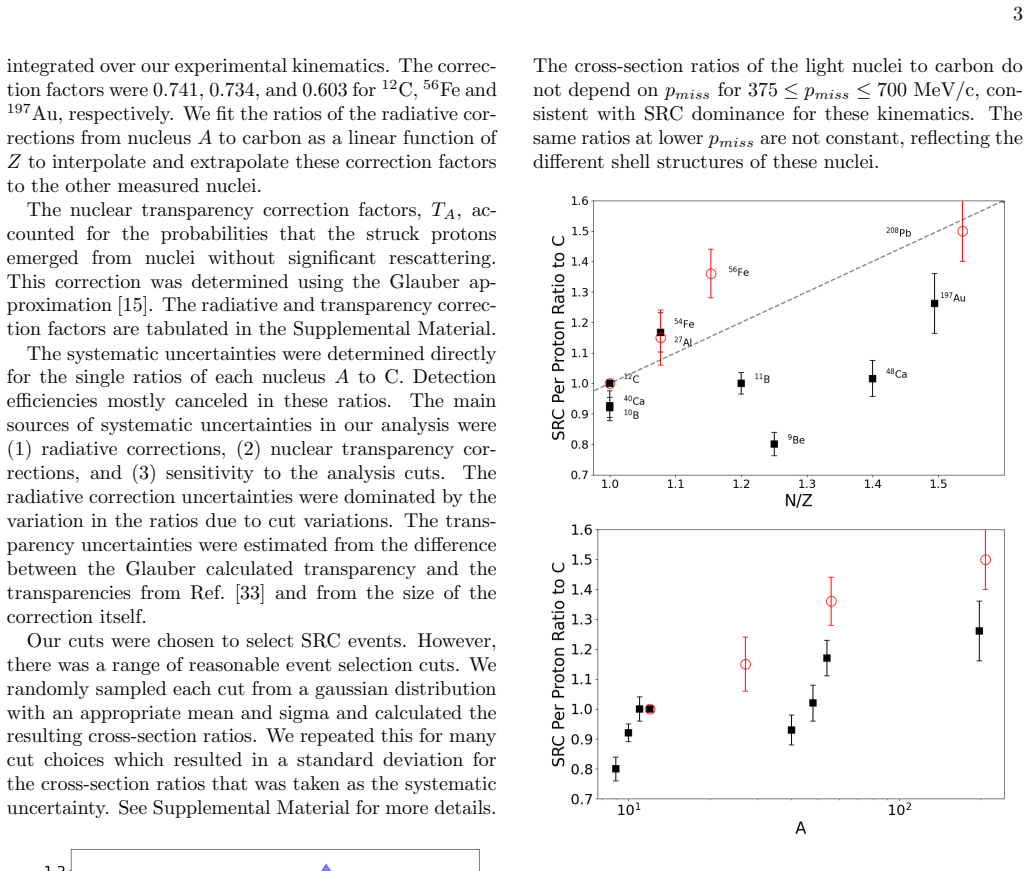
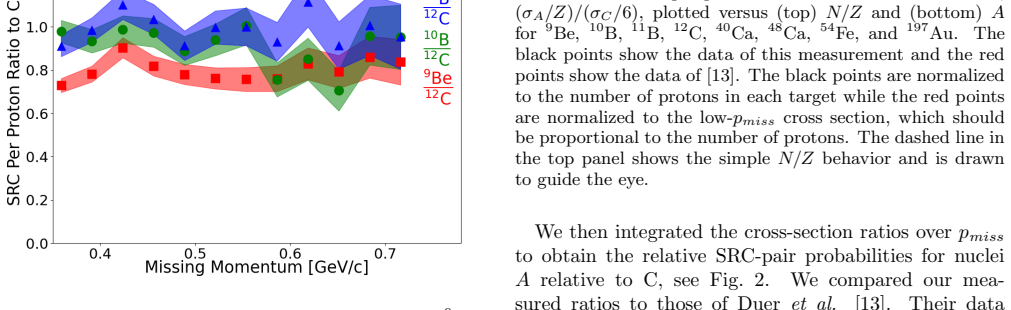
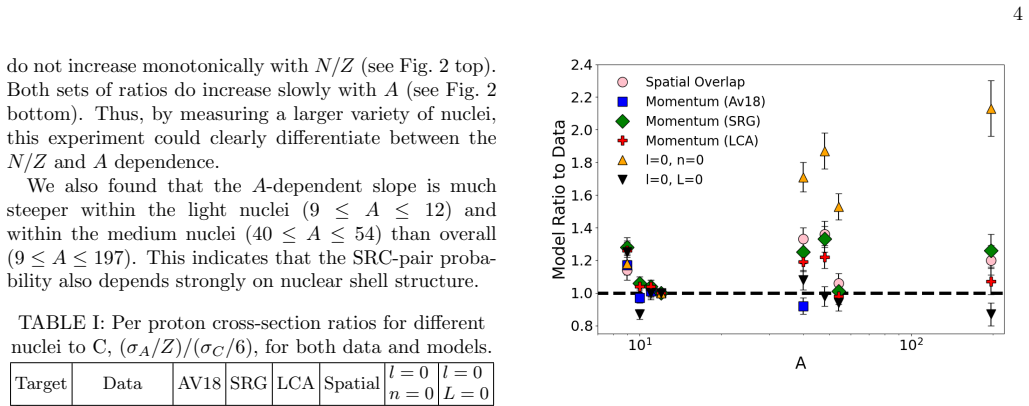
Measurements of high-missing-momentum protons knocked out by electron scattering from 9Be, 10B, 11B, 12C, 40Ca, 48Ca, 54Fe, and 197Au show that while proton pairing probability increases with A, the slope of that increase is much greater from Be to C and from 40Ca to Fe than from Be to Au, demonstrating that long-range nuclear shell structure affects the probability of short-range nucleon pairing.
What carries the argument
Comparison of the slopes of pairing-probability increase across nuclei selected for distinct shell configurations, extracted from high-missing-momentum proton knockout yields in electron scattering.
Load-bearing premise
The measured differences in pairing-probability slopes arise primarily from the nuclei's distinct shell configurations rather than from N/Z variations, acceptance differences, or background in the high-missing-momentum region.
What would settle it
Observing identical slopes of pairing-probability increase for all nuclei regardless of shell crossings, or slopes that track only A or N/Z without regard to shell structure, would falsify the central claim.
Figures
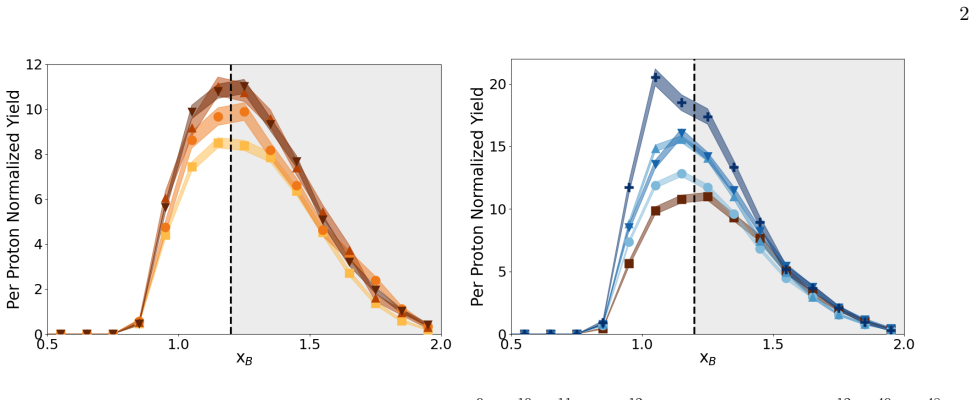
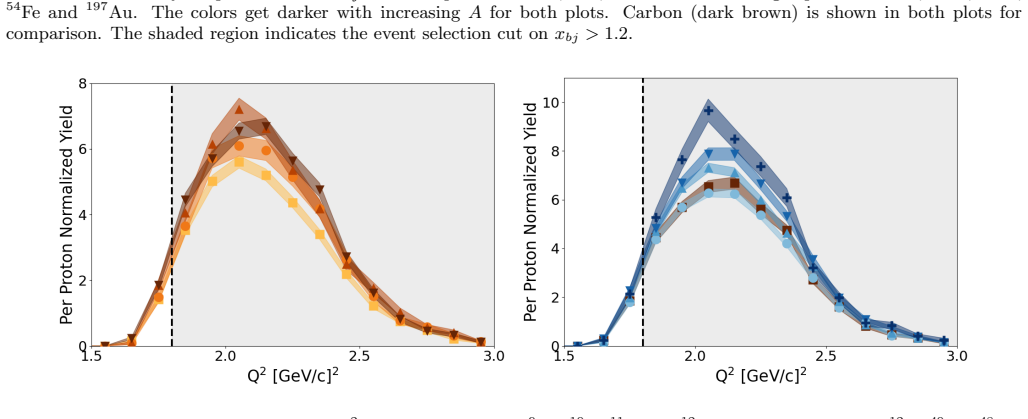
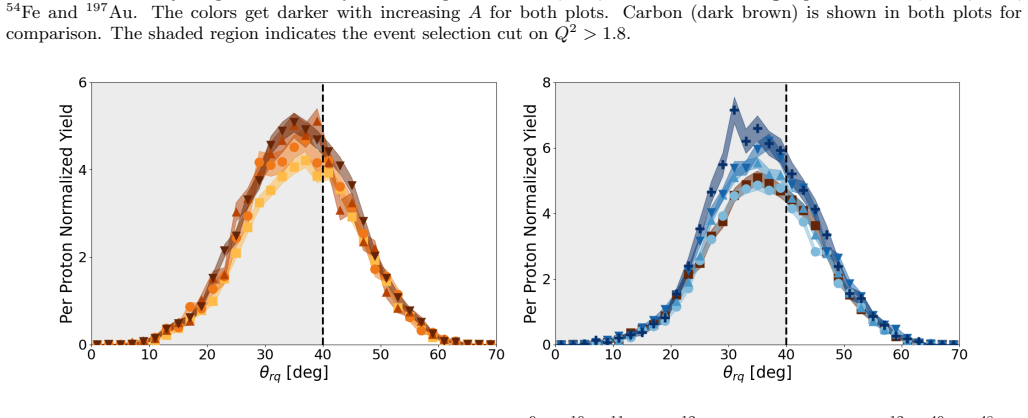
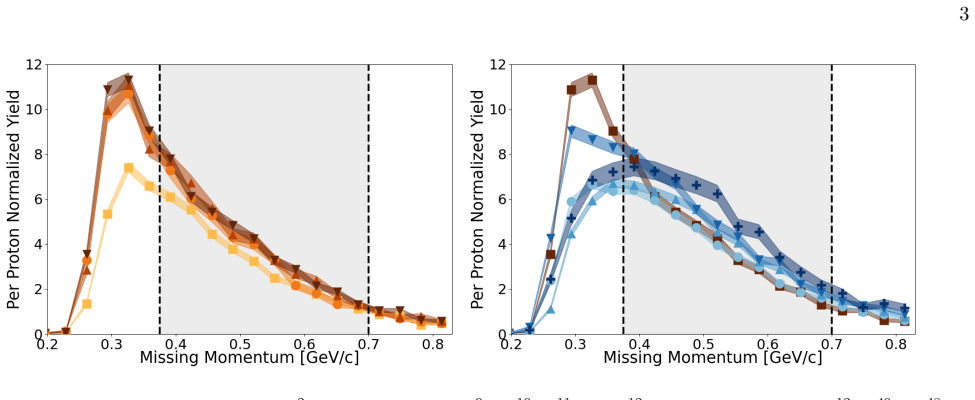
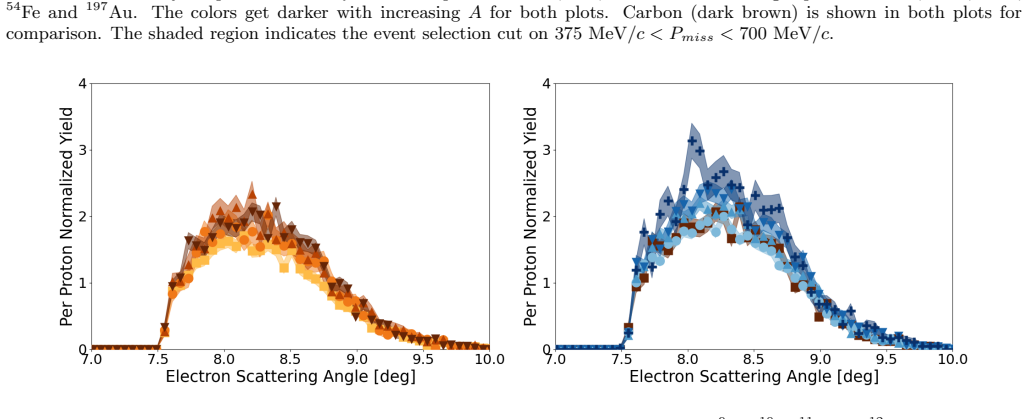
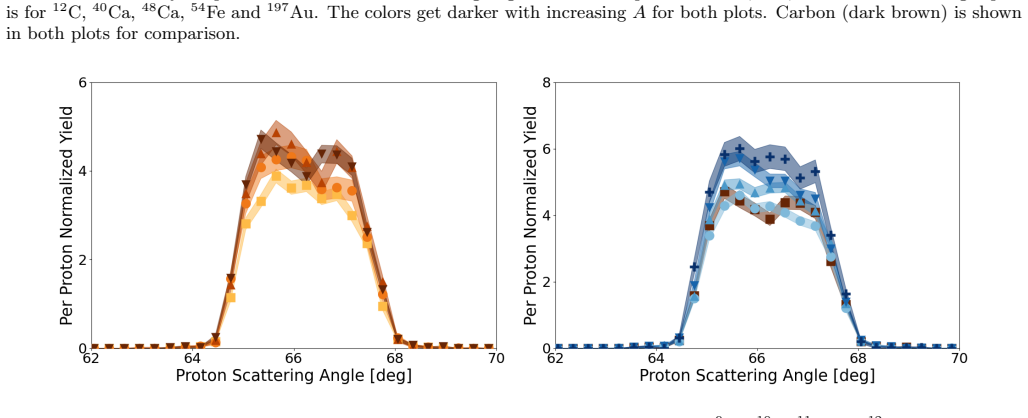
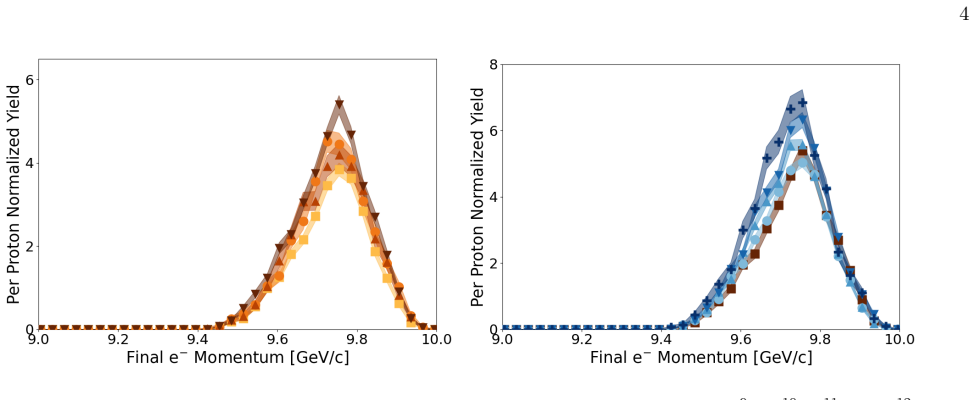
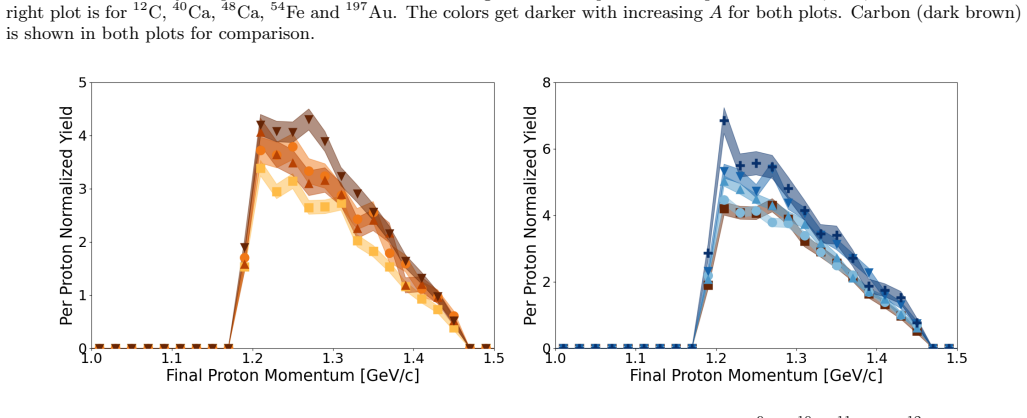
read the original abstract
Short-range correlated (SRC) nucleon pairs - caused by brief, high-momentum interactions between two nucleons - are dominated by neutron-proton pairs with large relative and smaller center-of-mass momenta. However, the underlying dynamics that determines which nucleons form such pairs remains uncertain. Previous measurements showed that proton pairing probabilities increased strongly with nuclear asymmetry N/Z, but could not rule out an increase with nuclear mass A. We measured high-missing-momentum protons knocked out in electron scattering from selected nuclei with a range of shell configurations, A, and N/Z, including 9Be, 10B, 11B, 12C, 40Ca, 48Ca, 54Fe and 197Au. Unexpectedly, we found that while the pairing probability increased with A, the slope of the increase was much greater from Be to C and from 40Ca to Fe, than from Be to Au. This shows the importance of long-range nuclear shell structure on the probability of short-range nucleon pairing.
Editorial analysis
A structured set of objections, weighed in public.
Referee Report
Summary. The manuscript reports electron-scattering measurements of high-missing-momentum protons from nuclei chosen to span shell configurations, A, and N/Z (9Be, 10B, 11B, 12C, 40Ca, 48Ca, 54Fe, 197Au). It finds that SRC pairing probability increases with A, but the slope is steeper from Be to C and from 40Ca to Fe than the overall rise to Au, concluding that long-range nuclear shell structure influences short-range pair formation beyond the known N/Z dependence.
Significance. If the slope differences can be shown to arise primarily from shell structure after controlling for N/Z and A variations, the result would link long- and short-range nuclear phenomena and motivate refinements to SRC models. The experimental choice of nuclei spanning multiple parameters is a methodological strength. The current analysis, however, does not yet isolate the claimed effect, limiting the strength of the interpretation.
major comments (2)
- [Abstract] Abstract: the claim that the slope 'was much greater from Be to C and from 40Ca to Fe, than from Be to Au' is presented without reported slope values, uncertainties, or a statistical test of the difference, which is load-bearing for the central attribution to shell structure.
- [Results] Results section: no quantitative decomposition (partial correlation, regression after N/Z correction, or similar) is provided to demonstrate that shell quantum numbers dominate the observed slope contrast over the simultaneous N/Z (1.0–1.5) and A variations across the chosen nuclei; this isolation is required to support the claim that long-range shell structure determines the pairing probability.
minor comments (1)
- [Table 1] The manuscript would benefit from explicit tabulation of the extracted pairing probabilities and their uncertainties for each nucleus to allow independent assessment of the slopes.
Simulated Author's Rebuttal
Thank you for the opportunity to respond to the referee's report. We appreciate the constructive criticism and have revised the manuscript to address the concerns raised regarding the quantitative support for our claims about shell structure effects on SRC pairing probabilities.
read point-by-point responses
-
Referee: [Abstract] Abstract: the claim that the slope 'was much greater from Be to C and from 40Ca to Fe, than from Be to Au' is presented without reported slope values, uncertainties, or a statistical test of the difference, which is load-bearing for the central attribution to shell structure.
Authors: We concur that providing the numerical slope values, associated uncertainties, and a statistical test is essential for substantiating the claim. We have reanalyzed our data to extract these quantities. The slopes and their uncertainties have been added to the abstract, and we have included the result of a statistical comparison demonstrating that the differences in slopes are significant. This revision strengthens the presentation of our findings. revision: yes
-
Referee: [Results] Results section: no quantitative decomposition (partial correlation, regression after N/Z correction, or similar) is provided to demonstrate that shell quantum numbers dominate the observed slope contrast over the simultaneous N/Z (1.0–1.5) and A variations across the chosen nuclei; this isolation is required to support the claim that long-range shell structure determines the pairing probability.
Authors: The referee correctly identifies that a quantitative method to separate the contributions of shell structure from N/Z and A is important. We have now included a partial correlation analysis and a multiple regression model in the results section. These analyses control for N/Z and A variations and show that the shell configuration parameters remain significant predictors of the SRC pairing probability. Details of the model, coefficients, and statistical significance are provided in the revised manuscript. revision: yes
Circularity Check
No circularity: experimental data presentation with no derivation chain
full rationale
This is a pure experimental measurement paper reporting knockout yields and pairing probabilities across nuclei. The central claim is an empirical observation (steeper slopes in specific mass ranges) interpreted as evidence for shell-structure dependence. No equations, fitted parameters, or predictions are defined in terms of themselves; no self-citation chain justifies a uniqueness theorem or ansatz; no renaming of known results occurs. The attribution to shell structure versus N/Z is a question of experimental controls and interpretation, not a reduction of the reported result to its inputs by construction. Score 0 is the appropriate default for self-contained experimental work.
Axiom & Free-Parameter Ledger
Reference graph
Works this paper leans on
-
[1]
Lapikas, Nuclear Physics A553, 297 (1993)
L. Lapikas, Nuclear Physics A553, 297 (1993)
1993
-
[2]
Subedi et al., Science320, 1476 (2008), 0908.1514
R. Subedi et al., Science320, 1476 (2008), 0908.1514
Pith/arXiv arXiv 2008
-
[3]
O. Hen, G. A. Miller, E. Piasetzky, and L. B. Weinstein, Rev. Mod. Phys.89, 045002 (2017)
2017
-
[4]
Gautam, A
S. Gautam, A. Venneti, S. Banik, and B. K. Agrawal, Nucl. Phys. A1053, 122978 (2025)
2025
-
[5]
F. F. Deppisch, L. Graf, F. Iachello, and J. Kotila, Phys. Rev. D102, 095016 (2020), 2009.10119
arXiv 2020
-
[6]
M. Kortelainen and J. Suhonen, Phys. Rev.C75, 051303 (2007), 0705.0469
Pith/arXiv arXiv 2007
-
[7]
A. Papadopoulou et al. (electrons for neutrinos), Phys. Rev. D103, 113003 (2021), 2009.07228
arXiv 2021
-
[8]
Vanhalst, W
M. Vanhalst, W. Cosyn, and J. Ryckebusch, Phys. Rev. C84, 031302 (2011)
2011
-
[9]
J.-W. Chen, W. Detmold, J. E. Lynn, and A. Schwenk, Phys. Rev. Lett.119, 262502 (2017)
2017
-
[10]
J. Lynn, D. Lonardoni, J. Carlson, J. Chen, W. Detmold, S. Gandolfi, and A. Schwenk, J. Phys. G47, 045109 (2020), 1903.12587
arXiv 2020
-
[11]
Cruz-Torres et al., Nature Physics17, 306 (2020), 1907.03658
R. Cruz-Torres et al., Nature Physics17, 306 (2020), 1907.03658
arXiv 2020
-
[12]
E. I. Piasetzky and L. B. Weinstein,Measurements of NN Correlations in Nuclei(Springer Singapore, 2022), pp. 1–22
2022
-
[13]
Duer et al
M. Duer et al. (CLAS Collaboration), Nature560, 617 (2018)
2018
-
[14]
E. O. Cohen et al. (CLAS Collaboration), Phys. Rev. Lett.121, 092501 (2018), 1805.01981
Pith/arXiv arXiv 2018
-
[15]
Hen et al., Science346, 614 (2014), 1412.0138
O. Hen et al., Science346, 614 (2014), 1412.0138
Pith/arXiv arXiv 2014
- [16]
- [17]
-
[18]
Egiyan et al
K. Egiyan et al. (CLAS Collaboration), Phys. Rev. C68, 014313 (2003)
2003
-
[19]
Egiyan et al
K. Egiyan et al. (CLAS Collaboration), Phys. Rev. Lett. 96, 082501 (2006)
2006
-
[20]
Fomin et al., Phys
N. Fomin et al., Phys. Rev. Lett.108, 092502 (2012)
2012
-
[21]
Schmookler et al
B. Schmookler et al. (CLAS Collaboration), Nature566, 354 (2019)
2019
-
[22]
Accurate and precise quan- tum computation of valence two-neutron systems.Phys
D. Nguyen et al. (Jefferson Lab Hall A Collabora- tion), Phys. Rev. C102, 064004 (2020), 2004.11448, URLhttps://link.aps.org/doi/10.1103/PhysRevC. 102.064004
- [23]
-
[24]
Nguyen, C
D. Nguyen, C. Yero, et al., Naturein press(2026)
2026
-
[25]
S. Ali et al., Nuclear Instruments and Methods in Physics Research Section A: Accelerators, Spectrometers, Detec- tors and Associated Equipment1083, 171070 (2026), ISSN 0168-9002, URLhttps://www.sciencedirect. com/science/article/pii/S0168900225008721
2026
-
[26]
O. K. Baker et al., Nucl. Instrum. Meth. A367, 92 (1995)
1995
- [27]
-
[28]
J. Arrington, D. Higinbotham, G. Rosner, and M. Sargsian, Prog.Part.Nucl.Phys.67, 898 (2012), 1104.1196
Pith/arXiv arXiv 2012
-
[29]
K. S. Egiyan et al. (CLAS), Phys. Rev. Lett.98, 262502 (2007), nucl-ex/0701013
Pith/arXiv arXiv 2007
-
[30]
C. Yero et al. (Hall C), Phys. Rev. Lett.125, 262501 (2020), 2008.08058. [31]Simc,https://github.com/JeffersonLab/simc_ gfortran
arXiv 2020
-
[31]
Benhar, A
O. Benhar, A. Fabrocini, S. Fantoni, and I. Sick, Nuclear Physics A579, 493 (1994), ISSN 0375-9474
1994
-
[32]
M. Duer et al. (CLAS Collaboration), Phys. Lett.B797, 134792 (2019), 1811.01823
arXiv 2019
-
[33]
D. Lonardoni, A. Lovato, S. C. Pieper, and R. B. Wiringa, Phys. Rev.C96, 024326 (2017), 1705.04337
Pith/arXiv arXiv 2017
-
[34]
A. J. Tropiano, S. K. Bogner, R. J. Furnstahl, M. A. Hisham, A. Lovato, and R. B. Wiringa, Phys. Lett. B 852, 138591 (2024), 2402.00634
arXiv 2024
-
[35]
J. Ryckebusch, W. Cosyn, T. Vieijra, and C. Casert, Phys. Rev. C100, 054620 (2019), 1907.07259
arXiv 2019
-
[36]
Colle et al., Phys
C. Colle et al., Phys. Rev. C92, 024604 (2015)
2015
-
[37]
I. Wischnevsky Shlush, A. Denniston, R. Wagner, I. Ko- rover, and E. Piasetzky, submitted to Phys Rev C (2026), 2512.14447
arXiv 2026
-
[38]
Lane,Nuclear Theory(W.A
A. Lane,Nuclear Theory(W.A. Benjamin, New York, 1964). Supplementary Materials: Short-range correlated pair formation and nuclear shell structure
1964
-
[39]
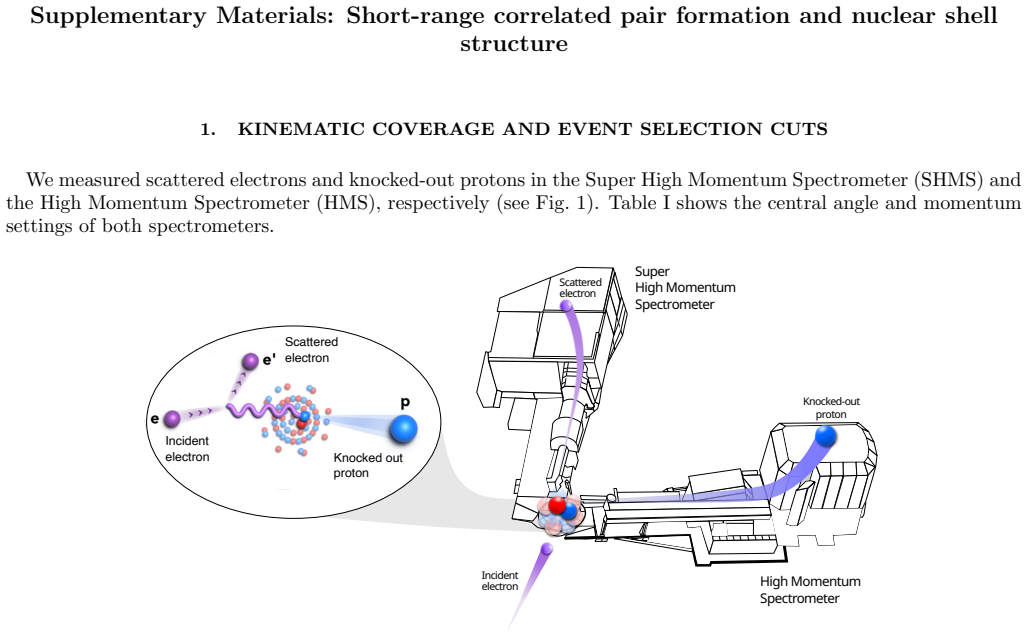
KINEMA TIC COVERAGE AND EVENT SELECTION CUTS We measured scattered electrons and knocked-out protons in the Super High Momentum Spectrometer (SHMS) and the High Momentum Spectrometer (HMS), respectively (see Fig. 1). Table I shows the central angle and momentum settings of both spectrometers. Incident electron Incident electron Scattered electron Knocked-...
-
[40]
48Ca” target contained 10% 40Ca. This contribution was measured using the 40Ca target and subtracted from the “ 48Ca
T ARGET INFORMA TION The target information is summarized in Table 2. The boron targets were made of B 4C. The C contribution was measured using the C target and subtracted from the B 4C data to get the B results. The “ 48Ca” target contained 10% 40Ca. This contribution was measured using the 40Ca target and subtracted from the “ 48Ca” target data to get ...
-
[41]
RADIA TIVE AND TRANSP ARENCY CORRECTIONS We calculated the ratio of the radiative corrections (R A/RC) and transparency corrections (T A/TC) for different nuclei relative to 12C and applied these corrections to the measured cross section ratios, see Table III. Ratio RA/RC TA/TC 9Be/C 1.00±0.02 1.17±0.05 10B/C 1.00±0.02 1.09±0.02 11B/C 1.00±0.02 1.04±0.02 ...
-
[42]
A total of 10,000 cut sets were generated
CUT V ARIA TION The values of the cuts applied to both the kinematic variables and the collimator apertures were randomly sampled from Gaussian distributions with the mean and correspondingσfor each variable listed in Table IV. A total of 10,000 cut sets were generated. For each set, the cross-section ratio was calculated. The 10,000 resulting ratios yiel...
-
[43]
SUMMAR Y OF UNCER T AINTIES 6 Cut variables Means ±σ P min miss (GeV/c) 0.375 ±0.0125 P max miss (GeVc) 0.7 ±0.05 xmin bj 1.2 ±0.05 θmax rq (deg) 40 ±2 Q2,min (GeV2/c2) 1.8 ±0.05 HMS Collimator Size ±4% SHMS Collimator Size ±4% TABLE IV: The mean values and standard deviations of the Gaussian distributions for the cut variations. Ratio δrad(%) δcut (%) δt...
discussion (0)
Sign in with ORCID, Apple, or X to comment. Anyone can read and Pith papers without signing in.