A Finite-Lattice Model from a Reciprocal Cost Action: Spectral and Reflection-Positivity Properties
Pith reviewed 2026-06-27 19:32 UTC · model grok-4.3
The pith
A reciprocal cost bond potential yields reflection positivity after restricting fields to a finite alphabet, but the continuous version fails the Bochner test.
A machine-rendered reading of the paper's core claim, the machinery that carries it, and where it could break.
Core claim
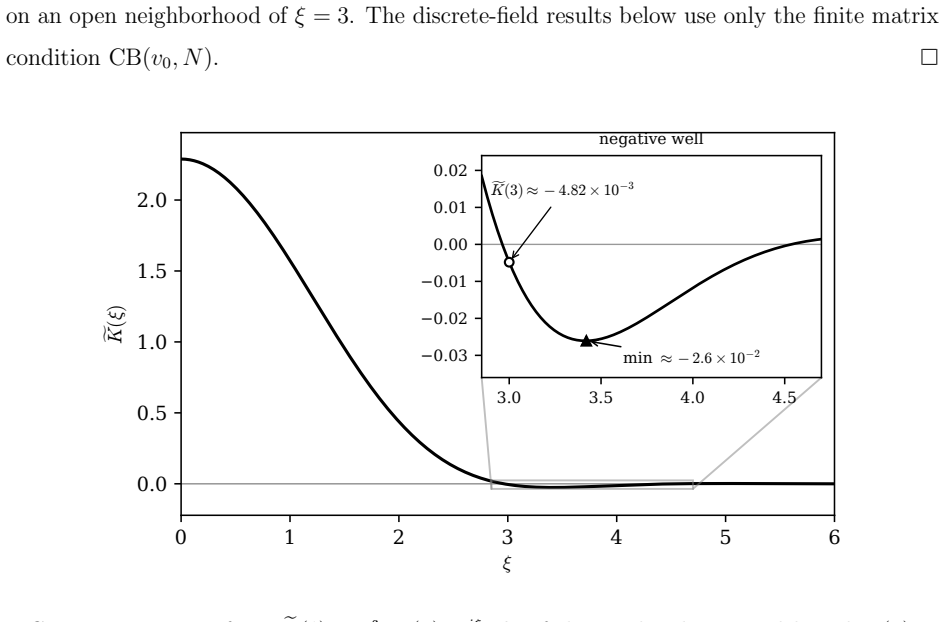
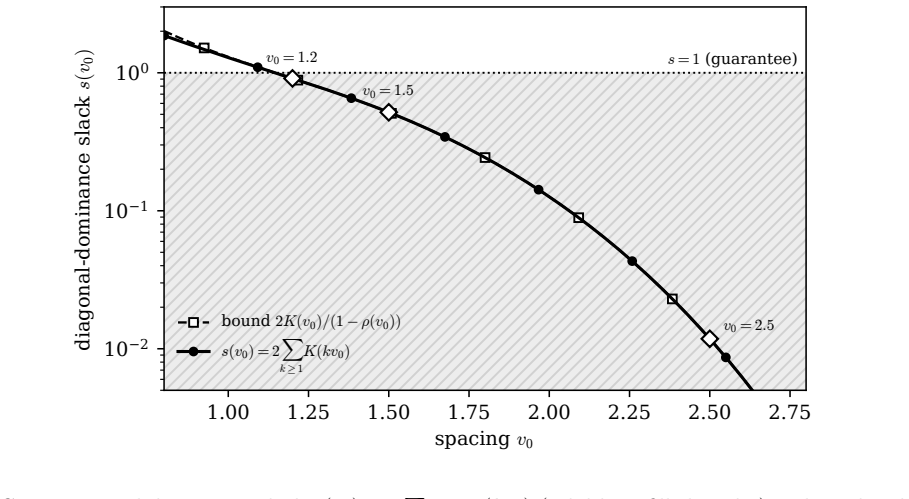
For the continuous noncompact model the natural temporal kernel K(u) = exp[−(cosh u − 1)] fails the Bochner positive-definiteness test because an interval-certified quadrature gives ilde K(3) < 0, obstructing the standard route to reflection positivity; for the finite-alphabet variant with field values restricted to Φ = v0{−N, …, N}, the Toeplitz matrix (K_Φ(v0,N))_{a,b} := K(b − a) is positive semidefinite for v0 ∈ {1.2, 1.5, 2.5} by a rigorous diagonal-dominance certificate uniform in N, so the one-step transfer operator is positive and self-adjoint in the reflection-positivity inner product.
What carries the argument
The finite crossing-bond Toeplitz matrix (K_Φ(v0,N))_{a,b} := K(b − a) whose positive semidefiniteness, established by diagonal dominance, certifies reflection positivity for the discrete model.
If this is right
- The one-step transfer operator is positive and self-adjoint in an explicit reflection-positivity inner product.
- Reflection positivity holds uniformly in lattice size N for the chosen v0 scalings.
- The construction applies directly to finite boxes in Z^3 × Z/8Z with the given bond action.
Where Pith is reading between the lines
- The same diagonal-dominance test could be applied to other v0 values to map the region where positivity holds.
- The continuous-model failure suggests that additional regularization or compactification may be needed before attempting a continuum limit.
- The finite-alphabet restriction might be replaced by a soft cutoff whose effect on the transfer operator could be bounded.
Load-bearing premise
The bond potential is uniquely selected as the reciprocal cost by the d'Alembert functional equation under the stated regularity and calibration assumptions.
What would settle it
An explicit numerical check that either the Fourier transform ilde K(3) is nonnegative or that the Toeplitz matrix for one of the listed v0 values has a negative eigenvalue.
Figures
read the original abstract
We study the finite-lattice statistical-mechanical model whose nearest-neighbor bond potential is the reciprocal cost $J(e^\varepsilon)=\cosh\varepsilon-1$, selected by the d'Alembert functional equation under the stated regularity and calibration assumptions. The structural inputs are stated explicitly; once they are fixed, the analysis is rigorous mathematics about the bond action $V(\Delta\phi)=\cosh(\Delta\phi)-1$ on finite boxes in $\mathbb Z^3\times\mathbb Z/8\mathbb Z$. Our main result pairs a negative and a positive statement about reflection positivity. For the continuous noncompact model the natural temporal kernel $K(u)=\exp[-(\cosh u-1)]$ fails the Bochner positive-definiteness test: an interval-certified quadrature gives $\widetilde K(3)<0$. Thus the standard Bochner route to Osterwalder-Schrader reflection positivity is obstructed. For a finite-alphabet variant, with field values restricted to a finite symmetric set $\Phi=v_0\{-N,\ldots,N\}$, reflection positivity holds whenever the finite crossing-bond Toeplitz matrix $(K_{\Phi(v_0,N)})_{a,b}:=K(b-a), a,b\in\Phi$, is positive semidefinite. For $v_0\in\{1.2,1.5,2.5\}$, this is discharged by a rigorous diagonal-dominance certificate uniform in $N$, and the associated one-step transfer operator is then positive and self-adjoint in an explicit reflection-positivity inner product. These finite-volume results do not provide a continuum Wightman theory, Osterwalder-Schrader reconstruction, LSZ scattering, or a continuum mass gap.
Editorial analysis
A structured set of objections, weighed in public.
Referee Report
Summary. The manuscript studies a finite-lattice model on ℤ^{3} imes ℤ/8ℤ whose nearest-neighbor bond potential is fixed to V(Δϕ) = cosh(Δϕ) − 1 by the d'Alembert functional equation under stated regularity and calibration assumptions. It asserts two main results: (i) the continuous non-compact temporal kernel K(u) = exp[−(cosh u − 1)] fails Bochner positive-definiteness, certified by an interval quadrature yielding ilde K(3) < 0; (ii) for the finite-alphabet restriction Φ = v_{0}{−N, …, N} with v_{0} ∈ {1.2, 1.5, 2.5}, the associated Toeplitz matrix K_Φ is positive semidefinite by a rigorous diagonal-dominance argument uniform in N, so that the one-step transfer operator is positive and self-adjoint in the reflection-positivity inner product. All claims are confined to finite volume; no continuum reconstruction or mass gap is claimed.
Significance. If the stated certificates are supplied and correct, the work supplies an explicit, verifiable counter-example to Bochner positivity for this kernel together with a constructive recovery of reflection positivity under finite truncation. The use of interval-certified quadrature and a uniform diagonal-dominance proof are concrete strengths that allow direct checking rather than reliance on numerics alone. The significance remains limited by the model's construction via a specific functional equation and the explicit restriction to finite alphabet, both of which are presented as modeling choices rather than derivations forced by independent physical principles.
major comments (2)
- [Abstract] Abstract: the negative claim rests on an 'interval-certified quadrature' giving ilde K(3) < 0, yet the manuscript supplies neither the explicit quadrature rule, the interval-arithmetic library, nor the numerical bounds obtained. Because this certificate is the sole evidence that Bochner positivity fails, its details are load-bearing and must be exhibited (or referenced to a verifiable appendix) before the claim can be accepted.
- [Abstract] Abstract: the positive claim for v_{0} ∈ {1.2, 1.5, 2.5} is discharged by a 'rigorous diagonal-dominance certificate uniform in N,' but the text does not indicate where the explicit bound on the off-diagonal entries of K_Φ (or the verification that the diagonal term dominates for every N) appears. Since this certificate is the sole support for reflection positivity and the existence of the positive self-adjoint transfer operator, the proof must be supplied in full.
minor comments (1)
- [Abstract] The notation ilde K for the Bochner transform (or Fourier transform) of the kernel is used without an explicit definition in the abstract; a one-sentence definition should be added on first use.
Simulated Author's Rebuttal
We thank the referee for the careful reading and for identifying the need to make the certificates fully explicit and verifiable. We agree that both the interval quadrature details and the diagonal-dominance proof must be exhibited in the manuscript and will supply them in the revision.
read point-by-point responses
-
Referee: [Abstract] Abstract: the negative claim rests on an 'interval-certified quadrature' giving ilde K(3) < 0, yet the manuscript supplies neither the explicit quadrature rule, the interval-arithmetic library, nor the numerical bounds obtained. Because this certificate is the sole evidence that Bochner positivity fails, its details are load-bearing and must be exhibited (or referenced to a verifiable appendix) before the claim can be accepted.
Authors: We agree that the quadrature certificate must be fully documented. In the revised version we will add an appendix containing the explicit quadrature rule (a validated interval method with the precise nodes and weights), the interval-arithmetic library employed, and the computed enclosure showing ilde K(3) < 0 together with the rigorous error bound. revision: yes
-
Referee: [Abstract] Abstract: the positive claim for v_{0} ∈ {1.2, 1.5, 2.5} is discharged by a 'rigorous diagonal-dominance certificate uniform in N,' but the text does not indicate where the explicit bound on the off-diagonal entries of K_Φ (or the verification that the diagonal term dominates for every N) appears. Since this certificate is the sole support for reflection positivity and the existence of the positive self-adjoint transfer operator, the proof must be supplied in full.
Authors: We accept that the location and content of the diagonal-dominance argument must be stated explicitly. The revised manuscript will include a dedicated section (or appendix) that presents the full uniform-in-N proof: the explicit upper bound on the off-diagonal entries of the Toeplitz matrix K_Φ, the comparison with the diagonal term for each listed v_{0}, and the verification that the resulting matrix is positive semidefinite for all N. revision: yes
Circularity Check
No circularity: results are direct mathematical assertions on explicitly fixed inputs.
full rationale
The paper states that the bond potential is fixed by the d'Alembert functional equation under stated regularity and calibration assumptions, then performs rigorous analysis (Bochner test failure via quadrature, diagonal-dominance certificate for Toeplitz matrices) on the resulting finite-alphabet model. No equation reduces a claimed positivity or negativity result to a fitted parameter or self-referential definition. The finite-alphabet restriction and specific v0 values are explicit modeling choices, not derived outputs. No self-citations are load-bearing for the central claims, and the derivation chain is self-contained once the structural inputs are granted.
Axiom & Free-Parameter Ledger
axioms (1)
- domain assumption regularity and calibration assumptions under which the d'Alembert functional equation selects J(e^ε)=coshε−1
Reference graph
Works this paper leans on
-
[1]
Uniqueness of the Canonical Reciprocal Cost
J. Washburn and M. Zlatanovi\'c, ``Uniqueness of the canonical reciprocal cost,'' Mathematics 14, 935 (2026), doi:10.3390/math14060935 https://doi.org/10.3390/math14060935; preprint arXiv:2602.05753 https://arxiv.org/abs/2602.05753
-
[2]
J. Washburn and A. Rahnamai Barghi, ``The coercive projection theorem for canonical reciprocal costs,'' arXiv:2603.20205 https://arxiv.org/abs/2603.20205 (2026)
arXiv 2026
-
[3]
S. Pardo-Guerra, A. Thapa, M. Simons, and J. Washburn, ``Coherent comparison as information cost: axiomatic foundations for discrete ledger dynamics,'' Foundations 6(2), 17 (2026), doi:10.3390/foundations6020017 https://doi.org/10.3390/foundations6020017
-
[4]
Acz\'el, Lectures on Functional Equations and Their Applications (Academic Press, New York, 1966)
J. Acz\'el, Lectures on Functional Equations and Their Applications (Academic Press, New York, 1966)
1966
-
[5]
The d'Alembert Inevitability Theorem
J. Washburn, M. Zlatanovi\'c, and E. Allahyarov, ``The d'Alembert inevitability theorem,'' Mathematics 14, 1386 (2026), doi:10.3390/math14081386 https://doi.org/10.3390/math14081386; preprint arXiv:2603.16237 https://arxiv.org/abs/2603.16237
work page internal anchor Pith review Pith/arXiv arXiv doi:10.3390/math14081386 2026
-
[6]
G. N. Watson, A Treatise on the Theory of Bessel Functions, 2nd ed. (Cambridge University Press, Cambridge, 1944), 6.22
1944
-
[7]
NIST Digital Library of Mathematical Functions, https://dlmf.nist.gov/ https://dlmf.nist.gov/, Release 1.2.6 of 2026-03-15, edited by F. W. J. Olver, A. B. Olde Daalhuis, D. W. Lozier, B. I. Schneider, R. F. Boisvert, C. W. Clark, B. R. Miller, B. V. Saunders, H. S. Cohl, and M. A. McClain; 10.32, https://dlmf.nist.gov/10.32 https://dlmf.nist.gov/10.32 (a...
2026
-
[8]
Osterwalder and R
K. Osterwalder and R. Schrader, ``Axioms for Euclidean Green's functions,'' Commun. Math. Phys. 31, 83 (1973)
1973
-
[9]
Osterwalder and R
K. Osterwalder and R. Schrader, ``Axioms for Euclidean Green's functions. II,'' Commun. Math. Phys. 42, 281 (1975)
1975
-
[10]
Fr\"ohlich, R
J. Fr\"ohlich, R. Israel, E. H. Lieb, and B. Simon, ``Phase transitions and reflection positivity. I. General theory and long range lattice models,'' Commun. Math. Phys. 62(1), 1 (1978)
1978
-
[11]
Glimm and A
J. Glimm and A. Jaffe, Quantum Physics: A Functional Integral Point of View, 2nd ed. (Springer, New York, 1987)
1987
-
[12]
M. Biskup, ``Reflection positivity and phase transitions in lattice spin models,'' in Methods of Contemporary Mathematical Statistical Physics, Lecture Notes in Mathematics Vol. 1970, edited by R. Koteck\'y (Springer, Berlin, 2009), pp. 1--86, arXiv:math-ph/0610025 https://arxiv.org/abs/math-ph/0610025
Pith/arXiv arXiv 1970
-
[13]
Osterwalder and E
K. Osterwalder and E. Seiler, ``Gauge field theories on a lattice,'' Ann. Phys. 110(2), 440 (1978)
1978
-
[14]
Simon, The Statistical Mechanics of Lattice Gases, Volume I (Princeton University Press, Princeton, NJ, 1993)
B. Simon, The Statistical Mechanics of Lattice Gases, Volume I (Princeton University Press, Princeton, NJ, 1993)
1993
-
[15]
Georgii, Gibbs Measures and Phase Transitions, 2nd ed., De Gruyter Studies in Mathematics Vol
H.-O. Georgii, Gibbs Measures and Phase Transitions, 2nd ed., De Gruyter Studies in Mathematics Vol. 9 (de Gruyter, Berlin, 2011), doi:10.1515/9783110250329 https://doi.org/10.1515/9783110250329
-
[16]
Cambridge University Press, 2017
S. Friedli and Y. Velenik, Statistical Mechanics of Lattice Systems: A Concrete Mathematical Introduction (Cambridge University Press, Cambridge, 2017), doi:10.1017/9781316882603 https://doi.org/10.1017/9781316882603
-
[17]
J. L. Lebowitz and E. Presutti, ``Statistical mechanics of systems of unbounded spins,'' Commun. Math. Phys. 50(3), 195 (1976)
1976
-
[18]
A. M. Gleason, ``Measures on the closed subspaces of a Hilbert space,'' J. Math. Mech. 6(6), 885 (1957)
1957
-
[19]
Busch, ``Quantum states and generalized observables: a simple proof of Gleason's theorem,'' Phys
P. Busch, ``Quantum states and generalized observables: a simple proof of Gleason's theorem,'' Phys. Rev. Lett. 91(12), 120403 (2003), arXiv:quant-ph/9909073 https://arxiv.org/abs/quant-ph/9909073
Pith/arXiv arXiv 2003
-
[20]
W. H. Zurek, ``Probabilities from entanglement, Born's rule p_k=| _k|^2 from envariance,'' Phys. Rev. A 71(5), 052105 (2005), arXiv:quant-ph/0405161 https://arxiv.org/abs/quant-ph/0405161
Pith/arXiv arXiv 2005
-
[21]
Wallace, The Emergent Multiverse: Quantum Theory according to the Everett Interpretation (Oxford University Press, Oxford, 2012)
D. Wallace, The Emergent Multiverse: Quantum Theory according to the Everett Interpretation (Oxford University Press, Oxford, 2012)
2012
-
[22]
Reed and B
M. Reed and B. Simon, Methods of Modern Mathematical Physics, Volume II: Fourier Analysis, Self-Adjointness (Academic Press, New York, 1975)
1975
-
[23]
R. A. Horn and C. R. Johnson, Matrix Analysis, 2nd ed. (Cambridge University Press, Cambridge, 2013)
2013
-
[24]
Johansson, ``Arb: efficient arbitrary-precision midpoint-radius interval arithmetic,'' IEEE Trans
F. Johansson, ``Arb: efficient arbitrary-precision midpoint-radius interval arithmetic,'' IEEE Trans. Comput. 66(8), 1281 (2017)
2017
discussion (0)
Sign in with ORCID, Apple, or X to comment. Anyone can read and Pith papers without signing in.