A New Route to the Annihilation of Multi-Wall String Topological Configurations
Pith reviewed 2026-06-27 19:36 UTC · model grok-4.3
The pith
Small bare masses of right-handed neutrinos generate a bias that annihilates domain-wall networks attached to cosmic strings.
A machine-rendered reading of the paper's core claim, the machinery that carries it, and where it could break.
Core claim
In a majoron framework where gravitational effects reduce a global U(1) to a discrete subgroup, a wall-string network forms. The small bare masses of the right-handed neutrinos induce radiative corrections that generate a temperature-dependent bias; this bias is responsible for triggering the annihilation of the domain-wall network before it can dominate the cosmic energy density.
What carries the argument
The temperature-dependent bias generated by radiative corrections from the small bare mass term of right-handed neutrinos coupled to the majoron scalar.
If this is right
- The domain-wall network annihilates before dominating the cosmic energy density.
- Constraints from Big Bang Nucleosynthesis on domain walls are satisfied in models with this bias.
- The mechanism operates for the simplest continuous global symmetry, U(1).
- Annihilation is triggered specifically by the bare masses of the right-handed neutrinos.
Where Pith is reading between the lines
- The same bias mechanism could operate in other global-symmetry models containing fermions with small explicit mass terms.
- Annihilation timing might leave a distinct imprint on the gravitational-wave spectrum produced by the network.
- The required mass scale for the bias could be confronted with laboratory bounds on neutrino masses.
Load-bearing premise
Radiative corrections induced by the small bare mass term of the fermion generate a temperature-dependent bias that is both present and large enough to drive annihilation of the domain-wall network before it dominates the cosmic energy density.
What would settle it
A calculation demonstrating that the induced bias remains too weak to annihilate the walls prior to their domination of the energy density, or direct cosmological evidence for persistent multi-wall networks at late times.
Figures

read the original abstract
Particle physics models beyond the Standard Model often contain global symmetries to address various unanswered questions. However, a common criticism of theories based on global symmetries is that such symmetries are generally expected to be explicitly violated by gravitational effects at the Planck scale. In the case of a global $U(1)$ symmetry, this explicit breaking can reduce the symmetry to a discrete subgroup of $U(1)$, leading to the formation of cosmic strings attached to multiple domain walls (DWs). These DWs are usually cosmologically problematic, since their slow scaling behavior can eventually dominate the energy density of the Universe, giving rise to the well-known cosmological DW problem, which is strongly constrained by Big Bang Nucleosynthesis. In this letter, we propose a new annihilation mechanism of such DWs in theories with the simplest continuous global symmetry, $U(1)$, in the presence of gravitational effects. The mechanism is as follows: if a fermion coupled to the symmetry-breaking scalar possesses a small bare mass term, radiative corrections can generate a temperature-dependent bias for triggering DW annihilation. As a representative example, we study a majoron framework containing right-handed neutrinos with small bare mass terms, in which a wall-string network can arise once gravitational effects are taken into account. Within this setup, we show that the small bare masses of the right-handed neutrinos provide the origin of the bias responsible for triggering the annihilation of the DW network.
Editorial analysis
A structured set of objections, weighed in public.
Referee Report
Summary. The paper claims that gravitational Planck-scale effects reduce a global U(1) to a discrete subgroup, producing string-wall networks in a majoron model with right-handed neutrinos; a small bare Majorana mass for the neutrinos then induces, via one-loop radiative corrections, a temperature-dependent bias in the majoron potential that explicitly breaks the residual discrete symmetry and drives annihilation of the multi-wall network before it dominates the cosmic energy density, thereby solving the cosmological domain-wall problem.
Significance. If demonstrated, the result would supply a mechanism for evading the domain-wall problem that relies only on the existing small neutrino mass parameters already present in the model, without additional fields or ad-hoc potentials. The approach is conceptually economical and directly addresses a long-standing issue in global-symmetry extensions of the Standard Model.
major comments (2)
- [Abstract and mechanism description] Abstract and mechanism description: the assertion that radiative corrections from the small bare mass term generate a temperature-dependent bias sufficient to annihilate the domain-wall network is presented without any derivation of the finite-temperature effective potential, extraction of the bias coefficient, or comparison of its magnitude against the wall tension times the Hubble scale at T ≳ 1 MeV. The central claim therefore rests on an undemonstrated assertion.
- [Parameter choice for the bias] Parameter choice for the bias: the bare masses are introduced with values selected so that the resulting bias triggers annihilation at the required epoch; a concrete test would be to compute the one-loop bias term explicitly and verify that it exceeds the critical value for annihilation without tuning the mass parameter to that specific scale.
Simulated Author's Rebuttal
We thank the referee for the careful reading of our manuscript and the constructive comments. We agree that the central mechanism requires a more explicit quantitative demonstration and will revise the manuscript accordingly to include the requested derivations and comparisons.
read point-by-point responses
-
Referee: [Abstract and mechanism description] Abstract and mechanism description: the assertion that radiative corrections from the small bare mass term generate a temperature-dependent bias sufficient to annihilate the domain-wall network is presented without any derivation of the finite-temperature effective potential, extraction of the bias coefficient, or comparison of its magnitude against the wall tension times the Hubble scale at T ≳ 1 MeV. The central claim therefore rests on an undemonstrated assertion.
Authors: We acknowledge that the current manuscript presents the bias mechanism at a schematic level without a full derivation of the finite-temperature one-loop effective potential or a direct numerical comparison to the wall tension times Hubble scale. In the revised version we will add an explicit calculation of the temperature-dependent bias term arising from the small bare Majorana masses, derive its coefficient, and compare its magnitude against the critical value required for network annihilation at T ≳ 1 MeV, thereby substantiating the claim. revision: yes
-
Referee: [Parameter choice for the bias] Parameter choice for the bias: the bare masses are introduced with values selected so that the resulting bias triggers annihilation at the required epoch; a concrete test would be to compute the one-loop bias term explicitly and verify that it exceeds the critical value for annihilation without tuning the mass parameter to that specific scale.
Authors: We agree that an explicit verification is needed. In the revision we will compute the one-loop bias term using the bare mass values already fixed by the observed neutrino masses and demonstrate that the resulting bias exceeds the annihilation threshold at the relevant epoch, showing that no additional tuning beyond the existing small-mass parameters is required. revision: yes
Circularity Check
Annihilation 'shown' via bias from small bare masses whose values are selected to satisfy the cosmological requirement
specific steps
-
fitted input called prediction
[Abstract]
"Within this setup, we show that the small bare masses of the right-handed neutrinos provide the origin of the bias responsible for triggering the annihilation of the DW network."
The annihilation is asserted to follow from the bias generated by the small bare masses. Those masses are model inputs whose values are tuned small enough for the bias to be both present and large enough to drive annihilation prior to domination; the claimed result is therefore forced by the choice of those inputs rather than an independent derivation from external constraints or benchmarks.
full rationale
The paper's central result is that small bare Majorana masses for right-handed neutrinos generate, via radiative corrections, a temperature-dependent bias that annihilates the DW network before it dominates. This is presented as a derived mechanism in the abstract. However, the masses are introduced as free parameters whose smallness is chosen precisely so that the induced bias is parametrically sufficient. No independent benchmark or first-principles calculation fixes their magnitude; the outcome therefore reduces to the input choice rather than emerging externally. This matches the fitted-input-called-prediction pattern. The remainder of the setup (gravitational explicit breaking to discrete symmetry, formation of wall-string network) is standard and does not itself create circularity.
Axiom & Free-Parameter Ledger
free parameters (1)
- bare mass of right-handed neutrinos
axioms (2)
- domain assumption Gravitational effects at the Planck scale explicitly break global U(1) symmetries down to discrete subgroups
- ad hoc to paper Radiative corrections from a small bare fermion mass generate a temperature-dependent bias on domain walls
Reference graph
Works this paper leans on
-
[1]
(15) also exactly cancels, i.e
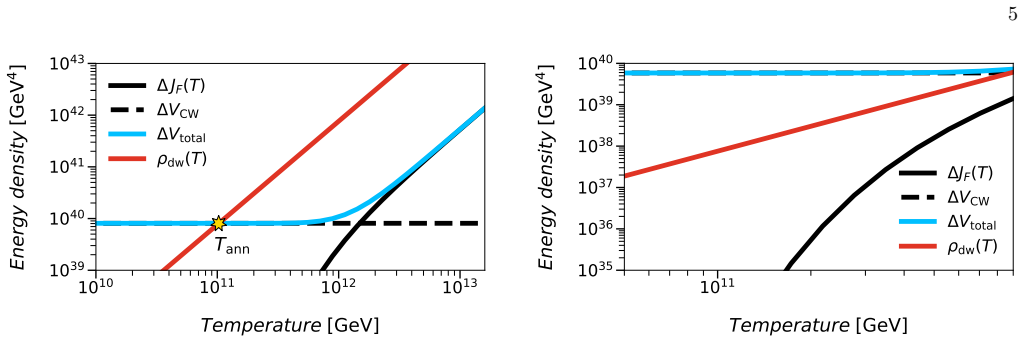
Furthermore, the contribution arising from the second term in Eq. (15) also exactly cancels, i.e. (V majoron|k1 − Vmajoron|k2) = 0, since the argument of the cosine in Eq. (5) is given bynχ/v, while the vacua are located at χ= 2πkv/n. Consequently, cos(nχ/v) = cos(2πk) = 1 5 1010 1011 1012 1013 Temperature [GeV] 1039 1040 1041 1042 1043 Energy density [Ge...
-
[2]
T. W. B. Kibble, J. Phys. A9, 1387 (1976)
1976
-
[3]
Vilenkin and A
A. Vilenkin and A. E. Everett, Phys. Rev. Lett.48, 1867 (1982)
1982
-
[4]
E. B. Bogomolny, Sov. J. Nucl. Phys.24, 449 (1976)
1976
-
[5]
’t Hooft, Nucl
G. ’t Hooft, Nucl. Phys. B79, 276 (1974)
1974
-
[6]
A. M. Polyakov, JETP Lett.20, 194 (1974)
1974
-
[7]
Nambu, Nucl
Y. Nambu, Nucl. Phys. B130, 505 (1977)
1977
-
[8]
T. W. B. Kibble and T. Vachaspati, J. Phys. G42, 094002 (2015), arXiv:1506.02022 [astro-ph.CO]
Pith/arXiv arXiv 2015
-
[9]
I. Z. Rothstein, K. S. Babu, and D. Seckel, Nucl. Phys. B403, 725 (1993), arXiv:hep-ph/9301213
Pith/arXiv arXiv 1993
-
[10]
Turok, Phys
N. Turok, Phys. Rev. Lett.63, 2625 (1989)
1989
-
[11]
D. P. Bennett and S. H. Rhie, Phys. Rev. Lett.65, 1709 (1990)
1990
-
[12]
Y. B. Zeldovich, I. Y. Kobzarev, and L. B. Okun, Zh. Eksp. Teor. Fiz.67, 3 (1974)
1974
-
[13]
L. F. Abbott and M. B. Wise, Nucl. Phys. B325, 687 (1989)
1989
-
[14]
G. B. Gelmini, M. Gleiser, and E. W. Kolb, Phys. Rev. D39, 1558 (1989)
1989
-
[15]
S. E. Larsson, S. Sarkar, and P. L. White, Phys. Rev. D 55, 5129 (1997), arXiv:hep-ph/9608319. 8
Pith/arXiv arXiv 1997
-
[16]
S. Chang, C. Hagmann, and P. Sikivie, Phys. Rev. D 59, 023505 (1999), arXiv:hep-ph/9807374
Pith/arXiv arXiv 1999
-
[17]
Vilenkin and E
A. Vilenkin and E. P. S. Shellard,Cosmic Strings and Other Topological Defects(Cambridge University Press, 2000)
2000
- [18]
-
[19]
Q.-Q. Zeng, X. He, Z.-H. Yu, and J. Zheng, Phys. Rev. D111, 115017 (2025), arXiv:2501.10059 [hep-ph]
arXiv 2025
- [20]
- [21]
-
[22]
D. Bhandari, D. Borah, and I. Saha, (2026), arXiv:2604.02421 [hep-ph]
Pith/arXiv arXiv 2026
- [23]
-
[24]
Chikashige, R
Y. Chikashige, R. N. Mohapatra, and R. D. Peccei, Phys. Lett. B98, 265 (1981)
1981
-
[25]
Minkowski, Phys
P. Minkowski, Phys. Lett. B67, 421 (1977)
1977
-
[26]
Yanagida, inProceedings of the Workshop on the Uni- fied Theory and the Baryon Number in the Universe, edited by O
T. Yanagida, inProceedings of the Workshop on the Uni- fied Theory and the Baryon Number in the Universe, edited by O. Sawada and A. Sugamoto (Tsukuba, Japan,
-
[27]
Gell-Mann, P
M. Gell-Mann, P. Ramond, and R. Slansky, inSupergrav- ity, edited by P. van Nieuwenhuizen and D. Z. Freedman (North-Holland, Amsterdam, 1979) pp. 315–321
1979
-
[28]
S. L. Glashow, inQuarks and Leptons, Cargese Summer Institute(Plenum Press, New York, 1980) p. 687
1980
-
[29]
R. N. Mohapatra and G. Senjanovic, Phys. Rev. Lett. 44, 912 (1980)
1980
-
[30]
Schechter and J
J. Schechter and J. W. F. Valle, Phys. Rev. D22, 2227 (1980)
1980
-
[31]
Georgi and S
H. Georgi and S. L. Glashow, Phys. Rev. D23, 783 (1981)
1981
-
[32]
Preskill, S
J. Preskill, S. P. Trivedi, F. Wilczek, and M. B. Wise, Nucl. Phys. B363, 207 (1991)
1991
- [33]
- [34]
-
[35]
J. Preskill and A. Vilenkin, Phys. Rev. D47, 2324 (1993), arXiv:hep-ph/9209210
Pith/arXiv arXiv 1993
- [36]
- [37]
-
[38]
Berbig, (2025), arXiv:2506.02910 [hep-ph]
M. Berbig, (2025), arXiv:2506.02910 [hep-ph]
Pith/arXiv arXiv 2025
-
[39]
S. B. Giddings and A. Strominger, Nucl. Phys. B307, 854 (1988)
1988
-
[40]
B. Heidenreich, J. McNamara, M. Montero, M. Reece, T. Rudelius, and I. Valenzuela, JHEP11, 053 (2021), arXiv:2012.00009 [hep-th]
arXiv 2021
-
[41]
Reece, PoST ASI2022, 008 (2024), arXiv:2304.08512 [hep-ph]
M. Reece, PoST ASI2022, 008 (2024), arXiv:2304.08512 [hep-ph]
arXiv 2024
-
[42]
S. R. Coleman and E. J. Weinberg, Phys. Rev. D7, 1888 (1973)
1973
-
[43]
G. B. Gelmini, S. Pascoli, E. Vitagliano, and Y.-L. Zhou, JCAP02, 032 (2021), arXiv:2009.01903 [hep-ph]
arXiv 2021
- [44]
-
[45]
T. Hiramatsu, M. Kawasaki, K. Saikawa, and T. Sekiguchi, JCAP01, 001 (2013), arXiv:1207.3166 [hep-ph]
Pith/arXiv arXiv 2013
- [46]
-
[47]
Y.-J. Li, J. Liu, and Z.-K. Guo, Phys. Rev. D112, 103510 (2025), arXiv:2502.13644 [astro-ph.CO]
arXiv 2025
-
[48]
A. Mariotti, X. Nagels, A. Rase, and M. Vanvlasselaer, JHEP03, 199 (2025), arXiv:2411.13494 [hep-ph]
arXiv 2025
discussion (0)
Sign in with ORCID, Apple, or X to comment. Anyone can read and Pith papers without signing in.