GeoGNN: Time Series Geo-Localization using Two-Tower Graph Neural Networks
Pith reviewed 2026-06-27 20:07 UTC · model grok-4.3
The pith
A two-tower graph neural network learns geographic cell embeddings from adjacency graphs and matches them to time series representations to infer recording locations.
A machine-rendered reading of the paper's core claim, the machinery that carries it, and where it could break.
Core claim
GeoGNN is a two-tower architecture in which the spatial tower produces embeddings for candidate geographic cells by running a graph neural network over the geographic adjacency graph, while the temporal tower extracts representations from each input time series; at inference time each temporal representation is scored against the cell embeddings by dot-product similarity, and an auxiliary classification head is added, to predict the geographic origin of the time series.
What carries the argument
Two-tower model whose spatial tower embeds geographic cells via a graph neural network on the adjacency graph and whose temporal tower encodes time series, with matching performed by dot-product similarity plus a classification head.
If this is right
- Time series acquire usable spatial context that enables location-aware downstream applications.
- The two-tower matching approach outperforms adapted image-geolocalization baselines on large-scale electricity data.
- Both fine-grained and coarse-grained geolocalization accuracy improve by roughly 27 percent on average across the tested countrywide datasets.
- Dot-product similarity between temporal representations and graph-derived cell embeddings, when combined with classification, suffices to rank geographic origins.
Where Pith is reading between the lines
- The same separation of spatial graph embedding and temporal encoding could be tested on other spatially distributed time series such as traffic or environmental sensor data, provided an adjacency graph can be defined.
- Varying the resolution of the geographic cells would reveal how sensitive the accuracy gain is to the granularity of the adjacency graph.
- If the method succeeds, it indicates that graph-based spatial priors can transfer to embedding-matching tasks that do not involve images.
Load-bearing premise
The geographic adjacency graph supplies useful structure for embeddings that can be reliably matched to time series representations, and the electricity-consumption datasets are representative of the general time series geolocalization problem.
What would settle it
If removing the adjacency graph or replacing the geographic cell embeddings with random vectors produces equal or higher accuracy on the same electricity datasets, the claim that graph-derived structure drives the matching would be falsified.
Figures



read the original abstract
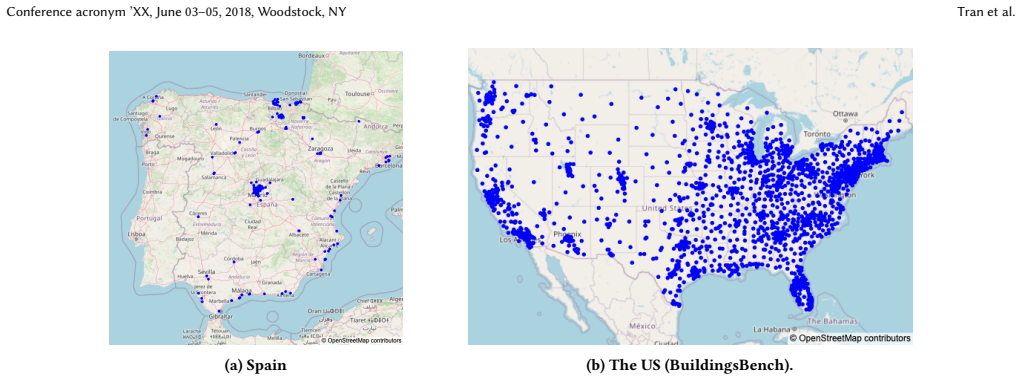
This paper investigates a novel concept of time series geolocalization, where the goal is to infer the geographic origin of each raw time series. Successful geolocalization can provide spatial context to time series, enabling downstream location-aware applications. We formalize the problem, adapt core ideas from image geolocalization to establish strong baselines, and propose GeoGNN, a two-tower architecture. During training, GeoGNN's spatial tower learns embeddings of geographic cell candidates by leveraging the geographic adjacency graph, while the temporal tower extracts informative representations from time series. During inference, each temporal representation is matched against candidate geographic embeddings using dot-product similarity, combined with an auxiliary classification head, to predict the time series' associated geographic origin. Experiments on large-scale, countrywide electricity-consumption datasets demonstrate that GeoGNN achieves the best performance across datasets and enhances both fine- and coarse-grained geolocalization accuracy by ~27% on average.
Editorial analysis
A structured set of objections, weighed in public.
Referee Report
Summary. The paper formalizes the time series geolocalization task of inferring geographic origin from raw time series. It adapts image geolocalization baselines and introduces GeoGNN, a two-tower architecture in which a spatial GNN tower learns embeddings of geographic cells from an adjacency graph while a temporal tower processes the time series; inference matches the towers via dot-product similarity augmented by an auxiliary classification head. Experiments on large-scale countrywide electricity-consumption datasets are claimed to show that GeoGNN attains the best performance and improves both fine- and coarse-grained accuracy by ~27% on average.
Significance. If the reported gains are reproducible and attributable to the geographic graph component, the work could enable new location-aware downstream tasks for time series. The two-tower design is a straightforward transfer from other modalities, but the manuscript supplies no machine-checked proofs, reproducible code, or parameter-free derivations that would strengthen the assessment.
major comments (2)
- [Experiments] Experiments section: the central claim of ~27% average improvement is stated without any description of baselines, dataset splits, number of runs, statistical tests, or validation procedures, rendering the performance result unverifiable.
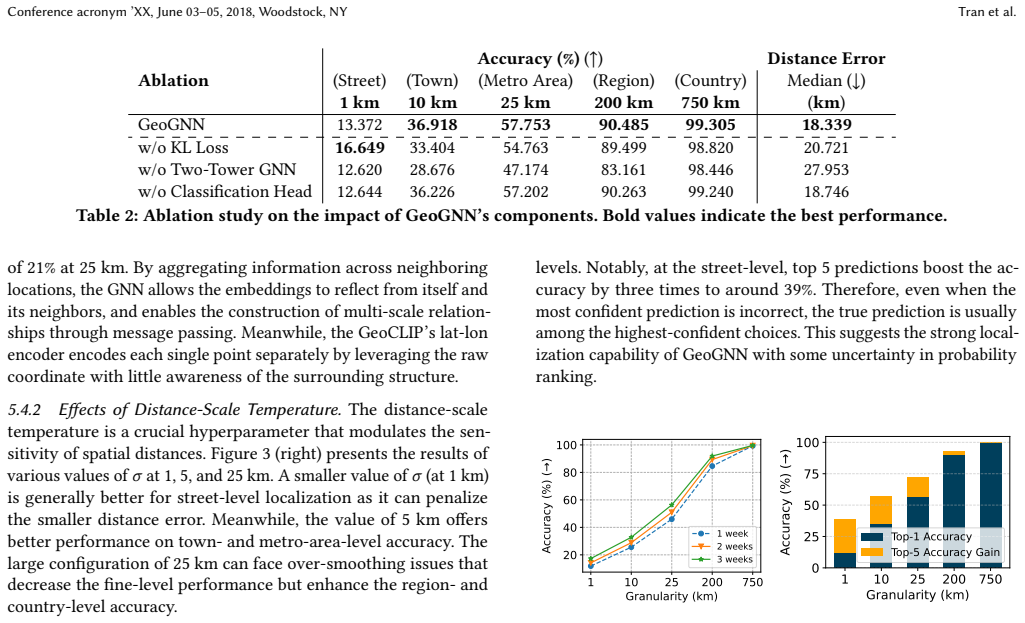
- [Method / Experiments] Method and Experiments sections: no ablation is reported that replaces the geographic adjacency graph with a random graph, removes edges, or substitutes a non-graph spatial encoder; without such controls it is impossible to confirm that the GNN on geographic structure (rather than the temporal tower plus classification head alone) drives the reported gains.
minor comments (1)
- [Abstract] Abstract: the datasets are described only as 'large-scale, countrywide electricity-consumption datasets' with no mention of the specific countries, sampling rates, or preprocessing.
Simulated Author's Rebuttal
We thank the referee for the detailed and constructive report. We address each major comment below and commit to revisions that will make the experimental claims verifiable and the contribution of the geographic graph explicit.
read point-by-point responses
-
Referee: Experiments section: the central claim of ~27% average improvement is stated without any description of baselines, dataset splits, number of runs, statistical tests, or validation procedures, rendering the performance result unverifiable.
Authors: We agree that the submitted manuscript lacks sufficient experimental detail. In the revision we will expand the Experiments section to fully specify the baselines (including the image-geolocalization adaptations mentioned in the abstract), train/validation/test splits, number of independent runs, statistical significance tests, and validation procedures. revision: yes
-
Referee: Method and Experiments sections: no ablation is reported that replaces the geographic adjacency graph with a random graph, removes edges, or substitutes a non-graph spatial encoder; without such controls it is impossible to confirm that the GNN on geographic structure (rather than the temporal tower plus classification head alone) drives the reported gains.
Authors: We concur that an ablation isolating the geographic graph is necessary. The revised manuscript will include new experiments that (i) replace the adjacency graph with a random graph of identical degree, (ii) remove edges, and (iii) substitute a non-graph spatial encoder (e.g., MLP or CNN on cell coordinates), thereby quantifying the contribution of the geographic structure. revision: yes
Circularity Check
No significant circularity in claimed derivation or results
full rationale
The paper presents an empirical ML method (two-tower GNN with geographic adjacency graph for spatial embeddings, temporal tower, dot-product matching plus auxiliary head) and reports measured accuracy gains on held-out electricity datasets. No equations or claims reduce a 'prediction' or result to a fitted parameter or input by construction. No self-citation chains or uniqueness theorems are invoked as load-bearing. The central performance numbers are external experimental outcomes, not definitional identities. This is the normal case of a self-contained empirical contribution.
Axiom & Free-Parameter Ledger
Reference graph
Works this paper leans on
-
[1]
Oluwaseun Ajao, Jun Hong, and Weiru Liu. 2015. A survey of location inference techniques on Twitter.Journal of Information Science41, 6 (Nov. 2015), 855–864. doi:10.1177/0165551515602847
-
[2]
Anderson and M
Oliver D. Anderson and M. G. Kendall. 1976. Time-Series. 2nd edn.The Statistician 25 (1976), 308. https://api.semanticscholar.org/CorpusID:134001785
1976
-
[3]
Abdul Fatir Ansari, Lorenzo Stella, Caner Turkmen, Xiyuan Zhang, Pedro Mercado, Huibin Shen, Oleksandr Shchur, Syama Sundar Rangapuram, Sebas- tian Pineda Arango, Shubham Kapoor, Jasper Zschiegner, Danielle C. Maddix, Hao Wang, Michael W. Mahoney, Kari Torkkola, Andrew Gordon Wilson, Michael Bohlke-Schneider, and Yuyang Wang. 2024. Chronos: Learning the L...
Pith/arXiv arXiv 2024
-
[4]
Defu Cao, Furong Jia, Sercan O Arik, Tomas Pfister, Yixiang Zheng, Wen Ye, and Yan Liu. 2024. TEMPO: Prompt-based Generative Pre-trained Transformer for Time Series Forecasting. InThe Twelfth International Conference on Learning Representations. https://openreview.net/forum?id=YH5w12OUuU
2024
-
[5]
Ching Chang, Wei-Yao Wang, Wen-Chih Peng, and Tien-Fu Chen. 2025. LLM4TS: Aligning Pre-Trained LLMs as Data-Efficient Time-Series Forecasters.ACM Trans. Intell. Syst. Technol.16, 3, Article 60 (April 2025), 20 pages. doi:10.1145/3719207
-
[6]
Mustafa Chasmai, Wuao Liu, Subhransu Maji, and Grant Van Horn. 2025. Audio Geolocation: A Natural Sounds Benchmark. arXiv:2505.18726 [cs.SD] https: //arxiv.org/abs/2505.18726
Pith/arXiv arXiv 2025
-
[7]
Lingqiu Chen, Hongzhou Chai, Naiquan Zheng, Min Wang, and Minzhi Xiang
-
[8]
Feasibility and performance evaluation of low-cost GNSS devices for sea level measurement based on GNSS-IR.Advances in Space Research72, 11 (2023), 4651–4662
2023
-
[9]
Zhiyuan Cheng, James Caverlee, and Kyumin Lee. 2010. You are where you tweet: a content-based approach to geo-locating twitter users. InProceedings of the 19th ACM International Conference on Information and Knowledge Management (Toronto, ON, Canada)(CIKM ’10). Association for Computing Machinery, New York, NY, USA, 759–768. doi:10.1145/1871437.1871535
-
[10]
Brandon Clark, Alec Kerrigan, Parth Parag Kulkarni, Vicente Vivanco Cepeda, and Mubarak Shah. 2023. Where We Are and What We’re Looking At: Query Based Worldwide Image Geo-localization Using Hierarchies and Scenes . In2023 IEEE/CVF Conference on Computer Vision and Pattern Recognition (CVPR). IEEE Computer Society, Los Alamitos, CA, USA, 23182–23190
2023
-
[11]
Crandall, Lars Backstrom, Daniel Huttenlocher, and Jon Kleinberg
David J. Crandall, Lars Backstrom, Daniel Huttenlocher, and Jon Kleinberg. 2009. Mapping the world’s photos. InProceedings of the 18th International Conference on World Wide Web(Madrid, Spain)(WWW ’09). Association for Computing Machinery, New York, NY, USA, 761–770. doi:10.1145/1526709.1526812
-
[12]
Abhimanyu Das, Weihao Kong, Rajat Sen, and Yichen Zhou. 2024. A decoder- only foundation model for time-series forecasting. arXiv:2310.10688 [cs.CL] https://arxiv.org/abs/2310.10688
Pith/arXiv arXiv 2024
-
[13]
Tien Huu Do, Duc Minh Nguyen, Evaggelia Tsiligianni, Bruno Cornelis, and Nikos Deligiannis. 2018. Twitter User Geolocation Using Deep Multiview Learning. In2018 IEEE International Conference on Acoustics, Speech and Signal Processing (ICASSP)(Calgary, AB, Canada). IEEE Press, 6304–6308. doi:10.1109/ICASSP.2018. 8462191
-
[14]
Abhilash Durgam, Sidike Paheding, Vikas Dhiman, and Vijay Devabhaktuni. 2024. Cross-View Geo-Localization: A Survey.IEEE Access12 (2024), 192028–192050. doi:10.1109/access.2024.3507280
-
[15]
Nguyen, Wesley M
Vijay Ekambaram, Arindam Jati, Pankaj Dayama, Sumanta Mukherjee, Nam H. Nguyen, Wesley M. Gifford, Chandra Reddy, and Jayant Kalagnanam. 2025. Tiny Time Mixers (TTMs): fast pre-trained models for enhanced zero/few-shot forecast- ing of multivariate time series. InProceedings of the 38th International Conference on Neural Information Processing Systems(Van...
2025
-
[16]
Patrick Emami, Abhijeet Sahu, and Peter Graf. 2023. BuildingsBench: A Large- Scale Dataset of 900K Buildings and Benchmark for Short-Term Load Forecasting. InThirty-seventh Conference on Neural Information Processing Systems Datasets and Benchmarks Track. https://openreview.net/forum?id=c5rqd6PZn6
2023
-
[17]
Aaron Grattafiori et al. 2024. The Llama 3 Herd of Models. arXiv:2407.21783 [cs.AI] https://arxiv.org/abs/2407.21783
Pith/arXiv arXiv 2024
-
[18]
Yutong Feng, Qiongyan Wang, Yutong Xia, Junlin Huang, Siru Zhong, Kun Wang, Shifen Cheng, and Yuxuan Liang. 2024. Spatio-Temporal Field Neural Networks for Air Quality Inference. InInternational Joint Conference on Artificial Intelligence. https://api.semanticscholar.org/CorpusID:268247464
2024
-
[19]
Narges Ghasemi, Amir Ziashahabi, Salman Avestimehr, and Cyrus Shahabi. 2025. GeoToken: Hierarchical Geolocalization of Images via Next Token Prediction. arXiv:2511.01082 [cs.CV] https://arxiv.org/abs/2511.01082
arXiv 2025
-
[20]
Mononito Goswami, Konrad Szafer, Arjun Choudhry, Yifu Cai, Shuo Li, and Artur Dubrawski. 2024. MOMENT: A Family of Open Time-series Foundation Models. InInternational Conference on Machine Learning
2024
-
[21]
Nate Gruver, Marc Anton Finzi, Shikai Qiu, and Andrew Gordon Wilson. 2023. Large Language Models Are Zero-Shot Time Series Forecasters. InThirty-seventh Conference on Neural Information Processing Systems. https://openreview.net/ forum?id=md68e8iZK1
2023
-
[22]
Shengnan Guo, Youfang Lin, Ning Feng, Chao Song, and Huaiyu Wan. 2019. Attention Based Spatial-Temporal Graph Convolutional Networks for Traffic Flow Forecasting.Proceedings of the AAAI Conference on Artificial Intelligence33, 01 (Jul. 2019), 922–929. doi:10.1609/aaai.v33i01.3301922
-
[23]
Lukas Haas, Michal Skreta, Silas Alberti, and Chelsea Finn. 2024. PIGEON: Predicting Image Geolocations. InProceedings of the IEEE/CVF Conference on Computer Vision and Pattern Recognition (CVPR). 12893–12902
2024
-
[24]
James Hays and Alexei A. Efros. 2008. IM2GPS: estimating geographic informa- tion from a single image. In2008 IEEE Conference on Computer Vision and Pattern Recognition. 1–8. doi:10.1109/CVPR.2008.4587784
-
[25]
Sepp Hochreiter and Jürgen Schmidhuber. 1997. Long Short-Term Memory. Neural Computation9, 8 (1997), 1735–1780. doi:10.1162/neco.1997.9.8.1735
-
[26]
Sixing Hu, Mengdan Feng, Rang M. H. Nguyen, and Gim Hee Lee. 2018. CVM- Net: Cross-View Matching Network for Image-Based Ground-to-Aerial Geo- Localization. In2018 IEEE/CVF Conference on Computer Vision and Pattern Recog- nition. 7258–7267. doi:10.1109/CVPR.2018.00758
-
[27]
Binxuan Huang and Kathleen M. Carley. 2017.On Predicting Geolocation of Tweets Using Convolutional Neural Networks. Springer International Publishing, 281–291. doi:10.1007/978-3-319-60240-0_34
-
[28]
Pengyue Jia, Yiding Liu, Xiaopeng Li, Xiangyu Zhao, Yuhao Wang, Yantong Du, Xiao Han, Xuetao Wei, Shuaiqiang Wang, and Dawei Yin. 2024. G3: An Effective and Adaptive Framework for Worldwide Geolocalization Using Large Multi- Modality Models. InThe Thirty-eighth Annual Conference on Neural Information Processing Systems. https://openreview.net/forum?id=21tn63ee15
2024
-
[29]
Pengyue Jia, Seongheon Park, Song Gao, Xiangyu Zhao, and Sharon Li. 2025. GeoRanker: Distance-Aware Ranking for Worldwide Image Geolocalization. arXiv:2505.13731 [cs.CV] https://arxiv.org/abs/2505.13731
Pith/arXiv arXiv 2025
-
[30]
Jiawei Jiang, Chengkai Han, Wayne Xin Zhao, and Jingyuan Wang. 2023. PDFormer: Propagation Delay-aware Dynamic Long-range Transformer for Traf- fic Flow Prediction. InAAAI. AAAI Press
2023
-
[31]
Yue Jiang, Yile Chen, Xiucheng Li, Qin Chao, SHUAI LIU, and Gao Cong. 2025. FSTLLM: Spatio-Temporal LLM for Few Shot Time Series Forecasting. InForty- second International Conference on Machine Learning. https://openreview.net/ forum?id=oyoiHf51es
2025
-
[32]
Webb, Irwin King, and Shirui Pan
Ming Jin, Huan Yee Koh, Qingsong Wen, Daniele Zambon, Cesare Alippi, Ge- offrey I. Webb, Irwin King, and Shirui Pan. 2024. A Survey on Graph Neural Networks for Time Series: Forecasting, Classification, Imputation, and Anomaly Detection.IEEE Transactions on Pattern Analysis and Machine Intelligence46, 12 (2024), 10466–10485. doi:10.1109/TPAMI.2024.3443141
-
[33]
Webb, Irwin King, and Shirui Pan
Ming Jin, Huan Yee Koh, Qingsong Wen, Daniele Zambon, Cesare Alippi, Ge- offrey I. Webb, Irwin King, and Shirui Pan. 2024. A Survey on Graph Neural Networks for Time Series: Forecasting, Classification, Imputation, and Anomaly Detection. arXiv:2307.03759 [cs.LG] https://arxiv.org/abs/2307.03759
arXiv 2024
-
[34]
Zhang, Xiaoming Shi, Pin-Yu Chen, Yuxuan Liang, Yuan-Fang Li, Shirui Pan, and Qingsong Wen
Ming Jin, Shiyu Wang, Lintao Ma, Zhixuan Chu, James Y. Zhang, Xiaoming Shi, Pin-Yu Chen, Yuxuan Liang, Yuan-Fang Li, Shirui Pan, and Qingsong Wen
-
[35]
InThe Twelfth International Conference on Learning Representations
Time-LLM: Time Series Forecasting by Reprogramming Large Language Models. InThe Twelfth International Conference on Learning Representations. https://openreview.net/forum?id=Unb5CVPtae
-
[36]
Anurag Kumar, Benjamin Elizalde, and Bhiksha Raj. 2016. Audio Content based Geotagging in Multimedia. arXiv:1606.02816 [cs.SD] https://arxiv.org/abs/1606. 02816
Pith/arXiv arXiv 2016
-
[37]
Yaguang Li, Rose Yu, Cyrus Shahabi, and Yan Liu. 2018. Diffusion Convolutional Recurrent Neural Network: Data-Driven Traffic Forecasting. InInternational Conference on Learning Representations (ICLR ’18)
2018
-
[38]
Zhonghang Li, Long Xia, Lei Shi, Yong Xu, Dawei Yin, and Chao Huang. 2024. OpenCity: Open Spatio-Temporal Foundation Models for Traffic Prediction. arXiv:2408.10269
arXiv 2024
-
[39]
Zhonghang Li, Lianghao Xia, Yong Xu, and Chao Huang. 2023. Generative Pre- Training of Spatio-Temporal Graph Neural Networks. InThirty-seventh Conference on Neural Information Processing Systems. https://openreview.net/forum?id= nMH5cUaSj8
2023
-
[40]
Zhonghang Li, Lianghao Xia, Yong Xu, and Chao Huang. 2024. FlashST: A simple and universal prompt-tuning framework for traffic prediction. InProceedings of the 41st International Conference on Machine Learning(Vienna, Austria)(ICML’24). JMLR.org, Article 1165, 11 pages
2024
-
[41]
Weixuan Lin and Di Wu. 2021. Residential Electric Load Forecasting via Attentive Transfer of Graph Neural Networks. InProceedings of the Thirtieth International Joint Conference on Artificial Intelligence, IJCAI-21, Zhi-Hua Zhou (Ed.). Inter- national Joint Conferences on Artificial Intelligence Organization, 2716–2722. doi:10.24963/ijcai.2021/374 Main Track
-
[42]
Minhao Liu, Ailing Zeng, Muxi Chen, Zhijian Xu, Qiuxia LAI, Lingna Ma, and Qiang Xu. 2022. SCINet: Time Series Modeling and Forecasting with Sample Convolution and Interaction. InAdvances in Neural Information Processing Sys- tems, Alice H. Oh, Alekh Agarwal, Danielle Belgrave, and Kyunghyun Cho (Eds.). https://openreview.net/forum?id=AyajSjTAzmg
2022
-
[43]
Kateryna Lutsai and Christoph Lampert. 2024. Predicting the geolocation of tweets using transformer models on customized data.Journal of Spatial Informa- tion Science29 (Dec. 2024), 69–99. doi:10.5311/josis.2024.29.295 Conference acronym ’XX, June 03–05, 2018, Woodstock, NY Tran et al
-
[44]
Yulian Mao, Qingqing Ye, Qi Wang, and Haibo Hu. 2024. Differential Privacy for Time Series: A Survey.IEEE Data Eng. Bull.48 (2024), 67–92. https://api. semanticscholar.org/CorpusID:270869013
2024
-
[45]
Nowara, Joshua Gleason, Carlos D
Shraman Pramanick, Ewa M. Nowara, Joshua Gleason, Carlos D. Castillo, and Rama Chellappa. 2022. Where in the World Is This Image? Transformer-Based Geo-localization in the Wild. InComputer Vision – ECCV 2022: 17th European Conference, Tel A viv, Israel, October 23–27, 2022, Proceedings, Part XXXVIII(Tel Aviv, Israel). Springer-Verlag, Berlin, Heidelberg, 196–215
2022
-
[46]
Carlos Quesada, Leire Astigarraga, Chris Merveille, and Cruz Borges. 2024. An electricity smart meter dataset of Spanish households: insights into consumption patterns.Scientific Data11 (01 2024). doi:10.1038/s41597-023-02846-0
-
[47]
Alec Radford, Jong Wook Kim, Chris Hallacy, Aditya Ramesh, Gabriel Goh, Sandhini Agarwal, Girish Sastry, Amanda Askell, Pamela Mishkin, Jack Clark, Gretchen Krueger, and Ilya Sutskever. 2021. Learning Transferable Visual Models From Natural Language Supervision. arXiv:2103.00020 [cs.CV] https://arxiv.org/ abs/2103.00020
Pith/arXiv arXiv 2021
-
[48]
Afshin Rahimi, Trevor Cohn, and Timothy Baldwin. 2017. A Neural Model for User Geolocation and Lexical Dialectology. arXiv:1704.04008 [cs.CL] https: //arxiv.org/abs/1704.04008
Pith/arXiv arXiv 2017
-
[49]
David Salinas, Valentin Flunkert, Jan Gasthaus, and Tim Januschowski. 2020. DeepAR: Probabilistic forecasting with autoregressive recurrent networks.Inter- national Journal of Forecasting36, 3 (2020), 1181–1191. doi:10.1016/j.ijforecast. 2019.07.001
-
[50]
Mingtian Tan, Mike A Merrill, Vinayak Gupta, Tim Althoff, and Thomas Hartvigsen. 2024. Are Language Models Actually Useful for Time Series Forecast- ing?. InThe Thirty-eighth Annual Conference on Neural Information Processing Systems. https://openreview.net/forum?id=DV15UbHCY1
2024
-
[51]
David A. van Leeuwen and Rosemary Orr. 2016. The "Sprekend Nederland" project and its application to accent location. arXiv:1602.02499 [stat.ML] https: //arxiv.org/abs/1602.02499
Pith/arXiv arXiv 2016
-
[52]
Petar Veličković, Guillem Cucurull, Arantxa Casanova, Adriana Romero, Pietro Liò, and Yoshua Bengio. 2018. Graph Attention Networks. InInternational Confer- ence on Learning Representations. https://openreview.net/forum?id=rJXMpikCZ
2018
-
[53]
Vicente Vivanco, Gaurav Kumar Nayak, and Mubarak Shah. 2023. GeoCLIP: Clip-Inspired Alignment between Locations and Images for Effective Worldwide Geo-localization. InAdvances in Neural Information Processing Systems
2023
-
[54]
Vo, Nathan Jacobs, and James Hays
Nam N. Vo, Nathan Jacobs, and James Hays. 2017. Revisiting IM2GPS in the Deep Learning Era.2017 IEEE International Conference on Computer Vision (ICCV) (2017), 2640–2649
2017
-
[55]
Huiqiang Wang, Jian Peng, Feihu Huang, Jince Wang, Junhui Chen, and Yifei Xiao. 2023. MICN: Multi-scale Local and Global Context Modeling for Long- term Series Forecasting. InThe Eleventh International Conference on Learning Representations. https://openreview.net/forum?id=zt53IDUR1U
2023
-
[56]
Yuxuan Wang, Haixu Wu, Jiaxiang Dong, Yong Liu, Mingsheng Long, and Jianmin Wang. 2024. Deep Time Series Models: A Comprehensive Survey and Benchmark. arXiv:2407.13278 [cs.LG] https://arxiv.org/abs/2407.13278
Pith/arXiv arXiv 2024
-
[57]
Benjamin Westrich. 2025. Privacy-Preserving Analytics for Smart Meter (AMI) Data: A Hybrid Approach to Comply with CPUC Privacy Regulations. arXiv:2505.08237 [cs.CR] https://arxiv.org/abs/2505.08237
arXiv 2025
-
[58]
2016.PlaNet - Photo Geolocation with Convolutional Neural Networks
Tobias Weyand, Ilya Kostrikov, and James Philbin. 2016.PlaNet - Photo Geolocation with Convolutional Neural Networks. Springer International Publishing, 37–55. doi:10.1007/978-3-319-46484-8_3
-
[59]
Haixu Wu, Tengge Hu, Yong Liu, Hang Zhou, Jianmin Wang, and Mingsheng Long. 2023. TimesNet: Temporal 2D-Variation Modeling for General Time Series Analysis. InInternational Conference on Learning Representations
2023
-
[60]
Haixu Wu, Jiehui Xu, Jianmin Wang, and Mingsheng Long. 2021. Autoformer: Decomposition Transformers with Auto-Correlation for Long-Term Series Fore- casting. InAdvances in Neural Information Processing Systems
2021
-
[61]
Zonghan Wu, Shirui Pan, Guodong Long, Jing Jiang, Xiaojun Chang, and Chengqi Zhang. 2020. Connecting the Dots: Multivariate Time Series Forecasting with Graph Neural Networks. InProceedings of the 26th ACM SIGKDD International Conference on Knowledge Discovery & Data Mining
2020
-
[62]
Zonghan Wu, Shirui Pan, Guodong Long, Jing Jiang, and Chengqi Zhang. 2019. Graph wavenet for deep spatial-temporal graph modeling. InProceedings of the 28th International Joint Conference on Artificial Intelligence(Macao, China) (IJCAI’19). AAAI Press, 1907–1913
2019
-
[63]
Hao Xue and Flora D. Salim. 2023. PromptCast: A New Prompt-based Learning Paradigm for Time Series Forecasting. arXiv:2210.08964 [stat.ME] https://arxiv. org/abs/2210.08964
arXiv 2023
-
[64]
Zhengyuan Yang, Linjie Li, Kevin Lin, Jianfeng Wang, Chung-Ching Lin, Zicheng Liu, and Lijuan Wang. 2023. The Dawn of LMMs: Preliminary Explorations with GPT-4V(ision). arXiv:2309.17421 [cs.CV] https://arxiv.org/abs/2309.17421
Pith/arXiv arXiv 2023
-
[65]
Qingren Yao, Chao-Han Huck Yang, Renhe Jiang, Yuxuan Liang, Ming Jin, and Shirui Pan. 2025. Towards Neural Scaling Laws for Time Series Foundation Models. InThe Thirteenth International Conference on Learning Representations. https://openreview.net/forum?id=uCqxDfLYrB
2025
-
[66]
Bing Yu, Haoteng Yin, and Zhanxing Zhu. 2018. Spatio-Temporal Graph Con- volutional Networks: A Deep Learning Framework for Traffic Forecasting. In Proceedings of the Twenty-Seventh International Joint Conference on Artificial In- telligence (IJCAI-2018). International Joint Conferences on Artificial Intelligence Organization, 3634–3640. doi:10.24963/ijca...
-
[67]
Amir Roshan Zamir and Mubarak Shah. 2014. Image Geo-Localization Based on MultipleNearest Neighbor Feature Matching UsingGeneralized Graphs.IEEE Transactions on Pattern Analysis and Machine Intelligence36, 8 (2014), 1546–1558. doi:10.1109/TPAMI.2014.2299799
-
[68]
Ce Zhou, Qian Li, Chen Li, Jun Yu, Yixin Liu, Guangjing Wang, Kai Zhang, Cheng Ji, Qiben Yan, Lifang He, Hao Peng, Jianxin Li, Jia Wu, Ziwei Liu, Pengtao Xie, Caiming Xiong, Jian Pei, Philip S. Yu, and Lichao Sun. 2023. A Comprehensive Survey on Pretrained Foundation Models: A History from BERT to ChatGPT. arXiv:2302.09419 [cs.AI] https://arxiv.org/abs/2302.09419
arXiv 2023
-
[69]
Haoyi Zhou, Jianxin Li, Shanghang Zhang, Shuai Zhang, Mengyi Yan, and Hui Xiong. 2023. Expanding the prediction capacity in long sequence time-series forecasting.Artificial Intelligence318 (2023), 103886
2023
-
[70]
Haoyi Zhou, Shanghang Zhang, Jieqi Peng, Shuai Zhang, Jianxin Li, Hui Xiong, and Wancai Zhang. 2021. Informer: Beyond Efficient Transformer for Long Se- quence Time-Series Forecasting. InThe Thirty-Fifth AAAI Conference on Artificial Intelligence, AAAI 2021, Virtual Conference. AAAI Press
2021
-
[71]
Tian Zhou, Ziqing Ma, Qingsong Wen, Xue Wang, Liang Sun, and Rong Jin. 2022. FEDformer: Frequency enhanced decomposed transformer for long-term series forecasting. InProc. 39th International Conference on Machine Learning (ICML 2022)(Baltimore, Maryland)
2022
-
[72]
latitude
Zhongliang Zhou, Jielu Zhang, Zihan Guan, Mengxuan Hu, Ni Lao, Lan Mu, Sheng Li, and Gengchen Mai. 2024. Img2Loc: Revisiting Image Geolocalization using Multi-modality Foundation Models and Image-based Retrieval-Augmented Generation. InProceedings of the 47th International ACM SIGIR Conference on Research and Development in Information Retrieval (SIGIR ’2...
2024
discussion (0)
Sign in with ORCID, Apple, or X to comment. Anyone can read and Pith papers without signing in.