Probing Dark Photons from Nuclear De-excitation in Reactor Neutrino Experiment
Pith reviewed 2026-06-27 18:24 UTC · model grok-4.3
The pith
Nuclear de-excitation after neutron capture produces on-shell dark photons up to 6.9 MeV and sets stronger reactor limits than electron scattering.
A machine-rendered reading of the paper's core claim, the machinery that carries it, and where it could break.
Core claim
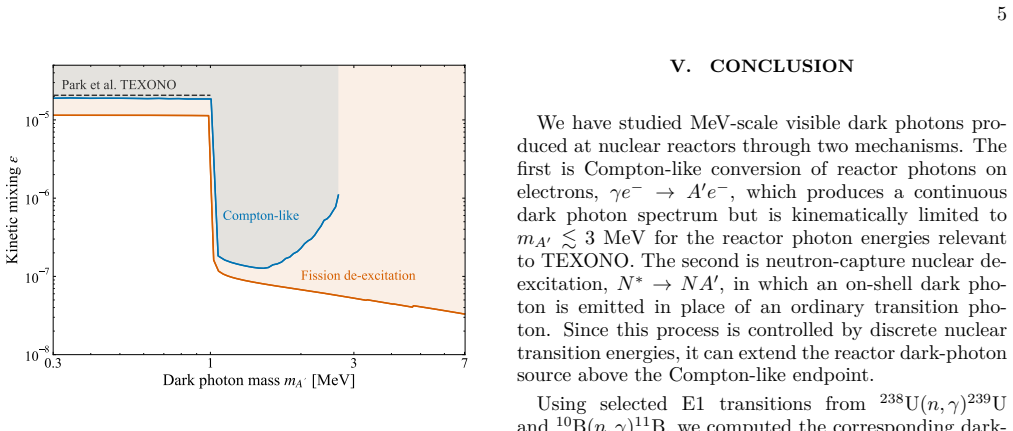
Nuclear de-excitation following neutron capture in reactors produces visible dark photons with masses up to the nuclear transition energy. Using TEXONO CsI(Tl) data, this yields new constraints on the kinetic mixing parameter ε for 0.1 MeV < m_A' < 6.9 MeV, stronger than those from the Compton-like process γ e⁻ → A' e⁻.
What carries the argument
The nuclear de-excitation channel N* → N A', whose rate is fixed by the kinetic mixing parameter ε and the known nuclear transition energy.
If this is right
- The searchable dark photon mass range in reactor experiments increases from previous values up to the nuclear transition energy of roughly 7 MeV.
- Limits on the kinetic mixing parameter become stronger across the entire MeV interval than those obtained from the Compton-like channel alone.
- Existing reactor neutrino detectors can be reanalyzed to probe visible dark photons without hardware changes.
- The same nuclear production mechanism applies to any reactor with neutron capture on the target material.
Where Pith is reading between the lines
- The nuclear channel could be applied to other light bosons that couple to nucleons, such as dark scalars or axion-like particles, in the same datasets.
- Higher-statistics reactor experiments or those with better energy resolution could translate the same production process into even tighter bounds.
- If the kinetic mixing model holds, these limits also constrain dark photon contributions to neutron star cooling or other astrophysical processes involving nuclear transitions.
Load-bearing premise
The production rate of on-shell dark photons from nuclear transitions follows the standard kinetic mixing prediction and the detector data allow clean separation of any signal from backgrounds.
What would settle it
Reanalysis of the TEXONO CsI(Tl) dataset that finds the observed rate fully consistent with known backgrounds and no excess events in the 0.1-6.9 MeV window after accounting for the predicted dark photon contribution would remove the claimed new limits.
Figures
read the original abstract
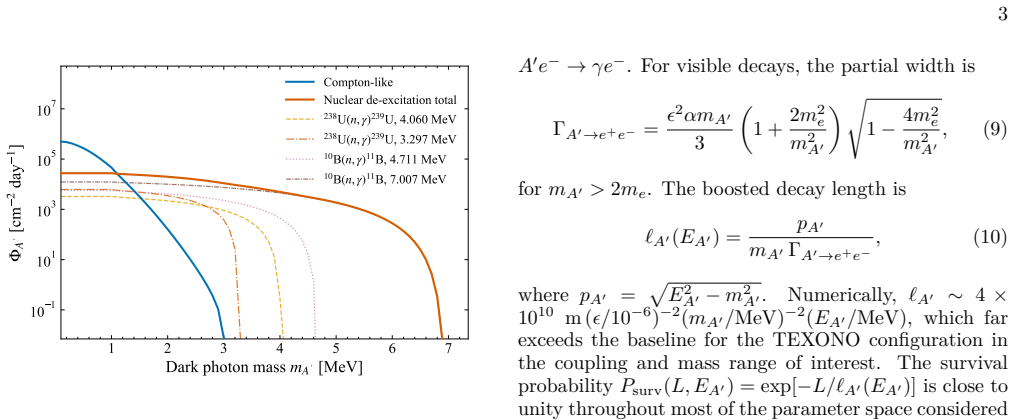
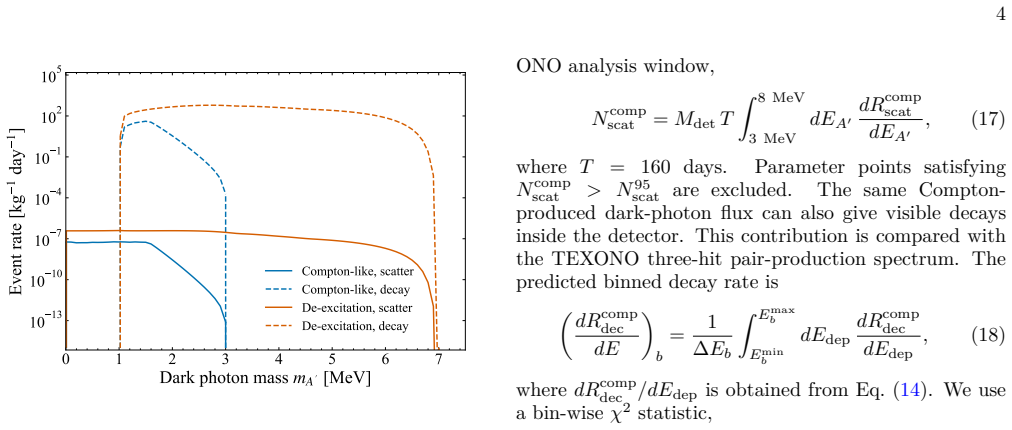
Reactor neutrino experiments serve as powerful probes of light new physics. We investigate MeV-scale visible dark photons ($A'$) produced in nuclear reactors through nuclear de-excitation following neutron capture $N^*\to N A'$. Compared with the conventional Compton-like production process $\gamma e^-\to A'e^-$, the nuclear de-excitation yields on-shell dark photons with masses up to the nuclear transition energy. Using data from the TEXONO CsI(Tl) detector, we derive the new constraints on the kinetic mixing parameter $\epsilon$ for dark photon masses in the range $0.1\,\mathrm{MeV} < m_{A'} < 6.9\,\mathrm{MeV}$. We find that nuclear de-excitation not only extends the mass reach of reactor searches to higher dark photon masses but also provides a stronger limit than the Compton-like production process.
Editorial analysis
A structured set of objections, weighed in public.
Referee Report
Summary. The manuscript proposes that MeV-scale visible dark photons can be produced on-shell in nuclear reactors via the de-excitation process N* → N A' following neutron capture, in addition to the conventional Compton-like channel. Using existing data from the TEXONO CsI(Tl) detector, the authors extract new upper limits on the kinetic mixing parameter ε for dark-photon masses in the interval 0.1 MeV < m_A' < 6.9 MeV and assert that the nuclear channel both extends the mass reach and yields stronger constraints than the Compton-like process.
Significance. If the production-rate normalization and background subtraction are robust, the result would furnish competitive, data-driven limits on visible dark-photon models in a mass window that is otherwise difficult to access with reactor experiments, thereby strengthening the experimental coverage of light hidden-sector scenarios.
major comments (2)
- [Production-rate section (presumably §3)] The central claim that nuclear de-excitation supplies a stronger limit than the Compton-like channel rests on the absolute normalization of the differential production rate dΓ(N* → N A')/dE. No explicit formula for this rate (including the nuclear matrix element, phase-space factor, and form-factor suppression near m_A' ≈ E_transition) is provided; without it the ε² scaling and the numerical event yield in the TEXONO CsI(Tl) fiducial volume cannot be verified.
- [Analysis and limit-setting section (presumably §4)] The extraction of limits from TEXONO data requires a background-subtracted spectrum in the 0.1–6.9 MeV window. The manuscript does not show a comparison of the predicted A' signal rate against the published TEXONO background model (originally derived for neutrino magnetic-moment searches) or quantify the impact of reactor-related backgrounds; this step is load-bearing for the “stronger limit” assertion.
minor comments (2)
- The abstract states that the nuclear channel “provides a stronger limit,” yet no quantitative ratio or overlay of the two exclusion curves is given; a dedicated figure or table comparing the two channels would clarify the improvement.
- Notation for the dark-photon mass (m_A') and kinetic mixing (ε) is introduced without a brief reminder of the standard Lagrangian term (ε/2) F_μν F'^μν; a single sentence would aid readers unfamiliar with the model.
Simulated Author's Rebuttal
We thank the referee for the careful and constructive review. The comments highlight areas where additional detail will strengthen the manuscript. We address each major comment below and have revised the paper to incorporate the requested clarifications and comparisons.
read point-by-point responses
-
Referee: [Production-rate section (presumably §3)] The central claim that nuclear de-excitation supplies a stronger limit than the Compton-like channel rests on the absolute normalization of the differential production rate dΓ(N* → N A')/dE. No explicit formula for this rate (including the nuclear matrix element, phase-space factor, and form-factor suppression near m_A' ≈ E_transition) is provided; without it the ε² scaling and the numerical event yield in the TEXONO CsI(Tl) fiducial volume cannot be verified.
Authors: We agree that the explicit differential rate formula was insufficiently detailed. In the revised manuscript we have added a dedicated subsection deriving dΓ(N* → N A')/dE in full, with the nuclear matrix element obtained from the measured electromagnetic transition width, the two-body phase-space factor, and the nuclear form-factor suppression for m_A' approaching the transition energy. The ε² scaling is shown explicitly, and the resulting event yield in the TEXONO fiducial volume is recalculated with these expressions. These additions allow direct verification of the normalization used for the limits. revision: yes
-
Referee: [Analysis and limit-setting section (presumably §4)] The extraction of limits from TEXONO data requires a background-subtracted spectrum in the 0.1–6.9 MeV window. The manuscript does not show a comparison of the predicted A' signal rate against the published TEXONO background model (originally derived for neutrino magnetic-moment searches) or quantify the impact of reactor-related backgrounds; this step is load-bearing for the “stronger limit” assertion.
Authors: We acknowledge the need for an explicit comparison. The revised Section 4 now includes a figure overlaying the predicted A' signal spectra (for representative masses) on the published TEXONO background model from the magnetic-moment analysis. We also add a short discussion quantifying that reactor-correlated backgrounds are already incorporated in that model and contribute negligibly to the subtracted spectrum in the relevant window after the standard cuts. These additions directly support the claim that the nuclear-de-excitation channel yields stronger limits than the Compton-like process. revision: yes
Circularity Check
No significant circularity; limits from external TEXONO data
full rationale
The paper calculates on-shell dark photon production rates via N* → N A' using the standard kinetic mixing model and nuclear transition energies, then applies published TEXONO CsI(Tl) data to extract limits on ε. The claim that nuclear de-excitation yields stronger limits than Compton-like production follows from comparing these independently computed rates against the same external dataset. No self-definitional equivalences, fitted inputs renamed as predictions, or load-bearing self-citations appear in the derivation chain. The result is self-contained against external benchmarks.
Axiom & Free-Parameter Ledger
axioms (1)
- domain assumption Dark photons interact with the Standard Model via kinetic mixing parameterized by ε
invented entities (1)
-
dark photon A'
no independent evidence
Reference graph
Works this paper leans on
-
[1]
N. Aghanim et al. (Planck), Astron. Astrophys. 641, A6 (2020), [Erratum: Astron.Astrophys. 652, C4 (2021)], arXiv:1807.06209 [astro-ph.CO]
Pith/arXiv arXiv 2020
-
[2]
G. Bertone, D. Hooper, and J. Silk, Phys. Rept. 405, 279 (2005), arXiv:hep-ph/0404175
Pith/arXiv arXiv 2005
-
[3]
Holdom, Phys
B. Holdom, Phys. Lett. B 166, 196 (1986)
1986
-
[4]
L. B. Okun, Sov. Phys. JETP 56, 502 (1982)
1982
-
[5]
N. Arkani-Hamed, D. P. Finkbeiner, T. R. Slatyer, and N. Weiner, Phys. Rev. D 79, 015014 (2009) , arXiv:0810.0713 [hep-ph]
Pith/arXiv arXiv 2009
-
[6]
J. D. Bjorken, R. Essig, P. Schuster, and N. Toro, Phys. Rev. D 80, 075018 (2009) , arXiv:0906.0580 [hep-ph]
Pith/arXiv arXiv 2009
-
[7]
J. Jaeckel and A. Ringwald, Ann. Rev. Nucl. Part. Sci. 60, 405 (2010) , arXiv:1002.0329 [hep-ph]
Pith/arXiv arXiv 2010
-
[8]
R. Essig et al. , in Snowmass 2013: Snowmass on the Mississippi (2013) arXiv:1311.0029 [hep-ph]
Pith/arXiv arXiv 2013
-
[9]
M. Fabbrichesi, E. Gabrielli, and G. Lanfranchi, The Dark Photon (Springer, 2021) arXiv:2005.01515 [hep-ph]
Pith/arXiv arXiv 2021
- [10]
- [11]
-
[12]
C. Boehm and P. Fayet, Nucl. Phys. B 683, 219 (2004) , hep-ph/0305261
Pith/arXiv arXiv 2004
-
[13]
J. L. Feng and J. Kumar, Phys. Rev. Lett. 101, 231301 (2008), 0803.4196
Pith/arXiv arXiv 2008
-
[14]
F. Compagnin, S. Profumo, and N. Fornengo, JCAP 03, 012, arXiv:2211.13825 [hep-ph]
-
[15]
T. Nomura and X. Xu, Chin. Phys. C 49, 063104 (2025) , arXiv:2405.17885 [hep-ph]
arXiv 2025
-
[16]
S. Knapen, T. Lin, and K. M. Zurek, Phys. Rev. D 96, 115021 (2017) , 1709.07882
Pith/arXiv arXiv 2017
-
[17]
Davier and H
M. Davier and H. Nguyen Ngoc, Phys. Lett. B 229, 150 (1989)
1989
-
[18]
Konaka et al
A. Konaka et al. , Phys. Rev. Lett. 57, 659 (1986)
1986
-
[19]
J. D. Bjorken, S. Ecklund, W. R. Nelson, A. Abashian, C. Church, B. Lu, L. W. Mo, T. A. Nunamaker, and P. Rassmann, Phys. Rev. D 38, 3375 (1988)
1988
-
[20]
E. M. Riordan et al. , Phys. Rev. Lett. 59, 755 (1987)
1987
-
[21]
Bross, M
A. Bross, M. Crisler, S. Pordes, J. Volk, S. Errede, and J. Wrbanek, Phys. Rev. Lett. 67, 2942 (1991)
1991
-
[22]
L. Marsicano, M. Battaglieri, M. Bondi’, C. D. R. Car- vajal, A. Celentano, M. De Napoli, R. De Vita, E. Nardi, M. Raggi, and P. Valente, Phys. Rev. D 98, 015031 (2018), arXiv:1802.03794 [hep-ex]
Pith/arXiv arXiv 2018
-
[23]
B. Batell, R. Essig, and Z. Surujon, Phys. Rev. Lett. 113, 171802 (2014) , arXiv:1406.2698 [hep-ph]
Pith/arXiv arXiv 2014
-
[24]
S. Abrahamyan et al. (APEX), Phys. Rev. Lett. 107, 191804 (2011) , arXiv:1108.2750 [hep-ex]
Pith/arXiv arXiv 2011
-
[25]
O. Moreno and M. Solt (HPS), PoS ICHEP2018, 076 (2019), arXiv:1812.02169 [hep-ex]
Pith/arXiv arXiv 2019
-
[26]
D. Banerjee et al. , Phys. Rev. Lett. 123, 121801 (2019) , arXiv:1906.00176 [hep-ex]
arXiv 2019
-
[27]
D. Banerjee et al. (NA64), Phys. Rev. Lett. 118, 011802 (2017), arXiv:1610.02988 [hep-ex]
Pith/arXiv arXiv 2017
-
[28]
S.-F. Ge, J. Liang, Z. Liu, and U. Min, Dark Photon Searches with Initial-State Radiation at Fixed-Target Configurations (2025), arXiv:2505.10302 [hep-ph]
arXiv 2025
- [29]
-
[30]
J. P. Lees et al. (BaBar), Phys. Rev. Lett. 113, 201801 (2014), arXiv:1406.2980 [hep-ex]
Pith/arXiv arXiv 2014
-
[31]
F. Archilli et al. (KLOE-2), Phys. Lett. B 706, 251 (2012), arXiv:1110.0411 [hep-ex]
Pith/arXiv arXiv 2012
-
[32]
D. Babusci et al. (KLOE-2), Phys. Lett. B 720, 111 (2013), arXiv:1210.3927 [hep-ex]
Pith/arXiv arXiv 2013
-
[33]
A. Anastasi et al. (KLOE-2), Phys. Lett. B 757, 356 (2016), arXiv:1603.06086 [hep-ex]
Pith/arXiv arXiv 2016
-
[34]
M. Du, Z. Liu, and V. Q. Tran, JHEP 05, 055 , arXiv:1912.00422 [hep-ph]
arXiv 1912
- [35]
-
[36]
H. An, M. Pospelov, and J. Pradler, Phys. Rev. Lett. 111, 041302 (2013) , arXiv:1304.3461 [hep-ph]
Pith/arXiv arXiv 2013
- [37]
-
[38]
H. An, M. Pospelov, and J. Pradler, Phys. Lett. B 725, 190 (2013) , arXiv:1302.3884 [hep-ph]
Pith/arXiv arXiv 2013
- [39]
-
[40]
J. H. Chang, R. Essig, and S. D. McDermott, JHEP 01, 107, arXiv:1611.03864 [hep-ph]
-
[41]
E. Rrapaj and S. Reddy, Phys. Rev. C 94, 045805 (2016) , arXiv:1511.09136 [nucl-th]
Pith/arXiv arXiv 2016
- [42]
-
[43]
M. Ibe, S. Kobayashi, Y. Nakayama, and S. Shirai, JHEP 04, 009 , arXiv:1912.12152 [hep-ph]
arXiv 1912
-
[44]
P. Arias, D. Cadamuro, M. Goodsell, J. Jaeckel, J. Re- dondo, and A. Ringwald, JCAP 06, 013, arXiv:1201.5902 [hep-ph]
-
[45]
A. Fradette, M. Pospelov, J. Pradler, and A. Ritz, Phys. Rev. D 99, 075004 (2019) , arXiv:1812.07585 [hep-ph]
Pith/arXiv arXiv 2019
-
[46]
M. Hufnagel, K. Schmidt-Hoberg, and S. Wild, JCAP 11, 032 , arXiv:1808.09324 [hep-ph]
-
[47]
W. Dai, Y. Gong, G. Gu, L. Su, L. Wang, L. Wu, Y. Wu, and L. Yang, Hunting for Axions in REactor neu- trino COherent scattering Detection Experiment (2025), arXiv:2509.01538 [hep-ph]
arXiv 2025
-
[48]
H. Park, Phys. Rev. Lett. 119, 081801 (2017) , arXiv:1705.02470 [hep-ph]
Pith/arXiv arXiv 2017
-
[49]
M. Danilov, S. Demidov, and D. Gorbunov, Phys. Rev. Lett. 122, 041801 (2019) , arXiv:1804.10777 [hep-ph]
Pith/arXiv arXiv 2019
-
[50]
Bechteler, H
H. Bechteler, H. Faissner, R. Yogeshwar, and H. Seyfarth, The spectrum of gamma radiation emitted in the FRJ-1 (Merlin) reactor core and moderator region , Tech. Rep. Juel-Spez-255 (Kernforschungsanlage Jülich, 1984)
1984
-
[51]
T. Gao and M. Pospelov, Constraints on mil- licharged particles from nuclear gamma-decays (2025), arXiv:2507.17955 [hep-ph]
Pith/arXiv arXiv 2025
-
[52]
D. Feldman, Z. Liu, and P. Nath, Phys. Rev. D 75, 115001 (2007) , arXiv:hep-ph/0702123
Pith/arXiv arXiv 2007
-
[53]
D. Feldman, Z. Liu, and P. Nath, AIP Conf. Proc. 939, 50 (2007) , arXiv:0705.2924 [hep-ph]
Pith/arXiv arXiv 2007
-
[54]
C. Pitrou and M. Pospelov, Phys. Rev. C 102, 015803 (2020), arXiv:1904.07795 [astro-ph.CO]
arXiv 2020
-
[55]
Schunck, Nuclear Fission: Theories, Experiments and Applications (Springer, 2024)
N. Schunck, Nuclear Fission: Theories, Experiments and Applications (Springer, 2024)
2024
-
[56]
B. Xin et al. (TEXONO), Phys. Rev. D 72, 012006 (2005), arXiv:hep-ex/0502001
Pith/arXiv arXiv 2005
-
[57]
National Nuclear Data Center, Evaluated Nuclear Struc- ture Data File (ENSDF), https://www.nndc.bnl.gov/ ensdf/ (2024), accessed: 2024
2024
-
[58]
M. Deniz et al. (TEXONO), Phys. Rev. D 81, 072001 (2010), arXiv:0911.1597 [hep-ex]
Pith/arXiv arXiv 2010
-
[59]
html (2010)
Xcom: Photon cross sections database, https: //physics.nist.gov/PhysRefData/Xcom/html/xcom1. html (2010)
2010
-
[60]
L. Su, L. Wu, and B. Zhu, Phys. Rev. D 105, 055021 (2022), arXiv:2105.06326 [hep-ph]
arXiv 2022
-
[61]
A. Abusleme et al. (JUNO), TAO Conceptual Design Report: A Precision Measurement of the Reactor An- tineutrino Spectrum with Sub-percent Energy Resolution (2020), arXiv:2005.08745 [physics.ins-det]
arXiv 2020
discussion (0)
Sign in with ORCID, Apple, or X to comment. Anyone can read and Pith papers without signing in.